
Autism Spectrum Disorders An Overview Sarah Mohiuddin M

- Slides: 32
Autism Spectrum Disorders: An Overview Sarah Mohiuddin M. D. Clinical Director Multidisciplinary Autism Program Child and Adolescent Psychiatry University of Michigan Health System
Introduction In 1943, Leo Kanner, a psychiatrist at Johns Hopkins University, first described autism in a small group of children who demonstrated extreme aloofness and total indifference to other people. In 1944, Hans Asperger, an Austrian pediatrician who was unaware of Kanner's work, published an article that described children who demonstrated symptoms similar to those of Kanner's patients, with the exception that verbal and cognitive skills were higher.
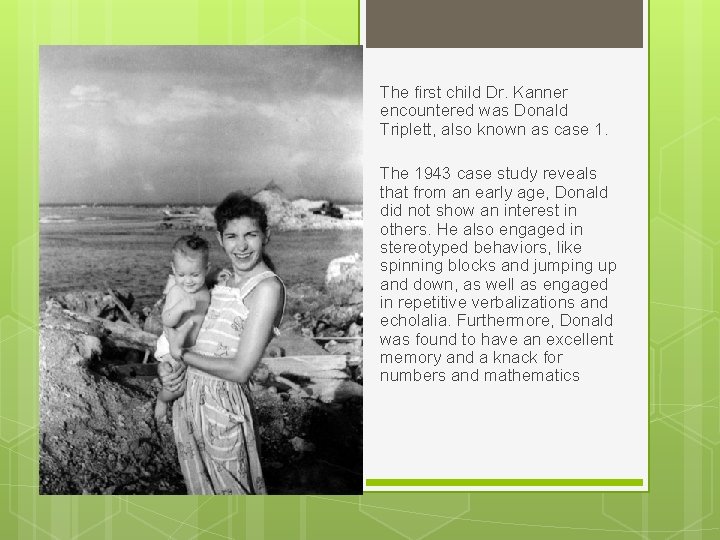
The first child Dr. Kanner encountered was Donald Triplett, also known as case 1. The 1943 case study reveals that from an early age, Donald did not show an interest in others. He also engaged in stereotyped behaviors, like spinning blocks and jumping up and down, as well as engaged in repetitive verbalizations and echolalia. Furthermore, Donald was found to have an excellent memory and a knack for numbers and mathematics
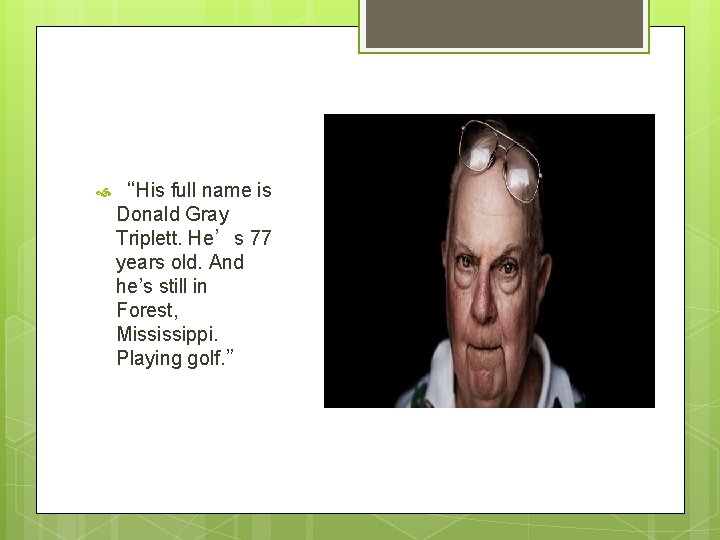
“His full name is Donald Gray Triplett. He’s 77 years old. And he’s still in Forest, Mississippi. Playing golf. ”
Definitions Definition: Autism and the pervasive developmental disorders (PDDs) are neuropsychiatric disorders characterized by: Delay in the development of social reciprocity Delay in communicative skills Repetitive and stereotyped behaviors/interests
Prognosis mediated by: Language development by the age of 5 Other medical problems/seizure disorders Addition of intellectual disability/global developmental delay Psychiatric Comorbidity (ADHD, anxiety, Depression, etc)
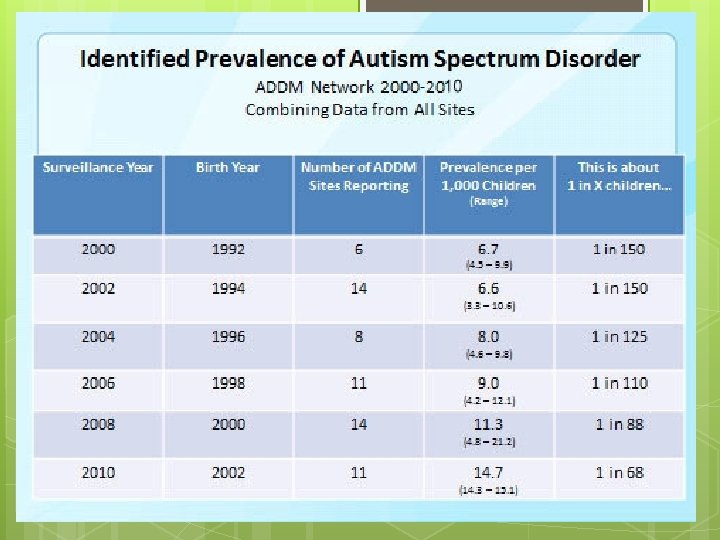
What kind of numbers are we talking about? About 1 in 68 children has been identified with autism spectrum disorder (ASD) according to estimates from CDC's Autism and Developmental Disabilities Monitoring (ADDM) Network. ASD is almost 5 times more common among boys (1 in 42) boys than girls (1 in 189).
What kind of numbers are we talking about? ASD tends to occur more often in people who have certain genetic or chromosomal conditions. About 10 -30% of children with autism are also identified as having a known genetic and chromosomal disorder Almost half (46%) of children identified with ASD has average to above average intellectual ability.
Diagnosis Rates Studies have shown that a diagnosis of autism at age 12 months can be reliable and valid (but may be unstable). The average of parental concern is between 15 and 18 months (Chawarska, Paul et al. 2007). On average, children identified with ASD were not diagnosed until after age 4 Autistic Disorder at age 4 PDD nos at age 4 years and 2 months Asperger Disorder at age 6 years and 2 months
What is the best age to screen? When symptoms present Regression Gabrielson et al 2015 42 children, 14 -33 months Typical behavior (89%), atypical behavior (11%) 39% of ASD cases missed
What Causes Autism? Prenatal risk factors for ASD (Gardener et al 2009) Meta analysis of 40 epidemiological studies that examined the association between pregnancy-related factors and autism The factors associated with autism risk in the meta-analysis were advanced parental age at birth, maternal prenatal medication use, bleeding, gestational diabetes, being first born v. third or later Genetic Findings
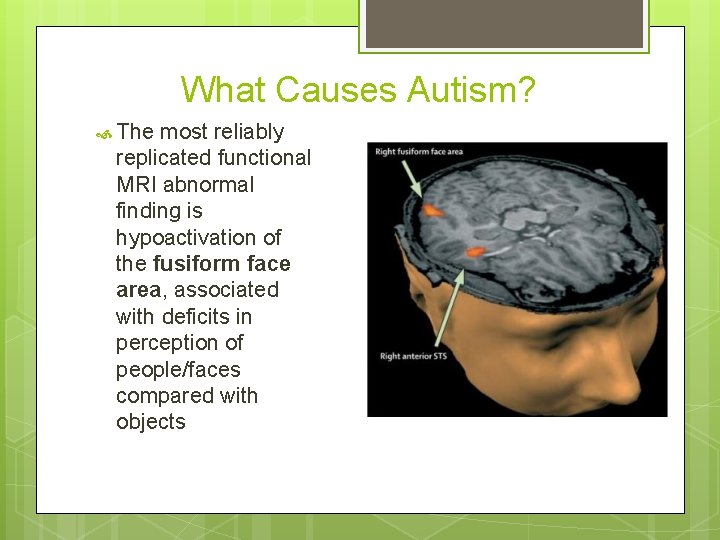
What Causes Autism? The most reliably replicated functional MRI abnormal finding is hypoactivation of the fusiform face area, associated with deficits in perception of people/faces compared with objects
What Causes Autism? There is no link between vaccines and autism. Between 1999 and 2001, thimerosal was removed or reduced to trace amounts in all childhood vaccines except for some flu vaccines. Multiple studies by the CDC
What Autism Looks Like in Young Children: Clinical Pearls
Clinical Pearls Social relatedness and social reciprocity Defined as the inherent drive to connect with others and share complementary feeling states Joint Attention One of the distinguishing characteristics of very young children with ASDs Defined as: the act of making eye contact with someone to share an experience At approx 8 months, an infant will follow the parent's gaze and look in the same direction Later, gestures and/or speech also can be used to engage another's attention with regard to the objects
Joint Attention “When you look at an object, what does your child do? Please give me an example. ”
Joint Attention PASS examples: Looks at object Points to object Looks and comments on object Looks if parent points and says “look!”
Joint Attention FAIL examples: Ignores parent Looks around room randomly Looks at parent’s finger
Response to Name When you call your child’s name, what do they do? Could you give me an example? ”
Response to Name PASS responses: Look up Turn towards you Vocalizes response
Response to Name FAIL responses: Make no response Seem to hear but ignores parent Respond only if parent is right in front of the child’s face Respond only if touched
Social smile “When you smile at your child, what does she do? ” Model in your office PASS example: Smiles at you when you smile
Helping Families to Seek Evaluations and Treatment
Michigan Autism Legislation As of October 15, 2012, legislation was passed in Michigan requiring that all HMO and private insurance plans (excluding the employer funded plans) cover medically necessary treatment for children with ASD. Requires medical diagnosis and ADOS School diagnoses do not count Reevaluations are required every 3 years
Early Management and Interventions
Interventions Intensive Behavioral Interventions Applied Behavior Analysis 20 -40 hours per week Home-based vs. Center-based Speech Therapy Management of Comorbidities Medical Psychiatric
Interventions School-based services Early-on IEP Social Skills Therapy Other services Occupational Therapy Physical Therapy
Applied Behavioral Analysis What is ABA? The application of behavioral principles, to everyday situations, that will, over time, increase or decrease targeted behaviors Employs objective data to drive decision-making about an individual’s program
Applied Behavior Analysis What does ABA do? Helps individuals acquire many different skills, such as language skills, self-help skills, and play skills Helps to decrease maladaptive behaviors such as aggression, self-stimulatory behaviors, and selfinjury.
Applied Behavior Analysis Does ABA work? Peters-Scheffer et al 2011 Meta-Analysis: 11 studies with 344 children with ASD Experimental groups who received EIBI outperformed the control groups on IQ, non-verbal IQ, expressive and receptive language and adaptive behavior Virues-Ortega 2010 Meta-Analysis: Dose-dependent effect sizes were apparent by levels of total treatment hours for language and adaptation composite scores.
Thank you!