
Autism Spectrum Disorder Lee Ann Loui Angie Loquiao

- Slides: 23
Autism Spectrum Disorder Lee. Ann Loui Angie Loquiao Megan Sathrum
Definition of Autism Spectrum Disorders Characterized by impairments in: – Communication skills – Social interactions – Repetitive behaviors Autism: – Resistance to change – Unusual responses to sensory experiences – Usually manifests before age 3 – Severe cognitive deficits Asperger’s syndrome: – “mild” autism
Definition of Autism Spectrum Disorders Childhood disintegrative disorder: – Normal development up to 10 years followed by significant loss of skills – Much more prevalent in males Pervasive developmental disorder: – Milder, onset later than 3 years Rett syndrome: – Normal development up to 4 years followed by mental retardation – Much more prevalent in females
Psychological and Behavioral Characteristics Autism: – Impaired social interaction – Impaired communication • Communicative intent – Repetitive and stereotyped behavior – Impaired cognition – Abnormal sensory perceptions Asperger syndrome: – Impaired social interaction – Impaired communication skills
Historical Context Leo Kanner’s: 1943 – Autism different from schizophrenia • Never made social connections • Unique language patterns • No deterioration over time Hans Asperger’s Paper: 1944 – Autistic psychopathy: Asperger’s syndrome • Average intelligence, normal language • Obsessive preoccupation in narrow pursuits
Causes • Neurological – Several areas of the brain are implicated as causes. • Cerebral cortex, basal ganglia, hippocampus, cerebellum. – Excessive brain growth in the first 2 years. • Hereditary – When one family member is diagnosed with Autism the chances are 50 to 200 times higher that another family member has Autism.
Assessment Psychiatrists use criteria of American Psychiatric Association: – Communication skills – Social interactions – Repetitive and stereotyped behaviors • Behavioral Observations • Relatively easy to diagnose: – Asperger syndrome harder to diagnose
What are the needs of students with Autism? • • Desire for routine Limited social awareness Restricted range of interests Problems focusing on toys, people’s faces, or information • Poor motor coordination • Academic difficulties • Emotional vulnerability
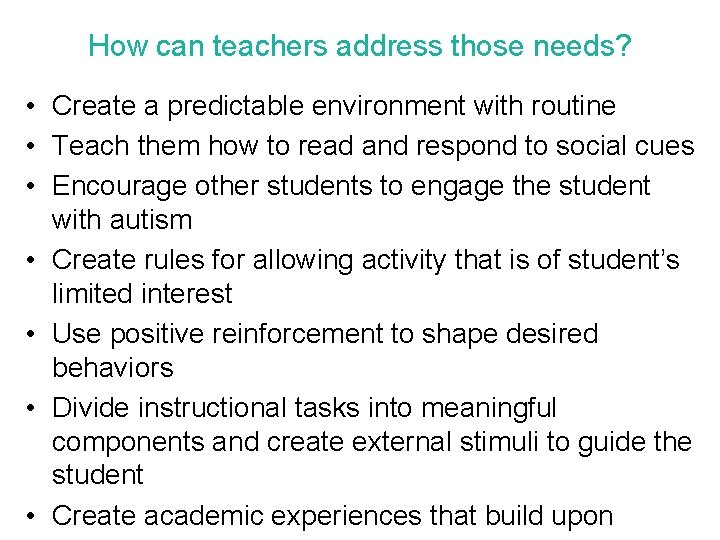
How can teachers address those needs? • Create a predictable environment with routine • Teach them how to read and respond to social cues • Encourage other students to engage the student with autism • Create rules for allowing activity that is of student’s limited interest • Use positive reinforcement to shape desired behaviors • Divide instructional tasks into meaningful components and create external stimuli to guide the student • Create academic experiences that build upon
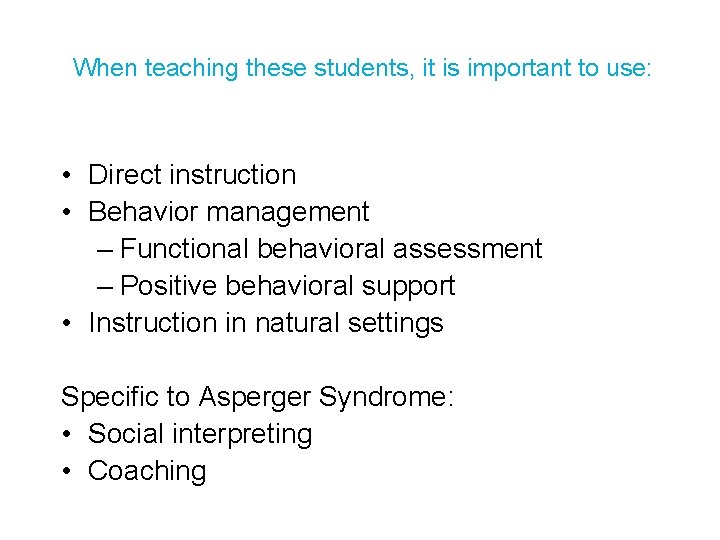
When teaching these students, it is important to use: • Direct instruction • Behavior management – Functional behavioral assessment – Positive behavioral support • Instruction in natural settings Specific to Asperger Syndrome: • Social interpreting • Coaching
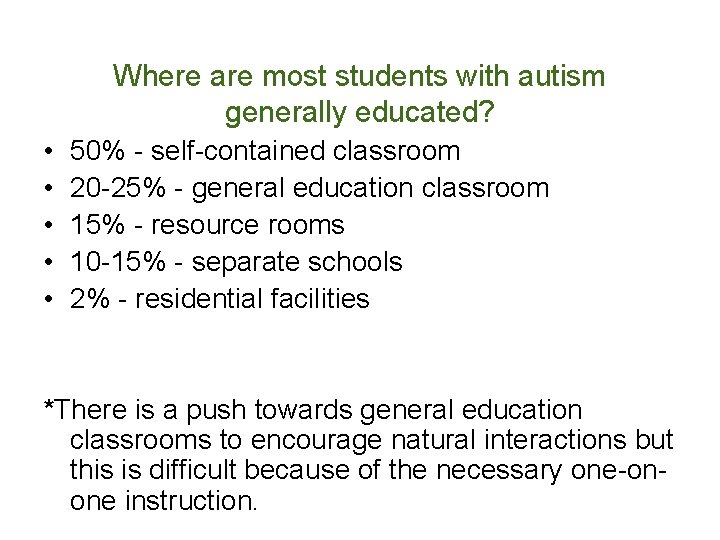
Where are most students with autism generally educated? • • • 50% - self-contained classroom 20 -25% - general education classroom 15% - resource rooms 10 -15% - separate schools 2% - residential facilities *There is a push towards general education classrooms to encourage natural interactions but this is difficult because of the necessary one-onone instruction.
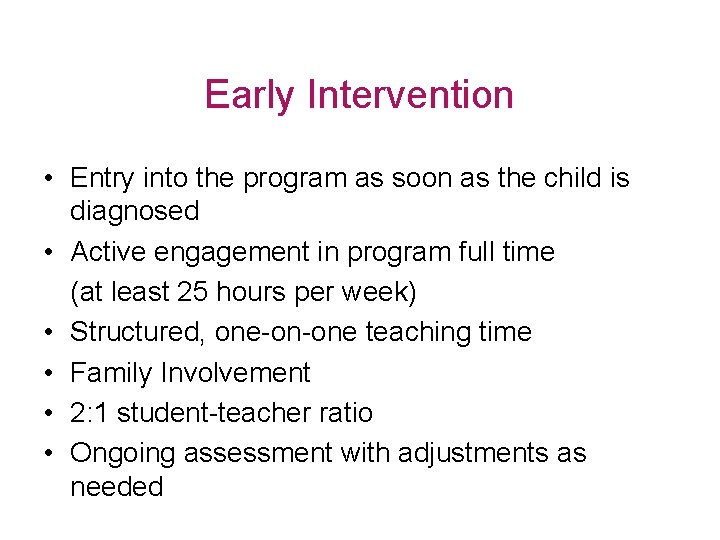
Early Intervention • Entry into the program as soon as the child is diagnosed • Active engagement in program full time (at least 25 hours per week) • Structured, one-on-one teaching time • Family Involvement • 2: 1 student-teacher ratio • Ongoing assessment with adjustments as needed
Transition to Adulthood • Essentially the same as those with other disabilities • Person-centered planning • Living in a community residential facility or in supported living • Working in competitive employment or supported competitive employment
True of False Autism is a single, well-defined category of disability.
False • Autism is a wide spectrum of disorders and ranges from very severe to very mild. Autism spectrum disorder includes conditions that can be difficult to identify with great accuracy.
True or False • All people with autism are impaired in some cognitive areas but are highly intelligent or geniuses in other areas.
False • Only a very few people with autism have extraordinary skills.
True or False • Asperger Syndrome is more difficult to diagnose than classic autism.
True • Since the symptoms of Asperger Syndrome are milder, and therefore harder to assess.
True or False • Causes of autism are mainly neurological and heredity plays NO role in causing the disorder.
False • Both hereditary and neurological causes play a role in austim.
True or False • It’s most likely that there are multiple genes involved in diagnosing autism.
True