
AUTISM SPECTRUM DISORDER ASD WHAT IS AUTISM Autism
- Slides: 12
AUTISM SPECTRUM DISORDER (ASD)
WHAT IS AUTISM? � Autism spectrum disorder is a range of complex neurodevelopment disorder. � It varies in character and severity � It occurs in all ethnic and socioeconomic groups and affects every age group � Estimation of 3: 6 children out of every 1, 000 will have ASD (MALES ARE FOUR TIMES MORE LIKELY TO HAVE ASD)
Impacts 3 Areas of Development 1. 2. 3. Language and communication skills Social skills Behavior, interests and activities Many children with ASD are identified in their Elementary years but children actually develop ASD much earlier.
AUTISM CHARACTERISTICS � Social impairments ◦ May avoid or lack eye contact ◦ May not imitate others ◦ May prefer to be alone � Communication difficulties ◦ May not speak at all ◦ May be severely language delayed ◦ May not be able to initiate conversation � Restricted, behavior ◦ ◦ May May repetitive and stereotyped patterns of line up their toys spin or spin objects be angry or upset in daily routines focus on a small part of a toy only
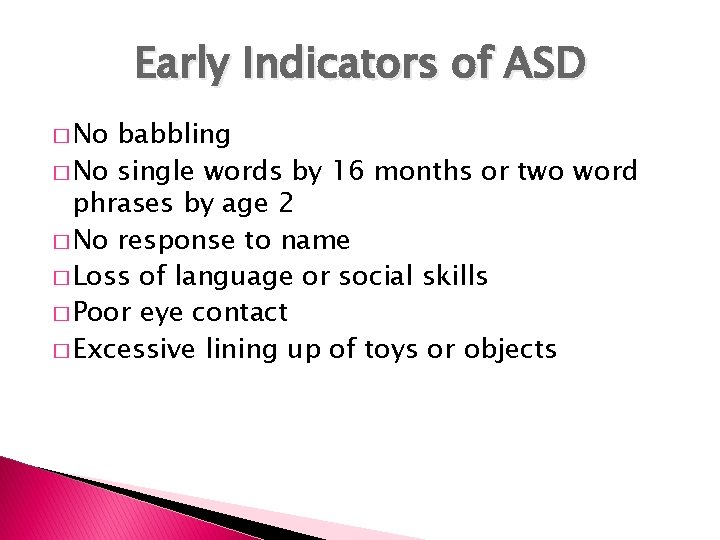
Early Indicators of ASD � No babbling � No single words by 16 months or two word phrases by age 2 � No response to name � Loss of language or social skills � Poor eye contact � Excessive lining up of toys or objects
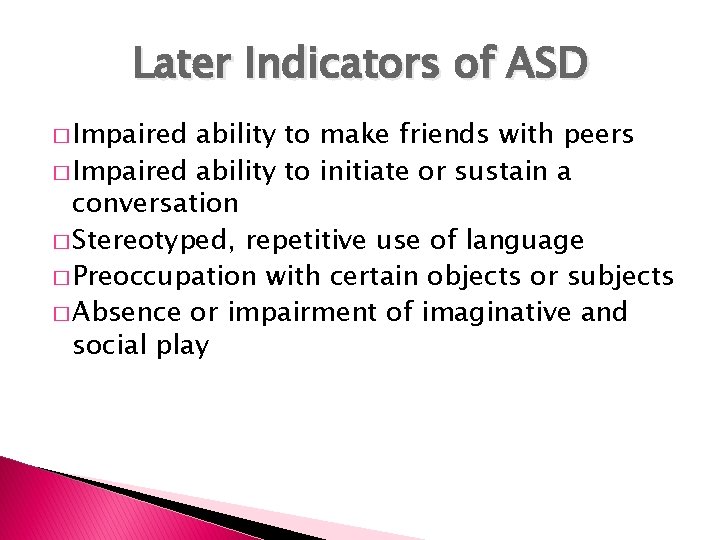
Later Indicators of ASD � Impaired ability to make friends with peers � Impaired ability to initiate or sustain a conversation � Stereotyped, repetitive use of language � Preoccupation with certain objects or subjects � Absence or impairment of imaginative and social play
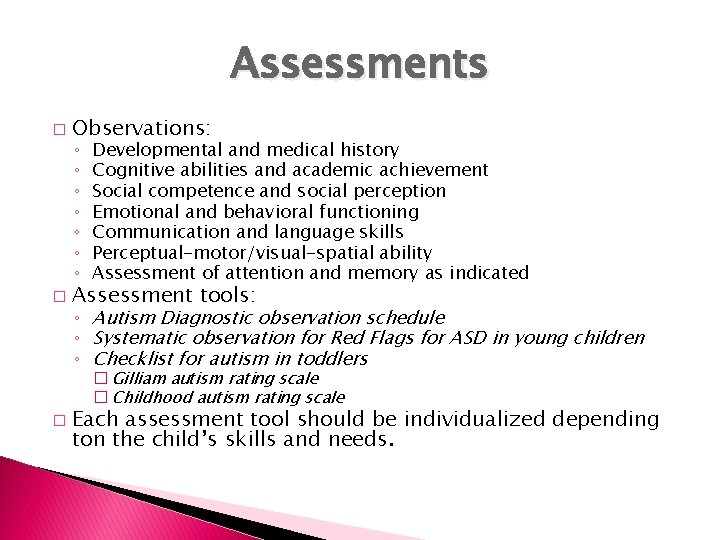
Assessments � Observations: ◦ ◦ ◦ ◦ � Developmental and medical history Cognitive abilities and academic achievement Social competence and social perception Emotional and behavioral functioning Communication and language skills Perceptual-motor/visual-spatial ability Assessment of attention and memory as indicated Assessment tools: ◦ Autism Diagnostic observation schedule ◦ Systematic observation for Red Flags for ASD in young children ◦ Checklist for autism in toddlers � Gilliam autism rating scale � Childhood autism rating scale � Each assessment tool should be individualized depending ton the child’s skills and needs.
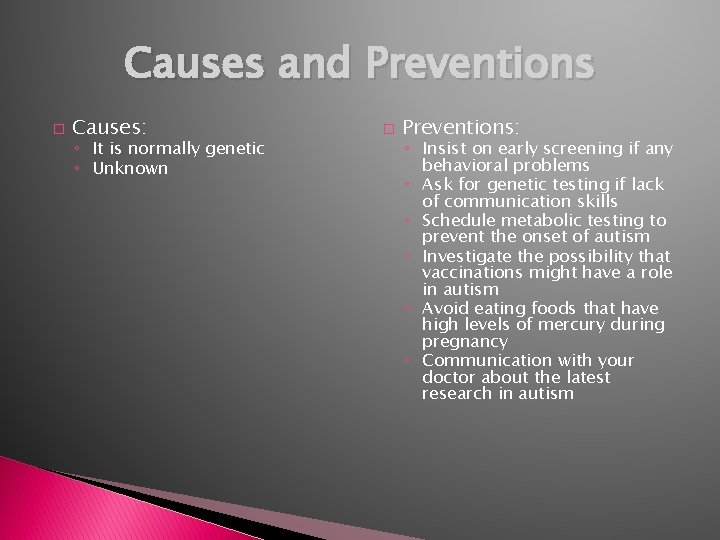
Causes and Preventions � Causes: ◦ It is normally genetic ◦ Unknown � Preventions: ◦ Insist on early screening if any behavioral problems ◦ Ask for genetic testing if lack of communication skills ◦ Schedule metabolic testing to prevent the onset of autism ◦ Investigate the possibility that vaccinations might have a role in autism ◦ Avoid eating foods that have high levels of mercury during pregnancy ◦ Communication with your doctor about the latest research in autism
Educational approaches � ABA-applied � Teacch � Picture behavioral analysis exchange communication systems � Floor time � Social stories � Sensory integration � Facilitated communication
Monitoring Academic Progress � Current level of performance is determined � Identified goals � Academic performance is measured on a regular basis (weekly or monthly) � Progress toward meeting goals (compare expected and actual rates of learning) ◦ Based on these observations teaching is adjusted. � The student’s progress is monitored and instructional techniques are adjusted to meet their needs.
Community resources � Autism society of Illinois � The autism program metro-Chicago � Have dreams � Autism research institute � Autism society of American Appeal More resources can be found at http: //www. chicagokids. com/resources/autis m. html
� http: //www. ehow. com/how_2052076_prevent- autism. html � http: //sitemaker. umich. edu/356. bernstein/education al_approaches � http: //www. studentprogress. org/progresmon. asp#2 � http: //www. chicagokids. com/resources/autism. html � http: //ici. umn. edu/products/impact/193/over 4. html � http: //www. ninds. nih. gov/disorders/autism/detail_a utism. htm � http: //www. child-autism-parentcafe. com/characteristics-for-autism. html