
Autism in the workplace Dr Elspeth Webb TEWV

Autism in the workplace Dr Elspeth Webb – TEWV CYPS ASD Lead Clinician Trustwide Autism Strategy Project County Durham and Darlington CAMHS ASD Clinical Lead Anne Cahill – Consultant Professional Lead Trustwide Autism Strategy Project / Adult Autism Service

What’s the legislation? • Autism Act (2009) – the only condition specific piece of legislation which places a statutory requirement on Local Authorities and Health Services to implement autism specific services and to train their staff. Also recommends that all public sector agencies train their staff. • Equality Act (2010) – requires employers to consider and, where appropriate, implement reasonable adjustments: changes to the way things are done in the workplace to remove any barriers and provide support to employees with disabilities – autism is included in this.

Tees Esk and Wear Valleys NHS Foundation. Trustwide Autism Strategy Project
What is autism? • Autism is a neurological diversity and is a lifelong developmental condition • Between 1% and 2 % of the population are autistic • Autism affects people in different ways • Social interaction • Social communication • Restricted interests and need for routine • Sensory needs • People with autism are more likely than the general population to have other neurodevelopmental difficulties such as dyslexia and dyspraxia. They are also vulnerable to developing mental health problems such as depression and anxiety.
The National Autistic Society reports: • Over 335, 000 autistic people of working age in the UK • Only 16% of autistic adults are in full-time paid work (static since 2007) • Only 32% of autistic adults are in some kind of paid work • Over 50% of autistic adults in the UK have spent time with either no work or no access to benefits • 26% of autistic graduates are unemployed

How will difficulties in social interaction affect autistic people at work? • • Difficulties with teamwork Avoiding socialising with work colleagues Appearing blunt and too forthright Difficulties expressing emotions appropriately Difficulties in perceiving and applying unwritten social rules Naïvity Anxiety about performance Extreme honesty
How will difficulties in social communication affect autistic people at work? • Difficulties in reciprocal interaction • Literal interpretation of communication • Literal thinking • Difficulties generalising • Difficulties thinking ‘on the spot’ and improvising • Difficulties in predicting the consequences of an action/perceiving cause and effect • Reduced safety awareness from an over-reliance on procedures
How will restricted interests and repetitive behaviours affect autistic people at work? • Punctuality and conscientiousness • Concrete thinking • Strong expression of likes and dislikes • Perfectionism • Limited clothing preferences • Comfortable with rules, routines and schedules – difficulties with unexpected events or the disruption of work plans – difficulties with flexibility
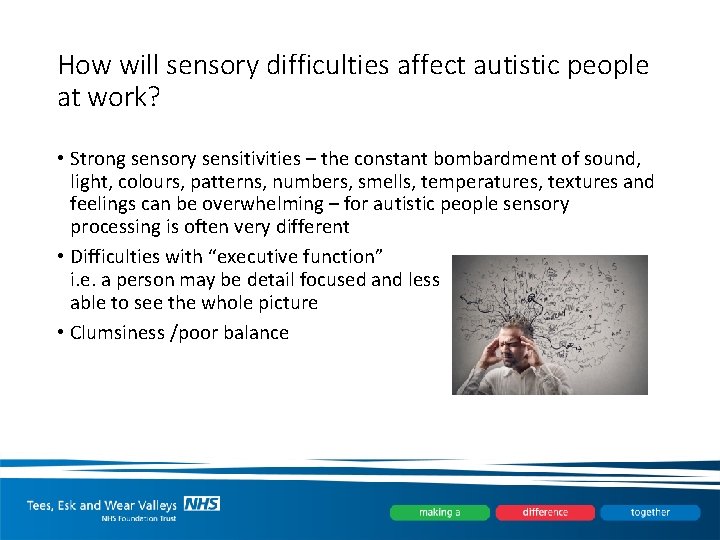
How will sensory difficulties affect autistic people at work? • Strong sensory sensitivities – the constant bombardment of sound, light, colours, patterns, numbers, smells, temperatures, textures and feelings can be overwhelming – for autistic people sensory processing is often very different • Difficulties with “executive function” i. e. a person may be detail focused and less able to see the whole picture • Clumsiness /poor balance
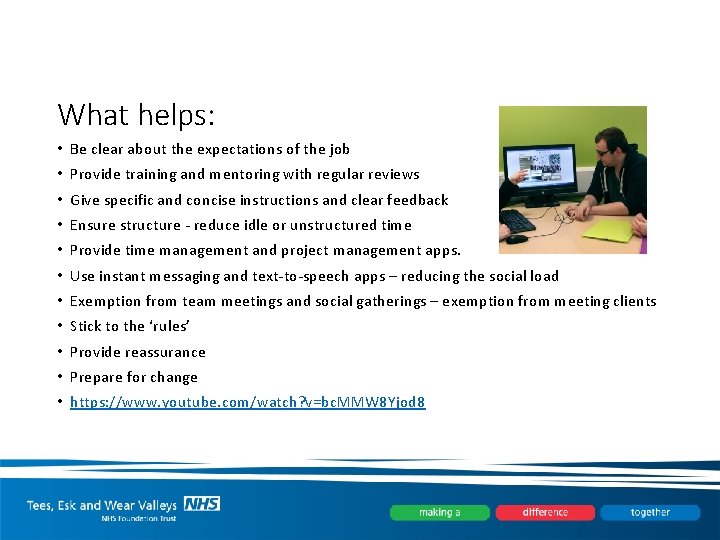
What helps: • • • Be clear about the expectations of the job Provide training and mentoring with regular reviews Give specific and concise instructions and clear feedback Ensure structure - reduce idle or unstructured time Provide time management and project management apps. Use instant messaging and text-to-speech apps – reducing the social load Exemption from team meetings and social gatherings – exemption from meeting clients Stick to the ‘rules’ Provide reassurance Prepare for change https: //www. youtube. com/watch? v=bc. MMW 8 Yjod 8
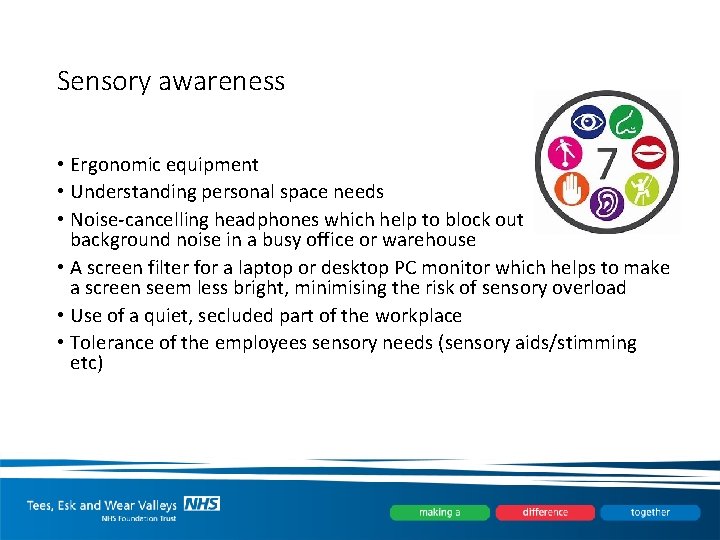
Sensory awareness • Ergonomic equipment • Understanding personal space needs • Noise-cancelling headphones which help to block out background noise in a busy office or warehouse • A screen filter for a laptop or desktop PC monitor which helps to make a screen seem less bright, minimising the risk of sensory overload • Use of a quiet, secluded part of the workplace • Tolerance of the employees sensory needs (sensory aids/stimming etc)
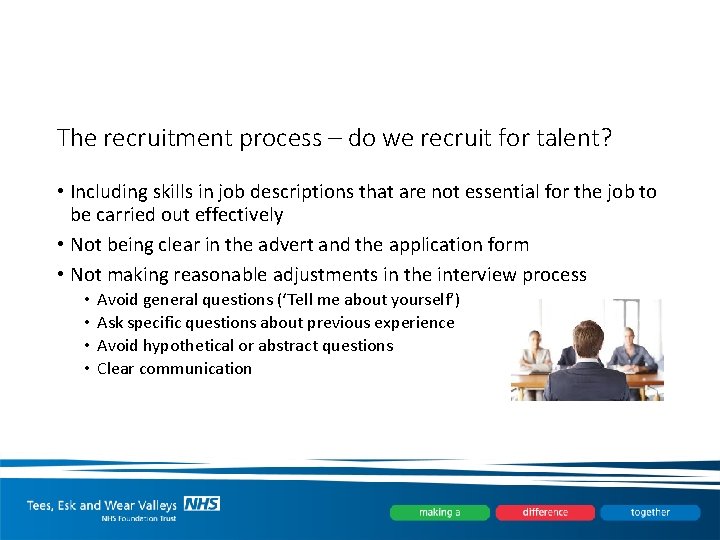
The recruitment process – do we recruit for talent? • Including skills in job descriptions that are not essential for the job to be carried out effectively • Not being clear in the advert and the application form • Not making reasonable adjustments in the interview process • • Avoid general questions (‘Tell me about yourself’) Ask specific questions about previous experience Avoid hypothetical or abstract questions Clear communication
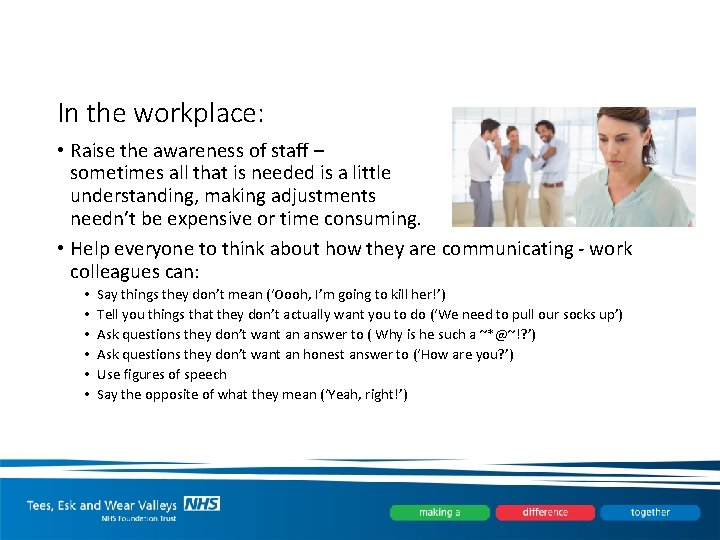
In the workplace: • Raise the awareness of staff – sometimes all that is needed is a little understanding, making adjustments needn’t be expensive or time consuming. • Help everyone to think about how they are communicating - work colleagues can: • • • Say things they don’t mean (‘Oooh, I’m going to kill her!’) Tell you things that they don’t actually want you to do (‘We need to pull our socks up’) Ask questions they don’t want an answer to ( Why is he such a ~*@~!? ’) Ask questions they don’t want an honest answer to (‘How are you? ’) Use figures of speech Say the opposite of what they mean (‘Yeah, right!’)
What do autistic employees bring to the workplace? • As well as their individual strengths and talents, autistic employees can bring the following above average skills: • • High level of concentration Reliability, conscientiousness and persistence Accuracy, close attention to detail and the ability to identify errors Technical abilities (IT etc) ‘Choosing to hire me based on my autistic Detailed factual knowledge and an excellent memory accomplishments and then Different approaches to problem solving expecting me to work in a non-autistic way doesn’t Strengths in developing creative and novel ideas really make sense’
Discussion: What can you do in your workplace to make it ‘autism aware’?
Best practice examples • JP Morgan Chase https: //www. youtube. com/watch ? v=0 i 9 MOp 5 l. NQo • Auticon https: //www. youtube. com/watch ? v=z 7 CZ 2 md. Cx 84 • Microsoft Autism Hiring Programme https: //www. youtube. com/watch ? v=XUAs. U_z. QVMo • Autonomy Works https: //www. youtube. com/watch ? v=P 8 h. Ru 0 h. SR-k
ANY QUESTIONS?
- Slides: 17