
Authors Patrick Carter Daniel Wachter Rockefeller Oteng Carl
- Slides: 52
Author(s): Patrick Carter, Daniel Wachter, Rockefeller Oteng, Carl Seger, 2009 -2010. License: Unless otherwise noted, this material is made available under the terms of the Creative Commons Attribution 3. 0 License: http: //creativecommons. org/licenses/by/3. 0/ We have reviewed this material in accordance with U. S. Copyright Law and have tried to maximize your ability to use, share, and adapt it. The citation key on the following slide provides information about how you may share and adapt this material. Copyright holders of content included in this material should contact open. michigan@umich. edu with any questions, corrections, or clarification regarding the use of content. For more information about how to cite these materials visit http: //open. umich. edu/education/about/terms-of-use. Any medical information in this material is intended to inform and educate and is not a tool for self-diagnosis or a replacement for medical evaluation, advice, diagnosis or treatment by a healthcare professional. Please speak to your physician if you have questions about your medical condition. Viewer discretion is advised: Some medical content is graphic and may not be suitable for all viewers.
Citation Key for more information see: http: //open. umich. edu/wiki/Citation. Policy Use + Share + Adapt { Content the copyright holder, author, or law permits you to use, share and adapt. } Public Domain – Government: Works that are produced by the U. S. Government. (USC 17 § 105) Public Domain – Expired: Works that are no longer protected due to an expired copyright term. Public Domain – Self Dedicated: Works that a copyright holder has dedicated to the public domain. Creative Commons – Zero Waiver Creative Commons – Attribution License Creative Commons – Attribution Share Alike License Creative Commons – Attribution Noncommercial Share Alike License GNU – Free Documentation License Make Your Own Assessment { Content Open. Michigan believes can be used, shared, and adapted because it is ineligible for copyright. } Public Domain – Ineligible: Works that are ineligible for copyright protection in the U. S. (USC 17 § 102(b)) *laws in your jurisdiction may differ { Content Open. Michigan has used under a Fair Use determination. } Fair Use: Use of works that is determined to be Fair consistent with the U. S. Copyright Act. (USC 17 § 107) *laws in your jurisdiction may differ Our determination DOES NOT mean that all uses of this 3 rd-party content are Fair Uses and we DO NOT guarantee that your use of the content is Fair. To use this content you should do your own independent analysis to determine whether or not your use will be Fair.
Advanced Emergency Trauma Course Environmental Injuries Presenter: Carl Seger, MD Ghana Emergency Medicine Collaborative Patrick Carter, MD ∙ Daniel Wachter, MD ∙ Rockefeller Oteng, MD ∙ Carl Seger, MD
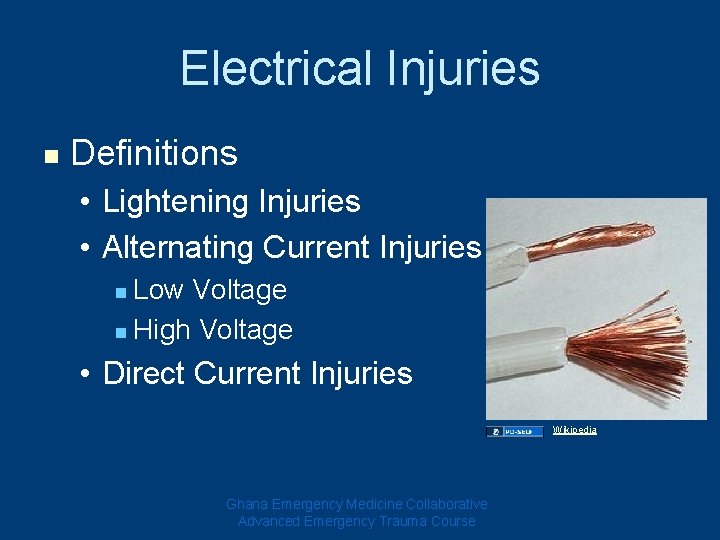
Electrical Injuries n Definitions • Lightening Injuries • Alternating Current Injuries Low Voltage n High Voltage n • Direct Current Injuries Wikipedia Ghana Emergency Medicine Collaborative Advanced Emergency Trauma Course
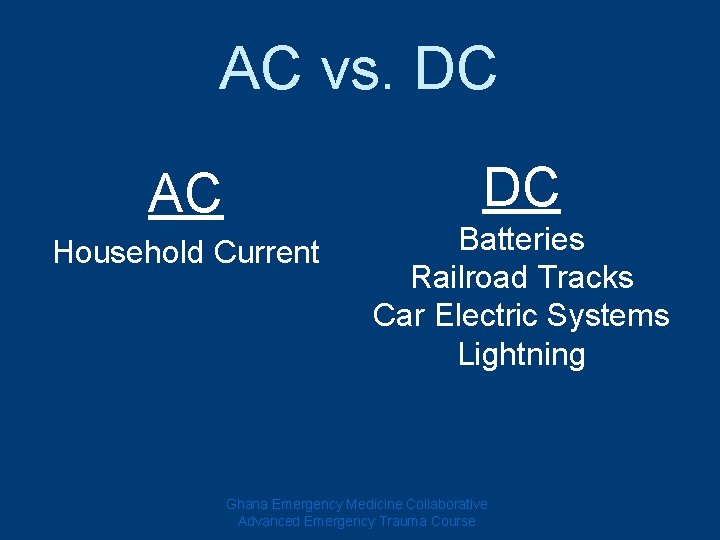
AC vs. DC DC AC Household Current Batteries Railroad Tracks Car Electric Systems Lightning Ghana Emergency Medicine Collaborative Advanced Emergency Trauma Course
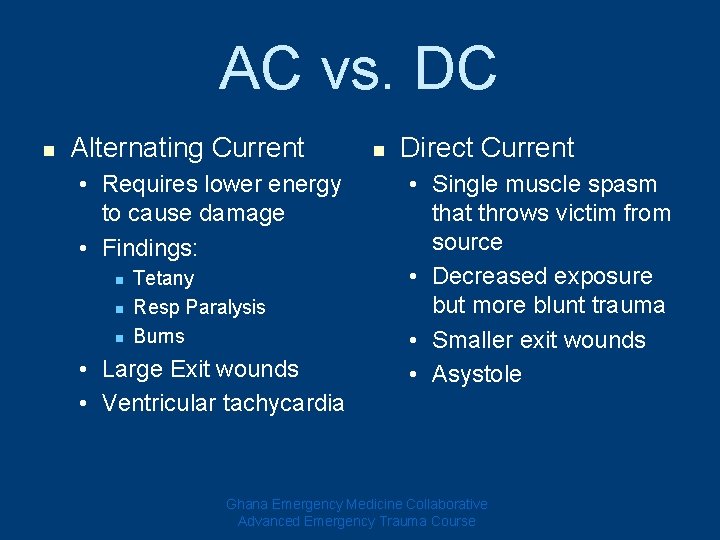
AC vs. DC n Alternating Current • Requires lower energy to cause damage • Findings: n n n Tetany Resp Paralysis Burns • Large Exit wounds • Ventricular tachycardia n Direct Current • Single muscle spasm that throws victim from source • Decreased exposure but more blunt trauma • Smaller exit wounds • Asystole Ghana Emergency Medicine Collaborative Advanced Emergency Trauma Course
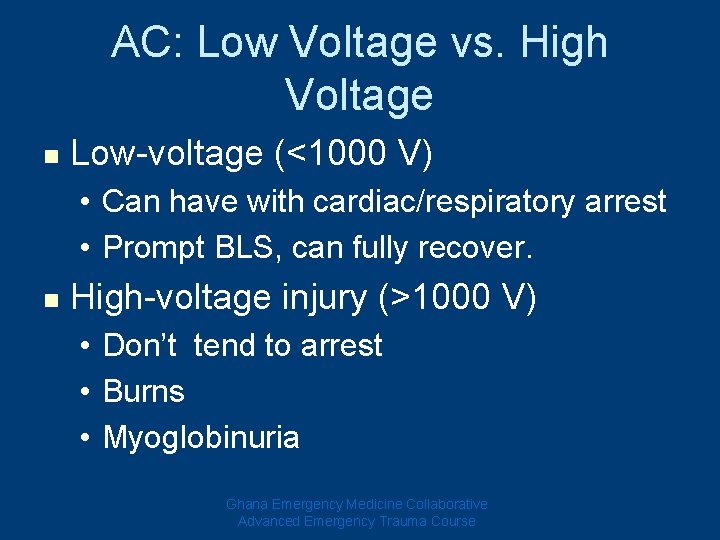
AC: Low Voltage vs. High Voltage n Low-voltage (<1000 V) • Can have with cardiac/respiratory arrest • Prompt BLS, can fully recover. n High-voltage injury (>1000 V) • Don’t tend to arrest • Burns • Myoglobinuria Ghana Emergency Medicine Collaborative Advanced Emergency Trauma Course
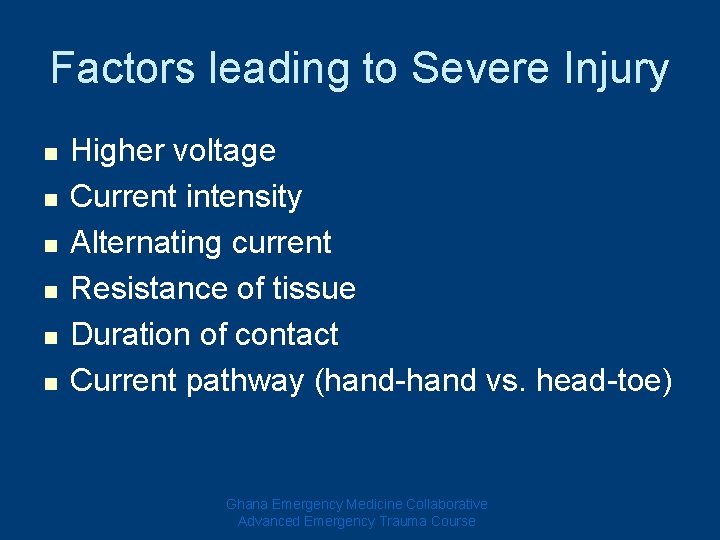
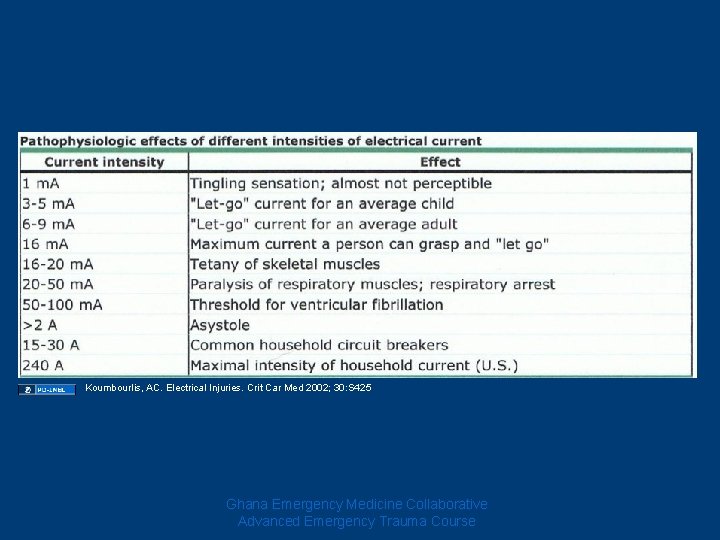
Factors leading to Severe Injury n n n Higher voltage Current intensity Alternating current Resistance of tissue Duration of contact Current pathway (hand-hand vs. head-toe) Ghana Emergency Medicine Collaborative Advanced Emergency Trauma Course
Koumbourlis, AC. Electrical Injuries. Crit Car Med 2002; 30: S 425 Ghana Emergency Medicine Collaborative Advanced Emergency Trauma Course
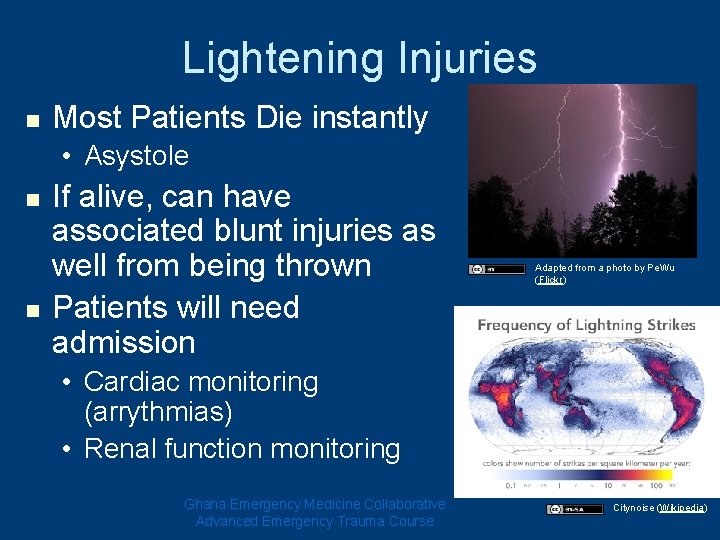
Lightening Injuries n Most Patients Die instantly • Asystole n n If alive, can have associated blunt injuries as well from being thrown Patients will need admission Adapted from a photo by Pe. Wu (Flickr) • Cardiac monitoring (arrythmias) • Renal function monitoring Ghana Emergency Medicine Collaborative Advanced Emergency Trauma Course Citynoise (Wikipedia)
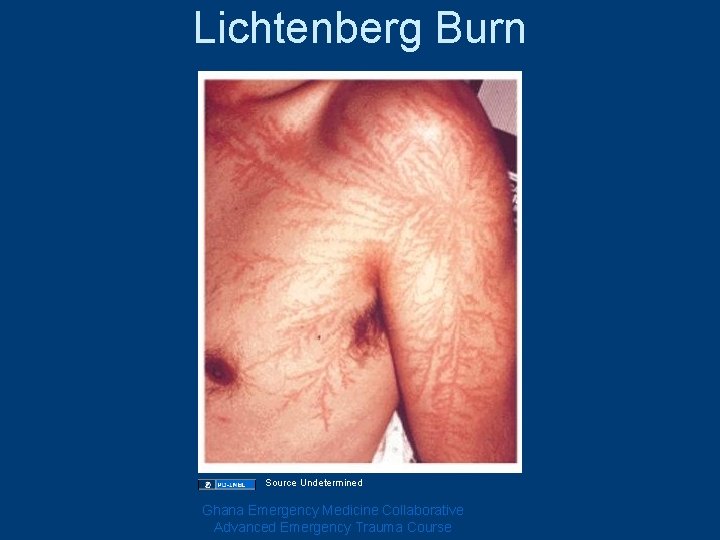
Lichtenberg Burn Source Undetermined Ghana Emergency Medicine Collaborative Advanced Emergency Trauma Course
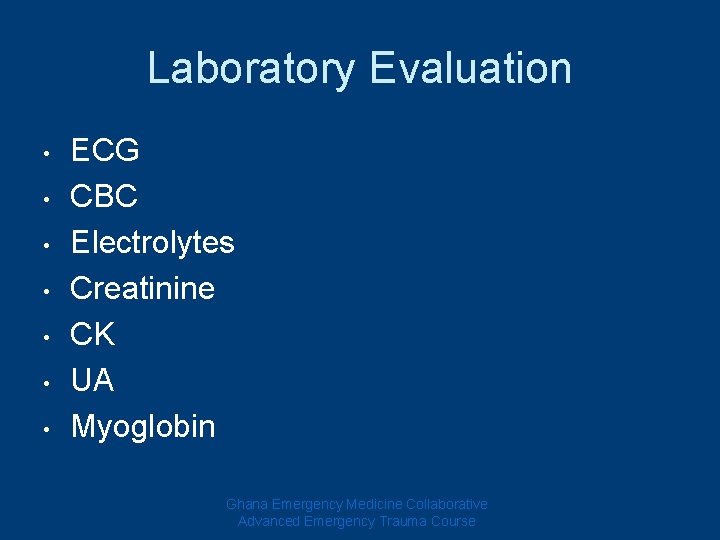
Laboratory Evaluation • • ECG CBC Electrolytes Creatinine CK UA Myoglobin Ghana Emergency Medicine Collaborative Advanced Emergency Trauma Course
Management § Stabilzation and Fluid Resuscitation § In CNS abnormality, avoid over-hydration and subsequent cerebral edema. § Mannitol or furosemide for patients with elevated CK/myoglobinemia. Avoid ATN § Lightning: CNS symptoms. If GCS =15 on arrival w/ no symptoms of impaired renal fxn & if CK is not > 2 x normal, consider OBS & DC. § Irregularities of pulse, ECG changes, myoglobinuria, or CNS abnormalities require hospitalization. Ghana Emergency Medicine Collaborative Advanced Emergency Trauma Course
Admission Criteria n n High Voltage (>1000 V) Low Voltage with • Conductive flow through head, chest or abd • Pts with chest pain, abdominal pain, confusion • Digit involvement with possible neurvascular compromise • Abnormal EKG, or suspected dysrrhythmia • Abnormal UA Ghana Emergency Medicine Collaborative Advanced Emergency Trauma Course
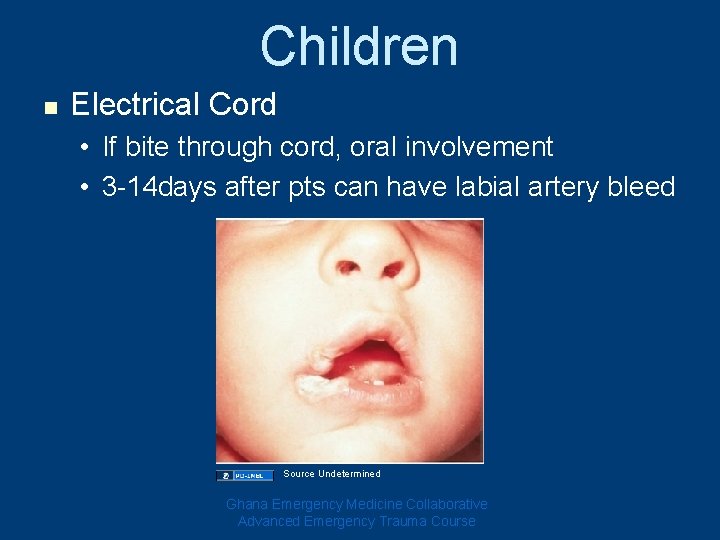
Children n Electrical Cord • If bite through cord, oral involvement • 3 -14 days after pts can have labial artery bleed Source Undetermined Ghana Emergency Medicine Collaborative Advanced Emergency Trauma Course
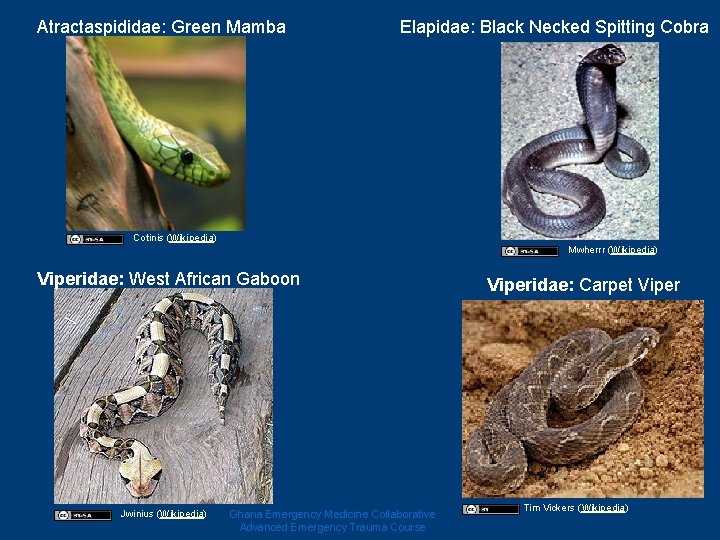
Bites n Snake Bites (4 Classes) • • Atractaspididae Elapidae (Sea Snakes) Viperidae (inc Pit Vipers) Colubridae n n Long considered harmless Now recognized to contain a number of species with venoms dangerous to humans Ghana Emergency Medicine Collaborative Advanced Emergency Trauma Course
Atractaspididae: Green Mamba Elapidae: Black Necked Spitting Cobra Cotinis (Wikipedia) Mwherrr (Wikipedia) Viperidae: West African Gaboon Jwinius (Wikipedia) Ghana Emergency Medicine Collaborative Advanced Emergency Trauma Course Viperidae: Carpet Viper Tim Vickers (Wikipedia)
Snake Bites n There is no quick, simple, and absolutely reliable method for distinguishing venomous from nonvenomous snakes. Ghana Emergency Medicine Collaborative Advanced Emergency Trauma Course
Poisonous African Snakes n n n n Vipers, adders Long-nosed viper Saw-scaled or carpet vipers West African Gaboon Puff adder African spitting cobras Egyptian and snouted cobras Mambas Ghana Emergency Medicine Collaborative Advanced Emergency Trauma Course
Factors affecting severity of Snake bite n n Dose of venom injected—depends on mechanical efficiency of bite and species and size of snake Composition and hence potency of venom depends on species and, within a species, the geographic location, season, and age of the snake Health, age, size, and specific immunity of human victim Nature and timing of first aid and medical treatment Ghana Emergency Medicine Collaborative Advanced Emergency Trauma Course
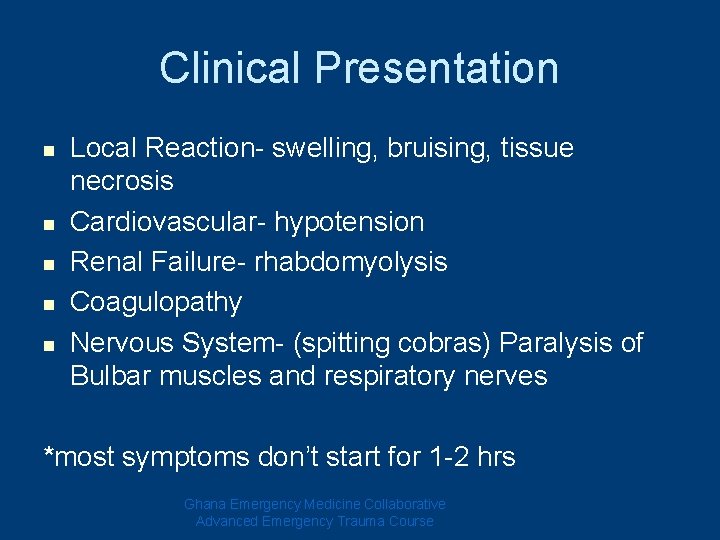
Clinical Presentation n n Local Reaction- swelling, bruising, tissue necrosis Cardiovascular- hypotension Renal Failure- rhabdomyolysis Coagulopathy Nervous System- (spitting cobras) Paralysis of Bulbar muscles and respiratory nerves *most symptoms don’t start for 1 -2 hrs Ghana Emergency Medicine Collaborative Advanced Emergency Trauma Course
Labs CBC n Electrolytes n Coagulation studies n LFT’s n UA n Ghana Emergency Medicine Collaborative Advanced Emergency Trauma Course
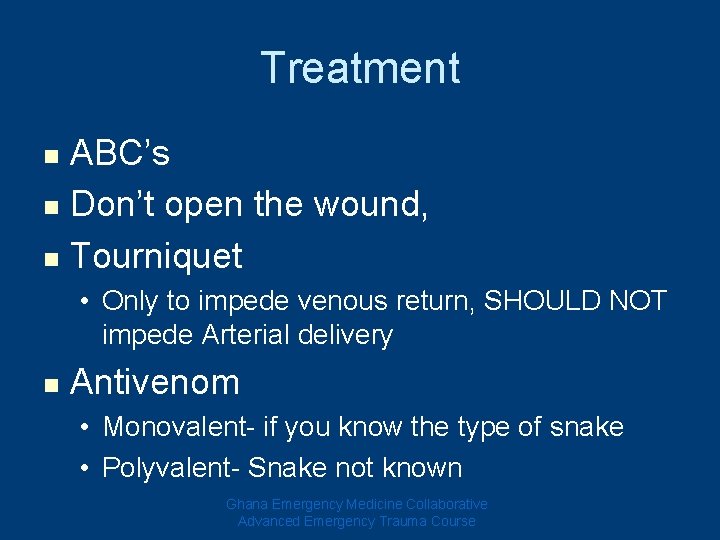
Treatment ABC’s n Don’t open the wound, n Tourniquet n • Only to impede venous return, SHOULD NOT impede Arterial delivery n Antivenom • Monovalent- if you know the type of snake • Polyvalent- Snake not known Ghana Emergency Medicine Collaborative Advanced Emergency Trauma Course
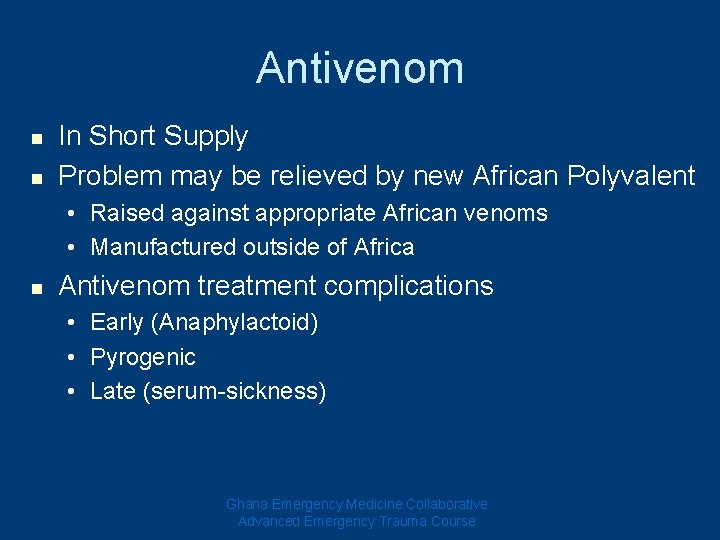
Antivenom n n In Short Supply Problem may be relieved by new African Polyvalent • Raised against appropriate African venoms • Manufactured outside of Africa n Antivenom treatment complications • Early (Anaphylactoid) • Pyrogenic • Late (serum-sickness) Ghana Emergency Medicine Collaborative Advanced Emergency Trauma Course
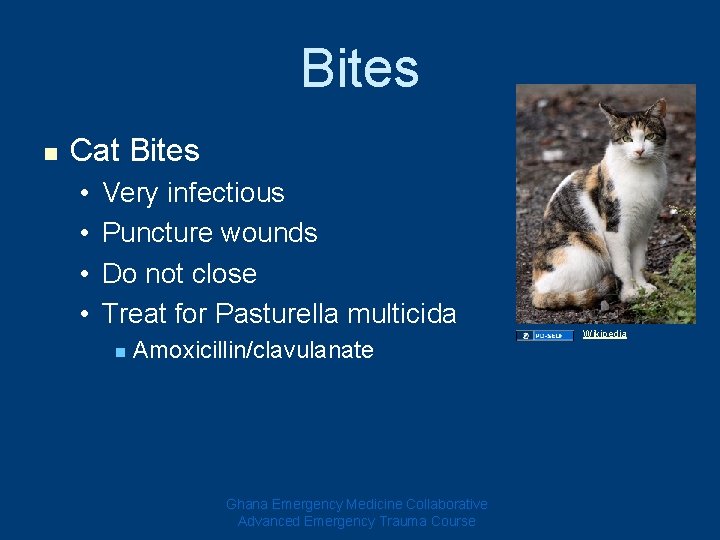
Bites n Cat Bites • • Very infectious Puncture wounds Do not close Treat for Pasturella multicida n Amoxicillin/clavulanate Ghana Emergency Medicine Collaborative Advanced Emergency Trauma Course Wikipedia
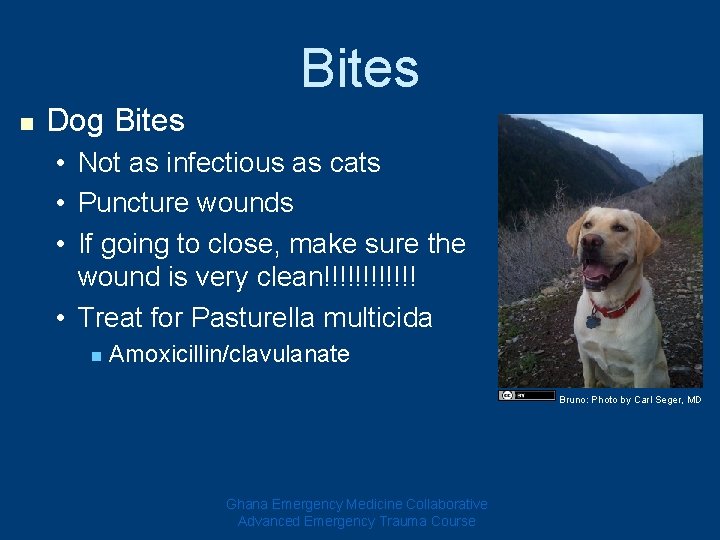
Bites n Dog Bites • Not as infectious as cats • Puncture wounds • If going to close, make sure the wound is very clean!!!!!! • Treat for Pasturella multicida n Amoxicillin/clavulanate Bruno: Photo by Carl Seger, MD Ghana Emergency Medicine Collaborative Advanced Emergency Trauma Course
Marine Envenomations n n n Scomboid (tuna, mahi-mahi) Ciguatera (coral reef fish, red snapper, sea bass) Tetrodotoxin (Puffer fish) Sting Rays Nematocyst (jellyfish) Ghana Emergency Medicine Collaborative Advanced Emergency Trauma Course
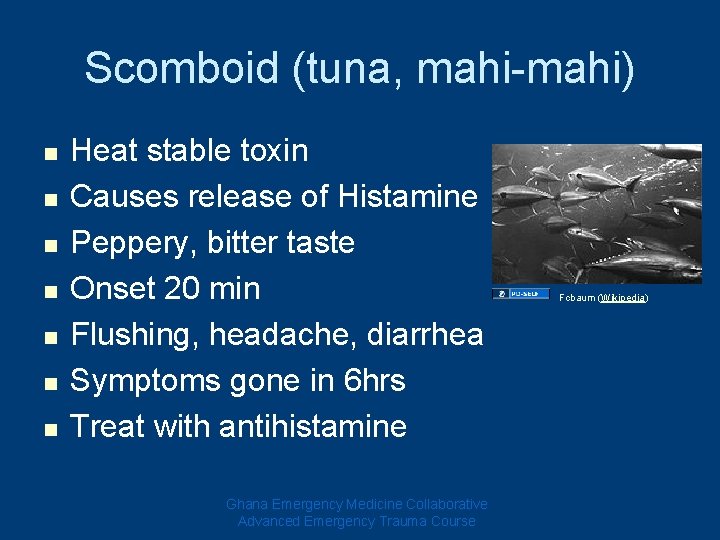
Scomboid (tuna, mahi-mahi) n n n n Heat stable toxin Causes release of Histamine Peppery, bitter taste Onset 20 min Flushing, headache, diarrhea Symptoms gone in 6 hrs Treat with antihistamine Ghana Emergency Medicine Collaborative Advanced Emergency Trauma Course Fcbaum (Wikipedia)
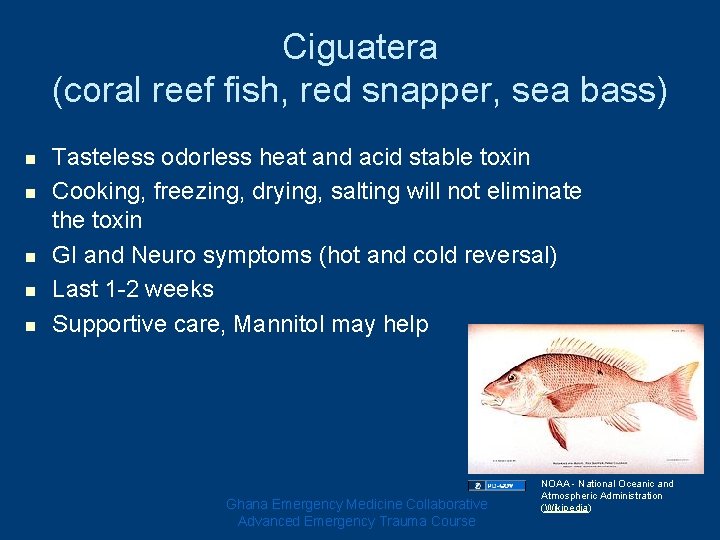
Ciguatera (coral reef fish, red snapper, sea bass) n n n Tasteless odorless heat and acid stable toxin Cooking, freezing, drying, salting will not eliminate the toxin GI and Neuro symptoms (hot and cold reversal) Last 1 -2 weeks Supportive care, Mannitol may help Ghana Emergency Medicine Collaborative Advanced Emergency Trauma Course NOAA - National Oceanic and Atmospheric Administration (Wikipedia)
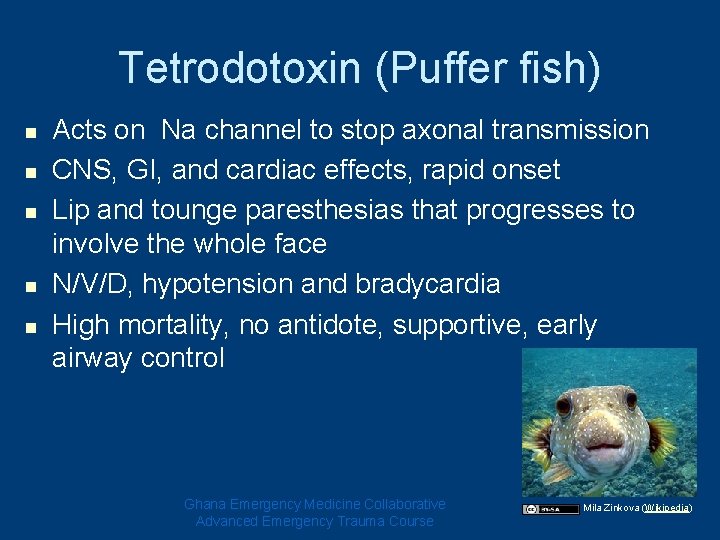
Tetrodotoxin (Puffer fish) n n n Acts on Na channel to stop axonal transmission CNS, GI, and cardiac effects, rapid onset Lip and tounge paresthesias that progresses to involve the whole face N/V/D, hypotension and bradycardia High mortality, no antidote, supportive, early airway control Ghana Emergency Medicine Collaborative Advanced Emergency Trauma Course Mila Zinkova (Wikipedia)
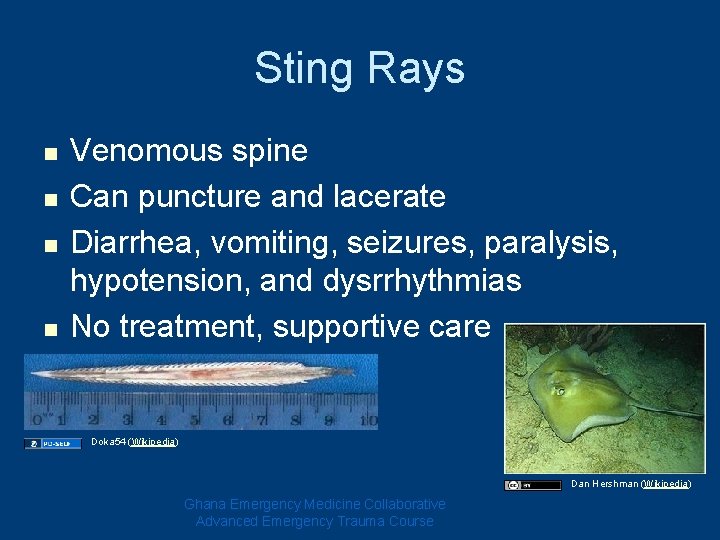
Sting Rays n n Venomous spine Can puncture and lacerate Diarrhea, vomiting, seizures, paralysis, hypotension, and dysrrhythmias No treatment, supportive care Doka 54 (Wikipedia) Dan Hershman (Wikipedia) Ghana Emergency Medicine Collaborative Advanced Emergency Trauma Course
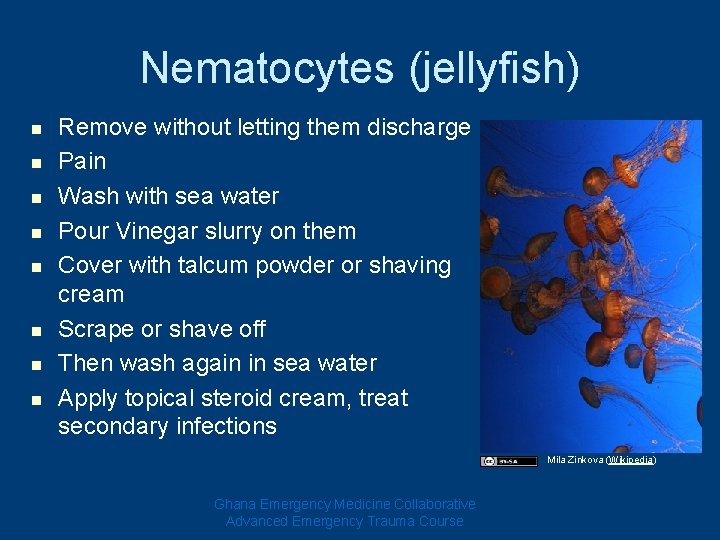
Nematocytes (jellyfish) n n n n Remove without letting them discharge Pain Wash with sea water Pour Vinegar slurry on them Cover with talcum powder or shaving cream Scrape or shave off Then wash again in sea water Apply topical steroid cream, treat secondary infections Mila Zinkova (Wikipedia) Ghana Emergency Medicine Collaborative Advanced Emergency Trauma Course
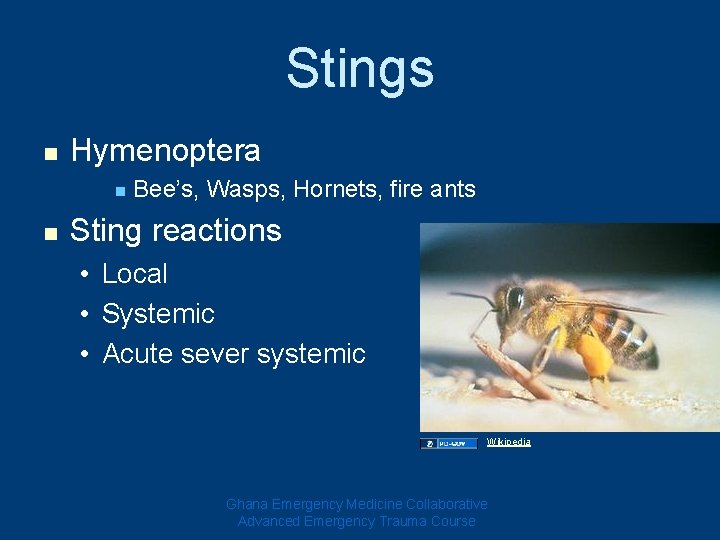
Stings n Hymenoptera n n Bee’s, Wasps, Hornets, fire ants Sting reactions • Local • Systemic • Acute sever systemic Wikipedia Ghana Emergency Medicine Collaborative Advanced Emergency Trauma Course
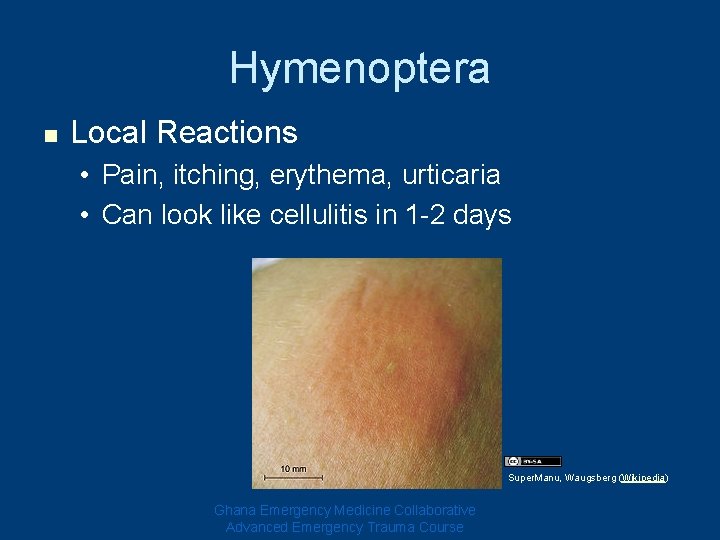
Hymenoptera n Local Reactions • Pain, itching, erythema, urticaria • Can look like cellulitis in 1 -2 days Super. Manu, Waugsberg (Wikipedia) Ghana Emergency Medicine Collaborative Advanced Emergency Trauma Course
Hymenoptera n Systemic Reaction • Generalized urticaria • Flushing and vasodilation • Cramps, vomiting, and diarrhea Ghana Emergency Medicine Collaborative Advanced Emergency Trauma Course
Hymenoptera n Acute Severe Systemic • • n Ig-E mediated Occurs rapidly with in 10 -20 min Usually with 1 -2 stings Hypotension, arrhythmias, laryngeal edema, bronchospasm, stridor Treatment • Epinephrine (1: 1000) IM 0. 4 mg in adults and 0. 01 mg/kg in peds • H 1 and H 2 blockers, Steroids Ghana Emergency Medicine Collaborative Advanced Emergency Trauma Course
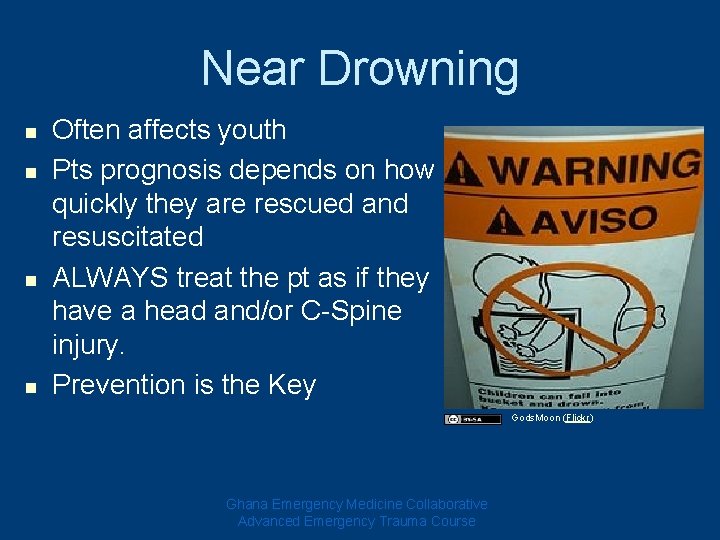
Near Drowning n n Often affects youth Pts prognosis depends on how quickly they are rescued and resuscitated ALWAYS treat the pt as if they have a head and/or C-Spine injury. Prevention is the Key Gods. Moon (Flickr) Ghana Emergency Medicine Collaborative Advanced Emergency Trauma Course
Near Drowning n n Hypoxemia- from flooding of alveoli and impairment of gas exchange This occurs with approximately 2. 2 ml/Kg of fresh or salt water. Aspiration of particulate matter contributes to lung injury This all results in non cardiogenic pulmonary edema Ghana Emergency Medicine Collaborative Advanced Emergency Trauma Course
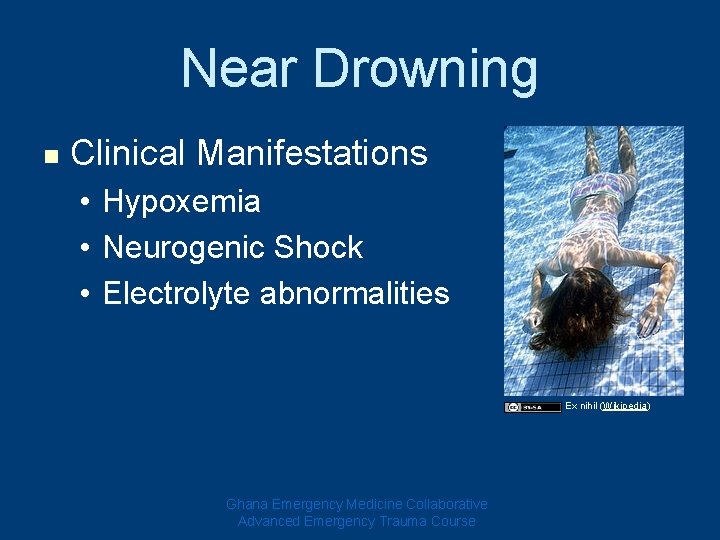
Near Drowning n Clinical Manifestations • Hypoxemia • Neurogenic Shock • Electrolyte abnormalities Ex nihil (Wikipedia) Ghana Emergency Medicine Collaborative Advanced Emergency Trauma Course
Near Drowning n Evaluation • • • CBC Electrolytes Clotting studies ABG CXR C-Spine films possibly CT of C-Spine Ghana Emergency Medicine Collaborative Advanced Emergency Trauma Course
Near Drowning n Management • ABCDE Airway with high flow O 2 and PEEP n ACLS if needed n Immobilize C-spine n • Treat electrolyte abnormalities n Admit pts who recover but have any respiratory complaints and they might develop pulmonary edema Ghana Emergency Medicine Collaborative Advanced Emergency Trauma Course
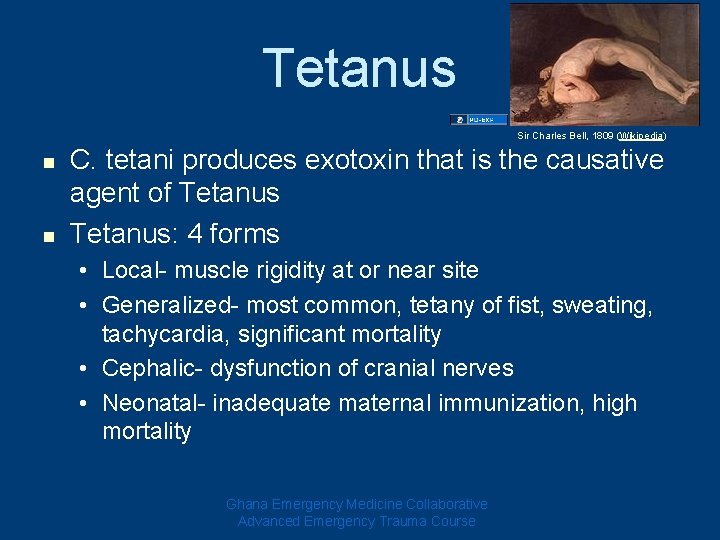
Tetanus Sir Charles Bell, 1809 (Wikipedia) n n C. tetani produces exotoxin that is the causative agent of Tetanus: 4 forms • Local- muscle rigidity at or near site • Generalized- most common, tetany of fist, sweating, tachycardia, significant mortality • Cephalic- dysfunction of cranial nerves • Neonatal- inadequate maternal immunization, high mortality Ghana Emergency Medicine Collaborative Advanced Emergency Trauma Course
Tetanus n Prophylaxis • Clean Wound Recent immunization (does not need booster) n No recent immunization (needs Td) n If never immunized pt needs Tetanus immunoglobulin (TIG and Td) n • Dirty Wound, crush injury, saliva, burns Recent immunization (needs Td) n No recent immunization (needs TIG and Td) n Ghana Emergency Medicine Collaborative Advanced Emergency Trauma Course
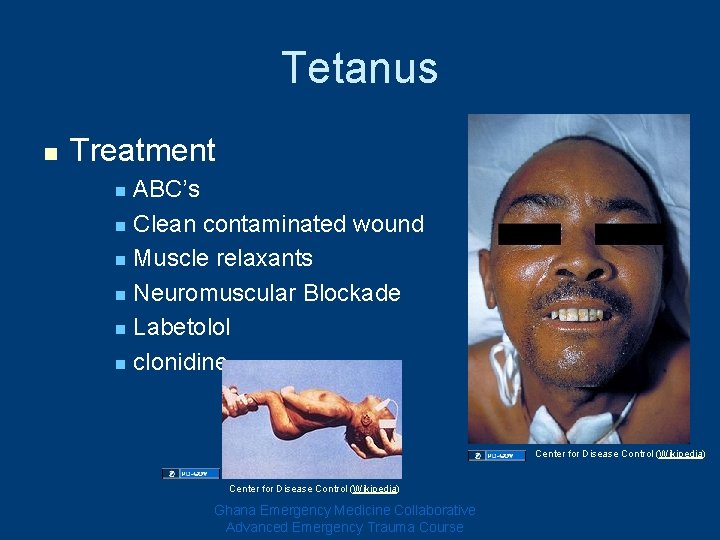
Tetanus n Treatment ABC’s n Clean contaminated wound n Muscle relaxants n Neuromuscular Blockade n Labetolol n clonidine n Center for Disease Control (Wikipedia) Ghana Emergency Medicine Collaborative Advanced Emergency Trauma Course
Heat illness n n Heat Gain • Metabolism- would heat up body 1. 1 degree per hour • Environmental Heat loss • Convection- heat release from body to air and water vapor • Conduction- contact with cooler object • Evaporation- transform sweat and saliva to vapor • Radiation- heat transfer to air, vasodilation, if temp higher then we gain heat Ghana Emergency Medicine Collaborative Advanced Emergency Trauma Course
Heat illness n At Risk • Extremes of age • Medical illness (DT’s, hyperthyroid, Parkinson’s) • Dehydrated • Drugs- Amphetamines, Cocaine, ETOH, Anticholinergic Ghana Emergency Medicine Collaborative Advanced Emergency Trauma Course
Heat Exhaustion n n Mild to Moderate dysfunction of temp control Symptoms similar to viral illness • Nausea, vomiting, cramps, headache, weakness n n n Temp < 41 degrees Labs: Electrolytes and liver function Treatment • Passive cooling, cool IVF Ghana Emergency Medicine Collaborative Advanced Emergency Trauma Course
Heat Stroke n n n Temp > 40. 5 degrees Same symptoms of exhaustion but neurologic involvement • AMS, hallucinations, ataxia, seizures Physical Exam • Altered • Tachycardia- arrhythmias resistant to Cardioversion • Tachypnea Ghana Emergency Medicine Collaborative Advanced Emergency Trauma Course
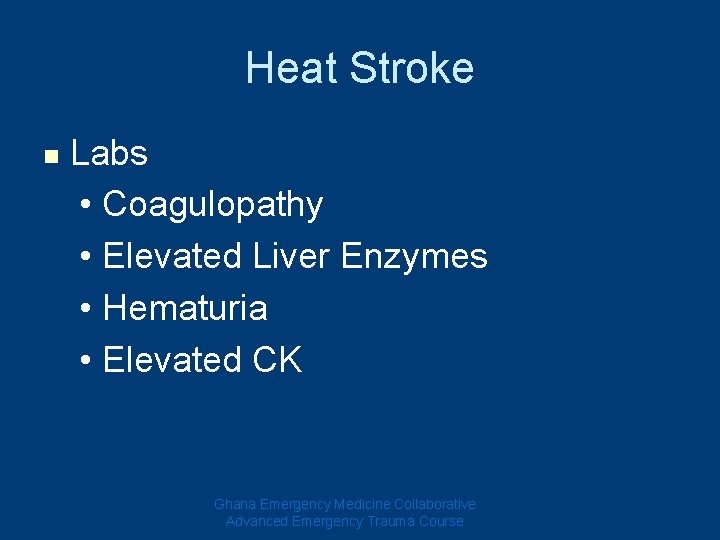
Heat Stroke n Labs • Coagulopathy • Elevated Liver Enzymes • Hematuria • Elevated CK Ghana Emergency Medicine Collaborative Advanced Emergency Trauma Course
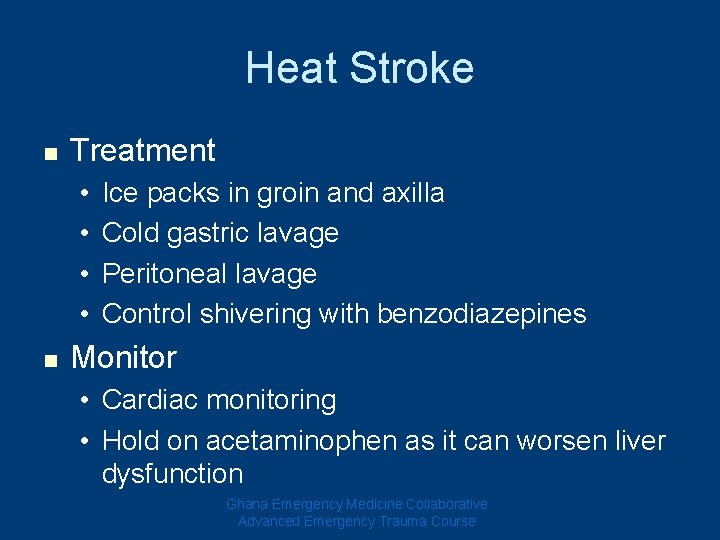
Heat Stroke n Treatment • • n Ice packs in groin and axilla Cold gastric lavage Peritoneal lavage Control shivering with benzodiazepines Monitor • Cardiac monitoring • Hold on acetaminophen as it can worsen liver dysfunction Ghana Emergency Medicine Collaborative Advanced Emergency Trauma Course
Questions? Dkscully (flickr)
References n n n n Bessen, H. Hypothermia, in Emergency Medicine: A Comprehensive Guide. Tintinalli, Editor. 2004, Mc. Graw-Hill. p. 1179 -1183 Clark, R. , Schneir, A. Arthropod Bites and Stings, in Emergency Medicine: A Comprehensive Guide. Tintinalli, Editor. 2004, Mc. Graw-Hill. p. 1190 -1200. Dart, R. , Caly, F. Reptile Bites, in Emergency Medicine: A Comprehensive Guide. Tintinalli, Editor. 2004, Mc. Graw-Hill. p. 1100 -1206. Isbister, G. , Caldicott, D. Trauma and Envenomations from Marine Fauna, in Emergency Medicine: A Comprehensive Guide. Tintinalli, Editor. 2004, Mc. Graw-Hill. p. 1206 -1213 Causey, A. , Nicher, M. Near-Drowning, in Emergency Medicine: A Comprehensive Guide. Tintinalli, Editor. 2004, Mc. Graw-Hill. p. 1218 -1220. Fish, R. Electrical Injuries and Lightning Injuries, in Emergency Medicine: A Comprehensive Guide. Tintinalli, Editor. 2004, Mc. Graw-Hill. p. 1231 -1238 Auerbach, P. Snakes Bites, in Wilderness Medicine, 5 th. Mosby. Jenson, C. , Counselman, F. Marine Envenomation and Injuries, in Emergency Medicine. Adams, Editor. 2008, Saunders. P 1711 -1717 Ghana Emergency Medicine Collaborative Advanced Emergency Trauma Course