
Authors Patrick Carter Daniel Wachter Rockefeller Oteng Carl
- Slides: 75
Author(s): Patrick Carter, Daniel Wachter, Rockefeller Oteng, Carl Seger, 2009 -2010. License: Unless otherwise noted, this material is made available under the terms of the Creative Commons Attribution 3. 0 License: http: //creativecommons. org/licenses/by/3. 0/ We have reviewed this material in accordance with U. S. Copyright Law and have tried to maximize your ability to use, share, and adapt it. The citation key on the following slide provides information about how you may share and adapt this material. Copyright holders of content included in this material should contact open. michigan@umich. edu with any questions, corrections, or clarification regarding the use of content. For more information about how to cite these materials visit http: //open. umich. edu/education/about/terms-of-use. Any medical information in this material is intended to inform and educate and is not a tool for self-diagnosis or a replacement for medical evaluation, advice, diagnosis or treatment by a healthcare professional. Please speak to your physician if you have questions about your medical condition. Viewer discretion is advised: Some medical content is graphic and may not be suitable for all viewers.
Citation Key for more information see: http: //open. umich. edu/wiki/Citation. Policy Use + Share + Adapt { Content the copyright holder, author, or law permits you to use, share and adapt. } Public Domain – Government: Works that are produced by the U. S. Government. (USC 17 § 105) Public Domain – Expired: Works that are no longer protected due to an expired copyright term. Public Domain – Self Dedicated: Works that a copyright holder has dedicated to the public domain. Creative Commons – Zero Waiver Creative Commons – Attribution License Creative Commons – Attribution Share Alike License Creative Commons – Attribution Noncommercial Share Alike License GNU – Free Documentation License Make Your Own Assessment { Content Open. Michigan believes can be used, shared, and adapted because it is ineligible for copyright. } Public Domain – Ineligible: Works that are ineligible for copyright protection in the U. S. (USC 17 § 102(b)) *laws in your jurisdiction may differ { Content Open. Michigan has used under a Fair Use determination. } Fair Use: Use of works that is determined to be Fair consistent with the U. S. Copyright Act. (USC 17 § 107) *laws in your jurisdiction may differ Our determination DOES NOT mean that all uses of this 3 rd-party content are Fair Uses and we DO NOT guarantee that your use of the content is Fair. To use this content you should do your own independent analysis to determine whether or not your use will be Fair.
Advanced Emergency Trauma Course Airway and Ventilator Management Presenter: Daniel Wachter, MD Ghana Emergency Medicine Collaborative Patrick Carter, MD ∙ Daniel Wachter, MD ∙ Rockefeller Oteng, MD ∙ Carl Seger, MD
Essentials of Emergency Airway Management Know the anatomy. n Learn the equipment. n Learn the techniques - 10 and 20. n Develop judgment. n Ghana Emergency Medicine Collaborative Advanced Emergency Trauma Course
Airway Compromise in Emergency Patients n Common Etiologies: • • • Cardiac failure and arrest Respiratory failure (primary) Neurological diseases Multiple trauma, head injury, burns Toxicological emergencies Ghana Emergency Medicine Collaborative Advanced Emergency Trauma Course
Indications for Emergency Airway Intervention What are the indications? Zen (flickr) Ghana Emergency Medicine Collaborative Advanced Emergency Trauma Course
Indications for Emergency Airway Intervention n n To correct hypoxemia (oxygenate) or hypercarbia (ventilate). To provide a patent, secure airway. To facilitate other interventions in critically ill patients (prophylactic). Anticipate need for intubation based on clinical course and likelihood of deterioration. Ghana Emergency Medicine Collaborative Advanced Emergency Trauma Course
Emergency Airway Management n Options • Patency maneuvers • Non-invasive ventilation • Endotracheal intubation with or without induction and paralytic agents • Nasotracheal intubation • Adjunct airways • Surgical airway Ghana Emergency Medicine Collaborative Advanced Emergency Trauma Course
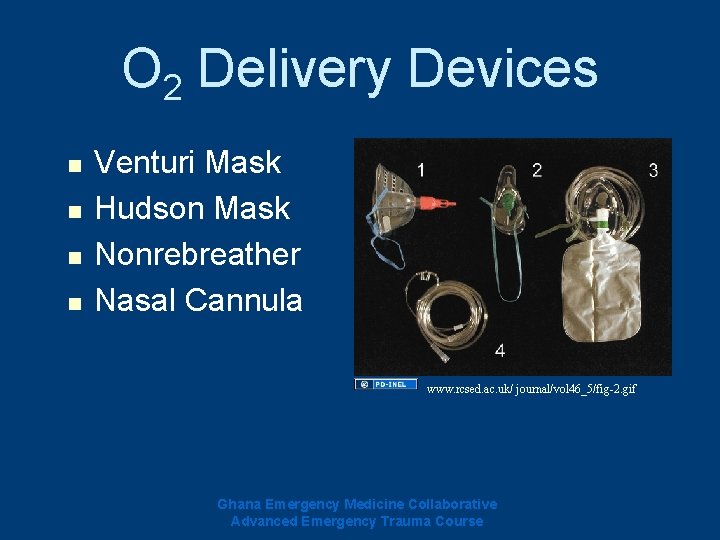
O 2 Delivery Devices n n Venturi Mask Hudson Mask Nonrebreather Nasal Cannula www. rcsed. ac. uk/ journal/vol 46_5/fig-2. gif Ghana Emergency Medicine Collaborative Advanced Emergency Trauma Course
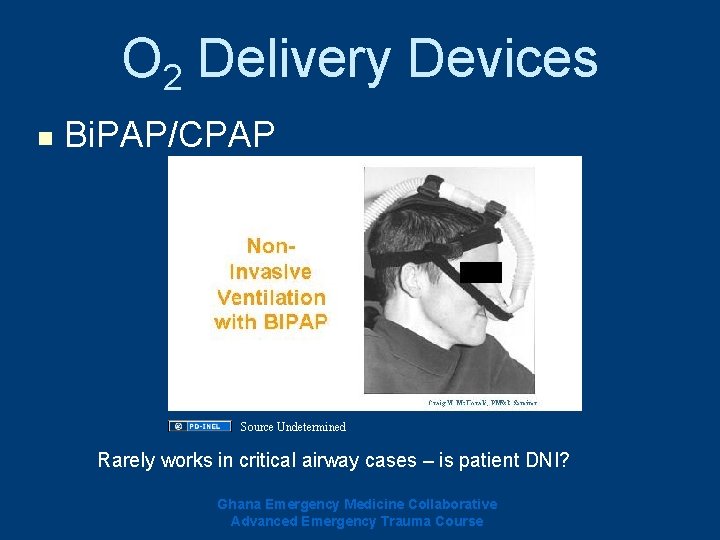
O 2 Delivery Devices n Bi. PAP/CPAP Source Undetermined Rarely works in critical airway cases – is patient DNI? Ghana Emergency Medicine Collaborative Advanced Emergency Trauma Course
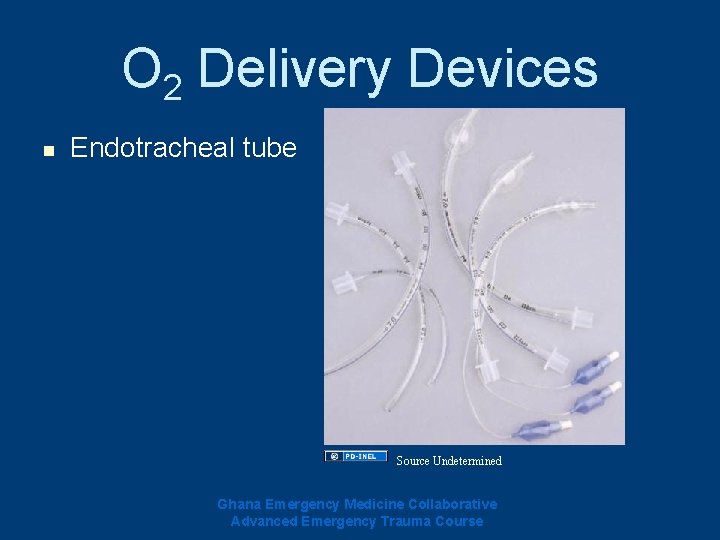
O 2 Delivery Devices n Endotracheal tube Source Undetermined Ghana Emergency Medicine Collaborative Advanced Emergency Trauma Course
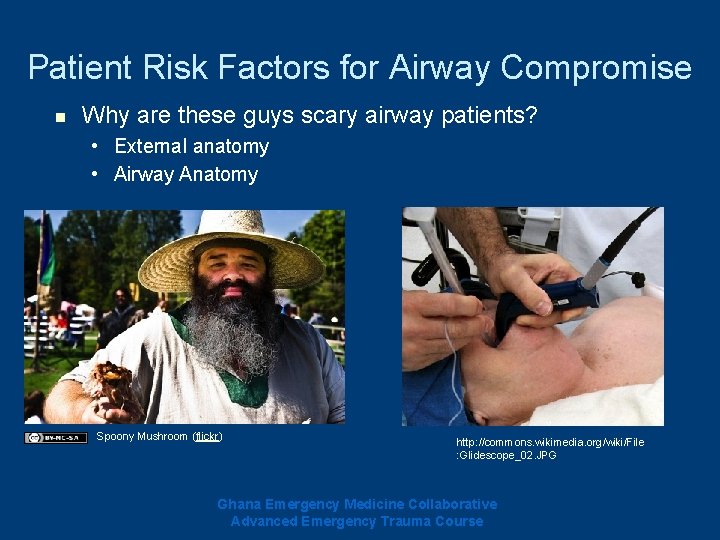
Patient Risk Factors for Airway Compromise n Why are these guys scary airway patients? • External anatomy • Airway Anatomy Spoony Mushroom (flickr) http: //commons. wikimedia. org/wiki/File : Glidescope_02. JPG Ghana Emergency Medicine Collaborative Advanced Emergency Trauma Course
External Anatomy n Difficult Bag/Mask Ventilation • Edentulous • Obese • History of Snoring/Sleep Apnea • Beard • Age > 55 • Anatomically abnormal facies • Facial/neck trauma • Obstructive airway disease • 3 rd trimester pregnancy Ghana Emergency Medicine Collaborative Advanced Emergency Trauma Course
External Anatomy n Difficult Intubation • Neck trauma • Prominent incisors • Receding mandible • Cervical spine immobilization n Eg. bamboo spine, fusion • Short, thin neck • Anatomically abnormal facies • Morbid obesity Ghana Emergency Medicine Collaborative Advanced Emergency Trauma Course
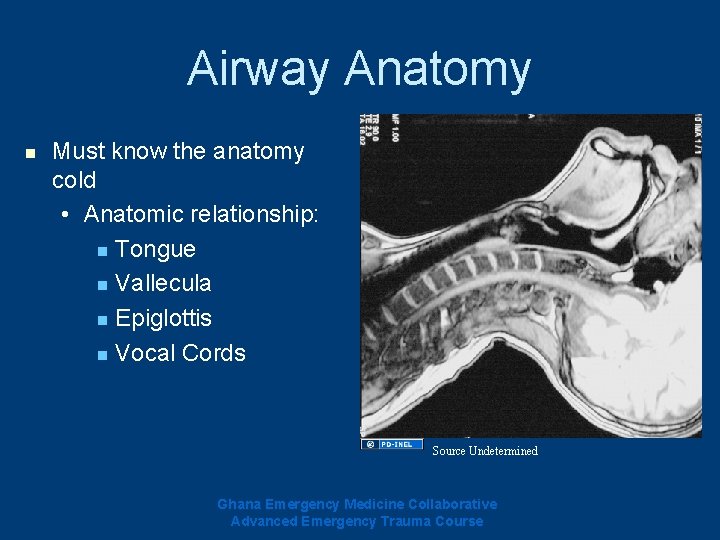
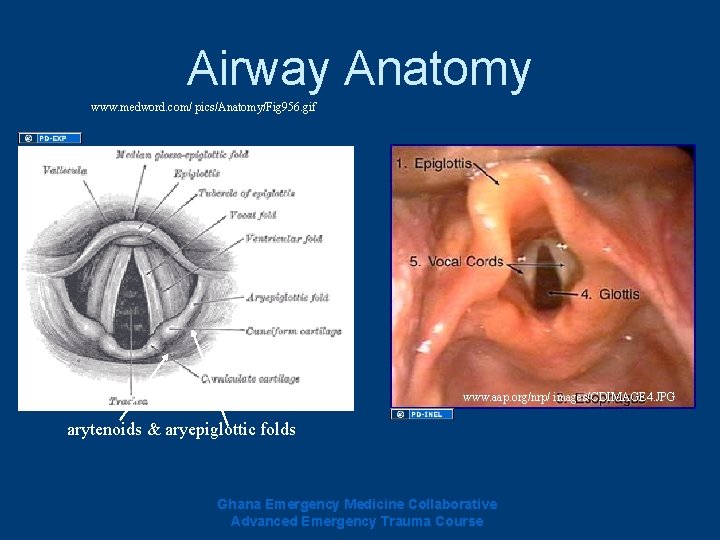
Airway Anatomy n Must know the anatomy cold • Anatomic relationship: n Tongue n Vallecula n Epiglottis n Vocal Cords Source Undetermined Ghana Emergency Medicine Collaborative Advanced Emergency Trauma Course
Review of Airway Anatomy n n Nasopharynx Oropharynx Hypopharynx Larynx – Laryngoscopic view • Must have this burned into your brain in order to be an airway expert Ghana Emergency Medicine Collaborative Advanced Emergency Trauma Course
Airway Anatomy www. medword. com/ pics/Anatomy/Fig 956. gif www. aap. org/nrp/ images/CDIMAGE 4. JPG arytenoids & aryepiglottic folds Ghana Emergency Medicine Collaborative Advanced Emergency Trauma Course
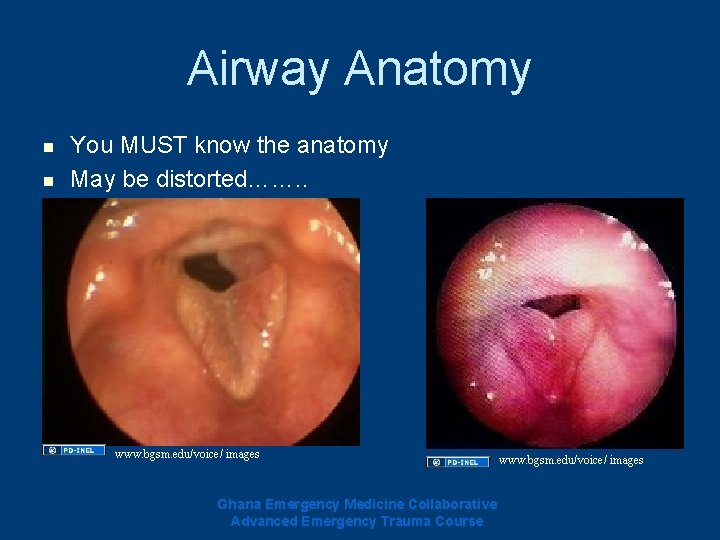
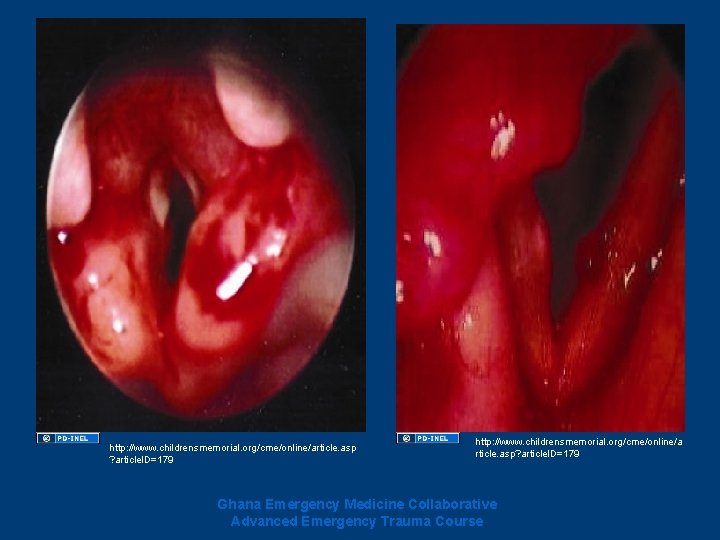
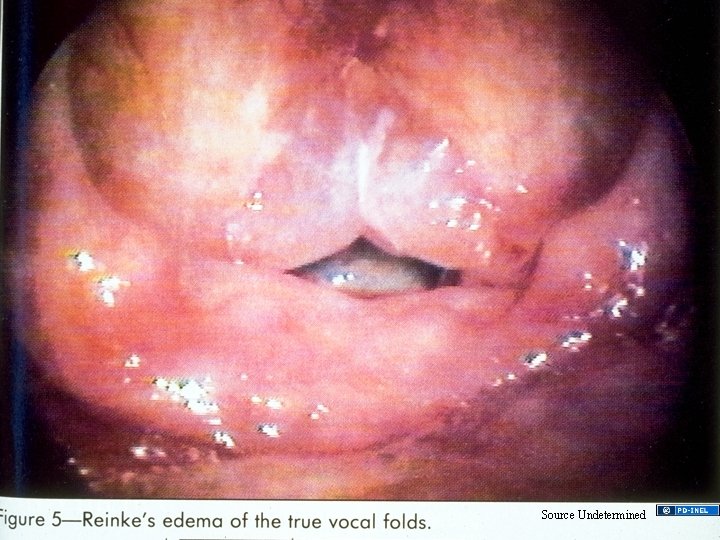
Airway Anatomy n n You MUST know the anatomy May be distorted……. . www. bgsm. edu/voice/ images Ghana Emergency Medicine Collaborative Advanced Emergency Trauma Course www. bgsm. edu/voice/ images
http: //www. childrensmemorial. org/cme/online/article. asp ? article. ID=179 http: //www. childrensmemorial. org/cme/online/a rticle. asp? article. ID=179 Ghana Emergency Medicine Collaborative Advanced Emergency Trauma Course
Ghana Emergency Medicine Collaborative Advanced Emergency Trauma Course Source Undetermined
Airway Assessment n Deciding who needs active airway management • History of prior difficulty intubations • Physical Exam Features n n n Obesity Short neck Macroglossia Micrognathia Large teeth Small Mouth • Clinical Condition n n Stable vs. Unstable Active Bleeding Vomiting Need for procedures Other Interventions Ghana Emergency Medicine Collaborative Advanced Emergency Trauma Course
Physical Assessment of Airway Status n Vital Signs • Respiratory Rate, O 2 sat, Blood Pressure, Heart rate n Mental Status • Agitation, Somnolence, Coma n Airway Patency • Secretions, Stridor, Obstruction, Edema n Ventilation • Breath Sounds, Accessory Muscle use, Retractions, Rales, Wheezing Ghana Emergency Medicine Collaborative Advanced Emergency Trauma Course
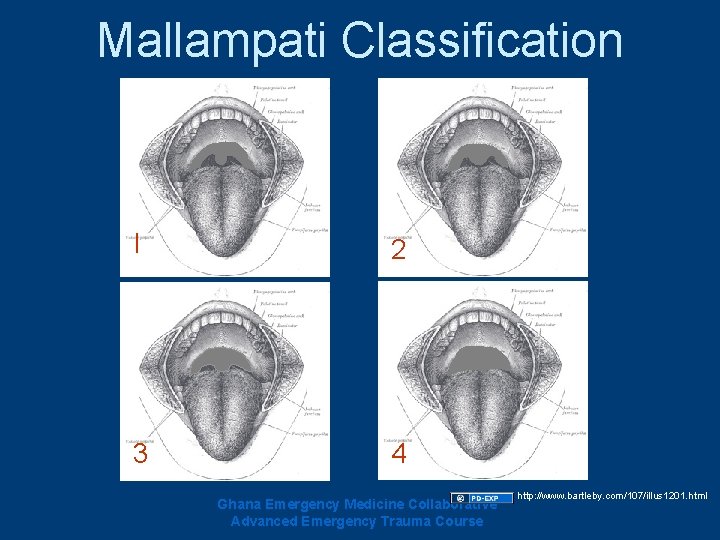
Airway Assessment Techniques n n Mallampati Score Mouth Opening • 3 fingers between incisors n Thyromental Distance • > 6 cm = “ 3 fingers” • Predicts laryngoscopic geometry n Adequate Neck Extension • Assuming no trauma n Evaluate for obstruction Ghana Emergency Medicine Collaborative Advanced Emergency Trauma Course
Mallampati Classification I 2 3 4 Ghana Emergency Medicine Collaborative Advanced Emergency Trauma Course http: //www. bartleby. com/107/illus 1201. html
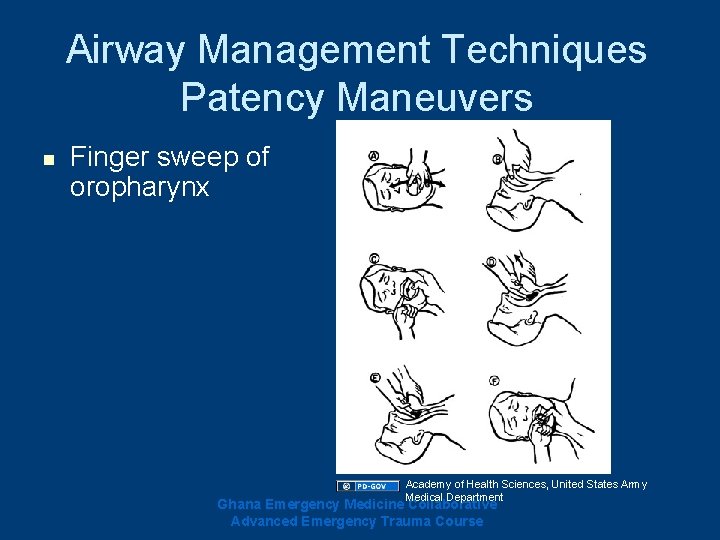
Airway Management Techniques Patency Maneuvers n Finger sweep of oropharynx Academy of Health Sciences, United States Army Medical Department Ghana Emergency Medicine Collaborative Advanced Emergency Trauma Course
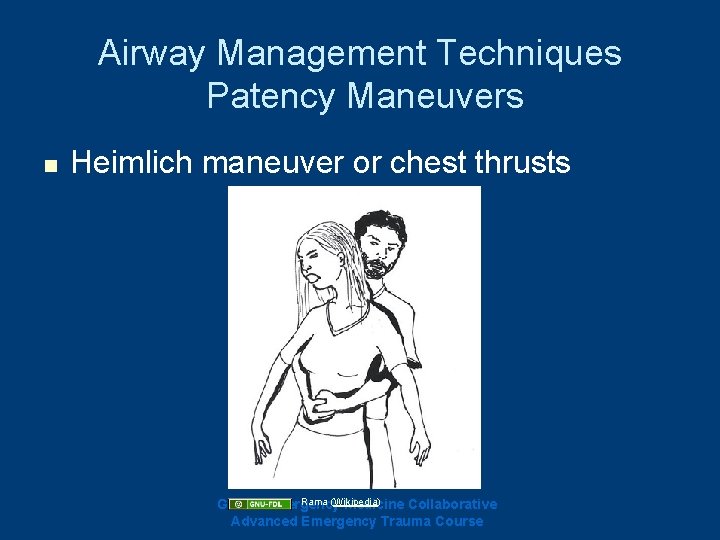
Airway Management Techniques Patency Maneuvers n Heimlich maneuver or chest thrusts Rama (Wikipedia) Ghana Emergency Medicine Collaborative Advanced Emergency Trauma Course
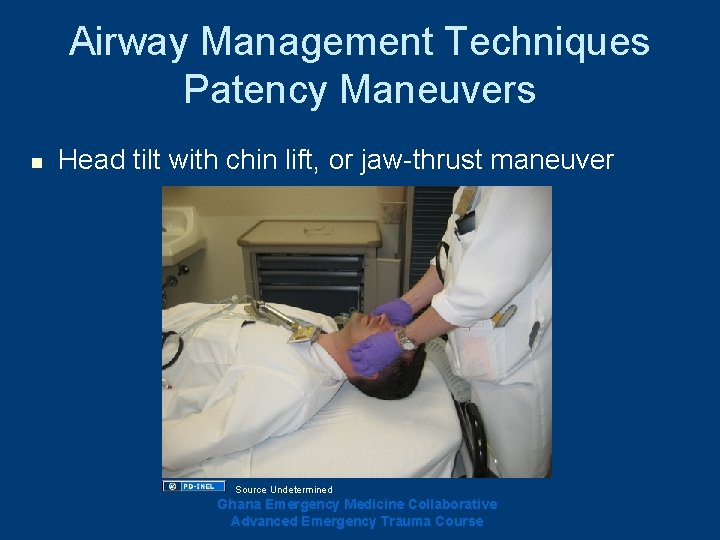
Airway Management Techniques Patency Maneuvers n Head tilt with chin lift, or jaw-thrust maneuver Source Undetermined Ghana Emergency Medicine Collaborative Advanced Emergency Trauma Course
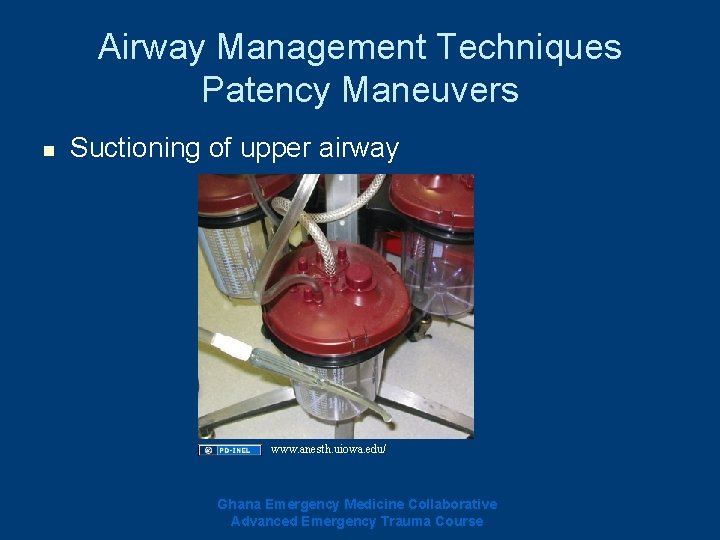
Airway Management Techniques Patency Maneuvers n Suctioning of upper airway www. anesth. uiowa. edu/ Ghana Emergency Medicine Collaborative Advanced Emergency Trauma Course
Oral Airway n n n Prevents tongue from occluding airway Requires absent gag reflex Can be used as a bite block Place carefully over the tongue If patient can tolerate oral airway, they likely need to be intubated Ghana Emergency Medicine Collaborative Advanced Emergency Trauma Course
Nasal Airway Device n n Pliable Good for sonorous patients Lubricate tip; place in most patent nostril Go in the inferior and medial portion of the nostril and horizontal to the hard palate Ghana Emergency Medicine Collaborative Advanced Emergency Trauma Course
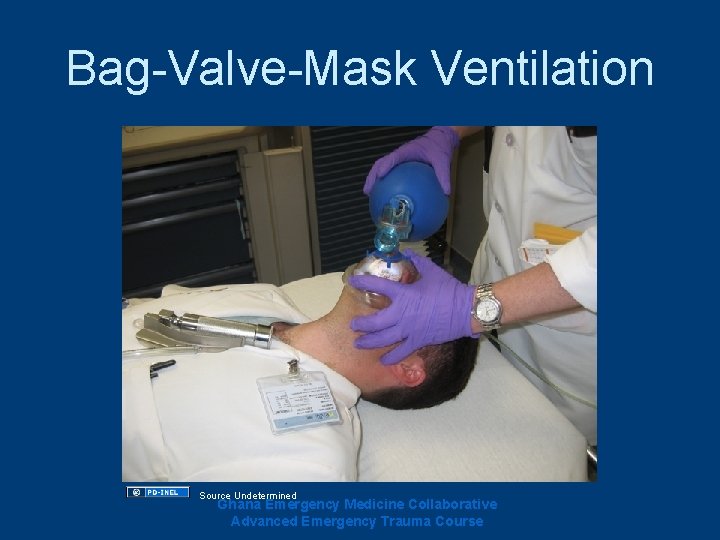
Bag-Valve-Mask Ventilation § Very important skill to know § May provide temporary or definitive airway management. § One person - importance of a good seal. § Two person technique more effective. § In EMS setting may be as useful as endotracheal intubation. Ghana Emergency Medicine Collaborative Advanced Emergency Trauma Course
Bag-Valve-Mask Ventilation Source Undetermined Ghana Emergency Medicine Collaborative Advanced Emergency Trauma Course
Oral Endotracheal Intubation n n The BASICS: • Use of laryngoscope to provide visualization. • Passage of a plastic air conduit through the vocal cords and into the trachea. Very difficult (and inadvisable) to do without pharmacological aids • Except in patients who are in cardiorespiratory arrest, deeply comatose, or neonates. Ghana Emergency Medicine Collaborative Advanced Emergency Trauma Course
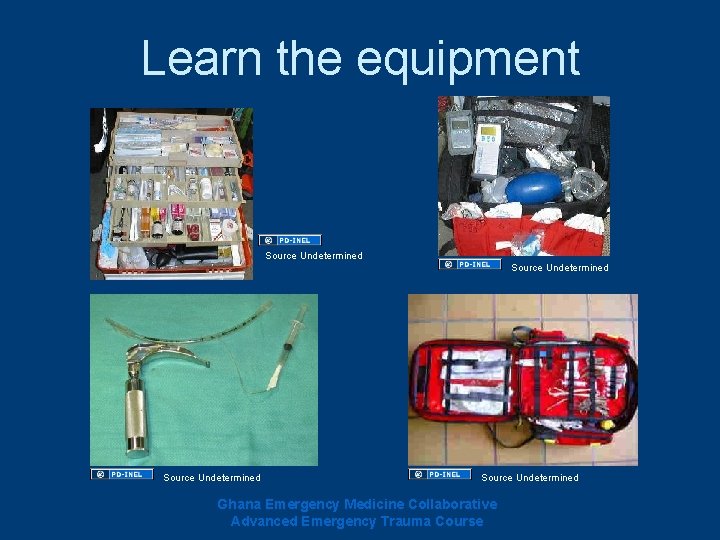
Learn the equipment Source Undetermined Ghana Emergency Medicine Collaborative Advanced Emergency Trauma Course
Equipment and Preparation § Laryngoscope handle and blade § Endotracheal tube § Bag-Valve-Mask § Suction - large bore § Meds and good IV line § Monitor, O 2 sat Ghana Emergency Medicine Collaborative Advanced Emergency Trauma Course
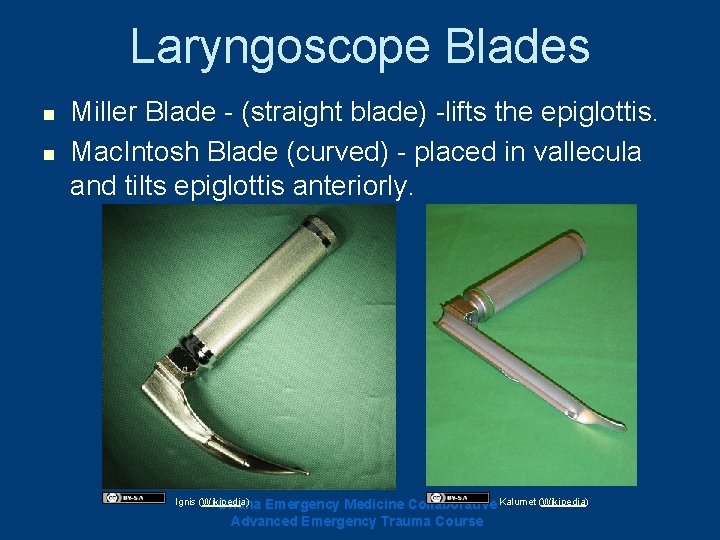
Laryngoscope Blades n n Miller Blade - (straight blade) -lifts the epiglottis. Mac. Intosh Blade (curved) - placed in vallecula and tilts epiglottis anteriorly. Ignis (Wikipedia) Ghana Emergency Medicine Collaborative Kalumet (Wikipedia) Advanced Emergency Trauma Course
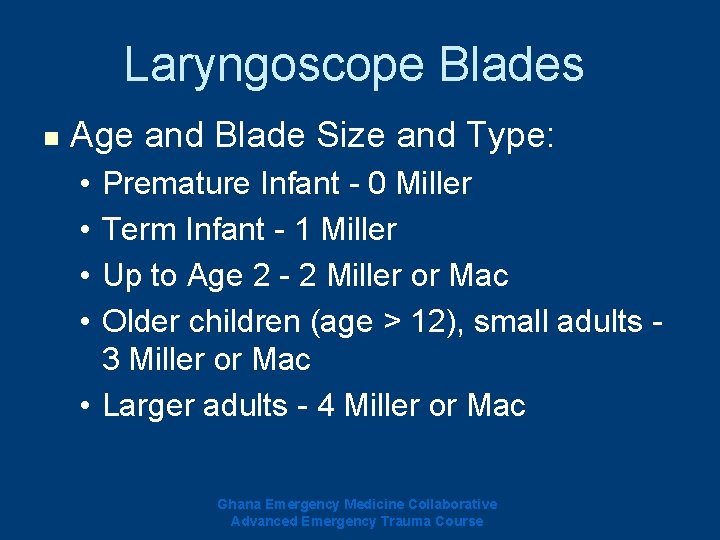
Laryngoscope Blades n Age and Blade Size and Type: • • Premature Infant - 0 Miller Term Infant - 1 Miller Up to Age 2 - 2 Miller or Mac Older children (age > 12), small adults - 3 Miller or Mac • Larger adults - 4 Miller or Mac Ghana Emergency Medicine Collaborative Advanced Emergency Trauma Course
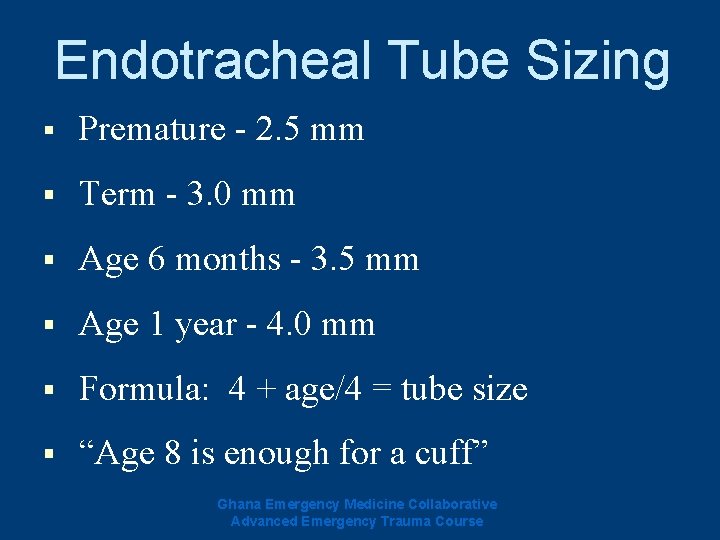
Endotracheal Tube Sizing § Premature - 2. 5 mm § Term - 3. 0 mm § Age 6 months - 3. 5 mm § Age 1 year - 4. 0 mm § Formula: 4 + age/4 = tube size § “Age 8 is enough for a cuff” Ghana Emergency Medicine Collaborative Advanced Emergency Trauma Course
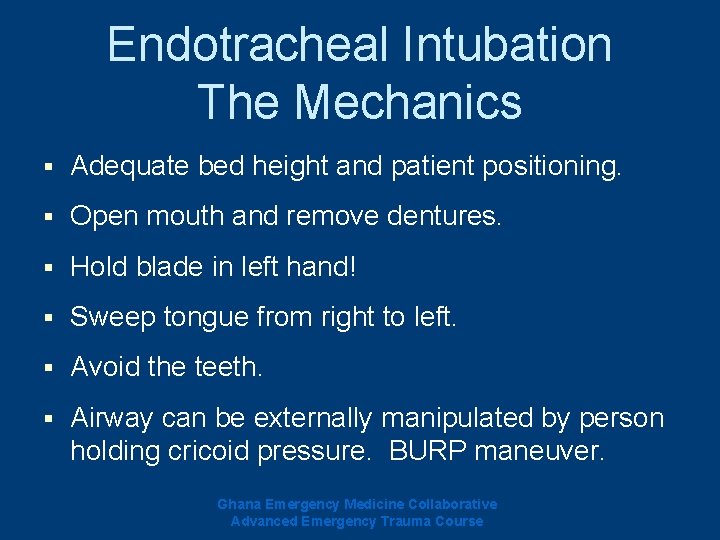
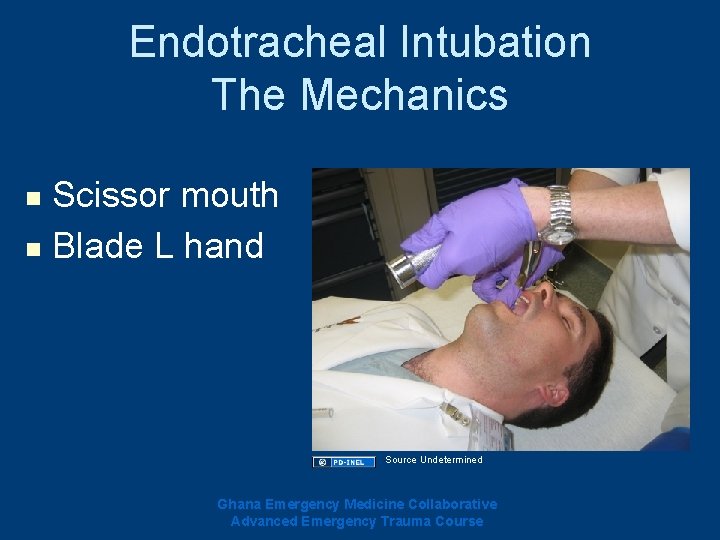
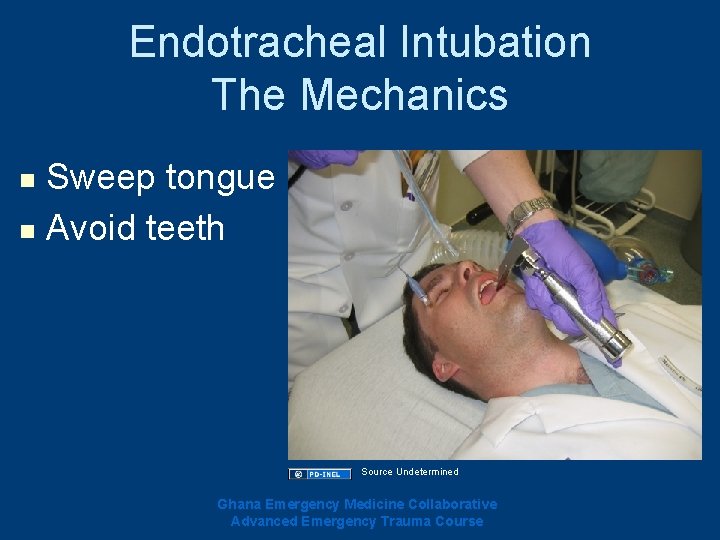
Endotracheal Intubation The Mechanics § Adequate bed height and patient positioning. § Open mouth and remove dentures. § Hold blade in left hand! § Sweep tongue from right to left. § Avoid the teeth. § Airway can be externally manipulated by person holding cricoid pressure. BURP maneuver. Ghana Emergency Medicine Collaborative Advanced Emergency Trauma Course
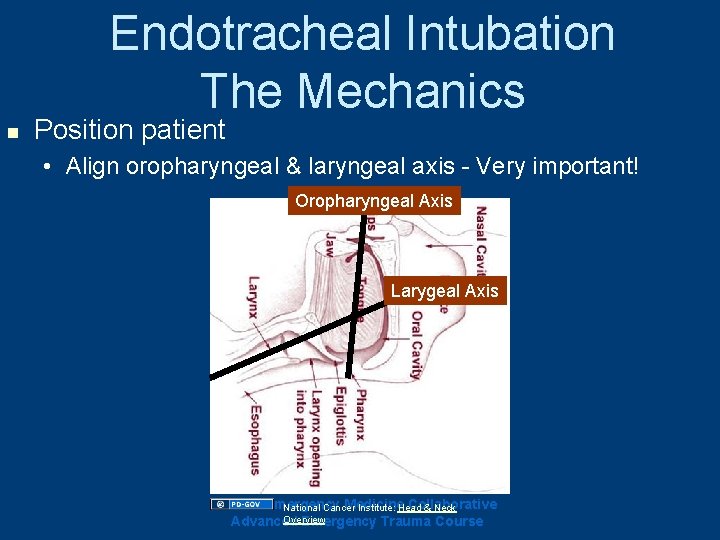
Endotracheal Intubation The Mechanics n Position patient • Align oropharyngeal & laryngeal axis - Very important! Oropharyngeal Axis Larygeal Axis Ghana Emergency Medicine Collaborative National Cancer Institute: Head & Neck Overview Advanced Emergency Trauma Course
Endotracheal Intubation The Mechanics Scissor mouth n Blade L hand n Source Undetermined Ghana Emergency Medicine Collaborative Advanced Emergency Trauma Course
Endotracheal Intubation The Mechanics Sweep tongue n Avoid teeth n Source Undetermined Ghana Emergency Medicine Collaborative Advanced Emergency Trauma Course
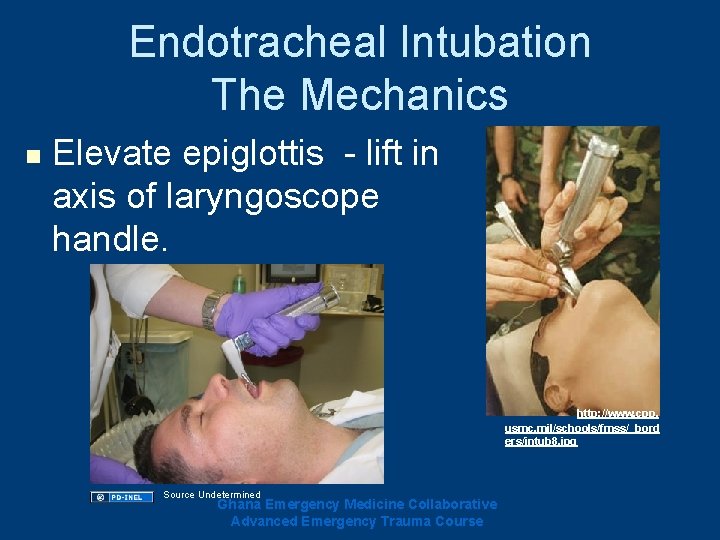
Endotracheal Intubation The Mechanics n Elevate epiglottis - lift in axis of laryngoscope handle. http: //www. cpp. usmc. mil/schools/fmss/_bord ers/intub 8. jpg Source Undetermined Ghana Emergency Medicine Collaborative Advanced Emergency Trauma Course
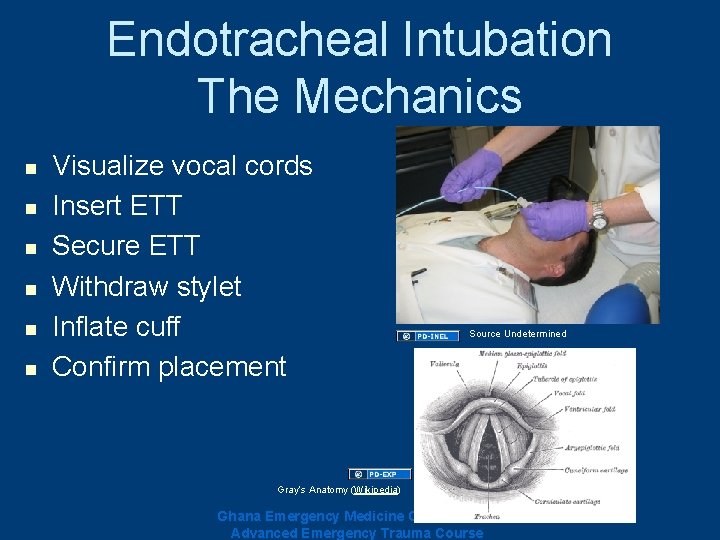
Endotracheal Intubation The Mechanics n n n Visualize vocal cords Insert ETT Secure ETT Withdraw stylet Inflate cuff Confirm placement Source Undetermined Gray’s Anatomy (Wikipedia) Ghana Emergency Medicine Collaborative Advanced Emergency Trauma Course
Endotracheal Intubation The Mechanics § KEY POINTS § Position the patient correctly § When you see the cords, do not look away; have assistant give you everything you need. § Place the tube, remove stylet, inflate cuff. § Hold the tube until secured. § Tube depth in centimeters = Tube number x 3; or F - 21 cm, M - 23 cm at mouth corner. Ghana Emergency Medicine Collaborative Advanced Emergency Trauma Course
Rapid Sequence Induction (RSI) Endotracheal Intubation § Use of drugs to improve intubating conditions by eliminating patient resistance and providing muscular relaxation. § Co-administration of a potent sedative and a neuromuscular blocking agent. § Given in rapid sequence to decrease time of unprotected airway. § Assumes full stomach in emergency patient. Ghana Emergency Medicine Collaborative Advanced Emergency Trauma Course
Emergency Induction Agents Etomidate § 0. 2 -0. 3 mg/kg IV § Decreases intracranial pressure and intragastric pressure. § Minimal hemodynamic effects. § Can lead to adrenal suppression after one dose - unclear clinical significance. Ghana Emergency Medicine Collaborative Advanced Emergency Trauma Course
Emergency Induction Agents Ketamine § 1 -2 mg/kg IV § Dissociative anesthetic, like PCP. § Catecholamine release leads to increased BP and HR and bronchodilation, increased secretions. § Good for asthma, bad for head injury or MI. Ghana Emergency Medicine Collaborative Advanced Emergency Trauma Course
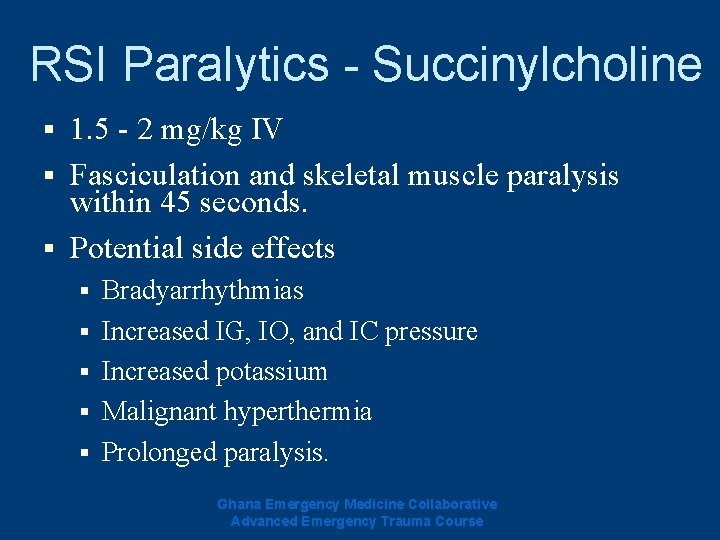
RSI Paralytics - Succinylcholine 1. 5 - 2 mg/kg IV § Fasciculation and skeletal muscle paralysis within 45 seconds. § Potential side effects § § § Bradyarrhythmias Increased IG, IO, and IC pressure Increased potassium Malignant hyperthermia Prolonged paralysis. Ghana Emergency Medicine Collaborative Advanced Emergency Trauma Course
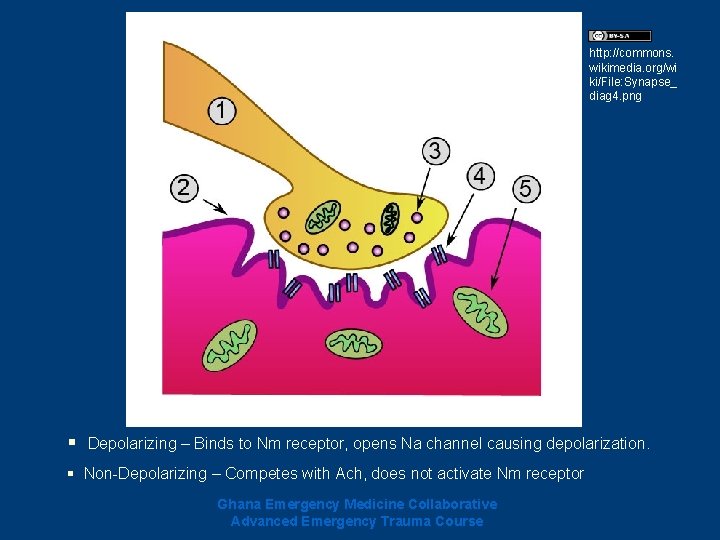
http: //commons. wikimedia. org/wi ki/File: Synapse_ diag 4. png § Depolarizing – Binds to Nm receptor, opens Na channel causing depolarization. § Non-Depolarizing – Competes with Ach, does not activate Nm receptor Ghana Emergency Medicine Collaborative Advanced Emergency Trauma Course
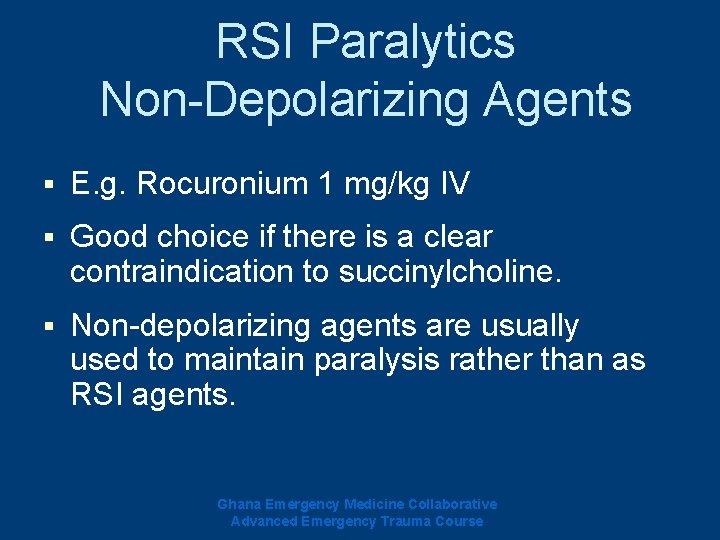
RSI Paralytics Non-Depolarizing Agents § E. g. Rocuronium 1 mg/kg IV § Good choice if there is a clear contraindication to succinylcholine. § Non-depolarizing agents are usually used to maintain paralysis rather than as RSI agents. Ghana Emergency Medicine Collaborative Advanced Emergency Trauma Course
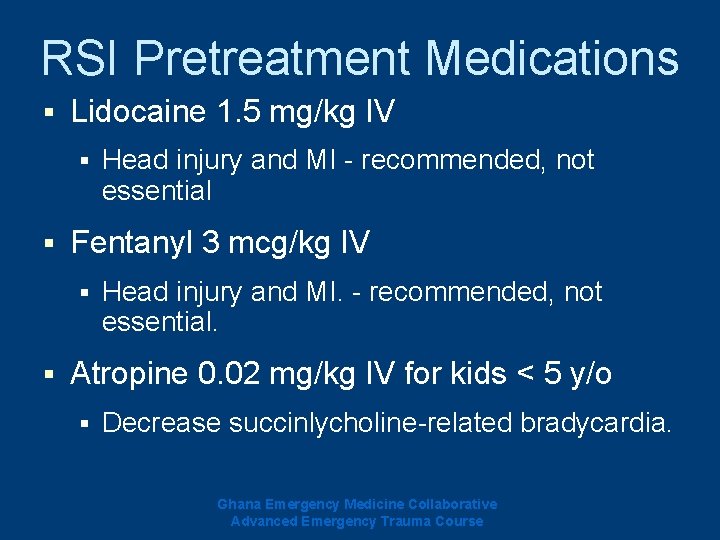
RSI Pretreatment Medications § Lidocaine 1. 5 mg/kg IV § § Fentanyl 3 mcg/kg IV § § Head injury and MI - recommended, not essential Head injury and MI. - recommended, not essential. Atropine 0. 02 mg/kg IV for kids < 5 y/o § Decrease succinlycholine-related bradycardia. Ghana Emergency Medicine Collaborative Advanced Emergency Trauma Course
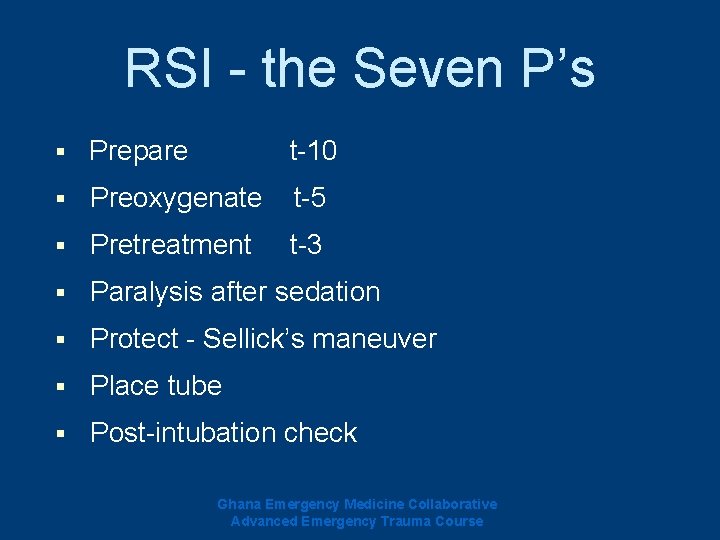
RSI - the Seven P’s § Prepare t-10 § Preoxygenate t-5 § Pretreatment t-3 § Paralysis after sedation § Protect - Sellick’s maneuver § Place tube § Post-intubation check Ghana Emergency Medicine Collaborative Advanced Emergency Trauma Course
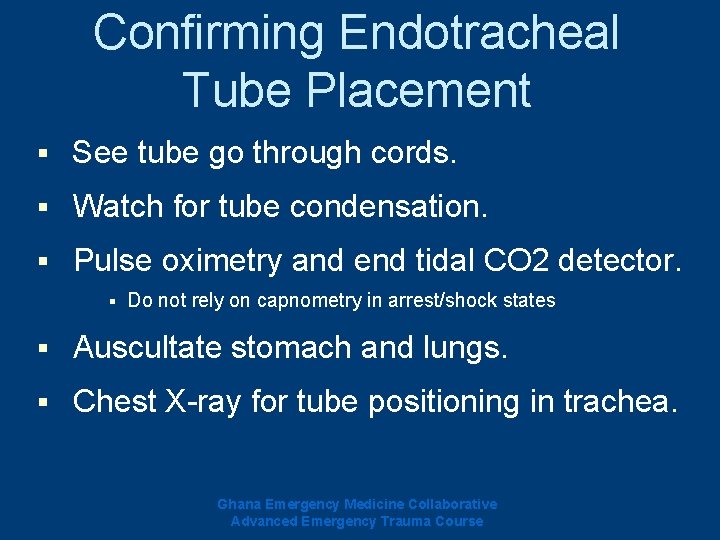
Confirming Endotracheal Tube Placement § See tube go through cords. § Watch for tube condensation. § Pulse oximetry and end tidal CO 2 detector. § Do not rely on capnometry in arrest/shock states § Auscultate stomach and lungs. § Chest X-ray for tube positioning in trachea. Ghana Emergency Medicine Collaborative Advanced Emergency Trauma Course
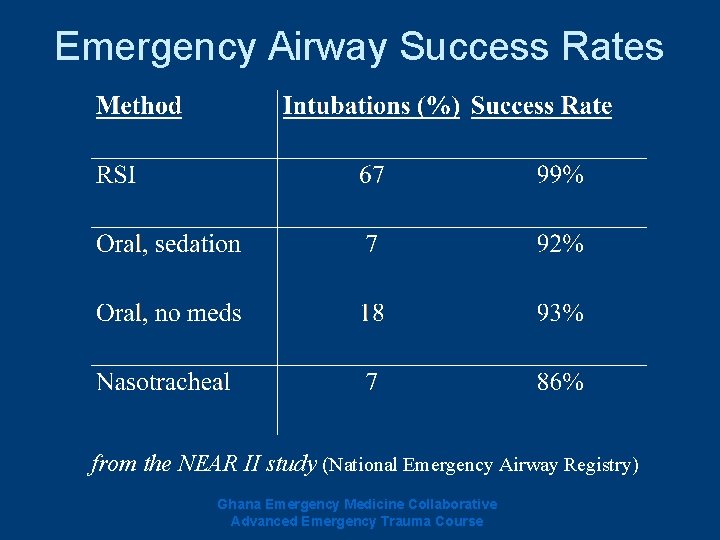
Emergency Airway Success Rates from the NEAR II study (National Emergency Airway Registry) Ghana Emergency Medicine Collaborative Advanced Emergency Trauma Course
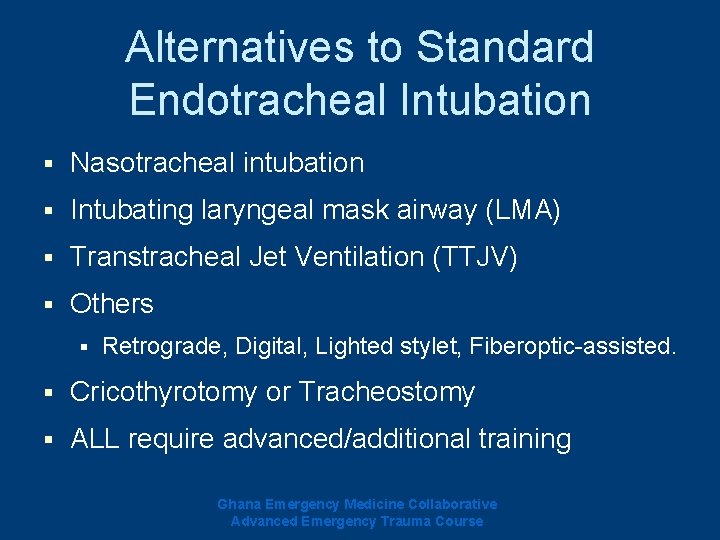
Alternatives to Standard Endotracheal Intubation § Nasotracheal intubation § Intubating laryngeal mask airway (LMA) § Transtracheal Jet Ventilation (TTJV) § Others § Retrograde, Digital, Lighted stylet, Fiberoptic-assisted. § Cricothyrotomy or Tracheostomy § ALL require advanced/additional training Ghana Emergency Medicine Collaborative Advanced Emergency Trauma Course
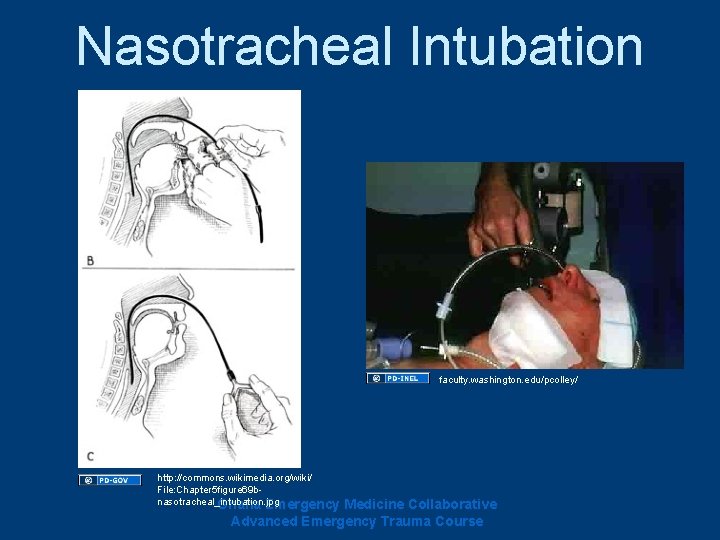
Nasotracheal Intubation § Pt. cooperative and upright. § Good for oxygenation and ventilation problems - CHF, asthma, COPD § Anesthetize nose, lubricate tube, use tube 0. 5 - 1 mm smaller than for oral use § Most patent nare, go medial and inferior, listen, advance - timing and rhythm are key. Ghana Emergency Medicine Collaborative Advanced Emergency Trauma Course
Nasotracheal Intubation faculty. washington. edu/pcolley/ http: //commons. wikimedia. org/wiki/ File: Chapter 5 figure 69 bnasotracheal_intubation. jpg Ghana Emergency Medicine Collaborative Advanced Emergency Trauma Course
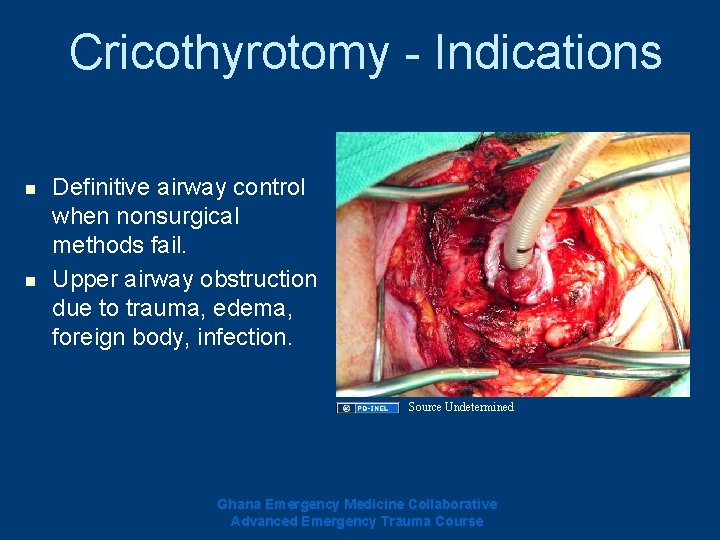
Cricothyrotomy - Indications n n Definitive airway control when nonsurgical methods fail. Upper airway obstruction due to trauma, edema, foreign body, infection. Source Undetermined Ghana Emergency Medicine Collaborative Advanced Emergency Trauma Course
Cricothyrotomy Relative Contraindications § Age < 8 years old § Bleeding disorder § Infections of neck or airway § Transection of airway Ghana Emergency Medicine Collaborative Advanced Emergency Trauma Course
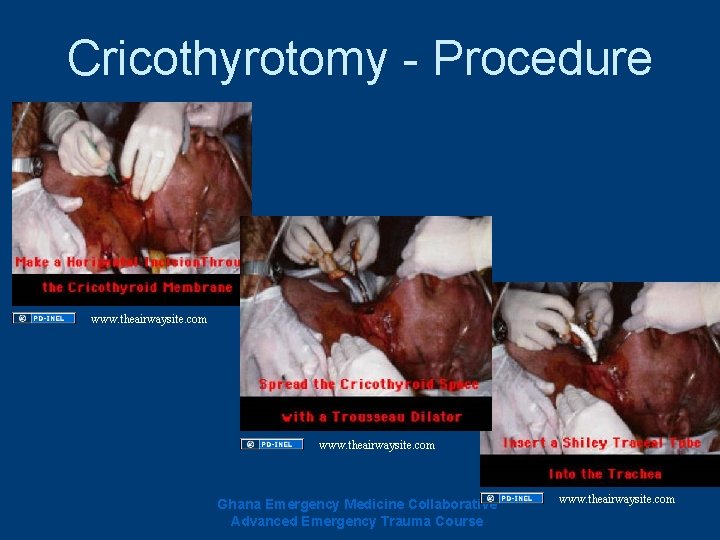
Cricothyrotomy - Procedure § Locate cricothyroid membrane. § Vertical skin incision 3 -4 cm. § Stabilize thyroid cartilage with hand or hook. § Horizontal incision through inferior portion of membrane. § Insert instrument to widen hole. § Place tube, inflate cuff, secure. Ghana Emergency Medicine Collaborative Advanced Emergency Trauma Course
Cricothyrotomy - Procedure www. theairwaysite. com Ghana Emergency Medicine Collaborative Advanced Emergency Trauma Course www. theairwaysite. com
Cricothyrotomy: Complications § § § Early § Bleeding § Trauma to adjacent structures § Tube misplacement. Later § Infection § Subglottic stenosis. Loss of the airway. Ghana Emergency Medicine Collaborative Advanced Emergency Trauma Course
Pediatric Airway Management § Airway smaller. § U-shaped floppy epiglottis. § Larynx more anterior and cephalad. § Narrowest point is cricoid cartilage. Ghana Emergency Medicine Collaborative Advanced Emergency Trauma Course
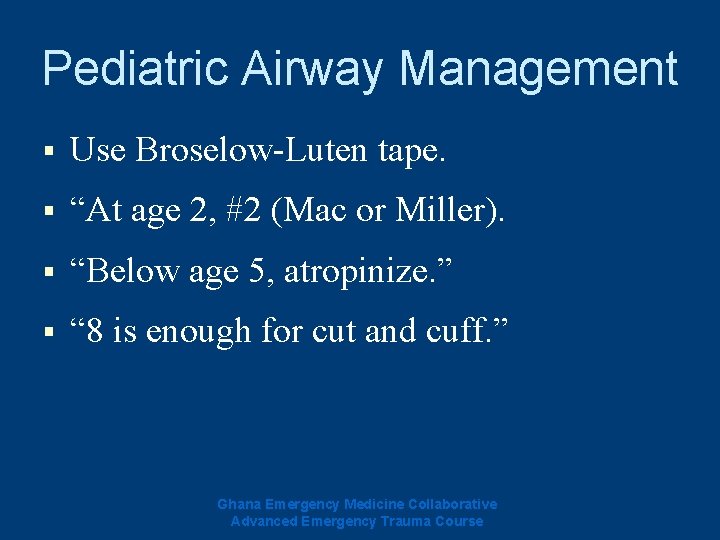
Pediatric Airway Management § Use Broselow-Luten tape. § “At age 2, #2 (Mac or Miller). § “Below age 5, atropinize. ” § “ 8 is enough for cut and cuff. ” Ghana Emergency Medicine Collaborative Advanced Emergency Trauma Course
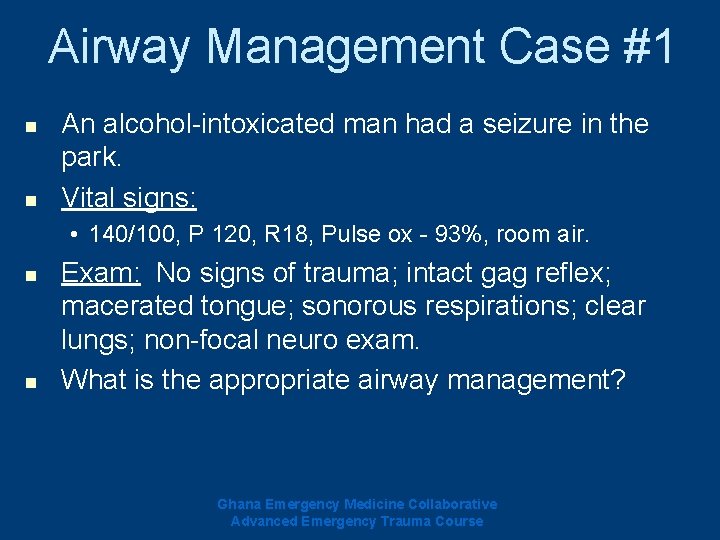
Airway Management Case #1 n n An alcohol-intoxicated man had a seizure in the park. Vital signs: • 140/100, P 120, R 18, Pulse ox - 93%, room air. n n Exam: No signs of trauma; intact gag reflex; macerated tongue; sonorous respirations; clear lungs; non-focal neuro exam. What is the appropriate airway management? Ghana Emergency Medicine Collaborative Advanced Emergency Trauma Course
Emergency Airway Management n Options • Patency maneuvers • Non-invasive ventilation • Endotracheal intubation with or without induction and paralytic agents • Nasotracheal intubation • Surgical airway Ghana Emergency Medicine Collaborative Advanced Emergency Trauma Course
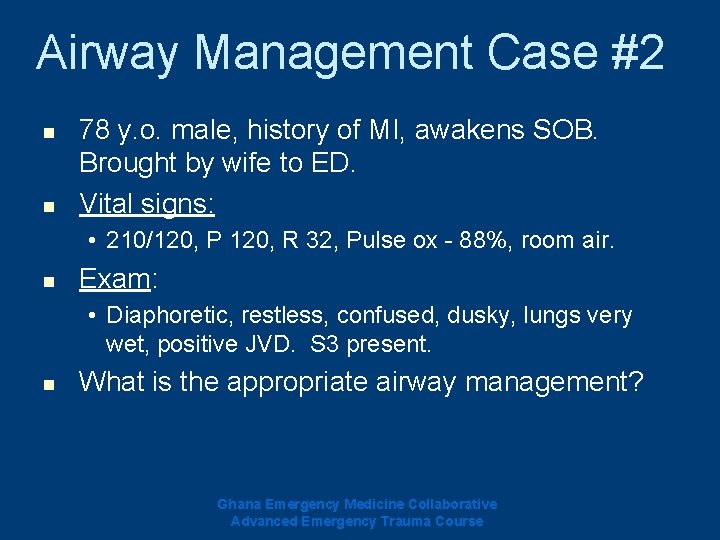
Airway Management Case #2 n n 78 y. o. male, history of MI, awakens SOB. Brought by wife to ED. Vital signs: • 210/120, P 120, R 32, Pulse ox - 88%, room air. n Exam: • Diaphoretic, restless, confused, dusky, lungs very wet, positive JVD. S 3 present. n What is the appropriate airway management? Ghana Emergency Medicine Collaborative Advanced Emergency Trauma Course
Emergency Airway Management n Options • Patency maneuvers • Non-invasive ventilation • Endotracheal intubation with or without induction and paralytic agents • Nasotracheal intubation • Surgical airway Ghana Emergency Medicine Collaborative Advanced Emergency Trauma Course
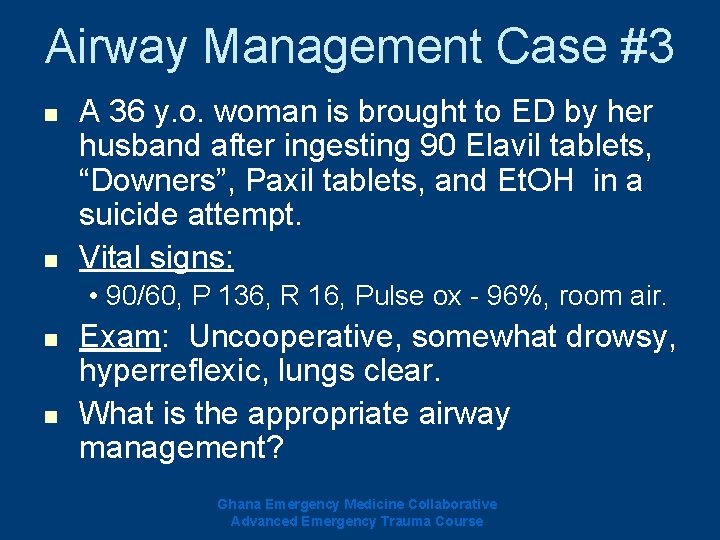
Airway Management Case #3 n n A 36 y. o. woman is brought to ED by her husband after ingesting 90 Elavil tablets, “Downers”, Paxil tablets, and Et. OH in a suicide attempt. Vital signs: • 90/60, P 136, R 16, Pulse ox - 96%, room air. n n Exam: Uncooperative, somewhat drowsy, hyperreflexic, lungs clear. What is the appropriate airway management? Ghana Emergency Medicine Collaborative Advanced Emergency Trauma Course
Emergency Airway Management n Options • Patency maneuvers • Non-invasive ventilation • Endotracheal intubation with or without induction and paralytic agents • Nasotracheal intubation • Surgical airway Ghana Emergency Medicine Collaborative Advanced Emergency Trauma Course
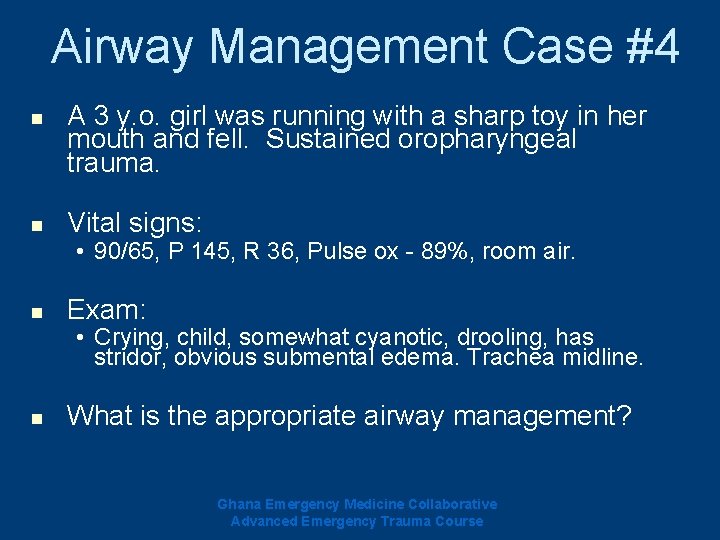
Airway Management Case #4 n n A 3 y. o. girl was running with a sharp toy in her mouth and fell. Sustained oropharyngeal trauma. Vital signs: • 90/65, P 145, R 36, Pulse ox - 89%, room air. n Exam: • Crying, child, somewhat cyanotic, drooling, has stridor, obvious submental edema. Trachea midline. n What is the appropriate airway management? Ghana Emergency Medicine Collaborative Advanced Emergency Trauma Course
Emergency Airway Management n Options • Patency maneuvers • Non-invasive ventilation • Endotracheal intubation with or without induction and paralytic agents • Nasotracheal intubation • Surgical airway Ghana Emergency Medicine Collaborative Advanced Emergency Trauma Course
Special thanks to Richard Taylor, MD Brian Zink, MD For developing slides and content For the UM ED M 4 Airway Lecture Ghana Emergency Medicine Collaborative Advanced Emergency Trauma Course
Questions? Dkscully (flickr) Ghana Emergency Medicine Collaborative Advanced Emergency Trauma Course