
Authoritative DNS over TLS ADo T Operational Considerations
![DNS ecosystem with DNS privacy technologies Authoritative Servers Root Loopback [RFC 7706] Root QNAME](https://slidetodoc.com/presentation_image_h2/6f4c724aff01005073e225c60d561772/image-4.jpg "DNS ecosystem with DNS privacy technologies Authoritative Servers Root Loopback [RFC 7706] Root QNAME")
- Slides: 19
Authoritative DNS over TLS (ADo. T) Operational Considerations Karl Henderson Verisign Labs OARC 31 on 31 October, 2019
The DNS encryption landscape Verisign Public 2
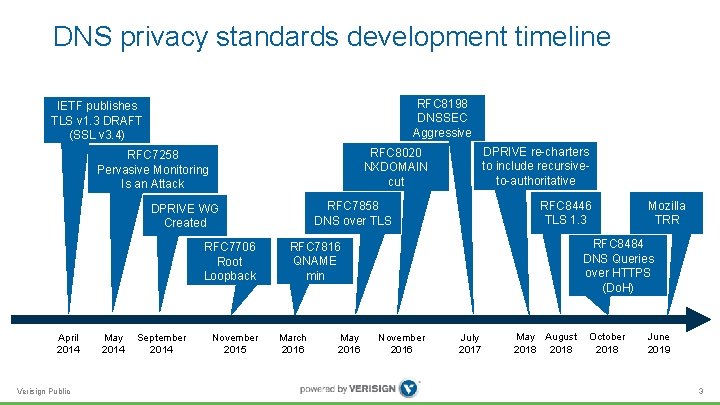
DNS privacy standards development timeline RFC 8198 DNSSEC Aggressive IETF publishes TLS v 1. 3 DRAFT (SSL v 3. 4) RFC 7706 Root Loopback Verisign Public May 2014 September 2014 November 2015 RFC 8446 TLS 1. 3 RFC 7858 DNS over TLS DPRIVE WG Created April 2014 DPRIVE re-charters to include recursiveto-authoritative RFC 8020 NXDOMAIN cut RFC 7258 Pervasive Monitoring Is an Attack RFC 8484 DNS Queries over HTTPS (Do. H) RFC 7816 QNAME min March 2016 May 2016 Mozilla TRR November 2016 July 2017 May August 2018 October 2018 June 2019 3
DNS ecosystem with DNS privacy technologies Authoritative Servers Root Loopback [RFC 7706] Root QNAME min [RFC 7816] NXDOMAIN cut [RFC 8020] DNSSEC Aggressive[RFC 8198] Recursive-to-authoritative encryption DNS Client > Do. T [RFC 8310] Do. H [RFC 8484] (stub-to-recursive encryption) Recursive resolver TLD SLD Verisign Public 4
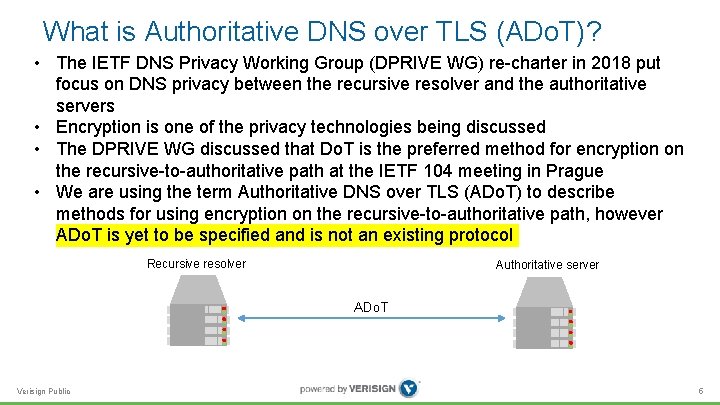
What is Authoritative DNS over TLS (ADo. T)? • The IETF DNS Privacy Working Group (DPRIVE WG) re-charter in 2018 put focus on DNS privacy between the recursive resolver and the authoritative servers • Encryption is one of the privacy technologies being discussed • The DPRIVE WG discussed that Do. T is the preferred method for encryption on the recursive-to-authoritative path at the IETF 104 meeting in Prague • We are using the term Authoritative DNS over TLS (ADo. T) to describe methods for using encryption on the recursive-to-authoritative path, however ADo. T is yet to be specified and is not an existing protocol Recursive resolver Authoritative server ADo. T Verisign Public 5
ADo. T Operational Considerations Verisign Public 6
ADo. T Operational Considerations Internet Draft • Reference: https: //datatracker. ietf. org/doc/draft-hal-adot-operationalconsiderations/ • Authors: • • Karl Henderson - Verisign • Tim April - Akamai • Jason Livingood - Comcast Status: Verisign Public • First published in July 2019 • Individual submission not yet adopted by DPRIVE working group • Adoption situation may change if/when ADo. T is fully specified • Possible input into an ADo. T requirements document and/or BCP 7
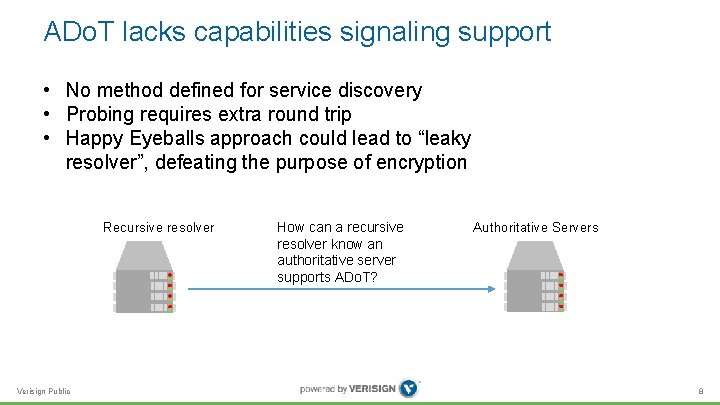
ADo. T lacks capabilities signaling support • No method defined for service discovery • Probing requires extra round trip • Happy Eyeballs approach could lead to “leaky resolver”, defeating the purpose of encryption Recursive resolver Verisign Public How can a recursive resolver know an authoritative server supports ADo. T? Authoritative Servers 8
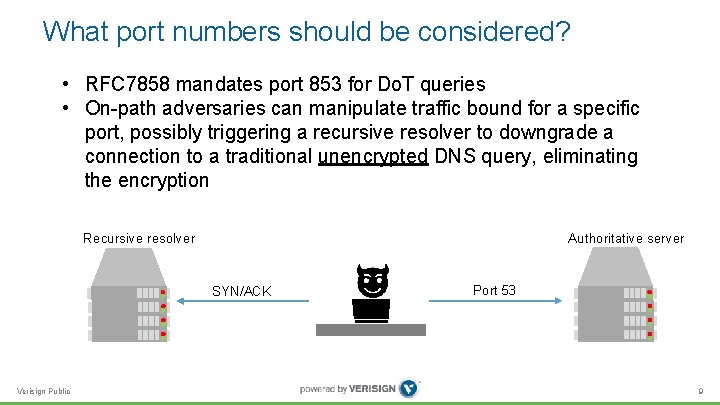
What port numbers should be considered? • RFC 7858 mandates port 853 for Do. T queries • On-path adversaries can manipulate traffic bound for a specific port, possibly triggering a recursive resolver to downgrade a connection to a traditional unencrypted DNS query, eliminating the encryption Recursive resolver Connection 853 refused SYN/ACK Port 53 Verisign Public Authoritative server Port 53 9
Which TLS version should operators consider? • TLS 1. 3 SHOULD be preferred as it offers both security and performance enhancements over TLS 1. 2 • Additionally, operators SHOULD monitor TLS version issues and cipher suites vulnerabilities for the version of TLS that their platform uses • In the absence of widespread ADo. T deployments, it’s easier to limit TLS to version 1. 3 or greater Verisign Public 10
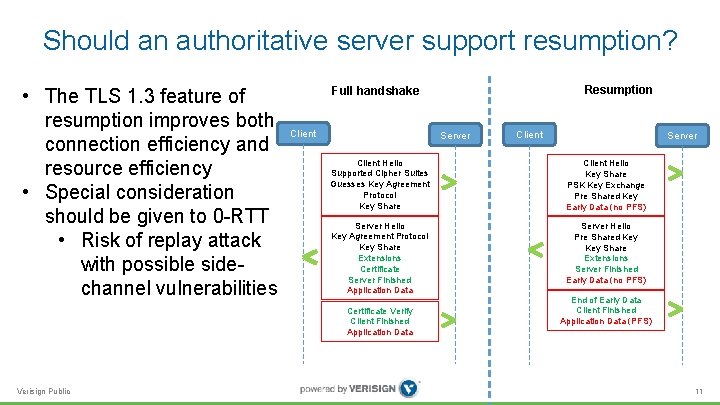
Should an authoritative server support resumption? • The TLS 1. 3 feature of resumption improves both connection efficiency and resource efficiency • Special consideration should be given to 0 -RTT • Risk of replay attack with possible sidechannel vulnerabilities Client Server Client Hello Supported Cipher Suites Guesses Key Agreement Protocol Key Share Client Hello Key Share PSK Key Exchange Pre Shared Key Early Data (no PFS) Server Hello Key Agreement Protocol Key Share Extensions Certificate Server Finished Application Data Server Hello Pre Shared Key Share Extensions Server Finished Early Data (no PFS) Certificate Verify Client Finished Application Data Verisign Public Resumption Full handshake End of Early Data Client Finished Application Data (PFS) 11
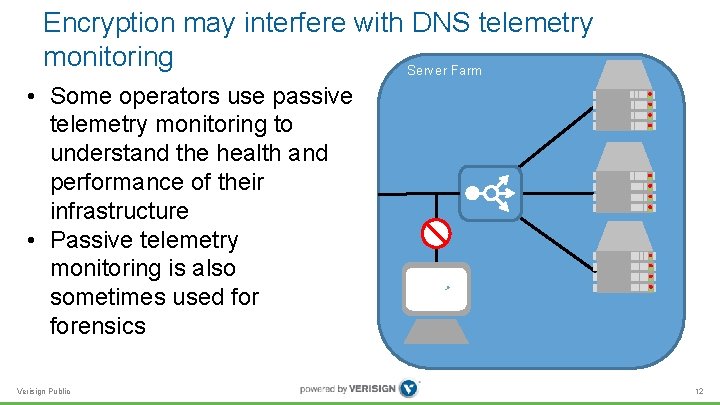
Encryption may interfere with DNS telemetry monitoring Server Farm • Some operators use passive telemetry monitoring to understand the health and performance of their infrastructure • Passive telemetry monitoring is also sometimes used forensics Verisign Public 12
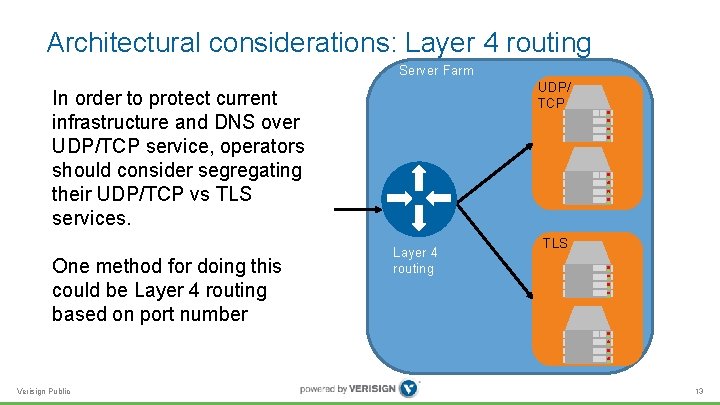
Architectural considerations: Layer 4 routing Server Farm UDP/ TCP In order to protect current infrastructure and DNS over UDP/TCP service, operators should consider segregating their UDP/TCP vs TLS services. One method for doing this could be Layer 4 routing based on port number Verisign Public Layer 4 routing TLS 13
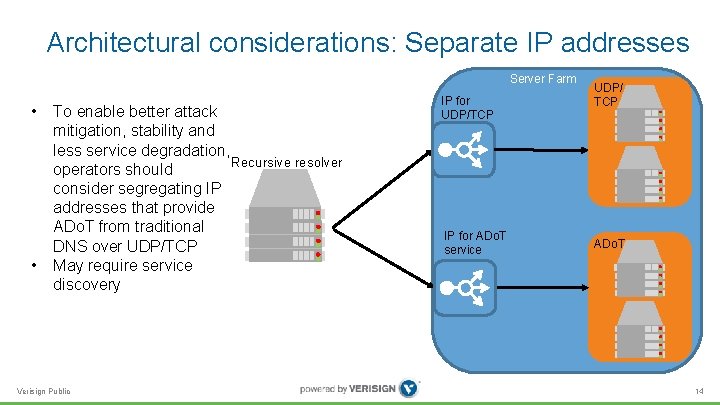
Architectural considerations: Separate IP addresses Server Farm • • To enable better attack mitigation, stability and less service degradation, Recursive resolver operators should consider segregating IP addresses that provide ADo. T from traditional DNS over UDP/TCP May require service discovery Verisign Public IP for UDP/TCP service IP for ADo. T service UDP/ TCP ADo. T 14
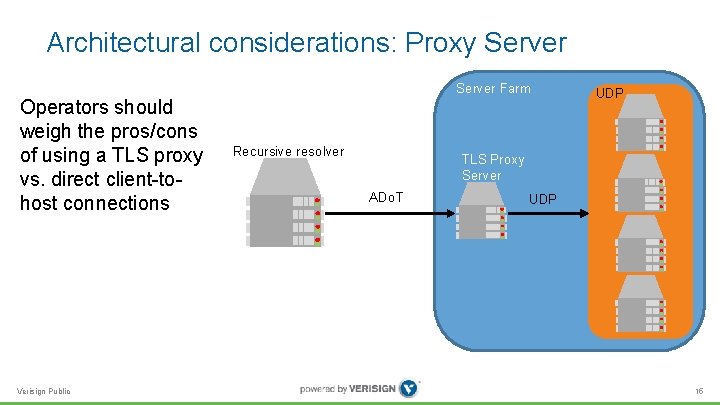
Architectural considerations: Proxy Server Operators should weigh the pros/cons of using a TLS proxy vs. direct client-tohost connections Verisign Public Server Farm Recursive resolver UDP TLS Proxy Server ADo. T UDP 15
Socket efficiency considerations Operators can realize substantial gains in client session establishment and improve overall RTT by tuning sockets setting for best use-case efficiency. Operators should consider optimizing: • number of persistent connections – both on recursive and authoritative sides • read/write buffer sizes • session timeout • close wait state time • connection time/timeout Verisign Public 16
Post-quantum considerations • ADo. T deployments will likely have a long lifetime and are being introduced in an era where post-quantum security is now a design consideration • It’s prudent to consider how quantum computing protections might be integrated into deployments • For instance, External Pre. Shared Keys (EPSKs) may be less vulnerable to quantum attacks Verisign Public 17
Further study • Attack vector vulnerabilities and mitigation • Capacity and footprint expansion • Traffic and traffic pattern analysis Verisign Public 18
© 2019 Veri. Sign, Inc. All rights reserved. VERISIGN and other trademarks, service marks, and designs are registered or unregistered trademarks of Veri. Sign, Inc. and its subsidiaries in the United States and in foreign countries. All other trademarks are property of their respective owners.