
Author responsibilities and rights Reed Elsevier Group PLC
Author responsibilities and rights © Reed Elsevier Group PLC
What are my responsibilities as an author? Publishing ethics © Reed Elsevier Group PLC
March 2015 Author responsibilities § § § Report only real, non-fabricated data Originality Declare any Conflicts of Interest Authorship Submit to one journal at a time © Reed Elsevier Group PLC | 3
January 2015 The most serious issues to avoid These are the 3 most common forms of ethical misconduct that the research community is challenged with 1. Fabrication Making up research data 2. Falsification Manipulation of existing research data 3. Plagiarism Previous work taken and passed off as one’s own Plagiarism takes many forms, from “passing off” another’s paper as the author’s own paper, to copying or paraphrasing substantial parts of another’s paper (without attribution), to claiming results from research conducted by others © Reed Elsevier Group PLC | 4

January 2015 Why do we need originality and ethical conduct? Unethical behavior by Researchers degrades the scientific record and the reputation of science and medicine in the broader community. It can unfairly affect the reputation and academic record of individual researchers/authors. A Massive Case Of Fraud Chemical & Engineering News February 18, 2008 Journal editors are left reeling as publishers move to rid their archives of scientist's falsified research William G. Schulz A CHEMIST IN INDIA has been found guilty of plagiarizing and/or falsifying more than 70 research papers published in a wide variety of Western scientific journals between 2004 and 2007, according to documents from his university, copies of which were obtained by C&EN. Some journal editors left reeling by the incident say it is one of the most spectacular and outrageous cases of scientific fraud they have ever seen. … © Reed Elsevier Group PLC | 5
January 2015 Conflicts of interest question Indicate if any of the following are examples of conflicts of interest: 1. A University Researcher, who owns stock in a large oil company, conducts an experiment on the environmental effects of oil drilling. 2. A University Researcher, who is developing and testing a new technology, is also a consultant for a financial services firm that weighs investments in new technologies. 3. A Researcher submits an article to a journal for which the Editor-in-Chief is a Professor in the Researcher’s department. 4. A Doctor who abides by traditional healing procedures writes a paper on emerging current medical technologies. © Reed Elsevier Group PLC | 6
January 2015 Conflicts of interest answer These are all present potential conflicts They can take many forms: § Direct Financial - employment, stock ownership, grants, patents § Indirect Financial - honoraria, consultancies, mutual fund ownership, expert testimony § Career & Intellectual - promotion, direct rival § Personal Belief The proper way to handle potential conflicts of interest is through transparency and disclosure. At the journal level, this means disclosure of the potential conflict in your cover letter to the Journal Editor © Reed Elsevier Group PLC | 7
January 2015 | 8 What does it mean to be an Author? A researcher completes her paper. Along the way she consulted her advisor for guidance on the experiment, the data analysis and writing and revising the final article. A professor in India assisted her in analyzing the data only. A lab assistant helped her in preparing the experimental design and maintaining and operating the equipment. Two fellow grad students read her paper and edited it, though they had no hand in the experiment. § § Who is listed as an Author? Who is listed first? © Reed Elsevier Group PLC
January 2015 Authorship The correct answer depends on journal policy. Authorship policies vary across disciplines, cultures and journals. Example, the International Committee of Medical Journal Editors (aka Vancouver Group) declared that an author must: 1. substantially contribute to conception and design, or acquisition of data, or analysis and interpretation of data AND 2. draft the article or revise it critically for important intellectual content AND 3. give their approval of the final version to be published all three conditions must be fulfilled to be an author § § Applying this set of policies to our example, only the researcher and her advisor would qualify as authors All others would qualify as “Acknowledged Individuals” © Reed Elsevier Group PLC | 9
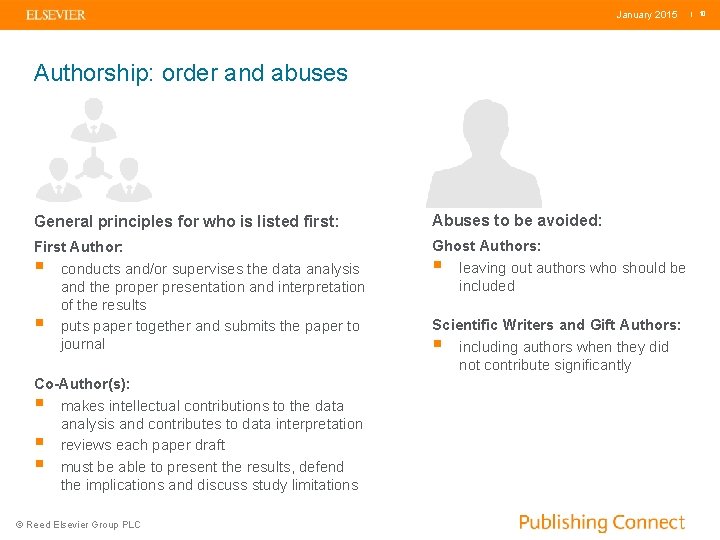
January 2015 | 10 Authorship: order and abuses General principles for who is listed first: Abuses to be avoided: First Author: § conducts and/or supervises the data analysis and the proper presentation and interpretation of the results § puts paper together and submits the paper to journal Ghost Authors: § leaving out authors who should be included Co-Author(s): § makes intellectual contributions to the data analysis and contributes to data interpretation § reviews each paper draft § must be able to present the results, defend the implications and discuss study limitations © Reed Elsevier Group PLC Scientific Writers and Gift Authors: § including authors when they did not contribute significantly
January 2015 Submission question These are all present potential conflicts § A researcher is ready to submit her paper and decides to submit to Science, Nature and Cell at the same time. § A researcher has had his paper rejected by Science and decides to submit it to Nature. Failing that, he plans to submit it to Cell. Failing that, he plans to submit to each journal in his discipline until it is accepted. The first scenario is not acceptable to most research communities and journals The second scenario is acceptable but authors should heed the advice of referees and editors concerning improvements. © Reed Elsevier Group PLC | 11
January 2015 Submissions answer Multiple, redundant, or concurrent publication issues Should be avoided where manuscripts that describe essentially the same research are published in more than one journal or primary publication. An author should avoid submitting a previously published paper for consideration in another journal. Duplication of the same paper in multiple journals of different languages should be avoided. “Salami Slicing”, or creating several publications from the same research, is manipulative and discouraged. © Reed Elsevier Group PLC | 12
January 2015 Re-cap Real, non-fabricated data Originality Authorship Declare any conflicts of interest © Reed Elsevier Group PLC | 13
Plagiarism © Reed Elsevier Group PLC
January 2015 What is plagiarism? Plagiarism is the appropriation of another person’s ideas, processes, results, or words without giving appropriate credit, including those obtained through confidential review of others’ research proposals and manuscripts. Federal Office of Science and Technology Policy, 1999 Presenting the data or interpretations of others without crediting them, and thereby gaining for yourself the rewards earned by others, is theft, and it eliminates the motivation of working scientists to generate new data and interpretations. Professor Bruce Railsback, Department of Geology, University of Georgia | 15
January 2015 What may be plagiarised? Work that can be plagiarised includes… § § § § Words (language) Ideas Findings Writings Graphic representations Computer programs Diagrams Higher Education Academy, UK © Reed Elsevier Group PLC § § § § Graphs Illustrations Information Lectures Printed material Electronic material Any other original work | 16
January 2015 Question Has the researcher violated any ethical boundaries? A researcher notices a paragraph in a previously published article that would be suitable as the Materials and Methods in his article. The researcher decides to copy that paragraph into his paper without quotes or attribution. © Reed Elsevier Group PLC | 17
January 2015 Answer Yes Re-using texts in the materials and methods when you followed the same technique and used the same equipment as another author may be a less serious form of plagiarism. However, it is still unacceptable: instead, just say that you followed the same technique as another author and cite them fully. . © Reed Elsevier Group PLC | 18
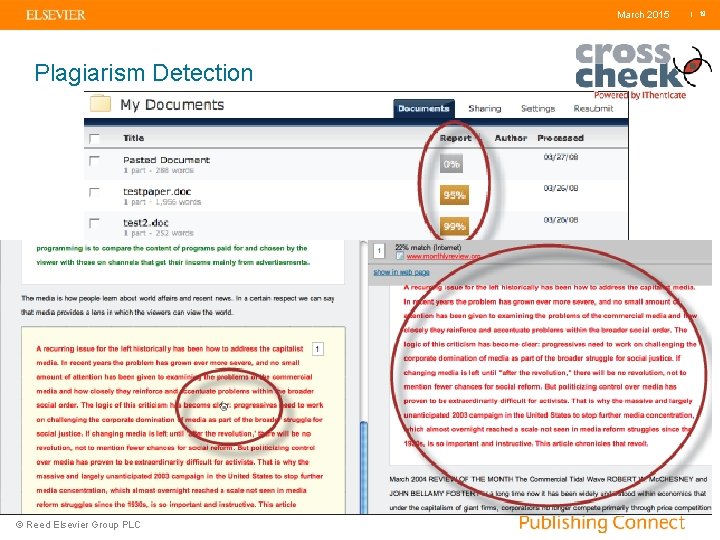
March 2015 Plagiarism Detection © Reed Elsevier Group PLC | 19
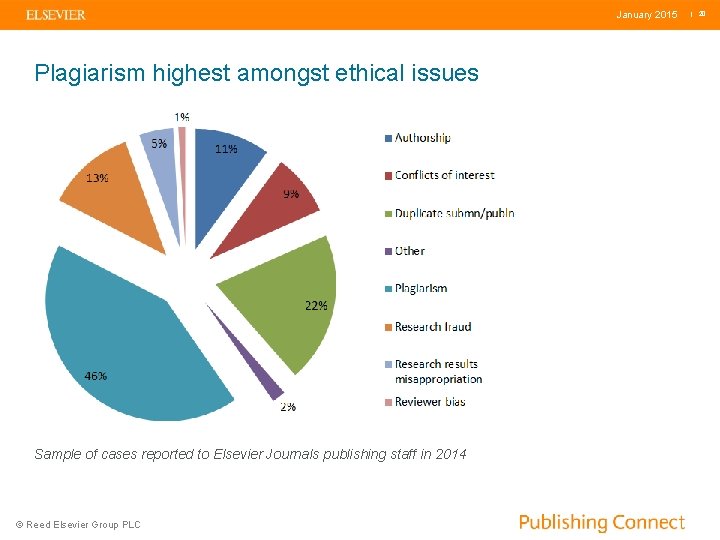
January 2015 Plagiarism highest amongst ethical issues Sample of cases reported to Elsevier Journals publishing staff in 2014 © Reed Elsevier Group PLC | 20
January 2015 How big is the problem of plagiarism? § § § Huge database of 30+ million articles, from 50, 000+ journals, from 400+ publishers Software alerts Editors to any similarities between the article and this huge database of published articles Many Elsevier journals now check every submitted article using Cross. Check © Reed Elsevier Group PLC | 21
January 2015 Plagiarism is serious but easily avoidable § § Plagiarism is easily avoided You can use ideas, phrases and arguments from sources already published, just acknowledge the source and the original author © Reed Elsevier Group PLC | 22
January 2015 Correct citation is key Crediting the work of others (including your advisor’s or your own previous work) by citation is important for at least three reasons: § § § To place your own work in context To acknowledge the findings of others on which you have built your research To maintain the credibility and accuracy of the scientific literature © Reed Elsevier Group PLC | 23
January 2015 Paraphrasing is restating someone else's ideas while not copying their actual words verbatim It is unacceptable: § Using exact phrases from the original source without enclosing them in quotation marks § Emulating sentence structure even when using different words § Emulating paragraph organization even when using different wording or sentence structure – Statement on Plagiarism Department of Biology, Davidson College. www. bio. davidson. edu/dept/plagiarism. html © Reed Elsevier Group PLC | 24
January 2015 Can you plagiarise your own work? Text re-cycling/Selfplagiarism A grey area, but best to err on the side of caution: always cite/quote even your own previous work For example You publish a paper and in a later paper, copy your Introduction wordfor word and perhaps a figure or two without citing the first paper Editors may conclude that you intentionally exaggerated your output © Reed Elsevier Group PLC | 25
March 2015 Consequences C A R T E D R TE § Potential consequences can vary according to the severity of the misconduct and the standards set by the journal editors, institutions and funding bodies. § Possible actions include: § Written letters of concern and reprimand § Article retractions § Some form of disciplinary action on the part of the researcher’s institute or funding body © Reed Elsevier Group PLC | 26
January 2015 Recap When in doubt, cite! Never cut & paste (even to save time in drafts) If you suspect: REPORT Responsibility © Reed Elsevier Group PLC | 27
January 2015 Useful links • • Elsevier. com/authors Elsevier. com/reviewers Elsevier. com/ethics Mendeley. com - free reference manager and academic social network • Elsevier. com/webshop - Language Editing Services • COPE - www. publicationethics. org. uk/about • PERK - http: //www. elsevier. com/editors | 28
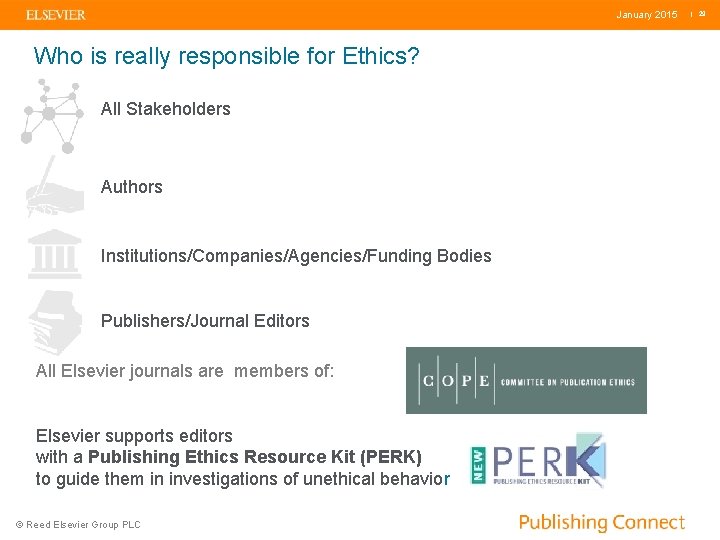
January 2015 Who is really responsible for Ethics? All Stakeholders Authors Institutions/Companies/Agencies/Funding Bodies Publishers/Journal Editors All Elsevier journals are members of: Elsevier supports editors with a Publishing Ethics Resource Kit (PERK) to guide them in investigations of unethical behavior © Reed Elsevier Group PLC | 29
Author rights Content ownership
| 31 I’ve written my paper but who technically owns it?
| 32 Copyright fundamentals Myth or Fact? Authors (and in some cases their employers) have the right under national copyright laws (and international treaties) to control how their works are to be used and distributed to others Fact
| 33 Copyright fundamentals Myth or Fact? Copyright protects the underlying facts, the ideas of your work, and the way you express your thoughts and describe your research and conclusions in your writing Myth
| 34 Copyright fundamentals Myth or Fact? The extent of copyrights allows authors to permit: the copying, distribution, online access, translation and creation of other derivative works of research such as a thesis, book etc Fact
| 35 Copyright fundamentals Myth or Fact? Publishers or other distributors do not need written agreements from authors to transfer copying and distribution rights Myth
| 36 Copyright fundamentals Myth or Fact? Journal publishing agreements can take the form of a transfer of copyright or a publishing license Fact
| 37 Copyright fundamentals Myth or Fact? Journal publishing agreements generally only spell out rights granted to the publisher Myth
| 38 Publishing agreements Author warranties § § § The publishing agreement has warranties as to originality Obtaining of necessary permissions Obtaining of any necessary privacy waivers (subjects) Compliance with research standards Compliance with publisher and journal ethics and conflicts of interest policies Agreement of all co-authors Government works § The laws of some countries note that the works of government employees may have a special copyright status US Government Works: if done in the scope of employment, exclusively by government authors, then will be public domain (no copyright attaches) Crown Copyright Works: for UK government authors, work is owned by and licensed out by UK government (similar rules in other countries)
| 39 Rights retained by authors ü Rights retained by authors in publishing agreements usually address ü ü ü academic usage rights Use of the work by the author in teaching Re-use in other scholarly works Publishing agreements differ by publisher
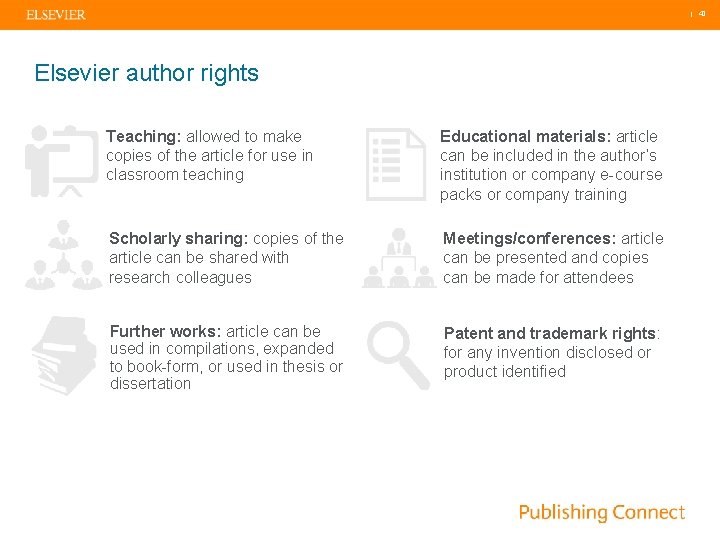
| 40 Elsevier author rights Teaching: allowed to make copies of the article for use in classroom teaching Educational materials: article can be included in the author’s institution or company e-course packs or company training Scholarly sharing: copies of the article can be shared with research colleagues Meetings/conferences: article can be presented and copies can be made for attendees Further works: article can be used in compilations, expanded to book-form, or used in thesis or dissertation Patent and trademark rights: for any invention disclosed or product identified
| 41 Other allowances and restrictions (I) Elsevier’s posting allowances: § Pre-print version of article to internet websites § Revised personal version of text of final article to author’s personal or institutional website or server § According to funding body agreements (e. g. Wellcome Trust, Howard Hughes Medical Institute, National Institutes of Health)
| 42 Other allowances and restrictions (II) Elsevier’s commercial purpose prohibitions § Posting by companies for customers to use § Placing advertisements against the postings § Charging fees for access to postings or delivering postings to third parties § Any form of systematic distribution of the article.

| 43 publishingcampus. com elsevier. com/authors elsevier. com/reviewers elsevier. com/editors Further reading at Understanding the Publishing Process with Elsevier – complete guide Publishing Ethics brochure – top reasons to publish ethically Get Published – top tips on writing, reviewing and grant writing etc. Get Noticed – new ways to promote your article and research Open access – definitions and options Career Planning Guide – download in 12 languages
Thank you For further information please visit: www. elsevier. com/authors Visit Elsevier Publishing Campus www. publishingcampus. com
Open access publishing
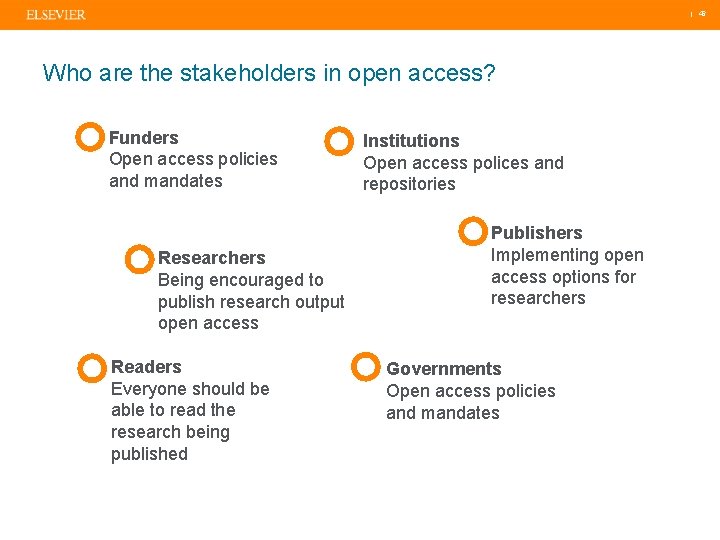
| 46 Who are the stakeholders in open access? Funders Open access policies and mandates Researchers Being encouraged to publish research output open access Readers Everyone should be able to read the research being published Institutions Open access polices and repositories Publishers Implementing open access options for researchers Governments Open access policies and mandates
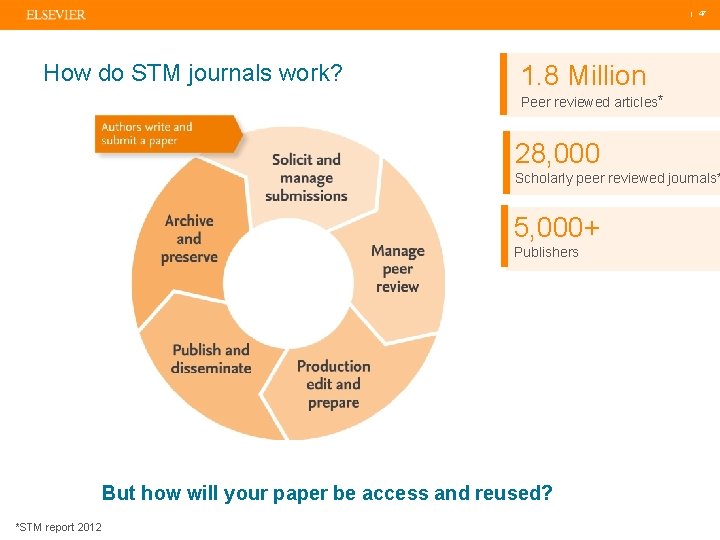
| 47 How do STM journals work? 1. 8 Million Peer reviewed articles* 28, 000 Scholarly peer reviewed journals* 5, 000+ Publishers But how will your paper be access and reused? *STM report 2012
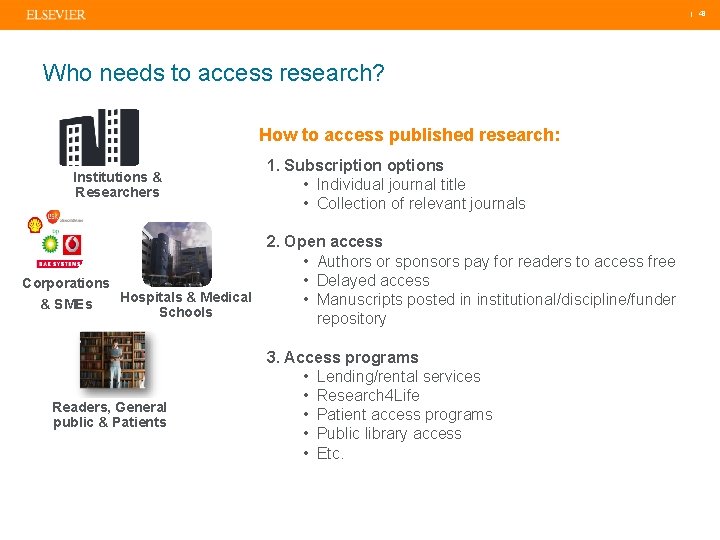
| 48 Who needs to access research? How to access published research: Institutions & Researchers 1. Subscription options • Individual journal title • Collection of relevant journals 2. Open access • Authors or sponsors pay for readers to access free • Delayed access Corporations Hospitals & Medical • Manuscripts posted in institutional/discipline/funder & SMEs Schools repository Readers, General public & Patients 3. Access programs • Lending/rental services • Research 4 Life • Patient access programs • Public library access • Etc.
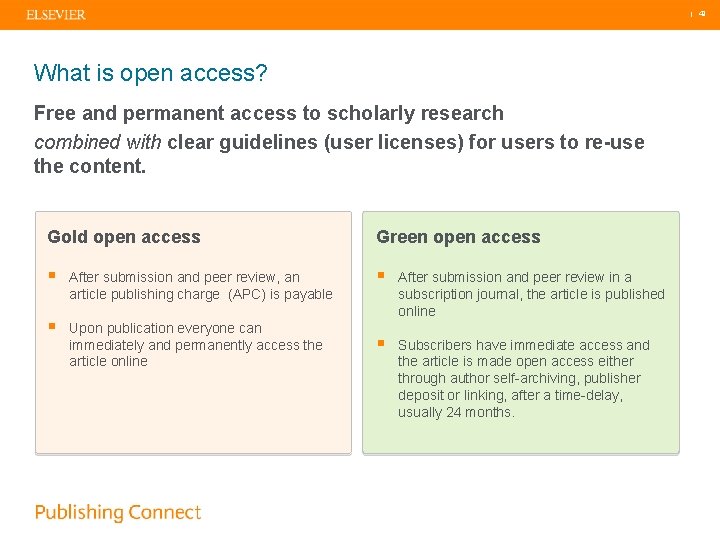
| 49 What is open access? Free and permanent access to scholarly research combined with clear guidelines (user licenses) for users to re-use the content. Gold open access Green open access § After submission and peer review, an article publishing charge (APC) is payable § § After submission and peer review in a subscription journal, the article is published online Upon publication everyone can immediately and permanently access the article online § Subscribers have immediate access and the article is made open access either through author self-archiving, publisher deposit or linking, after a time-delay, usually 24 months.
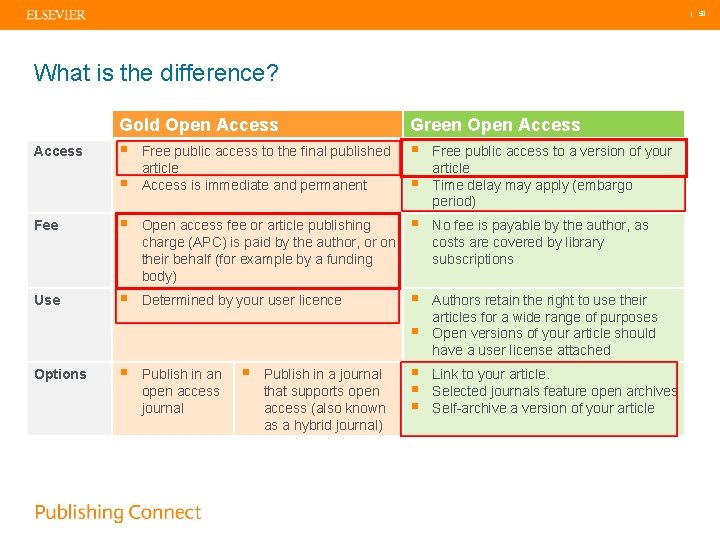
| 50 What is the difference? Access Gold Open Access Green Open Access § Free public access to the final published § Free public access to a version of your § article Access is immediate and permanent § article Time delay may apply (embargo period) Fee § Open access fee or article publishing charge (APC) is paid by the author, or on their behalf (for example by a funding body) § No fee is payable by the author, as costs are covered by library subscriptions Use § Determined by your user licence § § Authors retain the right to use their articles for a wide range of purposes Open versions of your article should have a user license attached § § § Link to your article. Selected journals feature open archives Self-archive a version of your article Options § Publish in an open access journal § Publish in a journal that supports open access (also known as a hybrid journal)
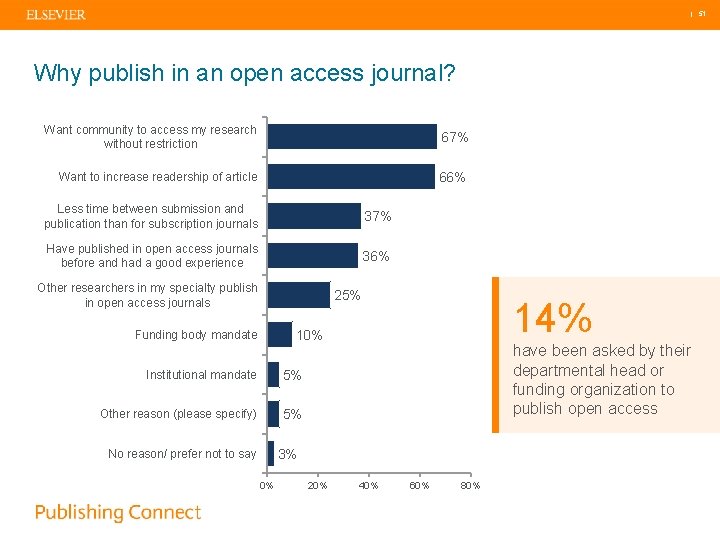
| 51 Why publish in an open access journal? Want community to access my research without restriction 67% Want to increase readership of article 66% Less time between submission and publication than for subscription journals 37% Have published in open access journals before and had a good experience 36% Other researchers in my specialty publish in open access journals 25% Institutional mandate 5% Other reason (please specify) 5% have been asked by their departmental head or funding organization to publish open access 3% No reason/ prefer not to say 14% 10% Funding body mandate 0% 20% 40% 60% 80%
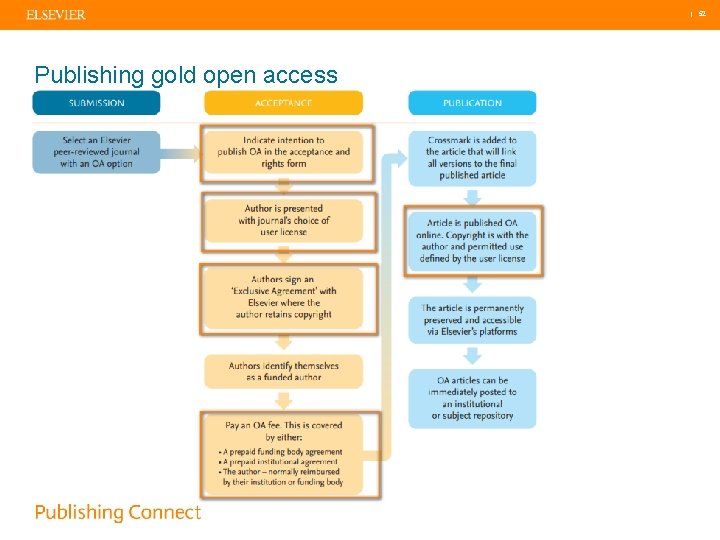
| 52 Publishing gold open access
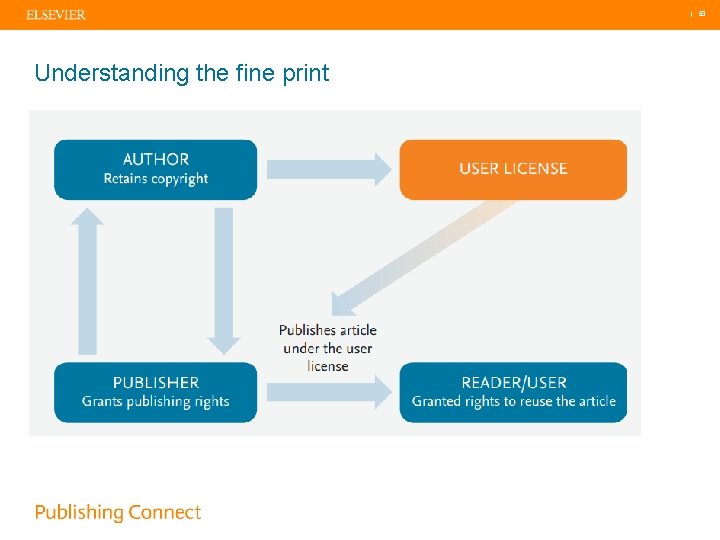
| 53 Understanding the fine print
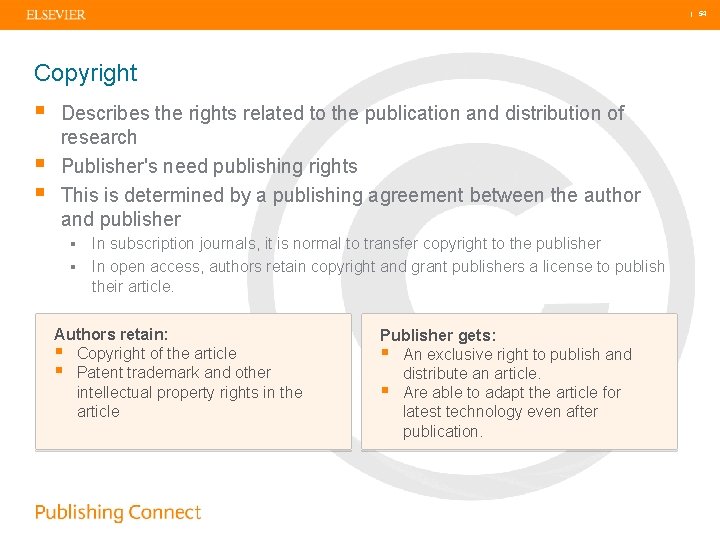
| 54 Copyright § § § Describes the rights related to the publication and distribution of research Publisher's need publishing rights This is determined by a publishing agreement between the author and publisher § § In subscription journals, it is normal to transfer copyright to the publisher In open access, authors retain copyright and grant publishers a license to publish their article. Authors retain: § Copyright of the article § Patent trademark and other intellectual property rights in the article Publisher gets: § An exclusive right to publish and distribute an article. § Are able to adapt the article for latest technology even after publication.
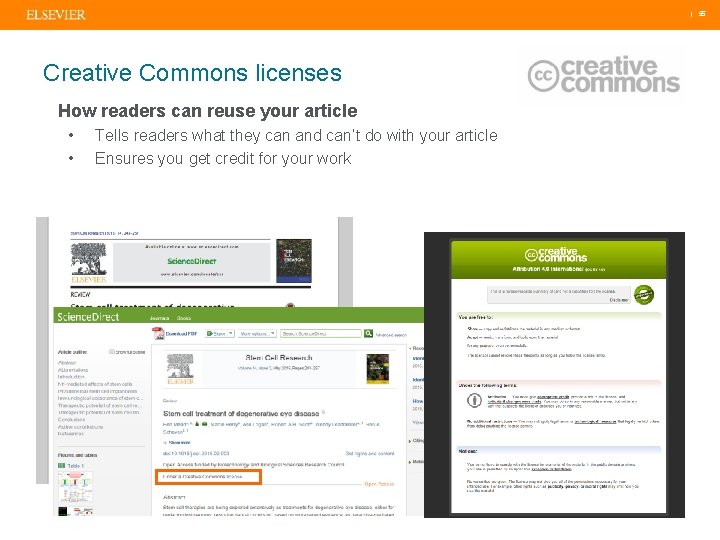
| 55 Creative Commons licenses How readers can reuse your article • • Tells readers what they can and can’t do with your article Ensures you get credit for your work
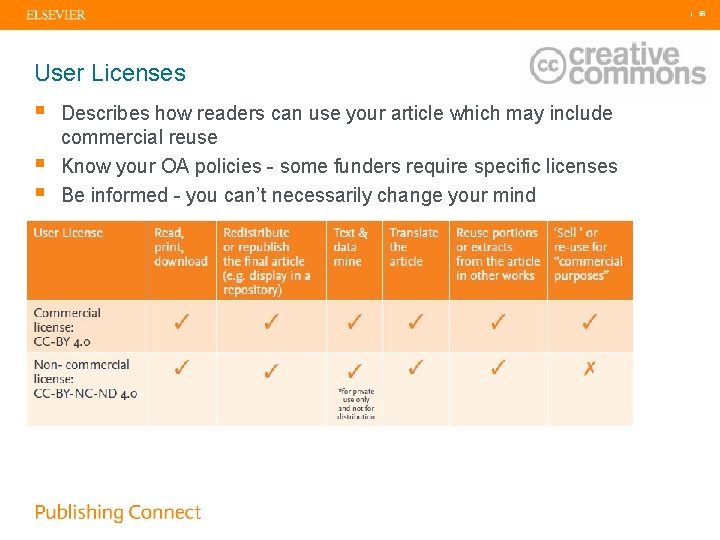
| 56 User Licenses § § § Describes how readers can use your article which may include commercial reuse Know your OA policies - some funders require specific licenses Be informed - you can’t necessarily change your mind
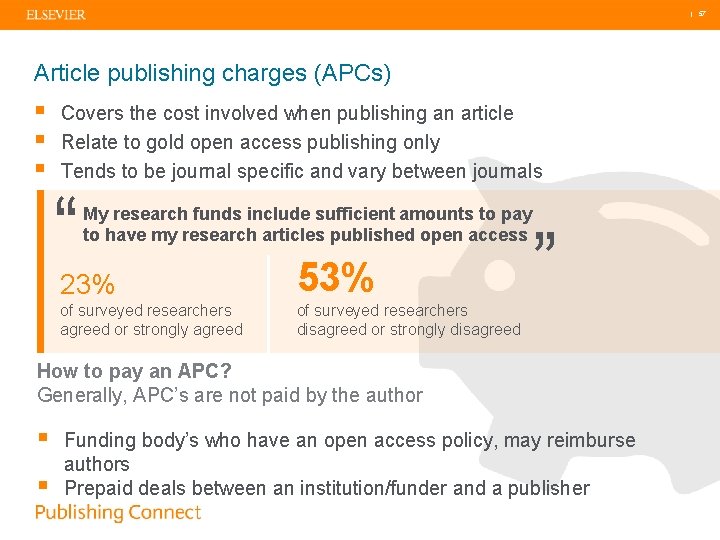
| 57 Article publishing charges (APCs) § § § Covers the cost involved when publishing an article Relate to gold open access publishing only Tends to be journal specific and vary between journals “ My research funds include sufficient amounts to pay to have my research articles published open access 23% 53% of surveyed researchers agreed or strongly agreed of surveyed researchers disagreed or strongly disagreed ” How to pay an APC? Generally, APC’s are not paid by the author § § Funding body’s who have an open access policy, may reimburse authors Prepaid deals between an institution/funder and a publisher
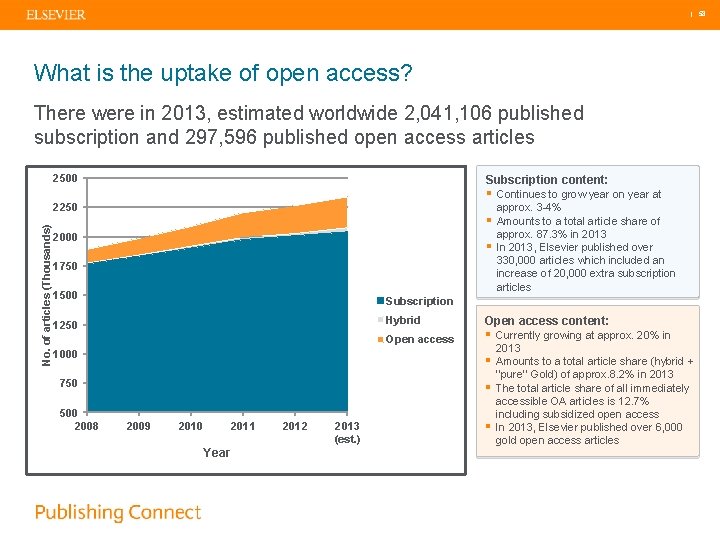
| 58 What is the uptake of open access? There were in 2013, estimated worldwide 2, 041, 106 published subscription and 297, 596 published open access articles 2500 Subscription content: § No. of articles (Thousands) 2250 § 2000 § 1750 1500 Subscription 1250 Hybrid Open access content: § 1000 § 750 § 500 2008 2009 2010 2011 Year 2012 2013 (est. ) Continues to grow year on year at approx. 3 -4% Amounts to a total article share of approx. 87. 3% in 2013 In 2013, Elsevier published over 330, 000 articles which included an increase of 20, 000 extra subscription articles § Currently growing at approx. 20% in 2013 Amounts to a total article share (hybrid + ‘’pure’’ Gold) of approx. 8. 2% in 2013 The total article share of all immediately accessible OA articles is 12. 7% including subsidized open access In 2013, Elsevier published over 6, 000 gold open access articles
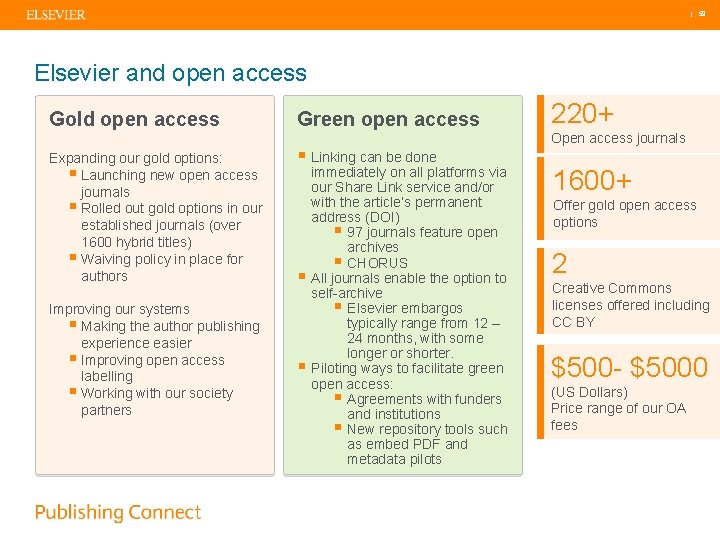
| 59 Elsevier and open access Gold open access Expanding our gold options: § Launching new open access journals § Rolled out gold options in our established journals (over 1600 hybrid titles) § Waiving policy in place for authors Improving our systems § Making the author publishing experience easier § Improving open access labelling § Working with our society partners Green open access § § § 220+ Open access journals Linking can be done immediately on all platforms via our Share Link service and/or with the article’s permanent address (DOI) § 97 journals feature open archives § CHORUS All journals enable the option to self-archive § Elsevier embargos typically range from 12 – 24 months, with some longer or shorter. Piloting ways to facilitate green open access: § Agreements with funders and institutions § New repository tools such as embed PDF and metadata pilots 1600+ Offer gold open access options 2 Creative Commons licenses offered including CC BY $500 - $5000 (US Dollars) Price range of our OA fees
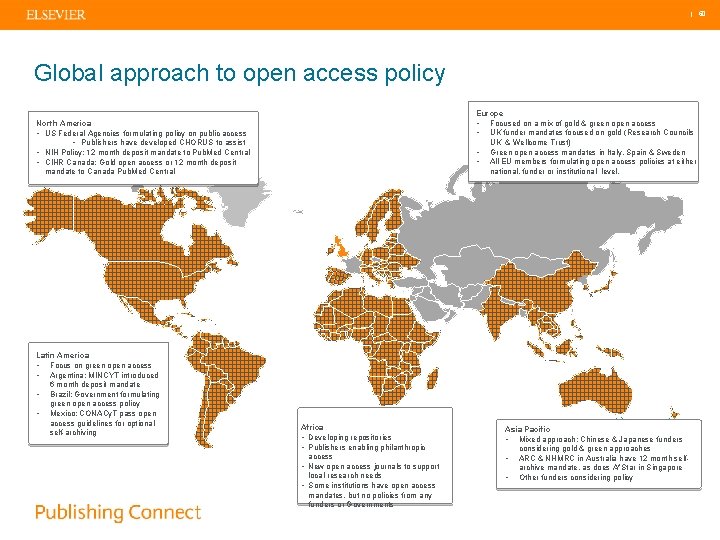
| 60 Global approach to open access policy Europe • Focused on a mix of gold & green open access • UK funder mandates focused on gold (Research Councils UK & Wellcome Trust) • Green open access mandates in Italy, Spain & Sweden • All EU members formulating open access policies at either national, funder or institutional level. North America • US Federal Agencies formulating policy on public access • Publishers have developed CHORUS to assist • NIH Policy: 12 month deposit mandate to Pub. Med Central • CIHR Canada: Gold open access or 12 month deposit mandate to Canada Pub. Med Central Latin America • Focus on green open access • Argentina: MINCYT introduced 6 month deposit mandate • Brazil: Government formulating green open access policy • Mexico: CONACy. T pass open access guidelines for optional self-archiving Africa • Developing repositories • Publishers enabling philanthropic access • New open access journals to support local research needs • Some institutions have open access mandates, but no policies from any funders or Governments Asia Pacific • Mixed approach: Chinese & Japanese funders considering gold & green approaches • ARC & NHMRC in Australia have 12 month selfarchive mandate, as does A*Star in Singapore • Other funders considering policy
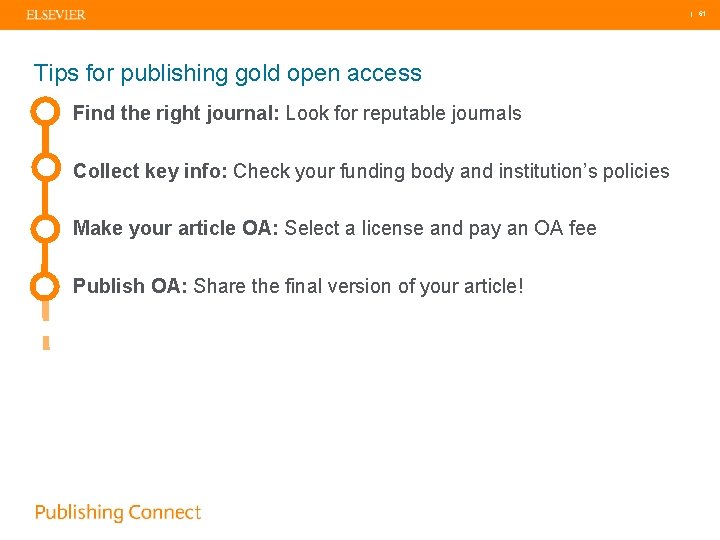
| 61 Tips for publishing gold open access Find the right journal: Look for reputable journals Collect key info: Check your funding body and institution’s policies Make your article OA: Select a license and pay an OA fee Publish OA: Share the final version of your article!
| 62 publishingcampus. com elsevier. com/authors elsevier. com/reviewers elsevier. com/editors Further reading at Understanding the Publishing Process with Elsevier – complete guide Publishing Ethics brochure – top reasons to publish ethically Get Published – top tips on writing, reviewing and grant writing etc. Get Noticed – new ways to promote your article and research Open access – definitions and options Career Planning Guide – download in 12 languages
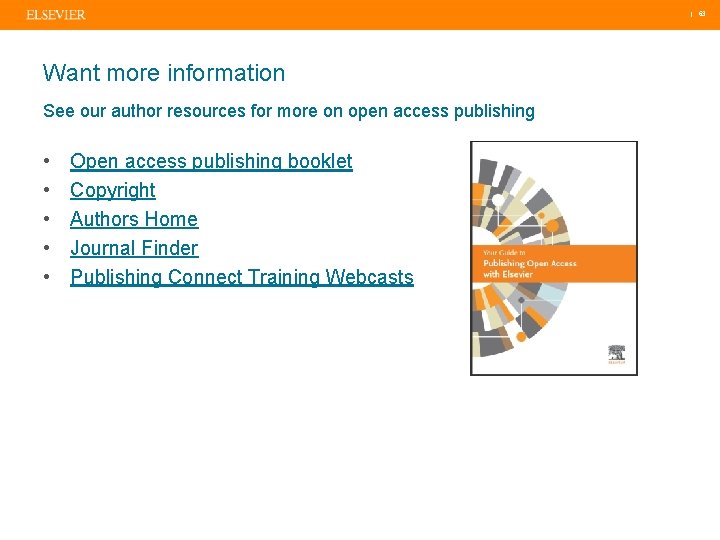
| 63 Want more information See our author resources for more on open access publishing • • • Open access publishing booklet Copyright Authors Home Journal Finder Publishing Connect Training Webcasts
Thank you For further information please visit: www. elsevier. com/openaccess www. elsevier. com/authors Visit Elsevier Publishing Campus www. publishingcampus. com
- Slides: 64