
Author Jack Slemenda Converse College SC Date submitted

Author: Jack Slemenda Converse College, SC Date submitted to deafed. net – March 20, 2008 To contact the author for permission to use this Power. Point, please e-mail: slemenjc@spart 5. k 12. sc. us To use this Power. Point presentation in its entirety, please give credit to the author.
Auditory Verbal Therapy Jack Slemenda Converse College
Slide Contents • I. Auditory Verbal Therapy (3 -23) • II. Cochlear Implants (24 -32) • III. Maintenance/Trouble Shooting for Cochlear Implants (33 -40) • IV. Speech, Language, Cognitive and Audition Evaluations (41 -46) • V. Expectations for a Child with a Hearing Loss (47 -55) • VI. Lesson Plans/Treatment Goals (56 -87)
All children have residual hearing that can be molded for functional use History and Philosophy of Auditory Verbal Therapy
What is AVT and where did it originate? • AVT was established as an approach to therapy in the mid 20 th century by pioneers Ling, Beebe, and Pollack. • Auditory Verbal International established ten principles to guide the field and foster understanding of Auditory Verbal Therapy.
First AVT Principle Ø Supporting and promoting programs for the early detection, identification, and diagnosis of hearing loss and the auditory management of infants, toddlers, and children identified along with Auditory-Verbal Therapy.
Second AVT Principle • Providing the earliest and most appropriate use of medical and amplification technology to achieve the maximum auditory stimulation benefit.
Third AVT Principle Ø Seeking to integrate listening as well as maximal acoustic stimulation into the child’s total personality in response to the environment by guiding/coaching caregivers without the use of sign language or emphasis on speechreading.
Fourth AVT Principle Ø Supporting the view that communication is a social act, and seeking to improve spoken communication interaction within the typical social dyad of infant/child with hearing loss and primary caregiver’s including use of the parents as primary models for spoken language development and implementing one-on-one teaching.
Fifth AVT Principle Ø Seeking to establish the child’s integrated auditory system for the self-monitoring of emerging speech.
Sixth AVT Principle Ø Using natural sequential patterns of auditory, perceptual, linguistic and cognitive stimulation to encourage the emergence of listening, speech, and language abilities.
Seventh AVT Principle Ø Guiding and coaching parents to create environments that support listening/spoken language through the child’s daily activities and to integrate listening and spoken language in the child’s life.
Eighth AVT Principle Ø Guiding and coaching parents to help their child self-monitor spoken language production.
Ninth AVT Principle Ø Making ongoing informal/formal diagnostic evaluation and prognosis of the development of listening skills as an integral part of the rehabilitative process.
Tenth AVT Principle Ø Supporting the concepts of mainstreaming and integration of children with hearing loss into regular education classes with appropriate support services and to the fullest extent possible.
Why does AVT work? ? • Existing Evidence Supporting the AVT practice v. The majority of children with hearing loss have useful residual hearing… a fact know for decades ( Bozold and Slebenmann, 1908, Goldstein, (1939); Urbantschitsch, 1982).
Why AVT cont… v. When properly aided, children with hearing loss can detect most if not all the speech spectrum (Beebe, 1953; Goldstein, 1939; Johnson, 1976; Ling and Ling, 1978; Pollack, 1970, 1985; Ross and Calvort, 1984).
Cont…. v Once all available residual hearing is accessed through amplification technology (eg. Binaural hearing aids and acoustically tuned earmolds, FM units, cochlear implants) in order to maximum detection on the speech spectrum, then a child will have the opportunity to develop language in a natural way through the auditory modality. v A child with a hearing loss need not automatically be a visual learner. v Hearing, rather than being a passive modality that receives information, can be the active agent of cognitive development (Boothroyd, 1982; Goldberg and Lebahn, 1990; Robertson and Flexor, 1990; Ross and Calvert, 1984).
Cont… v In order to benefit from the “critical periods” of neurological and linguistic development, then the identification of hearing loss, use of appropriate amplification and medical technology, and stimulation of hearing must occur as early as possible (Clapton, and Winfield, 1976; Johnson and Newport, 1989; Lenneberg, 1967; Marler, 1970; Newport, 1990).
Cont…. v If hearing is not accessed during the critical language years, a child’s ability to use acoustic input meaningfully will deteriorate due to physiological (retrograde deterioration of auditory pathways), and psychosocial (attention, practice, learning) factors (Evans, Webster, and Cullen, 1983; Merzenich and Kass, 1982; Patchett, 1977; Robertson and Irvine, 1989; Webster, 1983).
Cont…. v Current information about normal language development provides the framework and justification for the structure of Auditory -Verbal practice. That is infants/toddlers/children learn language most efficiently through consistent and continual meaningful interactions in a supportive environment with significant caretakers (Kretschmer and Kretscher, 1978; Lennenberg, 1967; Leonard, 1991; Ling, 1989; Mac. Donald and Gillette, 1989; Menyuk, 1977; Ross, 1990).
Cont… v. As verbal language develops through the auditory input of information, reading skills also develop (Geers and Moog, 1989; Ling 1989, Robertson and Flexor, 1990).
Rationale Cont… v Parents in Auditory-Verbal programs do not have to learn sign language or Cued Speech. More than 90% of parents with children with hearing loss have normal hearing (Moores, 1987). Studies have shown that over 90% of parents with normal hearing do not learn sign language beyond the basic preschool level of competency (Luetke. Stahlman and Moeller, 1987). Auditory-Verbal Practice requires that caregivers interact with a child through spoken language and create a listening environment which helps a child to learn.
Cont… v If a severe or profound hearing loss automatically makes an individual neurologically and functionally “different” from people with normal hearing (Furth, 1964; Myklebust and Brutton, 1953), then the Auditory-Verbal philosophy would not be tenable. v The fact is however, that outcome studies show that individuals who have, since early childhood, been taught through the active use of amplified residual hearing, are indeed independent, speaking, and contributing members of mainstream society (Goldberg and Flexer, 1991; Ling, 1989, Yoshinaga-Itano and Pollack, 1988).

Cochlear Implants Companies, Parts, Features
Cochlear Implants • Nucleus 24 Contour – Cochlear Corporation • Clarion CII Bionic Ear – Advanced Bionics • Combo 40+ – Med-EL
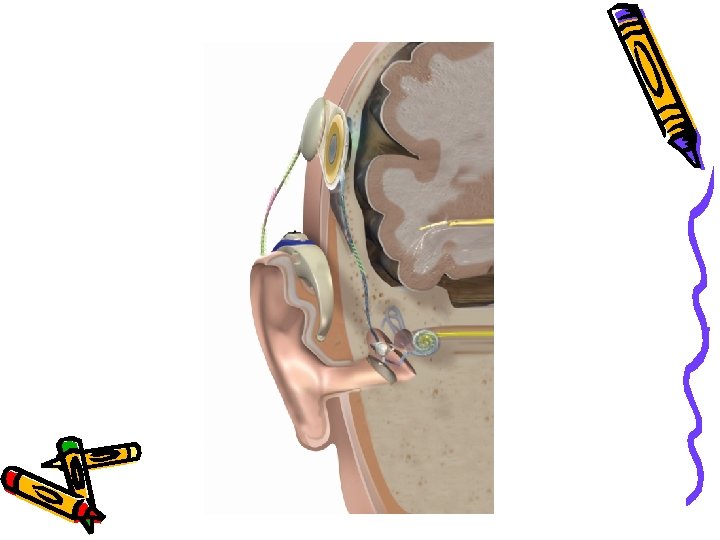
NUCLEUS • Processors – SPrint (Body worn device) • Rechargeable batteries – ESPrit 3 G (BTE) • No rechargeable batteries • Internal Device – Nucleus 24 Contour • 22 Electrodes
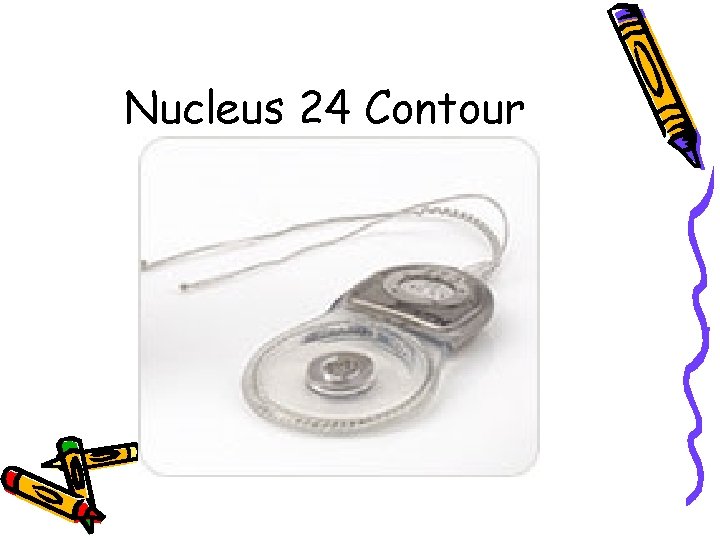
Nucleus 24 Contour
ADVANCED BIONICS • Platinum BTE • S-Series and Platinum Speech Processor (body worn) • All Rechargeable Batteries
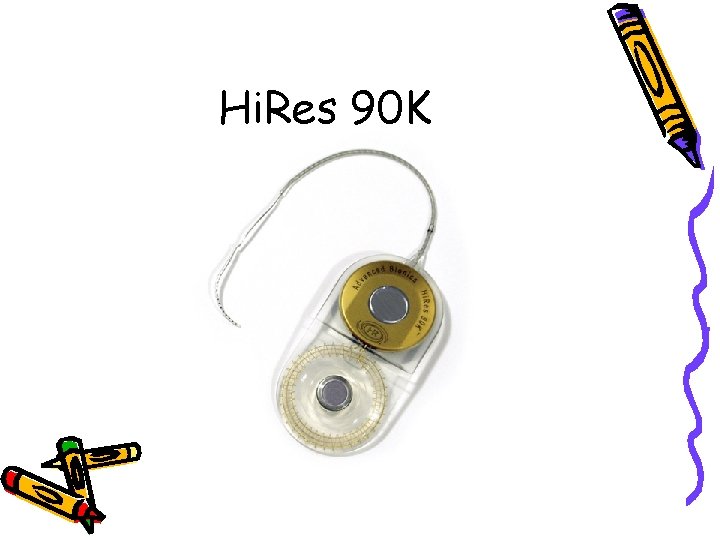
Hi. Res 90 K
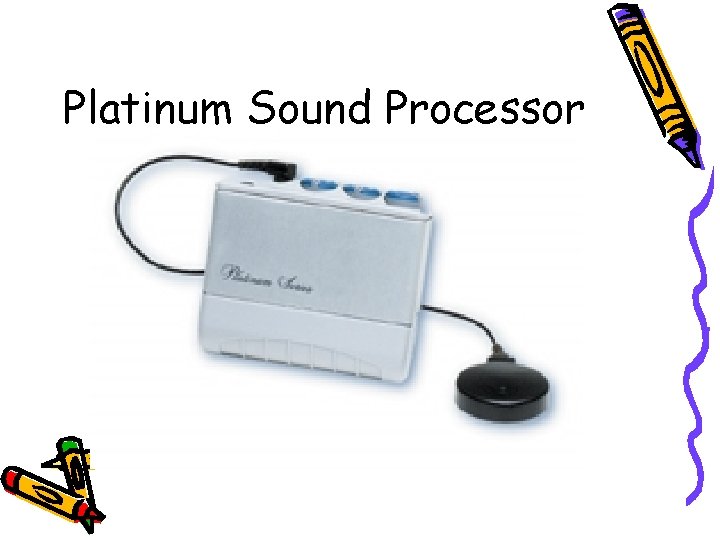
Platinum Sound Processor
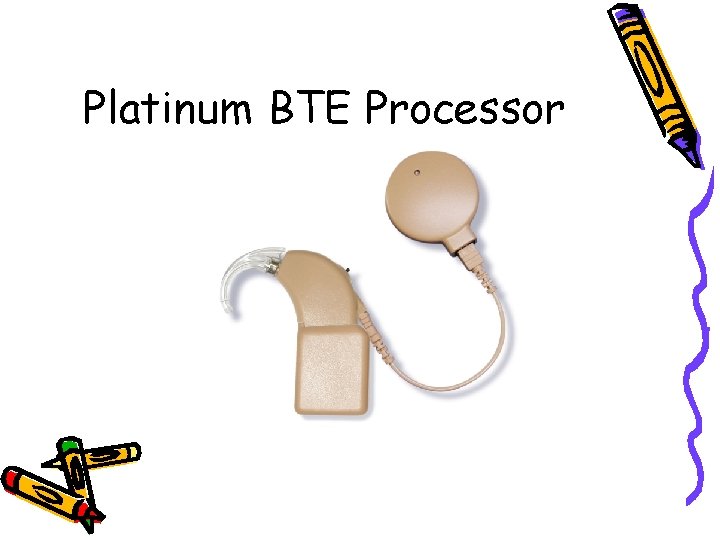
Platinum BTE Processor
Maintenance and Trouble Shooting for Hearing Aids and Cochlear Implants
What to do if there is no sound? • • Battery may be dead Battery may be in backwards Hearing aid may be turned off Sound outlet may be plugged with ear wax
What to do if there is weak sound? • Weak battery • Sound outlet or inlet may be plugged with ear wax • Current hearing condition may have changed
What to do if there is a crackling or frying sound? • Volume may be set too high • Object may be covering inlet such as a hat, scarf, or coat collar • Excessive wax present in the ear • Instrument may not be fitted correctly in the ear (contact audiologist)

Trouble Shooting for Cochlear Implants is Product Specific
If the problem with the hearing aid persists, it is important to call the audiologist right away!!
General Maintenance for Hearing Aids • Cleaning • Storage • Daily living
General Maintenance for Cochlear Implants • • Small children Moisture Batteries Static electricity

Speech, Language, Cognitive, and Audition Evaluations
Testing with Hearing Impaired Children • Areas of testing: – Language- Receptive and Expressive – Articulation/Phonology – Auditory Skills
Language • Testing may include comprehensive language tests, such as the CELF-P 2, CELF-4, PLS-4, CASL, CREVT-2, , TELD: 3, TOLD-P: 3, or TOLD-I: 3. • Tests of expressive language and vocabulary, such as, EOWPVT, EVT, SPELT-3 or SPELT-P.
Language • Tests of receptive language, such as ROWPVT or PPVT-3. • Screening tests: Rossetti Infant. Toddler Language Scale or the REEL-3. • Concept testing may also be completed, using a test such as the Bracken-R.
Articulation/Phonology Articulation: -GFTA-2 -CAAP -Arizona 3 -SPAT-D Phonology: KLPA-2 HAPP-3 CAAP Compton Assessment IEPN
Auditory Tests • Tests that focus on use of audition in language: – – – – TACL TARPS TAPS-R and TAPS-UL ESP APT-HI IT-MAIS MUSS TAC
Expectations for a Child with a Hearing Loss
Chronological Age vs. Cochlear Age • Chronological age begins at birth • Cochlear age begins when the implant is activated • Cochlear age used as tool • Speech and language expectations/development should be based on cochlear age
Progression of Development • Normal speech and language development can be expected on a delayed time scale • Speech and language goals should follow the natural progression of normal speech and language development
Auditory Expectations with AVT & CA @ 12 months • Respond to a variety of environmental and speech sounds at various distances • Imitate vowels and some consonants • Imitate motions of nursery rhymes • Identify nursery rhymes when sung
AVT & CA @ 12 months cont. • Respond to familiar phrases • Identify and imitate learning to listen sounds
Auditory Expectations with AVT & CA @ 24 months • Identify a picture that is part of a simple story • Identify an object with descriptors • Recall 3 critical elements • Answer questions about a picture, book, or set of objects
Auditory Expectations with AVT & CA @ 36 months • Answer questions & recall details about a story with the topic revealed • Answer questions without pictures • Recall four critical elements • Answer questions about a familiar topic
Auditory Expectations with AVT & CA @ 48 months • Repeat easy sentences • Process information (by live voice or on tape) at sentence and conversation level with background noise • Follow a conversation with an unrevealed topic
AVT & CA @ 48 months cont. • Retell a story recalling many details in the correct sequence Expectations taken from the Auditory Learning Guide (ALG) developed by Beth Walker, 1995
Lesson Plans and Treatment Goals
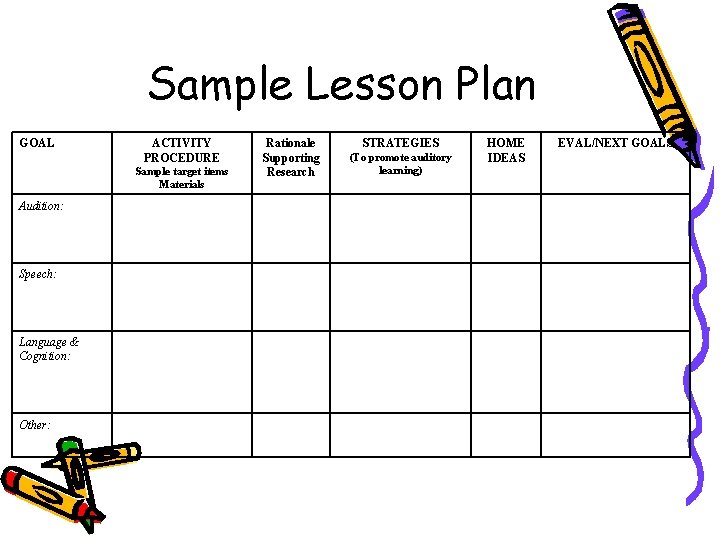
Sample Lesson Plan GOAL ACTIVITY PROCEDURE Sample target items Materials Audition: Speech: Language & Cognition: Other: Rationale Supporting Research STRATEGIES (To promote auditory learning) HOME IDEAS EVAL/NEXT GOALS
Audition Goals & Activities • Detect/identify sounds of the Ling 6/7 Sound Test “s” “m” “oo” “ee” “ah” “sh” “fff” – – Fish in a fish bowl with water Seeds in a flower pot Animals in sand Cars down a ramp
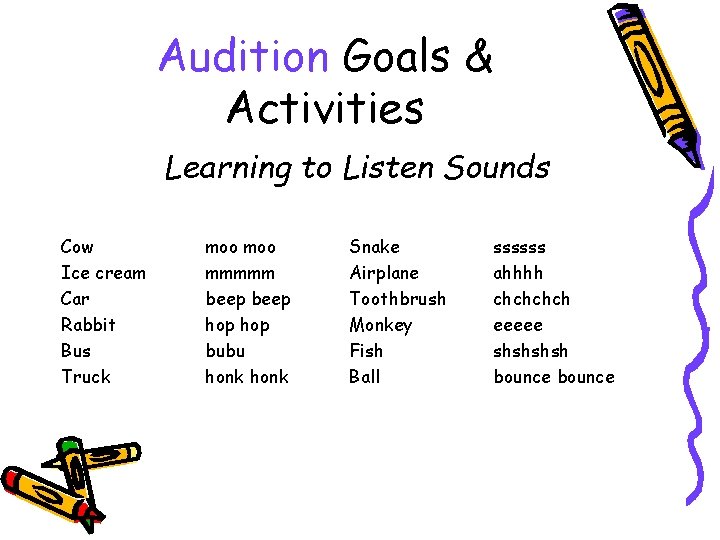
Audition Goals & Activities Learning to Listen Sounds Cow Ice cream Car Rabbit Bus Truck moo mmmmm beep hop bubu honk Snake Airplane Toothbrush Monkey Fish Ball ssssss ahhhh chch eeeee shsh bounce
Audition Goals & Activities • Identify/imitate approximations of Learning to Listen to Sounds – – Scavenger hunt Grab bag, surprise box Open the “presents” Guessing game with cups
Audition Goals & Activities • Follow directions by recalling three critical elements – – Barrier game Coloring activity Feed the people Build a castle
Auditory Strategies • • Move closer to the implant Vary the prosody and intonation Sing a song Put the key word at the end of the phrase Pause before saying the key word Whisper voiceless sounds Prolong fricatives and nasals /hausssss/ Repeat stops /kkkkeik/
Auditory Strategies • • • Vary the number of syllables Decrease background noise Ask “what did you hear? ” Auditory sandwich technique Present two choices Use the parent as a model
Speech Goals & Activities • Imitate consonants varying by manner with the same vowels ex: ssss vs tutu mmm vs bubu – Microphone – Basketball, bowling, soccer – Balloon toss – Marbles – Make a puzzle
Speech Goals & Activities • Produce /m/ in the initial position of words – /m/ magnets – Hide /m/ objects in rice, beans, or sand – Make a book
Language Goals and Activities A Review: Normal Language Development Checklist 6 Months q. Repeats self-produced sounds q. Imitates sounds q. Vocalizes to others q. Uses about 12 different phonemes
Language Goals And Activities 1 Year Old Communication Development q First true words 10 -15 months q Use of jargon 15 -18 months q Expressive Vocabulary 50 words-18 months q Gestures and vocalizes wants and needs q Develops object permanence
Language Goals and Activities 1 Year Old Vocabulary q Turns to name q Jabbers Loudly q Waves “bye bye” upon request q Plays “peek-a-boo” q Often over-generalizes meaning (ball, dog)
Language Goals and Activities 2 Year Old q Jargon almost completely dropped out q Pronouns are used often and correctly q Vocabulary may have grown from 50 -200 words q Average sentence length 2. 5 words
Language Goals and Activities 2 Year Old Vocabulary q Understands 300 -600 words q Points to five body parts on command q Responds to y/n questions appropriately q Knows and uses prepositions “in” and “on” q Names and produces sounds of common animals q Follows simple directions
Language Goals And Activities 2 Year Old Grammar q Speaks in 2 -3 word utterances q 25% of two-word combo’s consist of noun + verb (Open-Pivot) construction (Daddy go) q Asks “What’s that? ” q Uses rising intonation with other questions
Language Goals and Activities 3 Year Old q Talking in multi-word utterances q Vocabulary is extensive and long q Comprehensive of more complex directions q Concrete in regard to subjects they can discuss q The “why” question phenomenon
Language Goals and Activities 3 Year Old Vocabulary/Concepts q Understand the meaning of “Who? ”, “Why? ” and “How many? ” q Able to answer AGENT + ACTION? ’s q Knows own gender q Understands basic adjectives “big” and “little” q Counts up to 3 but only understand concept of “one”. q Follows 2 -4 part commands
Language Goals and Activities 3 Year Old Grammar q Speaks in 3 -4 word sentences q Articles “a” “the” and copula/auxiliary “is” are beginning to be included. q Use of word tense are present q Use of pronouns “I”, “me”, “you”, “my”, “mine” q Yes/no questions are developed “Is this a horse? ” q Over generalizes grammar rules
Language Goals and Activities 4 Year Old q Begin to play with words q Elaborates simple responses into long narratives q Comments with approval on his/her own behavior and criticizes that of others
Language Goals and Activities 4 Year Old Vocabulary/Concepts q Identifying and Expressing understanding of colors q Counts to ten by rote, understands concept of 3. q Can perform simple analogies “fire is hot, ice cream is ____” q Understands basic prepositions q Understands adjectives of size and quantity:
Language Goals and Activities 4 Year old Grammar q 4 -5 word sentences, on average. q Sentences are complete q Grammatical overgeneralizations continue q Uses third person singular q Use of conjunctions q Modal verbs
Language Goals and Activities 5 Year old q Has a sense of social standards and limitations. (pragmatically appropriate given then situations) q Mastered number concepts thru 10 q Can name and describe use and function of everyday objects q Grammatical and articulatory errors are eliminated
Language Goals and Activities 5 Year old Vocabulary Concepts q Can group objects by category q Aware of the function of senses (eyes, ears, nose, mouth) q Understands prepositions “behind” and ahead of” q Understands “first” and “last” q Understands the concept of time
Language Goals and Activities 5 Year old Grammar q Sentences are from 5 -6 words in length q Can understand almost any type of sentence spoken q Speaks in grammatically complete, correct sentences. q Begins to develop metalinguistic awareness
Language Goals and Activities 6 Year Old q Sentence Length- 6 -7 words q Vocabulary -5000 -6000 words q Number concepts- rote counting up to 30 q Asks meaning of words q Complete analogies
Language Goals and Activities Bloom and Lahey Overview Ø Phases Ø Content Categories
Language Goals and Activities HOW DO I TEACH LANGUAGE? . . Language Teaching Hierarchy
Language Goals and Activities Language Temptations: **** Reminders: Do's ü Remember Children need opportunities to communicate ü Deal with the child in a sensitive way ü Be aware of the child’s message ü Plan activities that mean something to the child through his or her daily activities ü Involve other people in the interaction ü Remember having fun is a part ü Allow wait time … typically 10 -15 seconds; for those significantly impaired up to 30 seconds
Language Goals and Activities Don’t ’s ü Don’t rush the child’s attempts to communicate ü Don’t overload the child’s ability to see, hear, and move. ü Don’t set the child up to fail ü Don’t waste valuable time doing things with child that will not help him or her in life ü Don’t assume you know what the child is trying to communicate Expectations taken from Wetherby and Prizant 1989 Communicative Temptations and Pamela Talbot 2002 Topics in Auditory Verbal Therapy See Communicative Temptations Handout
Language Goals and Activities Handouts: See sampling of activities following phases 1 -3 content categories of Bloom and Lahey. Note: Each activity can be modified to accommodate learners at varying phases of Bloom and Lahey.
Auditory Strategies ü Ask the child what did they hear; not are you listening? ? ? ü Use the hand cue ü Move in closer ü Repeat whole phrase ü Acoustically highlight; not over-articulate ü Rephrase ü Whisper the key sound ü Model on the parent first
- Slides: 88