
Authentication to access government services What might the

- Slides: 17
Authentication to access government services What might the future hold? Laurence Millar Deputy Commissioner Information and Communications Technology Privacy Issues Forum 30 March 2006 © State Services Commission, 2006
Agenda • Strategic context • Future for authentication • Questions © State Services Commission, 2006 2
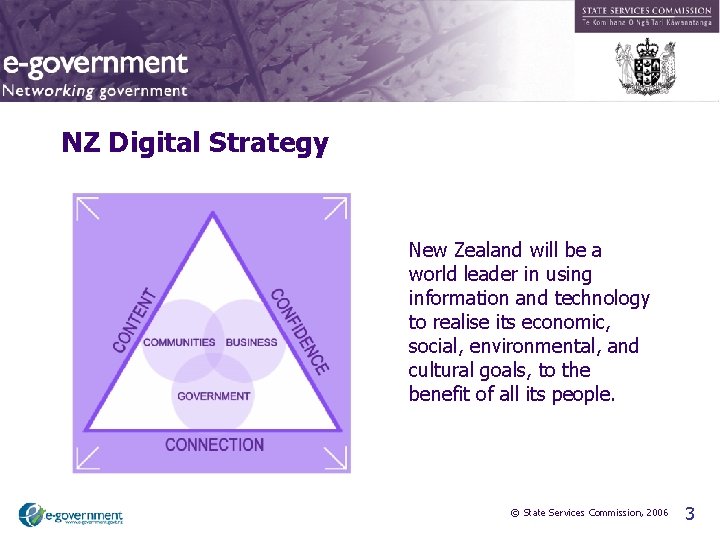
NZ Digital Strategy New Zealand will be a world leader in using information and technology to realise its economic, social, environmental, and cultural goals, to the benefit of all its people. © State Services Commission, 2006 3
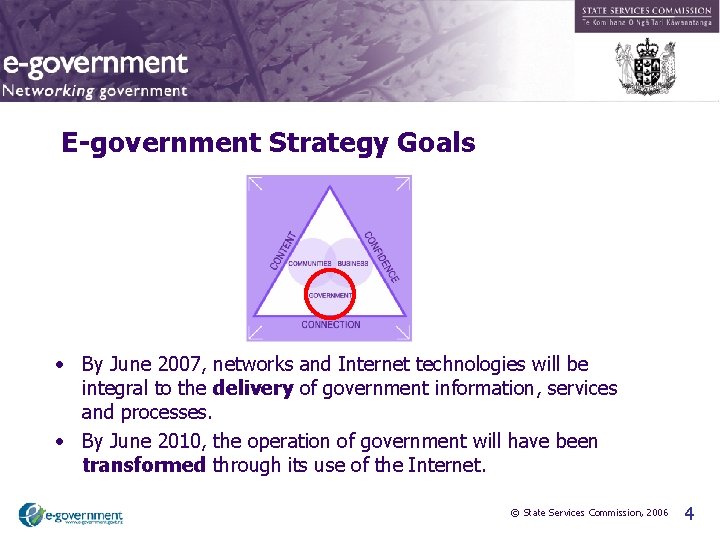
E-government Strategy Goals • By June 2007, networks and Internet technologies will be integral to the delivery of government information, services and processes. • By June 2010, the operation of government will have been transformed through its use of the Internet. © State Services Commission, 2006 4
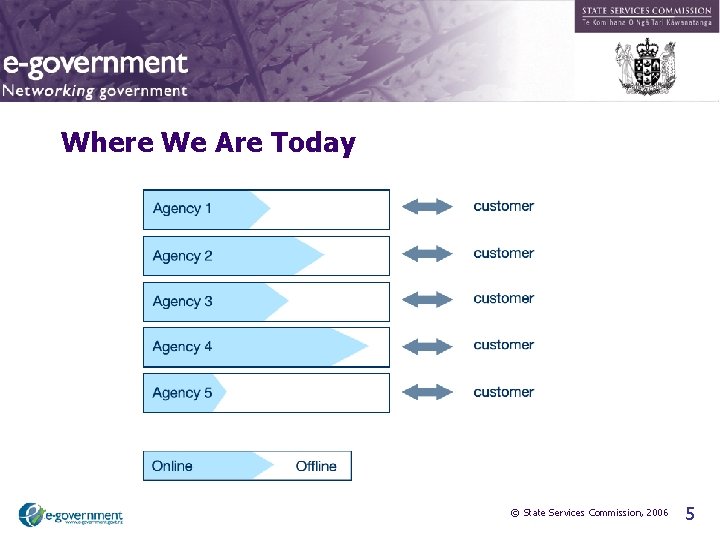
Where We Are Today © State Services Commission, 2006 5
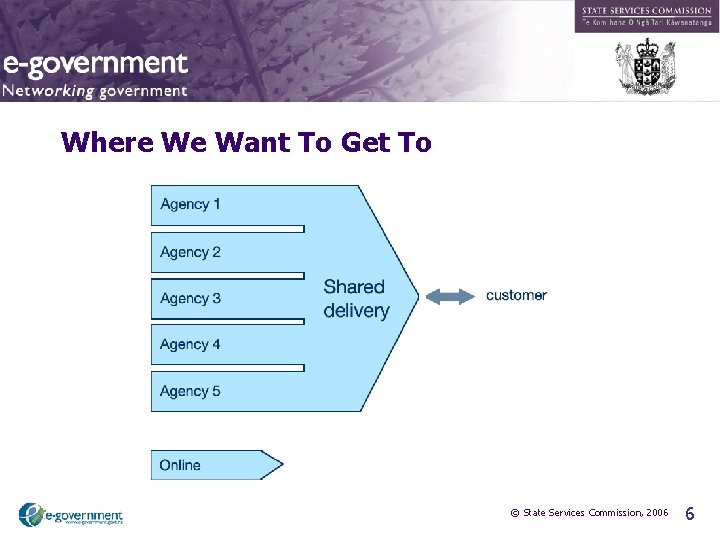
Where We Want To Get To © State Services Commission, 2006 6
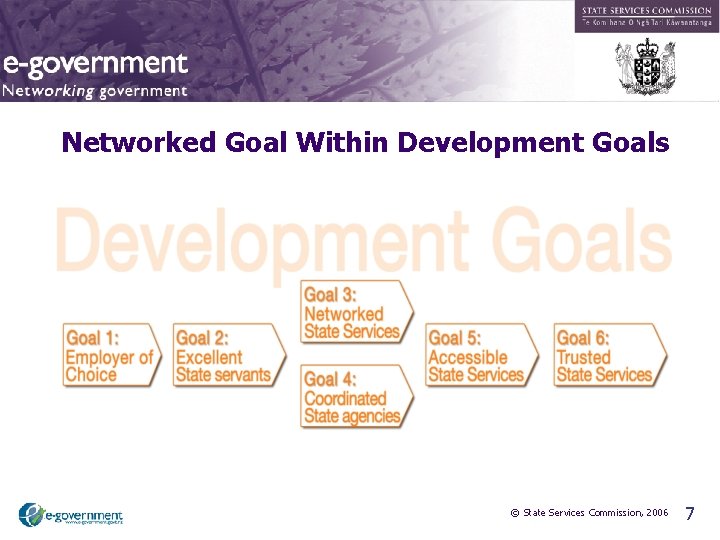
Networked Goal Within Development Goals © State Services Commission, 2006 7
Agenda • Strategic context • Future for authentication • Questions © State Services Commission, 2006 8
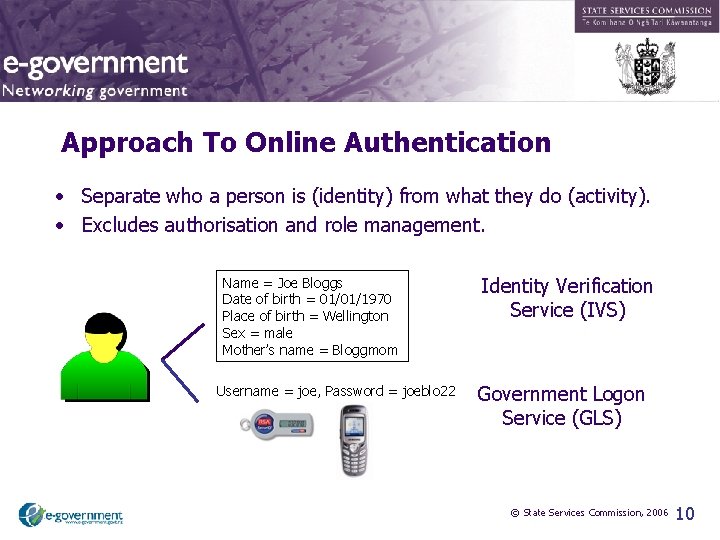
The Concept Of Authentication • When people or businesses deal with government, they need to prove who they are to access some government services, for example when registering a company or looking at a person’s medical records. • Authentication is the process of confirming the identity of the person, to the required level of confidence. • With the Internet becoming a mainstream channel for interacting, transacting and participating, online authentication has become a prerequisite for effective and efficient government worldwide. © State Services Commission, 2006 9
Approach To Online Authentication • Separate who a person is (identity) from what they do (activity). • Excludes authorisation and role management. Name = Joe Bloggs Date of birth = 01/01/1970 Place of birth = Wellington Sex = male Mother’s name = Bloggmom Username = joe, Password = joeblo 22 Identity Verification Service (IVS) Government Logon Service (GLS) © State Services Commission, 2006 10
IVS Overview • An online, real time service that links an identity verification credential (IVC) with a strong GLS logon to verify the person is who they say they are • Supports and enables a customer channel option (online) • Identity is authoritatively verified to a passport-standard evidence of identity (EOI) • IVS Design leverages: – Time, effort and expense of a passport application (and, subject to feasibility, citizenship and permanent residency) for both people and govt – Expertise, systems and resources of DIA, Identity Services – Authentication infrastructure – The Evidence of Identity Standard, as changes to the current EOI in Identity Services automatically flow through to the IVC © State Services Commission, 2006 11
IVS Privacy Protection • Implements core concept of separating identity from activity • Based on Cabinet-approved principles, in particular opt-in • Person initiates identity verification request and controls data release • Uniqueness per agency or sector, no national identifier • Minimum identity data stored • No view of entitlement to agency services or transactions • No additional identity data collected/stored • People can self-audit usage online • This is an additional channel, current offline methods will continue © State Services Commission, 2006 12
IVS Benefits • Provides people with additional means to verify their identity to agencies authoritatively at “passport strength” • People who have been through one of the identified high quality Evidence of Identity process with government don’t have to repeat it to receive an IVC • Better ability for agencies and people to leverage the convenience of the online channel – e. g. support rural communities, overseas New Zealanders • Ability to leverage the government’s identity experts’ skills and knowledge to reduce identity fraud • Tangible cost savings for agencies and government © State Services Commission, 2006 13
Long Term Benefits • Increased confidence and trust in using the online channel. • People have the choice of using a common logon when transacting online with government. • Cost-effective means for managing continuously evolving authentication technology changes and security threats. • Better ability to tackle identity fraud. • Benefits of government’s collective size in delivering scale economies, expertise and adoption of best practices available to all agencies, irrespective of size – Includes integrity of evidence of identity process – Respect for privacy principles © State Services Commission, 2006 14
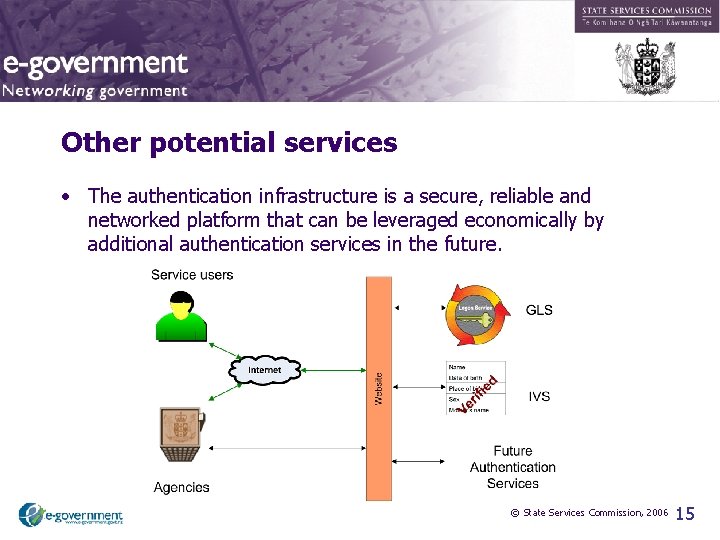
Other potential services • The authentication infrastructure is a secure, reliable and networked platform that can be leveraged economically by additional authentication services in the future. © State Services Commission, 2006 15
Types Of Services • Identification of services and their evaluation will start in July 2006. • We expect two categories of all-of-government services: – Value Added Services Authentication of remote access, digital signatures, online payments, authentication of access parameters – Distributed Sources Of Authoritative Data Company identity from Ministry of Economic Development Partnership identity from Inland Revenue Department © State Services Commission, 2006 16
Agenda • Strategic context • Future for authentication • Questions © State Services Commission, 2006 17