
Authentication and Authorisation for Research and Collaboration Assurance
Authentication and Authorisation for Research and Collaboration Assurance & Policy in Federated Incident Response Requirements along the AAI chain David Groep Policy and Best Practice Activity coordinator, AARC Nikhef Physics Data Processing programme Security Workshop DI 4 R 2016 September 2016 https: //aarc-project. eu
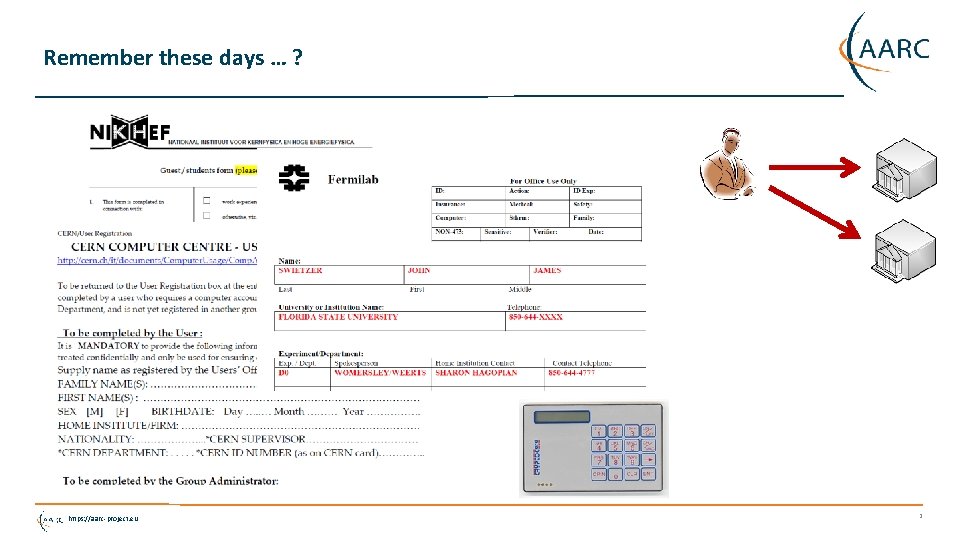
Remember these days … ? https: //aarc-project. eu 2
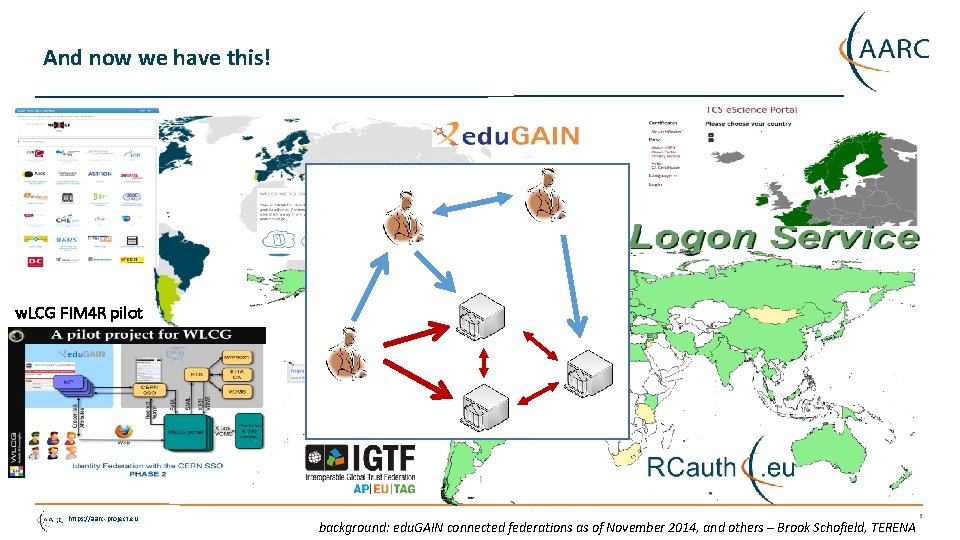
And now we have this! w. LCG FIM 4 R pilot https: //aarc-project. eu background: edu. GAIN connected federations as of November 2014, and others – Brook Schofield, TERENA 3
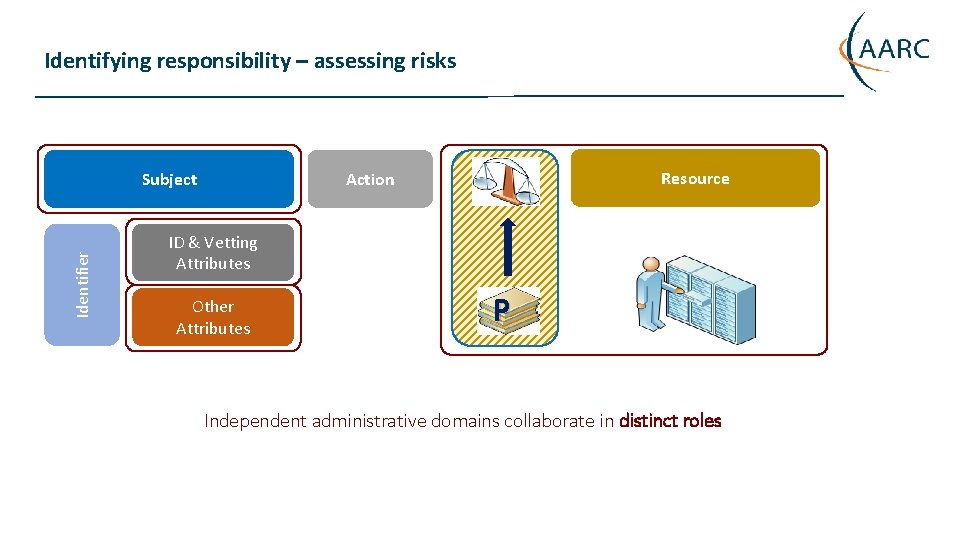
Identifying responsibility – assessing risks Identifier Subject Resource Action ID & Vetting Attributes Other Attributes P Independent administrative domains collaborate in distinct roles https: //aarc-project. eu
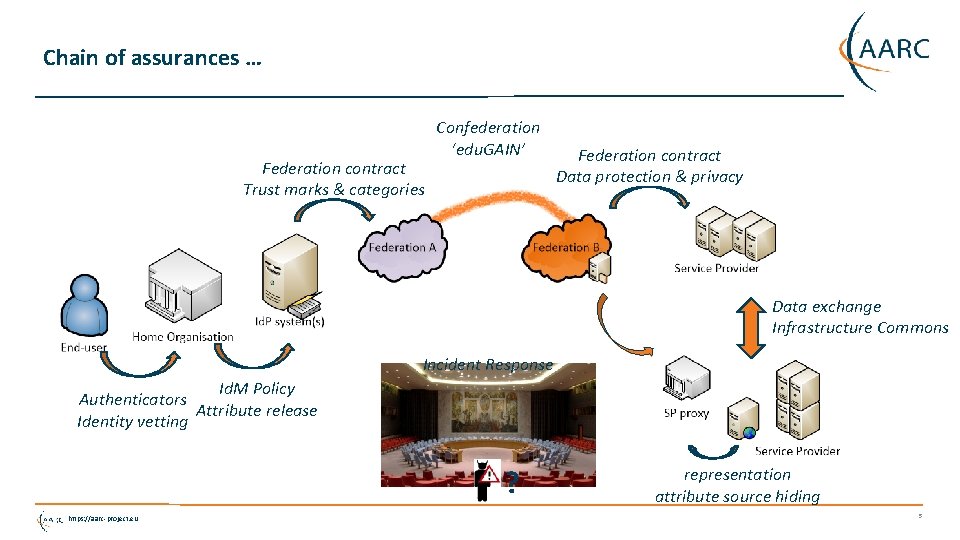
Chain of assurances … Federation contract Trust marks & categories Confederation ‘edu. GAIN’ Federation contract Data protection & privacy Data exchange Infrastructure Commons Incident Response Id. M Policy Authenticators Attribute release Identity vetting ? https: //aarc-project. eu representation attribute source hiding 5
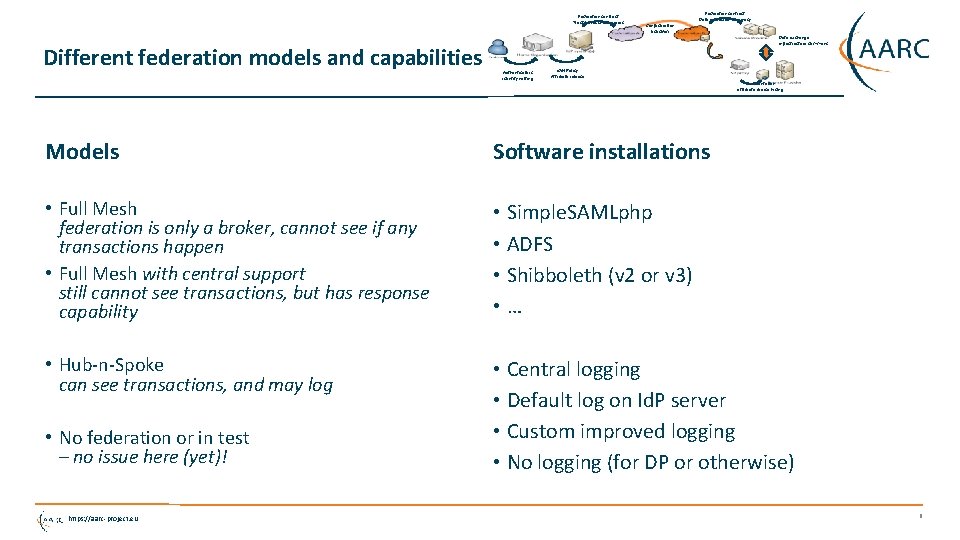
Federation contract Trust marks & categories Different federation models and capabilities Confederation ‘edu. GAIN’ Federation contract Data protection & privacy Data exchange Infrastructure Commons Authenticators Identity vetting Id. M Policy Attribute release representation attribute source hiding Models Software installations • Full Mesh federation is only a broker, cannot see if any transactions happen • Full Mesh with central support still cannot see transactions, but has response capability • Simple. SAMLphp • ADFS • Shibboleth (v 2 or v 3) • … • Hub-n-Spoke can see transactions, and may log • Central logging • Default log on Id. P server • Custom improved logging • No logging (for DP or otherwise) • No federation or in test – no issue here (yet)! https: //aarc-project. eu 6
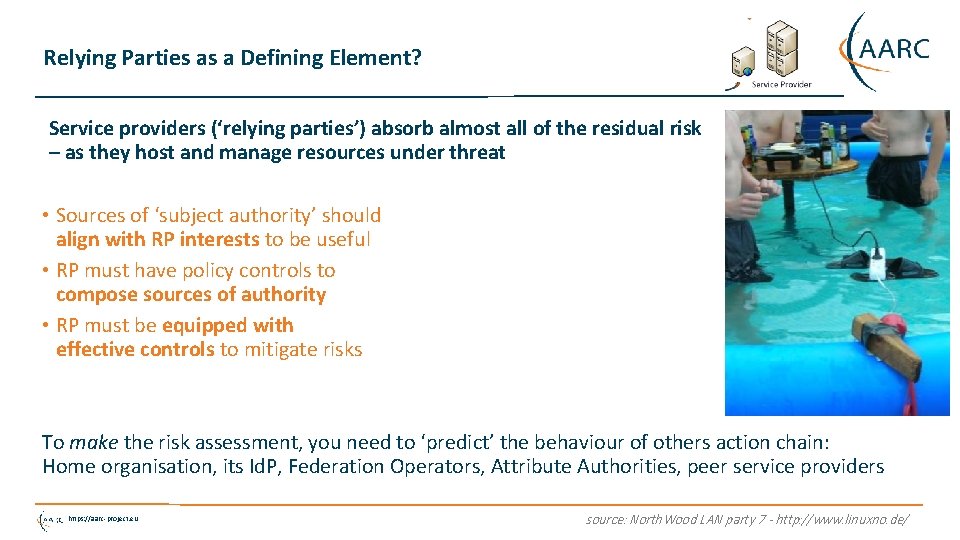
Relying Parties as a Defining Element? Service providers (‘relying parties’) absorb almost all of the residual risk – as they host and manage resources under threat • Sources of ‘subject authority’ should align with RP interests to be useful • RP must have policy controls to compose sources of authority • RP must be equipped with effective controls to mitigate risks To make the risk assessment, you need to ‘predict’ the behaviour of others action chain: Home organisation, its Id. P, Federation Operators, Attribute Authorities, peer service providers https: //aarc-project. eu source: North. Wood LAN party 7 - http: //www. linuxno. de/
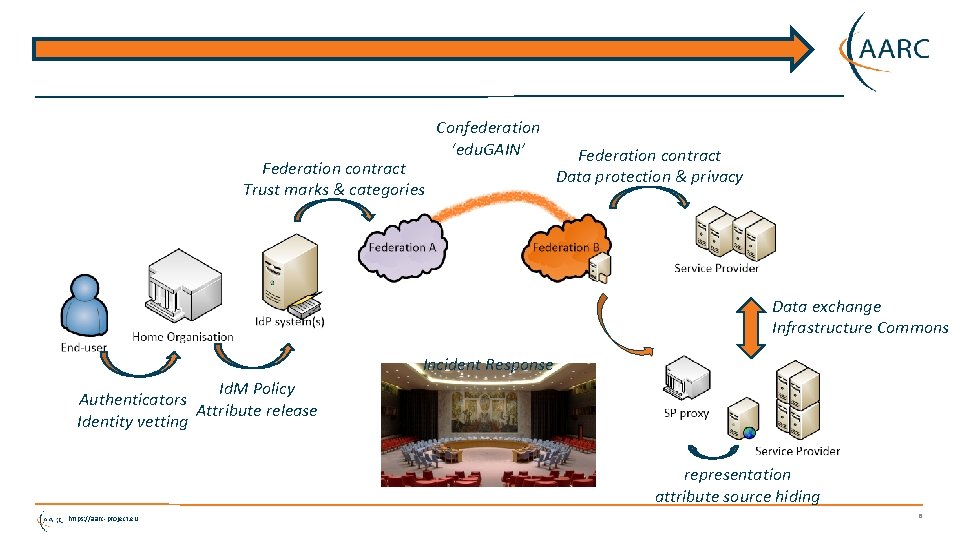
Federation contract Trust marks & categories Confederation ‘edu. GAIN’ Federation contract Data protection & privacy Data exchange Infrastructure Commons Incident Response Id. M Policy Authenticators Attribute release Identity vetting representation attribute source hiding https: //aarc-project. eu 8
Authentication and identity vetting • A wide variety of assurance levels exists • Formal specifications: ISO 29115, Kantara, NIST SP 800 -63 (OMB M-04 -04) – usually four levels • Europe put in a new scheme for their “e. IDAS” regulation, using three levels (including a “substantial”) • CI and e-Infrastructures around the IGTF now have ~ two levels (classic and ‘identifier-only’) • Levels are usually a combination of authenticator strength (passwords, tokens, biometrics) and identity vetting assurance (face-to-face, two photo IDs, verified home address, naming) How to get a defined assurance level? • Negotiate 1 -on-1 with each Id. P and get e. g. the edu. Person. Assurance attribute set • Rely on a ‘policy filter’ like the IGTF – only compliant and assessed Id. Ps make it through and how that is done depends on the CA model, e. g. TCS uses specific entitlements, In. Common Silver uses edu. Person. Assurance and institutional accreditation • For low assurance use cases, infer it from other Id. P properties or ‘generate’ uniqueness e. g. if an organisation has some incident response capability & send useful attributes … https: //aarc-project. eu 9
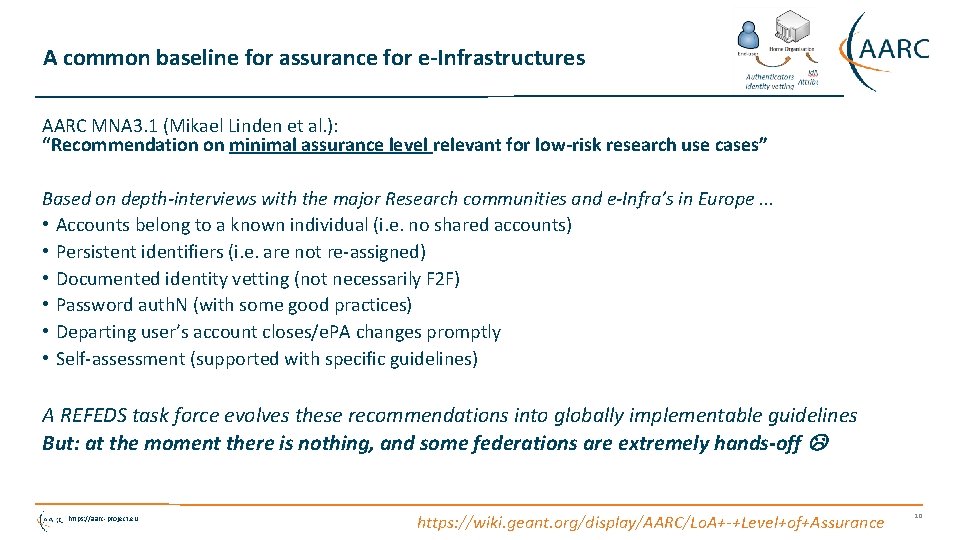
A common baseline for assurance for e-Infrastructures AARC MNA 3. 1 (Mikael Linden et al. ): “Recommendation on minimal assurance level relevant for low-risk research use cases” Based on depth-interviews with the major Research communities and e-Infra’s in Europe. . . • Accounts belong to a known individual (i. e. no shared accounts) • Persistent identifiers (i. e. are not re-assigned) • Documented identity vetting (not necessarily F 2 F) • Password auth. N (with some good practices) • Departing user’s account closes/e. PA changes promptly • Self-assessment (supported with specific guidelines) A REFEDS task force evolves these recommendations into globally implementable guidelines But: at the moment there is nothing, and some federations are extremely hands-off https: //aarc-project. eu https: //wiki. geant. org/display/AARC/Lo. A+-+Level+of+Assurance 10
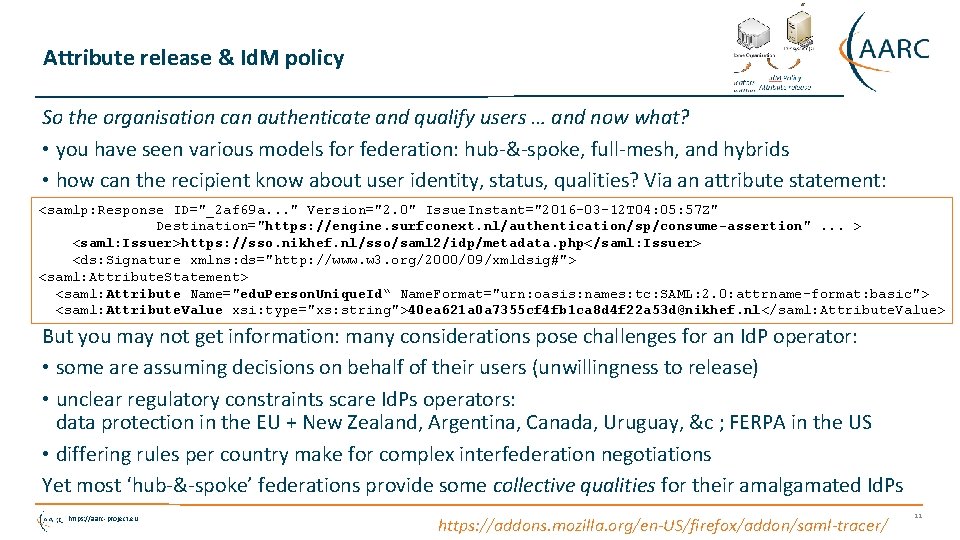
Attribute release & Id. M policy So the organisation can authenticate and qualify users … and now what? • you have seen various models for federation: hub-&-spoke, full-mesh, and hybrids • how can the recipient know about user identity, status, qualities? Via an attribute statement: <samlp: Response ID="_2 af 69 a. . . " Version="2. 0" Issue. Instant="2016 -03 -12 T 04: 05: 57 Z" Destination="https: //engine. surfconext. nl/authentication/sp/consume-assertion". . . > <saml: Issuer>https: //sso. nikhef. nl/sso/saml 2/idp/metadata. php</saml: Issuer> <ds: Signature xmlns: ds="http: //www. w 3. org/2000/09/xmldsig#"> <saml: Attribute. Statement> <saml: Attribute Name="edu. Person. Unique. Id“ Name. Format="urn: oasis: names: tc: SAML: 2. 0: attrname-format: basic"> <saml: Attribute. Value xsi: type="xs: string">40 ea 621 a 0 a 7355 cf 4 fb 1 ca 8 d 4 f 22 a 53 d@nikhef. nl</saml: Attribute. Value> But you may not get information: many considerations pose challenges for an Id. P operator: • some are assuming decisions on behalf of their users (unwillingness to release) • unclear regulatory constraints scare Id. Ps operators: data protection in the EU + New Zealand, Argentina, Canada, Uruguay, &c ; FERPA in the US • differing rules per country make for complex interfederation negotiations Yet most ‘hub-&-spoke’ federations provide some collective qualities for their amalgamated Id. Ps https: //aarc-project. eu https: //addons. mozilla. org/en-US/firefox/addon/saml-tracer/ 11
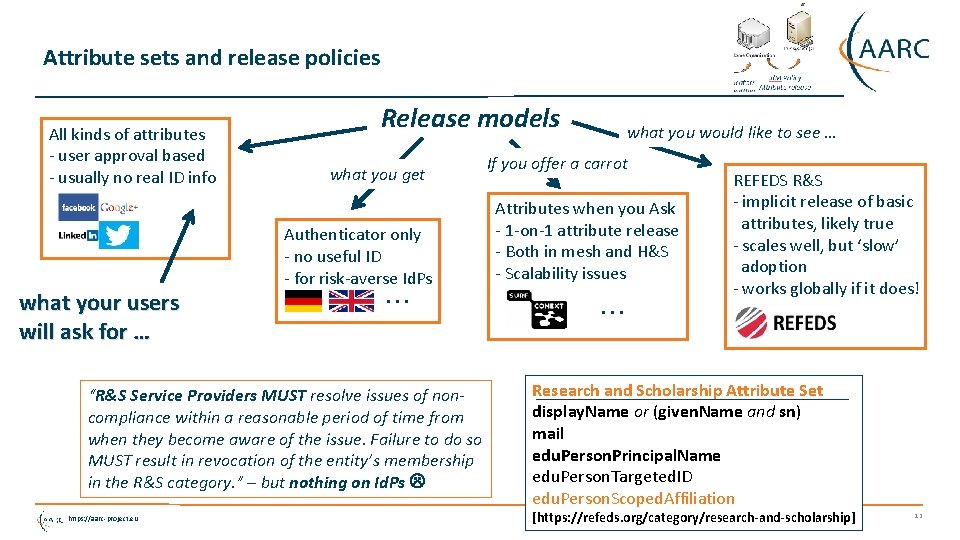
Attribute sets and release policies All kinds of attributes - user approval based - usually no real ID info what your users will ask for … Release models what you get Authenticator only - no useful ID - for risk-averse Id. Ps. . . “R&S Service Providers MUST resolve issues of noncompliance within a reasonable period of time from when they become aware of the issue. Failure to do so MUST result in revocation of the entity’s membership in the R&S category. ” – but nothing on Id. Ps https: //aarc-project. eu what you would like to see … If you offer a carrot Attributes when you Ask - 1 -on-1 attribute release - Both in mesh and H&S - Scalability issues. . . REFEDS R&S - implicit release of basic attributes, likely true - scales well, but ‘slow’ adoption - works globally if it does! Research and Scholarship Attribute Set display. Name or (given. Name and sn) mail edu. Person. Principal. Name edu. Person. Targeted. ID edu. Person. Scoped. Affiliation [https: //refeds. org/category/research-and-scholarship] 12
Federation policies for Id. Ps – Entity Categories and trust marks Federations operate according to very different assurance levels • Rather strict: SURFnet, HAKA, SWAMID, … • Very loose: ACOnet, In. Common, … • Little common practice in older federations, new ones might follow Marina’s Best Practice* When assessing a federation itself for usefulness, look for these elements: • Technology Profiles (Web. SSO, eduroam, …) – some technologies are transparent, others not • Authentication Lo. A profiles – is there a common baseline in the federation • Data Protection – can Id. Ps in that federation work with you and release attributes? • Operating practices (service level, contacts, &c) – are they willing to talk to you, as an outsider? • Governance and eligibility – what kind of entities can you expect in this federation? https: //aarc-project. eu * https: //wiki. refeds. org/display/FBP/Policy+Templates 13
Interfederation – edu. GAIN framework and interfederation edu. GAIN is a inter-federation scheme to connect federations to each other • although the one global known entity, it is not supposed to be seen by anyone but federation operators • yet an SP and Id. P should be aware of it, since it conveys your assertions and impacts trust • Limited policy around it: a top-level Declaration and a Constitution Governance is by federation operators, and at two levels • Public policy level Steering Group, and an Executive (actually: just the GEANT Project Executive) • Operations Team (Brook Schofield) Besides this, there are informal groups where things actually happen … the REFEDS Federation Operators Group (FOG) • wider scope than just edu. GAIN, and more practical - it’s the one reliable comms mechanism • closed - with Fed operators usually concerned about PR issues like outages handled there https: //aarc-project. eu services. geant. net/edugain/Resources/ 14
Interfederation – edu. GAIN policy-less operation Technical implementation: a large meta-data feed at http: //mds. edugain. org/ • You could filter on entities in there, and – as an independent service provider – you probably should • But it’s not much encouraged: you need your own software to process this. But then deploying a few scripts is not too complex for a service provider (unless you’re hidden behind a classic hub-n-spoke federation operator), and e. g. mod_mellon has this as a default feature What to consider as an independent Service Provider • Ability to suspend Id. Ps and registrars (=federations) • Filter on Entity Categories (attributes in the meta-data) • Subscribe to a central emergency suspension service? Of the self-assessment tool? But those are not there yet … Use the meta-data feed and MET to explore the world, via https: //met. refeds. org/ https: //aarc-project. eu https: //github. com/UNINETT/mod_auth_mellon - and see Mellon. Id. PIgnore 15
Exchanging data between SPs But what about data protection – will I get hit over the head by my DPA? Now what? • To exchange use data (accounting) and logged information, you need to stay within purpose • So in your policies and statement, add ‘security’ as a purpose of the data collection Personal Data of End Users (hereinafter “Personal Data”) shall be Processed only for those administrative, operational, accounting, monitoring and security purposes that are necessary for the safe and reliable operation of Infrastructure services, without prejudice to the End Users’ rights under the relevant laws. Make sure your peer service providers in the infrastructure sign up to the same policy suite “Personal Data may only be transferred to or otherwise shared with individuals or organisations where the recipient • has agreed to be bound by this Policy and the set of common Infrastructure policies, or • is part of a recognised Computer Incident Response Team framework and as part of an incident investigation to prevent active or suspected misuse of Infrastructure services, or • presents an appropriately enforced legal request. ” Ian Neilson et al. based on the EU BCR model https: //aarc-project. eu e. g. https: //documents. egi. eu/document/669, and https: //indico. egi. eu/indico/event/2923/contribution/2/material/0/17
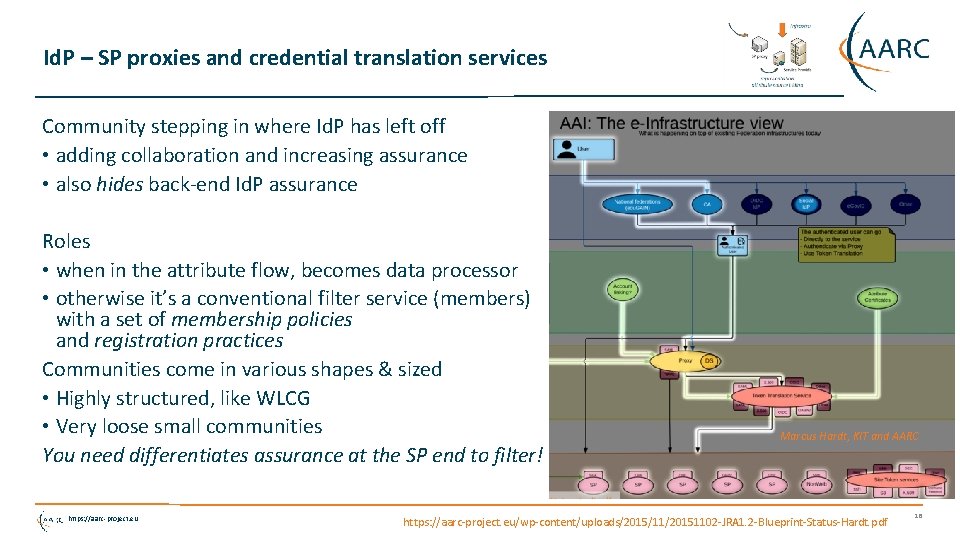
Id. P – SP proxies and credential translation services Community stepping in where Id. P has left off • adding collaboration and increasing assurance • also hides back-end Id. P assurance Roles • when in the attribute flow, becomes data processor • otherwise it’s a conventional filter service (members) with a set of membership policies and registration practices Communities come in various shapes & sized • Highly structured, like WLCG • Very loose small communities You need differentiates assurance at the SP end to filter! https: //aarc-project. eu Marcus Hardt, KIT and AARC https: //aarc-project. eu/wp-content/uploads/2015/11/20151102 -JRA 1. 2 -Blueprint-Status-Hardt. pdf 18
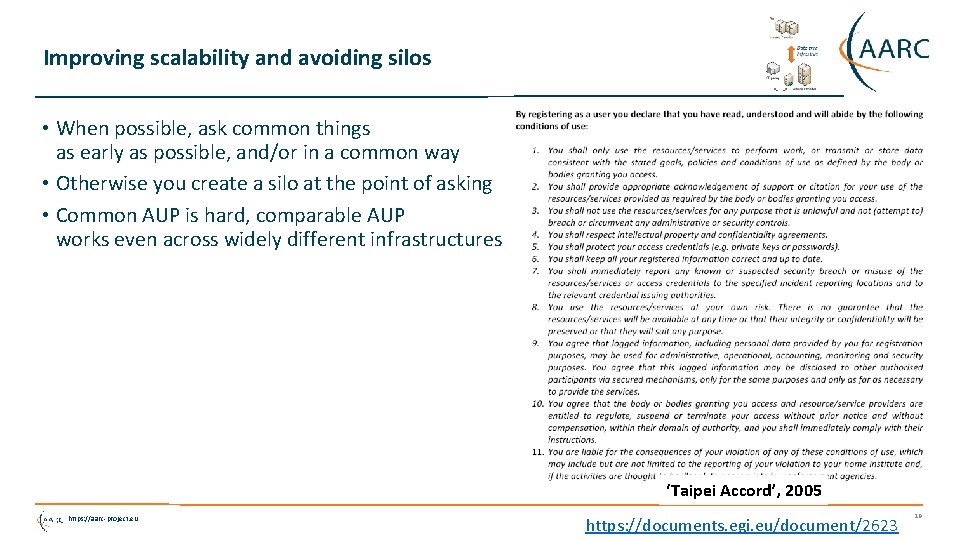
Improving scalability and avoiding silos • When possible, ask common things as early as possible, and/or in a common way • Otherwise you create a silo at the point of asking • Common AUP is hard, comparable AUP works even across widely different infrastructures ‘Taipei Accord’, 2005 https: //aarc-project. eu https: //documents. egi. eu/document/2623 19
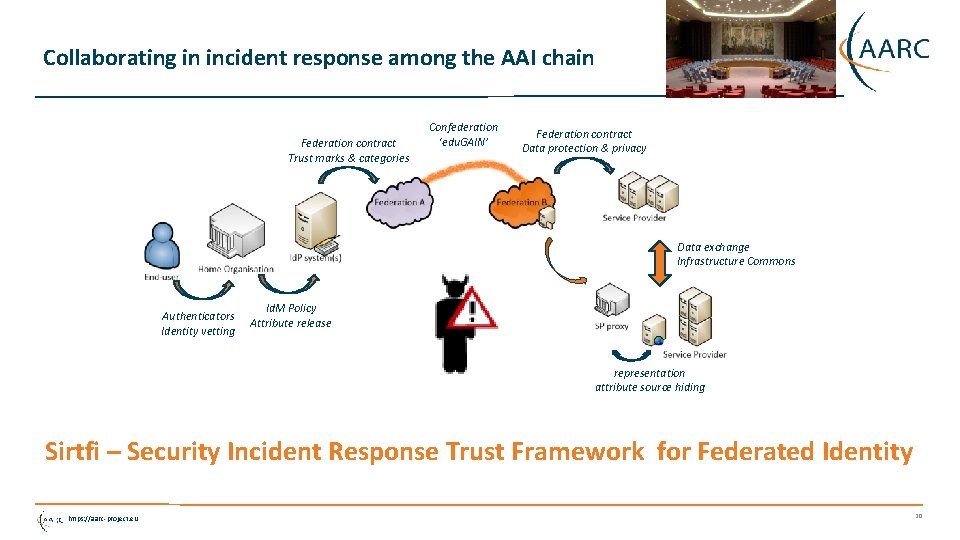
Collaborating in incident response among the AAI chain Federation contract Trust marks & categories Confederation ‘edu. GAIN’ Federation contract Data protection & privacy Data exchange Infrastructure Commons Authenticators Identity vetting Id. M Policy Attribute release representation attribute source hiding Sirtfi – Security Incident Response Trust Framework for Federated Identity https: //aarc-project. eu 20
Sirtfi Framework for Incident Response Collaboration Asserting Sirtfi compliance by an Id. P or SP (e. g. via SAML meta-data) means concretely • Operational Security • Managed vulnerability patching and processes, some intrusion detection, account management, contact information available, CSIRT established • Incident Response • Provide contact information, timely response to assistance requests, willing to collaborate, respect privacy and TLP classifications • Traceability • Logs are timestamped, retained, and available; and there is a policy governing its retention • Participant Responsibilities • There is an AUP for participants, users are made aware of it and agree to abide by it Some, not all, federation agreements actually cover some of this (e. g. an AUP in SURFconext) https: //aarc-project. eu https: //refeds. org/SIRTFI 21
Sirtfi – the road ahead! • Phase I: develop the SIRTFI Trust Framework specification, defining basic security incident response capabilities - organizations can self-assert compliance • Define meta-data schema for security contacts • Entity category definition and registration • Phase II: means for member organisations in R&E federations to indicate their compliance • Training and communication • Implement contact and category definitions in production federations (and keep it up to date) • Phase III: means for proactive notification of account compromise along the chain • Automated mechanisms for incident notification in the federation chain • Look e. g. at initiatives like Confyrm – incidents mostly spread based on commons user across SPs and Id. Ps • Tooling is needed, but maintaining privacy is always a challenge … https: //aarc-project. eu 22
Sirtfi in practice – Security Contact Meta-data in federations • Security Contact Data in the meta-data specification • Extends In. Common contact. Type (and will likely be renamed): <Contact. Person contact. Type="other" xmlns: icmd="http: //id. incommon. org/metadata" icmd: contact. Type= "http: //id. incommon. org/metadata/contact. Type/security"> Who to expect there? • Somebody in the entity organisation security team who knows about TLP and confidentiality • Promptly (within one business day) acknowledge receipt of the security incident report. • As soon as circumstances allow, investigate incident reports regarding resources, services, or identities for which they are responsible. • Respond to the incident reporter and any other impacted parties when the incident is resolved. https: //aarc-project. eu 23
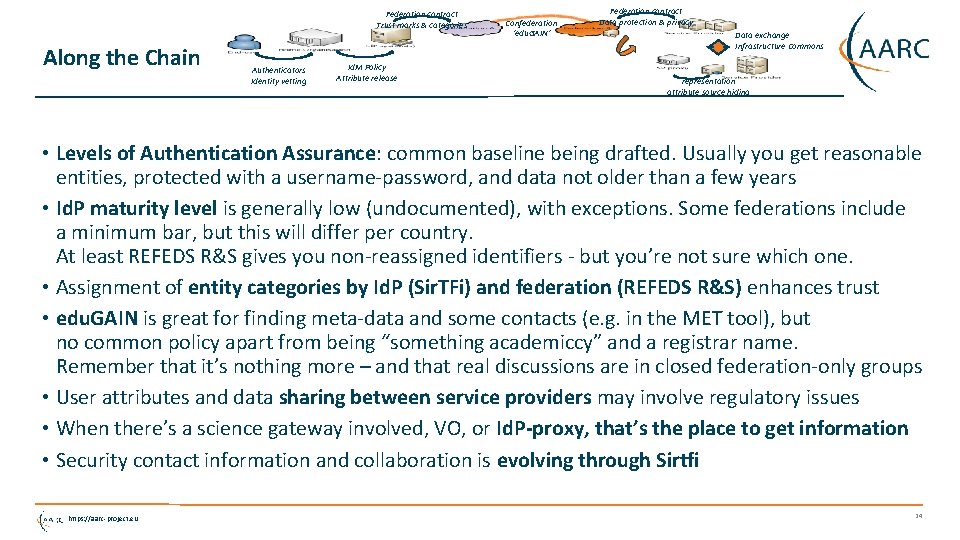
Federation contract Trust marks & categories Along the Chain Authenticators Identity vetting Id. M Policy Attribute release Confederation ‘edu. GAIN’ Federation contract Data protection & privacy Data exchange Infrastructure Commons representation attribute source hiding • Levels of Authentication Assurance: common baseline being drafted. Usually you get reasonable entities, protected with a username-password, and data not older than a few years • Id. P maturity level is generally low (undocumented), with exceptions. Some federations include a minimum bar, but this will differ per country. At least REFEDS R&S gives you non-reassigned identifiers - but you’re not sure which one. • Assignment of entity categories by Id. P (Sir. TFi) and federation (REFEDS R&S) enhances trust • edu. GAIN is great for finding meta-data and some contacts (e. g. in the MET tool), but no common policy apart from being “something academiccy” and a registrar name. Remember that it’s nothing more – and that real discussions are in closed federation-only groups • User attributes and data sharing between service providers may involve regulatory issues • When there’s a science gateway involved, VO, or Id. P-proxy, that’s the place to get information • Security contact information and collaboration is evolving through Sirtfi https: //aarc-project. eu 24
https: //www. nikhef. nl/~davidg/presentations/ISGC-Sec. WS-2016 -Assurance-and-Federation-AARC. ppdf Thank you Any Questions? davidg@nikhef. nl https: //aarc-project. eu © GÉANT on behalf of the AARC project. The work leading to these results has received funding from the European Union’s Horizon 2020 research and innovation programme under Grant Agreement No. 653965 (AARC). https: //aarc-project. eu
- Slides: 24