
AUTHENTIC DIGITAL WRITING CONTEXTS ON THE HOMEFRONT CRAFT



- Slides: 26
AUTHENTIC DIGITAL WRITING CONTEXTS ON THE HOMEFRONT: CRAFT, GENRE, PROCESS, AND PROMPTS
INTRODUCTION TO DIGITAL WRITING CRAFT AND PROCESS: TROY HICKS, NWP, NCTE, AND ILA DIGITAL WRITING PROCESS
QUESTIONS ABOUT DIGITAL WRITING • Should we, as Hicks claims, "focus on the many ways that we must use technology to teach writing? " (2). • How do we address concerns relative to digital writing practices in schools? • Not all students have reasonable access (or any access) to technology • Technologies can be fragile • Tangible feel of paper can be reassuring • We still face standardized tests (4)
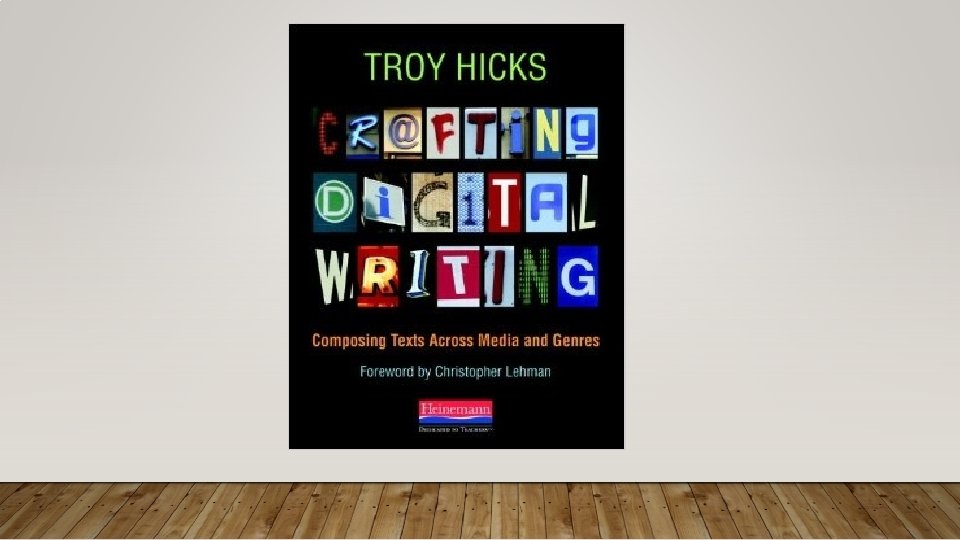
POINTS GUIDING TEACHING DIGITAL WRITING 1. Using Mentor Texts to highlight the "many qualities of good [digital] writing: According to Hicks, "We must find strong examples of digital writing that moves us, and then exploring the craft becomes essential" (7). 2. Modeling and incorporating the digital writing process: According to Kelly Gallagher, "the teacher should model by [digitally] writing—and think out loud while [digitally] writing—in front of the class (quoted in Hicks 8).
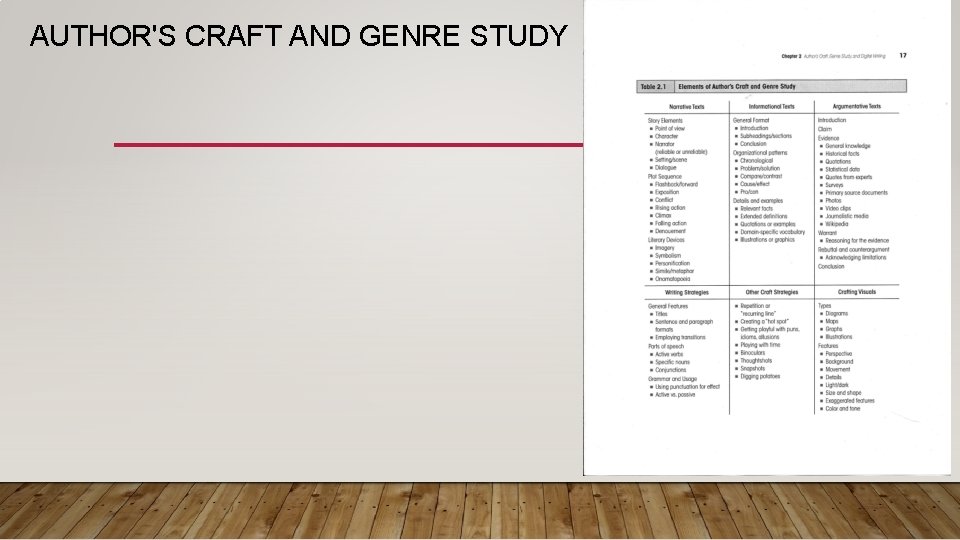
AUTHOR'S CRAFT, GENRE STUDY, AND DIGITAL WRITING • Study craft with lenses: Help students learn to read like a writer, getting a feel for elements such as recurring details. • Study craft by slowing down: "move backwards from what we see in a finished text to what we imagine the writer did to make it come out that way. . Slow this part way down and really explore the meaning of craft in text" (Katie Wood Ray quoted in Hicks 13). • Study craft by starting small: Teach craft in a variety of ways and a number of ways to the whole class, small group, or individuals. • Study craft in digital writing by incorporating genre study.
AUTHOR'S CRAFT AND GENRE STUDY
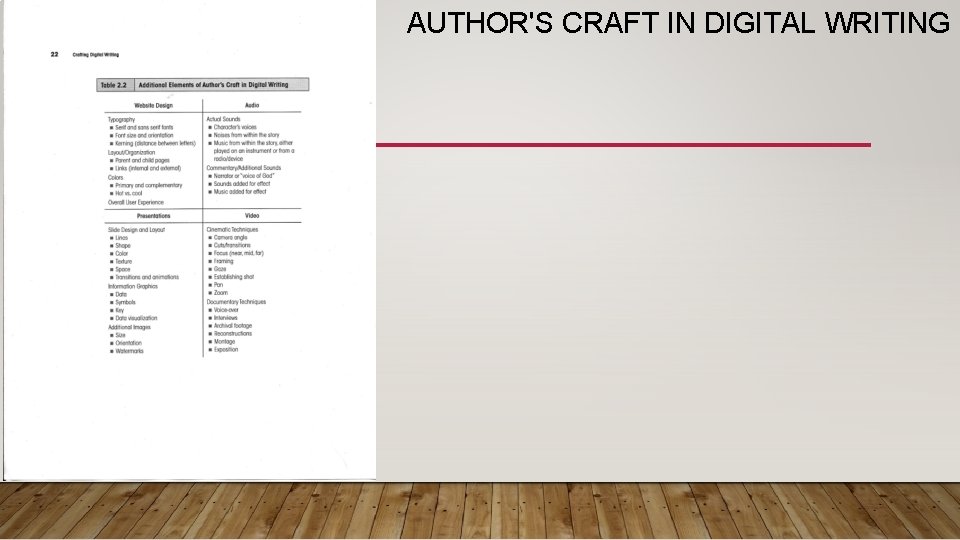
AUTHOR'S CRAFT IN DIGITAL WRITING
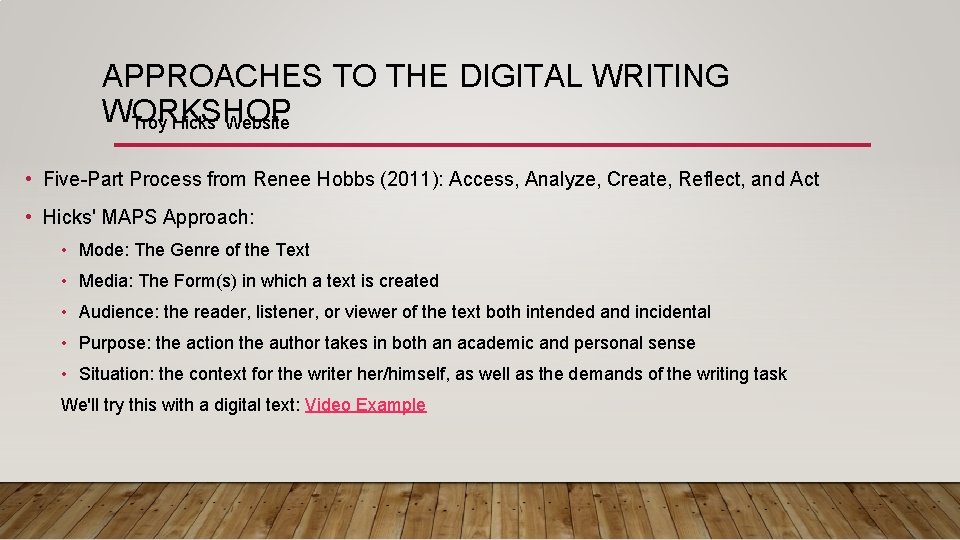
APPROACHES TO THE DIGITAL WRITING WORKSHOP Troy Hicks' Website • Five-Part Process from Renee Hobbs (2011): Access, Analyze, Create, Reflect, and Act • Hicks' MAPS Approach: • Mode: The Genre of the Text • Media: The Form(s) in which a text is created • Audience: the reader, listener, or viewer of the text both intended and incidental • Purpose: the action the author takes in both an academic and personal sense • Situation: the context for the writer her/himself, as well as the demands of the writing task We'll try this with a digital text: Video Example
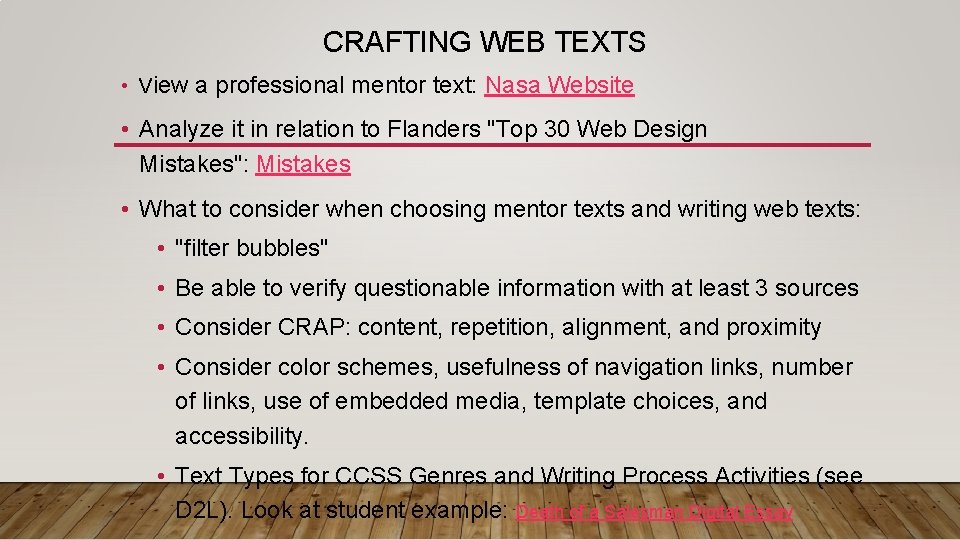
CRAFTING WEB TEXTS • View a professional mentor text: Nasa Website • Analyze it in relation to Flanders "Top 30 Web Design Mistakes": Mistakes • What to consider when choosing mentor texts and writing web texts: • "filter bubbles" • Be able to verify questionable information with at least 3 sources • Consider CRAP: content, repetition, alignment, and proximity • Consider color schemes, usefulness of navigation links, number of links, use of embedded media, template choices, and accessibility. • Text Types for CCSS Genres and Writing Process Activities (see D 2 L). Look at student example: Death of a Salesman Digital Essay
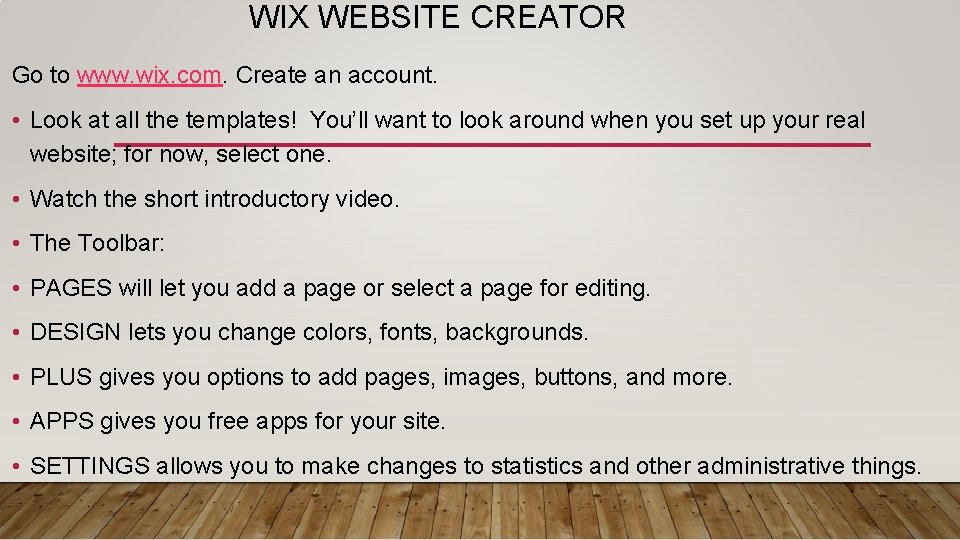
WIX WEBSITE CREATOR Go to www. wix. com. Create an account. • Look at all the templates! You’ll want to look around when you set up your real website; for now, select one. • Watch the short introductory video. • The Toolbar: • PAGES will let you add a page or select a page for editing. • DESIGN lets you change colors, fonts, backgrounds. • PLUS gives you options to add pages, images, buttons, and more. • APPS gives you free apps for your site. • SETTINGS allows you to make changes to statistics and other administrative things.
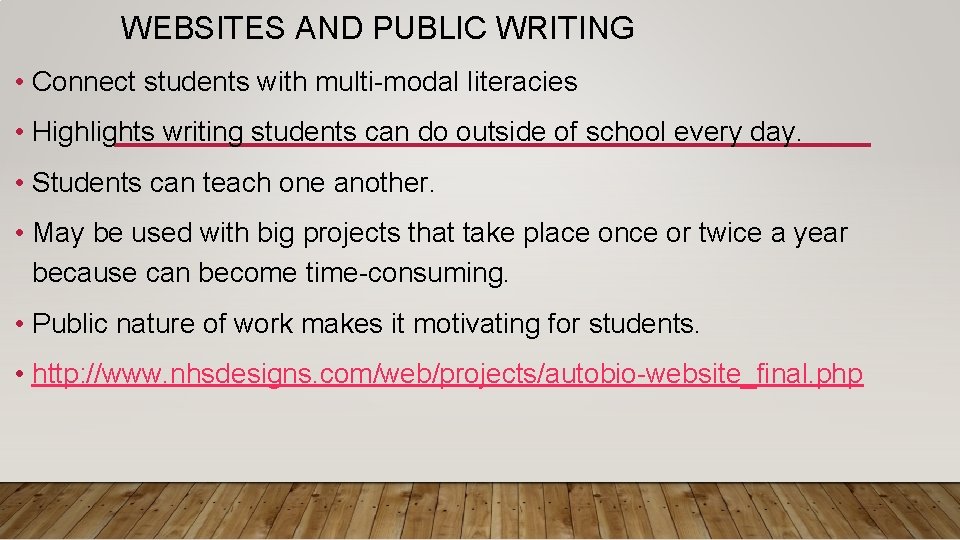
WEBSITES AND PUBLIC WRITING • Connect students with multi-modal literacies • Highlights writing students can do outside of school every day. • Students can teach one another. • May be used with big projects that take place once or twice a year because can become time-consuming. • Public nature of work makes it motivating for students. • http: //www. nhsdesigns. com/web/projects/autobio-website_final. php
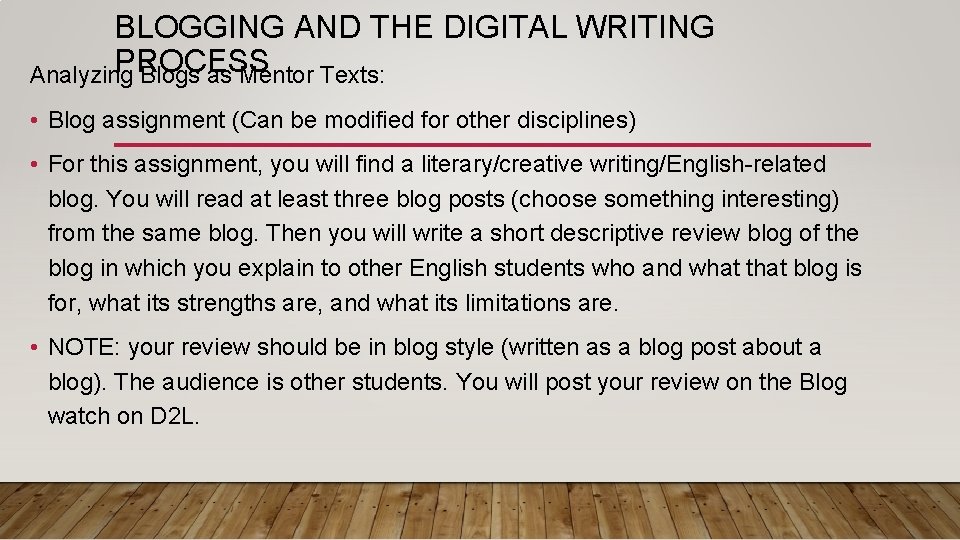
BLOGGING AND THE DIGITAL WRITING PROCESS Analyzing Blogs as Mentor Texts: • Blog assignment (Can be modified for other disciplines) • For this assignment, you will find a literary/creative writing/English-related blog. You will read at least three blog posts (choose something interesting) from the same blog. Then you will write a short descriptive review blog of the blog in which you explain to other English students who and what that blog is for, what its strengths are, and what its limitations are. • NOTE: your review should be in blog style (written as a blog post about a blog). The audience is other students. You will post your review on the Blog watch on D 2 L.
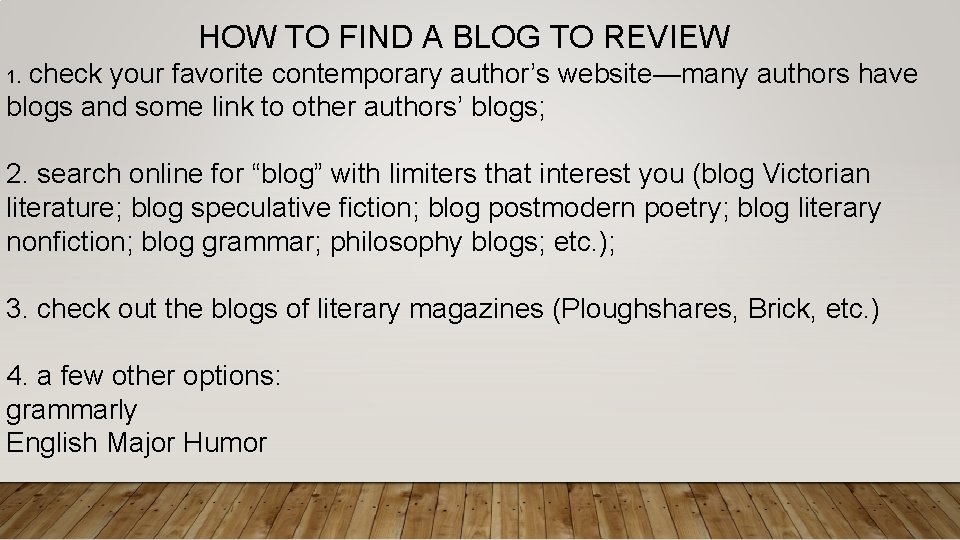
HOW TO FIND A BLOG TO REVIEW check your favorite contemporary author’s website—many authors have blogs and some link to other authors’ blogs; 1. 2. search online for “blog” with limiters that interest you (blog Victorian literature; blog speculative fiction; blog postmodern poetry; blog literary nonfiction; blog grammar; philosophy blogs; etc. ); 3. check out the blogs of literary magazines (Ploughshares, Brick, etc. ) 4. a few other options: grammarly English Major Humor
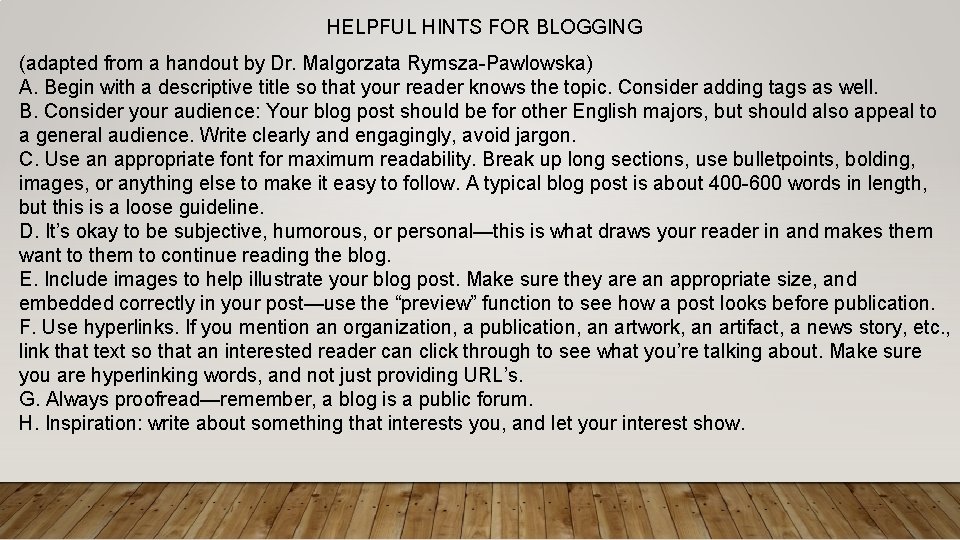
HELPFUL HINTS FOR BLOGGING (adapted from a handout by Dr. Malgorzata Rymsza-Pawlowska) A. Begin with a descriptive title so that your reader knows the topic. Consider adding tags as well. B. Consider your audience: Your blog post should be for other English majors, but should also appeal to a general audience. Write clearly and engagingly, avoid jargon. C. Use an appropriate font for maximum readability. Break up long sections, use bulletpoints, bolding, images, or anything else to make it easy to follow. A typical blog post is about 400 -600 words in length, but this is a loose guideline. D. It’s okay to be subjective, humorous, or personal—this is what draws your reader in and makes them want to them to continue reading the blog. E. Include images to help illustrate your blog post. Make sure they are an appropriate size, and embedded correctly in your post—use the “preview” function to see how a post looks before publication. F. Use hyperlinks. If you mention an organization, a publication, an artwork, an artifact, a news story, etc. , link that text so that an interested reader can click through to see what you’re talking about. Make sure you are hyperlinking words, and not just providing URL’s. G. Always proofread—remember, a blog is a public forum. H. Inspiration: write about something that interests you, and let your interest show.
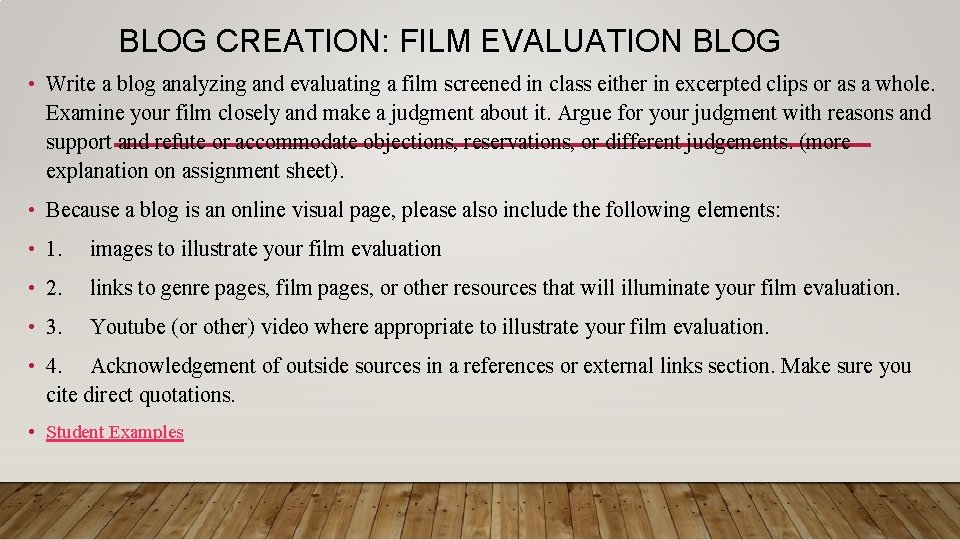
BLOG CREATION: FILM EVALUATION BLOG • Write a blog analyzing and evaluating a film screened in class either in excerpted clips or as a whole. Examine your film closely and make a judgment about it. Argue for your judgment with reasons and support and refute or accommodate objections, reservations, or different judgements. (more explanation on assignment sheet). • Because a blog is an online visual page, please also include the following elements: • 1. images to illustrate your film evaluation • 2. links to genre pages, film pages, or other resources that will illuminate your film evaluation. • 3. Youtube (or other) video where appropriate to illustrate your film evaluation. • 4. Acknowledgement of outside sources in a references or external links section. Make sure you cite direct quotations. • Student Examples
CRAFTING SOCIAL MEDIA • View Professional Mentor Texts: Tweets example • Think of it as micro-blogging • Microblogging involves both multidirectional links and linear pathways • Microblogging reflects upon itself as authors comment on previous posts • Microblogging involves a rapid and transparent process of text creation and distribution, with posts receiving feedback quickly.
DIGITAL WRITING PROCESS FOR SOCIAL MEDIA • Follow MAPS approach for invention and pre-writing and happens before logging in • Choose a social media platform that will work best for message and audience choices • Revise and edit before sending message/posting/publishing it. Think carefully about what posting and why. • See examples of social media tools for digital writing on D 2 L • Student example: Andrew's Initial Post
PODCAST ASSIGNMENT IDEAS • Group Podcast (can be modified for other disciplines) • Bredesen and Murray • Literary Podcast Assignment • For this assignment, you will make a podcast (between 1: 30 [one and one-half minutes] and 6: 00 [six minutes] in length) about some aspect of literary study. The purpose of your podcast is to help less-experienced literature students (including people who are not English majors) understand the text or concept that is the topic of your podcast.
Process: you may complete this assignment individually or in small groups (no more than 3 people per group). If your podcast is a group effort, all group members must participate in all aspects of the podcast—research, writing, and performing. Five minutes is an absolute maximum; no exceptions. Feel free to have a little fun with this! Final product: You will turn in a written script for your podcast (written in script form), a link to or video of the podcast itself, and of course your works cited (helpful hint: do a “works cited slide” at the end of your podcast). In class, you will play your podcast for your classmates. To submit your podcast: make a You. Tube video and post the link to the dropbox on D 2 L, or use another online video site (Vimeo, etc. ) and post the link to D 2 L, or make a video file and post that to D 2 L.
Topic choices—we invite you to run your topic ideas by us before beginning: 1. choose a literary text and provide an analysis of some part of it (think part-to-thewhole, here—don’t ignore the text as a whole, but analyze one aspect of it as an example of what is interesting or challenging in the text). One example of this is the Close Reading Cooperative podcast on motifs in Emerson’s “Self Reliance”: https: //www. youtube. com/watch? v=mc 95 ndkl. DYY. 2. choose a concept from literary studies that you find interesting or tricky and provide an explanation of it that helps us understand it. A couple of examples from the Close Reading Cooperative podcast: the pathetic fallacy (https: //www. youtube. com/watch? v=PUDNDsc. Ow 0 I) or irony vs. paradox (https: //www. youtube. com/watch? v=wt. U 2 Mth 86 Hc).
Other examples—any of the You. Tube videos from the Close Reading Cooperative, including: https: //www. youtube. com/watch? v=cyqi. Uw. IWGR 8 https: //www. youtube. com/watch? v=g. A 6 ISi 7 j. GB 8 Student-created examples—these examples are from previous class with a similar assignment. Note that they were required to do podcasts on figurative language, so that’s why all the topics are the same. http: //www. youtube. com/watch? v=VL 7 S 9 Fwa 86 c http: //www. youtube. com/watch? v=9 VKj. Md. CW-80 http: //www. youtube. com/watch? v=u 4 us. R 7 g. Gi. Ic