
Autacoids III EICOSANOIDS prostaglandins thromboxanes leukotrienes OBJECTIVES 1
Autacoids III EICOSANOIDS (prostaglandins, thromboxanes, leukotrienes)
OBJECTIVES 1. Describe the pharmacology of prostaglandins and its clinical n Implications n 2. List the major clinical implications and toxicities of ergot n alkaloids on the major organ systems

Inflammatory Biomolecules Signal Molecules – Histamine – Eicosanoids • Prostaglandins • Thromboxanes • Leukotrienes – Bradykinins – Cytokines • Interferons • Interleukins • Chemotaxins –. . . Other minor molecules • Made in almost all tissues • Very short half-life • Act locally on neighbors • Not usually stored up • 20 0 carbon backbones • Made from arachidonic acid
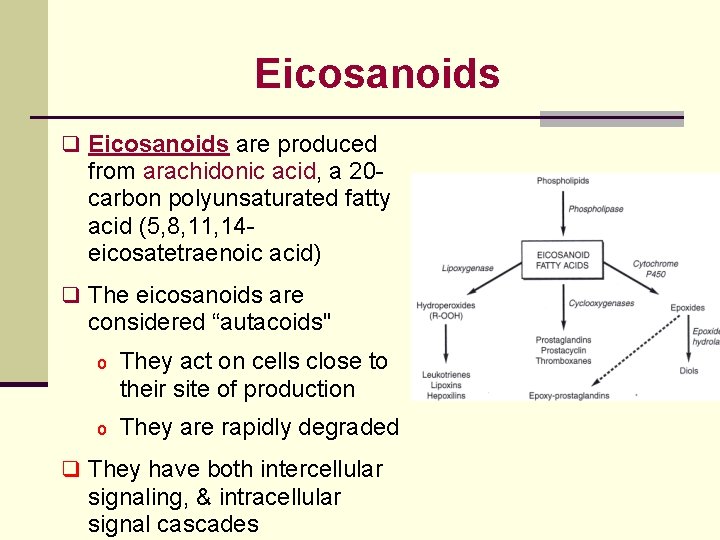
Eicosanoids q Eicosanoids are produced from arachidonic acid, a 20 carbon polyunsaturated fatty acid (5, 8, 11, 14 eicosatetraenoic acid) q The eicosanoids are considered “autacoids" o They act on cells close to their site of production o They are rapidly degraded q They have both intercellular signaling, & intracellular signal cascades
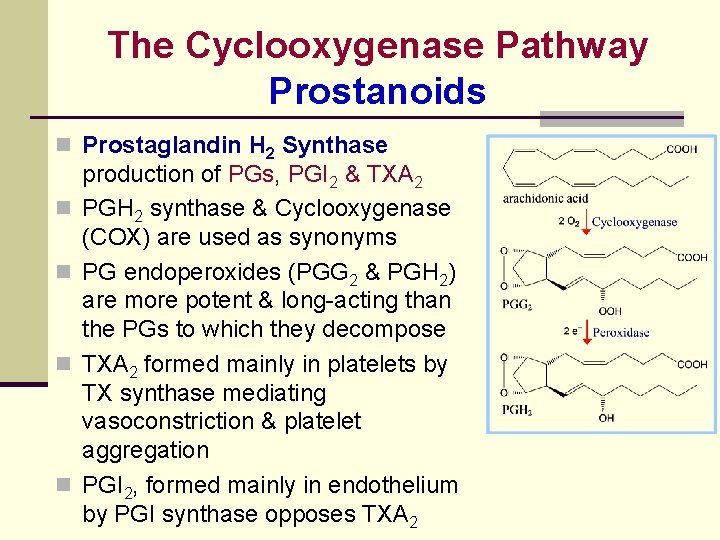
The Cyclooxygenase Pathway Prostanoids n Prostaglandin H 2 Synthase n n production of PGs, PGI 2 & TXA 2 PGH 2 synthase & Cyclooxygenase (COX) are used as synonyms PG endoperoxides (PGG 2 & PGH 2) are more potent & long-acting than the PGs to which they decompose TXA 2 formed mainly in platelets by TX synthase mediating vasoconstriction & platelet aggregation PGI 2, formed mainly in endothelium by PGI synthase opposes TXA 2

The Cyclooxygenase Pathway q Two isoforms of COX exists: COX-1 (constitutive form) & COX-2 (inducible form) q COX-1 is constitutively expressed at low levels in many cell types q COX-2 is constitutively expressed in kidney & CNS ü COX-2 gene transcription is stimulated by growth factors, cytokines, & endotoxins q A COX-1 variant, named COX-3, plays a significant role in pain sensation in paracetamol-sensitive way
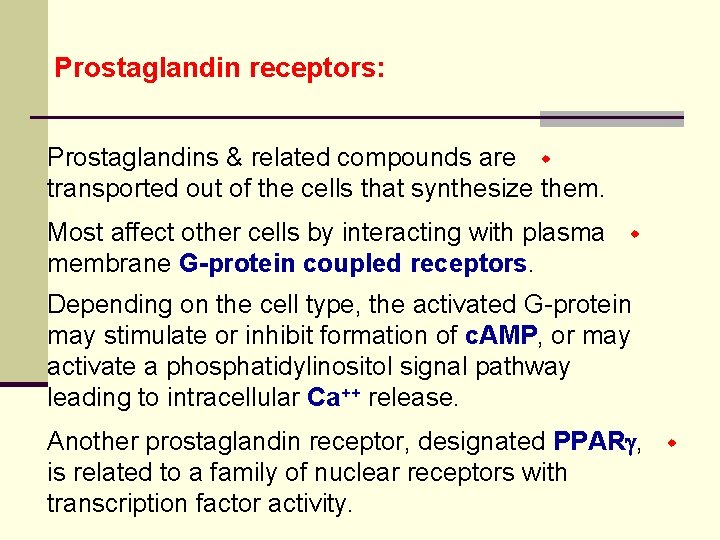
Prostaglandin receptors: Prostaglandins & related compounds are w transported out of the cells that synthesize them. Most affect other cells by interacting with plasma membrane G-protein coupled receptors. w Depending on the cell type, the activated G-protein may stimulate or inhibit formation of c. AMP, or may activate a phosphatidylinositol signal pathway leading to intracellular Ca++ release. Another prostaglandin receptor, designated PPARg, is related to a family of nuclear receptors with transcription factor activity. w
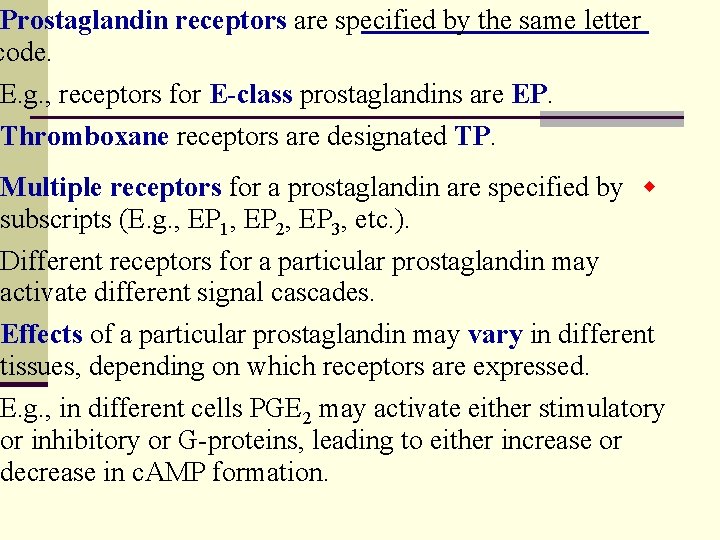
Prostaglandin receptors are specified by the same letter code. E. g. , receptors for E-class prostaglandins are EP. Thromboxane receptors are designated TP. Multiple receptors for a prostaglandin are specified by w subscripts (E. g. , EP 1, EP 2, EP 3, etc. ). Different receptors for a particular prostaglandin may activate different signal cascades. Effects of a particular prostaglandin may vary in different tissues, depending on which receptors are expressed. E. g. , in different cells PGE 2 may activate either stimulatory or inhibitory or G-proteins, leading to either increase or decrease in c. AMP formation.
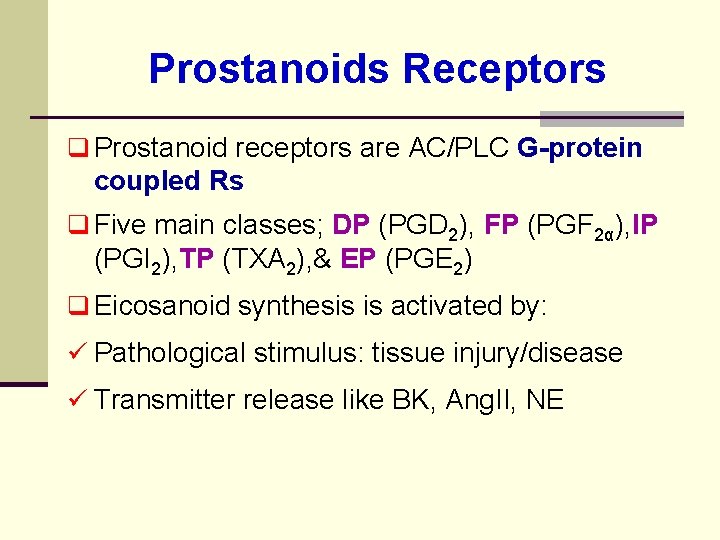
Prostanoids Receptors q Prostanoid receptors are AC/PLC G-protein coupled Rs q Five main classes; DP (PGD 2), FP (PGF 2α), IP (PGI 2), TP (TXA 2), & EP (PGE 2) q Eicosanoid synthesis is activated by: ü Pathological stimulus: tissue injury/disease ü Transmitter release like BK, Ang. II, NE
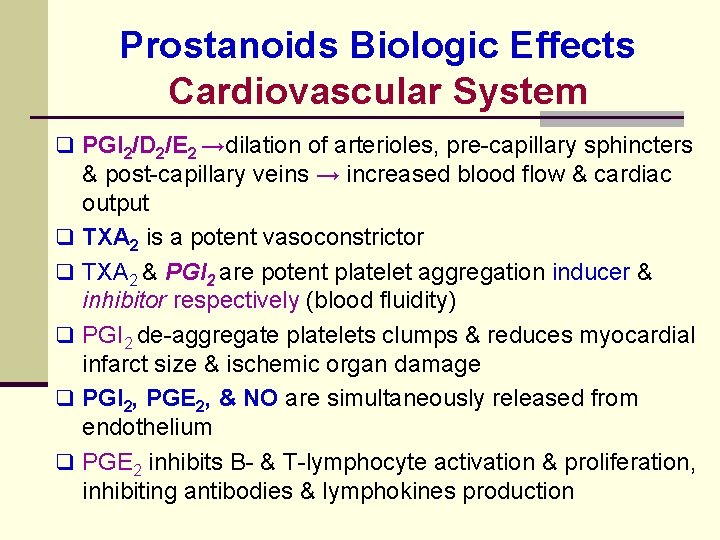
Prostanoids Biologic Effects Cardiovascular System q PGI 2/D 2/E 2 →dilation of arterioles, pre-capillary sphincters q q q & post-capillary veins → increased blood flow & cardiac output TXA 2 is a potent vasoconstrictor TXA 2 & PGI 2 are potent platelet aggregation inducer & inhibitor respectively (blood fluidity) PGI 2 de-aggregate platelets clumps & reduces myocardial infarct size & ischemic organ damage PGI 2, PGE 2, & NO are simultaneously released from endothelium PGE 2 inhibits B- & T-lymphocyte activation & proliferation, inhibiting antibodies & lymphokines production
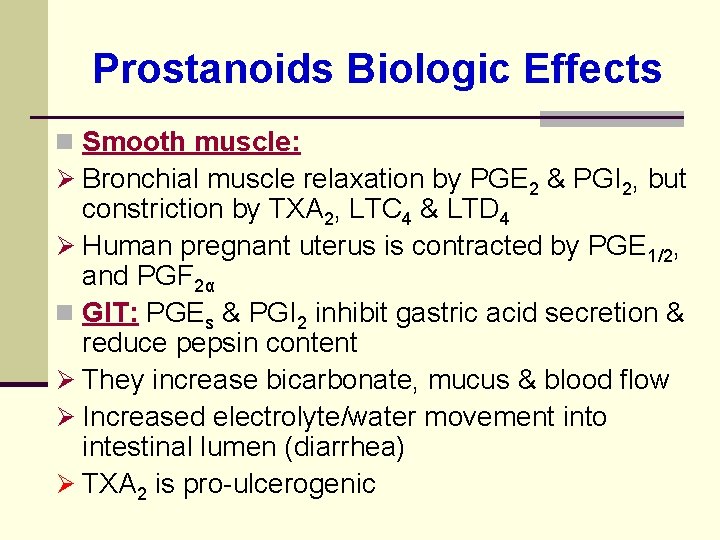
Prostanoids Biologic Effects n Smooth muscle: Ø Bronchial muscle relaxation by PGE 2 & PGI 2, but constriction by TXA 2, LTC 4 & LTD 4 Ø Human pregnant uterus is contracted by PGE 1/2, and PGF 2α n GIT: PGEs & PGI 2 inhibit gastric acid secretion & reduce pepsin content Ø They increase bicarbonate, mucus & blood flow Ø Increased electrolyte/water movement into intestinal lumen (diarrhea) Ø TXA 2 is pro-ulcerogenic
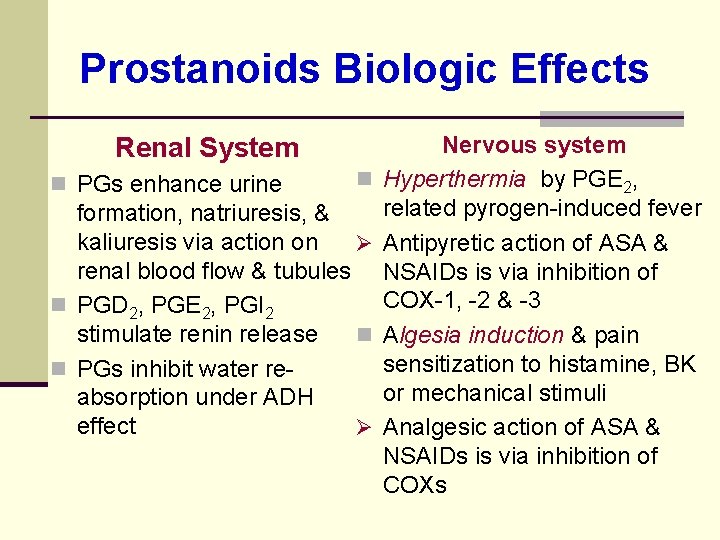
Prostanoids Biologic Effects Renal System n PGs enhance urine n formation, natriuresis, & kaliuresis via action on Ø renal blood flow & tubules n PGD 2, PGE 2, PGI 2 stimulate renin release n n PGs inhibit water reabsorption under ADH effect Ø Nervous system Hyperthermia by PGE 2, related pyrogen-induced fever Antipyretic action of ASA & NSAIDs is via inhibition of COX-1, -2 & -3 Algesia induction & pain sensitization to histamine, BK or mechanical stimuli Analgesic action of ASA & NSAIDs is via inhibition of COXs
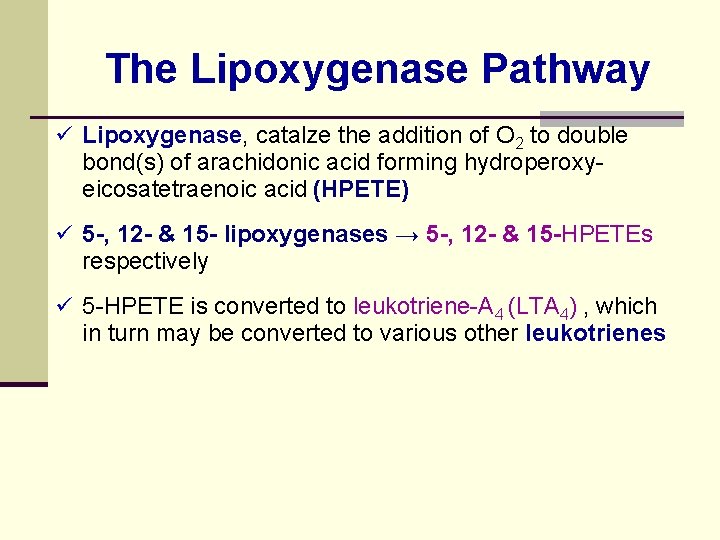
The Lipoxygenase Pathway ü Lipoxygenase, catalze the addition of O 2 to double bond(s) of arachidonic acid forming hydroperoxyeicosatetraenoic acid (HPETE) ü 5 -, 12 - & 15 - lipoxygenases → 5 -, 12 - & 15 -HPETEs respectively ü 5 -HPETE is converted to leukotriene-A 4 (LTA 4) , which in turn may be converted to various other leukotrienes
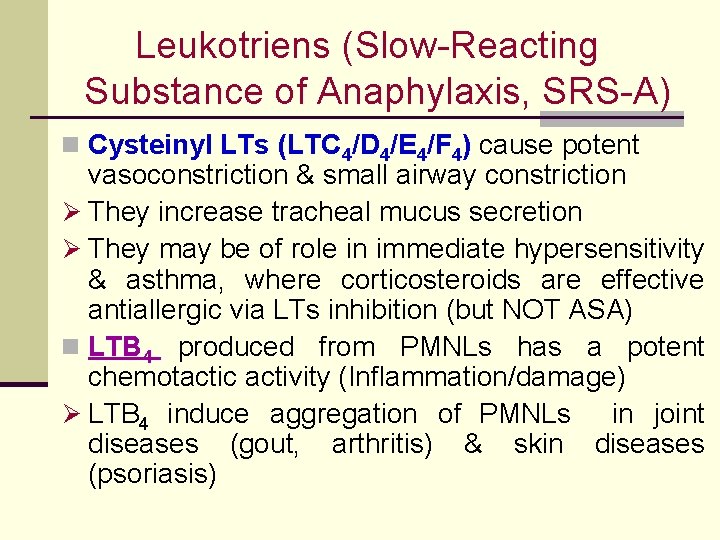
Leukotriens (Slow-Reacting Substance of Anaphylaxis, SRS-A) n Cysteinyl LTs (LTC 4/D 4/E 4/F 4) cause potent vasoconstriction & small airway constriction Ø They increase tracheal mucus secretion Ø They may be of role in immediate hypersensitivity & asthma, where corticosteroids are effective antiallergic via LTs inhibition (but NOT ASA) n LTB 4 produced from PMNLs has a potent chemotactic activity (Inflammation/damage) Ø LTB 4 induce aggregation of PMNLs in joint diseases (gout, arthritis) & skin diseases (psoriasis)
The Epoxygenase Pathway n A cytochrome P 450 epoxides double bonds of the precursor FA (arachidonate) into mono-epoxide FA; epoxy eicosatetraenoic acids (EPETEs) n EPETEs are involved in vascular tone modulation, ion transport, hemostasis & hematopoiesis
Prostanoids Therapeutic Uses Uterine Stimulation n Dinoprostone (PGE 2): Prostin E 2 vaginal suppositories used to induce abortion between 12 th -20 th gestational weeks Ø Prostin E 2 oral tablets for elective induction of labbour/obliged induction because of HTN, toxemia, intrauterine death • Treatment of duration ≤ 18 hrs Ø Prostin E 2 vaginal gel used for induction of labour at term or near term (I-2 mg intravaginal, repeated Q 6 hrs according to response)
Prostanoids Therapeutic Uses Uterine Stimulation n Carboprost (15 -methyl PGF 2α) n Used by IM route for induction of abortion between 12 th -20 th gestational weeks n Used at a dose of 250 μg every 1 -3 hrs n Dinoprost (PGF 2α) n Injection form for intra-amniotic administration n Used to induce labour or abortion
Prostanoids Therapeutic Uses GIT n Misoprostol is a synthetic methyl ester analogue of PGE 1 Ø Used to prevent drug-induced gastric ulceration during NSAIDs, corticosteroid or anticoagulant therapy Ø It can be used alone or in combination with antacids for duodenal ulcer treatment Ø Not used for pregnant women or whom are planning pregnancy
Prostanoids Therapeutic Uses Platelet Aggregation n Epoprostenol (PGI 2): n It is used as a heparin replacement in some hemodialysis patients n Used to prevent platelet aggregation in extracorporal circulation systems Impotence q Alprostadil (PGE 1) was used by in jection into corpora cavernosa to maintain erection ü Replaced by PDE-V inhibitors
Leukotriens Therapeutic Importance q LTs have no therapeutic uses, but LTs antagonists have q Anti-asthma medications: ü 5 -Lipoxygenase Inhibitors, e. g. , zileutin ü Leukotriene-receptor antagonists; montelukast, & zafirlukast
Platelet-Activating factor (PAF) n PAF, another lipid-derived autacoid n Released from inflammatory cells & platelets by PLA 2, upon activation n It has a role in many types of inflammation, bronchial hyper-responsiveness, and delayed phase of asthma n PAF antagonists (receptor/production inhibition) are potential antiinflammatory & antiasthmatic drugs n Corticosteroids anti-inflammatory effect comprise PAF production inhibition
Ergot Alkaloids Natural Products: Ergonovine Ergotamine Semisynthetic Products: Methylergonovine maleate Dihydroergotamine mesylate Lysergic acid diethylamine Synthetic Products: sumatriptan (Imitrex®)
Peripheral Effect smooth muscle contractions Cures migraine headaches lowers blood pressure Drugs Ergotamine tartrate + caffeine dihydroergotamine
Central Effects bradycardia vomiting inhibition of vasomotor center inhibition of pressoreceptor reflexes ergot alkaloids alone (has sedative effect)
Central Effects hyperthermia hyperglycemia mydriasis piloerection tachypnea hyperreflexia general motor hyperactivity
Uterotonic Effects childbirth accelerate childbirth arrest hemorrhaging Drugs ergonovine maleate ergometrine ergotamine (prolonged effects)

THANK YOU
- Slides: 27