
Austrian Economics VS Keynesian Macroeconomics and Modern Monetary
- Slides: 15
Austrian Economics VS Keynesian Macroeconomics and Modern Monetary Theory Mises University Auburn, Alabama
Macroeconomics First Use of Term: • Jacob Marschak, “A Cross Section of Business Cycle Discussion” The American Economic Review, Vol. 35, No. 3 (Jun. , 1945), pp. 368 -381 • “Across the distinction between statics and dynamics cuts another one: that between aggregative or "macro"economics, and the "micro"- economics of a single firm or household. ”
Macroeconomics Key topics: • Purchasing power of money • Recession • Economic Expansion and Development Must grasp how each individual market is integrated into the broad social economy
Macroeconomics Modern Macroeconomics Is Dominated by Modeling Model-Building: Abstract construction of only a few of the many relationships in economy or society. What are some common characteristics?
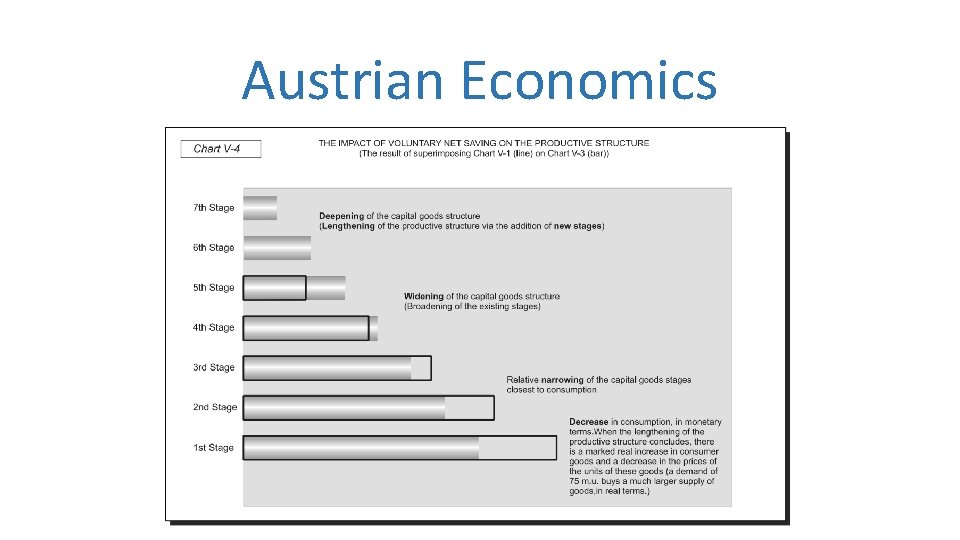
Austrian Economics Proceeds from human action to derive principles that allow us to ultimately analyze topics relevant for entire economic order. Sound Macroeconomics must incorporate what incorporates entire social economy. Economic progress is result of increases in voluntary saving.
Austrian Economics
Keynesian Macro Represents National Income (Y) as sum of spending in various sectors of the economy. Y=C+I+G Believe that economy is inherently unstable and easily tends to recession. • Due to volatile business investment (I) • Resulting from collapse of Marginal Efficiency of Capital (MEC) driven by changes in “animal spirits. ”
Keynesian Macro Important issue is the relative levels of MEC and the interest rate. • Interest rate: “Obviously measures…the premium which has to be offered to induce people to hold their wealth in some form other than hoarded money. ” • Determined by S of and D for money: Liquidity Preference Theory of Money. • Rate of payed and received in loanable funds market.
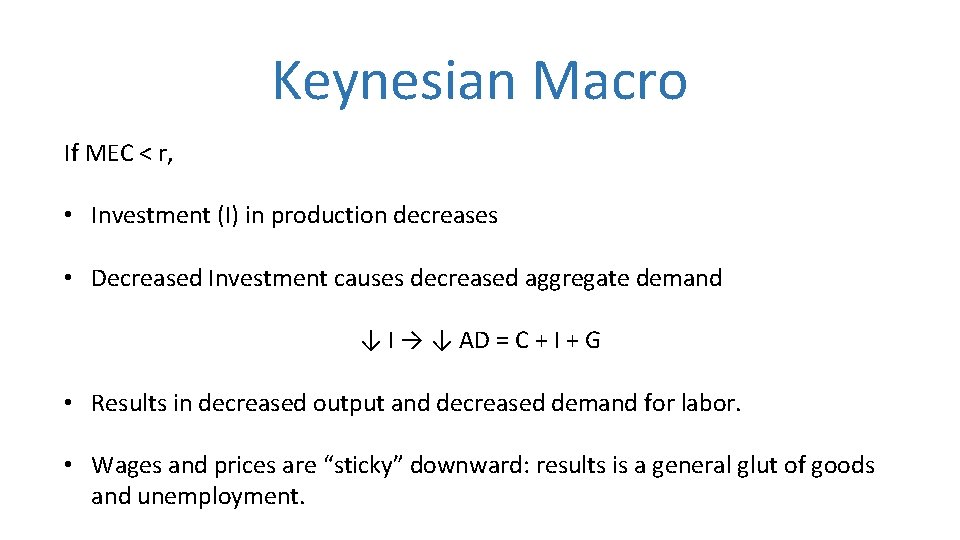
Keynesian Macro If MEC < r, • Investment (I) in production decreases • Decreased Investment causes decreased aggregate demand ↓ I → ↓ AD = C + I + G • Results in decreased output and decreased demand for labor. • Wages and prices are “sticky” downward: results is a general glut of goods and unemployment.
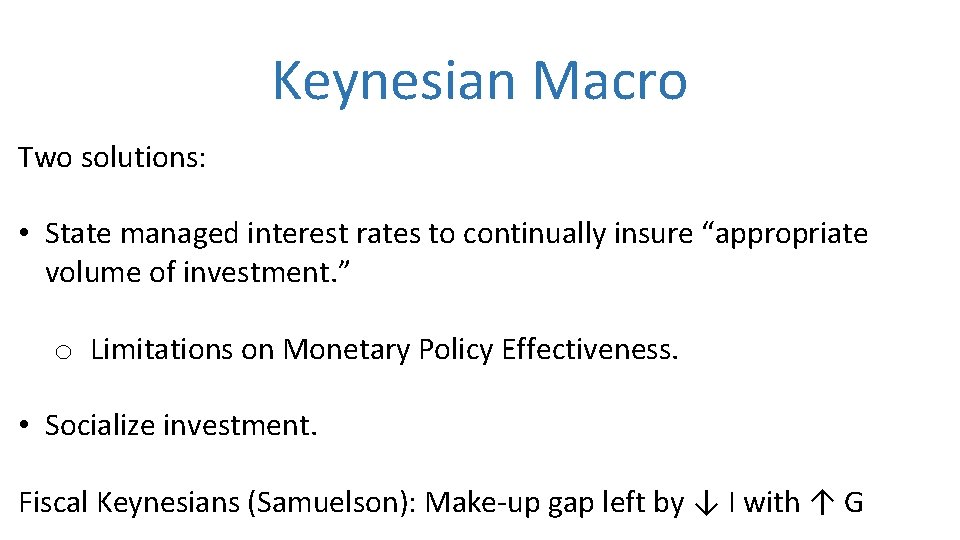
Keynesian Macro Two solutions: • State managed interest rates to continually insure “appropriate volume of investment. ” o Limitations on Monetary Policy Effectiveness. • Socialize investment. Fiscal Keynesians (Samuelson): Make-up gap left by ↓ I with ↑ G
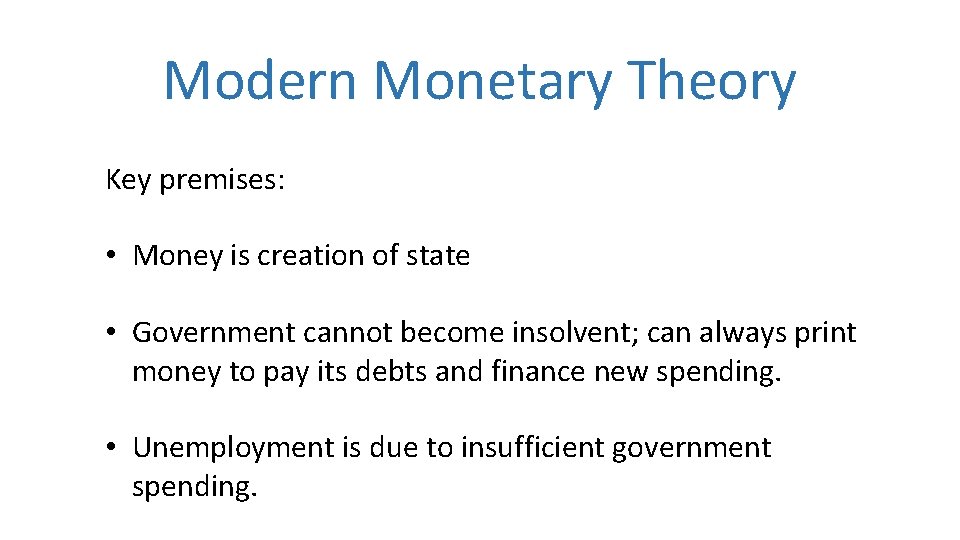
Modern Monetary Theory Key premises: • Money is creation of state • Government cannot become insolvent; can always print money to pay its debts and finance new spending. • Unemployment is due to insufficient government spending.
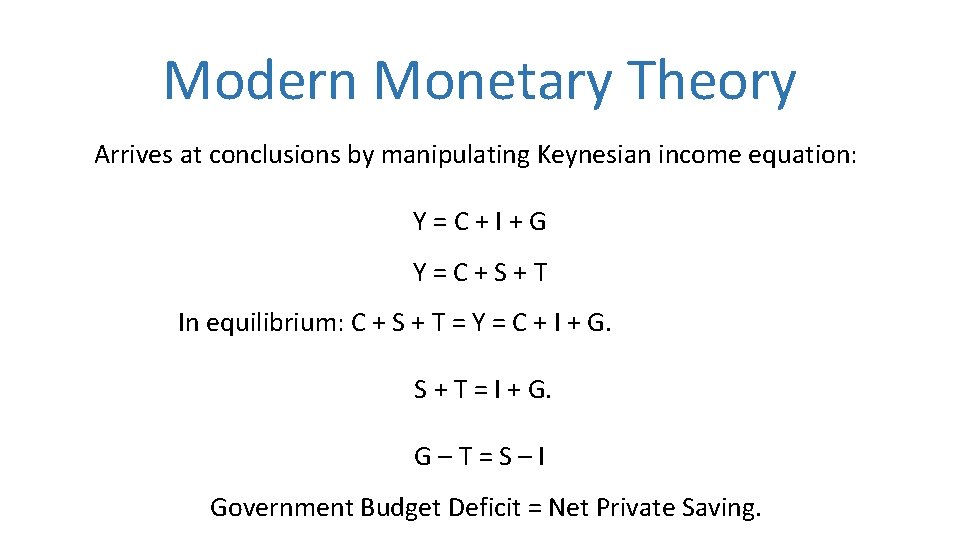
Modern Monetary Theory Arrives at conclusions by manipulating Keynesian income equation: Y=C+I+G Y=C+S+T In equilibrium: C + S + T = Y = C + I + G. S + T = I + G. G–T=S–I Government Budget Deficit = Net Private Saving.
Modern Monetary Theory Policy Conclusions: • Government can and should monetize government deficit spending. • If monetary inflation results in high price inflation, government can fix problem by increasing taxes.
Modern Monetary Theory Not Exactly New Not Exactly Monetary Not Exactly a Theory
Consequences Massive inflation Capital consumption • What if Treasury issues new bonds, which are resold to Fed in bond market? • What if newly created money will go directly into the Treasury?