
Australian Rules Football History and Legends ROTARY CLUB
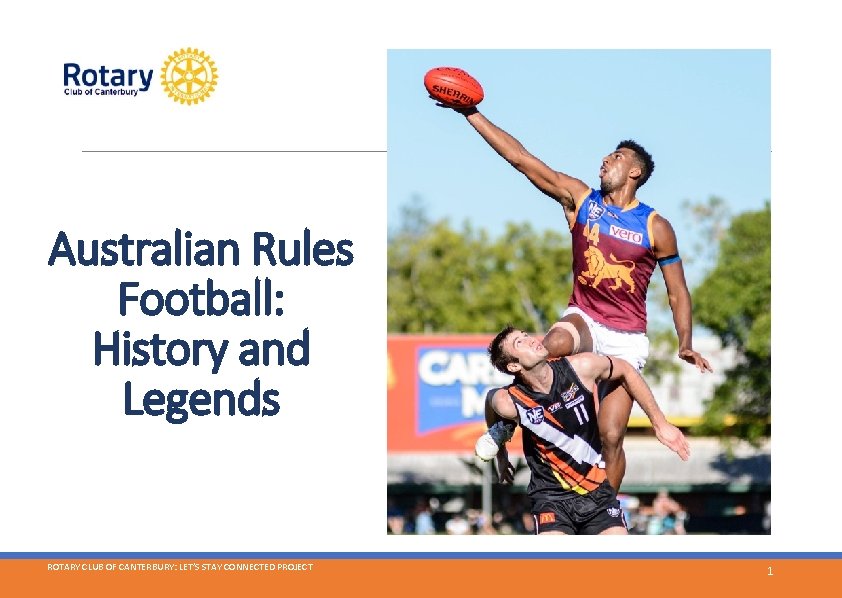
Australian Rules Football: History and Legends ROTARY CLUB OF CANTERBURY: LET’S STAY CONNECTED PROJECT 1
The Rotary Club of Canterbury “Let’s Stay Connected Project” has been developed as a response to an identified need within the Aged Care sector. At times when it’s difficult to connect in person with family and friends, the Rotary Club of Canterbury has pleasure in offering you this booklet, designed to promote conversation, recollection and engagement for those who are in isolation and without their usual social activities. The booklets have been designed for people in an aged care residence, village or at home to read by themselves, or to have a family or staff member share the booklet with them. You can download this and other booklets from the Rotary Club of Canterbury website (www. canterburyrotary. org). Source references for this book are held at the Rotary Club of Canterbury. Contact president@caterburyrotary. org for further details. Material in this book was reproduced in accordance with Section 113 F of the Copyright Act (1968). ROTARY CLUB OF CANTERBURY: LET’S STAY CONNECTED PROJECT 2
Hi My name is Sue. I am a friend of a member of the Rotary Club of Canterbury in Melbourne, Australia. I researched and wrote this booklet for those of you who enjoy Australian Rules Football and would like to read a short history of the game and the legendary footballers who played it. Hope you enjoy it! Sue ROTARY CLUB OF CANTERBURY: LET’S STAY CONNECTED PROJECT 3
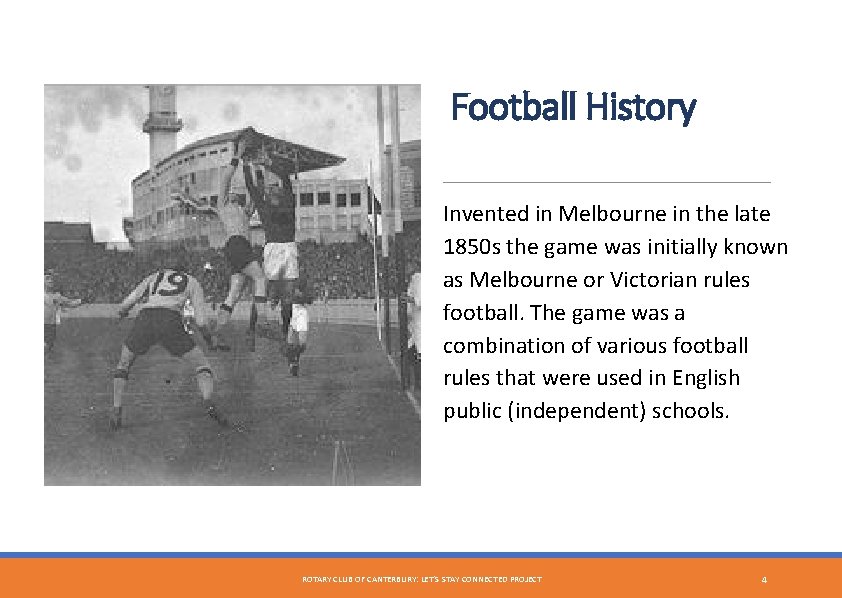
Football History Invented in Melbourne in the late 1850 s the game was initially known as Melbourne or Victorian rules football. The game was a combination of various football rules that were used in English public (independent) schools. ROTARY CLUB OF CANTERBURY: LET’S STAY CONNECTED PROJECT 4
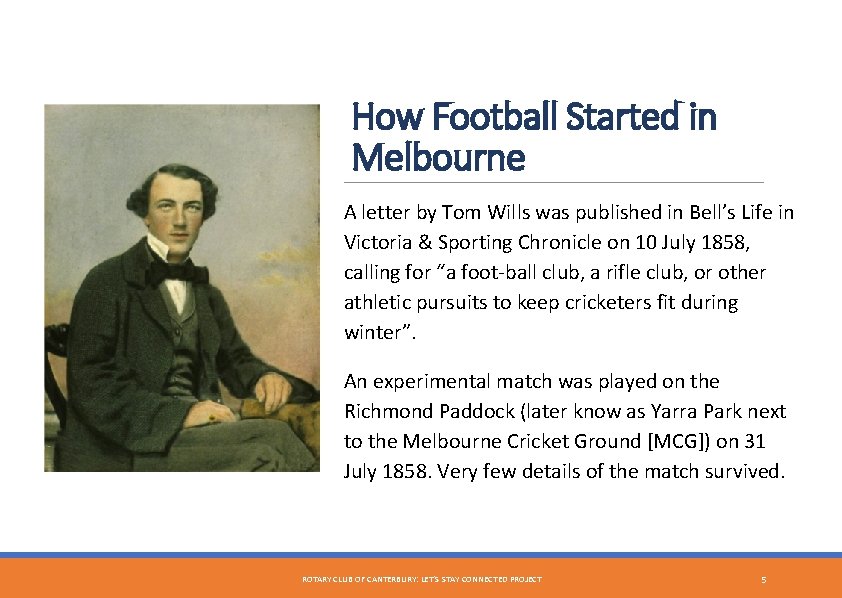
How Football Started in Melbourne A letter by Tom Wills was published in Bell’s Life in Victoria & Sporting Chronicle on 10 July 1858, calling for “a foot-ball club, a rifle club, or other athletic pursuits to keep cricketers fit during winter”. An experimental match was played on the Richmond Paddock (later know as Yarra Park next to the Melbourne Cricket Ground [MCG]) on 31 July 1858. Very few details of the match survived. ROTARY CLUB OF CANTERBURY: LET’S STAY CONNECTED PROJECT 5
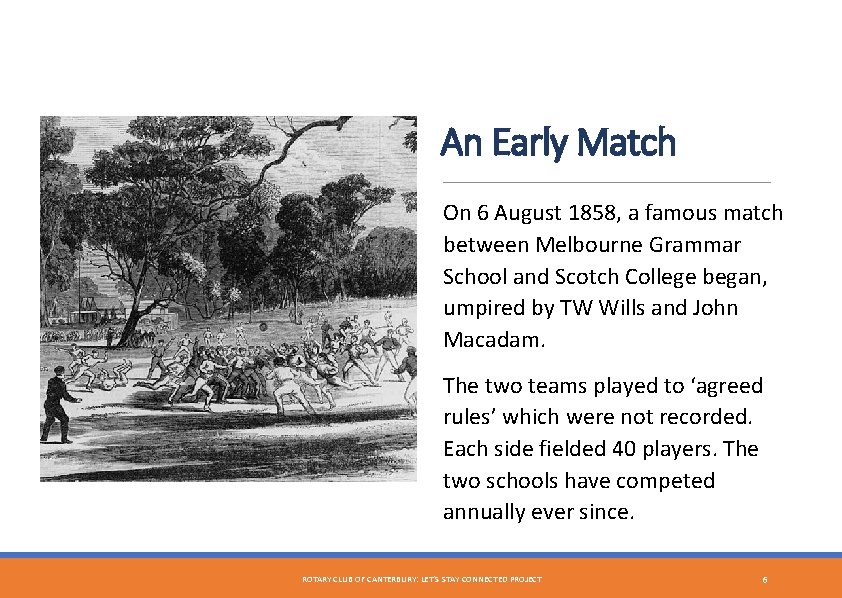
An Early Match On 6 August 1858, a famous match between Melbourne Grammar School and Scotch College began, umpired by TW Wills and John Macadam. The two teams played to ‘agreed rules’ which were not recorded. Each side fielded 40 players. The two schools have competed annually ever since. ROTARY CLUB OF CANTERBURY: LET’S STAY CONNECTED PROJECT 6
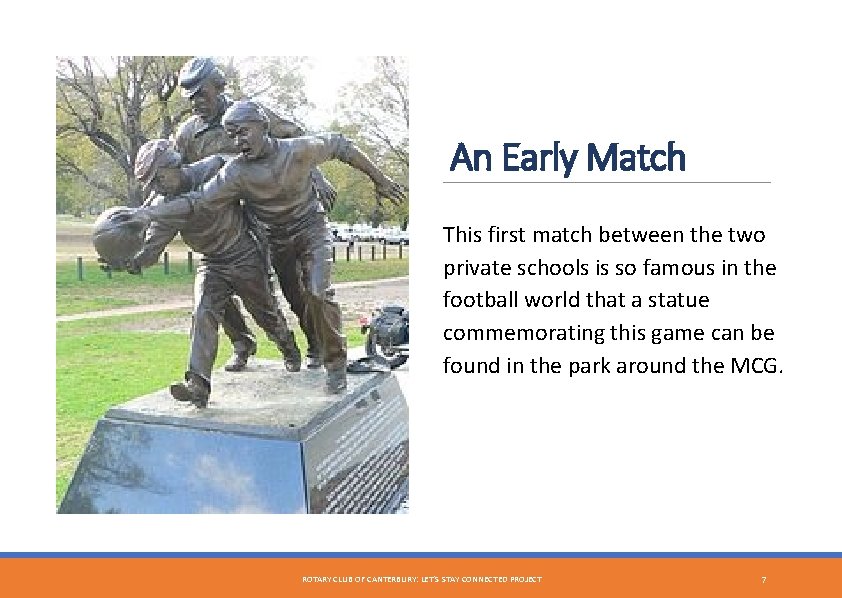
An Early Match This first match between the two private schools is so famous in the football world that a statue commemorating this game can be found in the park around the MCG. ROTARY CLUB OF CANTERBURY: LET’S STAY CONNECTED PROJECT 7

Development of Australia Football The first match the Australian Football League (AFL) Commission identified as a direct precursor of Australian football was a match held on July 31, 1858. The 1879 Melbourne Football Club team. ROTARY CLUB OF CANTERBURY: LET’S STAY CONNECTED PROJECT 8
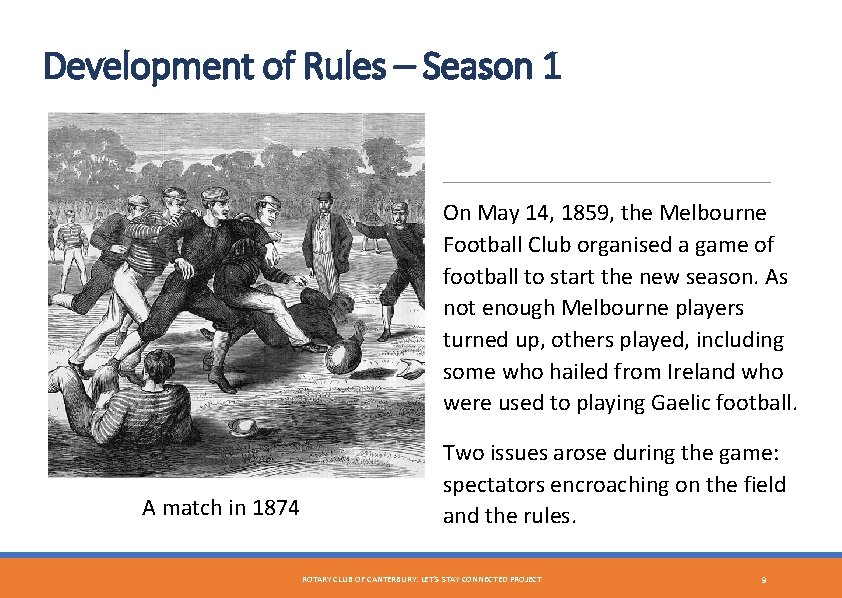
Development of Rules – Season 1 On May 14, 1859, the Melbourne Football Club organised a game of football to start the new season. As not enough Melbourne players turned up, others played, including some who hailed from Ireland who were used to playing Gaelic football. A match in 1874 Two issues arose during the game: spectators encroaching on the field and the rules. ROTARY CLUB OF CANTERBURY: LET’S STAY CONNECTED PROJECT 9
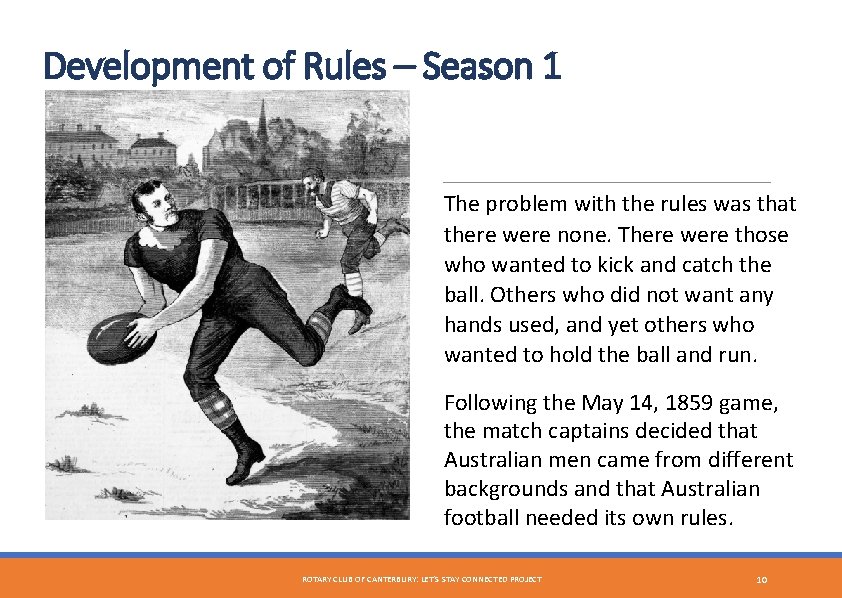
Development of Rules – Season 1 The problem with the rules was that there were none. There were those who wanted to kick and catch the ball. Others who did not want any hands used, and yet others who wanted to hold the ball and run. Following the May 14, 1859 game, the match captains decided that Australian men came from different backgrounds and that Australian football needed its own rules. ROTARY CLUB OF CANTERBURY: LET’S STAY CONNECTED PROJECT 10
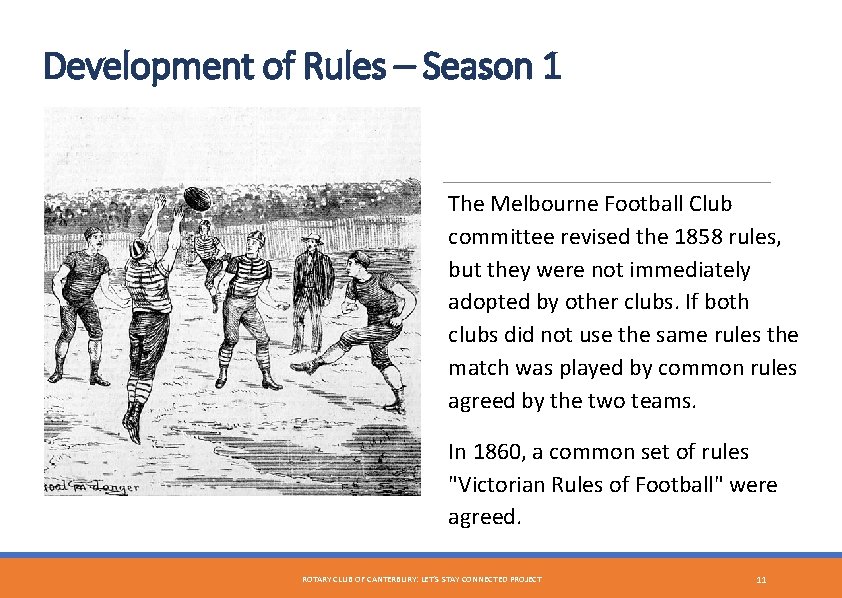
Development of Rules – Season 1 The Melbourne Football Club committee revised the 1858 rules, but they were not immediately adopted by other clubs. If both clubs did not use the same rules the match was played by common rules agreed by the two teams. In 1860, a common set of rules "Victorian Rules of Football" were agreed. ROTARY CLUB OF CANTERBURY: LET’S STAY CONNECTED PROJECT 11
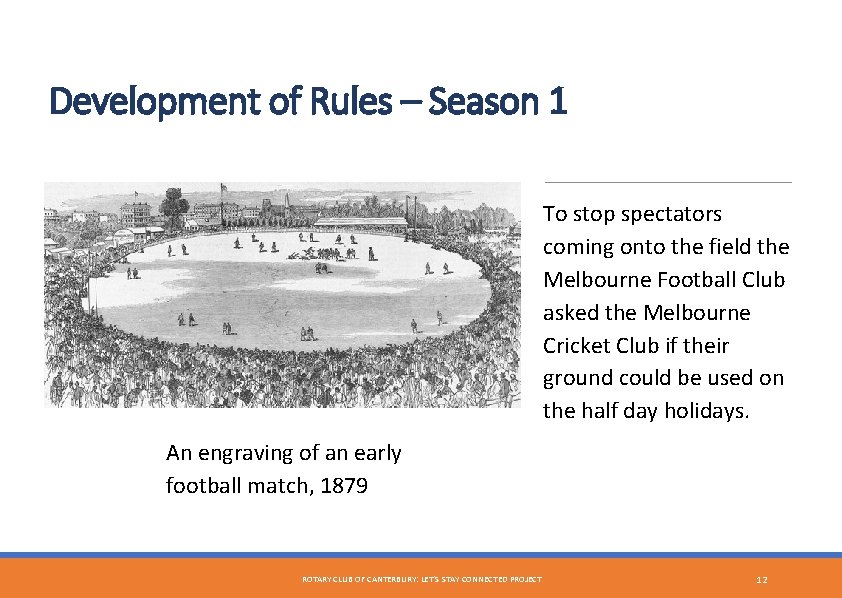
Development of Rules – Season 1 To stop spectators coming onto the field the Melbourne Football Club asked the Melbourne Cricket Club if their ground could be used on the half day holidays. An engraving of an early football match, 1879 ROTARY CLUB OF CANTERBURY: LET’S STAY CONNECTED PROJECT 12
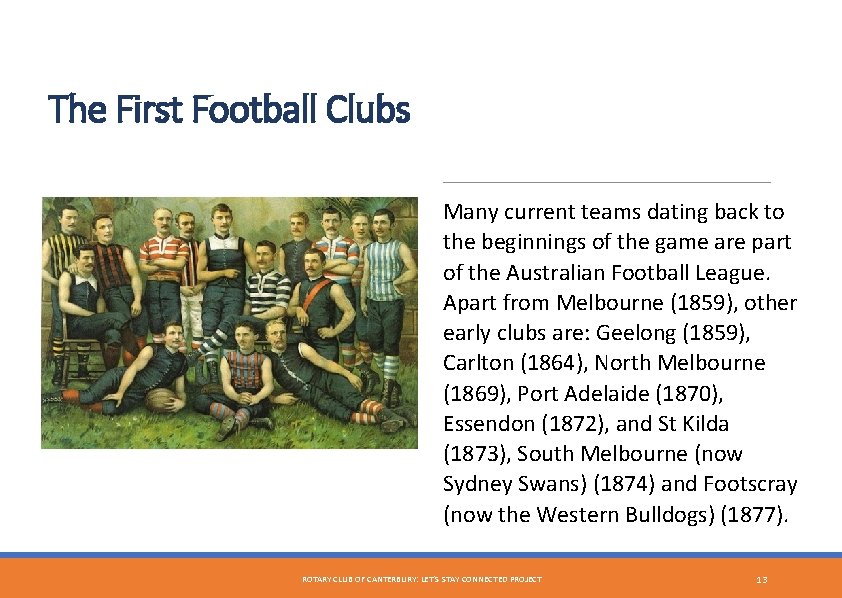
The First Football Clubs Many current teams dating back to the beginnings of the game are part of the Australian Football League. Apart from Melbourne (1859), other early clubs are: Geelong (1859), Carlton (1864), North Melbourne (1869), Port Adelaide (1870), Essendon (1872), and St Kilda (1873), South Melbourne (now Sydney Swans) (1874) and Footscray (now the Western Bulldogs) (1877). ROTARY CLUB OF CANTERBURY: LET’S STAY CONNECTED PROJECT 13
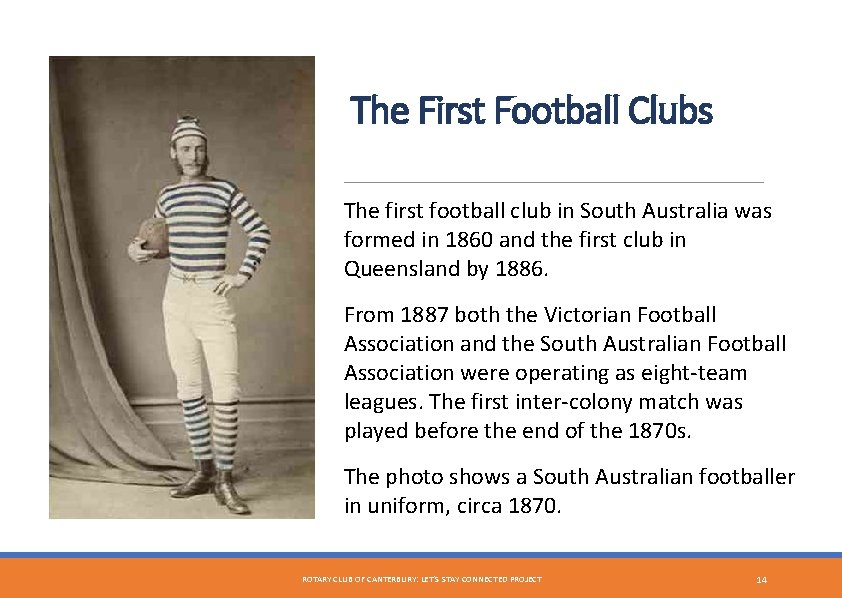
The First Football Clubs The first football club in South Australia was formed in 1860 and the first club in Queensland by 1886. From 1887 both the Victorian Football Association and the South Australian Football Association were operating as eight-team leagues. The first inter-colony match was played before the end of the 1870 s. The photo shows a South Australian footballer in uniform, circa 1870. ROTARY CLUB OF CANTERBURY: LET’S STAY CONNECTED PROJECT 14
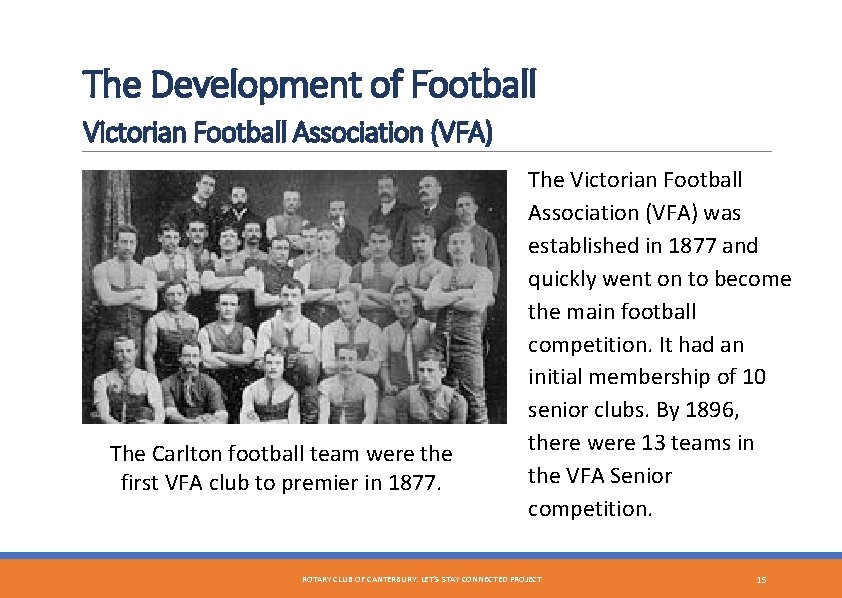
The Development of Football Victorian Football Association (VFA) The Carlton football team were the first VFA club to premier in 1877. The Victorian Football Association (VFA) was established in 1877 and quickly went on to become the main football competition. It had an initial membership of 10 senior clubs. By 1896, there were 13 teams in the VFA Senior competition. ROTARY CLUB OF CANTERBURY: LET’S STAY CONNECTED PROJECT 15
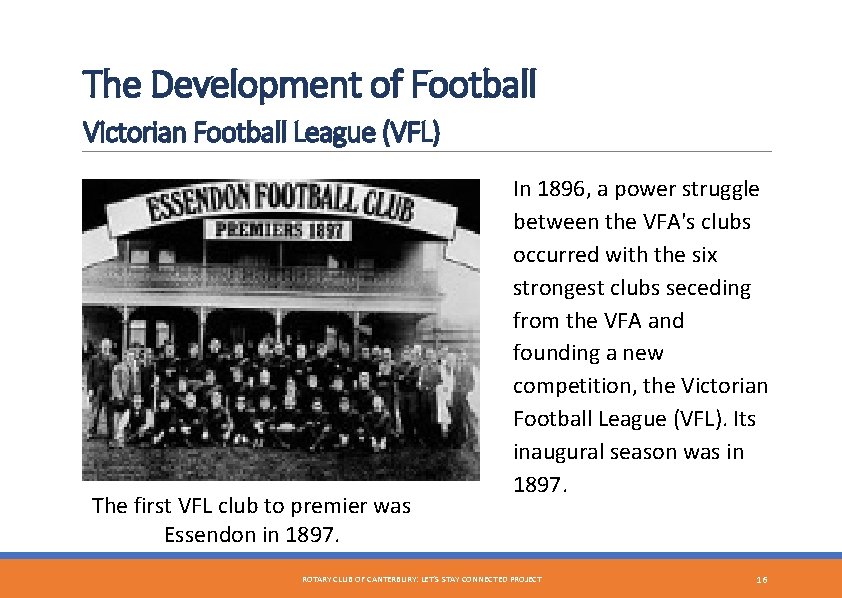
The Development of Football Victorian Football League (VFL) The first VFL club to premier was Essendon in 1897. In 1896, a power struggle between the VFA's clubs occurred with the six strongest clubs seceding from the VFA and founding a new competition, the Victorian Football League (VFL). Its inaugural season was in 1897. ROTARY CLUB OF CANTERBURY: LET’S STAY CONNECTED PROJECT 16
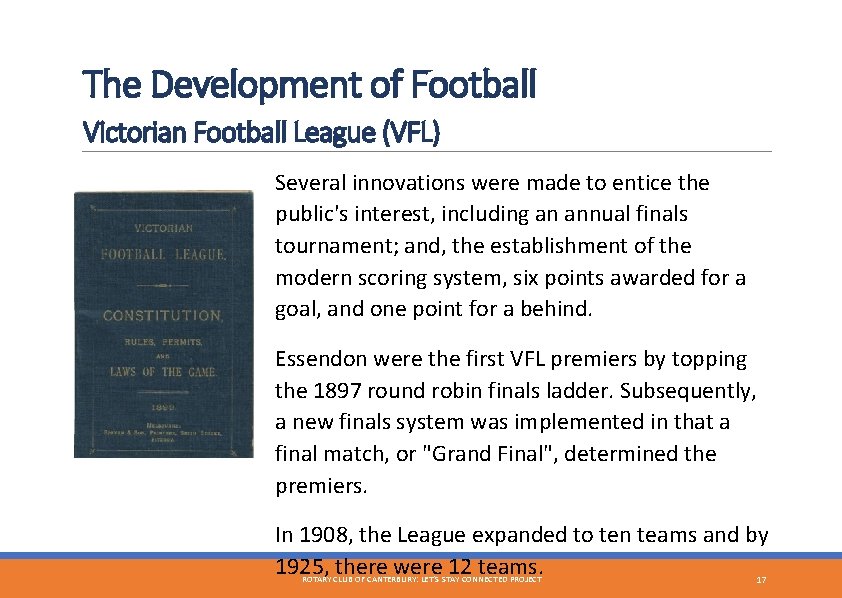
The Development of Football Victorian Football League (VFL) Several innovations were made to entice the public's interest, including an annual finals tournament; and, the establishment of the modern scoring system, six points awarded for a goal, and one point for a behind. Essendon were the first VFL premiers by topping the 1897 round robin finals ladder. Subsequently, a new finals system was implemented in that a final match, or "Grand Final", determined the premiers. In 1908, the League expanded to ten teams and by 1925, there were 12 teams. 17 ROTARY CLUB OF CANTERBURY: LET’S STAY CONNECTED PROJECT
The Development of Football Australian Football League (AFL) In the 1980 s strong interstate interest in the VFL led to a more national competition. The South Melbourne Football Club relocated to Sydney (Sydney Swans) and two more non. Victorian clubs, the West Coast Eagles and the Brisbane Bears began playing. The league changed its name to the Australian Football League (AFL) following the 1989 season. Over the next two decades, the League expanded and by 2012 there with 18 member clubs. The AFL is the sport's elite competition and the most powerful body in the world of Australian rules football. ROTARY CLUB OF CANTERBURY: LET’S STAY CONNECTED PROJECT 18
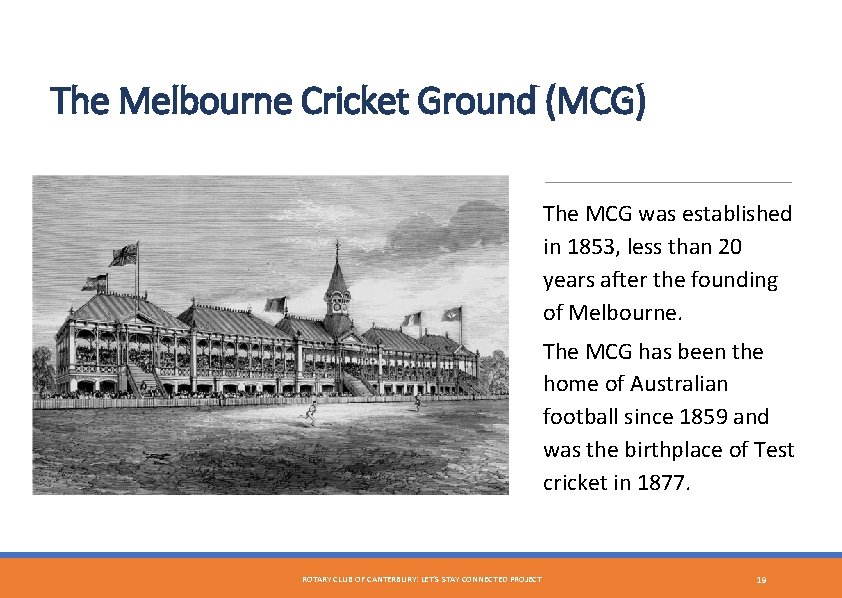
The Melbourne Cricket Ground (MCG) The MCG was established in 1853, less than 20 years after the founding of Melbourne. The MCG has been the home of Australian football since 1859 and was the birthplace of Test cricket in 1877. ROTARY CLUB OF CANTERBURY: LET’S STAY CONNECTED PROJECT 19
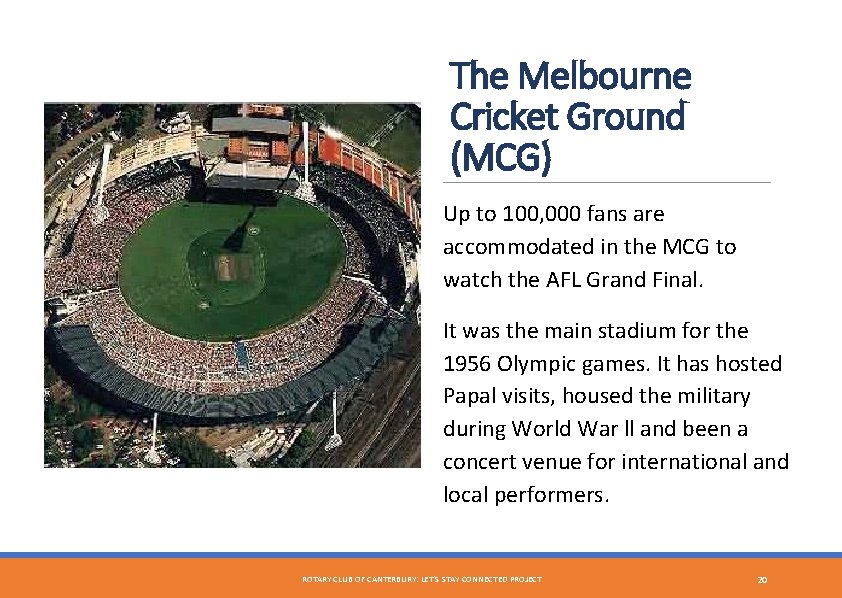
The Melbourne Cricket Ground (MCG) Up to 100, 000 fans are accommodated in the MCG to watch the AFL Grand Final. It was the main stadium for the 1956 Olympic games. It has hosted Papal visits, housed the military during World War ll and been a concert venue for international and local performers. ROTARY CLUB OF CANTERBURY: LET’S STAY CONNECTED PROJECT 20
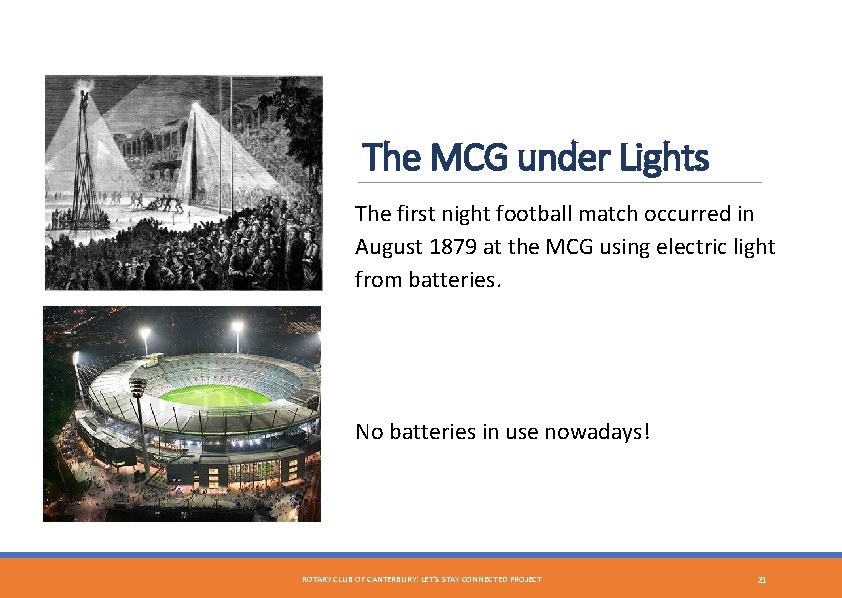
The MCG under Lights The first night football match occurred in August 1879 at the MCG using electric light from batteries. No batteries in use nowadays! ROTARY CLUB OF CANTERBURY: LET’S STAY CONNECTED PROJECT 21
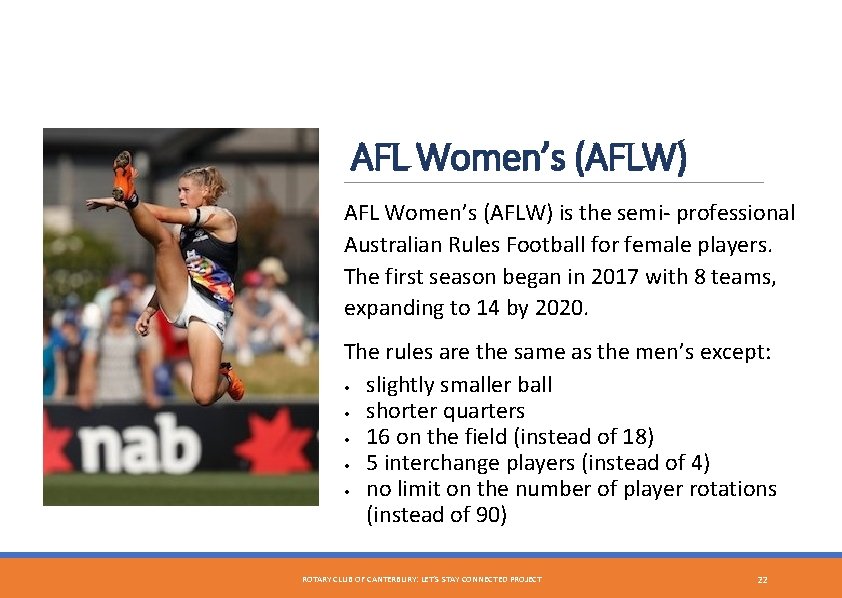
AFL Women’s (AFLW) is the semi- professional Australian Rules Football for female players. The first season began in 2017 with 8 teams, expanding to 14 by 2020. The rules are the same as the men’s except: • slightly smaller ball • shorter quarters • 16 on the field (instead of 18) • 5 interchange players (instead of 4) • no limit on the number of player rotations (instead of 90) ROTARY CLUB OF CANTERBURY: LET’S STAY CONNECTED PROJECT 22
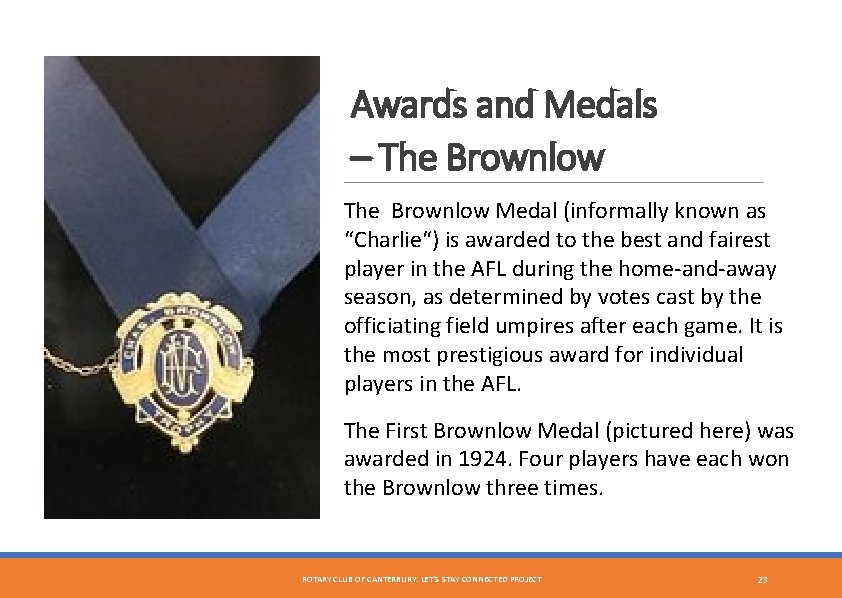
Awards and Medals – The Brownlow Medal (informally known as “Charlie“) is awarded to the best and fairest player in the AFL during the home-and-away season, as determined by votes cast by the officiating field umpires after each game. It is the most prestigious award for individual players in the AFL. The First Brownlow Medal (pictured here) was awarded in 1924. Four players have each won the Brownlow three times. ROTARY CLUB OF CANTERBURY: LET’S STAY CONNECTED PROJECT 23
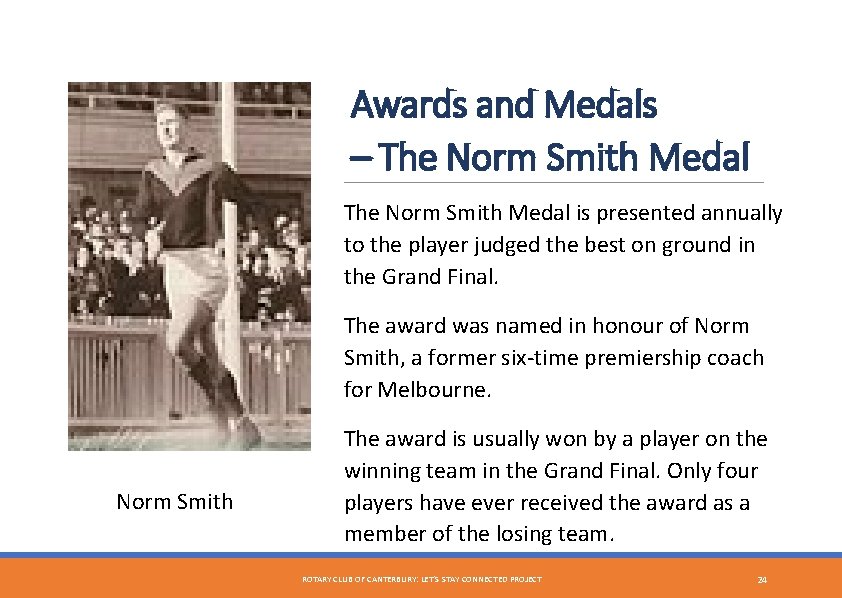
Awards and Medals – The Norm Smith Medal is presented annually to the player judged the best on ground in the Grand Final. The award was named in honour of Norm Smith, a former six-time premiership coach for Melbourne. Norm Smith The award is usually won by a player on the winning team in the Grand Final. Only four players have ever received the award as a member of the losing team. ROTARY CLUB OF CANTERBURY: LET’S STAY CONNECTED PROJECT 24
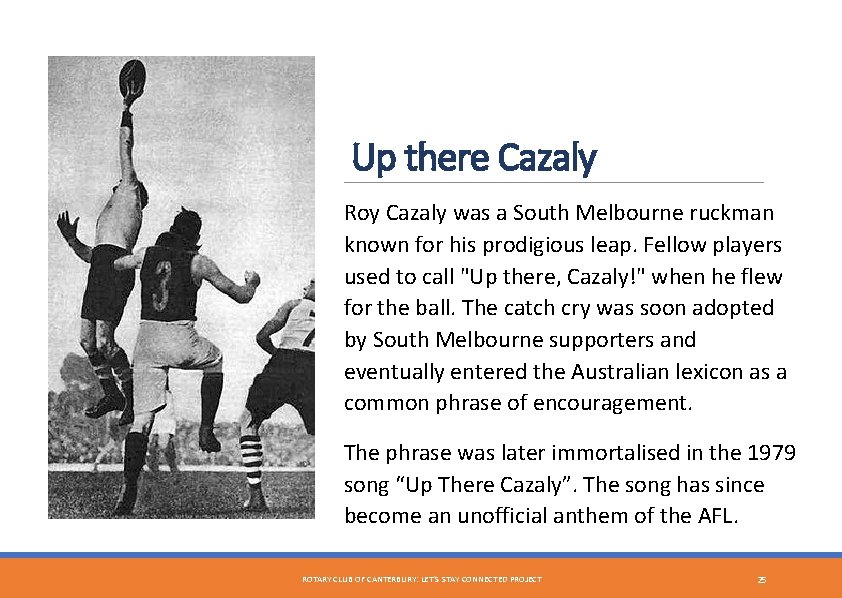
Up there Cazaly Roy Cazaly was a South Melbourne ruckman known for his prodigious leap. Fellow players used to call "Up there, Cazaly!" when he flew for the ball. The catch cry was soon adopted by South Melbourne supporters and eventually entered the Australian lexicon as a common phrase of encouragement. The phrase was later immortalised in the 1979 song “Up There Cazaly”. The song has since become an unofficial anthem of the AFL. ROTARY CLUB OF CANTERBURY: LET’S STAY CONNECTED PROJECT 25
AFL Legends The Australian Football Hall of Fame was established in 1996, the Centenary year of the AFL, to recognise the contributions made to the sport of Australian rules football by players and others. Candidates are considered on the basis of their ability, integrity, sportsmanship and character; the number of games played being a secondary consideration. The Legends category is reserved for those who are deemed to have had a significant impact on the game of Australian rules football. Being named as a "Legend" of the Australian Football Hall of Fame is the highest honour bestowed on an Australian footballer. ROTARY CLUB OF CANTERBURY: LET’S STAY CONNECTED PROJECT 26
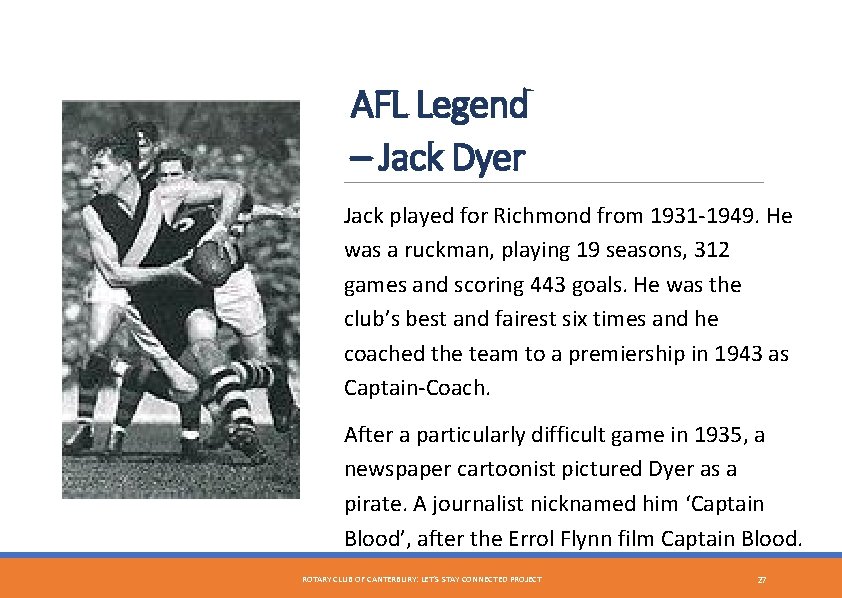
AFL Legend – Jack Dyer Jack played for Richmond from 1931 -1949. He was a ruckman, playing 19 seasons, 312 games and scoring 443 goals. He was the club’s best and fairest six times and he coached the team to a premiership in 1943 as Captain-Coach. After a particularly difficult game in 1935, a newspaper cartoonist pictured Dyer as a pirate. A journalist nicknamed him ‘Captain Blood’, after the Errol Flynn film Captain Blood. ROTARY CLUB OF CANTERBURY: LET’S STAY CONNECTED PROJECT 27
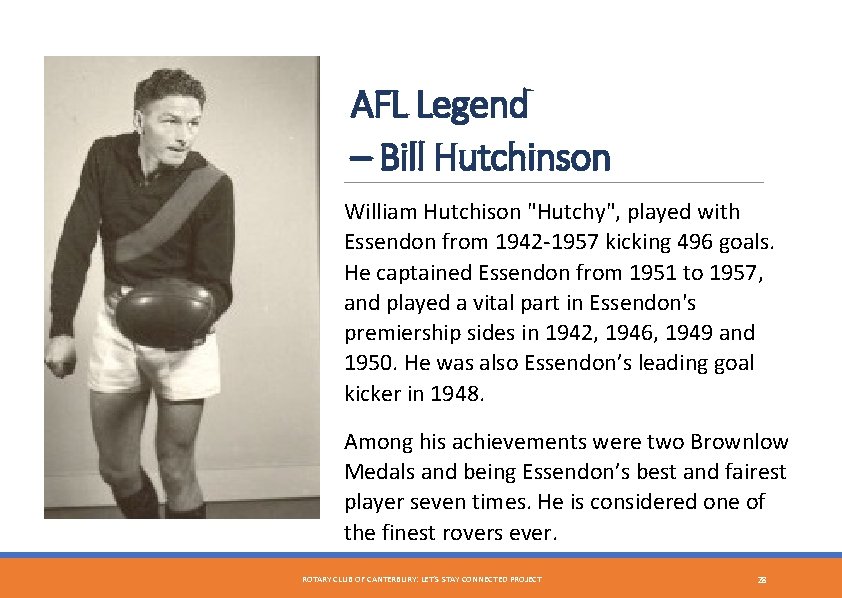
AFL Legend – Bill Hutchinson William Hutchison "Hutchy", played with Essendon from 1942 -1957 kicking 496 goals. He captained Essendon from 1951 to 1957, and played a vital part in Essendon's premiership sides in 1942, 1946, 1949 and 1950. He was also Essendon’s leading goal kicker in 1948. Among his achievements were two Brownlow Medals and being Essendon’s best and fairest player seven times. He is considered one of the finest rovers ever. ROTARY CLUB OF CANTERBURY: LET’S STAY CONNECTED PROJECT 28
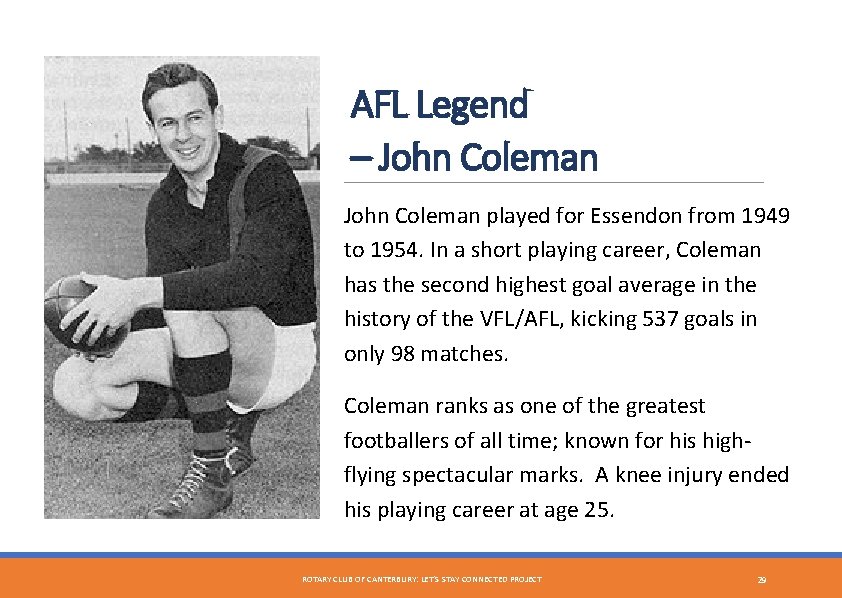
AFL Legend – John Coleman played for Essendon from 1949 to 1954. In a short playing career, Coleman has the second highest goal average in the history of the VFL/AFL, kicking 537 goals in only 98 matches. Coleman ranks as one of the greatest footballers of all time; known for his highflying spectacular marks. A knee injury ended his playing career at age 25. ROTARY CLUB OF CANTERBURY: LET’S STAY CONNECTED PROJECT 29
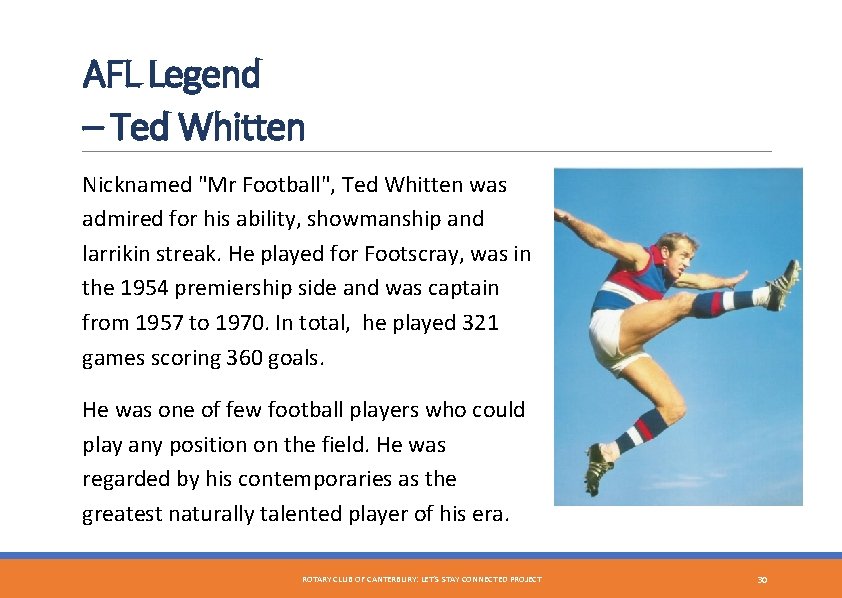
AFL Legend – Ted Whitten Nicknamed "Mr Football", Ted Whitten was admired for his ability, showmanship and larrikin streak. He played for Footscray, was in the 1954 premiership side and was captain from 1957 to 1970. In total, he played 321 games scoring 360 goals. He was one of few football players who could play any position on the field. He was regarded by his contemporaries as the greatest naturally talented player of his era. ROTARY CLUB OF CANTERBURY: LET’S STAY CONNECTED PROJECT 30
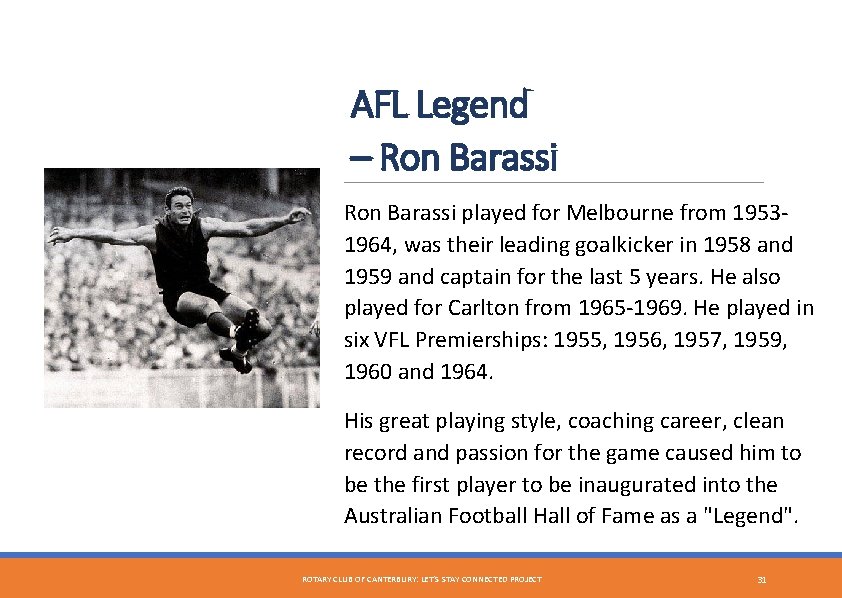
AFL Legend – Ron Barassi played for Melbourne from 19531964, was their leading goalkicker in 1958 and 1959 and captain for the last 5 years. He also played for Carlton from 1965 -1969. He played in six VFL Premierships: 1955, 1956, 1957, 1959, 1960 and 1964. His great playing style, coaching career, clean record and passion for the game caused him to be the first player to be inaugurated into the Australian Football Hall of Fame as a "Legend". ROTARY CLUB OF CANTERBURY: LET’S STAY CONNECTED PROJECT 31
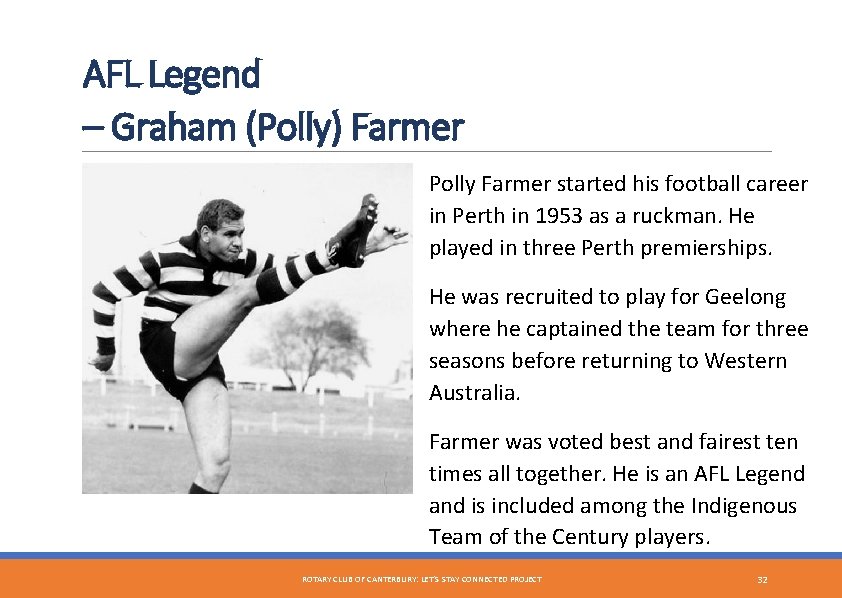
AFL Legend – Graham (Polly) Farmer Polly Farmer started his football career in Perth in 1953 as a ruckman. He played in three Perth premierships. He was recruited to play for Geelong where he captained the team for three seasons before returning to Western Australia. Farmer was voted best and fairest ten times all together. He is an AFL Legend and is included among the Indigenous Team of the Century players. ROTARY CLUB OF CANTERBURY: LET’S STAY CONNECTED PROJECT 32
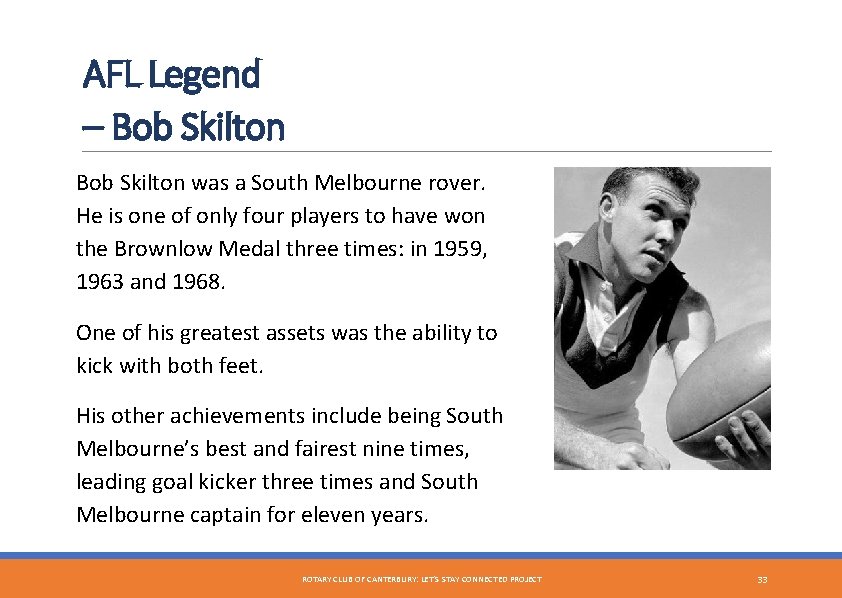
AFL Legend – Bob Skilton was a South Melbourne rover. He is one of only four players to have won the Brownlow Medal three times: in 1959, 1963 and 1968. One of his greatest assets was the ability to kick with both feet. His other achievements include being South Melbourne’s best and fairest nine times, leading goal kicker three times and South Melbourne captain for eleven years. ROTARY CLUB OF CANTERBURY: LET’S STAY CONNECTED PROJECT 33
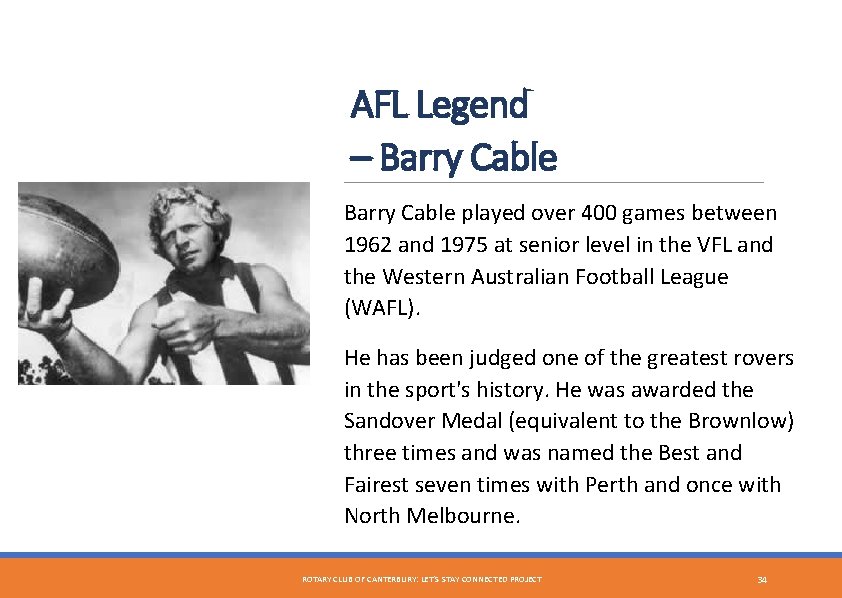
AFL Legend – Barry Cable played over 400 games between 1962 and 1975 at senior level in the VFL and the Western Australian Football League (WAFL). He has been judged one of the greatest rovers in the sport's history. He was awarded the Sandover Medal (equivalent to the Brownlow) three times and was named the Best and Fairest seven times with Perth and once with North Melbourne. ROTARY CLUB OF CANTERBURY: LET’S STAY CONNECTED PROJECT 34
- Slides: 34