
AUSTRALIAN ARMY CADETS Radiotelephone procedures RATEL Revision for































- Slides: 193
AUSTRALIAN ARMY CADETS Radiotelephone procedures (RATEL) Revision for Senior Leader Course Module 1 ©LTCOL(AAC) G. R. NEWMAN-MARTIN_2011
What is a proword? n A proword is: n a pronounceable word or phrase: which has been given a particular meaning – for the purpose of speeding up messages between users on radio circuits
Examples of prowords ROGER n Means ‘I have received your last transmission satisfactorily’ or ‘I understand your message’ n Can also mean ‘loud and clear’ SEND n Means ‘I am ready to receive your message’ WILCO n Means ‘Message understood, and will be complied with’ A full list of authorised prowords is at ANNEX A of your RATEL AIDE MEMOIRE
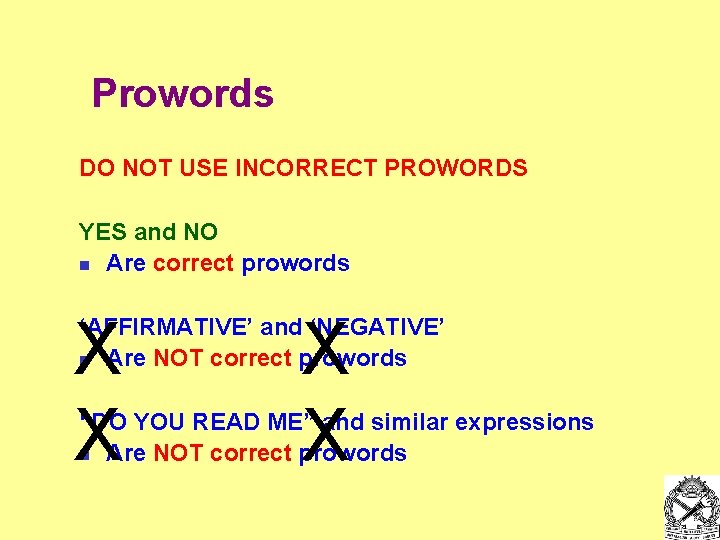
Prowords DO NOT USE INCORRECT PROWORDS YES and NO n Are correct prowords X X ‘AFFIRMATIVE’ and ‘NEGATIVE’ n Are NOT correct prowords “DO YOU READ ME” and similar expressions n Are NOT correct prowords
The phonetic alphabet Enables spelling of words or phrases in a radiotelephone message n n to be conveyed accurately and consistently in a standard format that all users know
The phonetic alphabet n n n n A B C D E F G ALPHA BRAVO CHARLIE DELTA ECHO FOXTROT GOLF AL-FAH BRAH-VOH CHAR-LEE DELL-TAH ECK-OH FOKS-TROT GOLF
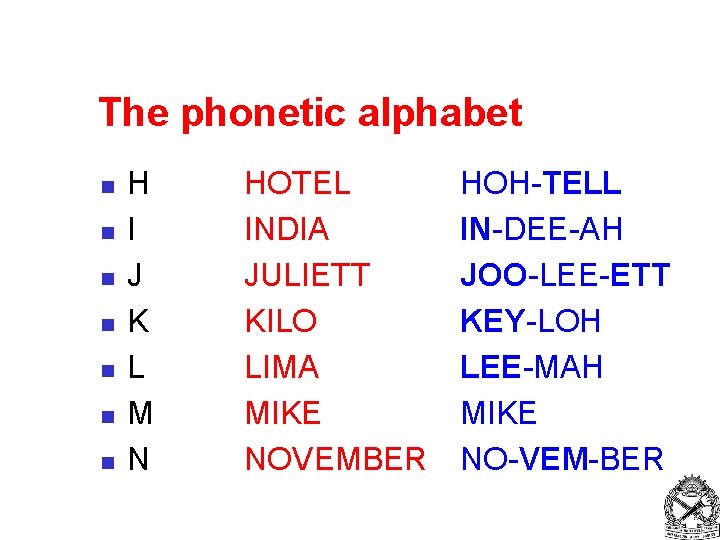
The phonetic alphabet n n n n H I J K L M N HOTEL INDIA JULIETT KILO LIMA MIKE NOVEMBER HOH-TELL IN-DEE-AH JOO-LEE-ETT KEY-LOH LEE-MAH MIKE NO-VEM-BER
The phonetic alphabet n n n n O P Q R S T U OSCAR PAPA QUEBEC ROMEO SIERRA TANGO UNIFORM OSS-CAH PAH-PAH KEH-BECK RO-ME-OH SEE-AIR-RAH TANG-GO YOU-NEE-FORM
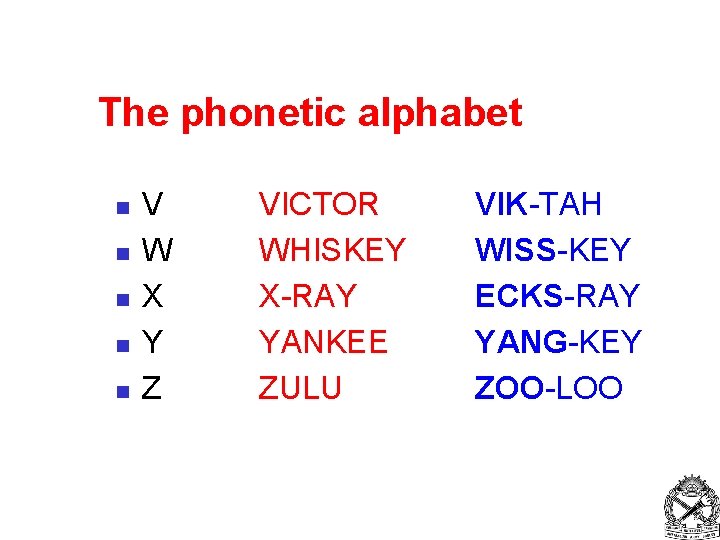
The phonetic alphabet n n n V W X Y Z VICTOR WHISKEY X-RAY YANKEE ZULU VIK-TAH WISS-KEY ECKS-RAY YANG-KEY ZOO-LOO
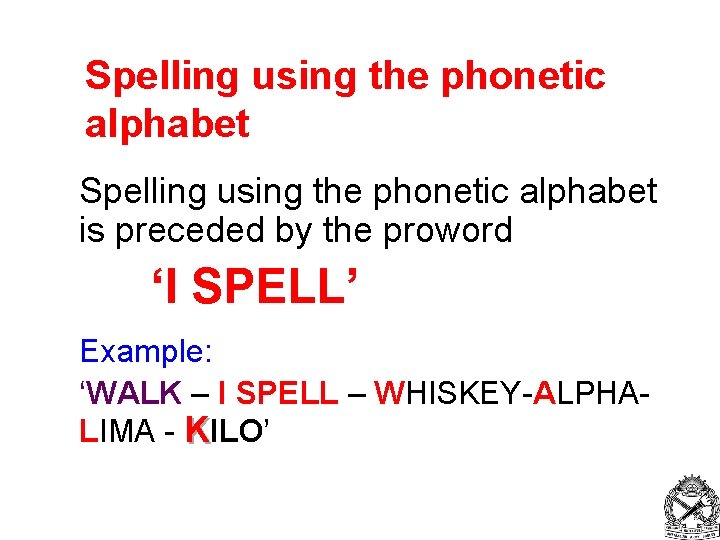
Spelling using the phonetic alphabet is preceded by the proword ‘I SPELL’ Example: ‘WALK – I SPELL – WHISKEY-ALPHALIMA - KILO’
Pronunciation of figures 0 ZERO 1 WUN 2 TOO 3 THU-REE 4 FO-WER 5 FI-YIV Emphasis on ‘n’ Sharp ‘t’, long ‘oo’ Short ‘u’, roll ‘r’, long ‘ee’ Long ‘o’ Emphasise ‘f’, ‘v’, first ‘i’ is long, second ‘i’ is short
Pronunciation of figures 6 SIX 7 SEV-EN Emphasis on ‘x’ Two distinct syllables, ‘en’ as in ‘hen’ 8 ATE Long ‘a’ 9 NINER Long ‘i’, emphasis both ‘n’s 10 WUN ZERO
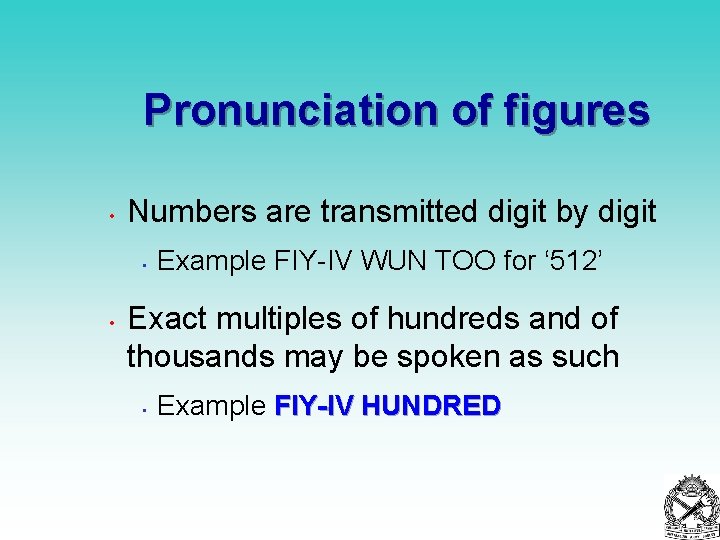
Pronunciation of figures • Numbers are transmitted digit by digit • • Example FIY-IV WUN TOO for ‘ 512’ Exact multiples of hundreds and of thousands may be spoken as such • Example FIY-IV HUNDRED
Pronunciation of figures • • In good conditions numbers may be sent as in normal speech Example ‘Forty-four’ for ’ 44’ Example ‘Two thousand eight’ for ‘ 2008’ Example: ‘Twenty-three fifty-nine hours’ for ‘ 2359 hours’
Pronunciation of figures Under poor or difficult conditions, figures are sent digit by digit, preceded by the proword FIGURES • Example: ‘FIGURES SEV-EN THUH-REE FOWER’ for ‘ 734’ •
Pronunciation of figures • Proword ‘FIGURES’ is NOT used with: • • • Callsigns Grid references Time checks
Pronunciation of figures • Decimal point spoken as ‘DAY-SEE-MAL’ • Example ‘Wun Too Thuh-ree DAY-SEE-MAL Fow-er’ for ‘ 123. 4’
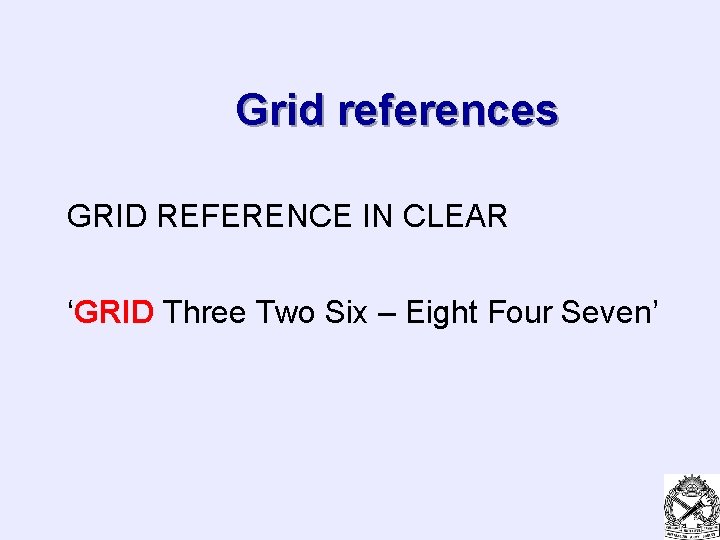
Grid references GRID REFERENCE IN CLEAR ‘GRID Three Two Six – Eight Four Seven’
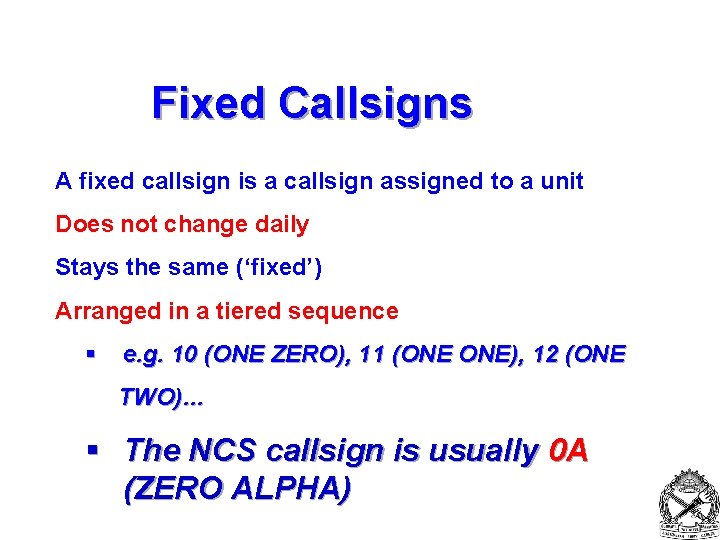
Fixed Callsigns A fixed callsign is a callsign assigned to a unit Does not change daily Stays the same (‘fixed’) Arranged in a tiered sequence § e. g. 10 (ONE ZERO), 11 (ONE ONE), 12 (ONE TWO)… § The NCS callsign is usually 0 A (ZERO ALPHA)
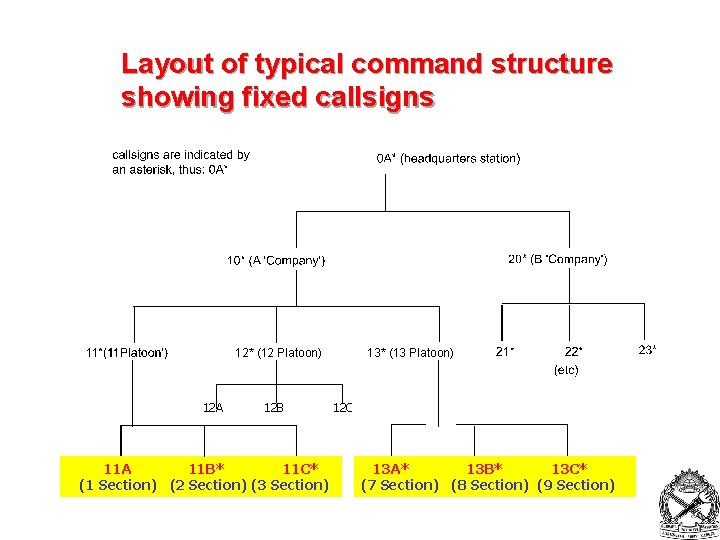
Layout of typical command structure showing fixed callsigns 12* (12 Platoon) 13* (13 Platoon) 12 A 12 B 12 C 11 A 11 B* 11 C* (1 Section) (2 Section) (3 Section) 13 A* 13 B* 13 C* (7 Section) (8 Section) (9 Section)
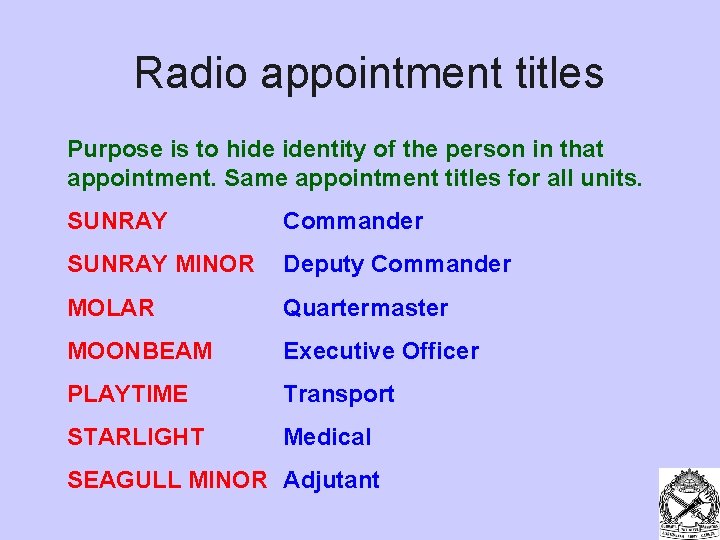
Radio appointment titles Purpose is to hide identity of the person in that appointment. Same appointment titles for all units. SUNRAY Commander SUNRAY MINOR Deputy Commander MOLAR Quartermaster MOONBEAM Executive Officer PLAYTIME Transport STARLIGHT Medical SEAGULL MINOR Adjutant
CALLING To communicate on a radio net, make an initial call (‘transmission’). An initial call has several parts:
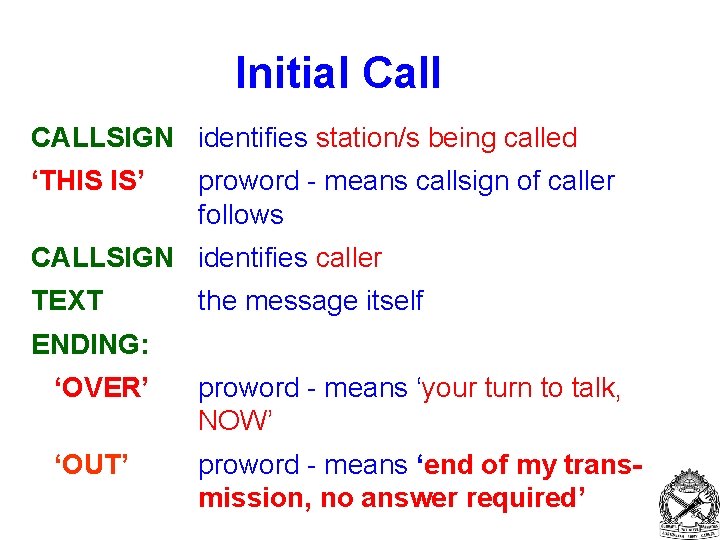
Initial Call CALLSIGN identifies station/s being called ‘THIS IS’ proword - means callsign of caller follows CALLSIGN identifies caller TEXT the message itself ENDING: ‘OVER’ proword - means ‘your turn to talk, NOW’ ‘OUT’ proword - means ‘end of my trans- mission, no answer required’
ANSWERING An answer to an initial call has several parts:
Parts of an answer CALLSIGN identifies station/s now being called ‘THIS IS’ proword – means callsign of caller follows – compulsory in first reply CALLSIGN identifies caller now calling RECEIPT
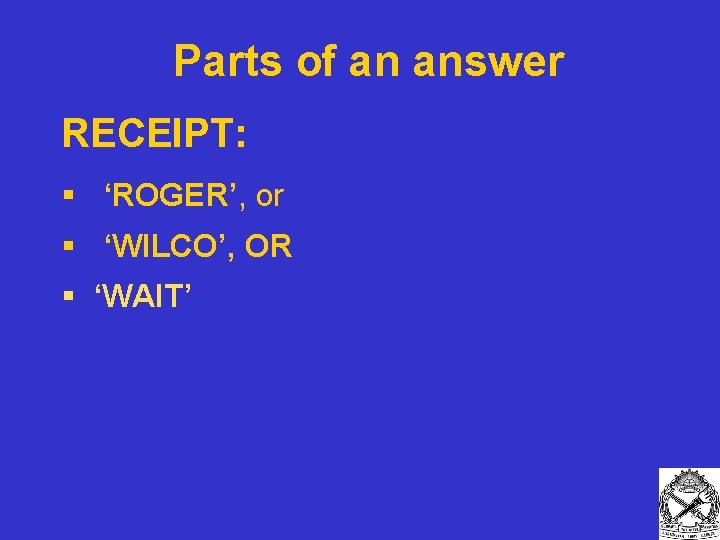
Parts of an answer RECEIPT: § ‘ROGER’, or § ‘WILCO’, OR § ‘WAIT’
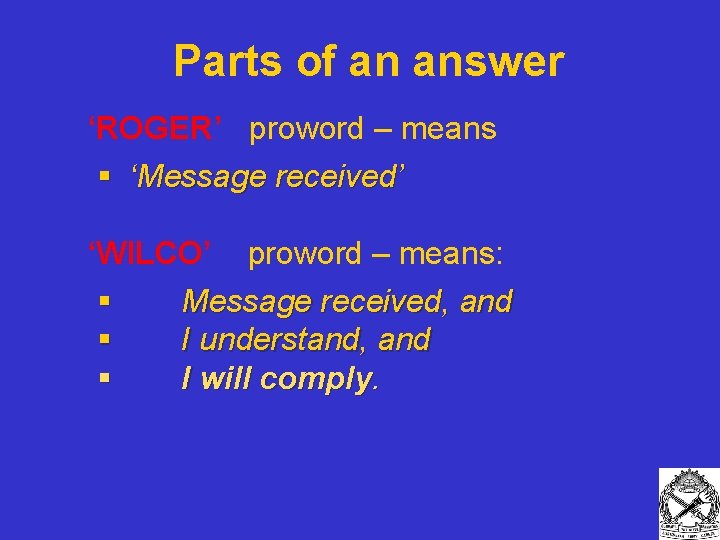
Parts of an answer ‘ROGER’ proword – means § ‘Message received’ ‘WILCO’ proword – means: § Message received, and § I understand, and § I will comply.
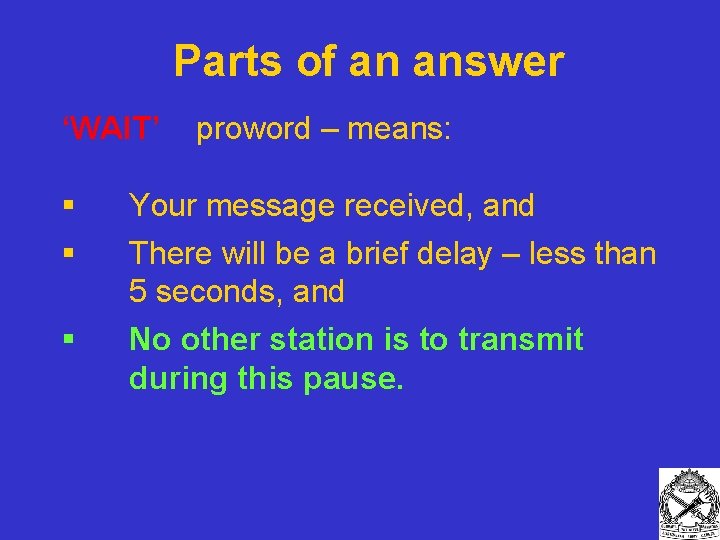
Parts of an answer ‘WAIT’ proword – means: § § § Your message received, and There will be a brief delay – less than 5 seconds, and No other station is to transmit during this pause.
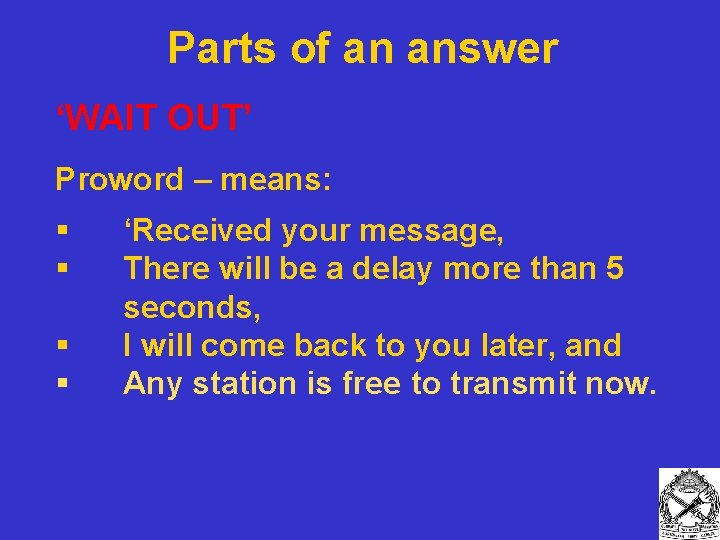
Parts of an answer ‘WAIT OUT’ Proword – means: § § ‘Received your message, There will be a delay more than 5 seconds, I will come back to you later, and Any station is free to transmit now.
Parts of an answer – 25 ‘OUT TO YOU’ Proword – means: § § § ‘This ends my transmission to you, and No answer needed, and I am going to call another station immediately.
Types of calls § Single call § Multiple call § Net call § Collective call § Exempt call
Single call A call from any station to only one station on the net
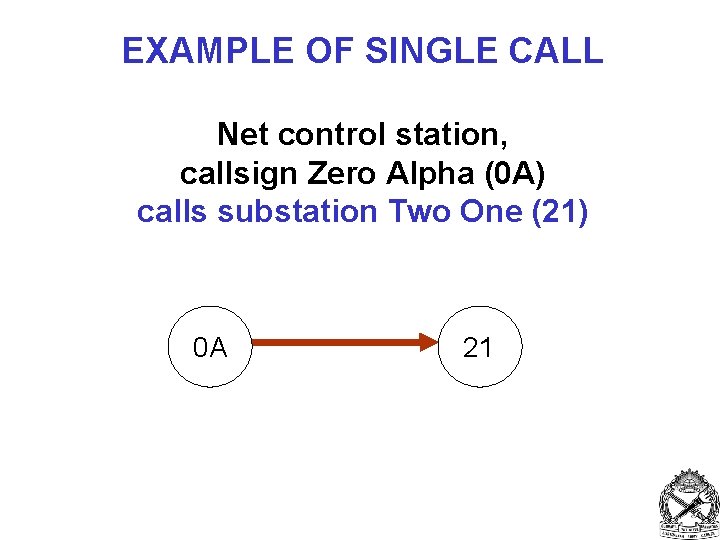
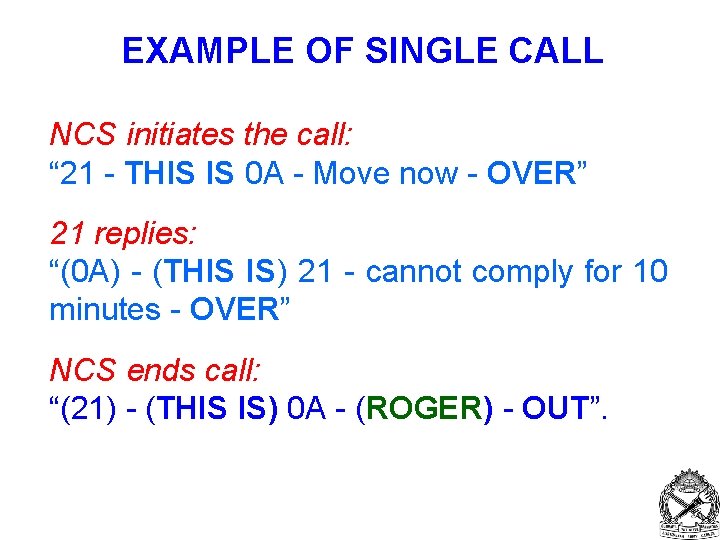
EXAMPLE OF SINGLE CALL Net control station, callsign Zero Alpha (0 A) calls substation Two One (21) 0 A 21
EXAMPLE OF SINGLE CALL NCS initiates the call: “ 21 - THIS IS 0 A - Move now - OVER” 21 replies: “(0 A) - (THIS IS) 21 - cannot comply for 10 minutes - OVER” NCS ends call: “(21) - (THIS IS) 0 A - (ROGER) - OUT”.
Multiple call A call from any station to two or more stations on the net ……but NOT to all stations on the net
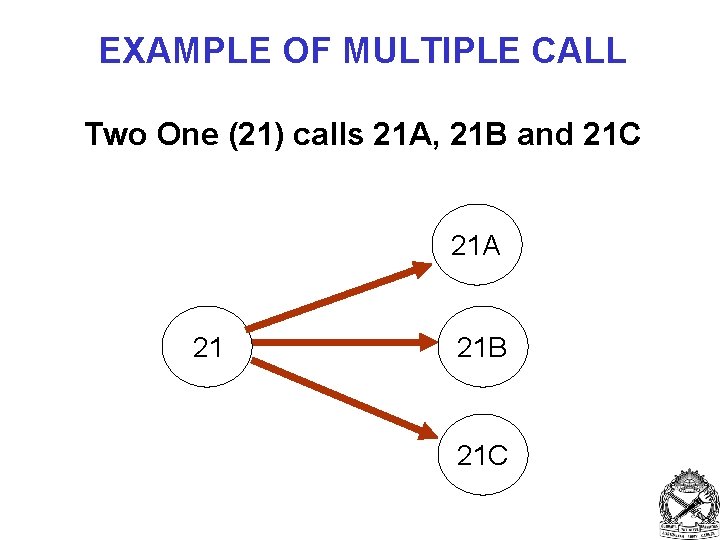
EXAMPLE OF MULTIPLE CALL Two One (21) calls 21 A, 21 B and 21 C 21 A 21 21 B 21 C
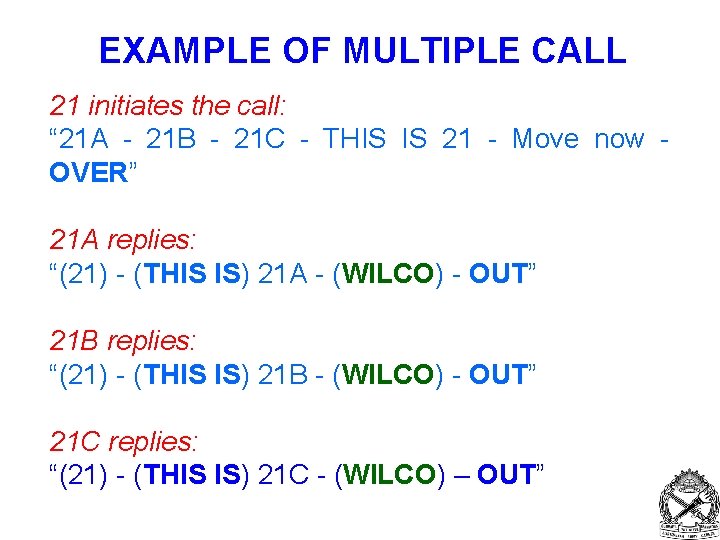
EXAMPLE OF MULTIPLE CALL 21 initiates the call: “ 21 A - 21 B - 21 C - THIS IS 21 - Move now - OVER” 21 A replies: “(21) - (THIS IS) 21 A - (WILCO) - OUT” 21 B replies: “(21) - (THIS IS) 21 B - (WILCO) - OUT” 21 C replies: “(21) - (THIS IS) 21 C - (WILCO) – OUT”
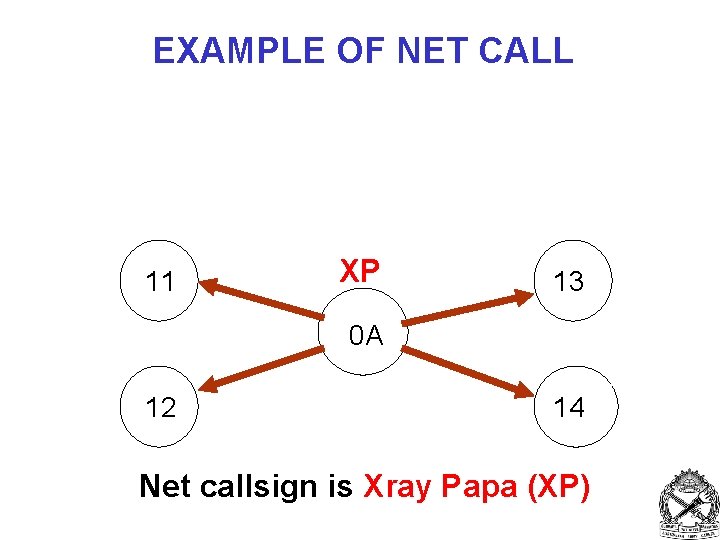
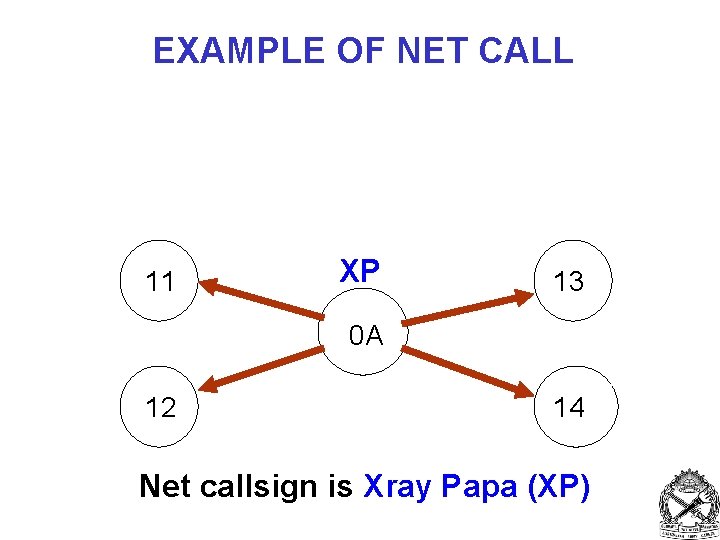
Net call A call to ALL stations on the net using a pre-arranged net callsign
EXAMPLE OF NET CALL 11 XP 13 0 A 12 14 Net callsign is Xray Papa (XP)
EXAMPLE OF NET CALL 0 A initiates the call: “XRAY PAPA – THIS IS 0 A - vehicle has departed this loc – OVER” 11 replies: “(0 A) – (THIS IS) 11 – (ROGER) – OUT” 12 replies: “(0 A) – (THIS IS) 12 – (ROGER) – OUT” 13 replies: “(0 A) – (THIS IS) 13 – (ROGER) – OUT” 14 replies: “(0 A) – (THIS IS) 14 – (ROGER) – OUT”.
Collective call A call to several stations on the net - but NOT all stations …. using a pre-arranged collective callsign
EXAMPLE OF COLLECTIVE CALL Zero Alpha (0 A) calls four stations on the net – 10, 20, 30, 40. 10 30 0 A 20 40
The collective callsign for 10, 20, 30 and 40 is ‘Charlie One’ (CC 1) Two other stations on the net – 50 and 60 – are not included in this collective callsign 10 30 0 A 20 40 X 50 X 60
EXAMPLE OF MULTIPLE CALL 21 initiates the call: “ 21 A - 21 B - 21 C - THIS IS 21 - Move now - OVER” 21 A replies: “(21) - (THIS IS) 21 A - (WILCO) - OUT” 21 B replies: “(21) - (THIS IS) 21 B - (WILCO) - OUT” 21 C replies: “(21) - (THIS IS) 21 C - (WILCO) – OUT”
EXAMPLE OF NET CALL 11 XP 13 0 A 12 14 Net callsign is Xray Papa (XP)
EXAMPLE OF NET CALL 0 A initiates the call: “XRAY PAPA – THIS IS 0 A - vehicle has departed this loc – OVER” 11 replies: “(0 A) – (THIS IS) 11 – (ROGER) – OUT” 12 replies: “(0 A) – (THIS IS) 12 – (ROGER) – OUT” 13 replies: “(0 A) – (THIS IS) 13 – (ROGER) – OUT” 14 replies: “(0 A) – (THIS IS) 14 – (ROGER) – OUT”.
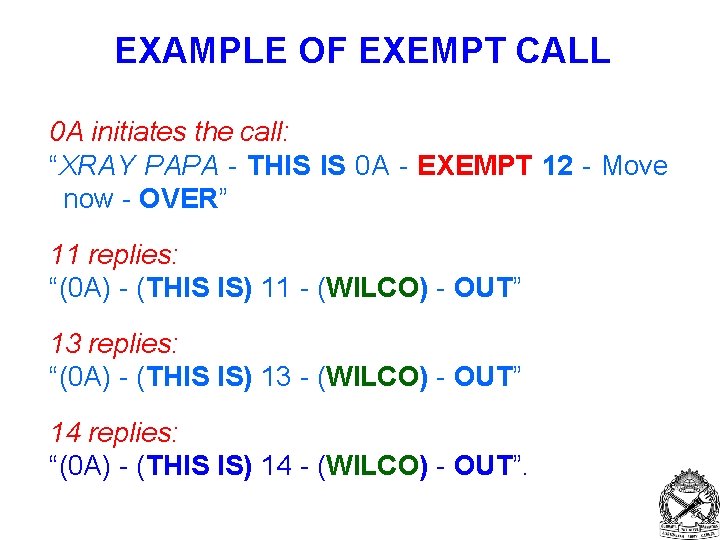
Exempt call To make a net call OR a collective call, where one or more stations is not required to answer or comply, use the proword EXEMPT.
EXAMPLE OF EXEMPT CALL 11 XP 0 A X 13 12 14 Net callsign is Xray Papa (XP)
EXAMPLE OF EXEMPT CALL 0 A initiates the call: “XRAY PAPA - THIS IS 0 A - EXEMPT 12 - Move now - OVER” 11 replies: “(0 A) - (THIS IS) 11 - (WILCO) - OUT” 13 replies: “(0 A) - (THIS IS) 13 - (WILCO) - OUT” 14 replies: “(0 A) - (THIS IS) 14 - (WILCO) - OUT”.
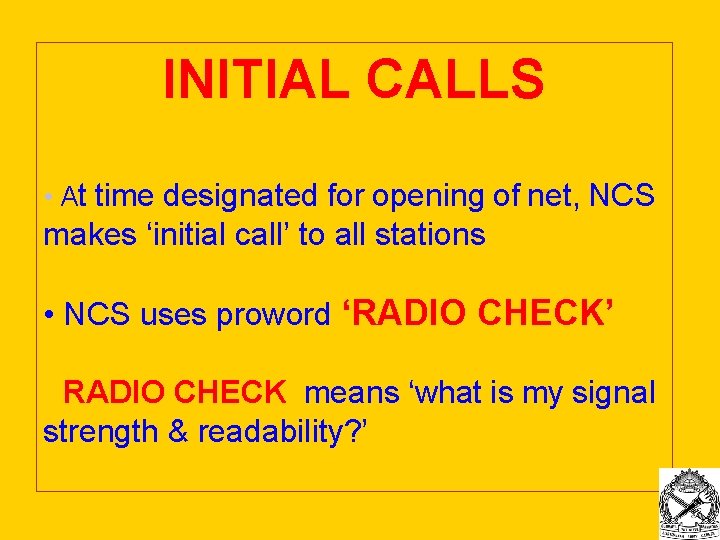
INITIAL CALLS • At time designated for opening of net, NCS makes ‘initial call’ to all stations • NCS uses proword ‘RADIO CHECK’ • RADIO CHECK means ‘what is my signal strength & readability? ’
INITIAL CALLS • Substations then reply in correct answering order, stating how they hear the NCS.
INITIAL CALLS • Substations use these prowords to report signal strength: • LOUD Your signal strength is excellent • GOOD Your signal strength is good • WEAK Your signal strength is weak • VERY WEAK Your signal strength is very weak • FADING Your signal strength at times fades so that continuous reception cannot be relied upon
DO NOTS DO NOT SAY ‘LOUD AND CLEAR’ - THE CORRECT PROWORD IS: ‘ROGER’ DO NOT say ‘how do you read’ – the correct proword is ‘RADIO CHECK’ DO NOT use any other unauthorised prowords
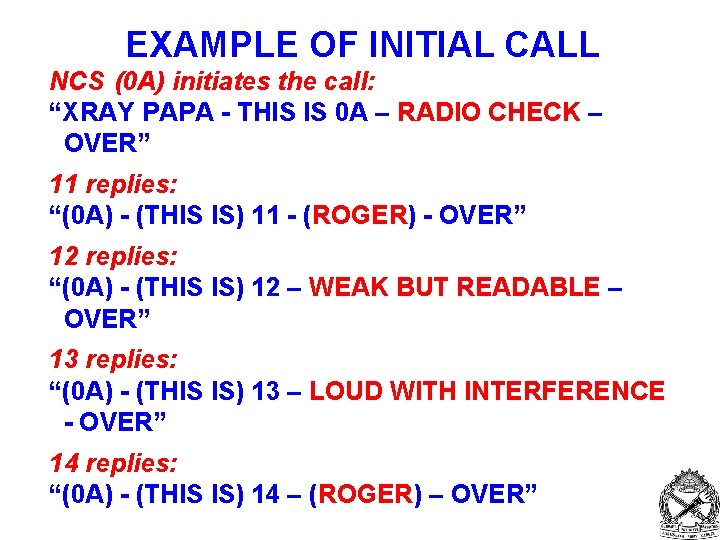
EXAMPLE OF INITIAL CALL NCS (0 A) initiates the call: “XRAY PAPA - THIS IS 0 A – RADIO CHECK – OVER” 11 replies: “(0 A) - (THIS IS) 11 - (ROGER) - OVER” 12 replies: “(0 A) - (THIS IS) 12 – WEAK BUT READABLE – OVER” 13 replies: “(0 A) - (THIS IS) 13 – LOUD WITH INTERFERENCE - OVER” 14 replies: “(0 A) - (THIS IS) 14 – (ROGER) – OVER”
Procedure if station fails to join the net When a substation fails to answer in proper sequence, it must wait until all other substations have answered
Procedure if station fails to join the net If NCS does not receive a reply to the final request, NCS transmits: ‘NOTHING HEARD’
Procedure if station fails to join the net When able to join net, substation reports in, using proword: ‘REPORTING INTO THE NET’ REPORTING INTO THE NET
EXAMPLE OF FIXED STATION JOINING A WORKING NET Substation 12 joins the net after it has already been opened 12 initiates call: “ 0 A - THIS IS 12 – REPORTING INTO THE NET – OVER” NCS (0 A) replies: “(12) - (THIS IS) 0 A - (ROGER) - OVER” 12 replies: “(0 A) - (THIS IS) 12 – OUT”
EXAMPLE OF AMPLIFYING REPORT FOLLOWING INITIAL CALL NCS continues after radio check shown in previous example: Stations report only those other stations which are not LOUD and CLEAR (i. e. not ‘ROGER’)
EXAMPLE OF AMPLIFYING REPORT FOLLOWING INITIAL CALL NCS continues: “X RAY PAPA – THIS IS 0 A – 11 WEAK BUT READABLE – 12 LOUD BUT DISTORTED – REPORT STRENGTHS AND READABILITY – OVER" 11 replies: "(0 A) – (THIS IS) 11 – 12 NOTHING HEARD – 13 WEAK BUT READABLE – OUT" 12 replies: "(0 A) – (THIS IS) 12 – 11 LOUD BUT DISTORTED – 14 WEAK BUT READABLE – OUT" 13 replies: "(0 A) – (THIS IS) 13 – ROGER – OUT“ 14 replies: "(0 A) – (THIS IS) 14 – 13 WEAK WITH INTERFERENCE – OUT"
AMPLIFIED REPORT ON INTERFERENCE These prowords may be used to amplify a report of difficulty in reading a signal due to interference WITH SLIGHT INTERFERENCE WITH MODERATE INTERFERENCE WITH SEVERE INTERFERENCE WITH EXTREME INTERFERENCE FADING – ‘AT TIMES YOUR SIGNAL DECREASES IN STRENGTH SO THAT CONTINUOUS RECEPTION CANNOT BE RELIED UPON’ DISTORTED – ‘I AM HAVING TROUBLE READING YOUR SIGNAL BECAUSE IT IS DISTORTED’
STATION-TO-STATION RADIO CHECKS A station experiencing difficulties may request a RADIO CHECK with one or more stations. The calling station will – in its reply – give a report of signal strength and readability to the other stations called.
EXAMPLE OF TIME CHECK NCS initiates call: “XRAY PAPA - THIS IS 0 A - TIME CHECK AT Zero Nine Three Zero. . . ” The NCS then pauses for sufficiently long to enable operators to prepare their watches. NCS then continues with a countdown: “ 15 seconds - 10 seconds - 5 - 4 - 3 - 2 - 1 - TIME [quote correct time, for example 0930] – OVER” All stations reply in turn: “[Callsign] - ROGER - OUT” Time checks are to be given in local 24 -hour time unless otherwise requested or directed. The time zone suffix (i. e. ZULU or KILO) is NOT to be included in the time check.
EXAMPLE OF ONE STATION CLOSING DOWN FOR MINOR OR TECHNICAL REASONS 14 A initiates call: “ 0 A - THIS IS 14 - CLOSING DOWN - battery change - OVER” NCS replies: “(14) - (THIS IS) 0 A - CLOSE DOWN - OUT”
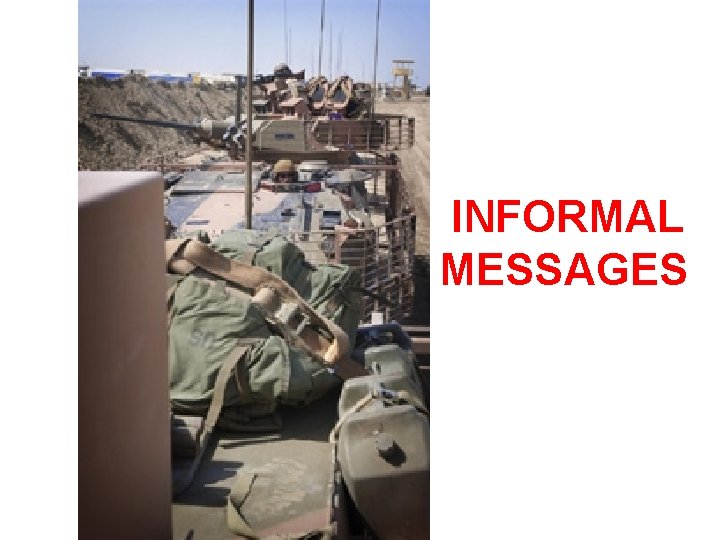
INFORMAL MESSAGES
ASKING TO SPEAK TO A NOMINATED INDIVIDUAL Two possible situations: Nominated individual is at receiving set and can answer immediately § § Nominated individual is NOT at the receiving set and has to be called to the set.
ASKING TO SPEAK TO A NOMINATED INDIVIDUAL In the following example, NOTE the use of the prowords ‘FETCH’ , ‘SPEAKING’, ‘WAIT’, ‘WAIT OUT’
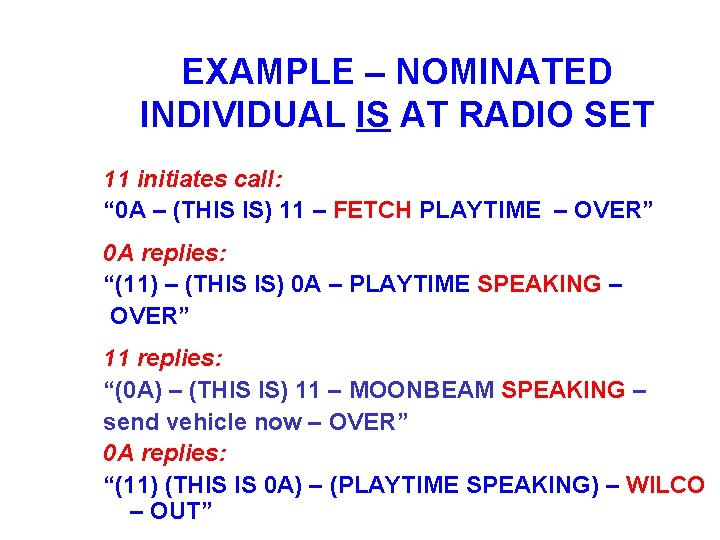
EXAMPLE – NOMINATED INDIVIDUAL IS AT RADIO SET 11 initiates call: “ 0 A – (THIS IS) 11 – FETCH PLAYTIME – OVER” 0 A replies: “(11) – (THIS IS) 0 A – PLAYTIME SPEAKING – OVER” 11 replies: “(0 A) – (THIS IS) 11 – MOONBEAM SPEAKING – send vehicle now – OVER” 0 A replies: “(11) (THIS IS 0 A) – (PLAYTIME SPEAKING) – WILCO – OUT”
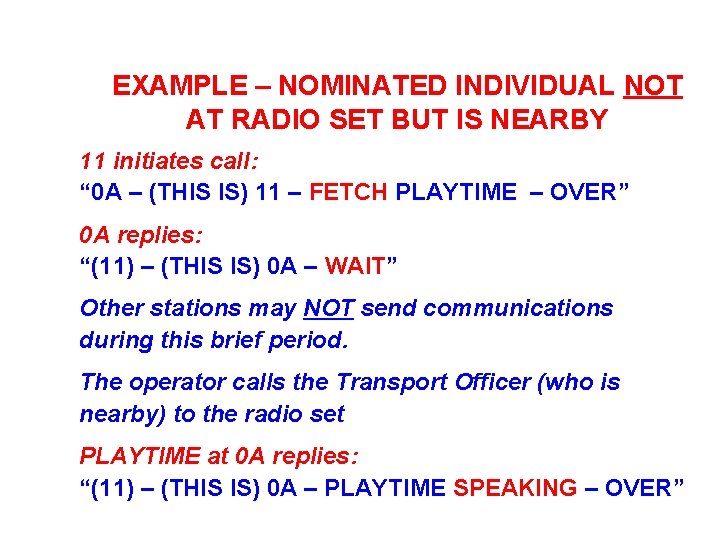
EXAMPLE – NOMINATED INDIVIDUAL NOT AT RADIO SET BUT IS NEARBY 11 initiates call: “ 0 A – (THIS IS) 11 – FETCH PLAYTIME – OVER” 0 A replies: “(11) – (THIS IS) 0 A – WAIT” Other stations may NOT send communications during this brief period. The operator calls the Transport Officer (who is nearby) to the radio set PLAYTIME at 0 A replies: “(11) – (THIS IS) 0 A – PLAYTIME SPEAKING – OVER”
EXAMPLE – NOMINATED INDIVIDUAL NOT AT RADIO SET BUT IS TOO FAR AWAY TO ANSWER IMMEDIATELY MOONBEAM at 11 initiates call: “ 0 A – THIS IS 11 – FETCH PLAYTIME – OVER” 0 A replies: “(11) – (THIS IS) 0 A – WAIT OUT” Other stations may now continue to send communications. The operator calls PLAYTIME to radio set PLAYTIME at 0 A replies: “(11) – (THIS IS) 0 A – PLAYTIME SPEAKING – OVER” 11 replies: “(0 A) – (THIS IS) 11 – MOONBEAM SPEAKING – send vehicle now – OVER” PLAYTIME replies: “(11) – (THIS IS) (0 A) WILCO – OUT”
I’ve got a message for you! OFFERING MESSAGES
OFFERING MESSAGES Messages are ‘offered’: to see if called station is ready to receive before sending reports or orders in poor or difficult conditions if message must be written down when NCS states that net is directed
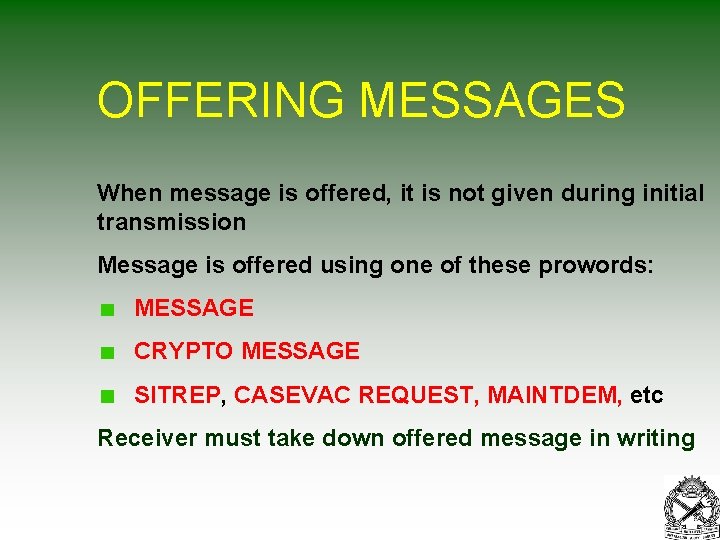
OFFERING MESSAGES When message is offered, it is not given during initial transmission Message is offered using one of these prowords: MESSAGE CRYPTO MESSAGE SITREP, CASEVAC REQUEST, MAINTDEM, etc Receiver must take down offered message in writing
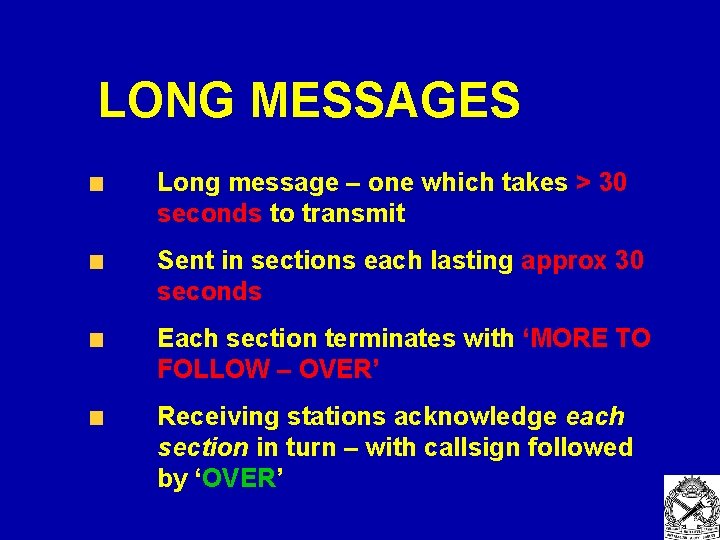
LONG MESSAGES Long message – one which takes > 30 seconds to transmit Sent in sections each lasting approx 30 seconds Each section terminates with ‘MORE TO FOLLOW – OVER’ Receiving stations acknowledge each section in turn – with callsign followed by ‘OVER’
LONG MESSAGES Procedure may be interrupted after any section by urgent traffic If no interruption, next section is transmitted using ‘ALL AFTER’ – followed by last word or phrase of section previously transmitted This procedure is continued until message is completed Receiving stations then acknowledge the last section & end with proword ‘OUT’
REPORTS
LOCSTAT © LTCOL G. Newman– Martin 2011
LOCSTAT ALPHA. Callsign BRAVO. Time (Date/Time Group) CHARLIE. Location (GR) DELTA. Direction (if moving) or length of halt (if halted) LOCSTAT to be provided on request If no change from previous LOCSTAT, state ‘LOCSTAT: No change’
LOCSTAT Conversation between 0 A and 11 © LTCOL G. Newman– Martin 2011
Note how punctuation marks such as full stops are spelled out as prowords. This draws attention to the start of each section. It also allows a brief catch up time when the receiver writes down the message. © LTCOL G. Newman– Martin 2011
EXAMPLE - LOCSTAT At 0900 hours on 31 July 2006, 11 sends a LOCSTAT to 0 A stating that they are at GR 563 728 and are heading North to checkpoint 3 (nickname CLEAR FOX) © LTCOL G. Newman– Martin 2011
EXAMPLE - LOCSTAT 11 initiates call: “ 0 A – THIS IS 11 – LOCSTAT – OVER” © LTCOL G. Newman– Martin 2011
EXAMPLE - LOCSTAT 11 initiates call: “ 0 A – THIS IS 11 – LOCSTAT – OVER” NCS replies: “(11) – (THIS IS) – 0 A – SEND LOCSTAT – OVER” © LTCOL G. Newman– Martin 2011
EXAMPLE - LOCSTAT 11 initiates call: “ 0 A – THIS IS 11 – LOCSTAT – OVER” NCS replies: “(11) – (THIS IS) – 0 A – SEND LOCSTAT – OVER” 11 replies with LOCSTAT: “(0 A) – (THIS IS) 11 – LOCSTAT – © LTCOL G. Newman– Martin 2011
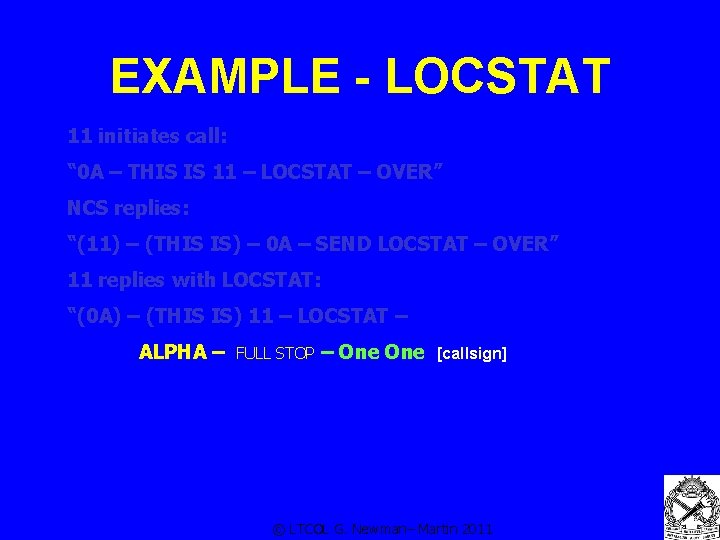
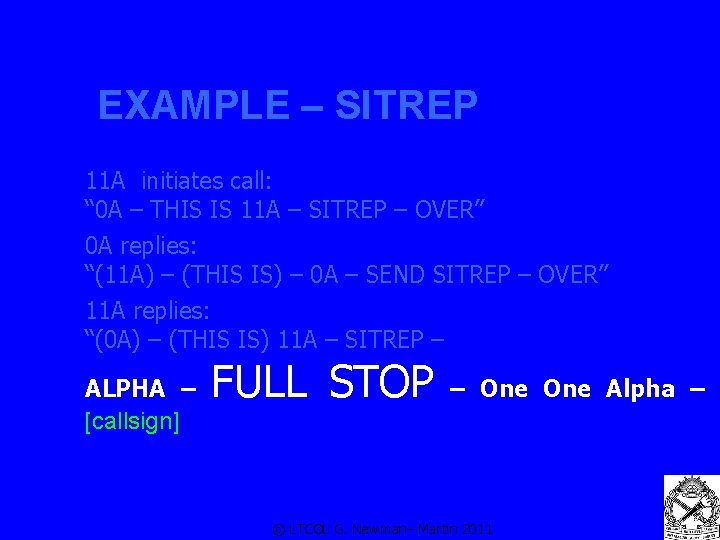
EXAMPLE - LOCSTAT 11 initiates call: “ 0 A – THIS IS 11 – LOCSTAT – OVER” NCS replies: “(11) – (THIS IS) – 0 A – SEND LOCSTAT – OVER” 11 replies with LOCSTAT: “(0 A) – (THIS IS) 11 – LOCSTAT – ALPHA – FULL STOP – One [callsign] © LTCOL G. Newman– Martin 2011
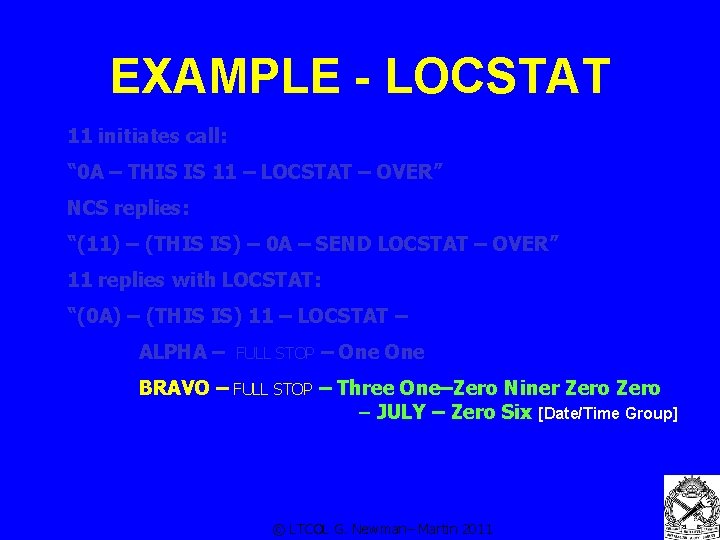
EXAMPLE - LOCSTAT 11 initiates call: “ 0 A – THIS IS 11 – LOCSTAT – OVER” NCS replies: “(11) – (THIS IS) – 0 A – SEND LOCSTAT – OVER” 11 replies with LOCSTAT: “(0 A) – (THIS IS) 11 – LOCSTAT – ALPHA – FULL STOP – One BRAVO – FULL STOP – Three One–Zero Niner Zero – JULY – Zero Six [Date/Time Group] © LTCOL G. Newman– Martin 2011
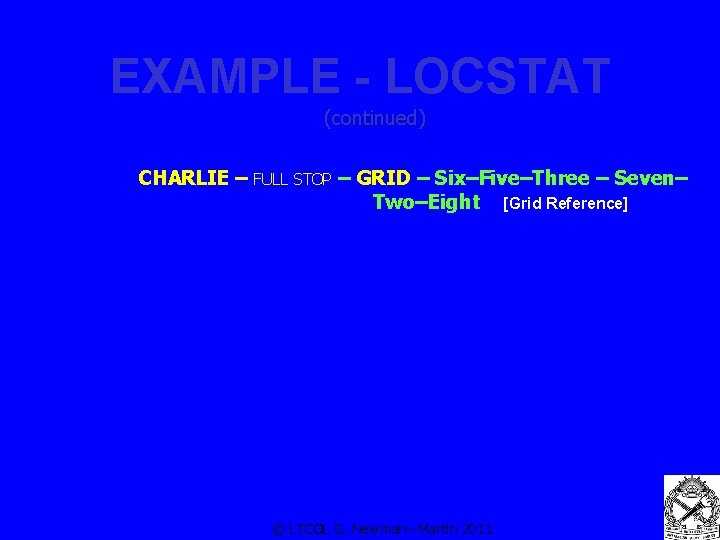
EXAMPLE - LOCSTAT (continued) CHARLIE – FULL STOP – GRID – Six–Five–Three – Seven– Two–Eight [Grid Reference] © LTCOL G. Newman– Martin 2011
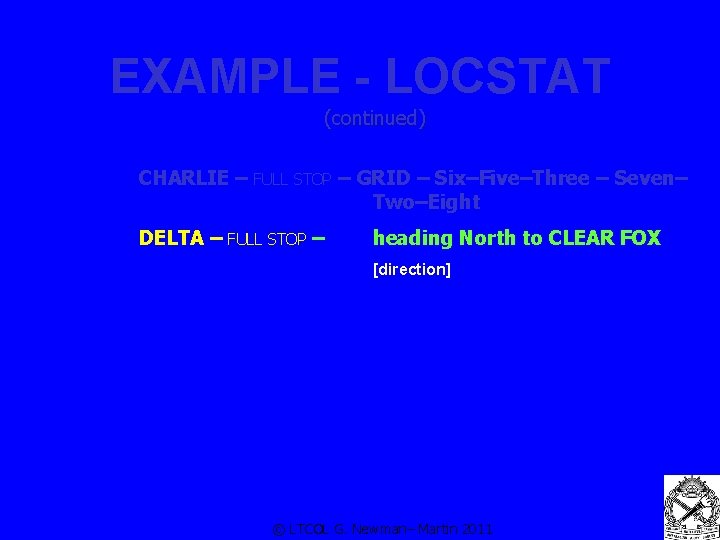
EXAMPLE - LOCSTAT (continued) CHARLIE – FULL STOP – GRID – Six–Five–Three – Seven– Two–Eight DELTA – FULL STOP – heading North to CLEAR FOX [direction] © LTCOL G. Newman– Martin 2011
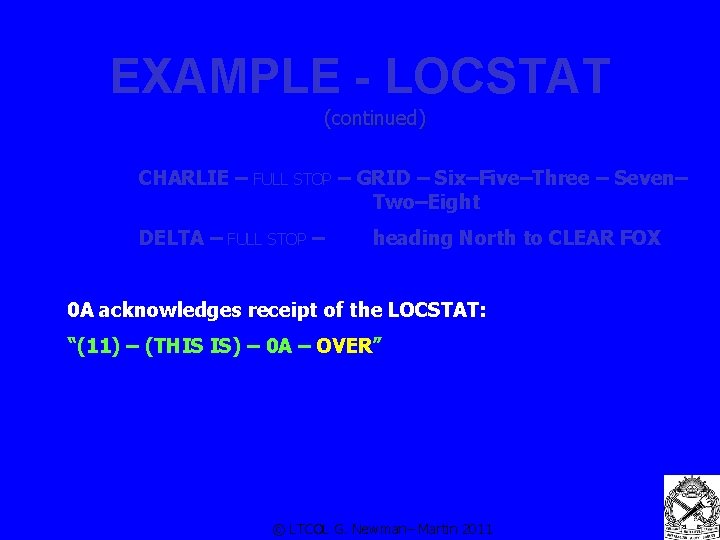
EXAMPLE - LOCSTAT (continued) CHARLIE – FULL STOP – GRID – Six–Five–Three – Seven– Two–Eight DELTA – FULL STOP – heading North to CLEAR FOX 0 A acknowledges receipt of the LOCSTAT: “(11) – (THIS IS) – 0 A – OVER” © LTCOL G. Newman– Martin 2011
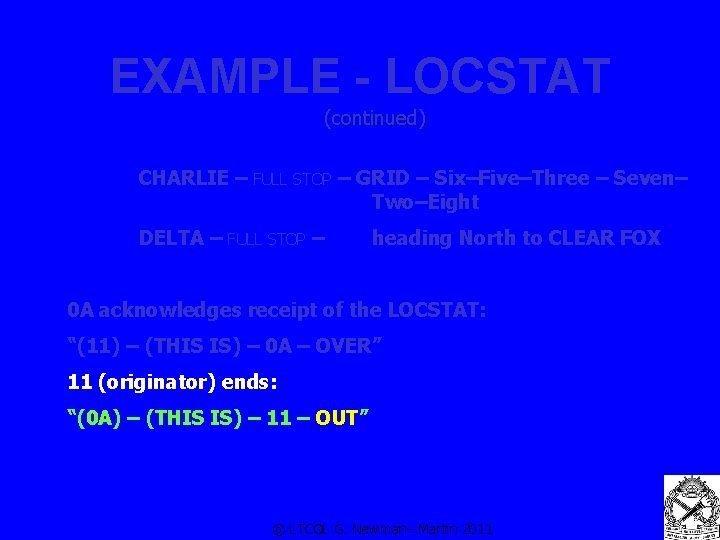
EXAMPLE - LOCSTAT (continued) CHARLIE – FULL STOP – GRID – Six–Five–Three – Seven– Two–Eight DELTA – FULL STOP – heading North to CLEAR FOX 0 A acknowledges receipt of the LOCSTAT: “(11) – (THIS IS) – 0 A – OVER” 11 (originator) ends: “(0 A) – (THIS IS) – 11 – OUT” OUT © LTCOL G. Newman– Martin 2011
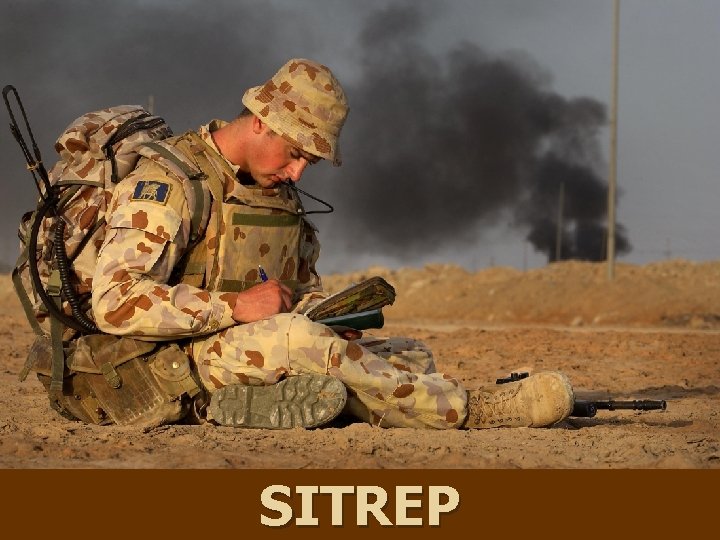
SITREP © LTCOL G. Newman– Martin 2011
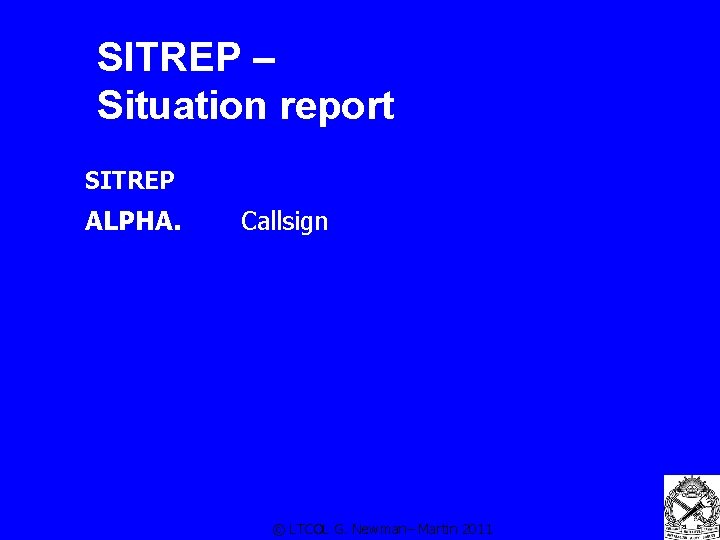
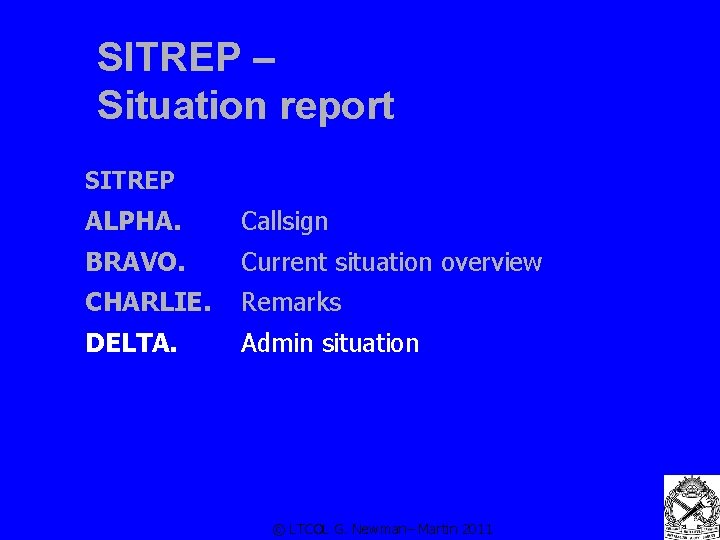
SITREP – Situation report SITREP ALPHA. Callsign © LTCOL G. Newman– Martin 2011
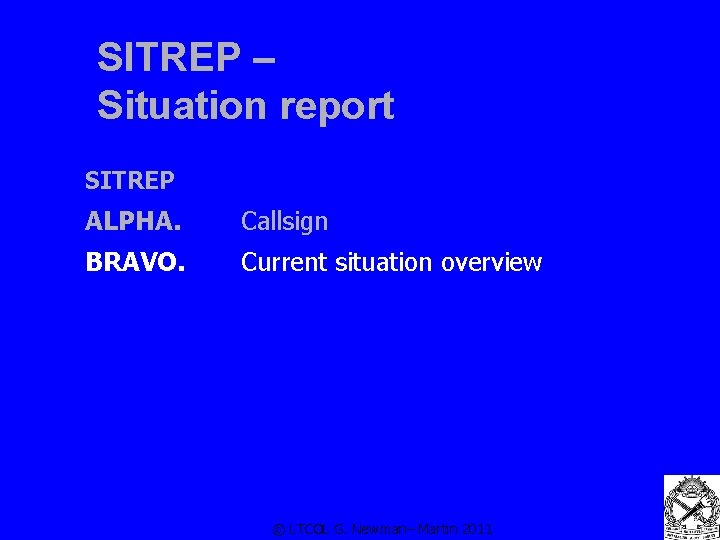
SITREP – Situation report SITREP ALPHA. BRAVO. Callsign Current situation overview © LTCOL G. Newman– Martin 2011
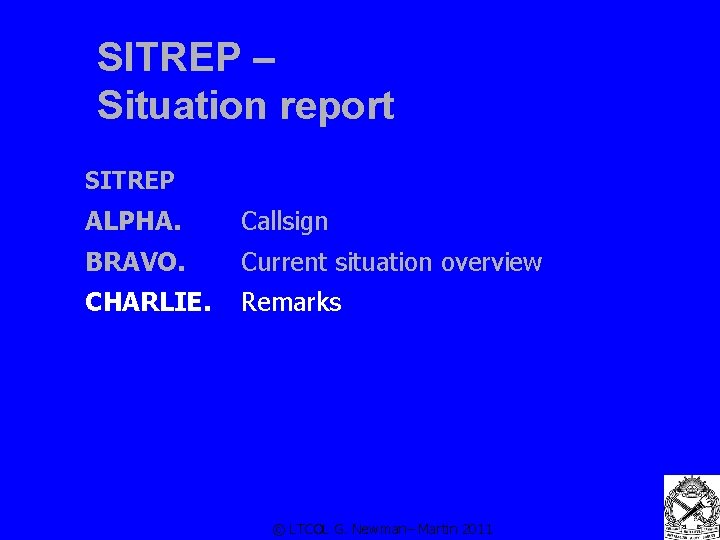
SITREP – Situation report SITREP ALPHA. Callsign BRAVO. Current situation overview CHARLIE. Remarks © LTCOL G. Newman– Martin 2011
SITREP – Situation report SITREP ALPHA. Callsign BRAVO. Current situation overview CHARLIE. Remarks DELTA. Admin situation © LTCOL G. Newman– Martin 2011
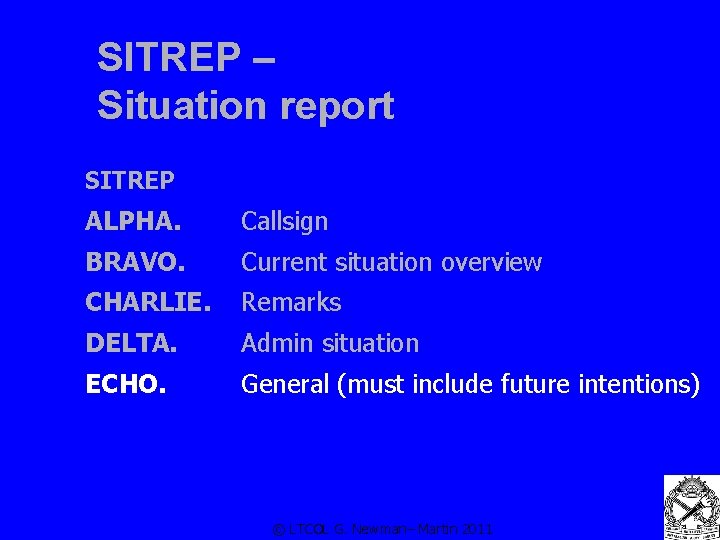
SITREP – Situation report SITREP ALPHA. Callsign BRAVO. Current situation overview CHARLIE. Remarks DELTA. Admin situation ECHO. General (must include future intentions) © LTCOL G. Newman– Martin 2011
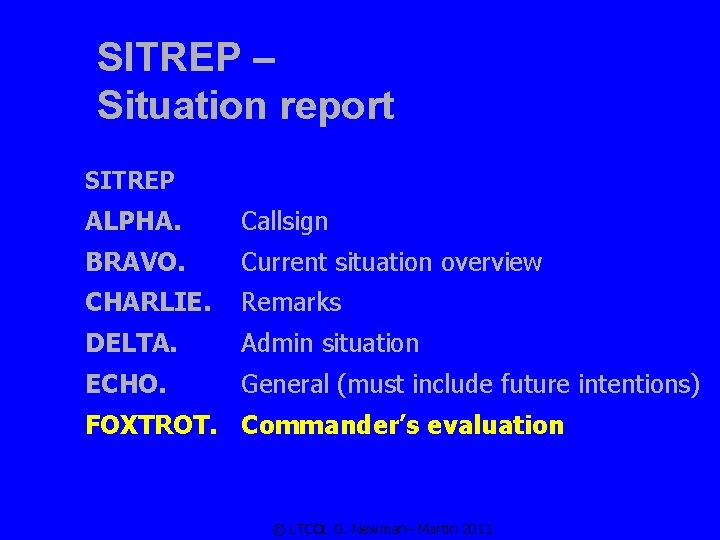
SITREP – Situation report SITREP ALPHA. Callsign BRAVO. Current situation overview CHARLIE. Remarks DELTA. Admin situation ECHO. General (must include future intentions) FOXTROT. Commander’s evaluation © LTCOL G. Newman– Martin 2011
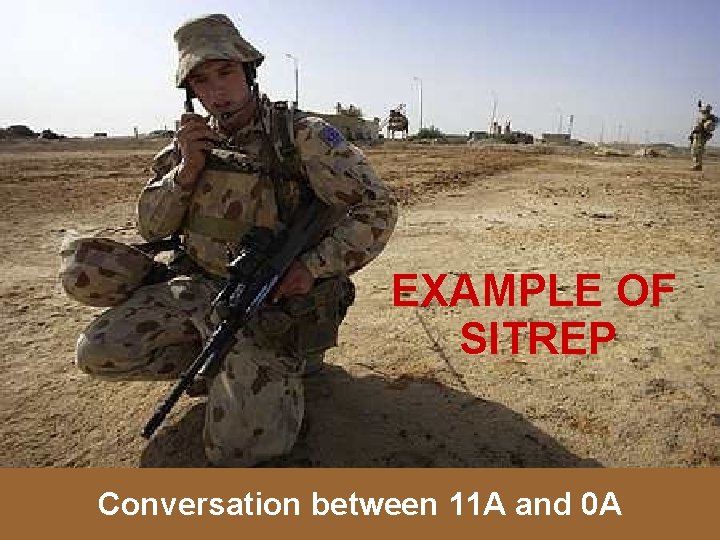
EXAMPLE OF SITREP Conversation between 11 A and 0 A © LTCOL G. Newman– Martin 2011
Punctuation marks – such as FULL STOP and COMMA – in the written message are pronounced as prowords when the message is transmitted by voice. © LTCOL G. Newman– Martin 2011
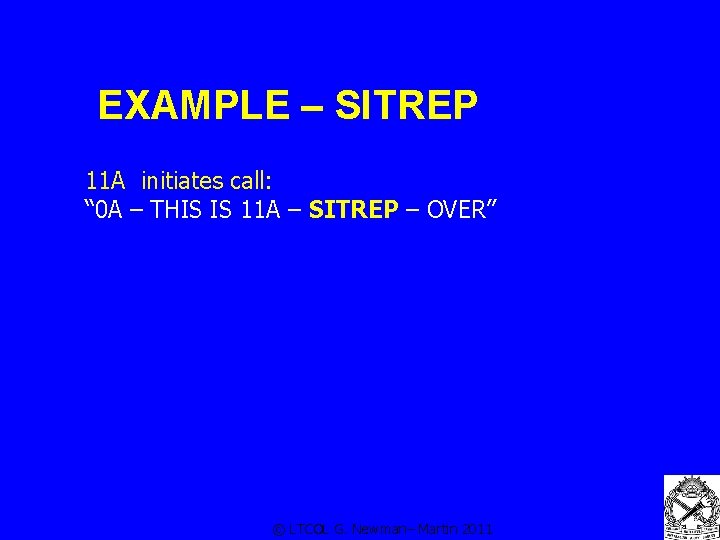
EXAMPLE – SITREP 11 A initiates call: “ 0 A – THIS IS 11 A – SITREP – OVER” © LTCOL G. Newman– Martin 2011
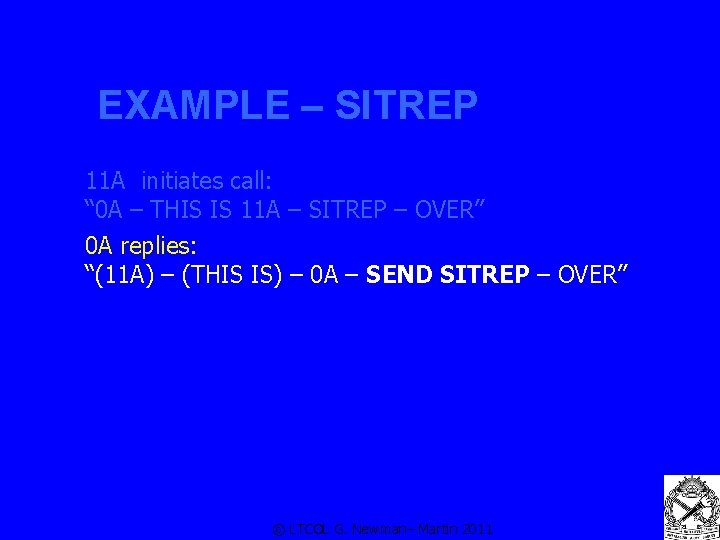
EXAMPLE – SITREP 11 A initiates call: “ 0 A – THIS IS 11 A – SITREP – OVER” 0 A replies: “(11 A) – (THIS IS) – 0 A – SEND SITREP – OVER” © LTCOL G. Newman– Martin 2011
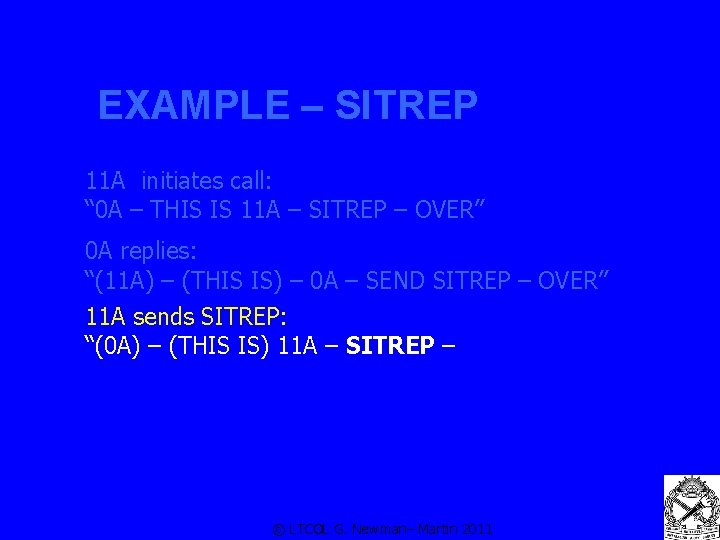
EXAMPLE – SITREP 11 A initiates call: “ 0 A – THIS IS 11 A – SITREP – OVER” 0 A replies: “(11 A) – (THIS IS) – 0 A – SEND SITREP – OVER” 11 A sends SITREP: “(0 A) – (THIS IS) 11 A – SITREP – © LTCOL G. Newman– Martin 2011
EXAMPLE – SITREP 11 A initiates call: “ 0 A – THIS IS 11 A – SITREP – OVER” 0 A replies: “(11 A) – (THIS IS) – 0 A – SEND SITREP – OVER” 11 A replies: “(0 A) – (THIS IS) 11 A – SITREP – ALPHA – [callsign] FULL STOP – One Alpha – © LTCOL G. Newman– Martin 2011
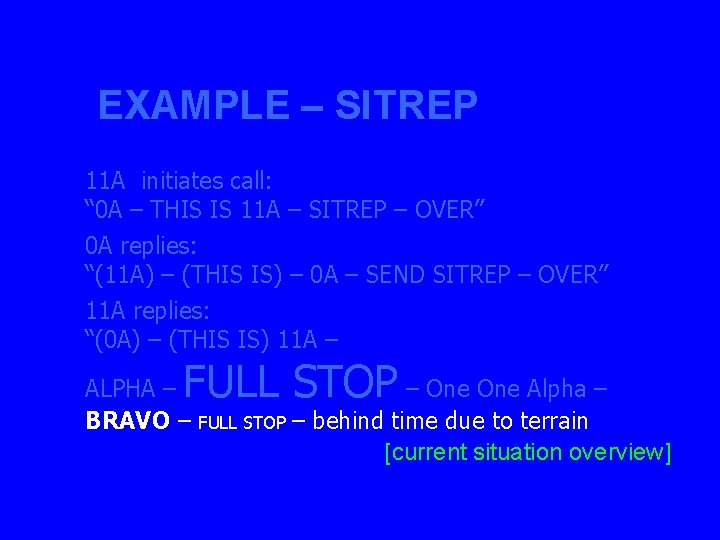
EXAMPLE – SITREP 11 A initiates call: “ 0 A – THIS IS 11 A – SITREP – OVER” 0 A replies: “(11 A) – (THIS IS) – 0 A – SEND SITREP – OVER” 11 A replies: “(0 A) – (THIS IS) 11 A – FULL STOP ALPHA – – One Alpha – BRAVO – FULL STOP – behind time due to terrain [current situation overview]
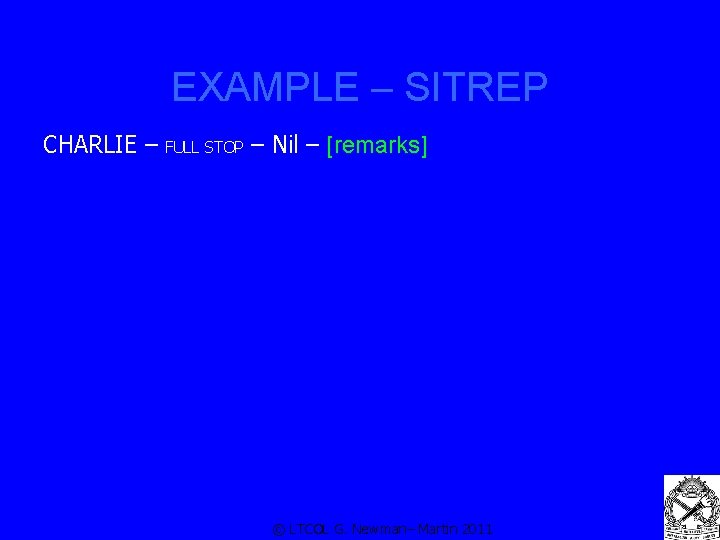
EXAMPLE – SITREP CHARLIE – FULL STOP – Nil – [remarks] © LTCOL G. Newman– Martin 2011
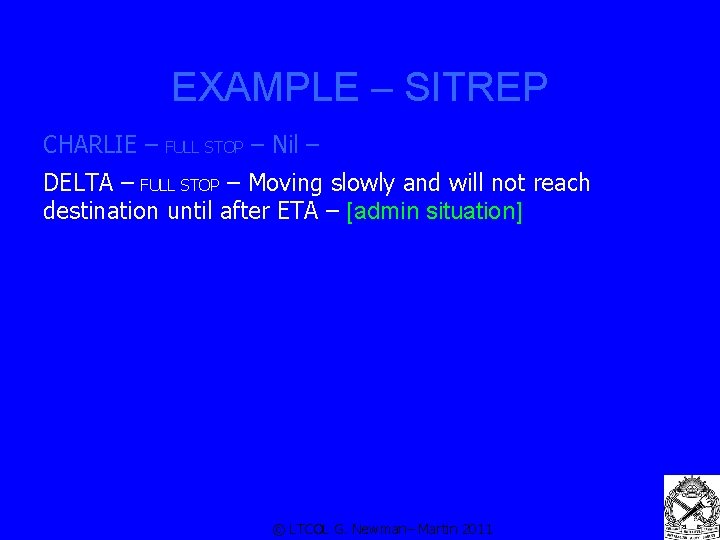
EXAMPLE – SITREP CHARLIE – FULL STOP – Nil – DELTA – FULL STOP – Moving slowly and will not reach destination until after ETA – [admin situation] © LTCOL G. Newman– Martin 2011
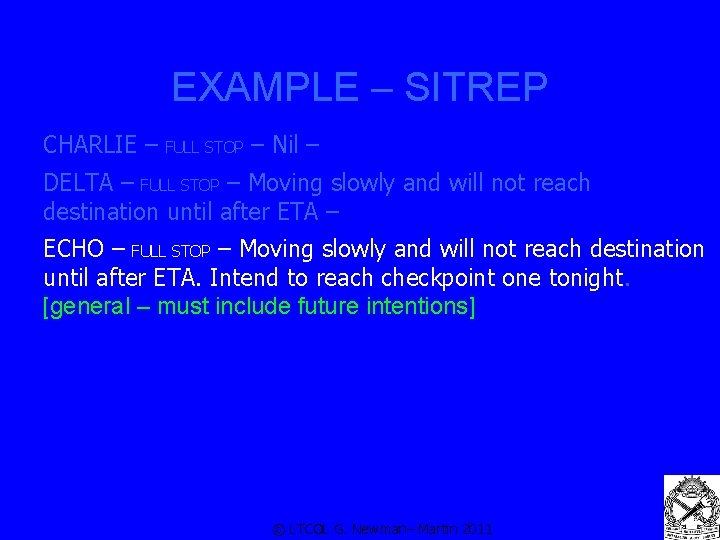
EXAMPLE – SITREP CHARLIE – FULL STOP – Nil – DELTA – FULL STOP – Moving slowly and will not reach destination until after ETA – ECHO – FULL STOP – Moving slowly and will not reach destination until after ETA. Intend to reach checkpoint one tonight. [general – must include future intentions] © LTCOL G. Newman– Martin 2011
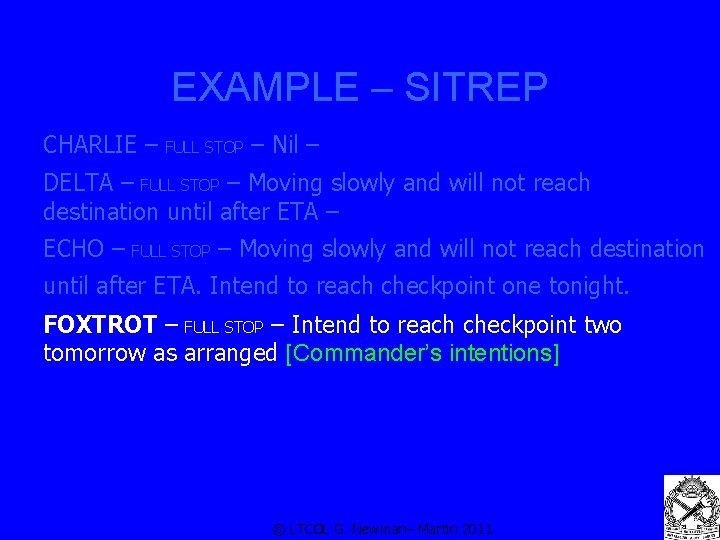
EXAMPLE – SITREP CHARLIE – FULL STOP – Nil – DELTA – FULL STOP – Moving slowly and will not reach destination until after ETA – ECHO – FULL STOP – Moving slowly and will not reach destination until after ETA. Intend to reach checkpoint one tonight. FOXTROT – FULL STOP – Intend to reach checkpoint two tomorrow as arranged [Commander’s intentions] © LTCOL G. Newman– Martin 2011
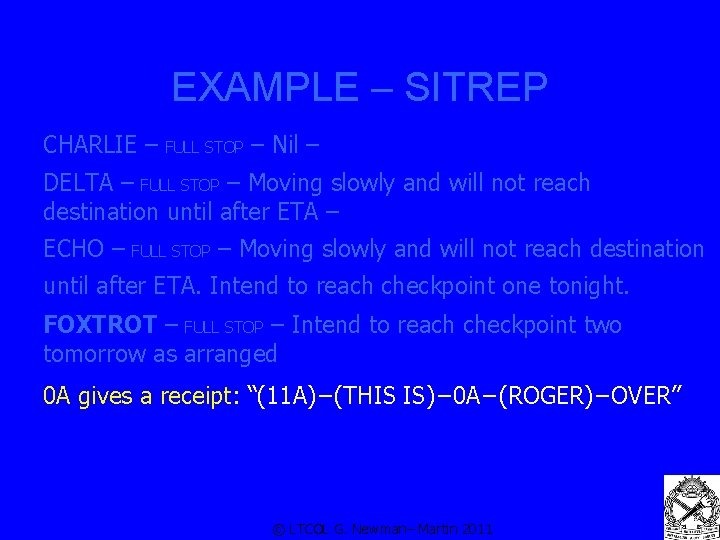
EXAMPLE – SITREP CHARLIE – FULL STOP – Nil – DELTA – FULL STOP – Moving slowly and will not reach destination until after ETA – ECHO – FULL STOP – Moving slowly and will not reach destination until after ETA. Intend to reach checkpoint one tonight. FOXTROT – FULL STOP – Intend to reach checkpoint two tomorrow as arranged 0 A gives a receipt: “(11 A) – (THIS IS) – 0 A – (ROGER) – OVER” © LTCOL G. Newman– Martin 2011
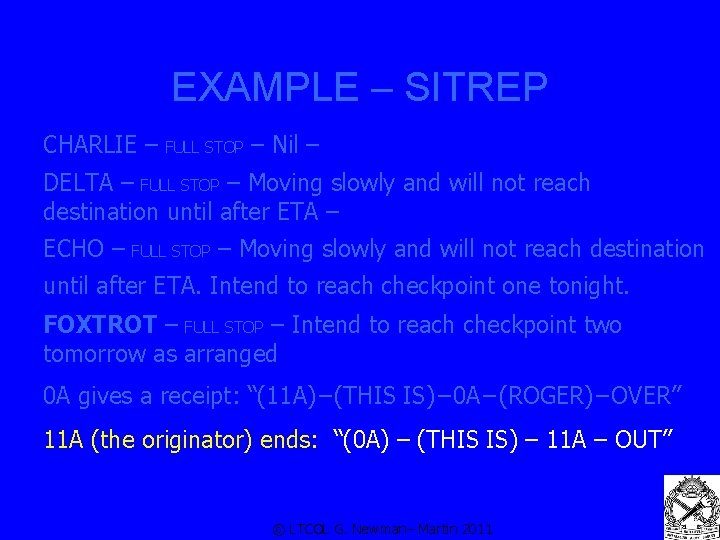
EXAMPLE – SITREP CHARLIE – FULL STOP – Nil – DELTA – FULL STOP – Moving slowly and will not reach destination until after ETA – ECHO – FULL STOP – Moving slowly and will not reach destination until after ETA. Intend to reach checkpoint one tonight. FOXTROT – FULL STOP – Intend to reach checkpoint two tomorrow as arranged 0 A gives a receipt: “(11 A) – (THIS IS) – 0 A – (ROGER) – OVER” 11 A (the originator) ends: “(0 A) – (THIS IS) – 11 A – OUT” © LTCOL G. Newman– Martin 2011
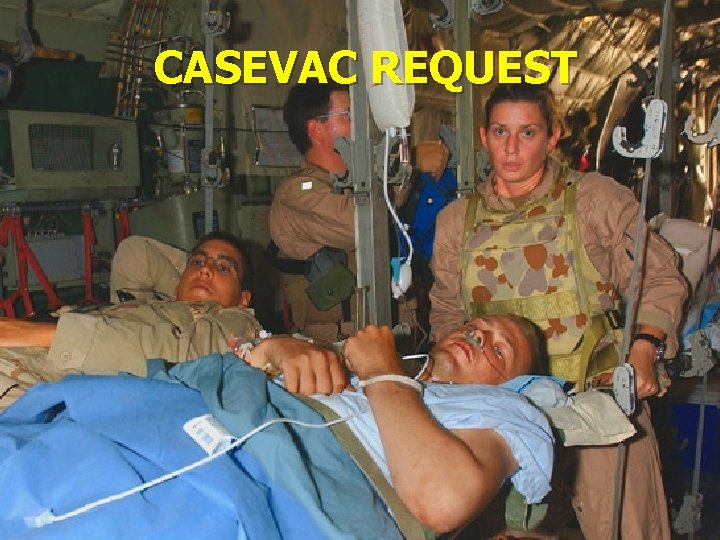
CASEVAC REQUEST © LTCOL G. Newman– Martin 2011
CASEVAC REQUEST …. REQUEST FOR TRANSPORT SUPPORT…. TO MOVE SICK OR INJURED PERSON. ……FROM THEIR PRESENT LOCATION… …………. . TO A MEDICAL FACILITY……… FOR TREATMENT © LTCOL G. Newman– Martin 2011
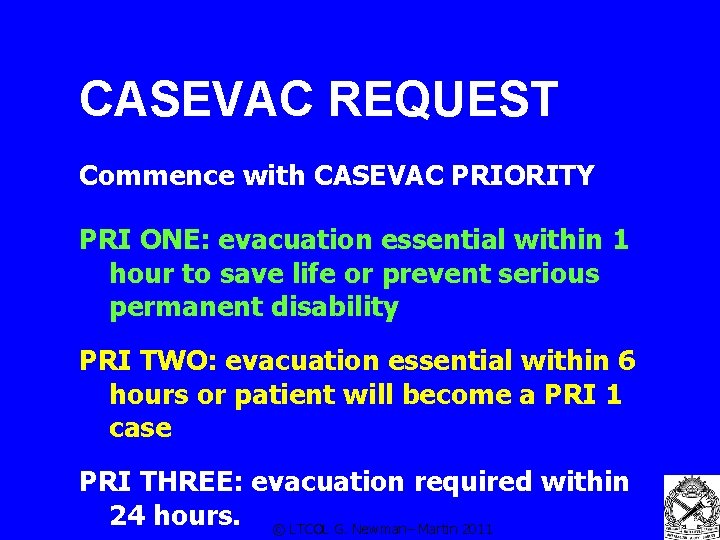
CASEVAC REQUEST Commence with CASEVAC PRIORITY PRI ONE: evacuation essential within 1 hour to save life or prevent serious permanent disability PRI TWO: evacuation essential within 6 hours or patient will become a PRI 1 case PRI THREE: evacuation required within 24 hours. © LTCOL G. Newman– Martin 2011
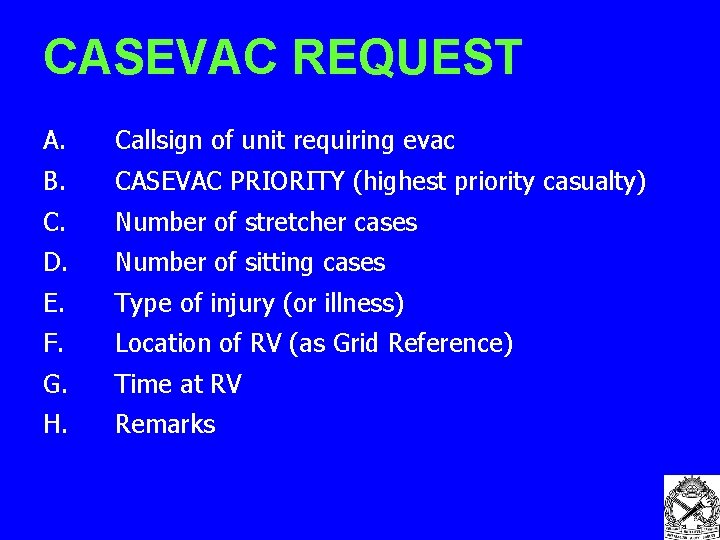
CASEVAC REQUEST A. Callsign of unit requiring evac B. CASEVAC PRIORITY (highest priority casualty) C. D. Number of stretcher cases Number of sitting cases E. Type of injury (or illness) F. Location of RV (as Grid Reference) G. Time at RV H. Remarks
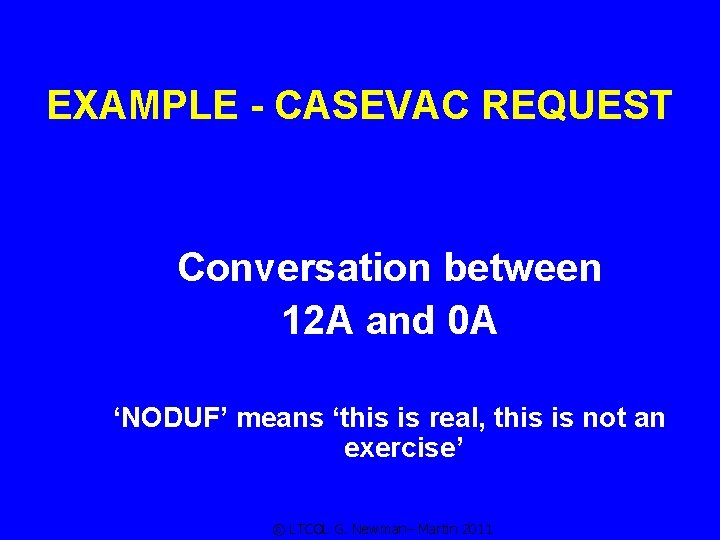
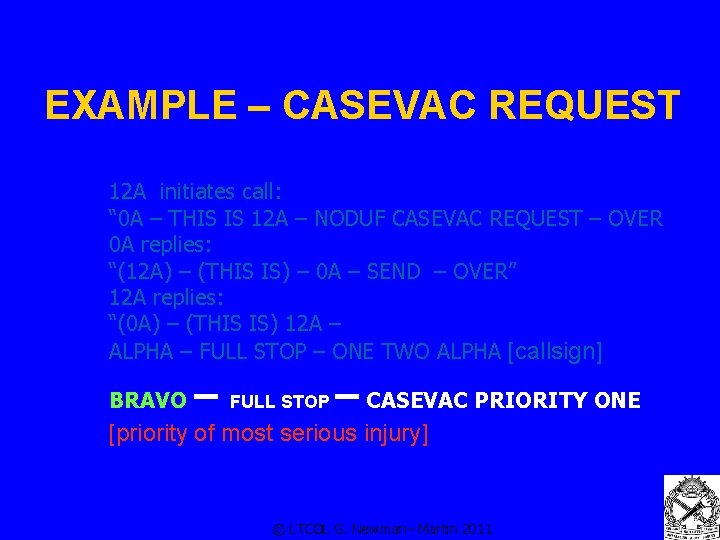
EXAMPLE - CASEVAC REQUEST Conversation between 12 A and 0 A ‘NODUF’ means ‘this is real, this is not an exercise’ © LTCOL G. Newman– Martin 2011
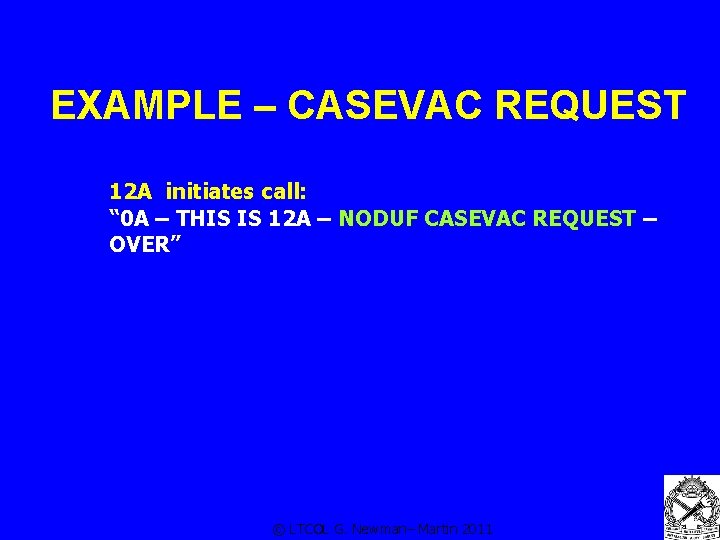
EXAMPLE – CASEVAC REQUEST 12 A initiates call: NODUF CASEVAC REQUEST – NODUF CASEVAC REQUEST “ 0 A – THIS IS 12 A – OVER” © LTCOL G. Newman– Martin 2011
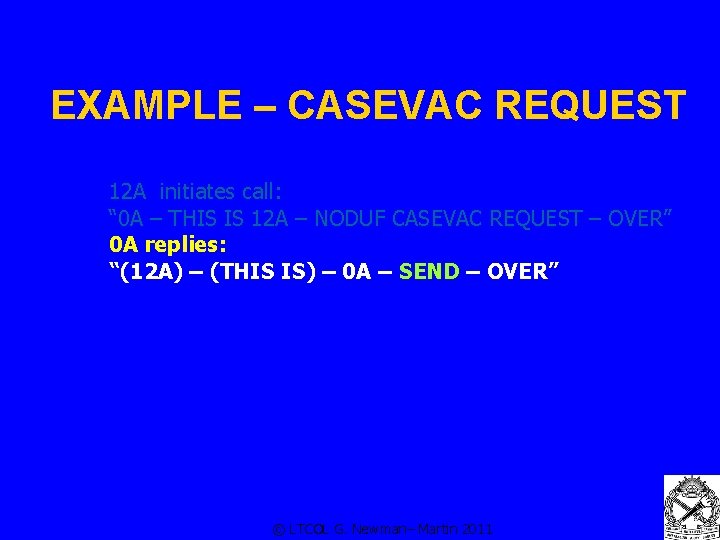
EXAMPLE – CASEVAC REQUEST 12 A initiates call: “ 0 A – THIS IS 12 A – NODUF CASEVAC REQUEST – OVER” 0 A replies: “(12 A) – (THIS IS) – 0 A – SEND – OVER” SEND © LTCOL G. Newman– Martin 2011
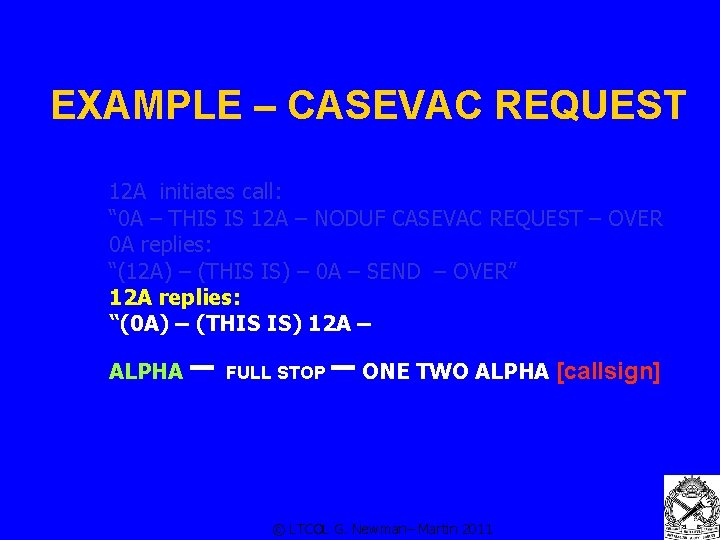
EXAMPLE – CASEVAC REQUEST 12 A initiates call: “ 0 A – THIS IS 12 A – NODUF CASEVAC REQUEST – OVER 0 A replies: “(12 A) – (THIS IS) – 0 A – SEND – OVER” 12 A replies: “(0 A) – (THIS IS) 12 A – ALPHA – FULL STOP – ONE TWO ALPHA [callsign] © LTCOL G. Newman– Martin 2011
EXAMPLE – CASEVAC REQUEST 12 A initiates call: “ 0 A – THIS IS 12 A – NODUF CASEVAC REQUEST – OVER 0 A replies: “(12 A) – (THIS IS) – 0 A – SEND – OVER” 12 A replies: “(0 A) – (THIS IS) 12 A – ALPHA – FULL STOP – ONE TWO ALPHA [callsign] BRAVO – FULL STOP – CASEVAC PRIORITY ONE [priority of most serious injury] © LTCOL G. Newman– Martin 2011
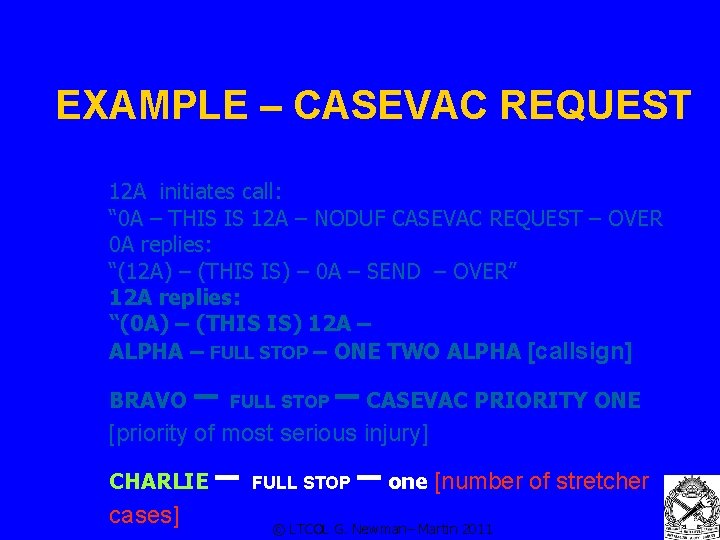
EXAMPLE – CASEVAC REQUEST 12 A initiates call: “ 0 A – THIS IS 12 A – NODUF CASEVAC REQUEST – OVER 0 A replies: “(12 A) – (THIS IS) – 0 A – SEND – OVER” 12 A replies: “(0 A) – (THIS IS) 12 A – ALPHA – FULL STOP – ONE TWO ALPHA [callsign] BRAVO – FULL STOP – CASEVAC PRIORITY ONE [priority of most serious injury] CHARLIE cases] – FULL STOP – one [number of stretcher © LTCOL G. Newman– Martin 2011
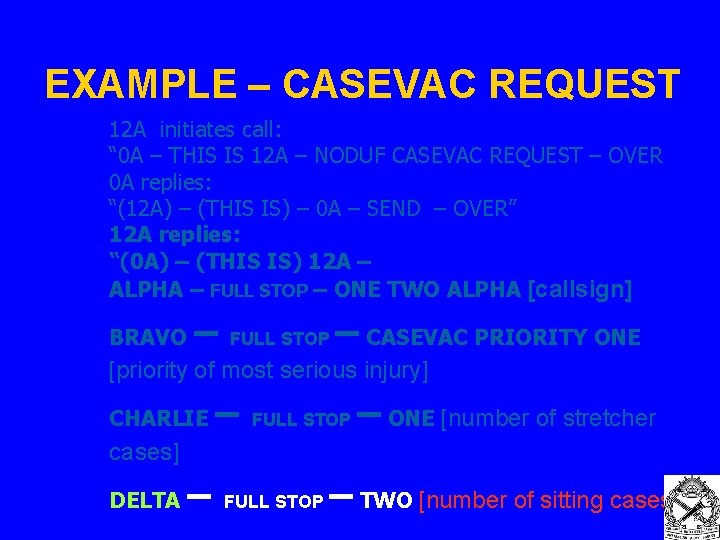
EXAMPLE – CASEVAC REQUEST 12 A initiates call: “ 0 A – THIS IS 12 A – NODUF CASEVAC REQUEST – OVER 0 A replies: “(12 A) – (THIS IS) – 0 A – SEND – OVER” 12 A replies: “(0 A) – (THIS IS) 12 A – ALPHA – FULL STOP – ONE TWO ALPHA [callsign] BRAVO – FULL STOP – CASEVAC PRIORITY ONE [priority of most serious injury] CHARLIE – FULL STOP – ONE [number of stretcher cases] DELTA – FULL STOP – TWO [number of sitting cases]
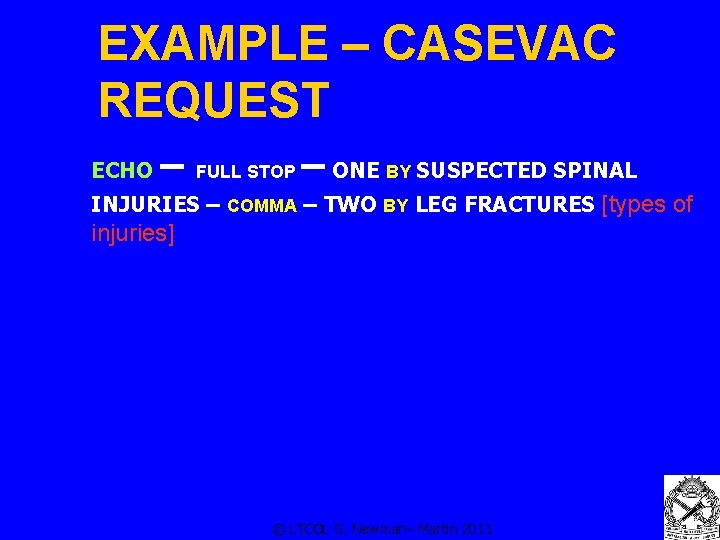
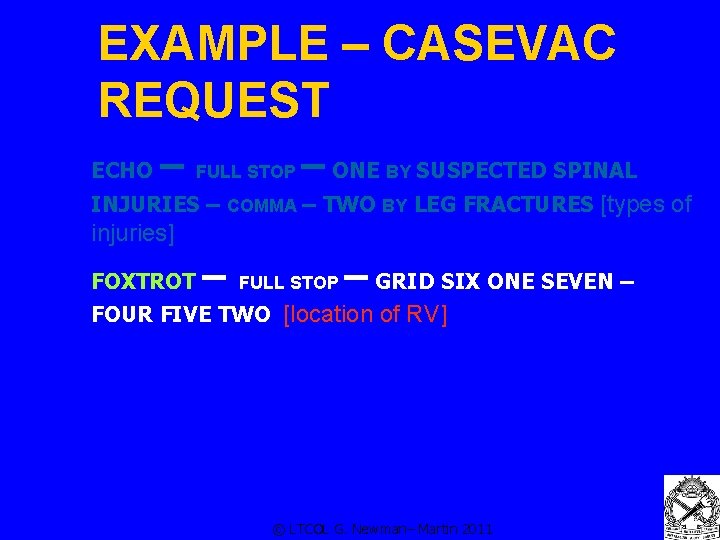
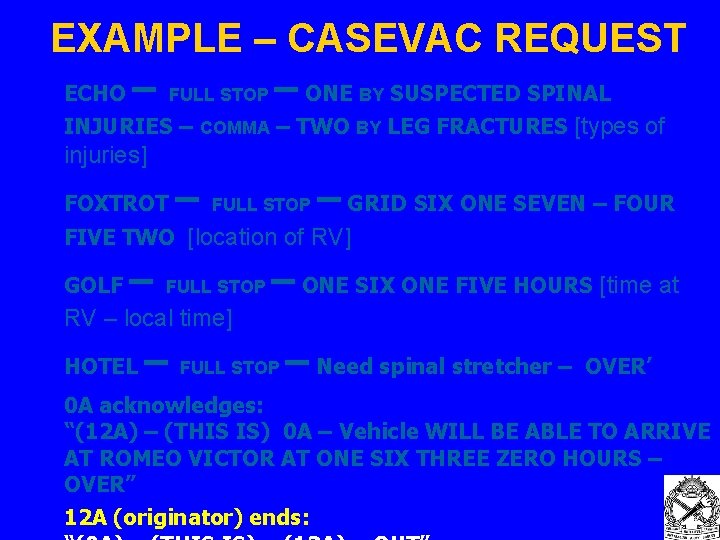
EXAMPLE – CASEVAC REQUEST ECHO – FULL STOP – ONE BY SUSPECTED SPINAL INJURIES – COMMA – TWO BY LEG FRACTURES [types of injuries] © LTCOL G. Newman– Martin 2011
EXAMPLE – CASEVAC REQUEST ECHO – FULL STOP – ONE BY SUSPECTED SPINAL INJURIES – COMMA – TWO BY LEG FRACTURES [types of injuries] FOXTROT – FULL STOP – GRID SIX ONE SEVEN – FOUR FIVE TWO [location of RV] © LTCOL G. Newman– Martin 2011
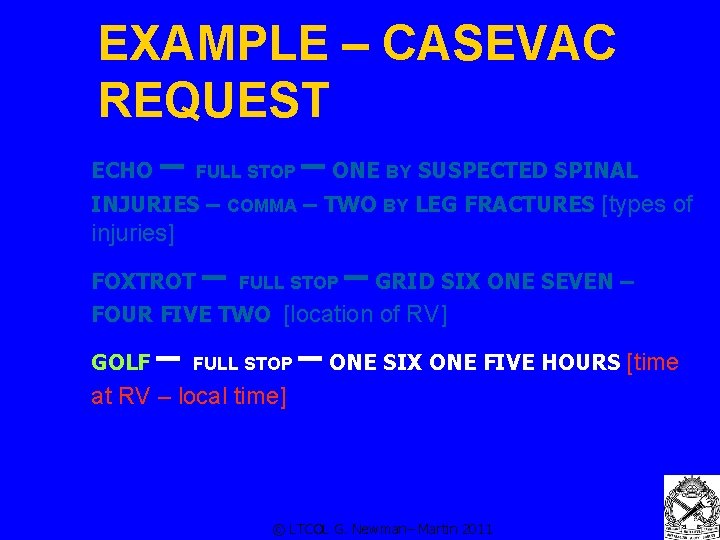
EXAMPLE – CASEVAC REQUEST ECHO – FULL STOP – ONE BY SUSPECTED SPINAL INJURIES – COMMA – TWO BY LEG FRACTURES [types of injuries] FOXTROT – FULL STOP – GRID SIX ONE SEVEN – FOUR FIVE TWO [location of RV] GOLF – FULL STOP – ONE SIX ONE FIVE HOURS [time at RV – local time] © LTCOL G. Newman– Martin 2011
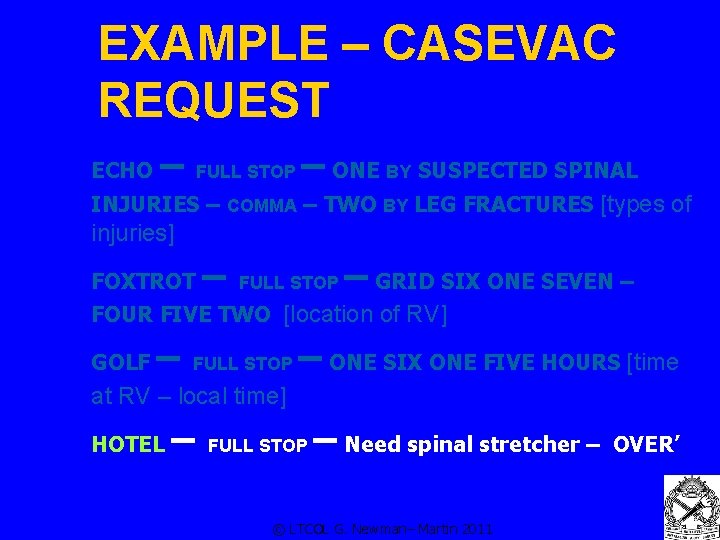
EXAMPLE – CASEVAC REQUEST ECHO – FULL STOP – ONE BY SUSPECTED SPINAL INJURIES – COMMA – TWO BY LEG FRACTURES [types of injuries] FOXTROT – FULL STOP – GRID SIX ONE SEVEN – FOUR FIVE TWO [location of RV] GOLF – FULL STOP – ONE SIX ONE FIVE HOURS [time at RV – local time] HOTEL – FULL STOP – Need spinal stretcher – OVER’ © LTCOL G. Newman– Martin 2011
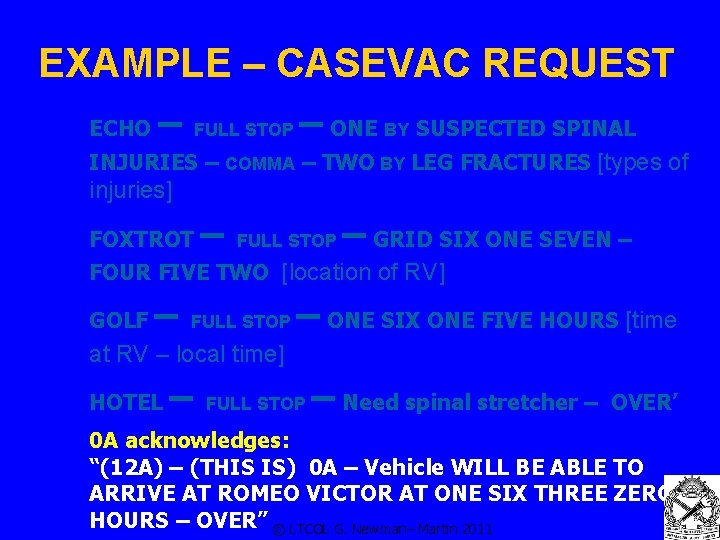
EXAMPLE – CASEVAC REQUEST ECHO – FULL STOP – ONE BY SUSPECTED SPINAL INJURIES – COMMA – TWO BY LEG FRACTURES [types of injuries] FOXTROT – FULL STOP – GRID SIX ONE SEVEN – FOUR FIVE TWO [location of RV] GOLF – FULL STOP – ONE SIX ONE FIVE HOURS [time at RV – local time] HOTEL – FULL STOP – Need spinal stretcher – OVER’ 0 A acknowledges: “(12 A) – (THIS IS) 0 A – Vehicle WILL BE ABLE TO ARRIVE AT ROMEO VICTOR AT ONE SIX THREE ZERO HOURS – OVER” © LTCOL G. Newman– Martin 2011
EXAMPLE – CASEVAC REQUEST ECHO – FULL STOP – ONE BY SUSPECTED SPINAL INJURIES – COMMA – TWO BY LEG FRACTURES [types of injuries] FOXTROT – FULL STOP – GRID SIX ONE SEVEN – FOUR FIVE TWO [location of RV] GOLF – FULL STOP – ONE SIX ONE FIVE HOURS [time at RV – local time] HOTEL – FULL STOP – Need spinal stretcher – OVER’ 0 A acknowledges: “(12 A) – (THIS IS) 0 A – Vehicle WILL BE ABLE TO ARRIVE AT ROMEO VICTOR AT ONE SIX THREE ZERO HOURS – OVER” 12 A (originator) ends:
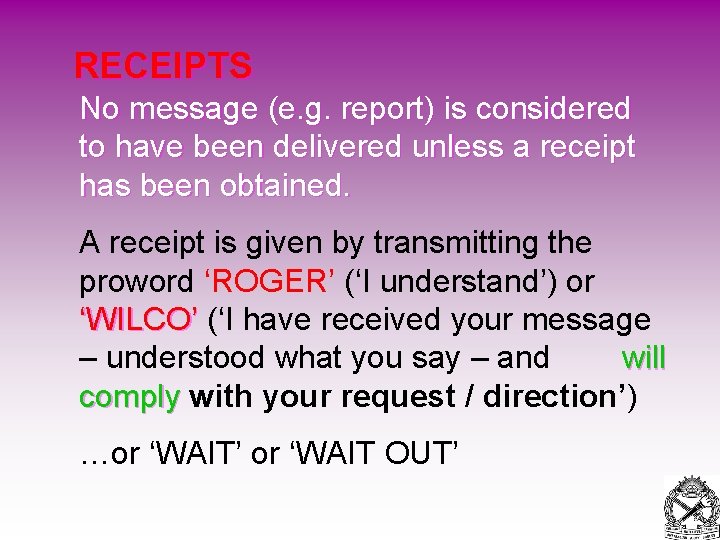
RECEIPTS No message (e. g. report) is considered to have been delivered unless a receipt has been obtained. A receipt is given by transmitting the proword ‘ROGER’ (‘I understand’) or ‘WILCO’ (‘I have received your message ‘WILCO’ – understood what you say – and will comply with your request / direction’) comply …or ‘WAIT’ or ‘WAIT OUT’
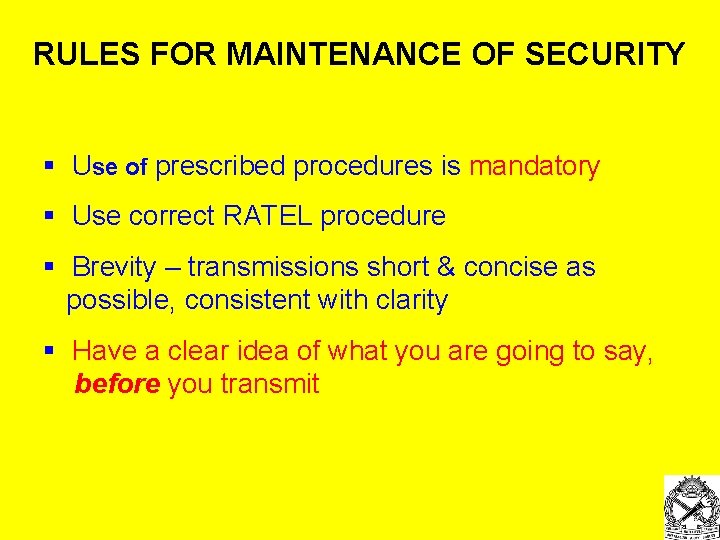
RULES FOR MAINTENANCE OF SECURITY § Use of prescribed procedures is mandatory § Use correct RATEL procedure § Brevity – transmissions short & concise as possible, consistent with clarity § Have a clear idea of what you are going to say, before you transmit
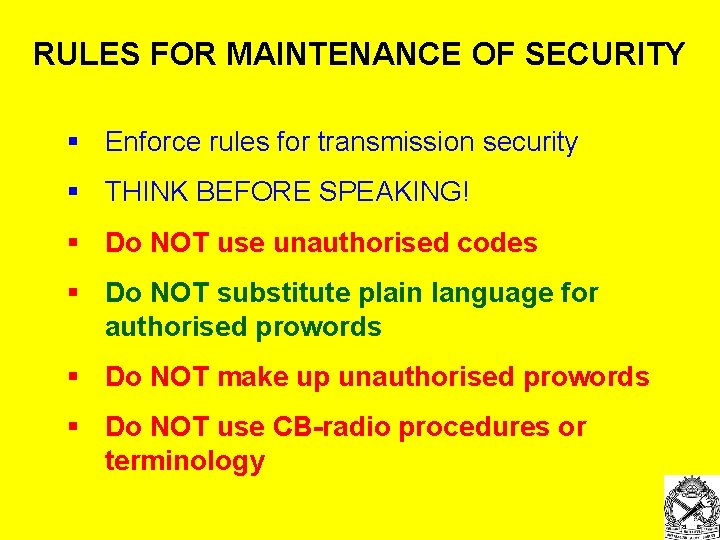
RULES FOR MAINTENANCE OF SECURITY § Enforce rules for transmission security § THINK BEFORE SPEAKING! § Do NOT use unauthorised codes § Do NOT substitute plain language for authorised prowords § Do NOT make up unauthorised prowords § Do NOT use CB-radio procedures or terminology
RULES FOR TRANSMISSION SECURITY Only authorised transmissions are to be made Practices specifically prohibited by this rule: • Violations of communications silence • Unofficial conversations between operators • Transmitting on a directed net without permission
RULES FOR TRANSMISSION SECURITY Do not give away information Practices specifically prohibited by this rule: • unauthorised use of plain language • compromising classified callsigns by: • plain language disclosure • linking them with unclassified callsigns • transmitting the operator’s personal sign or name • giving details of unit names
CORRECTIONS Use proword ‘CORRECTION’ in combination with other suitable prowords – such as: WORD BEFORE WORD AFTER WORD BEFORE followed by the last word, phrase or proword correctly transmitted No other explanation or words are required
EXAMPLE OF IMMEDIATE CORRECTION The operator at 11 sends incorrect number 10 instead of 20 – but realises his/her mistake immediately and corrects ’ 10’ to ’ 20’ 11 A transmits: “ 11 – THIS IS 11 A – I WILL BE IN YOUR LOCATION IN 10 – CORRECTION – LOCATION IN 20 – MINUTES – OVER” 11 replies: “ 11 – ROGER – OUT”
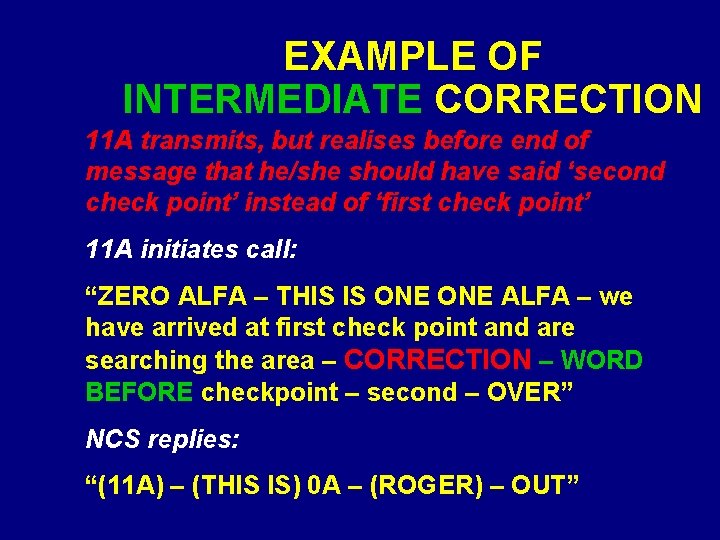
EXAMPLE OF INTERMEDIATE CORRECTION 11 A transmits, but realises before end of message that he/she should have said ‘second check point’ instead of ‘first check point’ 11 A initiates call: “ZERO ALFA – THIS IS ONE ALFA – we have arrived at first check point and are searching the area – CORRECTION – WORD BEFORE checkpoint – second – OVER” NCS replies: “(11 A) – (THIS IS) 0 A – (ROGER) – OUT”
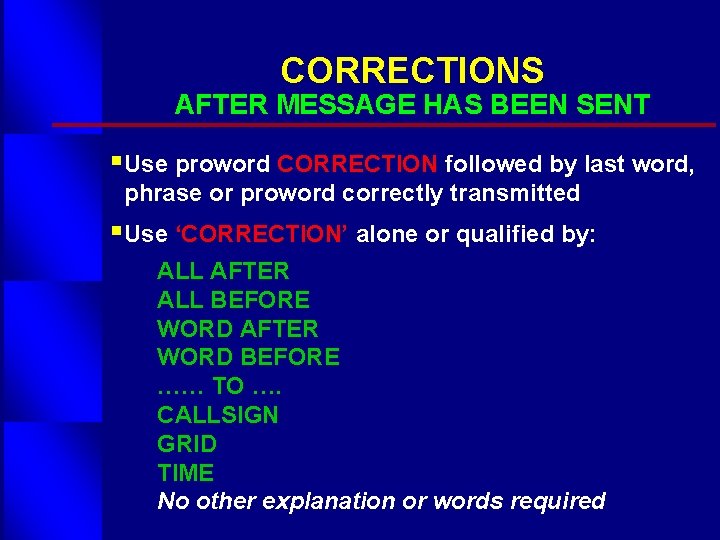
CORRECTIONS AFTER MESSAGE HAS BEEN SENT § Use proword CORRECTION followed by last word, phrase or proword correctly transmitted § Use ‘CORRECTION’ alone or qualified by: ALL AFTER ALL BEFORE WORD AFTER WORD BEFORE …… TO …. CALLSIGN GRID TIME No other explanation or words required
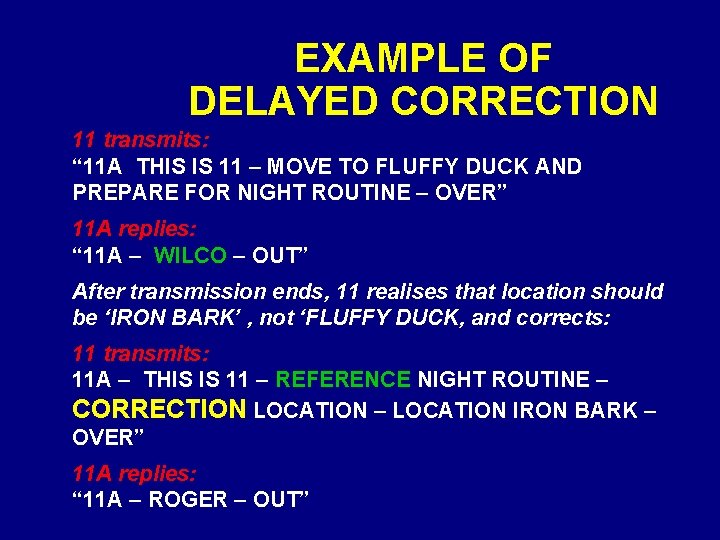
EXAMPLE OF DELAYED CORRECTION 11 transmits: “ 11 A THIS IS 11 – MOVE TO FLUFFY DUCK AND PREPARE FOR NIGHT ROUTINE – OVER” 11 A replies: “ 11 A – WILCO – OUT” After transmission ends, 11 realises that location should be ‘IRON BARK’ , not ‘FLUFFY DUCK, and corrects: 11 transmits: 11 A – THIS IS 11 – REFERENCE NIGHT ROUTINE – CORRECTION LOCATION – LOCATION IRON BARK – OVER” 11 A replies: “ 11 A – ROGER – OUT”
FREE NET Under normal conditions once a net has been established it is FREE… …and NCS will not usually intervene in communications between substations.
DIRECTED NET v When conditions are difficult and/or flow of radio traffic is heavy…. v NCS may order net to be DIRECTED v After this, ALL messages between substations MUST be offered. v NCS is the first to answer these offers. v In directed net, NCS regulates all traffic on net.
CHANGING STATE OF NET BETWEEN FREE AND DIRECTED NCS USES PROWORDS: THIS IS A DIRECTED NET OR THIS IS A FREE NET
REPLIES BY NCS WHEN NET IS DIRECTED SEND YOUR [MESSAGE, SITREP, ETC) – OUT i. e. permission for this message to be sent n WAIT OUT i. e. substation must wait until given permission by NCS to transmit n THROUGH ME i. e. NCS assumes responsibility for relaying message n RELAY THROUGH…. . – OUT NCS directs originating substation to relay through another station n
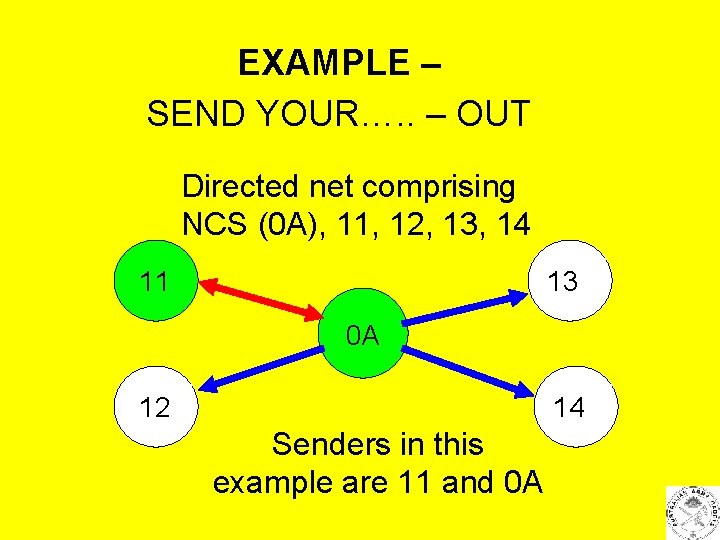
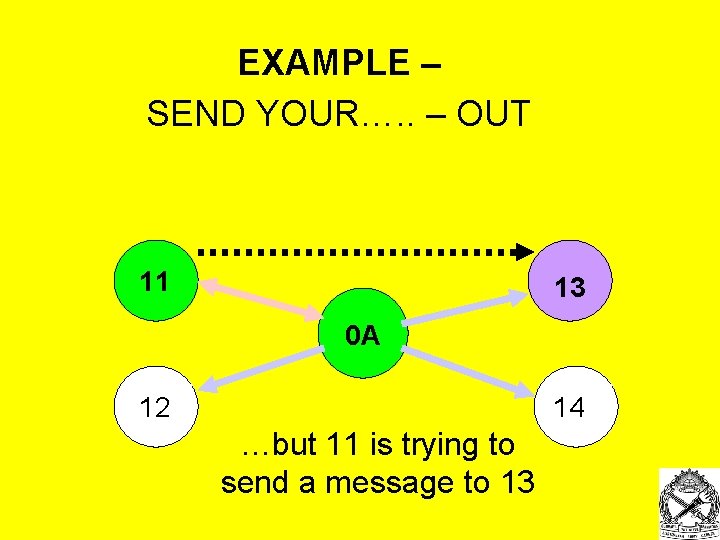
EXAMPLE – SEND YOUR…. . – OUT Directed net comprising NCS (0 A), 11, 12, 13, 14 11 13 0 A 12 14 Senders in this example are 11 and 0 A
EXAMPLE – SEND YOUR…. . – OUT 11 13 0 A 12 14 …but 11 is trying to send a message to 13
EXAMPLE – SEND YOUR…. . – OUT DIRECTED NET All stations can hear each other Substation 11 offers message (through NCS) for 13: “ 13 - THIS IS 11 - (MESSAGE) - OVER” NCS directs that message be sent: “(11) - THIS IS 0 A - SEND YOUR MESSAGE - OVER” 11 now sends message: “(13) - (THIS IS) 11 - Have reached checkpoint BIG APPLE - OVER [or OUT]” At this stage 13 would reply to 11.
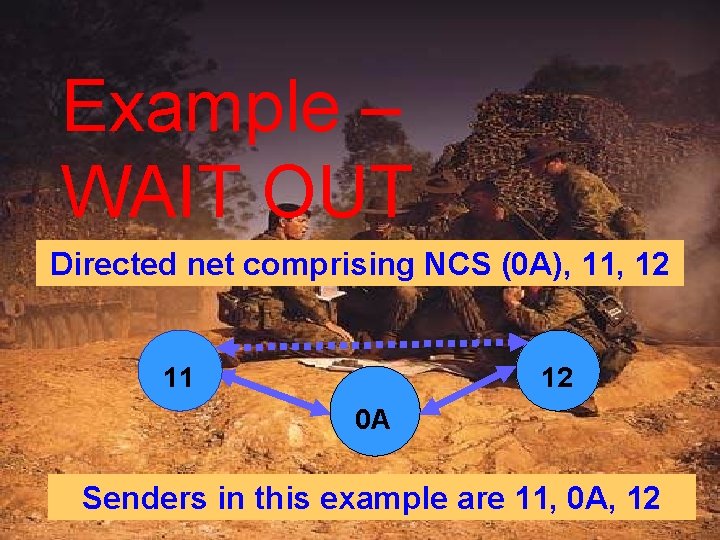
Example – WAIT OUT Directed net comprising NCS (0 A), 11, 12 11 12 0 A Senders in this example are 11, 0 A, 12
EXAMPLE – WAIT OUT DIRECTED NET 11 wishes to send message to 12, and calls: “ 12 - THIS IS 11 - (MESSAGE) - OVER” The call is addressed by 11 to 12, but NCS must respond first. As there is more urgent traffic to be passed, the NCS decides that 11 will have to wait. NCS transmits: “(11) - (THIS IS) - 0 A - WAIT OUT”
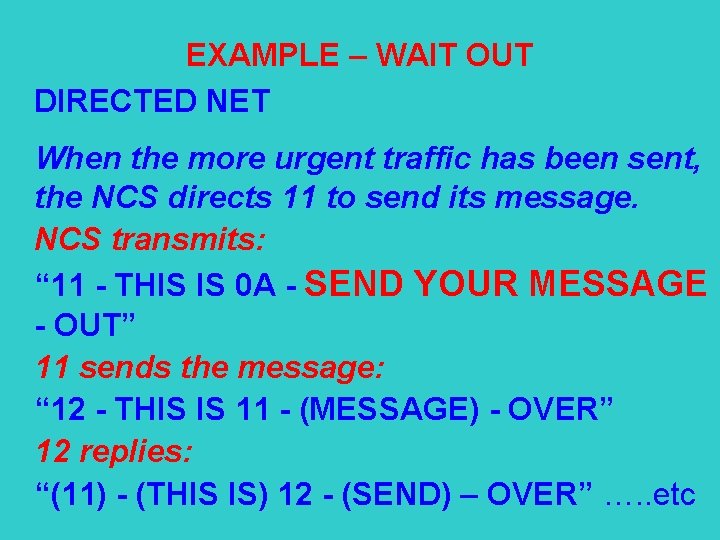
EXAMPLE – WAIT OUT DIRECTED NET When the more urgent traffic has been sent, the NCS directs 11 to send its message. NCS transmits: “ 11 - THIS IS 0 A - SEND YOUR MESSAGE - OUT” 11 sends the message: “ 12 - THIS IS 11 - (MESSAGE) - OVER” 12 replies: “(11) - (THIS IS) 12 - (SEND) – OVER” …. . etc
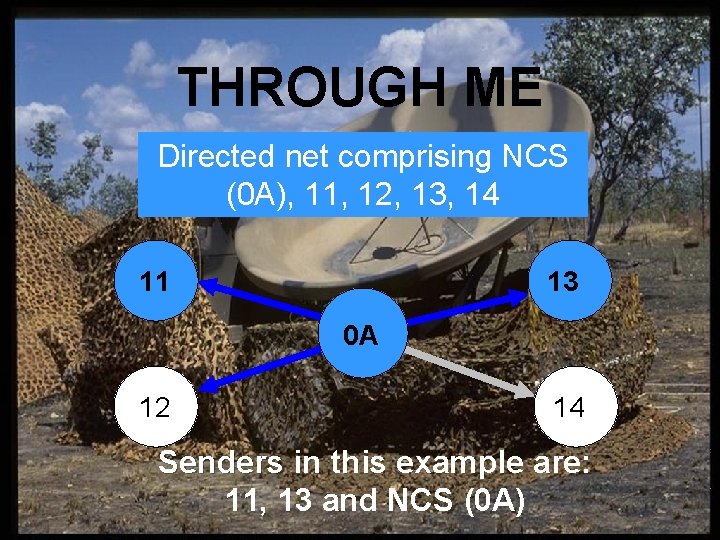
THROUGH ME TYPES OF CALLS Directed net comprising NCS (0 A), 11, 12, 13, 14 11 13 0 A 12 14 Senders in this example are: Senders 11, 13 and NCS (0 A)
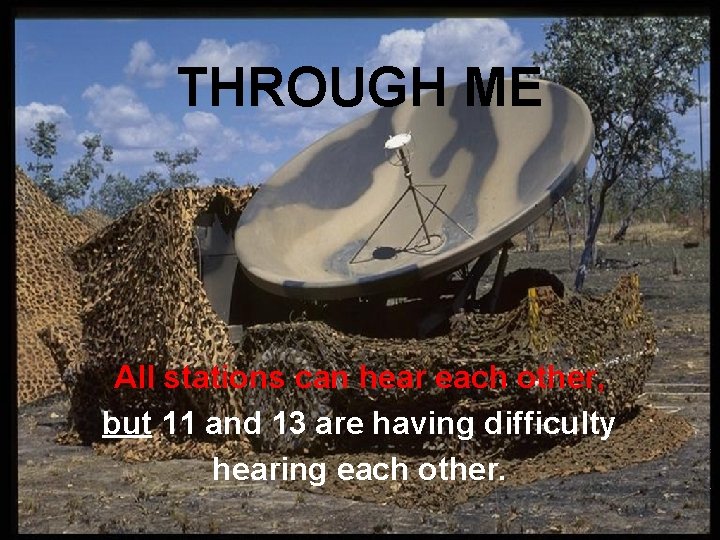
THROUGH ME TYPES OF CALLS All stations can hear each other, but 11 and 13 are having difficulty hearing each other.
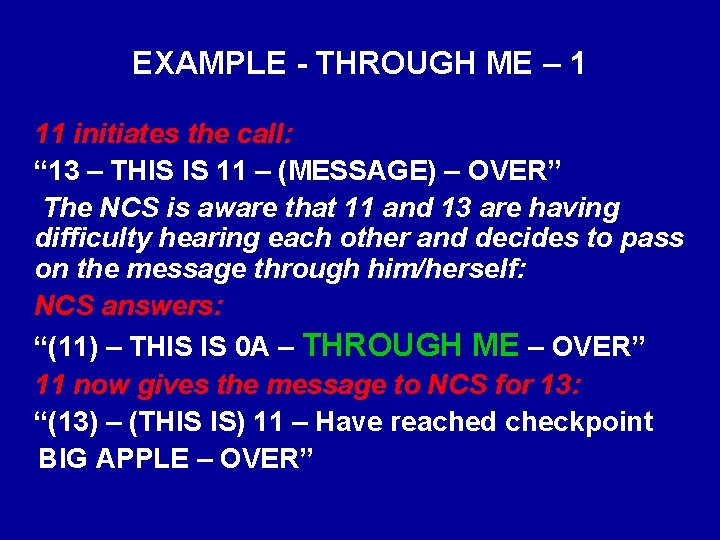
EXAMPLE - THROUGH ME – 1 11 initiates the call: “ 13 – THIS IS 11 – (MESSAGE) – OVER” The NCS is aware that 11 and 13 are having difficulty hearing each other and decides to pass on the message through him/herself: NCS answers: “(11) – THIS IS 0 A – THROUGH ME – OVER” 11 now gives the message to NCS for 13: “(13) – (THIS IS) 11 – Have reached checkpoint BIG APPLE – OVER”
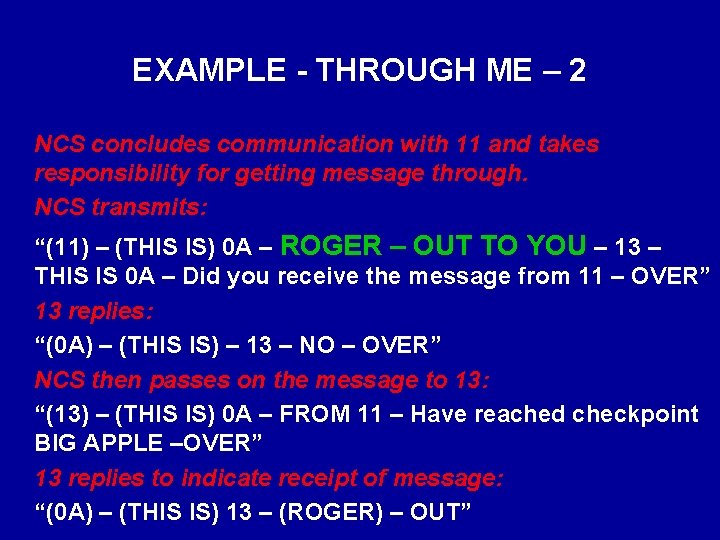
EXAMPLE - THROUGH ME – 2 NCS concludes communication with 11 and takes responsibility for getting message through. NCS transmits: “(11) – (THIS IS) 0 A – ROGER – OUT TO YOU – 13 – THIS IS 0 A – Did you receive the message from 11 – OVER” 13 replies: “(0 A) – (THIS IS) – 13 – NO – OVER” NCS then passes on the message to 13: “(13) – (THIS IS) 0 A – FROM 11 – Have reached checkpoint BIG APPLE –OVER” 13 replies to indicate receipt of message: “(0 A) – (THIS IS) 13 – (ROGER) – OUT”
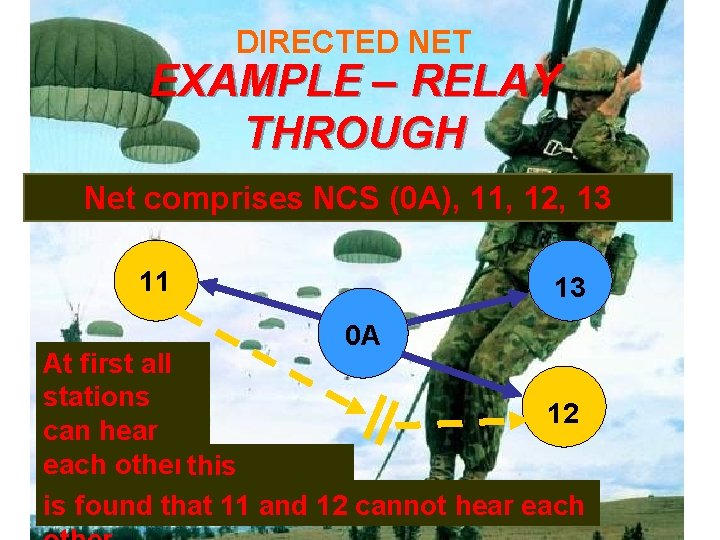
DIRECTED NET EXAMPLE – RELAY THROUGH Net comprises NCS (0 A), 11, 12, 13 11 13 0 A At first all stations 12 can hear each other, this but in example it is found that 11 and 12 cannot hear each
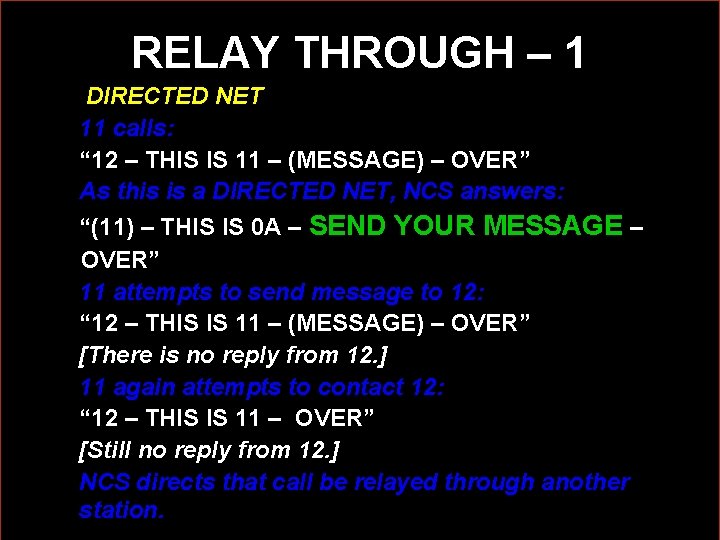
RELAY THROUGH – 1 DIRECTED NET 11 calls: “ 12 – THIS IS 11 – (MESSAGE) – OVER” As this is a DIRECTED NET, NCS answers: “(11) – THIS IS 0 A – SEND YOUR MESSAGE – OVER” 11 attempts to send message to 12: “ 12 – THIS IS 11 – (MESSAGE) – OVER” [There is no reply from 12. ] 11 again attempts to contact 12: “ 12 – THIS IS 11 – OVER” [Still no reply from 12. ] NCS directs that call be relayed through another station.
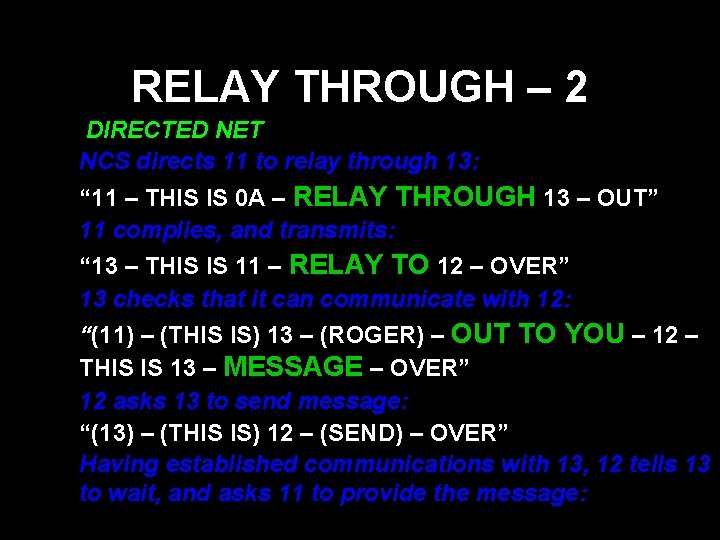
RELAY THROUGH – 2 DIRECTED NET NCS directs 11 to relay through 13: “ 11 – THIS IS 0 A – RELAY THROUGH 13 – OUT” 11 complies, and transmits: “ 13 – THIS IS 11 – RELAY TO 12 – OVER” 13 checks that it can communicate with 12: “(11) – (THIS IS) 13 – (ROGER) – OUT TO YOU – 12 – THIS IS 13 – MESSAGE – OVER” 12 asks 13 to send message: “(13) – (THIS IS) 12 – (SEND) – OVER” Having established communications with 13, 12 tells 13 to wait, and asks 11 to provide the message:
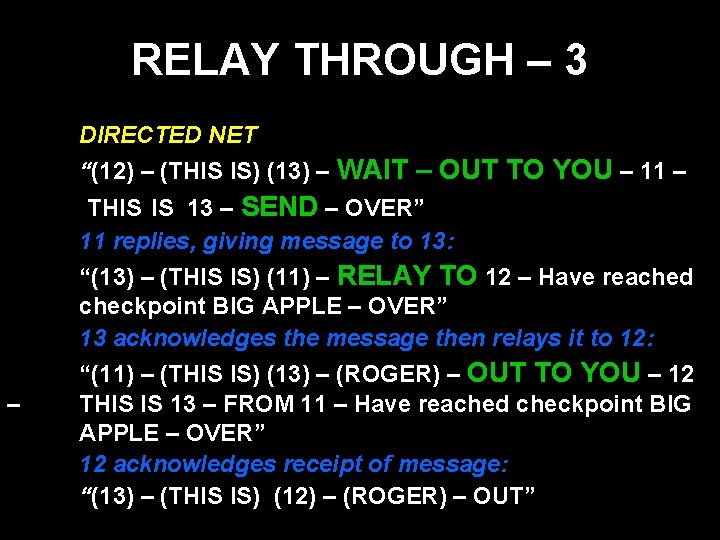
RELAY THROUGH – 3 DIRECTED NET “(12) – (THIS IS) (13) – WAIT – OUT TO YOU – 11 – THIS IS 13 – SEND – OVER” 11 replies, giving message to 13: “(13) – (THIS IS) (11) – RELAY TO 12 – Have reached checkpoint BIG APPLE – OVER” 13 acknowledges the message then relays it to 12: – “(11) – (THIS IS) (13) – (ROGER) – OUT TO YOU – 12 THIS IS 13 – FROM 11 – Have reached checkpoint BIG APPLE – OVER” 12 acknowledges receipt of message: “(13) – (THIS IS) (12) – (ROGER) – OUT”
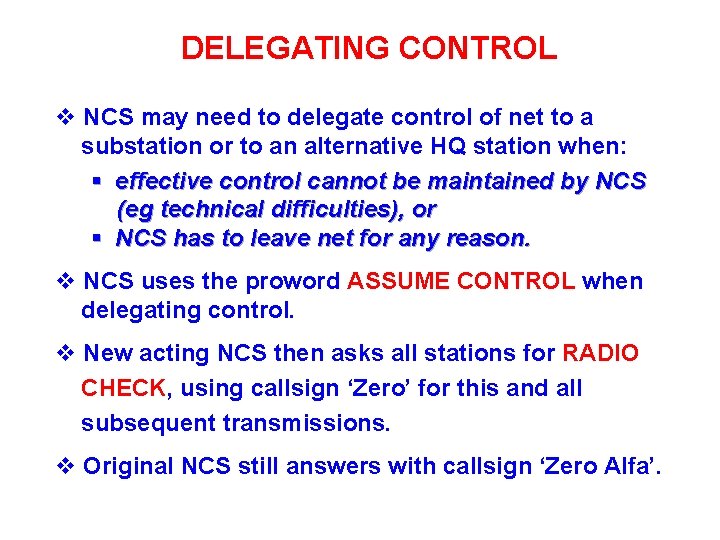
DELEGATING CONTROL v NCS may need to delegate control of net to a substation or to an alternative HQ station when: § effective control cannot be maintained by NCS (eg technical difficulties), or § NCS has to leave net for any reason. v NCS uses the proword ASSUME CONTROL when delegating control. v New acting NCS then asks all stations for RADIO CHECK, using callsign ‘Zero’ for this and all subsequent transmissions. v Original NCS still answers with callsign ‘Zero Alfa’.
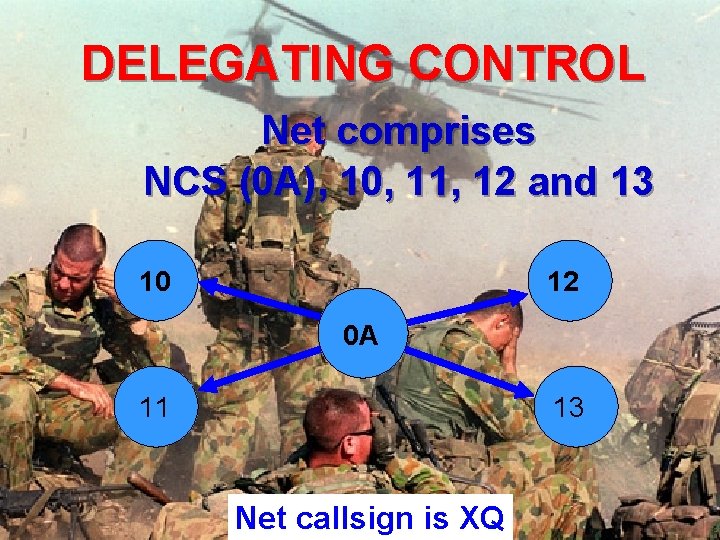
DELEGATING CONTROL Net comprises NCS (0 A), 10, 11, 12 and 13 10 12 0 A 11 13 Net callsign is XQ
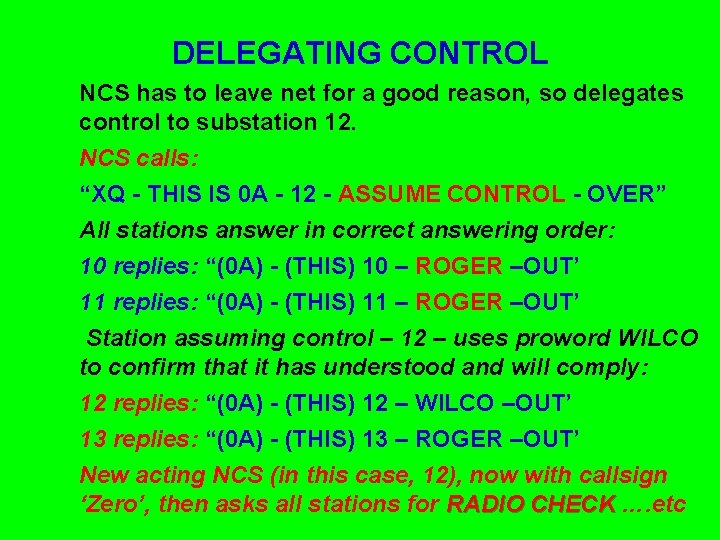
DELEGATING CONTROL NCS has to leave net for a good reason, so delegates control to substation 12. NCS calls: “XQ - THIS IS 0 A - 12 - ASSUME CONTROL - OVER” All stations answer in correct answering order: 10 replies: “(0 A) - (THIS) 10 – ROGER –OUT’ 11 replies: “(0 A) - (THIS) 11 – ROGER –OUT’ Station assuming control – 12 – uses proword WILCO to confirm that it has understood and will comply: 12 replies: “(0 A) - (THIS) 12 – WILCO –OUT’ 13 replies: “(0 A) - (THIS) 13 – ROGER –OUT’ New acting NCS (in this case, 12), now with callsign ‘Zero’, then asks all stations for RADIO CHECK …. etc CHECK
ASSUMING CONTROL
ASSUMING CONTROL § If NCS unable to continue as NCS (eg equipment breakdown, etc), control of net reverts to: § another pre-arranged substation or § next most senior substation on the net. § Before new NCS assumes control, it must confirm that NCS cannot be heard by other stations on net. § If necessary senior substation may delegate control to another substation which would have more effective control of the net. § Assume control using the proword I AM ASSUMING CONTROL
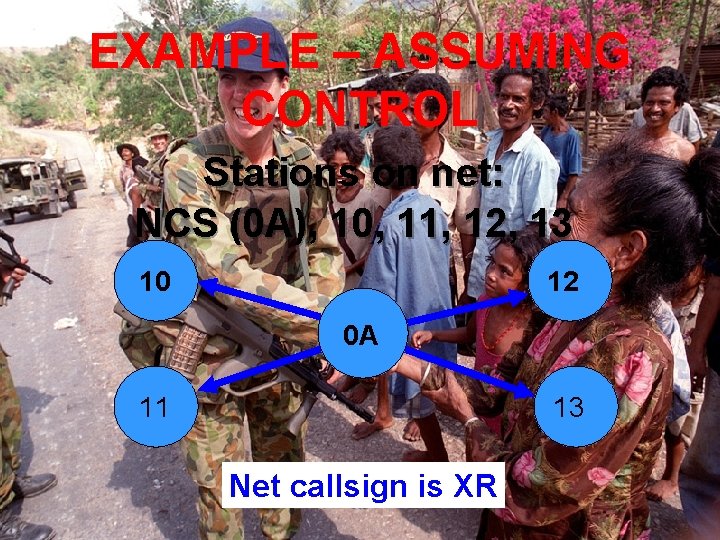
EXAMPLE – ASSUMING CONTROL Stations on net: NCS (0 A), 10, 11, 12, 13 10 12 0 A 11 13 Net callsign is XR
EXAMPLE – ASSUMING CONTROL Nothing has been heard from NCS for some time Substation 10 decides to assume control of net.
EXAMPLE – ASSUMING CONTROL 10 calls net: “XR - THIS IS 10 - Have you heard anything from CALLSIGN Zero Alfa – OVER’ 5 seconds pause for NCS to answer. No stations have heard from 0 A. All stations answer, in turn: ‘[callsign] - NO – OVER’ NCS does not answer 5 seconds again pause for NCS to answer, if able – but NCS does not answer
EXAMPLE – ASSUMING CONTROL 10 transmits to net: ‘(XR) - (THIS IS) 10 - I AM ASSUMING CONTROL - OVER’ In operational military nets this would be followed by self-authentication, but this is not required in AAC radio nets. All stations reply, in turn: ‘[callsign] - (ROGER) - OUT’ ©LTCOL(AAC) G. R. NEWMAN-MARTIN_2011
RESUMING CONTROL
EXAMPLE – RESUMING CONTROL 0 A reports into net after an absence and resumes control of net. Net callsign is XS. 0 A calls: “XRAY SIERRA – THIS IS 0 A - REPORTING INTO THE NET – I AM ASSUMING CONTROL – OVER” In operational military nets this would be followed by self-authentication, but this is not required in AAC radio nets. All stations reply in turn: “[callsign] – (ROGER) – OUT”
READ BACK PROCEDURE
READ BACK PROCEDURE Used by sender or receiver to make sure message: · was correct or · was received correctly Use proword READ BACK, then specify part concerned, e. g. : · READ BACK TEXT · READ BACK GRID, etc. ‘READ BACK’ on its own means ‘read back complete transmission’
READ BACK PROCEDURE Only stations directed to do so are to read back. In a collective or net call, it may only be necessary to require one or two stations to read back. Remaining stations keep silent until read back is completed, then answer in order. When reading back, use proword ‘I READ BACK’. Sending station verifies with proword CORRECT, or if not correct, by proword WRONG.
EXAMPLE – READ BACK PROCEDURE Conversation between NCS (0 A) and 10
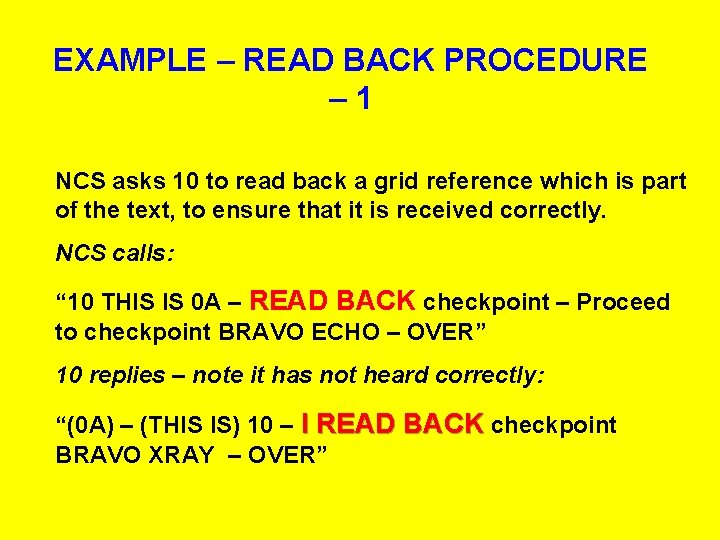
EXAMPLE – READ BACK PROCEDURE – 1 NCS asks 10 to read back a grid reference which is part of the text, to ensure that it is received correctly. NCS calls: “ 10 THIS IS 0 A – READ BACK checkpoint – Proceed to checkpoint BRAVO ECHO – OVER” 10 replies – note it has not heard correctly: “(0 A) – (THIS IS) 10 – I READ BACK checkpoint BRAVO XRAY – OVER”
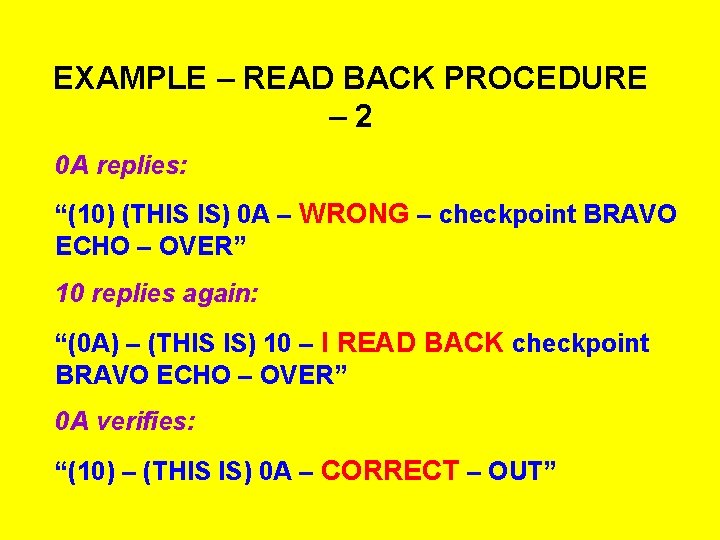
EXAMPLE – READ BACK PROCEDURE – 2 0 A replies: “(10) (THIS IS) 0 A – WRONG – checkpoint BRAVO ECHO – OVER” 10 replies again: “(0 A) – (THIS IS) 10 – I READ BACK checkpoint BRAVO ECHO – OVER” 0 A verifies: “(10) – (THIS IS) 0 A – CORRECT – OUT”
IMPOSING, LIFTING AND BREAKING RADIO SILENCE
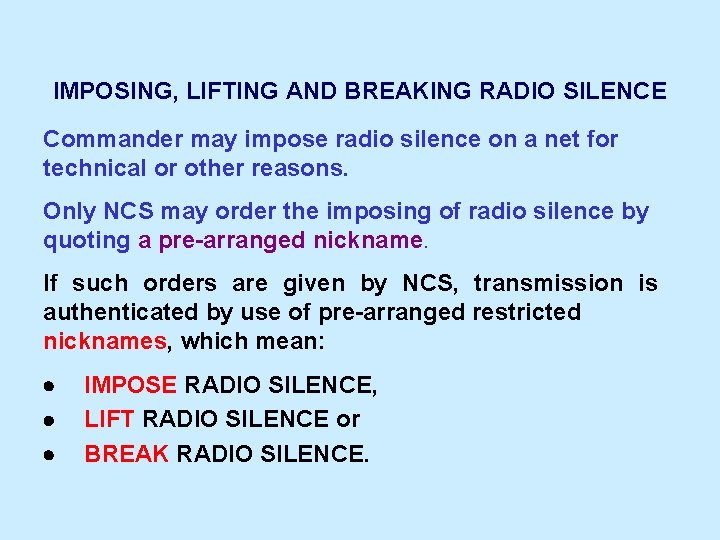
IMPOSING, LIFTING AND BREAKING RADIO SILENCE Commander may impose radio silence on a net for technical or other reasons. Only NCS may order the imposing of radio silence by quoting a pre-arranged nickname. If such orders are given by NCS, transmission is authenticated by use of pre-arranged restricted nicknames, which mean: · IMPOSE RADIO SILENCE, · LIFT RADIO SILENCE or · BREAK RADIO SILENCE.
IMPOSING, LIFTING AND BREAKING RADIO SILENCE These nicknames are short-term nicknames which will be changed at pre-arranged times. A station which is NOT NCS may break radio silence only in emergency, using a pre-arranged nickname. The only other authority for lifting or breaking radio silence is an authentication code.
EMERGENCY SILENCE Emergency silence is imposed for: · transmission security, or · technical reasons, or · emergency All radio sets remain on listening watch Emergency silence is imposed or lifted only by a person authorised by Standard Operating Instructions. Only NCS may give the order to impose emergency silence, using prowords: ‘SILENCE, SILENCE’, meaning ‘Cease transmission on this net immediately – silence is to be maintained until lifted’.
EMERGENCY SILENCE Transmission imposing emergency silence is made twice and ends with proword OUT. Transmissions which impose lifting or breaking radio silence must always be authenticated.
EMERGENCY SILENCE Stations DO NOT answer or give a receipt for such a transmission, except where it is not authenticated (due to nonavailability for some reason), in which case: · either senior sub-station challenges NCS with an authentication challenge, OR · authentication is achieved by use of pre-arranged code-word.
CHANGING THE OPERATING FREQUENCY OF A RADIO NET
CHANGING OPERATING FREQUENCY OF A RADIO NET v Frequency change may be made for security or technical reasons. v Only NCS may order change to designated frequency being used by net. v This is done by using the pre-arranged nickname or frequency. v Nickname means: · CHANGE TO ALTERNATE FREQUENCY, or · CHANGE TO PRIMARY FREQUENCY. but these words are not used, only nicknames
CHANGING OPERATING FREQUENCY OF A RADIO NET BEFORE CHANGING THE NET TO THE NEW FREQUENCY: · sub-stations must read back pre-arranged nickname, · NCS must transmit again, saying nickname again (as executive order to enforce frequency change), and · NCS may order one sub-station to new frequency to ensure it is workable. ©LTCOL(AAC) G. R. NEWMAN-MARTIN_2011
CHANGING OPERATING FREQUENCY OF A RADIO NET FREQUENCIES ARE NOT TO BE TRANSMITTED IN CLEAR, EXCEPT: CLEAR · under emergency circumstances, · when all other available methods (including written messages) have been considered), · if absolutely necessary, when enforcing emergency silence, · when frequencies are being changed daily and no nicknames or frequency designators have been allocated.
CHANGING OPERATING FREQUENCY OF A RADIO NET SHOULD CONTACT BE LOST WITH ONE OR MORE SUB-STATIONS DURING (OR AFTER) FREQUENCY CHANGE PROCEDURE: § NCS – or delegated sub-station – is to revert to old frequency and try to re-establish communications with ‘lost’ stations. § ‘Lost’ stations should try to re-establish comms. § If contact re-established, order to change frequency is tried again. § If this fails, NCS’ supervisor will decide on further action.
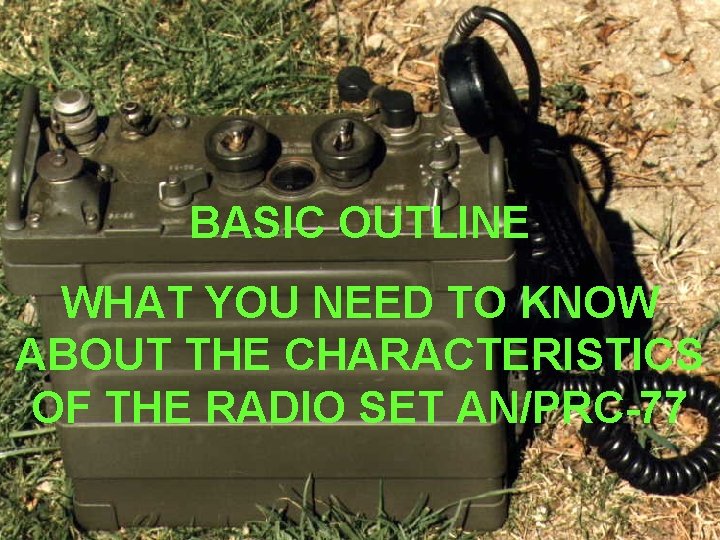
BASIC OUTLINE WHAT YOU NEED TO KNOW ABOUT THE CHARACTERISTICS OF THE RADIO SET AN/PRC-77
Radio Set AN/PRC-77 n Power and range are limited
Radio Set AN/PRC-77 frequencies Frequency range 30– 80 megahertz (MHz) n 920 channels n Frequencies assigned by unit supplying set n No frequencies may be used without prior approval n
Radio Set AN/PRC-77 BATTERY n n Special dry cell battery Operating life 20 hours – normal usage
Radio Set AN/PRC-77 RANGE n n Approx 8 km Line of sight Depends on terrain Can be much less in hilly country
Radio Set AN/PRC-77 ANTENNAS Short (0. 9 m) flexible steel tape useful for mobile comms n Long (0. 3 m) foldable multi-section or ‘whip’ antenna. Good range, not suitable for mobile use n ©LTCOL(AAC) G. R. NEWMAN-MARTIN_2011
Radio Set AN/PRC-77 OTHER EQUIPMENT Antenna Supports n n Support, Antenna, Flexible (‘Goose Neck’) – use with short tape antenna Rigid Tubular Support – use with foldable antenna Handset ©LTCOL(AAC) G. R. NEWMAN-MARTIN_2011
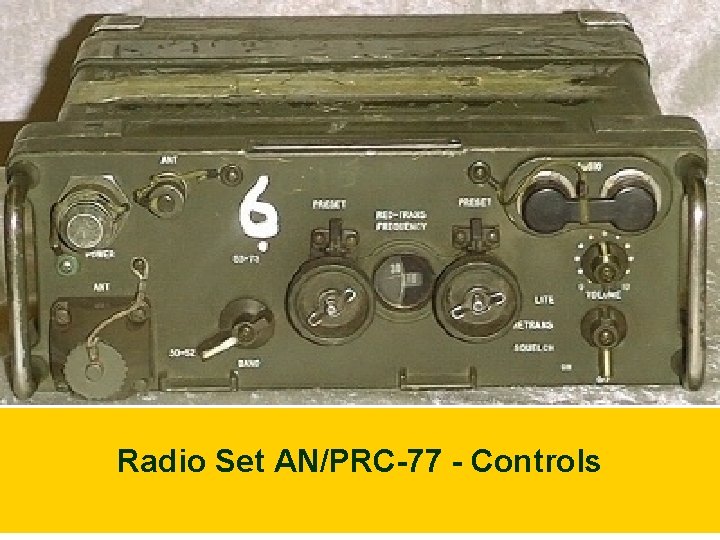
Radio Set AN/PRC-77 - Controls
ANY FINAL QUESTIONS ?
THAT’S ALL FOLKS