
Australasian Parliamentary English Debate System Johanes Leonardi T

Australasian Parliamentary English Debate System Johanes Leonardi T. , S. Pd, M. Sc English Education Study Program Faculty of Teacher Training & Education WIDYA MANDALA CATHOLIC UNIVERSITY SURABAYA
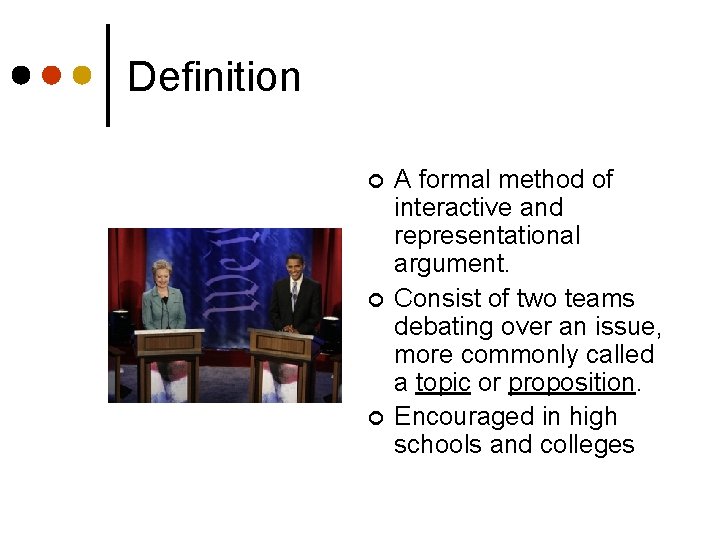
Definition ¢ ¢ ¢ A formal method of interactive and representational argument. Consist of two teams debating over an issue, more commonly called a topic or proposition. Encouraged in high schools and colleges
The Advantages ¢ ¢ ¢ A means of encouraging critical thinking. A means of personal expressions. Tolerance of others' opinions.
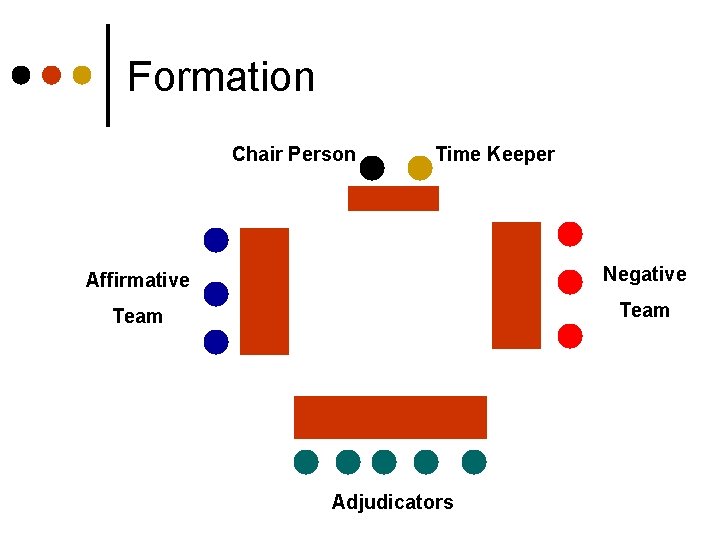
Formation Chair Person Time Keeper Affirmative Negative Team Adjudicators
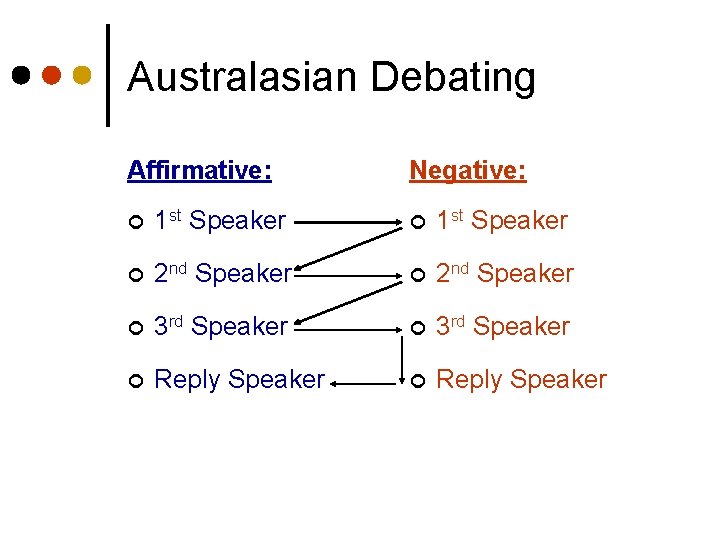
Australasian Debating Affirmative: Negative: ¢ 1 st Speaker ¢ 2 nd Speaker ¢ 3 rd Speaker ¢ Reply Speaker
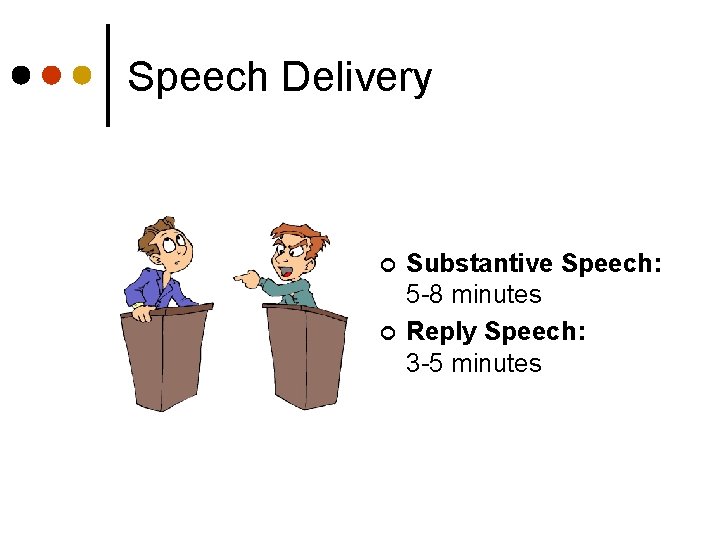
Speech Delivery ¢ ¢ Substantive Speech: 5 -8 minutes Reply Speech: 3 -5 minutes
Affirmative (“The Government”) ¢ ¢ Has the right to define the motion. Support it with constructive arguments.
Negative (“The Opposition”) ¢ ¢ ¢ Oppose the motion defined by the Affirmative. Build a counter-case against the Affirmative. Challenge the definition if invalid only.
Motion (Topic) ¢ ¢ ¢ A prepositional statement that determines what a debate shall be about: That we should give President SBY a chance. That American pop culture is a threat to civilization.
Defining the Motion ¢ ¢ Must be debatable. Must not a bizarre distortion of the motion.
Defining the Motion That what goes up must come down. ¢ what being the President of RI. ¢ goes up takes power ¢ come down step down from the power ¢ “That the Indonesian presidency should be limited to 2 terms” ¢
Challenging the Definition ¢ ¢ Truistic Tautological/ Circular Squirreling Time & Place Setting
Truistic Definition It is ‘true’ by nature thus make the arguments unarguable. ¢ That we should eat, drink, and be merry. ¢ That we should eat because otherwise we starve to death; drink because otherwise we would die; and be merry because we are alive. ¢
Tautological/Circular Definition The given definition is circling to the motion. ¢ That technology is killing our work ethic. ¢ That all scientific advancements that make life easier and therefore kill our work ethic are killing our work ethic. ¢
Squirreling Definition It isn’t tied down to the spirit of the motion & doesn’t have a proper logical link to the motion. ¢ That the USA is opening up to the PRC. ¢ USA: Untidy Students of Asia ¢ PRC: Pretty Room Cleaners ¢
Time & Place Setting Definition The subject matter of the debate cannot be confined to a very particular time & place. ¢ Limiting the subject matter to only the economic development of Japan during the specific period of the Meiji restoration. ¢
Theme Line It is the underlying logic of a team’s case. ¢ Used to prove a team’s stand on the motion. ¢ Key question: Why is it true? ¢ Indonesia’s presidency should be limited to 2 terms in respect to democracy, balance of power, and adapting to the world changes. ¢
Team Split Distribution of arguments to the 1 st, 2 nd, 3 rd speaker.
Argumentation ¢ ¢ The process of explaining why a point of view should be accepted. Valid by its supporting logic & facts.
Good argumentation ¢ ¢ ¢ Relevance Organization Consistency & internal logic Clarity Effective use of evidence
Rebuttal ¢ ¢ The process of proving that the opposing team’s arguments should be accorded less weight than its claim. Showing how & why the opposition’s arguments are invalid.
Rebuttal: The arguments are… Based on a wrong of facts/ interpretation of facts. ¢ Irrelevant to the topic. ¢ Illogical. ¢ Involving unacceptable implications. ¢
Role of the First Speaker Affirmative: ¢ Defines the motion. ¢ Presents the team’s theme line why the case is logically correct. ¢ Outlines the team split. ¢ Delivers 1 st substantial argument. ¢ Provide a brief summary of the case.
Role of the First Speaker Negative: ¢ Accepts/challenges the definition. ¢ Rebut 1 st affirmative’s arguments. ¢ Presents theme line. ¢ Outlines theme split. ¢ Delivers 1 st substantial arguments. ¢ Provides a brief summary.
Role of the Second Speaker Affirmative: ¢ Rebuts the 1 st negative’s arguments. ¢ Restates the affirmative team’s case. ¢ Delivers 2 nd substantial speech. ¢ Provides a brief summary.
Role of the Second Speaker Negative: ¢ Rebuts the two affirmative speakers. ¢ Restates the team’s case. ¢ Delivers the 2 nd substantial arguments. ¢ Provides a brief summary.
Role of the Third Speaker Affirmative: ¢ Rebuts the two negative speakers. ¢ Restates theme line & the two speakers’ arguments. ¢ Summarizes the issues of the debate.
Role of the Third Speaker Negative: ¢ Rebuts all three affirmative speakers. ¢ Restates theme line & the two speakers’ arguments. ¢ Summarizes the issues of the debate
Reply Speakers Provide an overview of the debate. ¢ Identify the issues by both sides. ¢ Provide a biased adjudication of the debate. ¢
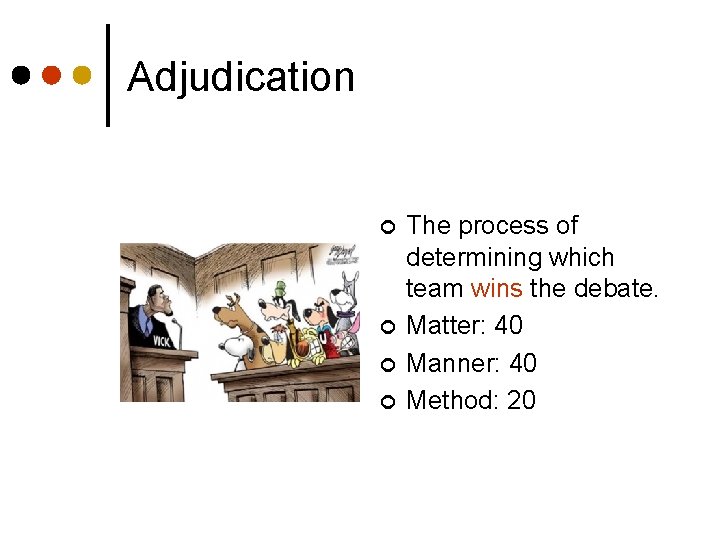
Adjudication ¢ ¢ The process of determining which team wins the debate. Matter: 40 Manner: 40 Method: 20
HAPPY DEBATING!!!
- Slides: 31