
AUSCULTATION HEART SOUND NORMAL HEART SOUND S 1
- Slides: 42
AUSCULTATION HEART SOUND
NORMAL HEART SOUND (S 1 & S 2) 1 - The first heart sound LUB is produced by the closing of the mitral and tricuspid valve leaflets. 2 -The second heart sound DUB is produced by the closing of the aortic and pulmonic valve leaflets.
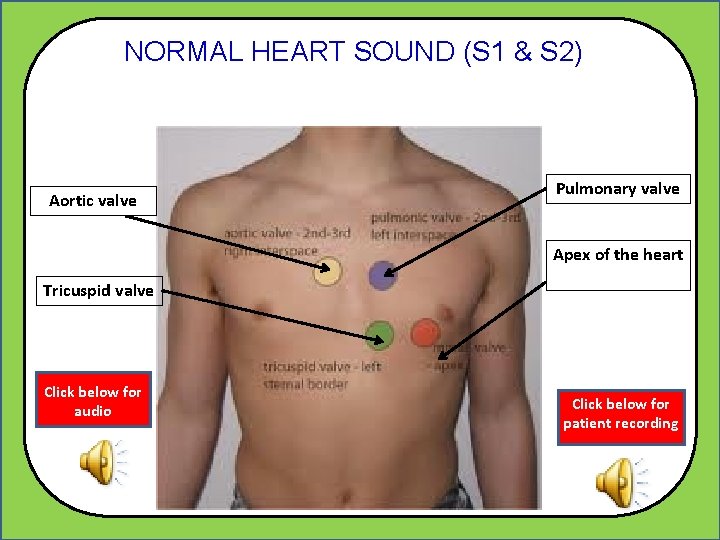
NORMAL HEART SOUND (S 1 & S 2) Aortic valve Pulmonary valve Apex of the heart Tricuspid valve Click below for audio Click below for patient recording
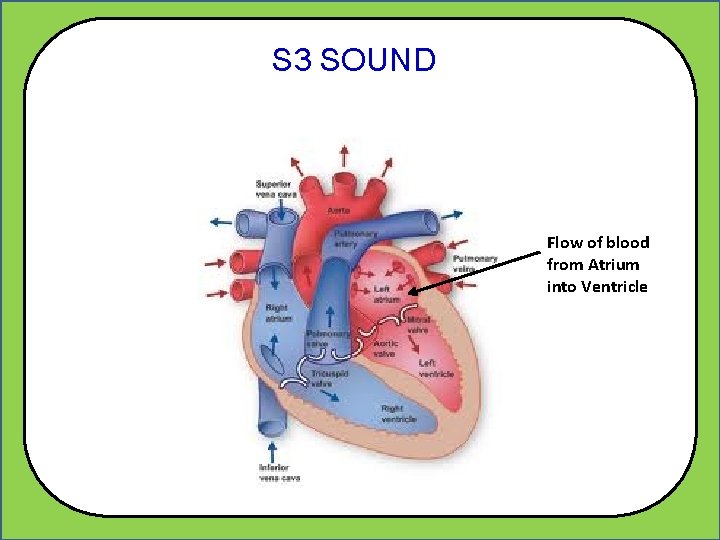
S 3 SOUND Cause of S 3 : It Is produced when blood from atria (atrium) falls into ventricles in a diastole. The rapid flow of blood causes vibration of the ventricular walls, resulting from the first rapid filling so it is heard just after S 2.
S 3 SOUND Flow of blood from Atrium into Ventricle
S 3 SOUND S 3 is considered normal in young children. But in adults more than 40 yrs in age S 3 sound may indicate heart problems. An abnormal S 3 is associated with: • Decreased intrinsic ability of the heart to contract known as decreased myocardial contraction • Heart failure also known as myocardial failure • Overfilling of ventricles with blood also known as volume overload of a ventricle because of mitral or tricuspid regurgitation (backflow of blood)
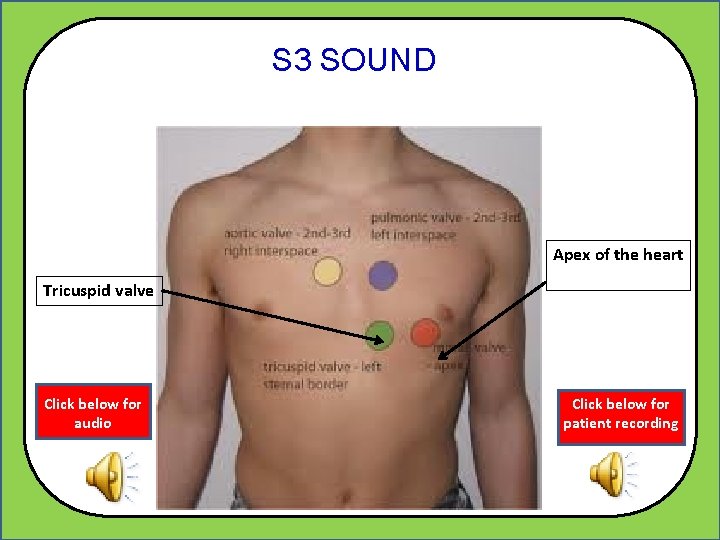
S 3 SOUND Chespiece : Diaphragm of stethoscope Location of stethoscope: On the left : Apex of the heart On the right : At the tricuspid region.
S 3 SOUND Apex of the heart Tricuspid valve Click below for audio Click below for patient recording
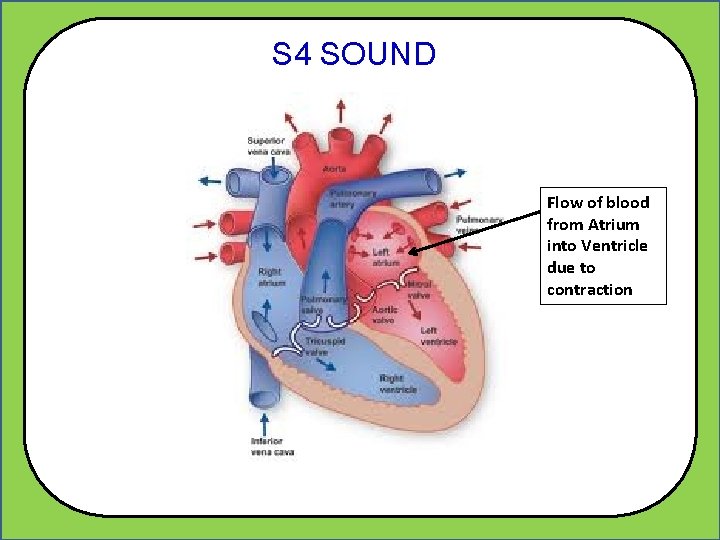
S 4 SOUND S 4 sound is produced when blood flows forcefully into a stiffened ventricle/ventricles due to active contraction of the atria. It is heard when the diastole is about to end and systole is about to begin. So it’s heard just before S 1.
S 4 SOUND Flow of blood from Atrium into Ventricle due to contraction
S 4 SOUND An S 4 sound may indicate: Myocardial ischemia/infarction (The term "myocardial infarction" focuses on the myocardium (the heart muscle) and the changes that occur in it due to the sudden deprivation of circulating blood. The main change is necrosis (death) of myocardial tissue. ) The word "infarction" comes from the Latin "infarcire" meaning "to plug up or cram. " It refers to the clogging of the artery.
S 4 SOUND LV hypertrophy Left ventricular hypertrophy is enlargement (hypertrophy) of the muscle tissue that makes up the wall of your heart's main pumping chamber (left ventricle). Left ventricular hypertrophy develops in response to some factor, such as high blood pressure, that requires the left ventricle to work harder. As the workload increases, the walls of the chamber grow thicker, lose elasticity and eventually may fail to pump with as much force as that of a healthy heart.
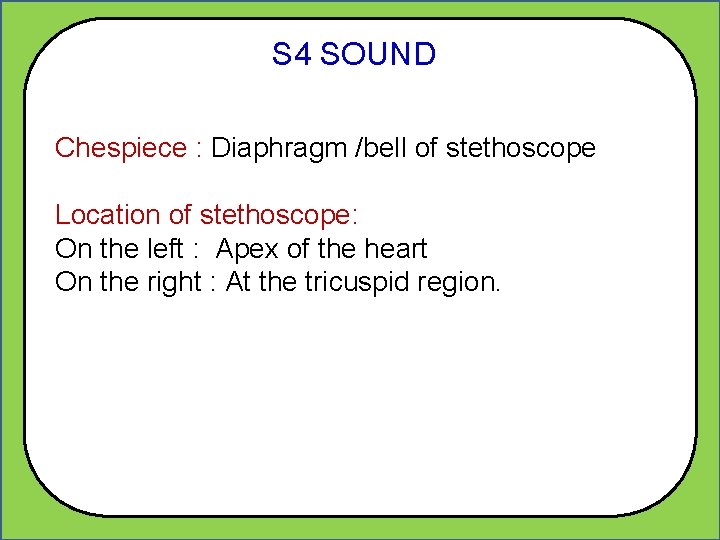
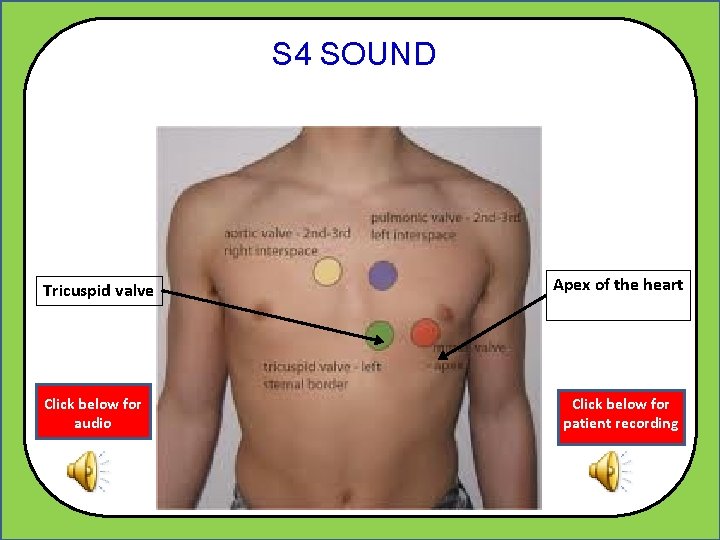
S 4 SOUND Chespiece : Diaphragm /bell of stethoscope Location of stethoscope: On the left : Apex of the heart On the right : At the tricuspid region.
S 4 SOUND Tricuspid valve Click below for audio Apex of the heart Click below for patient recording
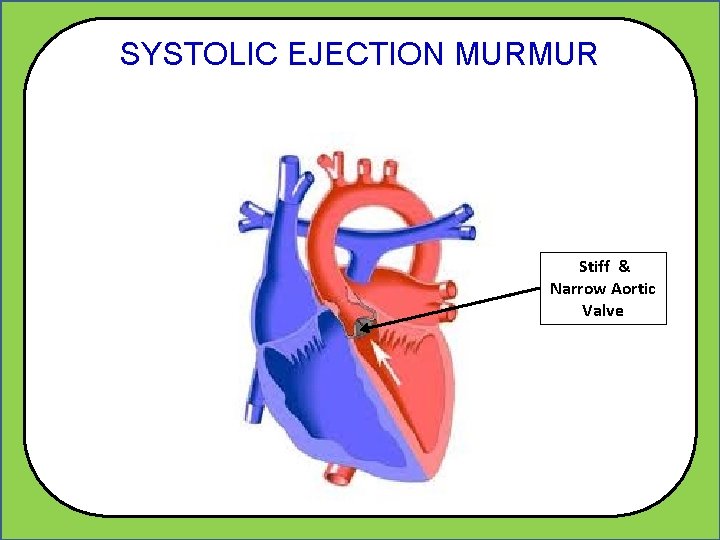
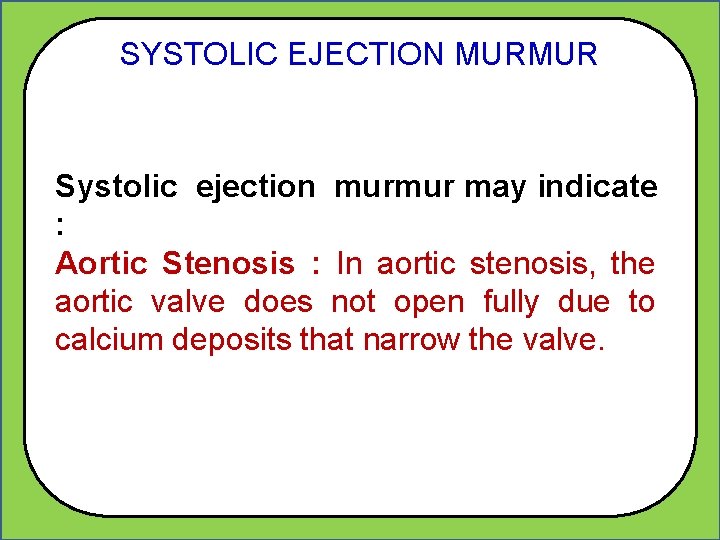
SYSTOLIC EJECTION MURMUR Sound produced when the blood is unable to flow freely from ventricle into the aorta due to stiffness in the aortic valve.
SYSTOLIC EJECTION MURMUR Stiff & Narrow Aortic Valve
SYSTOLIC EJECTION MURMUR Systolic ejection murmur may indicate : Aortic Stenosis : In aortic stenosis, the aortic valve does not open fully due to calcium deposits that narrow the valve.
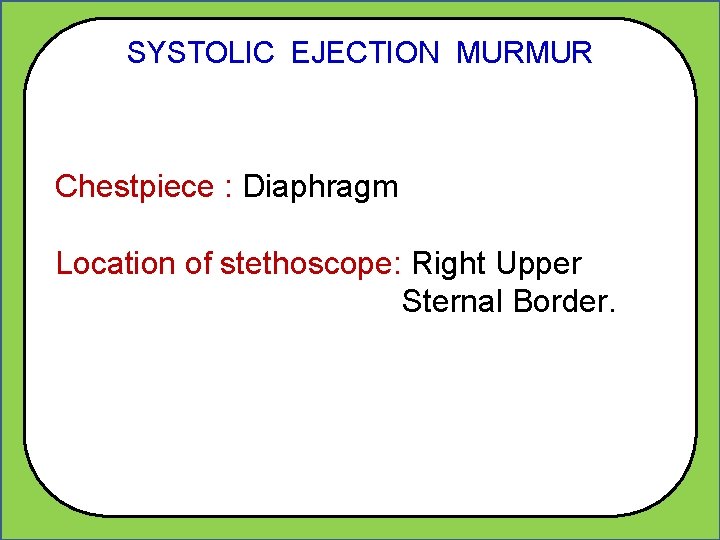
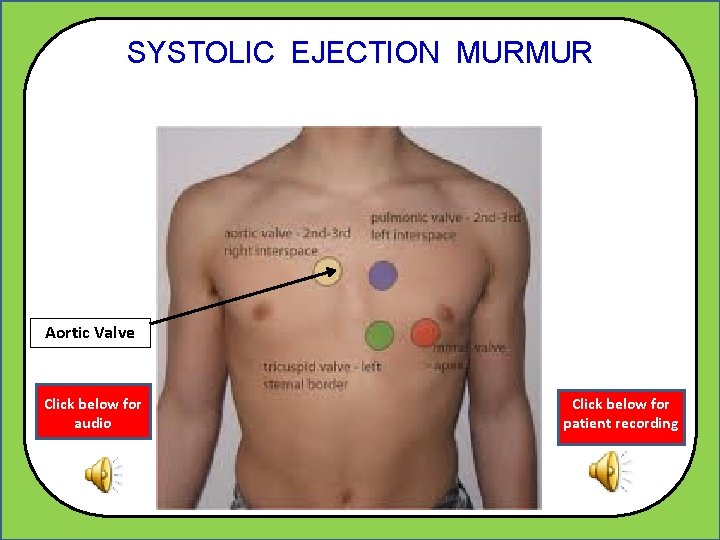
SYSTOLIC EJECTION MURMUR Chestpiece : Diaphragm Location of stethoscope: Right Upper Sternal Border.
SYSTOLIC EJECTION MURMUR Aortic Valve Click below for audio Click below for patient recording
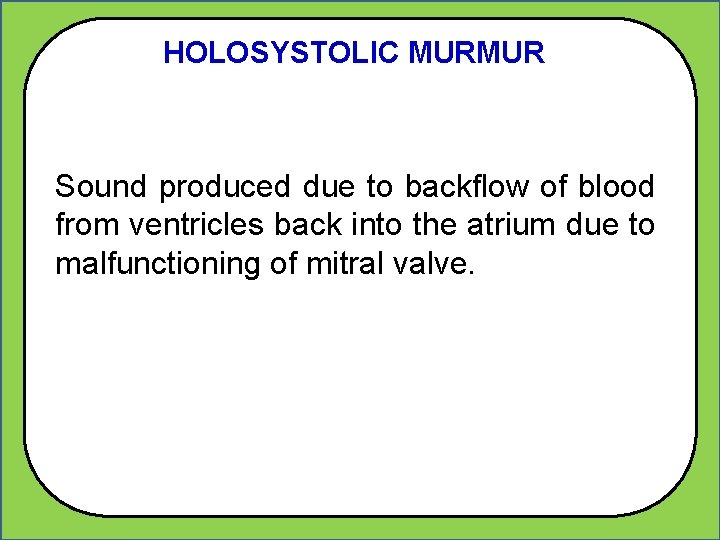
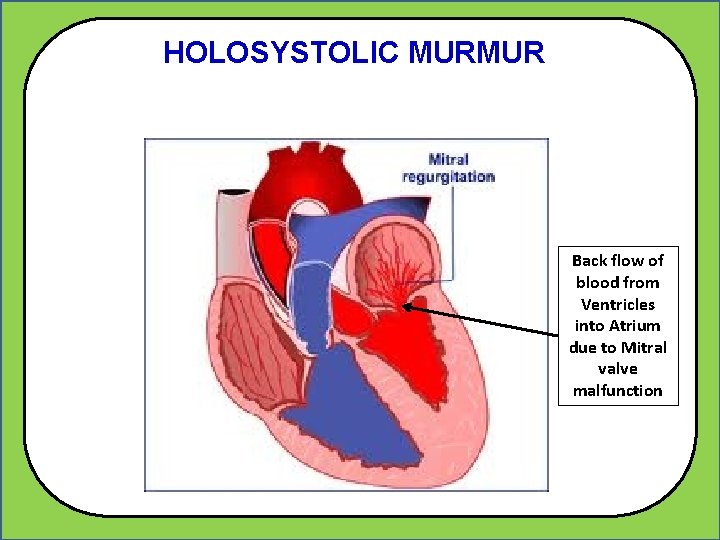
HOLOSYSTOLIC MURMUR Sound produced due to backflow of blood from ventricles back into the atrium due to malfunctioning of mitral valve.
HOLOSYSTOLIC MURMUR Back flow of blood from Ventricles into Atrium due to Mitral valve malfunction
HOLOSYSTOLIC MURMUR Holosystolic murmur may indicate: Mitral Regurgitation due to mitral valve prolapse. i. e backflow of blood into the atrium when mitral valve malfunctions.
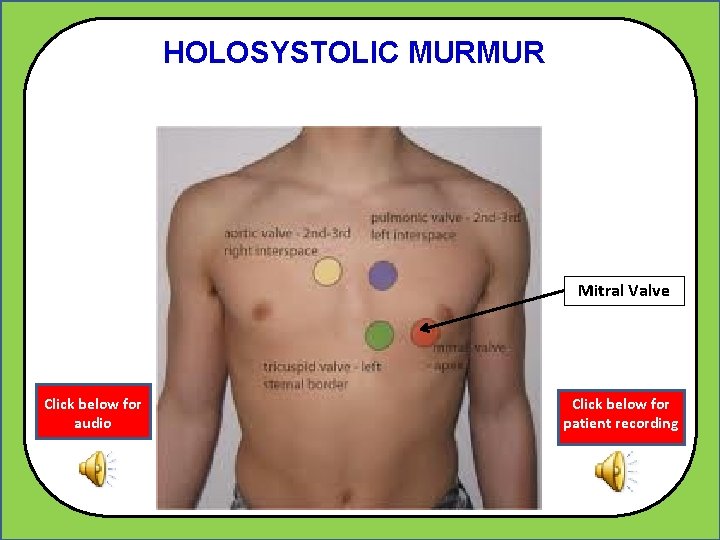
HOLOSYSTOLIC MURMUR Chespiece : Diaphragm Location of stethoscope: Mitral valve area
HOLOSYSTOLIC MURMUR Mitral Valve Click below for audio Click below for patient recording
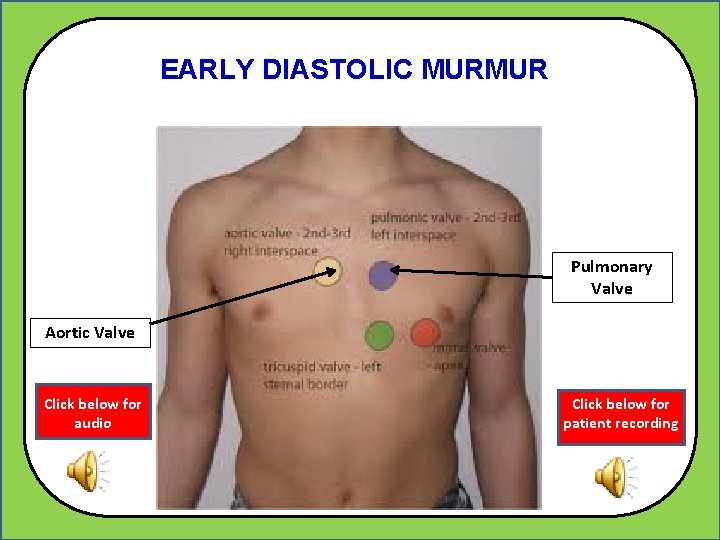
EARLY DIASTOLIC MURMUR Sound produced due to backflow of blood from aorta (major artery carrying blood to the body) and pulmonary artery( artery carrying blood to the lungs) back into the ventricles.
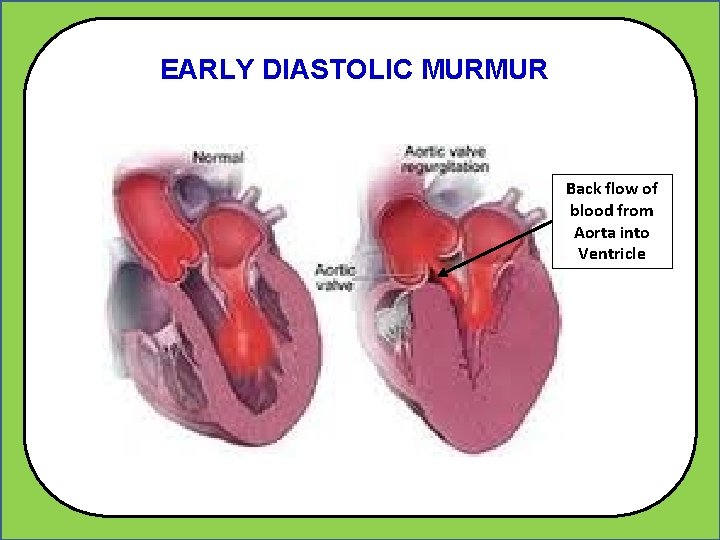
EARLY DIASTOLIC MURMUR Back flow of blood from Aorta into Ventricle
EARLY DIASTOLIC MURMUR Early diastolic murmur may indicate: Aoritc regurgitation : Backflow of blood from aorta into ventricles when the valve doesnot close properly. Pulmonary regurgitation: backflow of blood from pulmonary artery back into ventricle when the pulmonary valve doesnot close properly.
EARLY DIASTOLIC MURMUR Chespiece : Diaphragm Location of stethoscope: Aortic and Pulmonary valve
EARLY DIASTOLIC MURMUR z Pulmonary Valve Aortic Valve Click below for audio Click below for patient recording
MID SYSTOLIC CLICK (Heart murmur) It is heard when Mitral Valve doesn’t close properly.
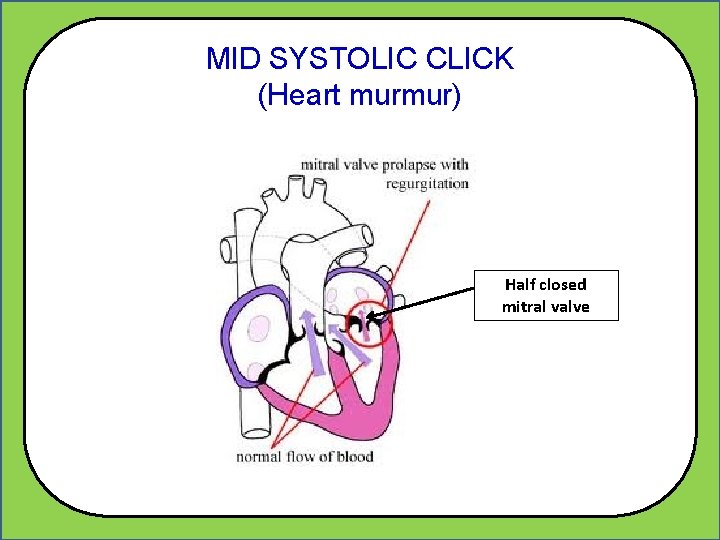
MID SYSTOLIC CLICK (Heart murmur) Half closed mitral valve
MID SYSTOLIC CLICK (Heart murmur) Midsystolic click may indicate MITRAL VALVE PROLAPSE which means Mitral valve is not able to close properly. This is because the connecting tissue of the valve which allows it to open and close properly has degenerated.
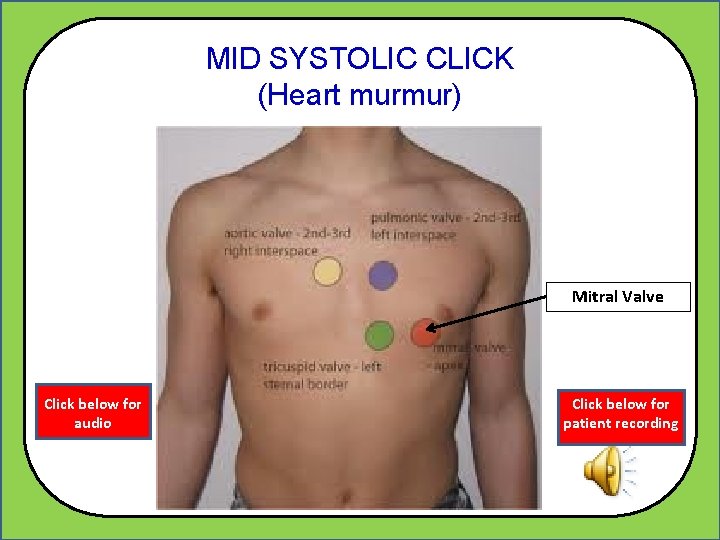
MID SYSTOLIC CLICK (Heart murmur) Chespiece : Diaphragm Location of stethoscope: Mitral valve area
MID SYSTOLIC CLICK (Heart murmur) Mitral Valve Click below for audio Click below for patient recording
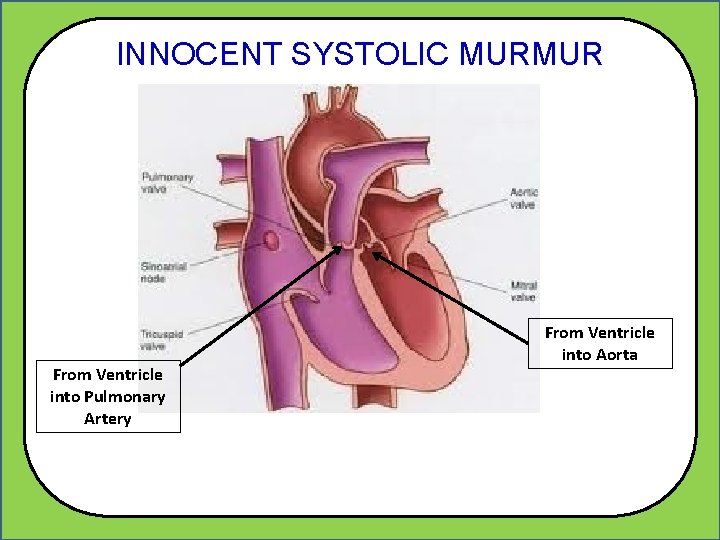
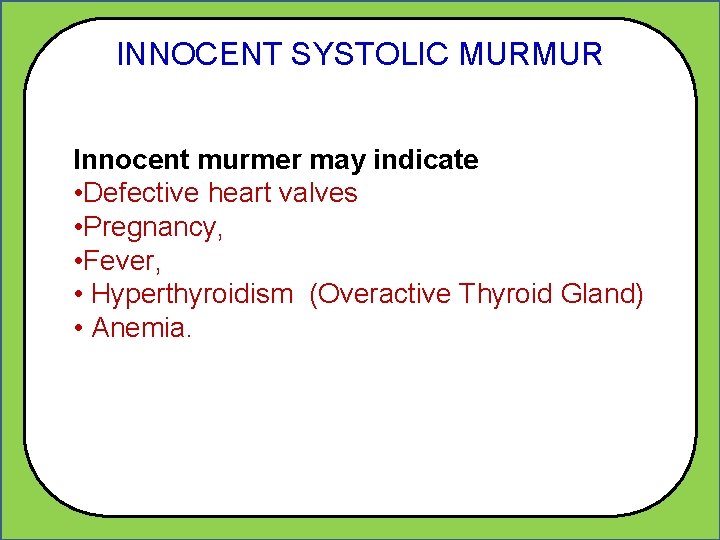
INNOCENT SYSTOLIC MURMUR Is produced due to flow of from ventricles into the aorta (major artery supplying blood to the body) or the pulmonary artery( artery taking blood to the lungs).
INNOCENT SYSTOLIC MURMUR From Ventricle into Pulmonary Artery From Ventricle into Aorta
INNOCENT SYSTOLIC MURMUR Innocent murmer may indicate • Defective heart valves • Pregnancy, • Fever, • Hyperthyroidism (Overactive Thyroid Gland) • Anemia.
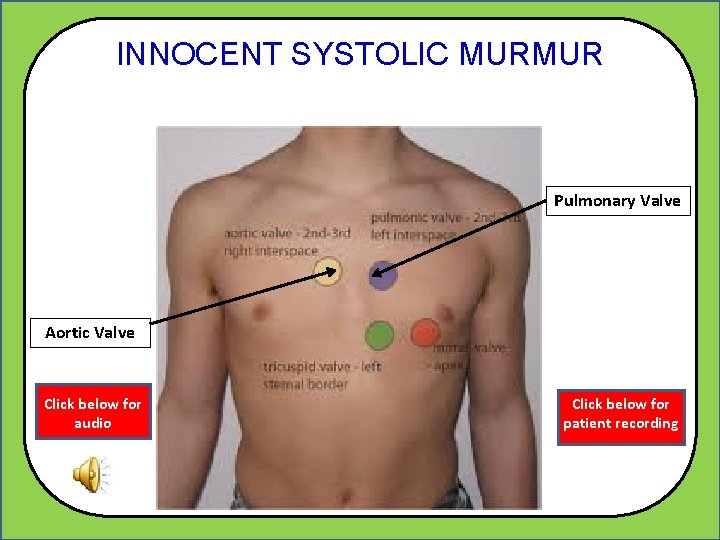
INNOCENT SYSTOLIC MURMUR Chespiece : Diaphragm Location of stethoscope: Right Upper Sternal Border.
INNOCENT SYSTOLIC MURMUR Pulmonary Valve Aortic Valve Click below for audio Click below for patient recording
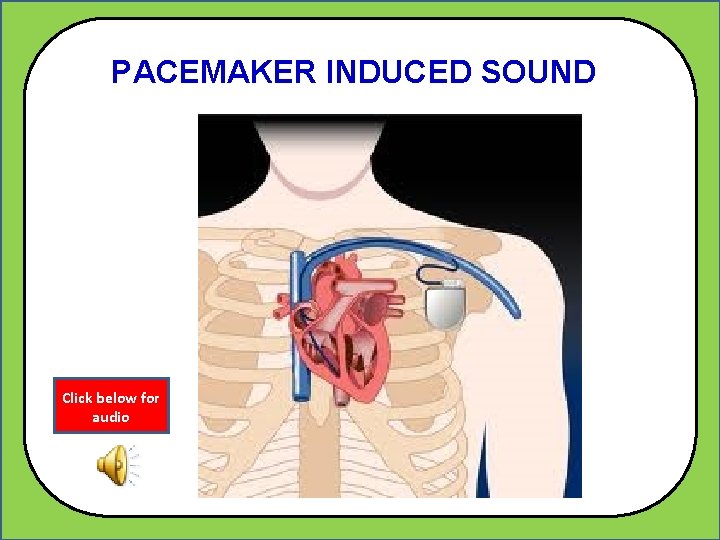
PACEMAKER INDUCED SOUND A pacemaker is a small device that's placed in the chest or abdomen to help control abnormal heart rhythms. This device uses electrical pulses to prompt the heart to beat at a normal rate.
PACEMAKER INDUCED SOUND Click below for audio
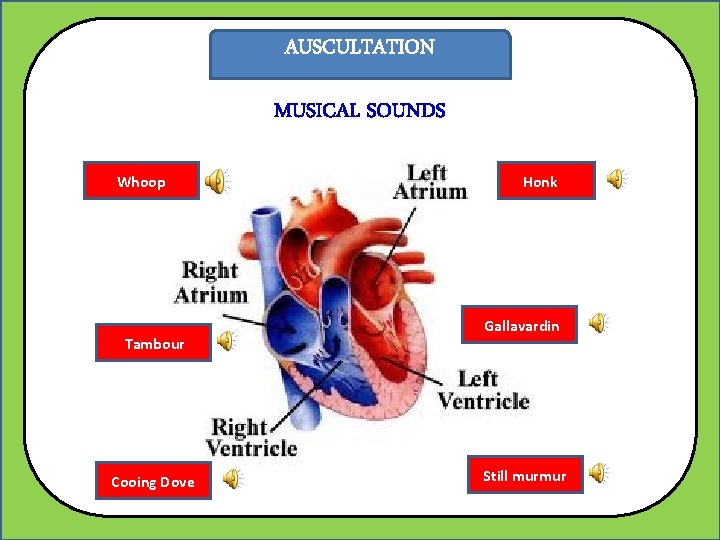
AUSCULTATION MUSICAL SOUNDS Whoop Tambour Cooing Dove Honk Gallavardin Still murmur