
Auscultation Auscultation By the time you listen you
Auscultation
Auscultation • By the time you listen, you should know what to hear • If you don’t hear what you expect, explain it • Don’t leave the bedside till you know what you are hearing • Never auscultate from the wrong side of the bed
Auscultation • Use the diaphragm for high pitched sounds and murmurs • Use the bell for low pitched sounds and murmurs • Sequence of auscultation – – – upper right sternal border (URSB) upper left sternal border (ULSB) lower left sternal border (LLSB) apex - left lateral decubitus position lower left sternal border (LLSB)- sitting, leaning forward, held expiration
Auscultation Grading of Murmurs: Grade 1 - only a staff man can hear Grade 2 - audible to a resident Grade 3 - audible to a medical student Grade 4 - associated with a thrill or palpable heart sound Grade 5 - audible with the stethoscope partially off the chest Grade 6 - audible at the bed-side

Characteristics of a “functional” murmur • • Short and soft SEM Normal S 1 and S 2 Normal cardiac impulse No evidence for any hemodynamic abnormality
Auscultation • Use the diaphragm for high pitched sounds and murmurs • Use the bell for low pitched sounds and murmurs • Sequence of auscultation – – – upper right sternal border (URSB) upper left sternal border (ULSB) lower left sternal border (LLSB) apex - left lateral decubitus position lower left sternal border (LLSB)- sitting, leaning forward, held expiration
Auscultation Grading of Murmurs: Grade 1 - only a staff man can hear Grade 2 - audible to a resident Grade 3 - audible to a medical student Grade 4 - associated with a thrill or palpable heart sound Grade 5 - audible with the stethoscope partially off the chest Grade 6 - audible at the bed-side
Assessing Murmurs Grading of Murmurs: Grade 1 - only a staff man can hear Grade 2 - audible to a resident Grade 3 - audible to a medical student Grade 4 - associated with a thrill or palpable heart sound Grade 5 - audible with the stethoscope partially off the chest Grade 6 - audible at the bedside Functional Murmur: • short and soft SEM • Normal S 1 and S 2 • Normal cardiac impulse • No evidence for hemodynamic abnormality
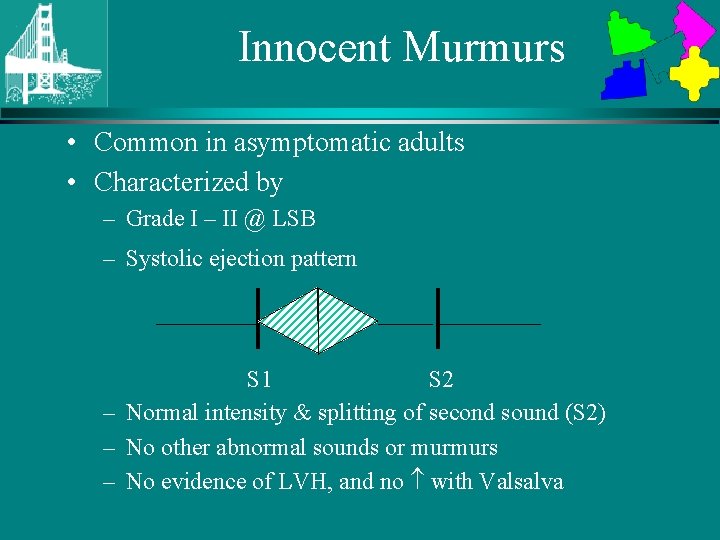
Innocent Murmurs • Common in asymptomatic adults • Characterized by – Grade I – II @ LSB – Systolic ejection pattern S 1 S 2 – Normal intensity & splitting of second sound (S 2) – No other abnormal sounds or murmurs – No evidence of LVH, and no with Valsalva
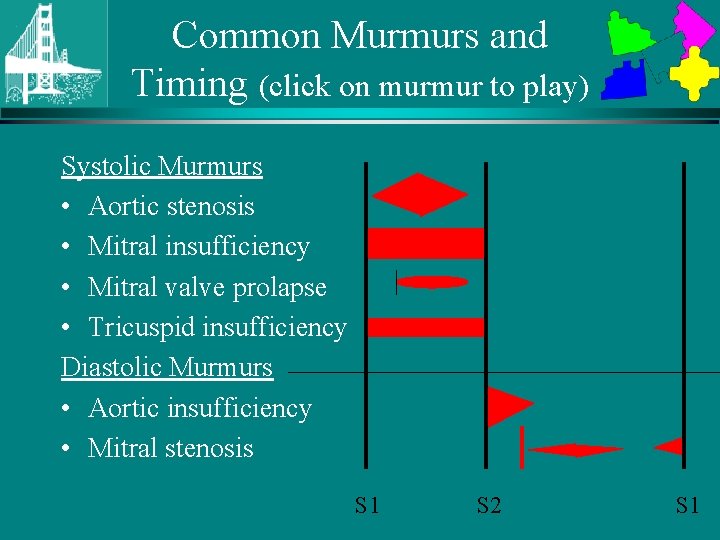
Common Murmurs and Timing (click on murmur to play) Systolic Murmurs • Aortic stenosis • Mitral insufficiency • Mitral valve prolapse • Tricuspid insufficiency Diastolic Murmurs • Aortic insufficiency • Mitral stenosis S 1 S 2 S 1
Auscultation “Aortic area” • 2 nd left intercostal space (URSB) – compare S 1 to S 2 -S 1 should be softer. If the same, think Mitral Stenosis – identify ejection murmur-time the peak intensity in relation to systole – identify ejection click if present
Auscultation “Pulmonary Area” • 2 nd right intercostal space (ULSB) – listen for split S 2 (A 2/P 2) – identify the intensities of A 2 and P 2 – time split S 2 with respiration – – normally widens with inspiration, closes with expiration wide split S 2 -RBBB, RV volume overload, PS, RV failure wide fixed split = ASD paradoxical split = LBBB, severe AS, severe LV dysfunction, pacemaker
Auscultation Differential diagnosis of split S 2 • A 2/Pericardial knock • A 2/OS Sometimes 3 components heard • A 2/P 2/OS • A 2/PK Exclude S 3 • Lower pitched • Heard with bell • At apex • In left decubitus position
Auscultation Left Sternal Border • Listen for early diastolic murmurs (AR/PR) • Press firmly with diaphragm • Listen upright with forced expiration • Listen on hands and knees
Auscultation “Mitral Area” (LLSB) • Listen for intensity of S 1 – Soft-LV dysfunction, first degree heart block, preclosure with sudden severe AR/MR – Loud-MS, sympathetic stimulation – Variable- Complete heart block with AV dissociation, Wenkebach • Identify splitting of S 1 – M 1/T 1, M 1/EC(aortic or pulmonary) , M 1/Non-EC (MVP), S 4/M 1
Auscultation “Mitral Area” (LLSB) • Identify quality, timing and intensity of systolic murmurs – ejection quality vs regurgitant quality – pansystolic vs early or mid to late systolic murmer
Auscultation Apex – Listen for S 3 and S 4 – Consider differential diagnosis of S 3 • A 2 -wide P 2, A 2 -OS, A 2 -PK, A 2 -S 3 – Identify diastolic rumble – Determine radiation of murmur e. g. . MR to axilla
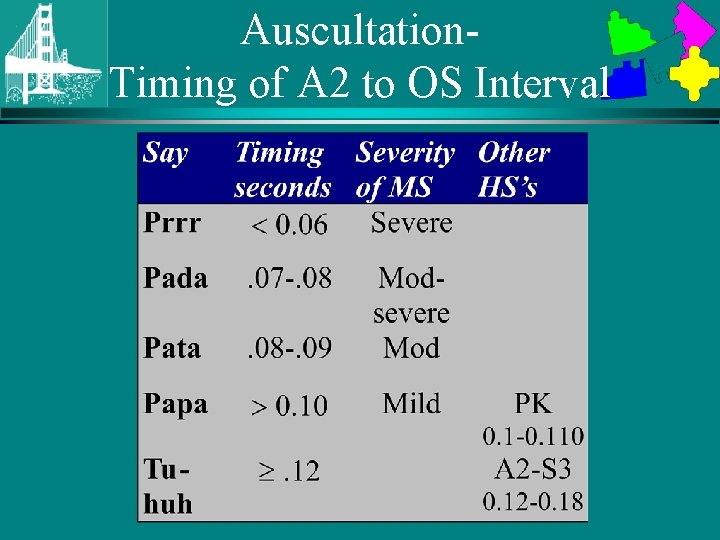
Auscultation. Timing of A 2 to OS Interval
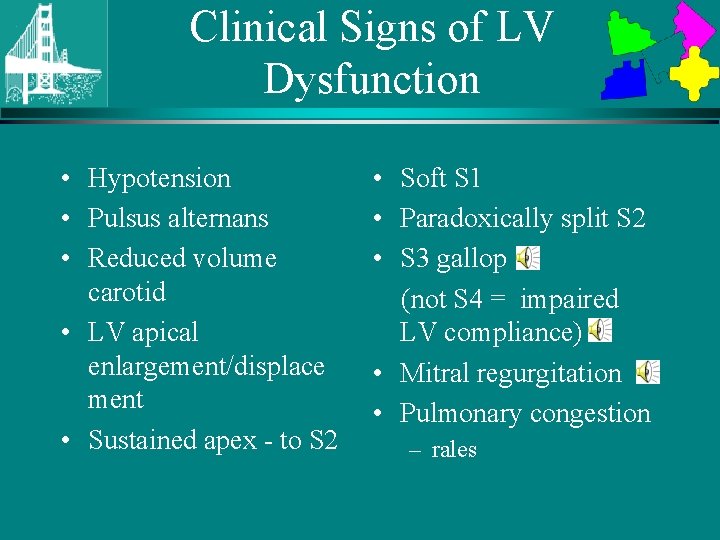
Clinical Signs of LV Dysfunction • Hypotension • Pulsus alternans • Reduced volume carotid • LV apical enlargement/displace ment • Sustained apex - to S 2 • Soft S 1 • Paradoxically split S 2 • S 3 gallop (not S 4 = impaired LV compliance) • Mitral regurgitation • Pulmonary congestion – rales
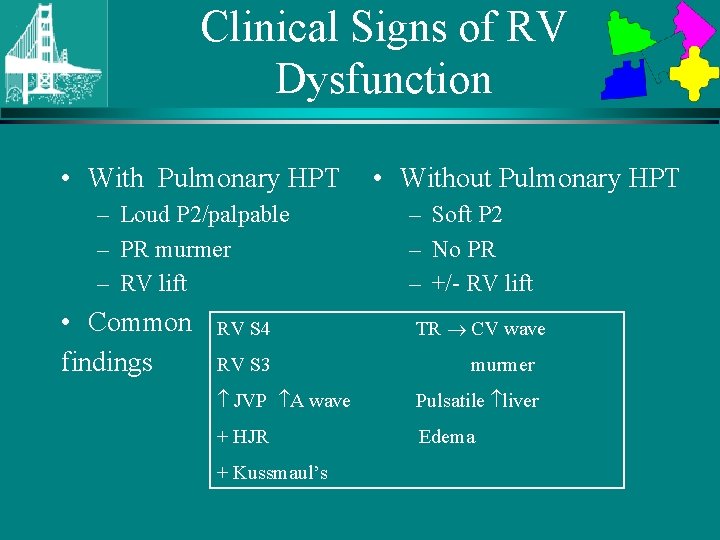
Clinical Signs of RV Dysfunction • With Pulmonary HPT – Loud P 2/palpable – PR murmer – RV lift • Common findings RV S 4 RV S 3 • Without Pulmonary HPT – Soft P 2 – No PR – +/- RV lift TR CV wave murmer JVP A wave Pulsatile liver + HJR Edema + Kussmaul’s
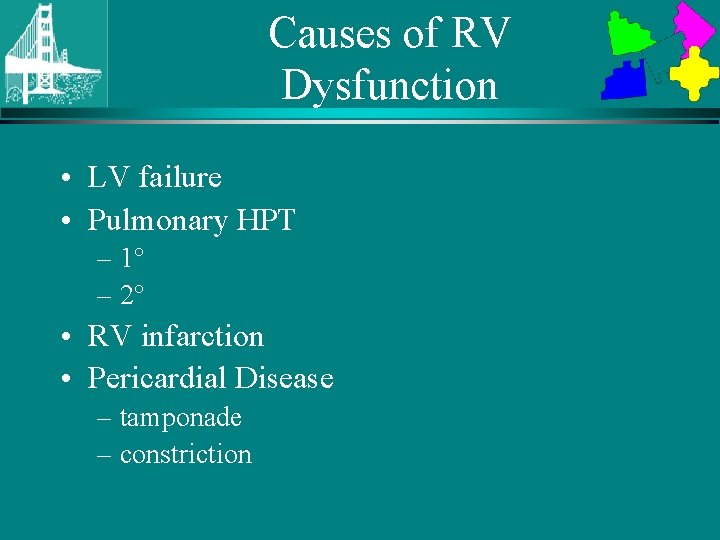
Causes of RV Dysfunction • LV failure • Pulmonary HPT – 1 – 2 • RV infarction • Pericardial Disease – tamponade – constriction
- Slides: 21