
AULA DE INGLS Quantificadores Quantifiers Os quantificadoresquantifiers so
- Slides: 8
AULA DE INGLÊS
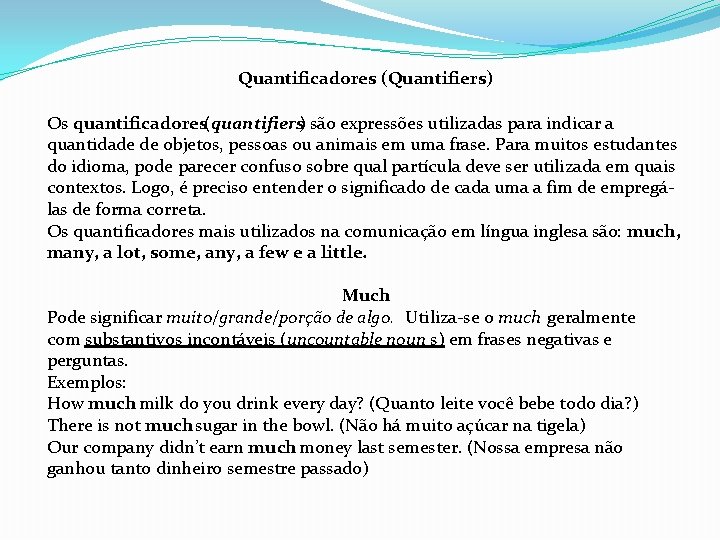
Quantificadores (Quantifiers) Os quantificadores(quantifiers) são expressões utilizadas para indicar a quantidade de objetos, pessoas ou animais em uma frase. Para muitos estudantes do idioma, pode parecer confuso sobre qual partícula deve ser utilizada em quais contextos. Logo, é preciso entender o significado de cada uma a fim de empregálas de forma correta. Os quantificadores mais utilizados na comunicação em língua inglesa são: much, many, a lot, some, any, a few e a little. Much Pode significar muito/grande/porção de algo. Utiliza-se o much geralmente com substantivos incontáveis (uncountable noun s) em frases negativas e perguntas. Exemplos: How much milk do you drink every day? (Quanto leite você bebe todo dia? ) There is not much sugar in the bowl. (Não há muito açúcar na tigela) Our company didn’t earn much money last semester. (Nossa empresa não ganhou tanto dinheiro semestre passado)
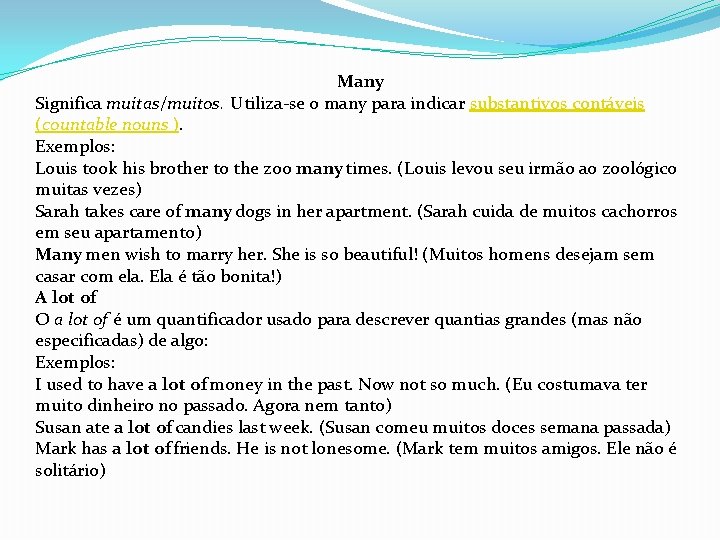
Many Significa muitas/muitos. Utiliza-se o many para indicar substantivos contáveis (countable nouns ). Exemplos: Louis took his brother to the zoo many times. (Louis levou seu irmão ao zoológico muitas vezes) Sarah takes care of many dogs in her apartment. (Sarah cuida de muitos cachorros em seu apartamento) Many men wish to marry her. She is so beautiful! (Muitos homens desejam sem casar com ela. Ela é tão bonita!) A lot of O a lot of é um quantificador usado para descrever quantias grandes (mas não especificadas) de algo: Exemplos: I used to have a lot of money in the past. Now not so much. (Eu costumava ter muito dinheiro no passado. Agora nem tanto) Susan ate a lot of candies last week. (Susan comeu muitos doces semana passada) Mark has a lot of friends. He is not lonesome. (Mark tem muitos amigos. Ele não é solitário)
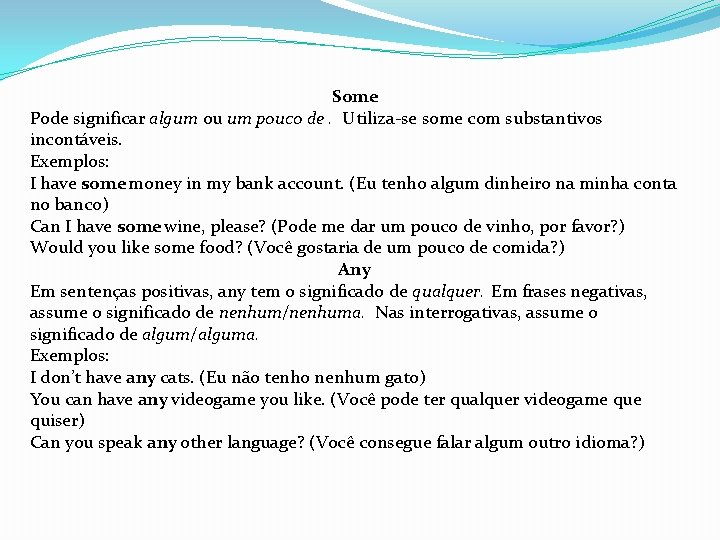
Some Pode significar algum ou um pouco de. Utiliza-se some com substantivos incontáveis. Exemplos: I have some money in my bank account. (Eu tenho algum dinheiro na minha conta no banco) Can I have some wine, please? (Pode me dar um pouco de vinho, por favor? ) Would you like some food? (Você gostaria de um pouco de comida? ) Any Em sentenças positivas, any tem o significado de qualquer. Em frases negativas, assume o significado de nenhum/nenhuma. Nas interrogativas, assume o significado de algum/alguma. Exemplos: I don’t have any cats. (Eu não tenho nenhum gato) You can have any videogame you like. (Você pode ter qualquer videogame quiser) Can you speak any other language? (Você consegue falar algum outro idioma? )
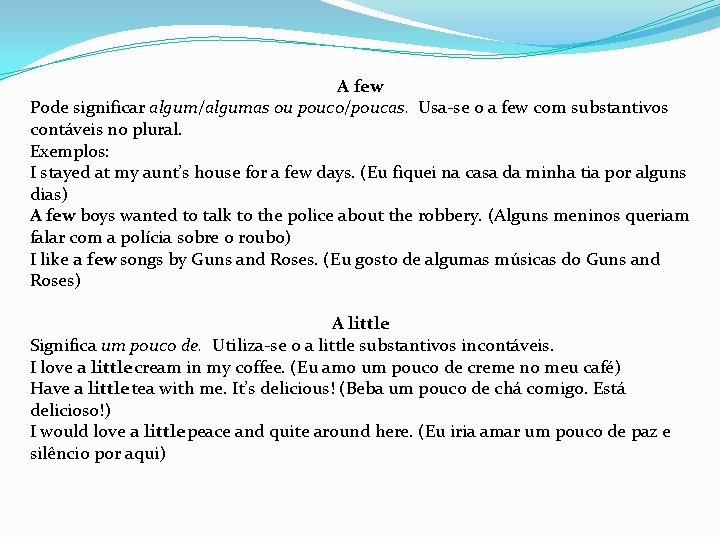
A few Pode significar algum/algumas ou pouco/poucas. Usa-se o a few com substantivos contáveis no plural. Exemplos: I stayed at my aunt’s house for a few days. (Eu fiquei na casa da minha tia por alguns dias) A few boys wanted to talk to the police about the robbery. (Alguns meninos queriam falar com a polícia sobre o roubo) I like a few songs by Guns and Roses. (Eu gosto de algumas músicas do Guns and Roses) A little Significa um pouco de. Utiliza-se o a little substantivos incontáveis. I love a little cream in my coffee. (Eu amo um pouco de creme no meu café) Have a little tea with me. It’s delicious! (Beba um pouco de chá comigo. Está delicioso!) I would love a little peace and quite around here. (Eu iria amar um pouco de paz e silêncio por aqui)
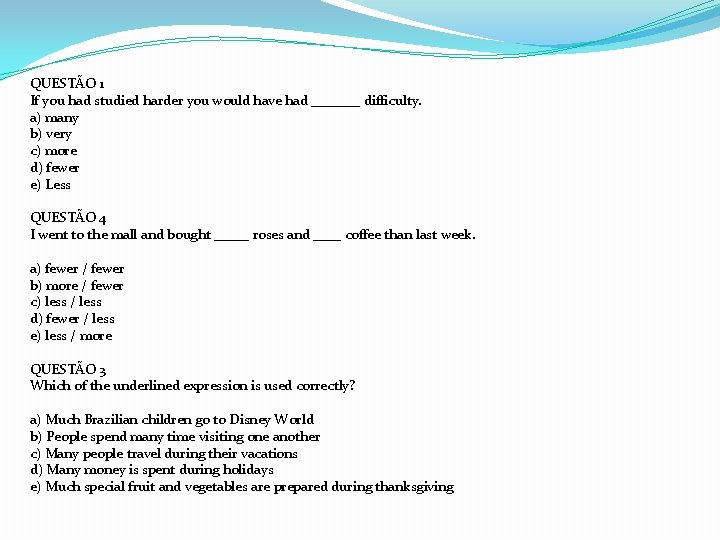
QUESTÃO 1 If you had studied harder you would have had _______ difficulty. a) many b) very c) more d) fewer e) Less QUESTÃO 4 I went to the mall and bought _____ roses and ____ coffee than last week. a) fewer / fewer b) more / fewer c) less / less d) fewer / less e) less / more QUESTÃO 3 Which of the underlined expression is used correctly? a) Much Brazilian children go to Disney World b) People spend many time visiting one another c) Many people travel during their vacations d) Many money is spent during holidays e) Much special fruit and vegetables are prepared during thanksgiving
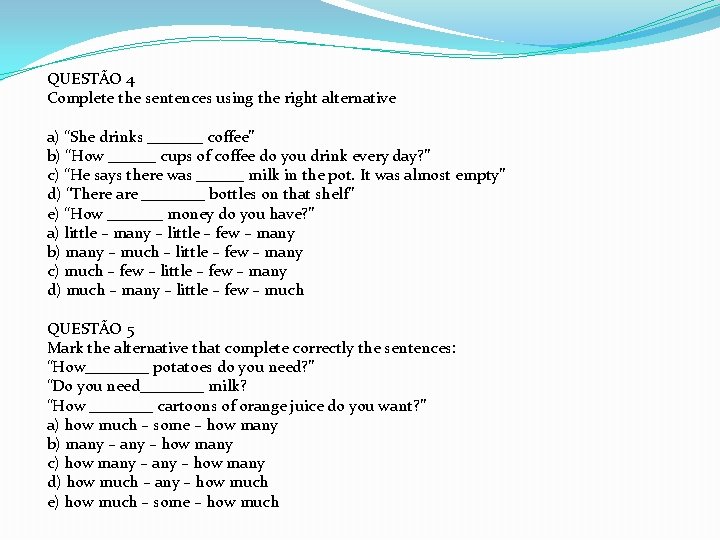
QUESTÃO 4 Complete the sentences using the right alternative a) “She drinks _______ coffee” b) “How ______ cups of coffee do you drink every day? ” c) “He says there was ______ milk in the pot. It was almost empty” d) “There are ____ bottles on that shelf” e) “How _______ money do you have? ” a) little – many – little – few – many b) many – much – little – few – many c) much – few – little – few – many d) much – many – little – few – much QUESTÃO 5 Mark the alternative that complete correctly the sentences: “How____ potatoes do you need? ” “Do you need____ milk? “How ____ cartoons of orange juice do you want? ” a) how much – some – how many b) many – how many c) how many – how many d) how much – any – how much e) how much – some – how much
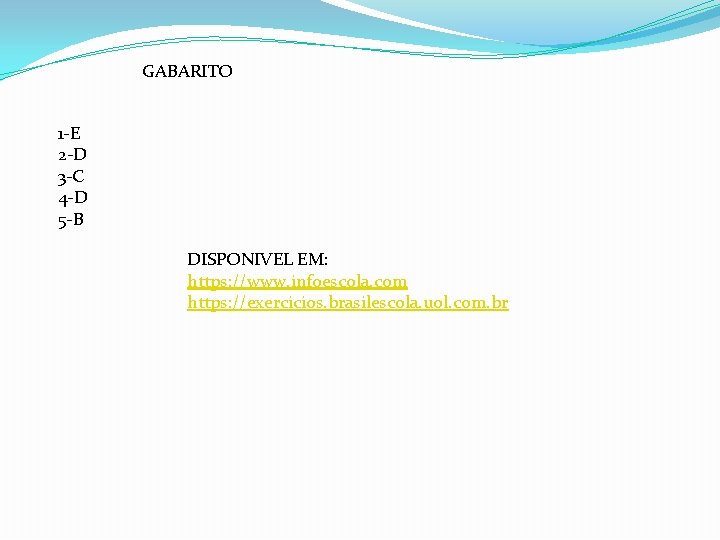
GABARITO 1 -E 2 -D 3 -C 4 -D 5 -B DISPONIVEL EM: https: //www. infoescola. com https: //exercicios. brasilescola. uol. com. br