
Augmenting Shared Personal Calendars Joe Tullio Jeremy Goecks


- Slides: 23
Augmenting Shared Personal Calendars Joe Tullio Jeremy Goecks Elizabeth D. Mynatt David H. Nguyen
Motivation Domain: Electronic (Shared) Calendars Studies: Palen, L. (1999) "Social, Individual & Technological Issues for Groupware Calendar Systems", CHI'99. Grudin, J. and Palen, L. (1997) "Emerging Groupware Successes in Major Corporations: Studies of Adoption and Adaptation", WWCA'97. “Calendar work” + – Locating colleagues – Assessing availability – Regulating privacy
Calendars: Three Interacting Perspectives Single-user calendar – Calendar work Interpersonal communication – Assessing availability – Meeting scheduling Socio-technical evolution – Privacy and defaults
Calendars: Three Interacting Perspectives Single-user calendar – Calendar work Interpersonal communication – Assessing availability – Meeting scheduling Socio-technical evolution – Privacy and defaults
Calendars: Three Interacting Perspectives Single-user calendar – Calendar work Interpersonal communication – Assessing availability – Meeting scheduling Socio-technical evolution – Privacy and defaults
Additional practices Single-user calendar • • Ad-hoc naming Inaccurate calendars Interpersonal communication • • • “Ambush” vs. “waylay” Media choice Awareness Socio-technical evolution • • Privacy and accountability Social norms
Augur System: Goals Support personal calendaring practices (ad hoc naming) “Improve” calendar accuracy through predictive models Enable informal communication practices (“ambushing”, awareness) Facilitate privacy management by visualizing access history
Overview Motivations: Calendar studies and perspectives Augur Design –Setting –Architecture • Component Technologies –Interface Design • Calendar browser and visualizations • Access count Future Work Conclusion
Setting University setting (Students, faculty, staff) – Single workgroup at Georgia Tech College of Computing Numerous public meetings/courses across multiple buildings Rapid schedule turnover (term changes) 9 participants (7 students, 1 faculty, 1 staff) 3 months, 2600+ events
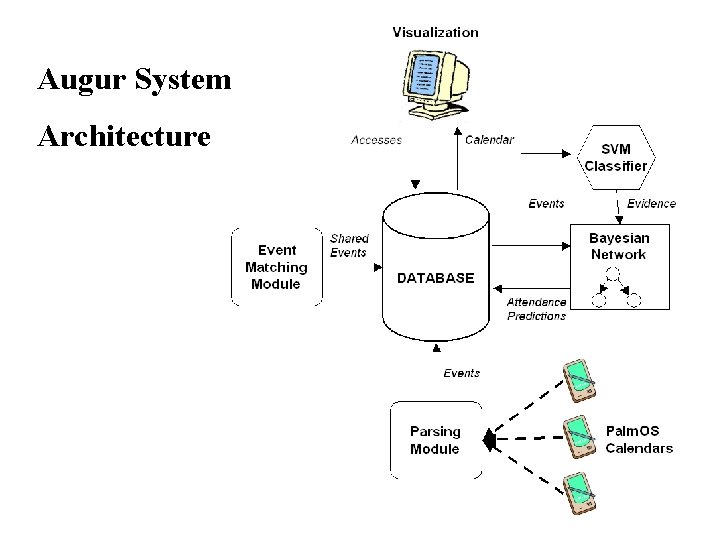
Augur System Architecture
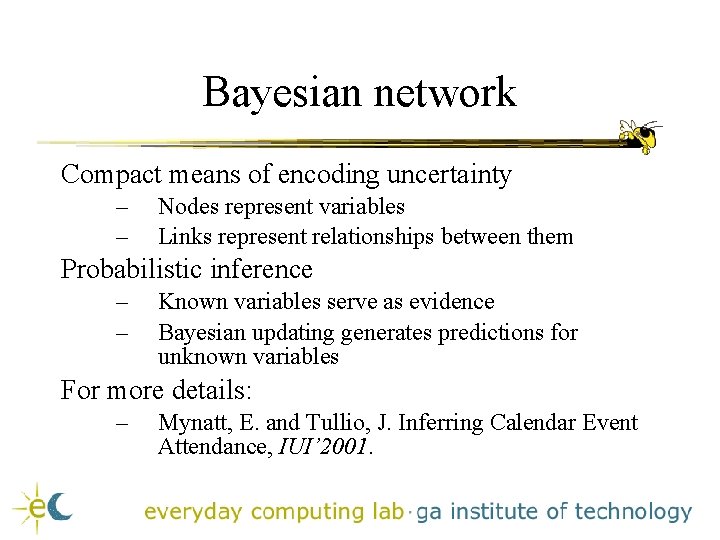
Bayesian network Compact means of encoding uncertainty – – Nodes represent variables Links represent relationships between them Probabilistic inference – – Known variables serve as evidence Bayesian updating generates predictions for unknown variables For more details: – Mynatt, E. and Tullio, J. Inferring Calendar Event Attendance, IUI’ 2001.
Augur Bayesian Network
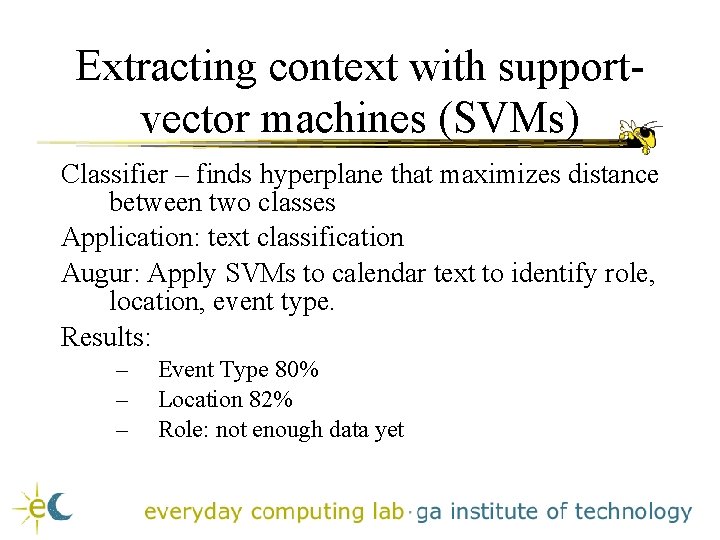
Extracting context with supportvector machines (SVMs) Classifier – finds hyperplane that maximizes distance between two classes Application: text classification Augur: Apply SVMs to calendar text to identify role, location, event type. Results: – – – Event Type 80% Location 82% Role: not enough data yet
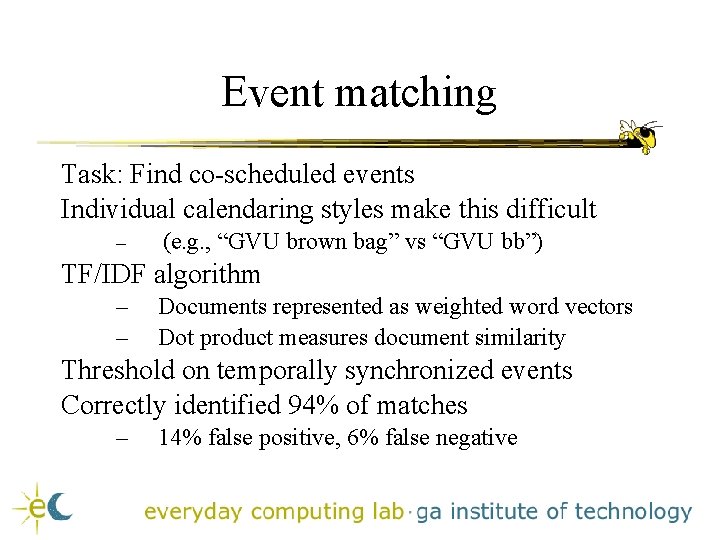
Event matching Task: Find co-scheduled events Individual calendaring styles make this difficult – (e. g. , “GVU brown bag” vs “GVU bb”) TF/IDF algorithm – – Documents represented as weighted word vectors Dot product measures document similarity Threshold on temporally synchronized events Correctly identified 94% of matches – 14% false positive, 6% false negative
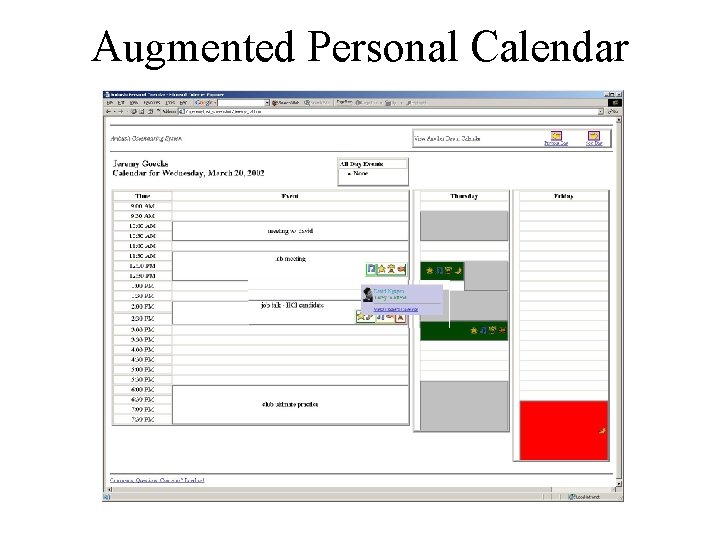
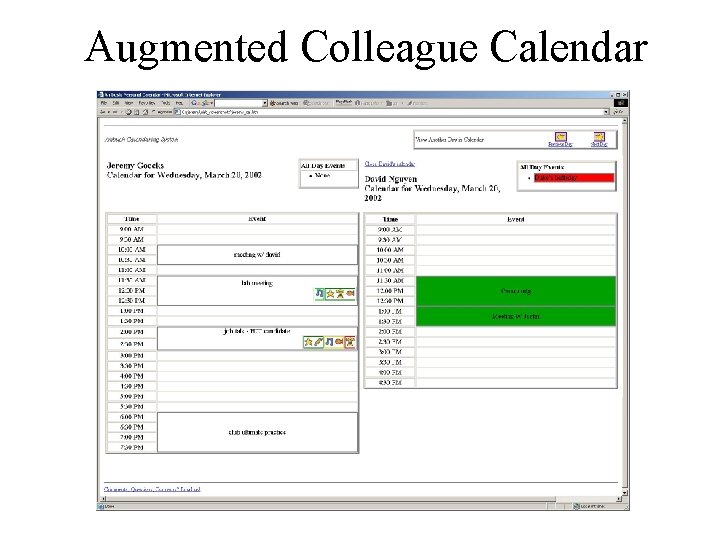
Calendar app Web-based (JSP) shared calendar Can browse own calendar or those of colleagues Attendance predictions represented as color coding Colleagues represented iconically within coscheduled events; details available as tooltips Allows side-by-side comparison
Augmented Personal Calendar
Augmented Colleague Calendar
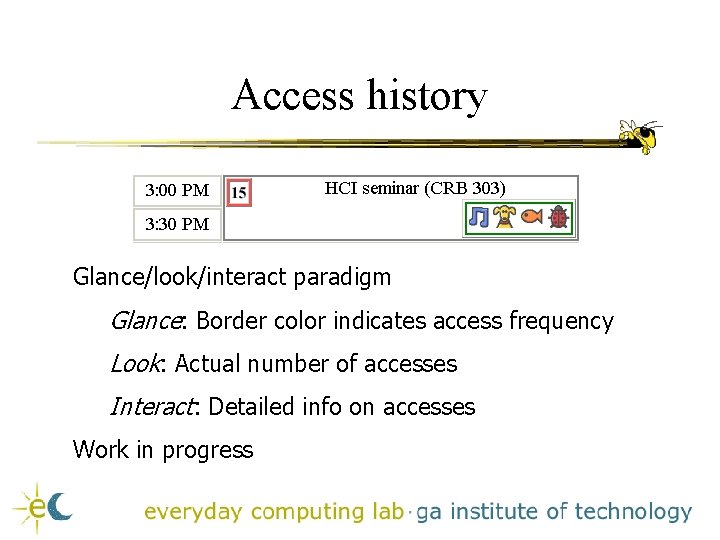
Access history Glance/look/interact paradigm Glance: Border color indicates access frequency Look: Actual number of accesses Interact: Detailed info on accesses Work in progress
Related work: Modeling/Prediction: – – – Ambush (Mynatt & Tullio, IUI 2001) Tempus Fugit (Ford et al, CIKM 2001) GPS (Ashbrook & Starner, CHI 2002) Coordinate (Horvitz et al, UAI 2002) Work rhythms (Begole et al, CSCW 2002) More to come! Learn models from data or construct by hand?
Related work: Calendar Visualization: – Fisheye view (Bederson et al, 2000) – 3 D Calendars (Mackinlay et al, 1994) – Transparency (Beard et al, 1990) Accountability: – – Social translucence (Erickson et al, 2000) History-enriched objects (Hill et al, 1993)
Future work Deployment – – – Participants among several research groups/occupations at the College of Computing Measure model accuracy over time Determine when/how predictions are used Interactive models – – Address learning time Control, trust promote adoption Sensitivity to social environment Heuristics vs. training Bayes?
Augur: A probabilistic shared calendar Calendars shared from personal mobile devices A probabilistic model drives predictions of attendance at future events Text processing identifies co-scheduled events Visualize predictions in a browsable calendar Reporting accesses promotes accountability
Thanks. http: //www. cc. gatech. edu/fce/ecl jtullio@cc. gatech. edu jeremy@cc. gatech. edu