
Augmenting Principle Brian Pochinski The trouble with attributions
Augmenting Principle Brian Pochinski
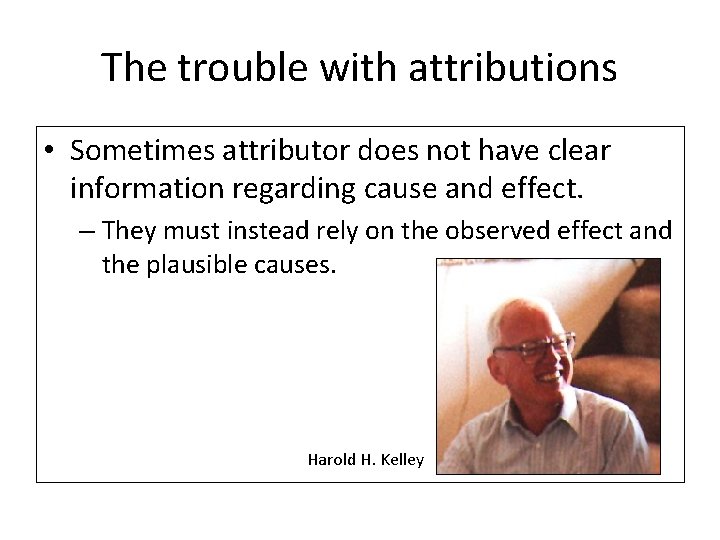
The trouble with attributions • Sometimes attributor does not have clear information regarding cause and effect. – They must instead rely on the observed effect and the plausible causes. Harold H. Kelley
Augmenting Principle • When an effect occurs with plausible inhibitory causes, augmenting occurs: – When a plausible facilitative cause and a plausible inhibitory cause is present, the role of the facilitative cause will be perceived as greater than if only the facilitative cause were present. – The facilitative cause must be efficacious because the effect occurred despite an inhibitory cause. Kelley, 1972 a
Discounting Principle • When several plausible facilitative causes could explain an effect, discounting occurs: – The role of a cause producing an effect is discounted if the other plausible facilitative causes are available Kelley, 1972 a
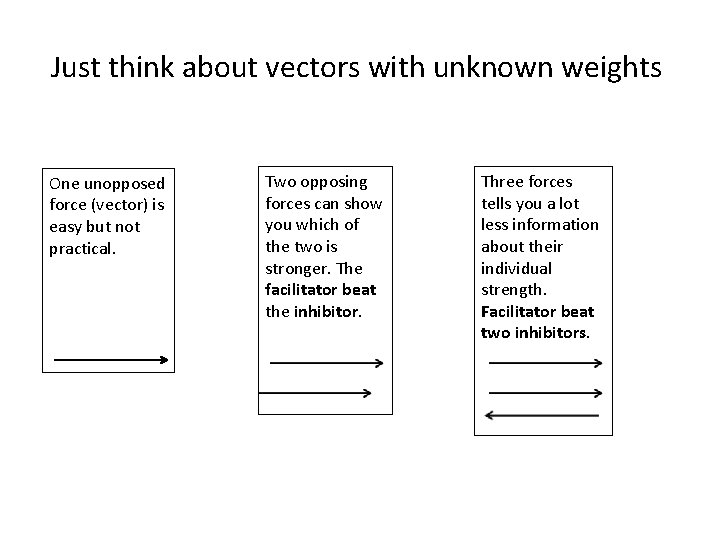
Just think about vectors with unknown weights One unopposed force (vector) is easy but not practical. Two opposing forces can show you which of the two is stronger. The facilitator beat the inhibitor. Three forces tells you a lot less information about their individual strength. Facilitator beat two inhibitors.
Hanson and Hall, 1985 • The observed effect magnitude is not diagnostic of individual force strength when multiple forces produce an effect. • The observed effect overestimates the strength of any single force.
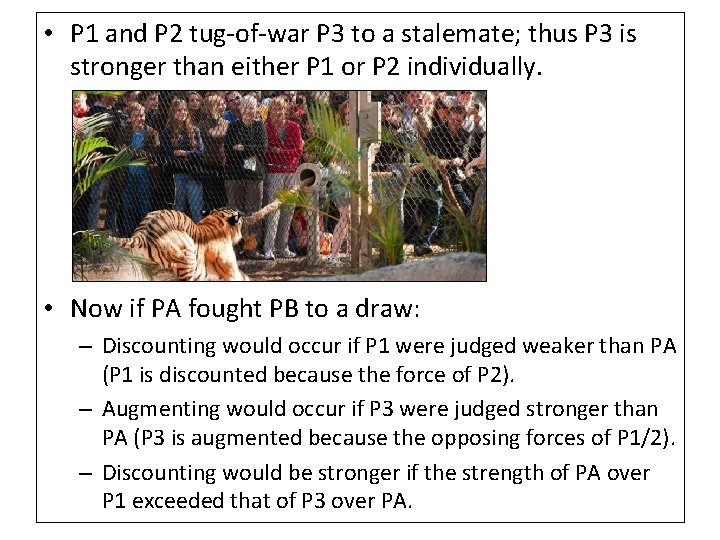
• P 1 and P 2 tug-of-war P 3 to a stalemate; thus P 3 is stronger than either P 1 or P 2 individually. • Now if PA fought PB to a draw: – Discounting would occur if P 1 were judged weaker than PA (P 1 is discounted because the force of P 2). – Augmenting would occur if P 3 were judged stronger than PA (P 3 is augmented because the opposing forces of P 1/2). – Discounting would be stronger if the strength of PA over P 1 exceeded that of P 3 over PA.
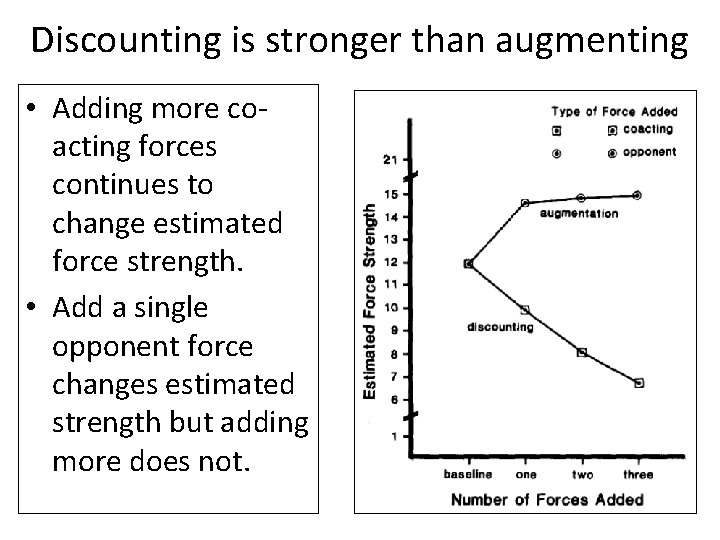
Discounting is stronger than augmenting • Adding more coacting forces continues to change estimated force strength. • Add a single opponent force changes estimated strength but adding more does not.
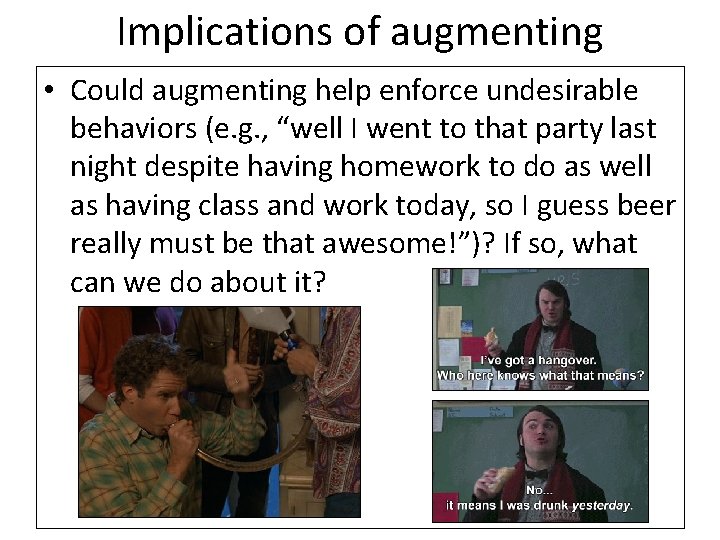
Implications of augmenting • Could augmenting help enforce undesirable behaviors (e. g. , “well I went to that party last night despite having homework to do as well as having class and work today, so I guess beer really must be that awesome!”)? If so, what can we do about it?
- Slides: 9