
Augmented Reality Markup Language 2 0 Manil Maskey
- Slides: 19
Augmented Reality Markup Language 2. 0 Manil Maskey Information Technology & Systems Center University of Alabama in Huntsville Martin Lechner Wikitude ESIP Summer Meeting 2012
Introduction • Augmented Reality • Semantic Context • ARML 1. 0 • Why? • Allow Distribution of AR content on multiple AR platforms and Applications
Scope • Target mobile, mainly geo-location based AR applications • Comprises of many different fields – Web. GL, Computer Vision, etc. • Why not KML? – KML built for map-based applications – Not flexible enough to bridge the gap between map and AR based (geo-)applications when defining the presentation of POIs and allowing tie-ins from other ARrelevant topics, such as visual tracking – KML also lacks the possibility of allowing dynamic components, such as Java. Script, to interact with the AR objects.
Scope. . Example • ARML 2. 0 could allow the specification of a reference image for a particular POI + a visual representation of the POI in case the reference image is detected in the video stream • However, ARML 2. 0 will not specify how the tracking should be done and what algorithms should be used to detect the reference image, this is supposed to be done in a group focusing on Web. GL.
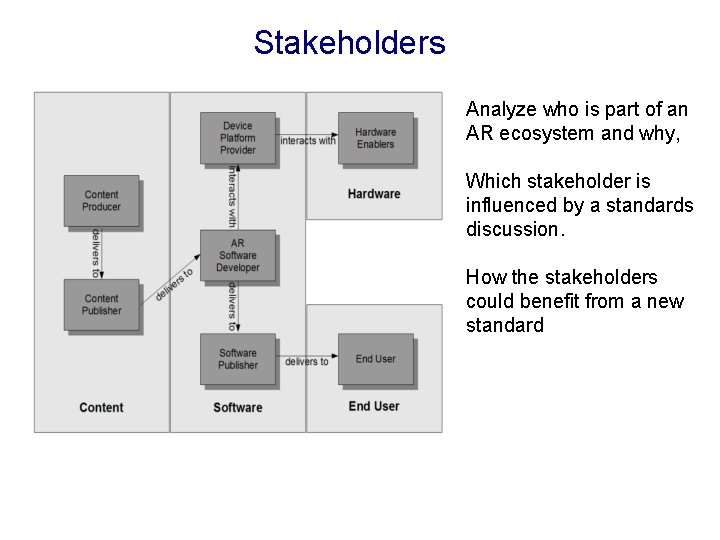
Stakeholders Analyze who is part of an AR ecosystem and why, Which stakeholder is influenced by a standards discussion. How the stakeholders could benefit from a new standard
Stake. Holders (Content) Content Producers: Create content for multiple occasions, not just for delivering the content to an AR application. Real life examples include travel book writers or tourist bureaus. Content Publishers: Receive content from the Content Producer and specifically publish the content to an AR application. Examples include publishing agencies specialized in mobile publishing.
Stakeholders (Software) AR Software Developers: • Develop software/app • Receive content from the Content Publisher Device Platform Providers: • Provide the platform the AR Software Developer is using to build the AR application • Operating systems and development platforms. • Provide the interface between the software and hardware. Google (Android), Apple (i. OS), Nokia (Symbian)… Software Publisher: • Make the AR Software available to the market. AR Software Developer delivers the software to the Software Publisher. • Mobile stakeholder is typically represented by Android Market, App Store, Ovi Store, App World etc. • It could also be a webpage advertising the AR for download
Stakeholders (Hardware/End User) Hardware Enablers: • Manufacture hardware necessary to build AR applications, including chipsets, sensors, cameras, network, battery etc. • Essentially, the Device Platform Provider builds the platform on top of the hardware. • Examples include Qualcomm, Nokia, HTC etc. End Users: • Download the application from the Software Publisher • Provide feedback
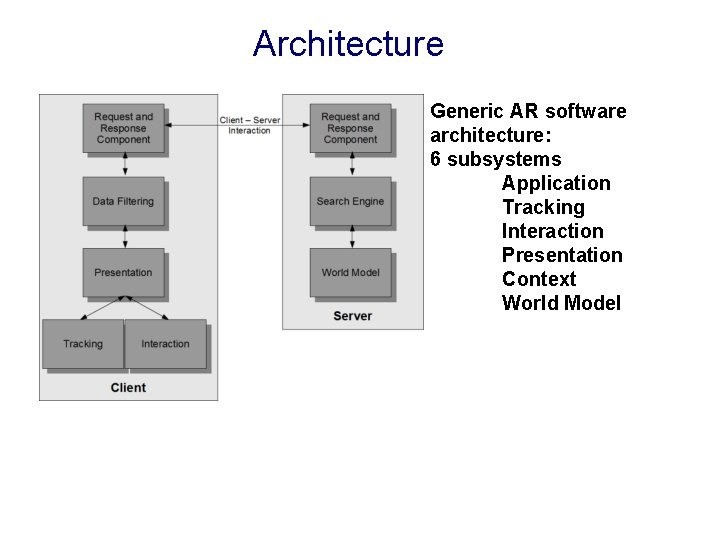
Architecture Generic AR software architecture: 6 subsystems Application Tracking Interaction Presentation Context World Model
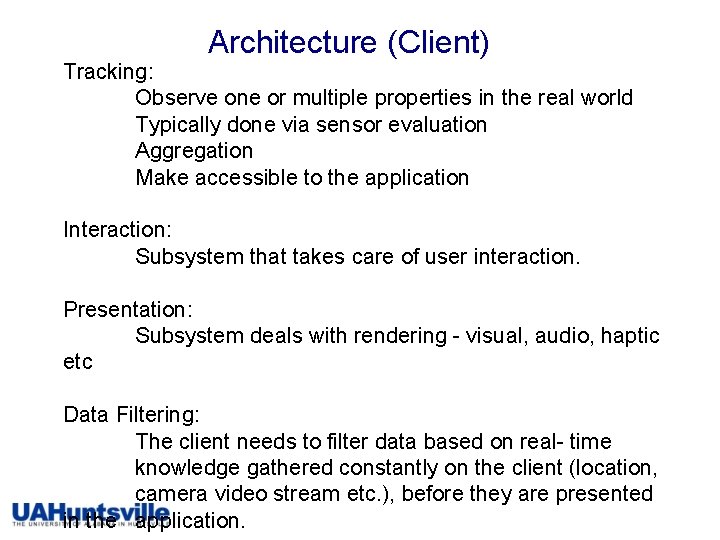
Architecture (Client) Tracking: Observe one or multiple properties in the real world Typically done via sensor evaluation Aggregation Make accessible to the application Interaction: Subsystem that takes care of user interaction. Presentation: Subsystem deals with rendering - visual, audio, haptic etc Data Filtering: The client needs to filter data based on real- time knowledge gathered constantly on the client (location, camera video stream etc. ), before they are presented in the application.
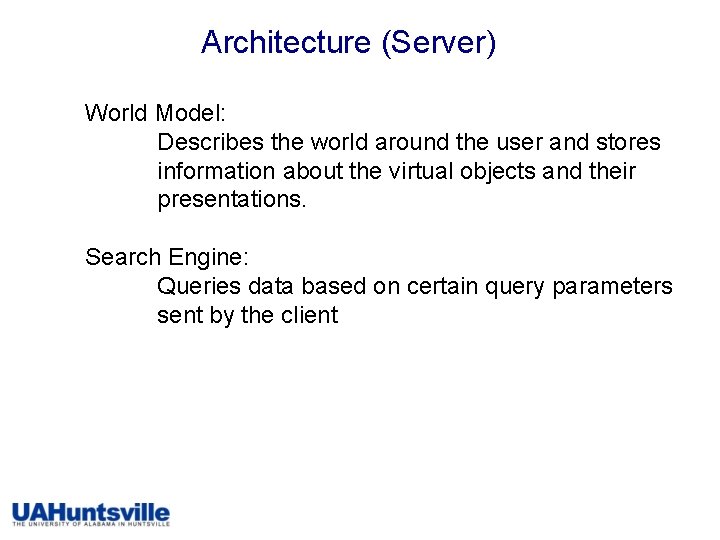
Architecture (Server) World Model: Describes the world around the user and stores information about the virtual objects and their presentations. Search Engine: Queries data based on certain query parameters sent by the client
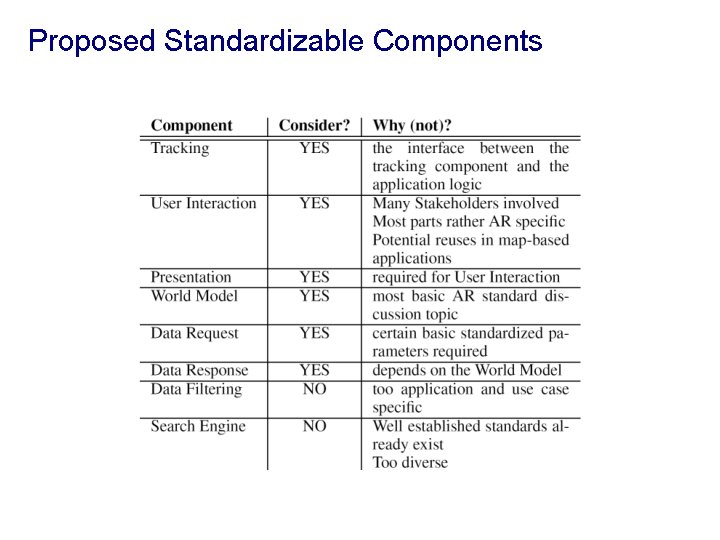
Proposed Standardizable Components
Related AR Technologies and Standards • Geospatial: GML Geo. JSON • 3 D: • Web Technologies: • And much more. . .
Example Issue • 3 D Models in Augmented Reality – Many proprietary formats (game engines etc. ) • • obj md 2, md 5 3 ds. . . – A couple of standardized formats • COLLADA, X 3 D • 3 D is complex! • Different ways to – define the model – define animations – define textures/shaders/materials
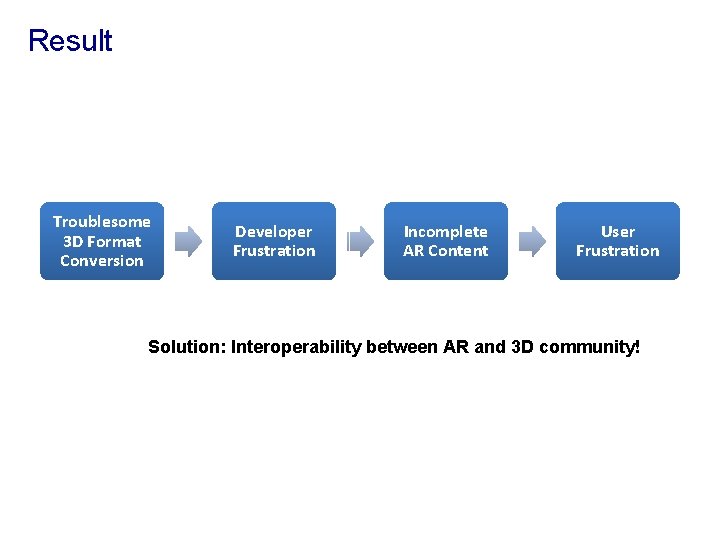
Result Troublesome 3 D Format Conversion Developer Frustration Incomplete AR Content User Frustration Solution: Interoperability between AR and 3 D community!
Starting Point • KML for POI geometries (+ any other geo data format which can be used as input, such as Geo. JSON, Geo. RSS or GML) • ARML 1. 0 • KARML and ARGON • City. GML • X 3 D, COLLADA • Web. GL • Java. Script • HTML and Java. Script as a reference architecture, supporting declarative and dynamic/interactive components.
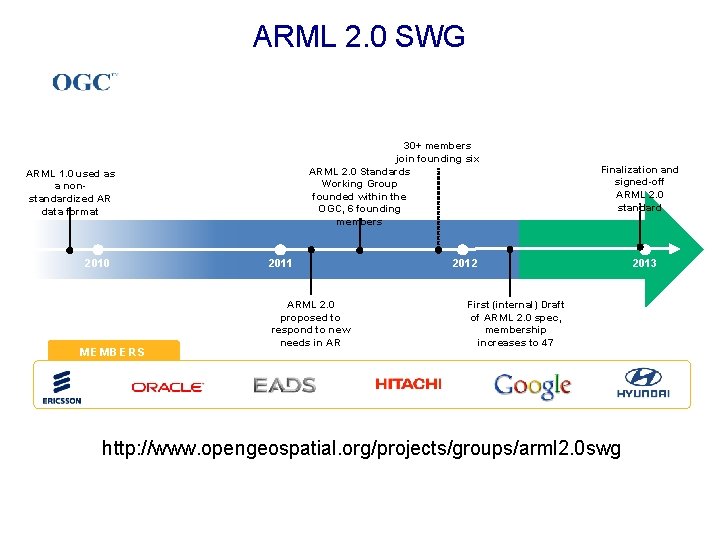
ARML 2. 0 SWG 30+ members join founding six ARML 2. 0 Standards Working Group founded within the OGC, 6 founding members ARML 1. 0 used as a nonstandardized AR data format 2010 MEMBERS 2011 ARML 2. 0 proposed to respond to new needs in AR Finalization and signed-off ARML 2. 0 standard 2012 First (internal) Draft of ARML 2. 0 spec, membership increases to 47 http: //www. opengeospatial. org/projects/groups/arml 2. 0 swg 2013
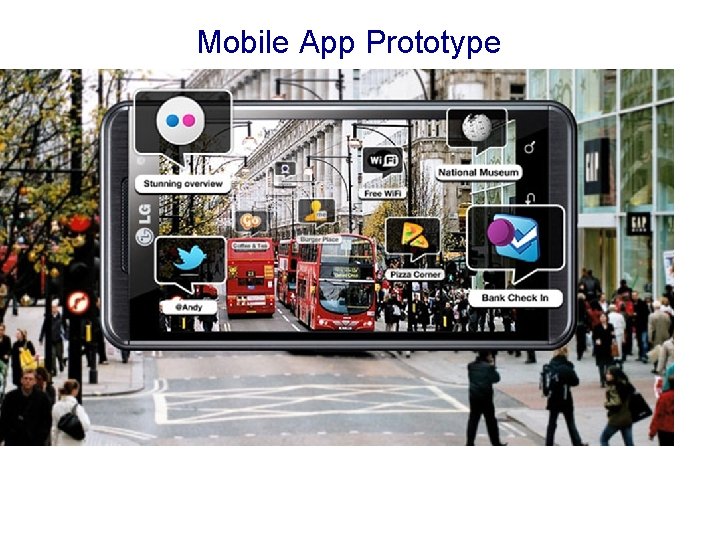
Mobile App Prototype
Contact Manil Maskey Information Technology & Systems Center University of Alabama in Huntsville mmaskey@itsc. uah. edu