
Augenabteilung am St Franziskus Hospital Mnster Lasik Flap
Augenabteilung am St. Franziskus Hospital Münster Lasik Flap Thickness using the Zyoptix XP Microkeratome Susanne Stottmeister, Suphi Taneri* * Travel grant by Bausch & Lomb ASCRS Symposium, April 4 -9, 2008, Chicago
Purpose To evaluate predictability and possible factors affecting flap thickness in laser in situ keratomileusis (LASIK) using the Zyoptix XP microkeratome. Augenabteilung am St. Franziskus Hospital Münster
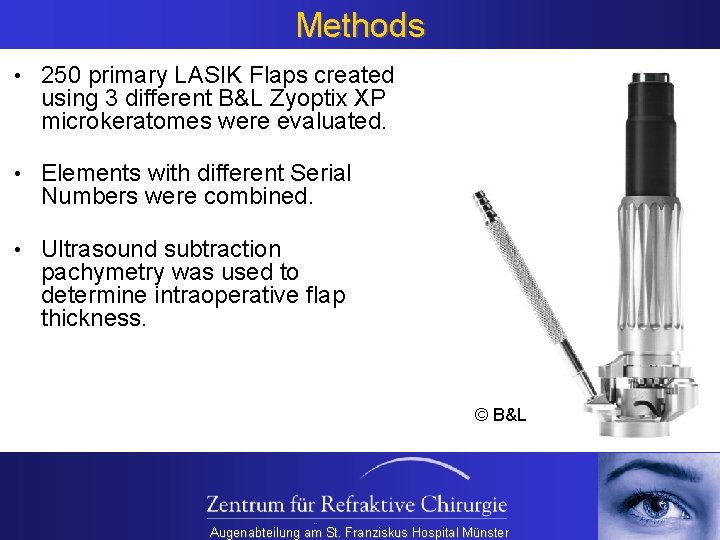
Methods • 250 primary LASIK Flaps created using 3 different B&L Zyoptix XP microkeratomes were evaluated. • Elements with different Serial Numbers were combined. • Ultrasound subtraction pachymetry was used to determine intraoperative flap thickness. © B&L Augenabteilung am St. Franziskus Hospital Münster
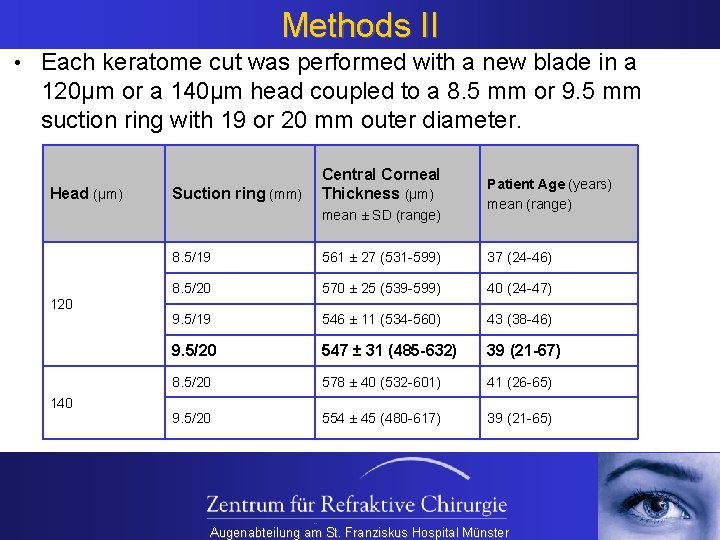
Methods II • Each keratome cut was performed with a new blade in a 120µm or a 140µm head coupled to a 8. 5 mm or 9. 5 mm suction ring with 19 or 20 mm outer diameter. Head (µm) Suction ring (mm) Central Corneal Thickness (µm) mean ± SD (range) 120 140 Patient Age (years) mean (range) 8. 5/19 561 ± 27 (531 -599) 37 (24 -46) 8. 5/20 570 ± 25 (539 -599) 40 (24 -47) 9. 5/19 546 ± 11 (534 -560) 43 (38 -46) 9. 5/20 547 ± 31 (485 -632) 39 (21 -67) 8. 5/20 578 ± 40 (532 -601) 41 (26 -65) 9. 5/20 554 ± 45 (480 -617) 39 (21 -65) Augenabteilung am St. Franziskus Hospital Münster
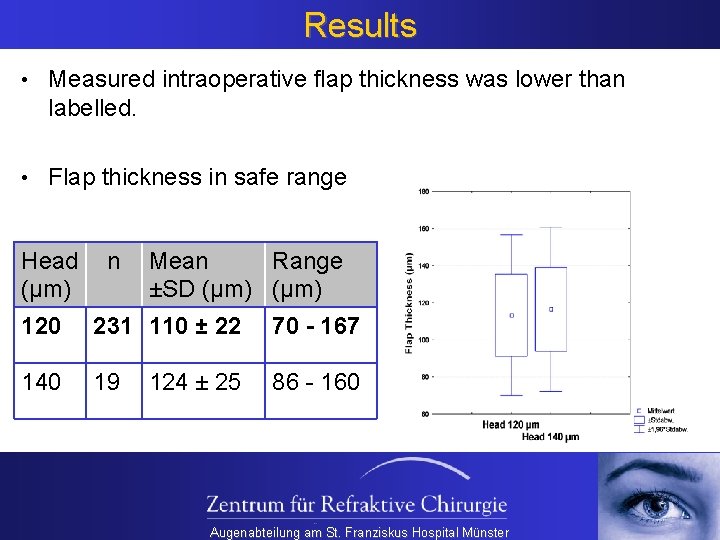
Results • Measured intraoperative flap thickness was lower than labelled. • Flap thickness in safe range Head (µm) n Mean Range ±SD (µm) 120 231 110 ± 22 70 - 167 140 19 86 - 160 124 ± 25 Augenabteilung am St. Franziskus Hospital Münster
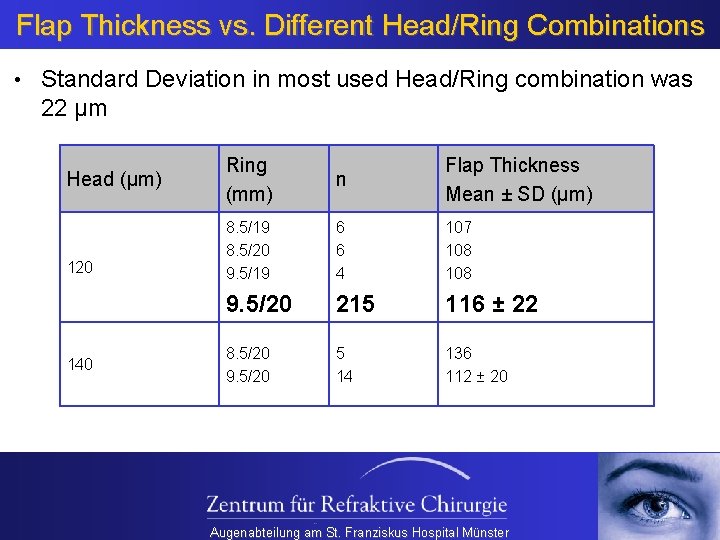
Flap Thickness vs. Different Head/Ring Combinations • Standard Deviation in most used Head/Ring combination was 22 µm Head (µm) 120 140 Ring (mm) n Flap Thickness Mean ± SD (µm) 8. 5/19 8. 5/20 9. 5/19 6 6 4 107 108 9. 5/20 215 116 ± 22 8. 5/20 9. 5/20 5 14 136 112 ± 20 Augenabteilung am St. Franziskus Hospital Münster
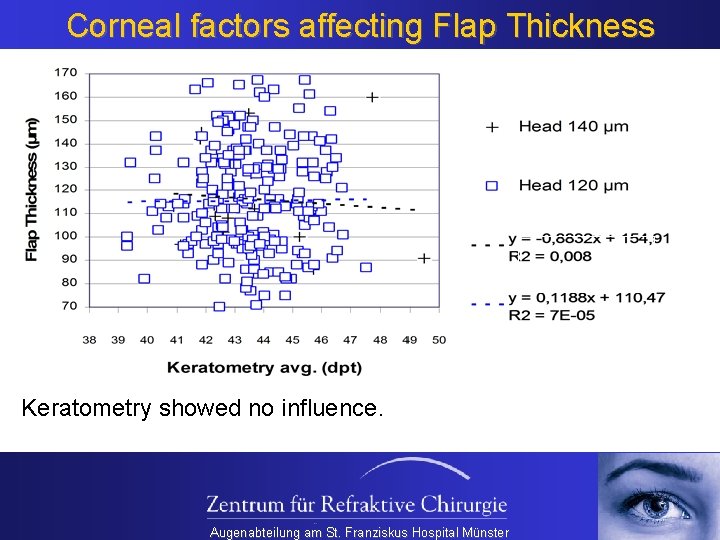
Corneal factors affecting Flap Thickness Keratometry showed no influence. Augenabteilung am St. Franziskus Hospital Münster
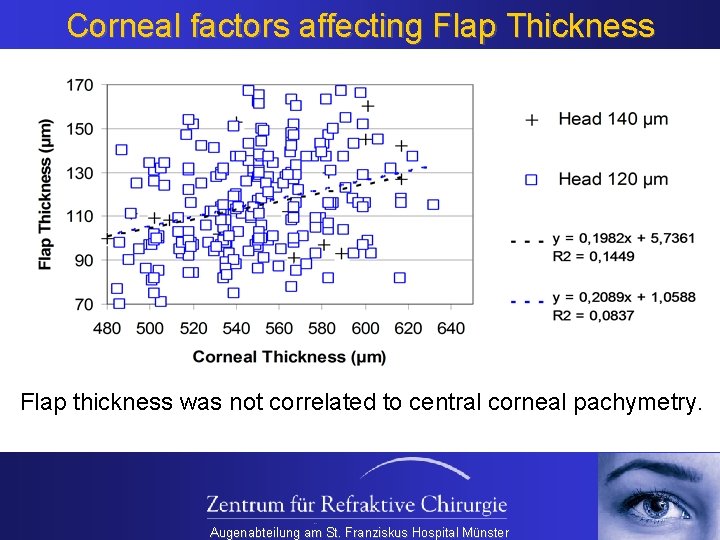
Corneal factors affecting Flap Thickness Flap thickness was not correlated to central corneal pachymetry. Augenabteilung am St. Franziskus Hospital Münster
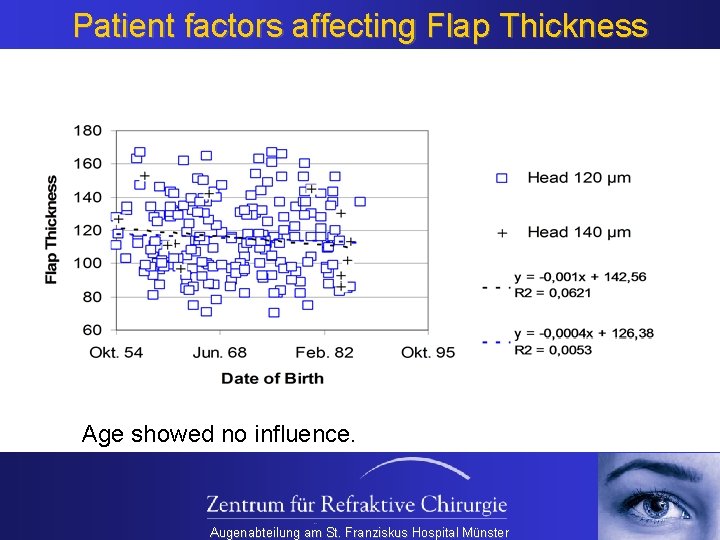
Patient factors affecting Flap Thickness Age showed no influence. Augenabteilung am St. Franziskus Hospital Münster
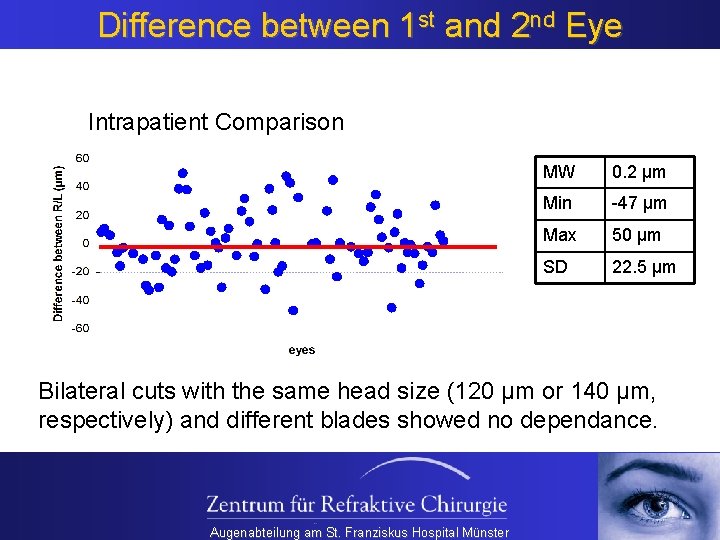
Difference between 1 st and 2 nd Eye Intrapatient Comparison MW 0. 2 µm Min -47 µm Max 50 µm SD 22. 5 µm Bilateral cuts with the same head size (120 µm or 140 µm, respectively) and different blades showed no dependance. Augenabteilung am St. Franziskus Hospital Münster
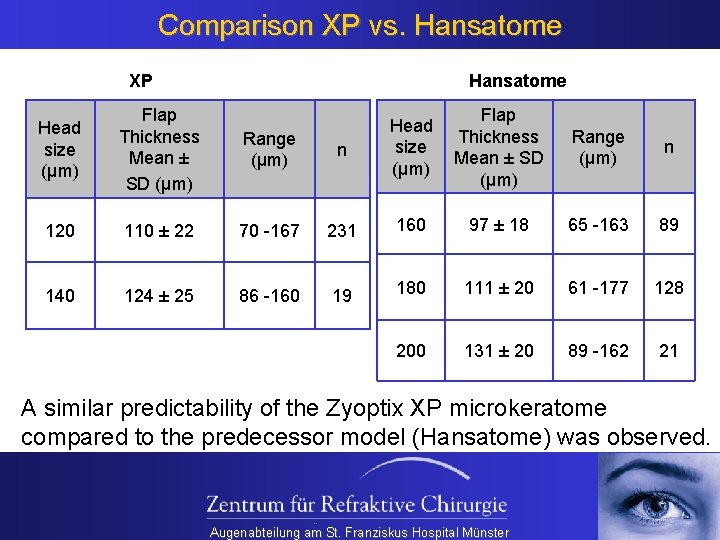
Comparison XP vs. Hansatome XP Hansatome Head size (µm) Flap Thickness Mean ± SD (µm) n Head size (µm) Flap Thickness Mean ± SD (µm) Range (µm) n 120 110 ± 22 70 -167 231 160 97 ± 18 65 -163 89 140 124 ± 25 86 -160 19 180 111 ± 20 61 -177 128 200 131 ± 20 89 -162 21 A similar predictability of the Zyoptix XP microkeratome compared to the predecessor model (Hansatome) was observed. Augenabteilung am St. Franziskus Hospital Münster
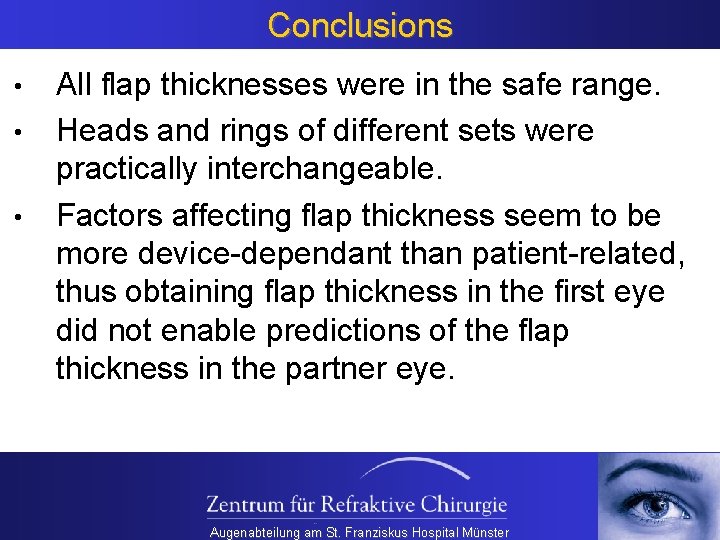
Conclusions • • • All flap thicknesses were in the safe range. Heads and rings of different sets were practically interchangeable. Factors affecting flap thickness seem to be more device-dependant than patient-related, thus obtaining flap thickness in the first eye did not enable predictions of the flap thickness in the partner eye. Augenabteilung am St. Franziskus Hospital Münster
- Slides: 12