
Auditory System Introduction Sound Physics Salient features of

- Slides: 41
Auditory System: Introduction • Sound: Physics; Salient features of perception. – Weber-Fechner laws, as in touch, vision • Auditory Pathway: cochlea – brainstem – cortex – Optimal design to pick up the perceptually salient features – Coding principles common to other sensory systems: Ø sensory or “place” maps, Ø receptive fields, Ø hierarchies of complexity. – Coding principles unique to auditory system: timing – Physiology explains perception • f. MRI of language processing • Plasticity (sensory experience or external manipulation). • Diseases: – Hearing impairment affects ~ 30 million in the USA
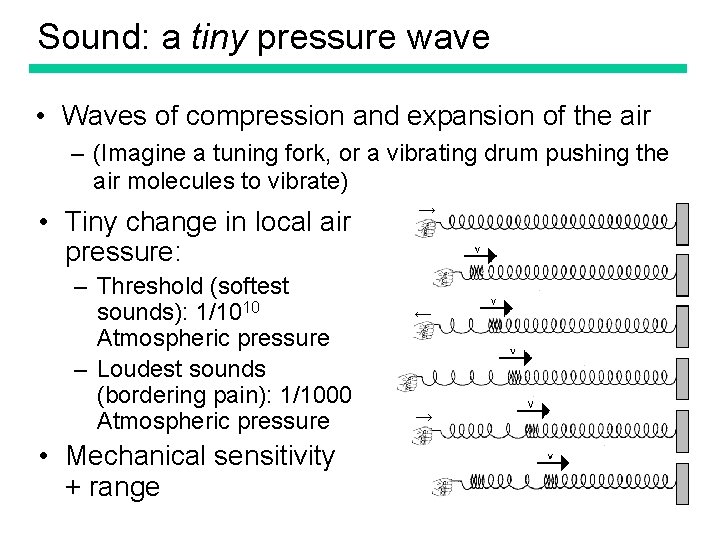
Sound: a tiny pressure wave • Waves of compression and expansion of the air – (Imagine a tuning fork, or a vibrating drum pushing the air molecules to vibrate) • Tiny change in local air pressure: – Threshold (softest sounds): 1/1010 Atmospheric pressure – Loudest sounds (bordering pain): 1/1000 Atmospheric pressure • Mechanical sensitivity + range
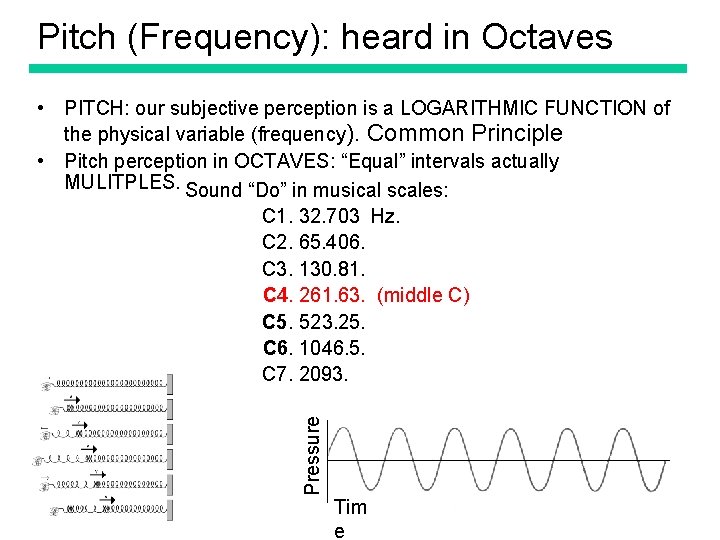
Pitch (Frequency): heard in Octaves Pressure • PITCH: our subjective perception is a LOGARITHMIC FUNCTION of the physical variable (frequency). Common Principle • Pitch perception in OCTAVES: “Equal” intervals actually MULITPLES. Sound “Do” in musical scales: C 1. 32. 703 Hz. C 2. 65. 406. C 3. 130. 81. C 4. 261. 63. (middle C) C 5. 523. 25. C 6. 1046. 5. C 7. 2093. Tim e
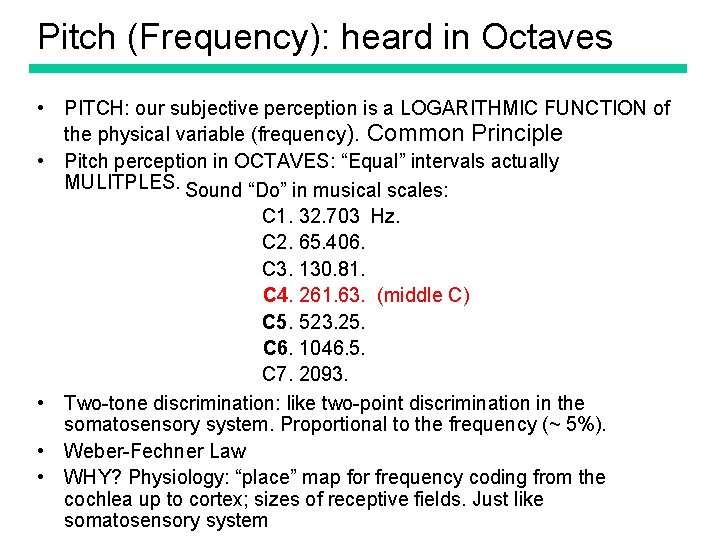
Pitch (Frequency): heard in Octaves • PITCH: our subjective perception is a LOGARITHMIC FUNCTION of the physical variable (frequency). Common Principle • Pitch perception in OCTAVES: “Equal” intervals actually MULITPLES. Sound “Do” in musical scales: C 1. 32. 703 Hz. C 2. 65. 406. C 3. 130. 81. C 4. 261. 63. (middle C) C 5. 523. 25. C 6. 1046. 5. C 7. 2093. • Two-tone discrimination: like two-point discrimination in the somatosensory system. Proportional to the frequency (~ 5%). • Weber-Fechner Law • WHY? Physiology: “place” map for frequency coding from the cochlea up to cortex; sizes of receptive fields. Just like somatosensory system
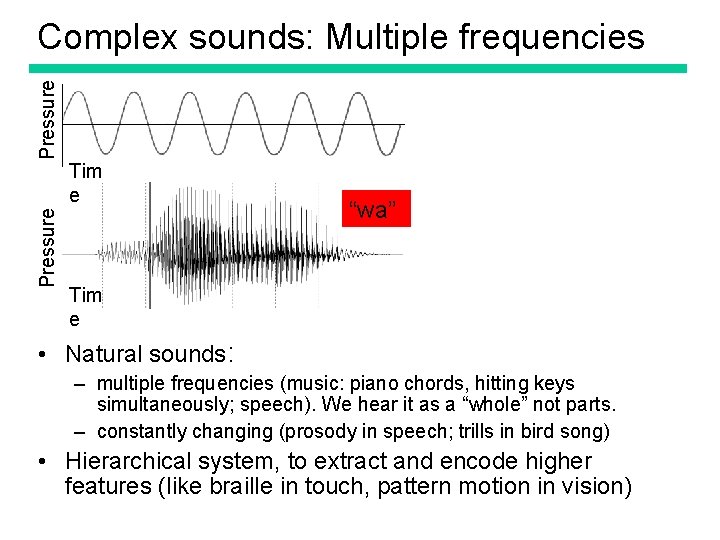
Pressure Complex sounds: Multiple frequencies Pressure Tim e “wa” Tim e • Natural sounds: – multiple frequencies (music: piano chords, hitting keys simultaneously; speech). We hear it as a “whole” not parts. – constantly changing (prosody in speech; trills in bird song) • Hierarchical system, to extract and encode higher features (like braille in touch, pattern motion in vision)
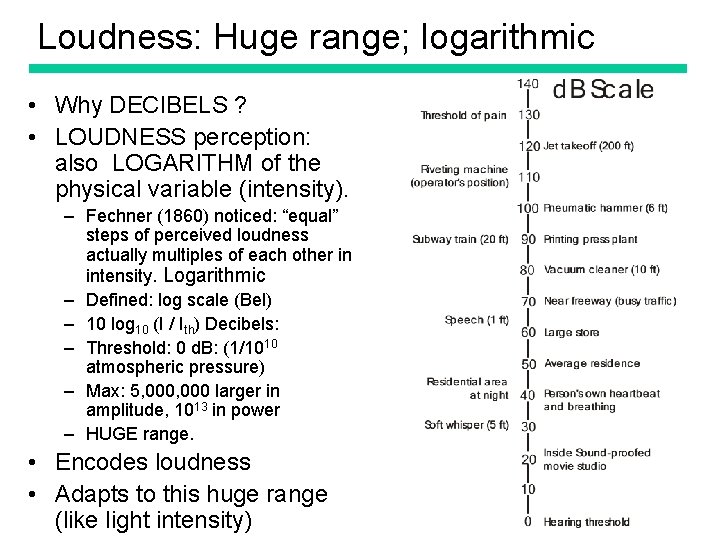
Loudness: Huge range; logarithmic • Why DECIBELS ? • LOUDNESS perception: also LOGARITHM of the physical variable (intensity). – Fechner (1860) noticed: “equal” steps of perceived loudness actually multiples of each other in intensity. Logarithmic – Defined: log scale (Bel) – 10 log 10 (I / Ith) Decibels: – Threshold: 0 d. B: (1/1010 atmospheric pressure) – Max: 5, 000 larger in amplitude, 1013 in power – HUGE range. • Encodes loudness • Adapts to this huge range (like light intensity)
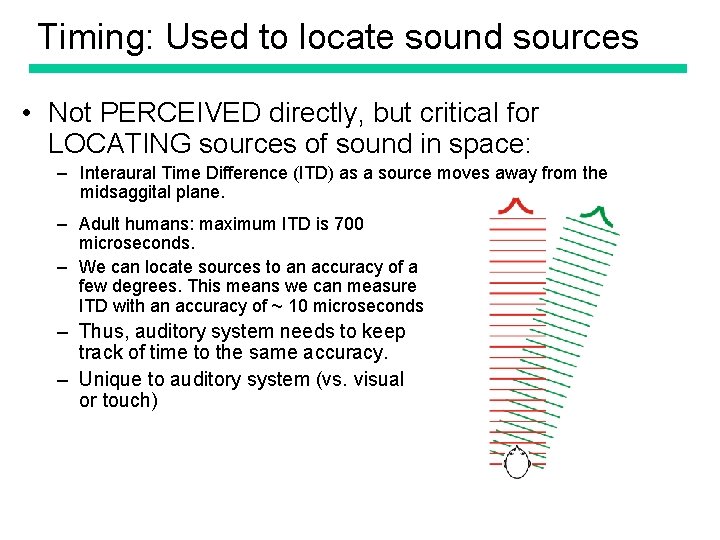
Timing: Used to locate sound sources • Not PERCEIVED directly, but critical for LOCATING sources of sound in space: – Interaural Time Difference (ITD) as a source moves away from the midsaggital plane. – Adult humans: maximum ITD is 700 microseconds. – We can locate sources to an accuracy of a few degrees. This means we can measure ITD with an accuracy of ~ 10 microseconds – Thus, auditory system needs to keep track of time to the same accuracy. – Unique to auditory system (vs. visual or touch)
Auditory System: Demands • Frequency (logarithmic, octave scale) • Complex sounds: multiple & changing frequencies. • Loudness (logarithmic scale; extending over a range of 5, 000 in amplitude, i. e. 2. 5 x 10¹³ in intensity) • (properties analogous to touch and vision) • Timing, to 10 microsecond accuracy
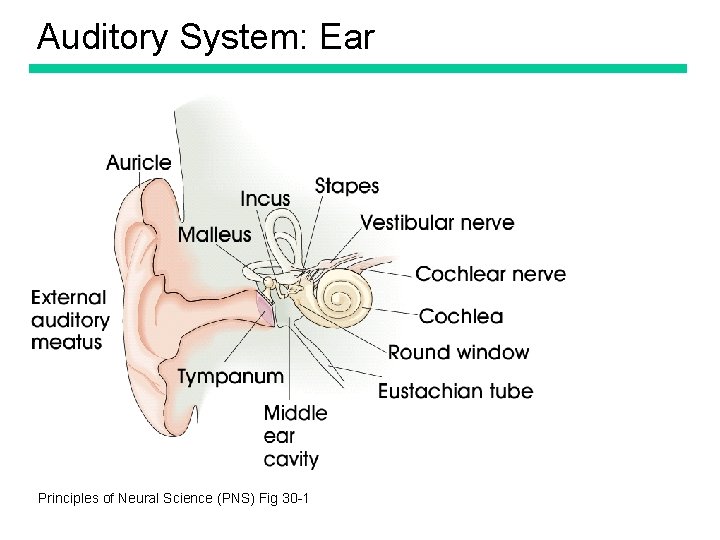
Auditory System: Ear Principles of Neural Science (PNS) Fig 30 -1
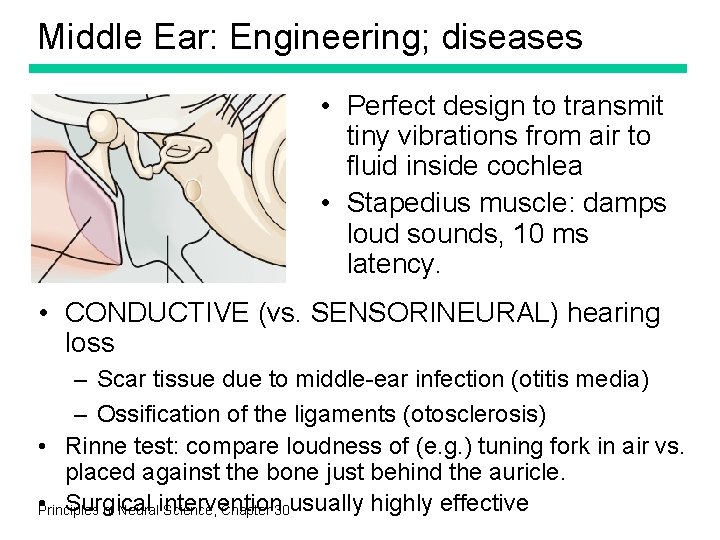
Middle Ear: Engineering; diseases • Perfect design to transmit tiny vibrations from air to fluid inside cochlea • Stapedius muscle: damps loud sounds, 10 ms latency. • CONDUCTIVE (vs. SENSORINEURAL) hearing loss – Scar tissue due to middle-ear infection (otitis media) – Ossification of the ligaments (otosclerosis) • Rinne test: compare loudness of (e. g. ) tuning fork in air vs. placed against the bone just behind the auricle. • Surgical Principles of Neuralintervention Science, Chapter 30 usually highly effective
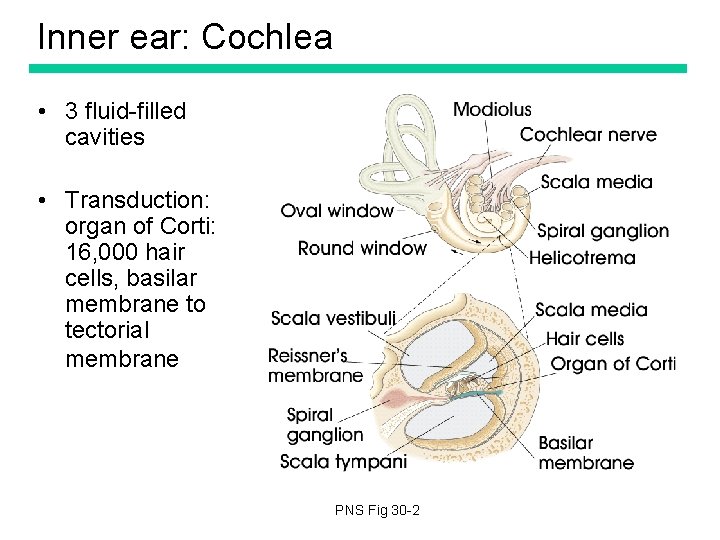
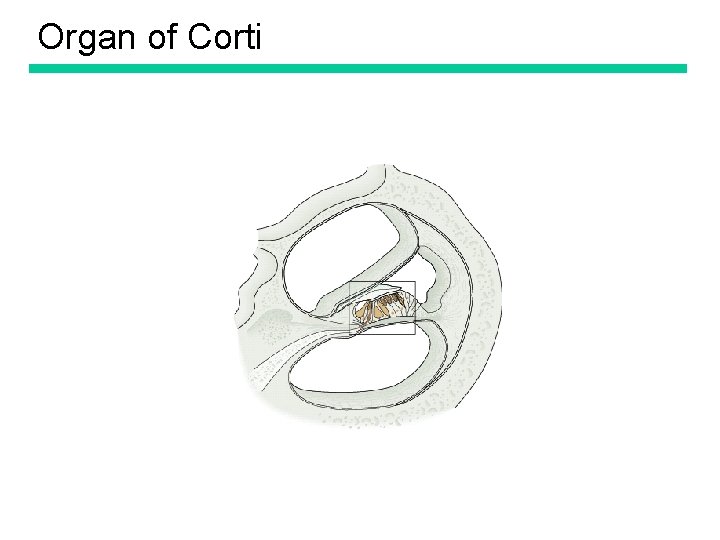
Inner ear: Cochlea • 3 fluid-filled cavities • Transduction: organ of Corti: 16, 000 hair cells, basilar membrane to tectorial membrane PNS Fig 30 -2
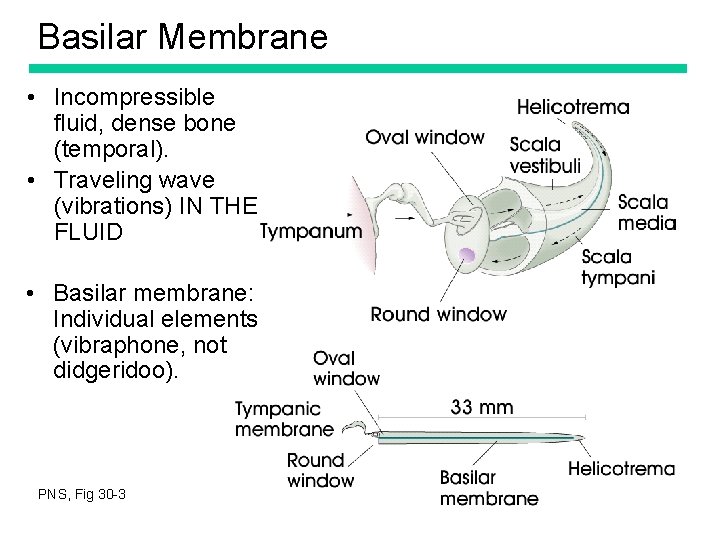
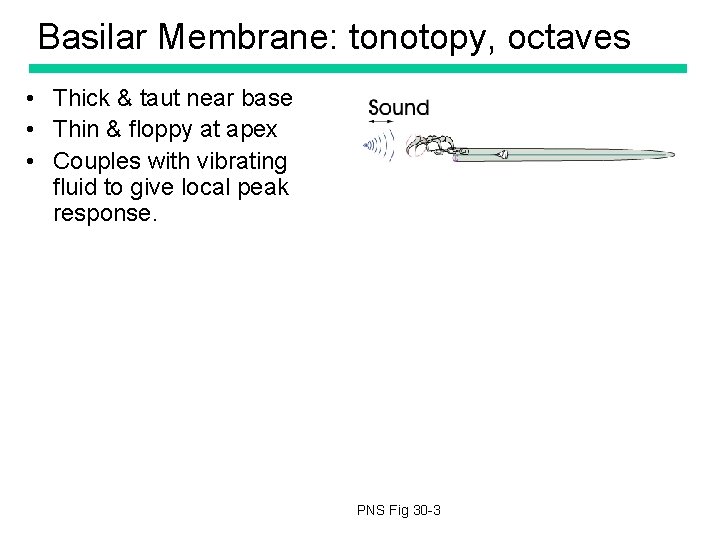
Basilar Membrane • Incompressible fluid, dense bone (temporal). • Traveling wave (vibrations) IN THE FLUID • Basilar membrane: Individual elements (vibraphone, not didgeridoo). PNS, Fig 30 -3
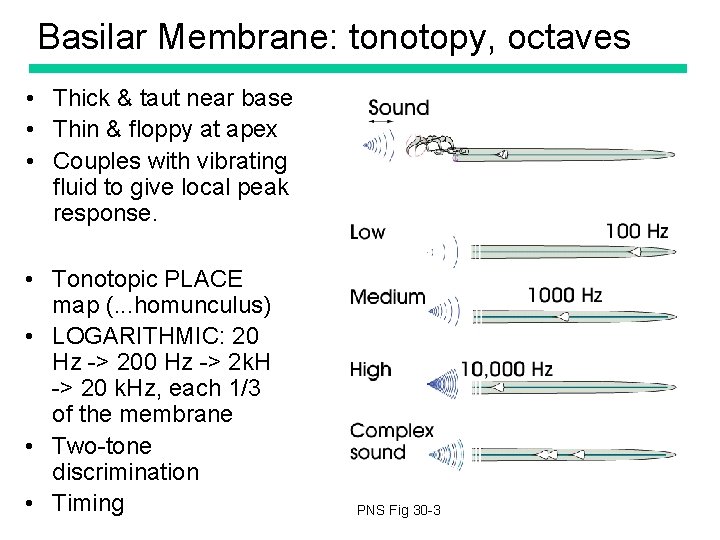
Basilar Membrane: tonotopy, octaves • Thick & taut near base • Thin & floppy at apex • Couples with vibrating fluid to give local peak response. PNS Fig 30 -3
Basilar Membrane: tonotopy, octaves • Thick & taut near base • Thin & floppy at apex • Couples with vibrating fluid to give local peak response. • Tonotopic PLACE map (. . . homunculus) • LOGARITHMIC: 20 Hz -> 200 Hz -> 2 k. H -> 20 k. Hz, each 1/3 of the membrane • Two-tone discrimination • Timing PNS Fig 30 -3
Organ of Corti
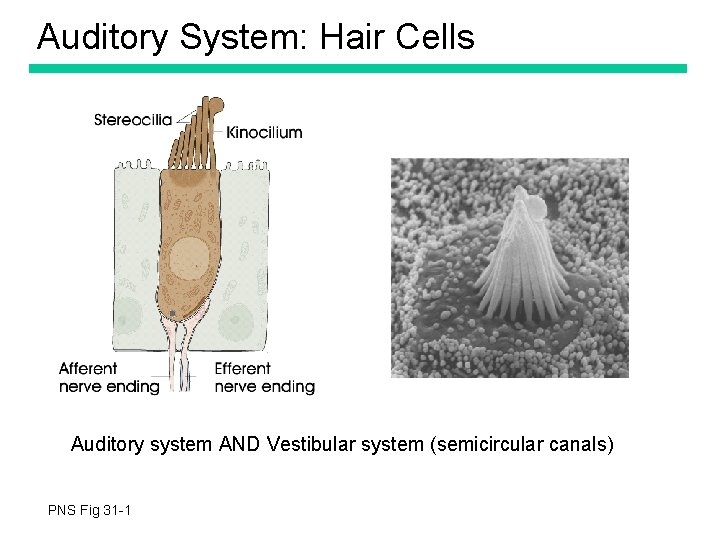
Auditory System: Hair Cells Auditory system AND Vestibular system (semicircular canals) PNS Fig 31 -1
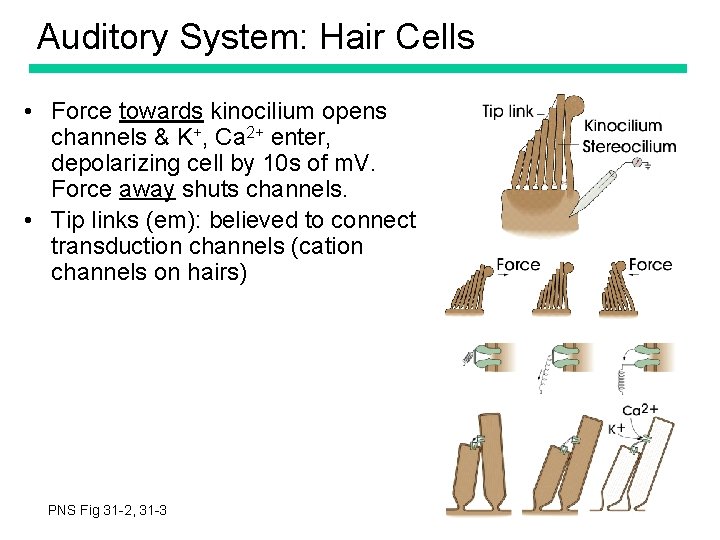
Auditory System: Hair Cells • Force towards kinocilium opens channels & K+, Ca 2+ enter, depolarizing cell by 10 s of m. V. Force away shuts channels. • Tip links (em): believed to connect transduction channels (cation channels on hairs) PNS Fig 31 -2, 31 -3
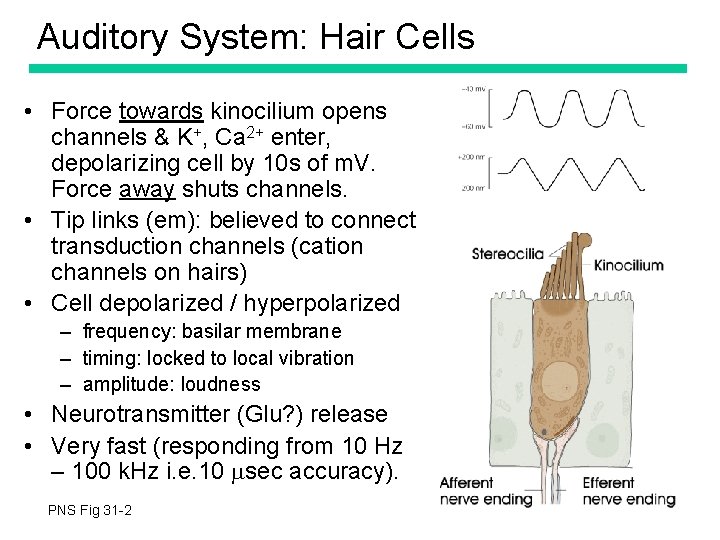
Auditory System: Hair Cells • Force towards kinocilium opens channels & K+, Ca 2+ enter, depolarizing cell by 10 s of m. V. Force away shuts channels. • Tip links (em): believed to connect transduction channels (cation channels on hairs) • Cell depolarized / hyperpolarized – frequency: basilar membrane – timing: locked to local vibration – amplitude: loudness • Neurotransmitter (Glu? ) release • Very fast (responding from 10 Hz – 100 k. Hz i. e. 10 msec accuracy). PNS Fig 31 -2
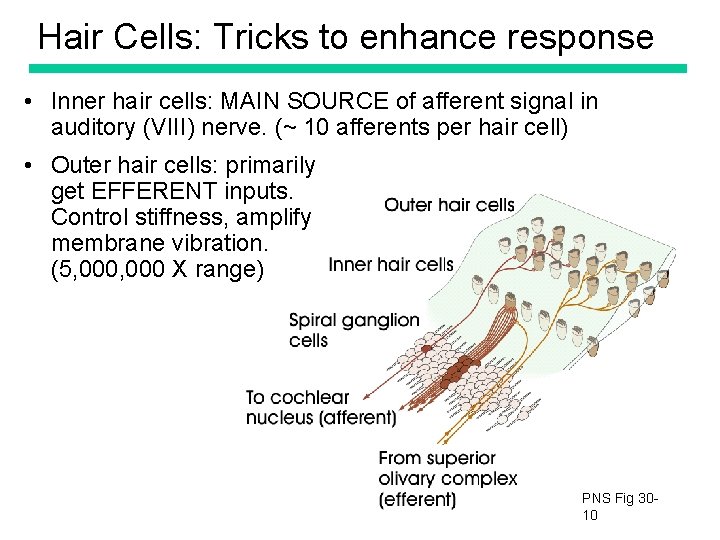
Hair Cells: Tricks to enhance response • Inner hair cells: MAIN SOURCE of afferent signal in auditory (VIII) nerve. (~ 10 afferents per hair cell) • Outer hair cells: primarily get EFFERENT inputs. Control stiffness, amplify membrane vibration. (5, 000 X range) PNS Fig 3010
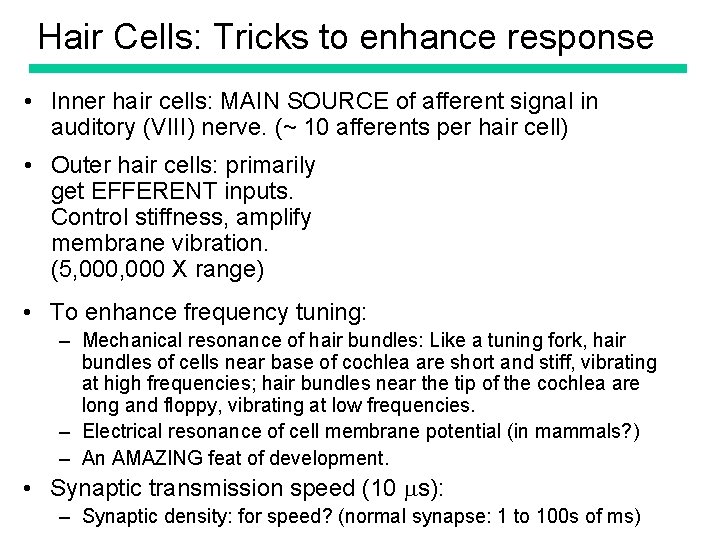
Hair Cells: Tricks to enhance response • Inner hair cells: MAIN SOURCE of afferent signal in auditory (VIII) nerve. (~ 10 afferents per hair cell) • Outer hair cells: primarily get EFFERENT inputs. Control stiffness, amplify membrane vibration. (5, 000 X range) • To enhance frequency tuning: – Mechanical resonance of hair bundles: Like a tuning fork, hair bundles of cells near base of cochlea are short and stiff, vibrating at high frequencies; hair bundles near the tip of the cochlea are long and floppy, vibrating at low frequencies. – Electrical resonance of cell membrane potential (in mammals? ) – An AMAZING feat of development. • Synaptic transmission speed (10 ms): – Synaptic density: for speed? (normal synapse: 1 to 100 s of ms)
Ear: a finely tuned machine Optimally engineered to: • pick up the very faint vibrations of sound & • extract perceptually relevant features – pitch – loudness – complex patterns – timing
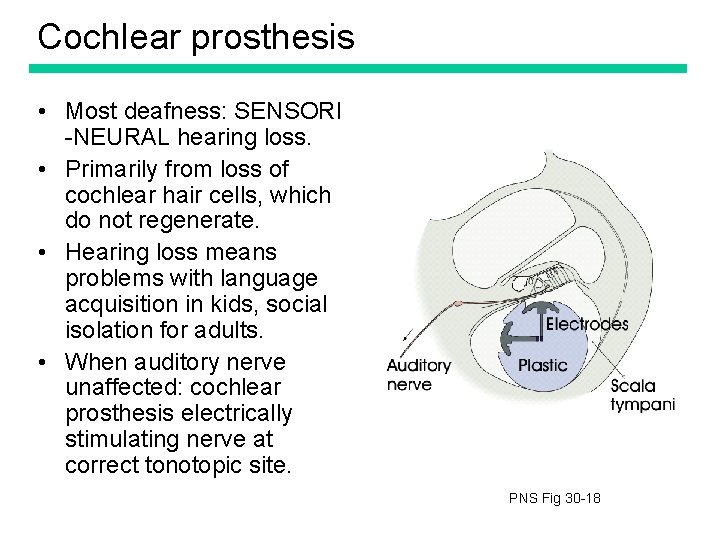
Cochlear prosthesis • Most deafness: SENSORI -NEURAL hearing loss. • Primarily from loss of cochlear hair cells, which do not regenerate. • Hearing loss means problems with language acquisition in kids, social isolation for adults. • When auditory nerve unaffected: cochlear prosthesis electrically stimulating nerve at correct tonotopic site. PNS Fig 30 -18
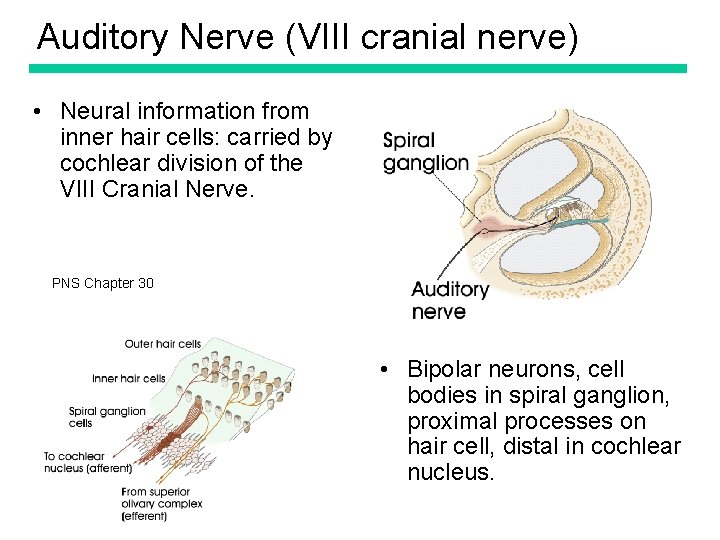
Auditory Nerve (VIII cranial nerve) • Neural information from inner hair cells: carried by cochlear division of the VIII Cranial Nerve. PNS Chapter 30 • Bipolar neurons, cell bodies in spiral ganglion, proximal processes on hair cell, distal in cochlear nucleus.
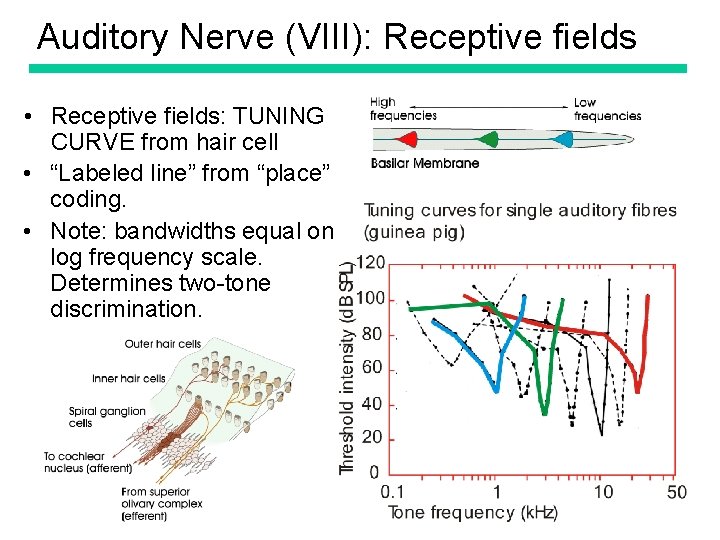
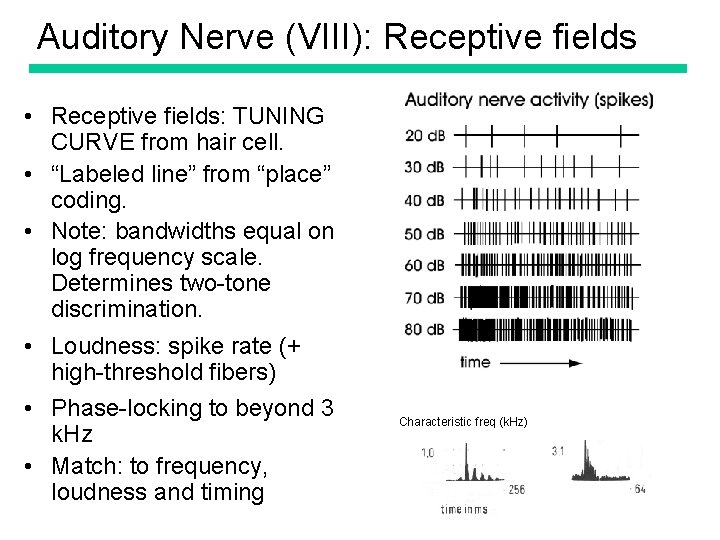
Auditory Nerve (VIII): Receptive fields • Receptive fields: TUNING CURVE from hair cell • “Labeled line” from “place” coding. • Note: bandwidths equal on log frequency scale. Determines two-tone discrimination.
Auditory Nerve (VIII): Receptive fields • Receptive fields: TUNING CURVE from hair cell. • “Labeled line” from “place” coding. • Note: bandwidths equal on log frequency scale. Determines two-tone discrimination. • Loudness: spike rate (+ high-threshold fibers) • Phase-locking to beyond 3 k. Hz • Match: to frequency, loudness and timing Characteristic freq (k. Hz)
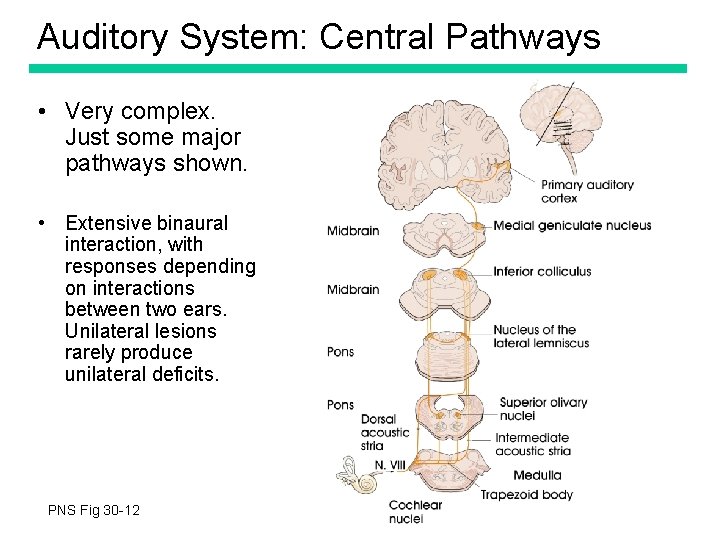
Auditory System: Central Pathways • Very complex. Just some major pathways shown. • Extensive binaural interaction, with responses depending on interactions between two ears. Unilateral lesions rarely produce unilateral deficits. PNS Fig 30 -12
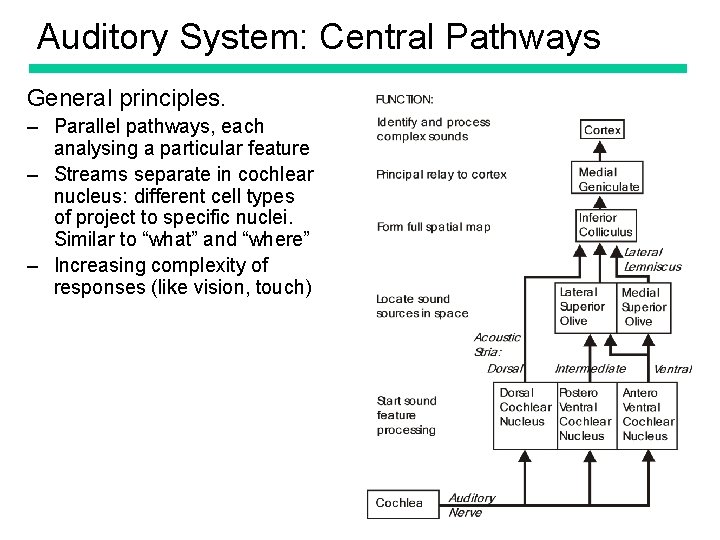
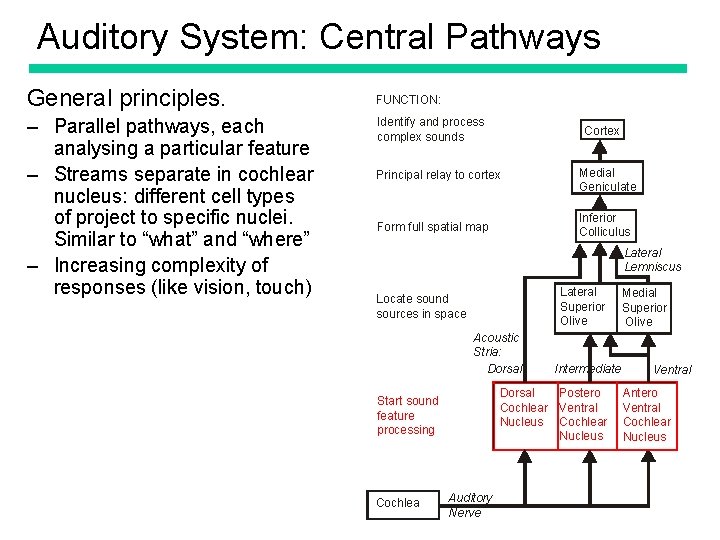
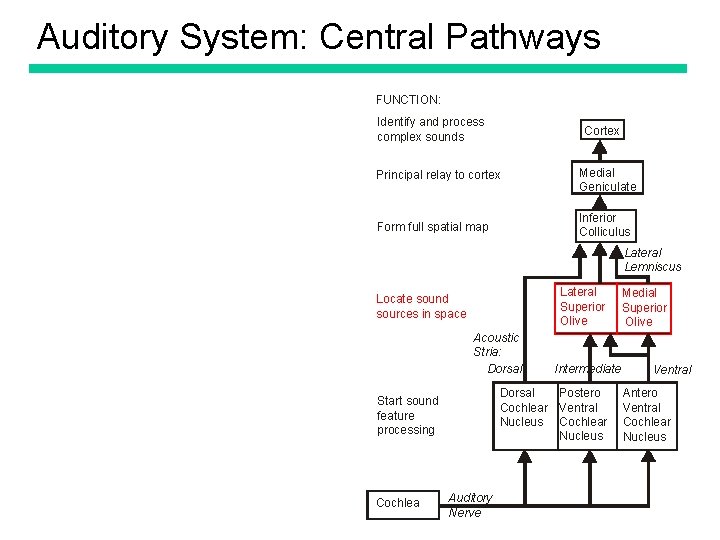
Auditory System: Central Pathways General principles. – Parallel pathways, each analysing a particular feature – Streams separate in cochlear nucleus: different cell types of project to specific nuclei. Similar to “what” and “where” – Increasing complexity of responses (like vision, touch)
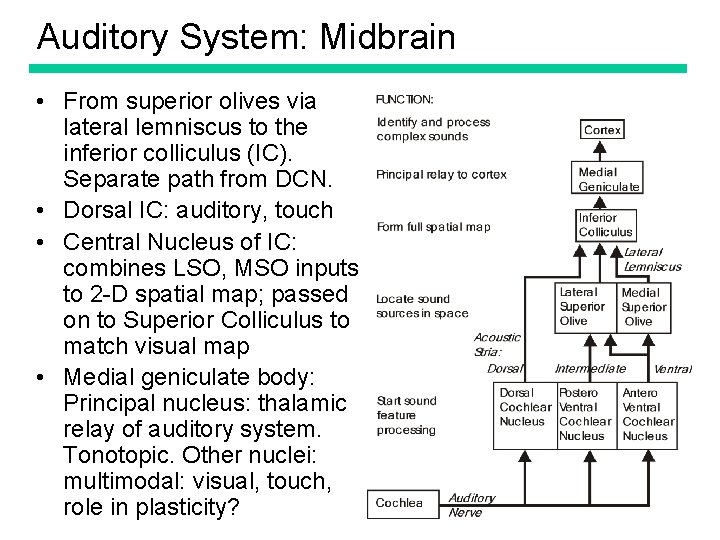
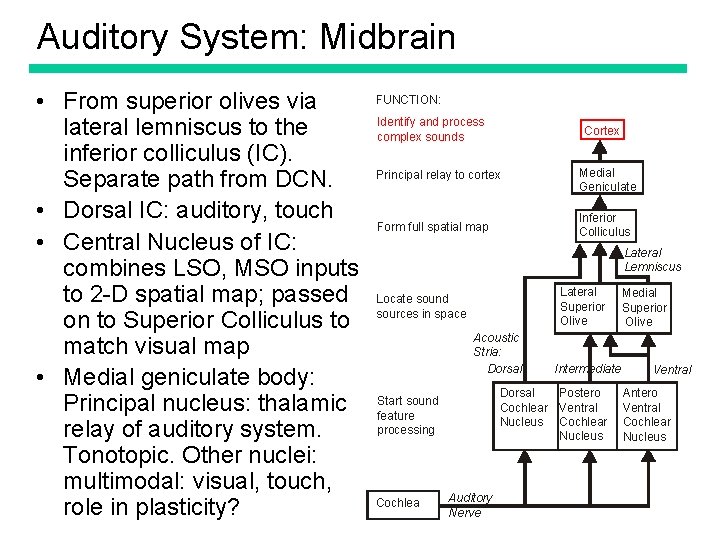
Auditory System: Central Pathways General principles. – Parallel pathways, each analysing a particular feature – Streams separate in cochlear nucleus: different cell types of project to specific nuclei. Similar to “what” and “where” – Increasing complexity of responses (like vision, touch) FUNCTION: Identify and process complex sounds Cortex Principal relay to cortex Medial Geniculate Form full spatial map Inferior Colliculus Lateral Lemniscus Lateral Superior Olive Locate sound sources in space Acoustic Stria: Dorsal Postero Cochlear Ventral Nucleus Cochlear Nucleus Start sound feature processing Cochlea Intermediate Auditory Nerve Medial Superior Olive Ventral Antero Ventral Cochlear Nucleus
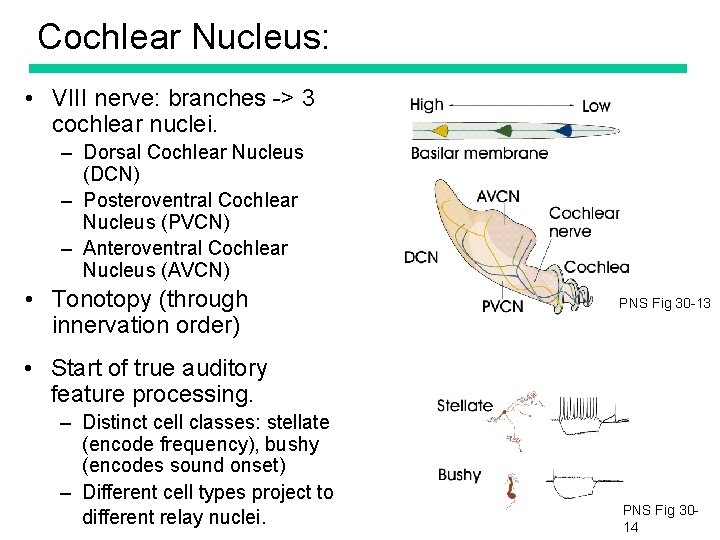
Cochlear Nucleus: • VIII nerve: branches -> 3 cochlear nuclei. – Dorsal Cochlear Nucleus (DCN) – Posteroventral Cochlear Nucleus (PVCN) – Anteroventral Cochlear Nucleus (AVCN) • Tonotopy (through innervation order) PNS Fig 30 -13 • Start of true auditory feature processing. – Distinct cell classes: stellate (encode frequency), bushy (encodes sound onset) – Different cell types project to different relay nuclei. PNS Fig 3014
Auditory System: Central Pathways FUNCTION: Identify and process complex sounds Cortex Principal relay to cortex Medial Geniculate Form full spatial map Inferior Colliculus Lateral Lemniscus Lateral Superior Olive Locate sound sources in space Acoustic Stria: Dorsal Postero Cochlear Ventral Nucleus Cochlear Nucleus Start sound feature processing Cochlea Intermediate Auditory Nerve Medial Superior Olive Ventral Antero Ventral Cochlear Nucleus
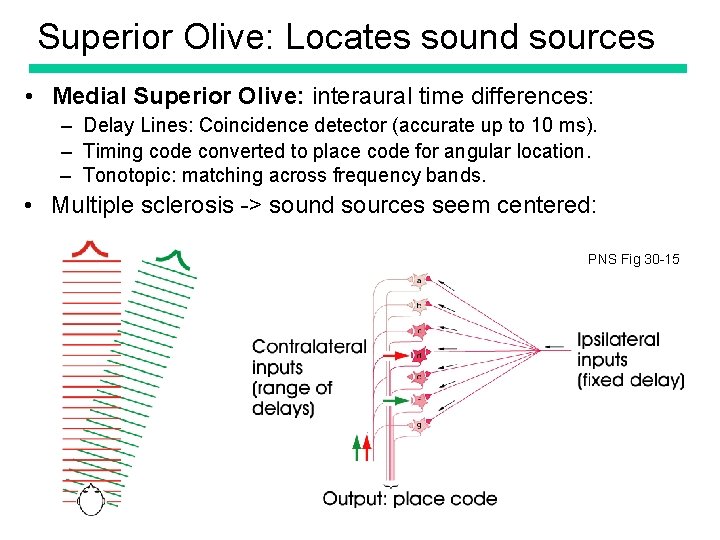
Superior Olive: Locates sound sources • Medial Superior Olive: interaural time differences: – Delay Lines: Coincidence detector (accurate up to 10 ms). – Timing code converted to place code for angular location. – Tonotopic: matching across frequency bands. • Multiple sclerosis -> sound sources seem centered: PNS Fig 30 -15
Superior Olive: locates sound sources • Lateral Superior Olive: interaural intensity differences. • Works best at high frequencies, the head casts a better shadow. • Again, organized tonotopically to match across frequencies. Principles of Neural Science, Chapter 30
Auditory System: Midbrain • From superior olives via lateral lemniscus to the inferior colliculus (IC). Separate path from DCN. • Dorsal IC: auditory, touch • Central Nucleus of IC: combines LSO, MSO inputs to 2 -D spatial map; passed on to Superior Colliculus to match visual map • Medial geniculate body: Principal nucleus: thalamic relay of auditory system. Tonotopic. Other nuclei: multimodal: visual, touch, role in plasticity?
Auditory System: Midbrain • From superior olives via lateral lemniscus to the inferior colliculus (IC). Separate path from DCN. • Dorsal IC: auditory, touch • Central Nucleus of IC: combines LSO, MSO inputs to 2 -D spatial map; passed on to Superior Colliculus to match visual map • Medial geniculate body: Principal nucleus: thalamic relay of auditory system. Tonotopic. Other nuclei: multimodal: visual, touch, role in plasticity? FUNCTION: Identify and process complex sounds Cortex Principal relay to cortex Medial Geniculate Form full spatial map Inferior Colliculus Lateral Lemniscus Lateral Superior Olive Locate sound sources in space Acoustic Stria: Dorsal Postero Cochlear Ventral Nucleus Cochlear Nucleus Start sound feature processing Cochlea Intermediate Auditory Nerve Medial Superior Olive Ventral Antero Ventral Cochlear Nucleus
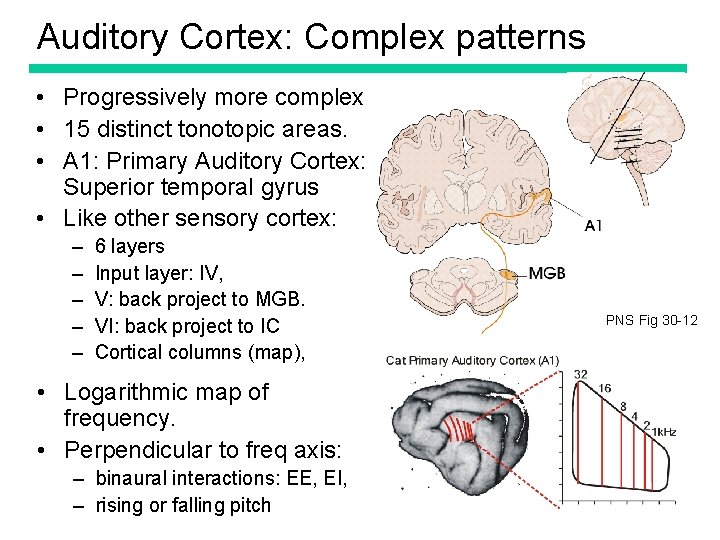
Auditory Cortex: Complex patterns • Progressively more complex • 15 distinct tonotopic areas. • A 1: Primary Auditory Cortex: Superior temporal gyrus • Like other sensory cortex: – – – 6 layers Input layer: IV, V: back project to MGB. VI: back project to IC Cortical columns (map), • Logarithmic map of frequency. • Perpendicular to freq axis: – binaural interactions: EE, EI, – rising or falling pitch PNS Fig 30 -12
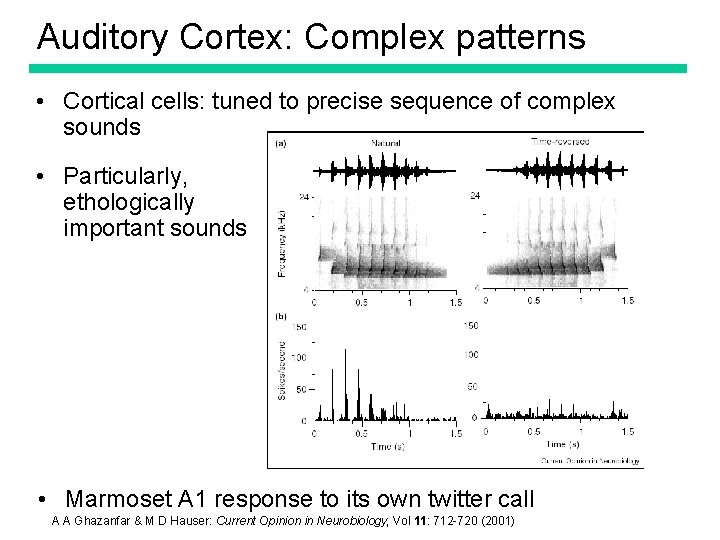
Auditory Cortex: Complex patterns • Cortical cells: tuned to precise sequence of complex sounds • Particularly, ethologically important sounds • Marmoset A 1 response to its own twitter call A A Ghazanfar & M D Hauser: Current Opinion in Neurobiology, Vol 11: 712 -720 (2001)
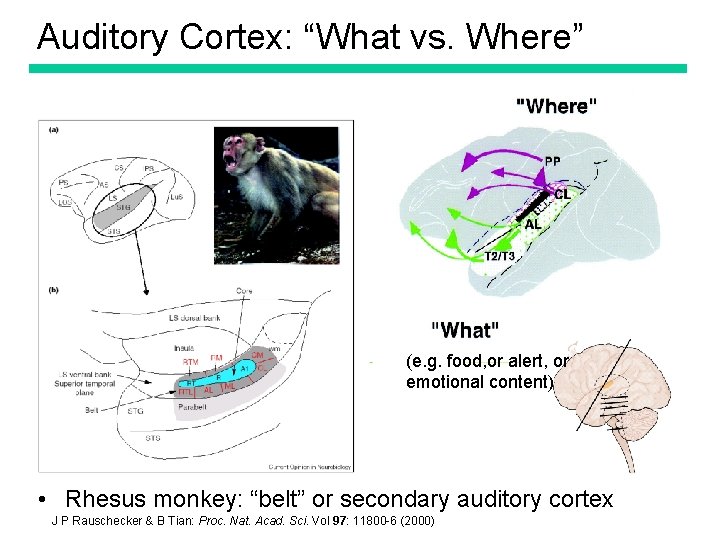
Auditory Cortex: “What vs. Where” (e. g. food, or alert, or emotional content) • Rhesus monkey: “belt” or secondary auditory cortex J P Rauschecker & B Tian: Proc. Nat. Acad. Sci. Vol 97: 11800 -6 (2000)
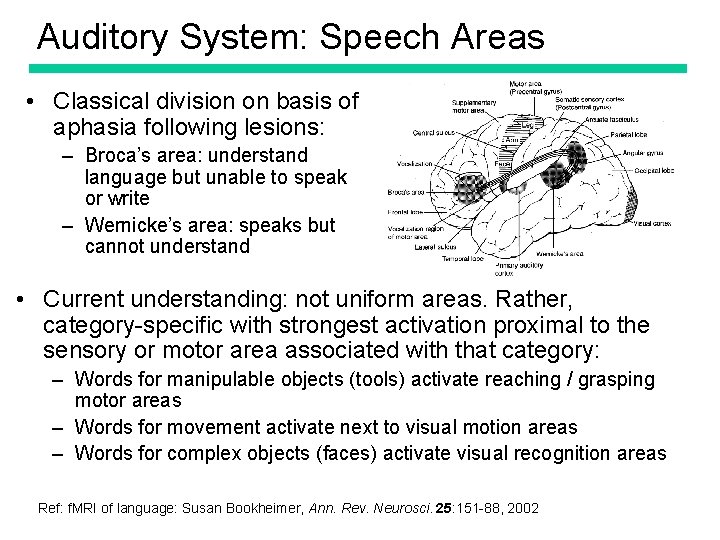
Auditory System: Speech Areas • Classical division on basis of aphasia following lesions: – Broca’s area: understand language but unable to speak or write – Wernicke’s area: speaks but cannot understand • Current understanding: not uniform areas. Rather, category-specific with strongest activation proximal to the sensory or motor area associated with that category: – Words for manipulable objects (tools) activate reaching / grasping motor areas – Words for movement activate next to visual motion areas – Words for complex objects (faces) activate visual recognition areas Ref: f. MRI of language: Susan Bookheimer, Ann. Rev. Neurosci. 25: 151 -88, 2002
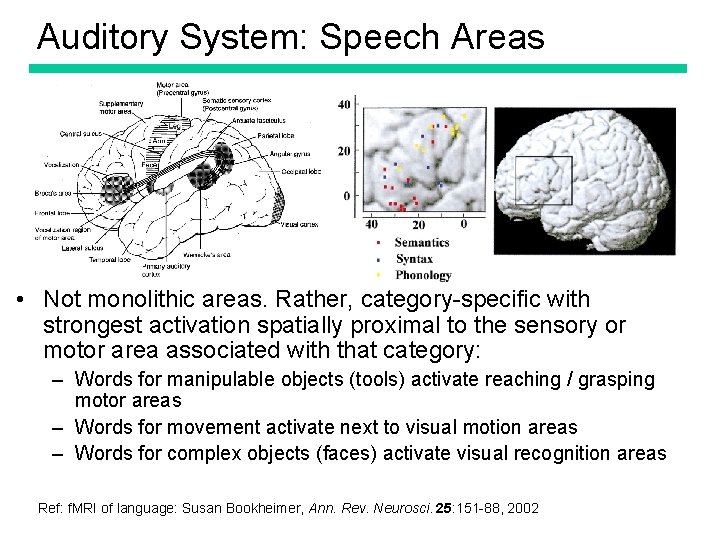
Auditory System: Speech Areas • Not monolithic areas. Rather, category-specific with strongest activation spatially proximal to the sensory or motor area associated with that category: – Words for manipulable objects (tools) activate reaching / grasping motor areas – Words for movement activate next to visual motion areas – Words for complex objects (faces) activate visual recognition areas Ref: f. MRI of language: Susan Bookheimer, Ann. Rev. Neurosci. 25: 151 -88, 2002
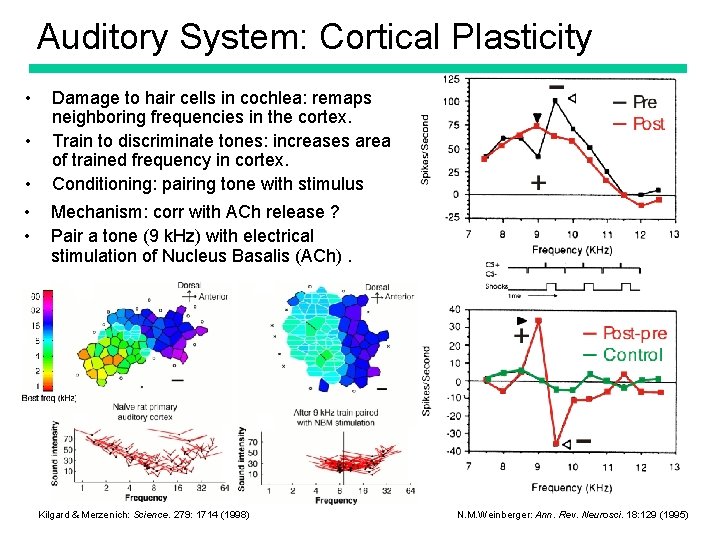
Auditory System: Cortical Plasticity • • • Damage to hair cells in cochlea: remaps neighboring frequencies in the cortex. Train to discriminate tones: increases area of trained frequency in cortex. Conditioning: pairing tone with stimulus Mechanism: corr with ACh release ? Pair a tone (9 k. Hz) with electrical stimulation of Nucleus Basalis (ACh). Kilgard & Merzenich: Science. 279: 1714 (1998) N. M. Weinberger: Ann. Rev. Neurosci. 18: 129 (1995)
Auditory System: Recapitulation: • Sound: Physics, Perception – Characterizing: Frequency (pitch), Loudness – Timing (sound source location; discriminating complex sounds) – Weber-Fechner law: perceptions are logarithmic; just noticeable differences are proportional to the value (of loudness or pitch) • Pathway: cochlea – brainstem – cortex – – Ear: finely engineered to pick up sound Parallel processing of pitch, loudness, timing, (complex sounds) Higher along pathway -> more complex processing. “Physiology explains perception”: receptive fields, tuning curves, place coding for pitch, loudness, sound source location. Similar to sensory systems of vision, touch • f. MRI of language processing • Plasticity (sensory experience or external manipulation).