
Auditory Perception 3 Linear Systems and their Transfer


- Slides: 10
Auditory Perception: 3: Linear Systems and their Transfer Characteristics
Signals en Systems: To understand why the auditory system represents sounds in the way it does, we need to cover some elementary background of signal analysis: - representation in the time domain (impulses) - representation in the frequency domain (sines, Fourier) and of linear systems analysis Mathematical concept for today: - the relation between impulse response (time domain) and transfer characteristic (frequency domain): Fourier
Remember: Consequence of the Superposition Principle: the CONVOLUTION INTEGRAL:
HERE IS THE LINK WITH THE FIRST LECTURE: Convolution analysis of a Linear System is performed in the TIME DOMAIN, in which signals are expressed by the IMPULSE FUNCTION and the associated IMPULSE RESPONSE However, just like Signal Analysis, also Linear Systems analysis can be performed in the FREQUENCY DOMAIN In that case, signals are represented by sine waves, and the system response is described by SINE-WAVE RESPONSES!
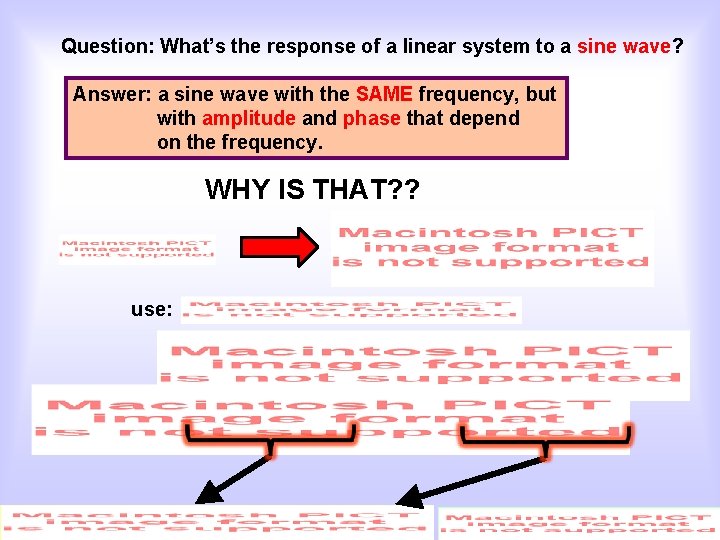
Question: What’s the response of a linear system to a sine wave? Answer: a sine wave with the SAME frequency, but with amplitude and phase that depend on the frequency. WHY IS THAT? ? use:
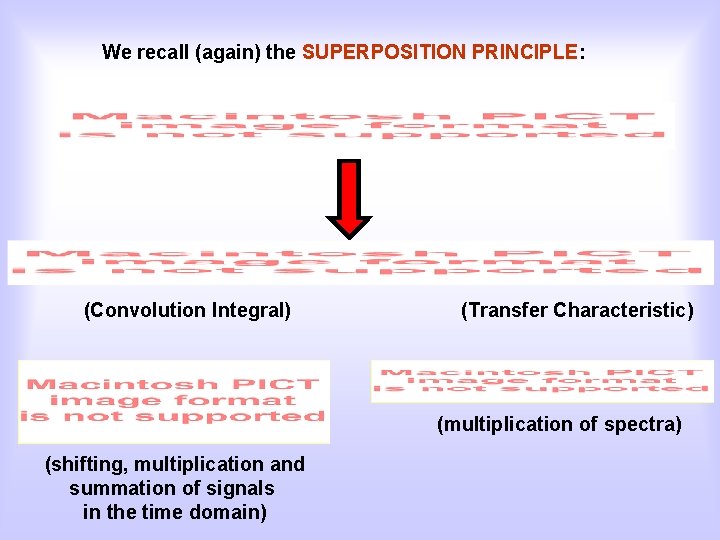
We recall (again) the SUPERPOSITION PRINCIPLE: (Convolution Integral) (Transfer Characteristic) (multiplication of spectra) (shifting, multiplication and summation of signals in the time domain)
Representation of the Linear System in the FREQUENCY DOMAIN: The TRANSFER CHARACTERISTIC Consists of: • AMPLITUDE CHARACTERISTIC • PHASE CHARACTERISTIC The Amplitude Characteristic describes how the amplitude of each sine wave varies with frequency The Phase Characteristic describes how the phase of each sine wave varies with frequency
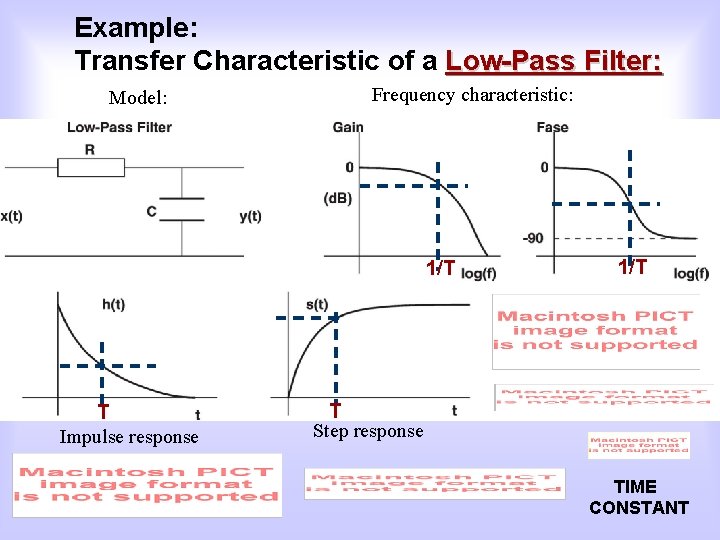
Example: Transfer Characteristic of a Low-Pass Filter: Model: Frequency characteristic: 1/T T Impulse response 1/T T Step response TIME CONSTANT
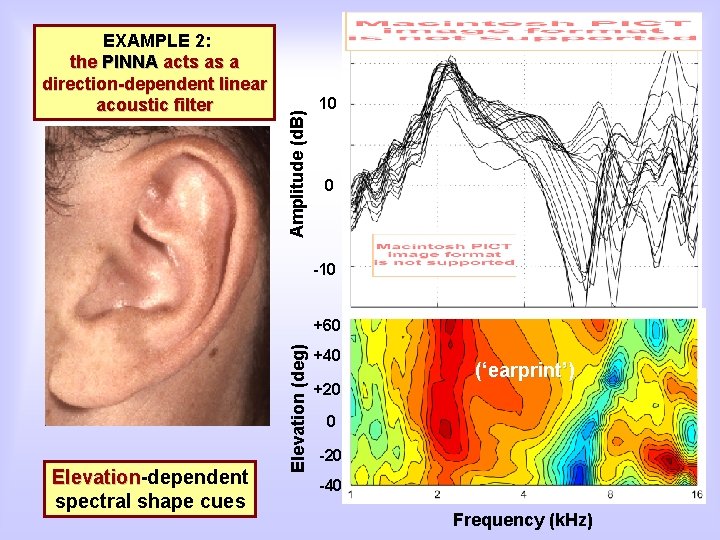
Amplitude (d. B) EXAMPLE 2: the PINNA acts as a direction-dependent linear acoustic filter 10 0 -10 Elevation-dependent Elevation spectral shape cues Elevation (deg) +60 +40 +20 (‘earprint’) 0 -20 -40 Frequency (k. Hz)
End third lecture