
Auditory and vestibular system Sensory organs on the
Auditory and vestibular system
Sensory organs on the inner ear • inner ear: audition (exteroceptor) and vestibular apparatus (proprioceptor) • bony and membranous labyrinths within the temporal bone (os temporale) • both sensory organs contain hair cells: secondary receptor cells • these sensory systems are related evolutionary with the lateral-line organ (fish, amphibians) – acousticolateral organ • structure of hair cells is similar everywhere • hair cells are flanked by supporting cells – tight junctions: perilymph and endolymph separated • perilymph: extracellular space, high Na+, low K+ • endolymph: transcellular fluid, high K+, low Na+ • endolymph is positive compared to perilymph – 150 m. V compared to the intracellular space • at the tip of the stereocilia mechanosensitive K+ channels, 10 -15% open - 90 Hz firing rate on primary axons – changes depend on direction of 2/14 bending
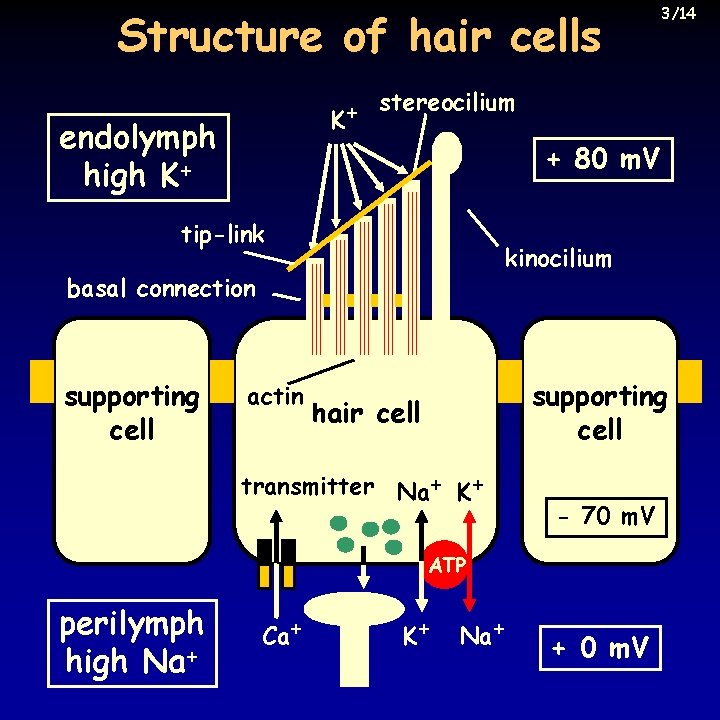
Structure of hair cells stereocilium + K endolymph high K+ + 80 m. V tip-link kinocilium basal connection supporting cell actin supporting cell hair cell transmitter Na+ K+ - 70 m. V ATP perilymph high Na+ 3/14 Ca+ K+ Na+ + 0 m. V
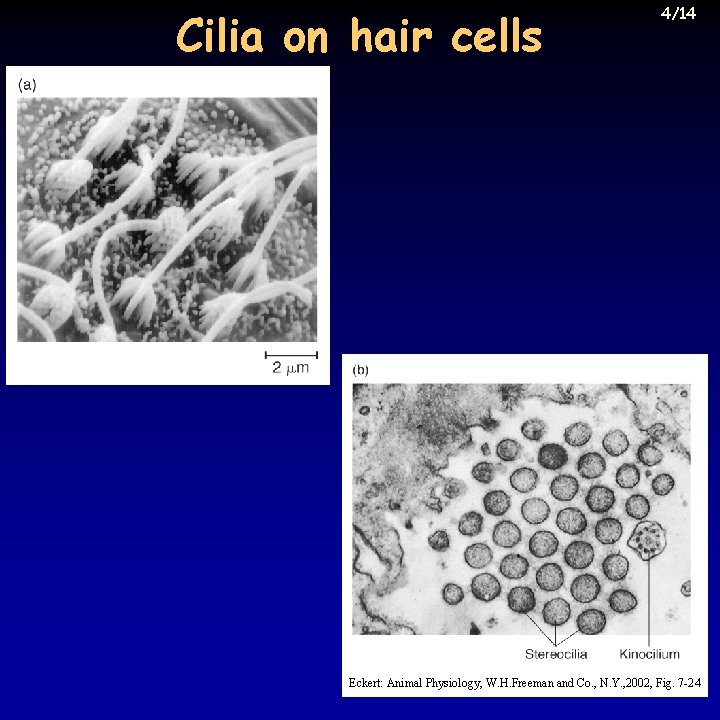
Cilia on hair cells 4/14 Eckert: Animal Physiology, W. H. Freeman and Co. , N. Y. , 2002, Fig. 7 -24

Vestibular system I. 5/14 • vestibular apparatus consists of two parts: – 3 semicircular canals – detect angular acceleration – otolith organs (utriculus, sacculus) – detect position of the head, linear acceleration • semicircular canals are approximately perpendicular to each other • horizontal one is tilted downwards by 25°, the two vertical ones have an angle of 41° and 56°, respectively with the sagittal plane • sensory epithelium with the hair cells is called crista ampullaris, it is located at one end of the canal in the ampulla • hair cells are covered by the cupula that almost blocks the flow of the endolymph • lateral-line organ works similarly • kinocilia are uniformly oriented in the crista • semicircular canals are in pairs within the same plane - complementary pairs – when one is excited, the other is inhibited

Vestibular system II. 6/14 • hair cells are located in maculas within the utriculus and sacculus • macula is horizontal in the utriculus, while it is vertical in the sacculus • hair cells are covered by otolith membrane containing otoliths (calcium carbonate) • kinocilia in maculas (maculae) are oriented with respect to an undulating line, the striola • any position of the head causes a specific firing pattern in the primary afferents • linear acceleration (lift) is also detected because of the inertia of the otoliths • primary sensory neurons are located in the ganglia vestibulare • central axons run to the four vestibular nuclei in the brainstem
Vestibular centers 7/14 • Deiters’ nucleus (nucl. vestibularis lateralis) – strong, tonic excitatory effect on spinal motor neurons – tractus vestibulospinalis lateralis – crucial for the maintenance of straight posture – opposite effects: cerebellar inhibition on Deiters’ nucleus, cortical (in tetrapods rubral) inhibition on spinal motor neurons – decerebration rigidity • nucl. vestibularis medialis – brief, short lasting input from semicircular canals – control of neck muscles • nucl. vestibularis superior – similar input – control of eye movements • nucl. vestibularis inferior – less known, it integrates inputs with cerebellar information and provides ascending pathways
Audition 8/14 • ear is one of the most important telereceptive organ – vision is limited by darkness, olfaction depends on the direction of the wind • audition is functioning even during sleep – weak sounds made by the baby awake the mother • audition is very important for communication too • sounds are longitudinal waves • human ear is sensitive to sounds between 20 Hz and 20 k. Hz, some animals hear ultrasounds (rat after coitus); infrasound is annoying • intensity in given as the logarithm of the ratio to a reference value (20 μPa – threshold at 2 k. Hz) because the range of intensities is wide • in practice tenth of Bel, decibel (d. B) is used, thus the logarithm should be multiplied by 10 • if voltage or current is used, then the second power of these values should be entered in the equation – that’s why we use 20 and not 10 in the equation

The organ of audition 9/14 • human ear consists of 3 parts: external, middle and inner ear • external ear: – pinna (can be moved in some animals) – auditory canal – tympanic membrane – closing external ear • middle ear: – ossicles (malleus, incus, stapes) – 22 -fold increase in pressure because the different surface size and the lever system – Eustachian tube to the pharynx – equalization of pressure in the external and middle ears (flying, yawning, candy) • inner ear: – bony and membranous labyrinth with three canals – scala media (ductus cochlearis) surrounded by membrana basilaris (with the organ of Corti) and Reissner’s membrane – above: scala vestibuli, below: scala tympani
Mechanism of audition I. 10/14 • ossicles forward sound stimuli to the perilymph (scala vestibuli) through fenestra ovale • cochlea has 2, 5 turns – sound waves reach the top of the cochlea, then return through scala tympani to fenestra rotunda • total length of the cochlea is about 32 -33 mm • sound waves also reach inner ear by bone conduction – it is less important, except when listening to our own sound record, or when middle ear is damaged and hearing aid is needed • the site of maximal oscillation of the membrana basilaris depends on frequency – tonotopy • movement of membrana basilaris stimulates hair cells • membrana basilaris is narrow and tight at the base (100μ), and wide and loose at the top (500μ) • Helmholtz suggested, György Békésy proved that high pitch tones are detected at the base, low pitch tones at the top of the cochlea
Mechanism of audition II. 11/14 • function of inner and outer hair cells is different • inner hair cells – sensation, outer hair cells setting sensitivity • activation induces shortening of outer hair cells due to activation of their cytoskeleton – amplitude of maximal oscillation increases • threshold of inner hair cells is higher, it reaches normal detection limit only due to amplification • noise-induced hearing loss: (Walkman), and certain medicines (streptomycin) destroy outer hair cells • sterocilia are also shorter and tighter at the base of the cochlea – contributes to tonotopy • outer hair cells reach tectorial membrane, inner ones not – turbulently flowing perilymph stimulates them
Mechanism of audition III. 12/14 • mechanosensitive channels of stereocilia respond with time resolution in the μs range – K+ enters, because of the 150 m. V potential difference • depolarization causes Ca++ influx – shape change in outer hair cells, increased glutamate (? ) release in inner hair cells • primary sensory neurons are located in the ganglion spirale – 1 hair cell 10 afferents, 1 afferent – 1 hair cell • there approx. 3500 -3500 hair cells, i. e. 60 -70000 afferents on the two sides together • afferents cannot follow 20 k. Hz frequency, spikes appear phase-locked • intensity is coded partly in frequency, partly in the number of cells activated (population code) depending on recruitment of neighboring and high -threshold hair cells • sensitivity is set by the lateral (inner hair cells and primary dendrites) and medial (outer hair cells) olivocochlear bundle

Central auditory pathway I. 13/14 • onset and termination of sounds, location of the source, and stimulus pattern should be analyzed by the central apparatus • anatomy is known, physiology is less well • general characteristics: parallel ascending fibers, two-directional connections, tonotopy • first relay stations are the cochlear nuclei (anteroventral, posteroventral and dorsal) – strictly ipsilateral • deafness restricted to one side is either because of damage to this nuclei or disruption at the periphery • primary afferents related to one hair cell (approx. 10 axons) terminate in one layer • fibers originating in these nuclei, join ipsi- and contralateral lemniscus lateralis and go to inferior colliculus, or reach superior olivary nucleus – second relay station
14/14 Central auditory pathway II. • oliva receives bilateral projection, it localizes sound source – based on differences in phase [below 2 k. Hz], or in intensity [above 2 k. Hz] • 1° difference in direction can be detected • fibers from oliva join lemniscus lateralis and run to the third relay station, inferior colliculus • inferior colliculus is also important in detection of sound direction – e. g. owls • output to non-auditory areas as well • fourth station is corpus geniculatum mediale (medial geniculate body) – tonotopic representation, input from other sensory areas as well • the end station is the primary auditory cortex, Br. 41 -42 in the temporal lobe – several areas arranged in a tonotopic way

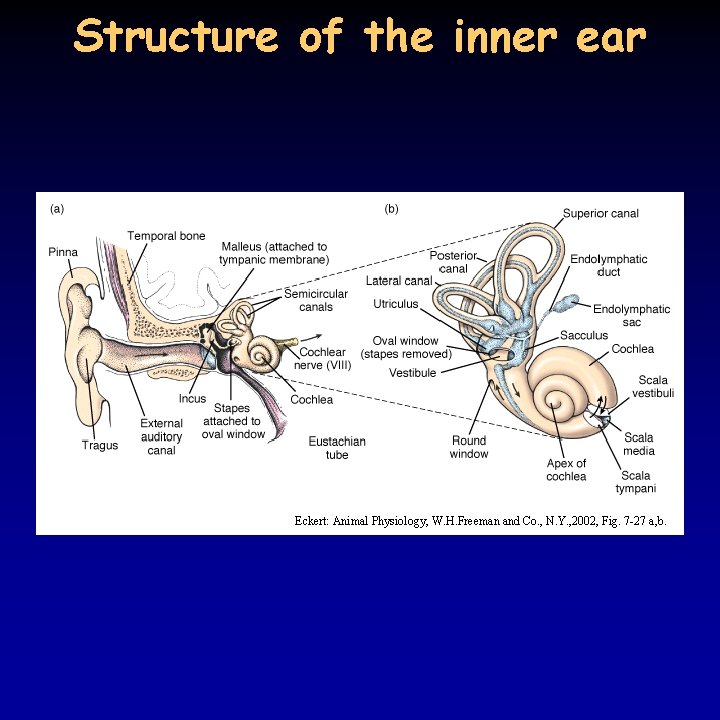
Structure of the inner ear Eckert: Animal Physiology, W. H. Freeman and Co. , N. Y. , 2002, Fig. 7 -27 a, b.
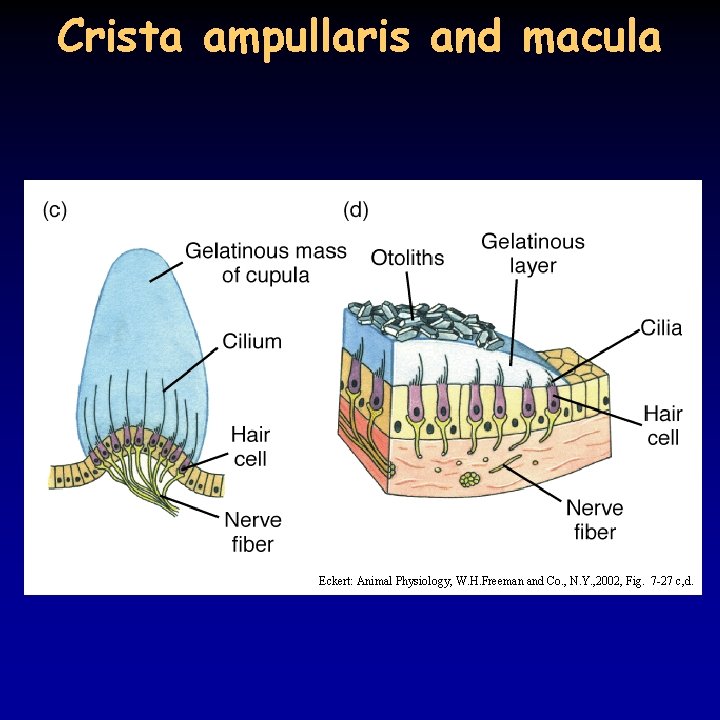
Crista ampullaris and macula Eckert: Animal Physiology, W. H. Freeman and Co. , N. Y. , 2002, Fig. 7 -27 c, d.

The lateral-line system Eckert: Animal Physiology, W. H. Freeman and Co. , N. Y. , 2002, Fig. 7 -25
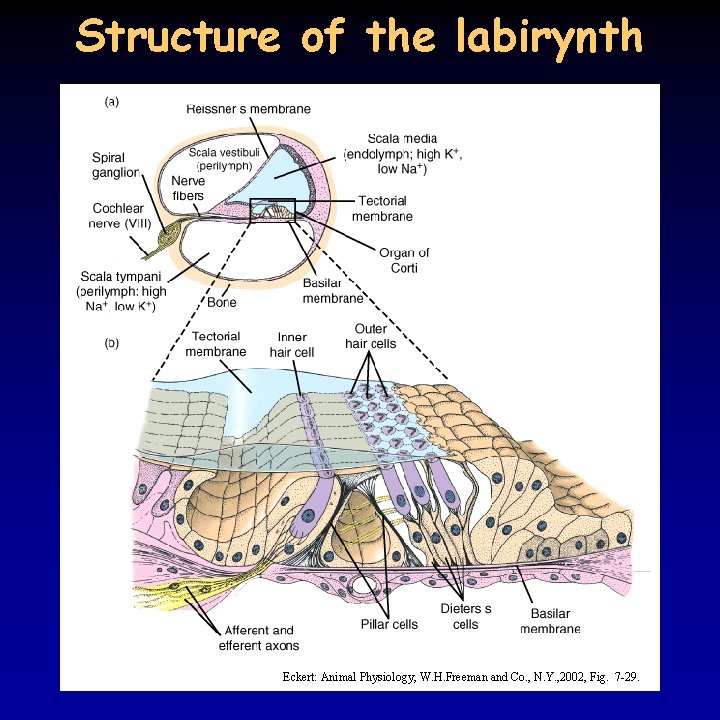
Structure of the labirynth Eckert: Animal Physiology, W. H. Freeman and Co. , N. Y. , 2002, Fig. 7 -29.
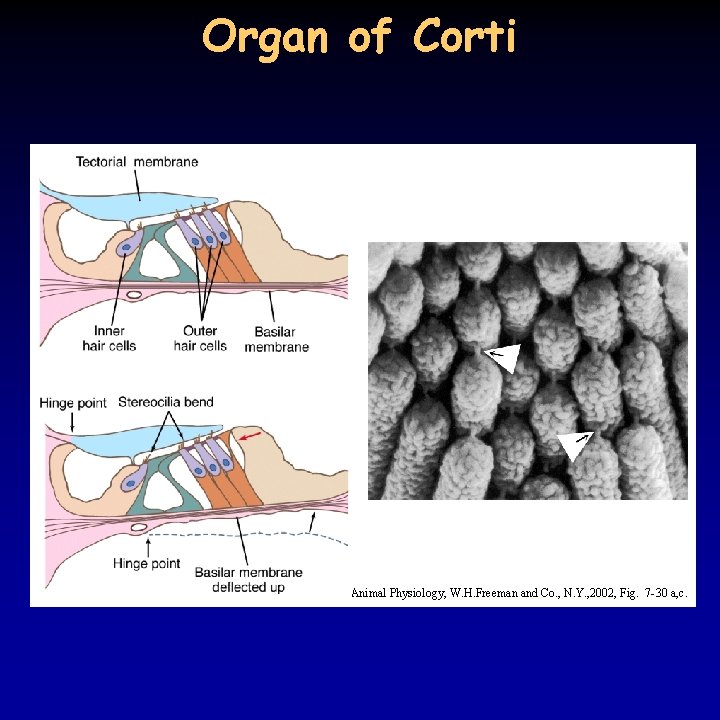
Organ of Corti Eckert: Animal Physiology, W. H. Freeman and Co. , N. Y. , 2002, Fig. 7 -30 a, c.
- Slides: 20