
Auditors Appointment Presentation By Shabbir Yunus Khairullah Partner

Auditor’s Appointment Presentation By: Shabbir Yunus Khairullah, Partner Mazars Pakistan

CONTENTS 1. PROFESSIONAL APPOINTMENTS 2. COMMUNICATION OF NEW AUDITOR WITH PREVIOUS AUDITOR 3. AUDIT FEES AND UNDERCUTTING 4. MARKETING AND ADVERTISEMENT REQUIREMENTS 5. REQUIREMENTS OF COMPANIES ACT, 2017
ICAP CODE OF ETHICS - INTRODUCTION 1. ICAP REVISED ITS CODE OF ETHICS IN 2019. 2. THE "CODE OF ETHICS FOR CHARTERED ACCOUNTANTS (REVISED 2019)" IS BASED ON THE HANDBOOK OF THE INTERNATIONAL CODE OF ETHICS FOR PROFESSIONAL ACCOUNTANTS, 2018 EDITION OF THE INTERNATIONAL ETHICS STANDARDS BOARD FOR ACCOUNTANTS (IESBA), PUBLISHED BY THE INTERNATIONAL FEDERATION OF ACCOUNTANTS (IFAC) IN JULY 2018 AND IS USED WITH PERMISSION OF IFAC.

Section 01: Professional Appointments ICAP Code Of Ethics - Section 320
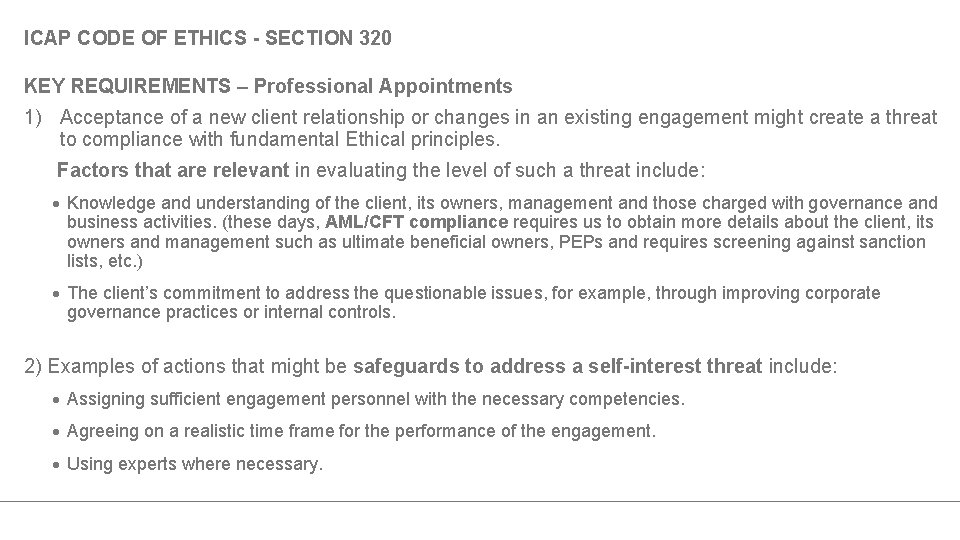
ICAP CODE OF ETHICS - SECTION 320 KEY REQUIREMENTS – Professional Appointments 1) Acceptance of a new client relationship or changes in an existing engagement might create a threat to compliance with fundamental Ethical principles. Factors that are relevant in evaluating the level of such a threat include: Knowledge and understanding of the client, its owners, management and those charged with governance and business activities. (these days, AML/CFT compliance requires us to obtain more details about the client, its owners and management such as ultimate beneficial owners, PEPs and requires screening against sanction lists, etc. ) The client’s commitment to address the questionable issues, for example, through improving corporate governance practices or internal controls. 2) Examples of actions that might be safeguards to address a self-interest threat include: Assigning sufficient engagement personnel with the necessary competencies. Agreeing on a realistic time frame for the performance of the engagement. Using experts where necessary.
Section 02: Communication of new auditor with previous auditor ICAP Code Of Ethics - Section 320
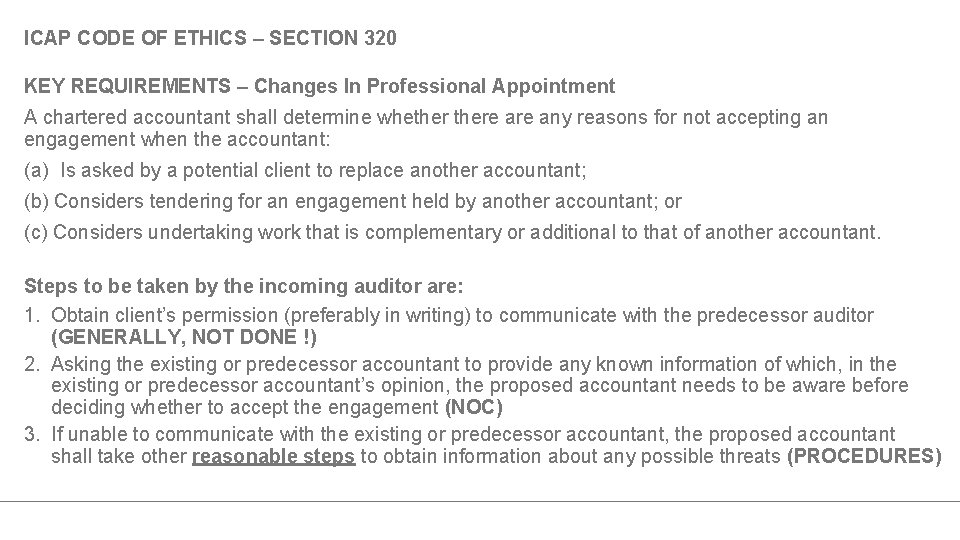
ICAP CODE OF ETHICS – SECTION 320 KEY REQUIREMENTS – Changes In Professional Appointment A chartered accountant shall determine whethere any reasons for not accepting an engagement when the accountant: (a) Is asked by a potential client to replace another accountant; (b) Considers tendering for an engagement held by another accountant; or (c) Considers undertaking work that is complementary or additional to that of another accountant. Steps to be taken by the incoming auditor are: 1. Obtain client’s permission (preferably in writing) to communicate with the predecessor auditor (GENERALLY, NOT DONE !) 2. Asking the existing or predecessor accountant to provide any known information of which, in the existing or predecessor accountant’s opinion, the proposed accountant needs to be aware before deciding whether to accept the engagement (NOC) 3. If unable to communicate with the existing or predecessor accountant, the proposed accountant shall take other reasonable steps to obtain information about any possible threats (PROCEDURES)
ICAP CODE OF ETHICS – SECTION 320 KEY REQUIREMENTS – Changes In Professional Appointment There is no guidance in the current Code for “Reasonable steps” to be taken by the incoming auditor in case he is unable to communicate with the predecessor auditor. As per the Code of 2015, “Reasonable steps” include: a) inquiries of third parties or b) background investigations of senior management or those charged with governance of the client.
ICAP CODE OF ETHICS – SECTION 320 Ethical responsibility of previous auditor: • He/she should provide any information honestly and unambiguously and comply with relevant laws and regulations governing the request. (R 320. 7) • An existing or previous auditor is bound by confidentiality. If the client fails or refuses to grant the existing or predecessor accountant permission to discuss the client’s affairs with the proposed accountant, the previous auditor shall disclose this fact to the incoming auditor, who shall carefully consider such failure or refusal when determining whether to accept the appointment. (R 320. 8)
ICAP CODE OF ETHICS – SECTION 320 Misconducts as per Part 1, Schedule I of the CA Ordinance, 1961: (7) Accepts a position as auditor previously held by another member of the Institute without first communicating with him in writing; (8) accepts appointments as auditor of a company without first ascertaining from it whether the requirements of sub-section (6) of section 144 of the Companies Act, 1913 (VII of 1913), in respect of such appointment have been duly complied with;
Section 03: Audit Fees And Undercutting ICAP Code Of Ethics - Section 330
ICAP CODE OF ETHICS – SECTION 330 1) UNDERCUTTING IS PROHOBITED Chartered accountants in practice should be careful not to quote fee lower than that charged by the chartered accountants in practice previously carrying out the audit unless: scope and quantum of work materially differs from the scope and quantum of work carried out by the previous auditor As per CA Ordinance, undercutting also results in a professional misconduct by a chartered accountant in practice (clause 11) 2) AUDIT FEE OF EXISTING AUDITOR IS OUTSTANDING (refer ATR 16) The appointment as auditor of an entity should not be accepted if undisputed audit fee of another Chartered Accountant is pending. “Undisputed audit fee” means the amount which has been agreed to and provided for in the financial statements.
ICAP CODE OF ETHICS – SECTION 330 3) MORE THAN ONE YEAR’S BOOKS TO BE AUDITED If no AGM takes place and accounts are not approved nor audited, the auditors would be appointed by the SECP on request made by the Company and their remuneration should be also fixed by SECP. The retiring auditors cannot continue to do the audit. The auditor so appointed can audit more than one year’s accounts during their period in the office. PECULIAR CIRCUMSTANCES - Public sector bidding or Tendering - What if the external audit shifts from a large audit firm to a small audit firm? .
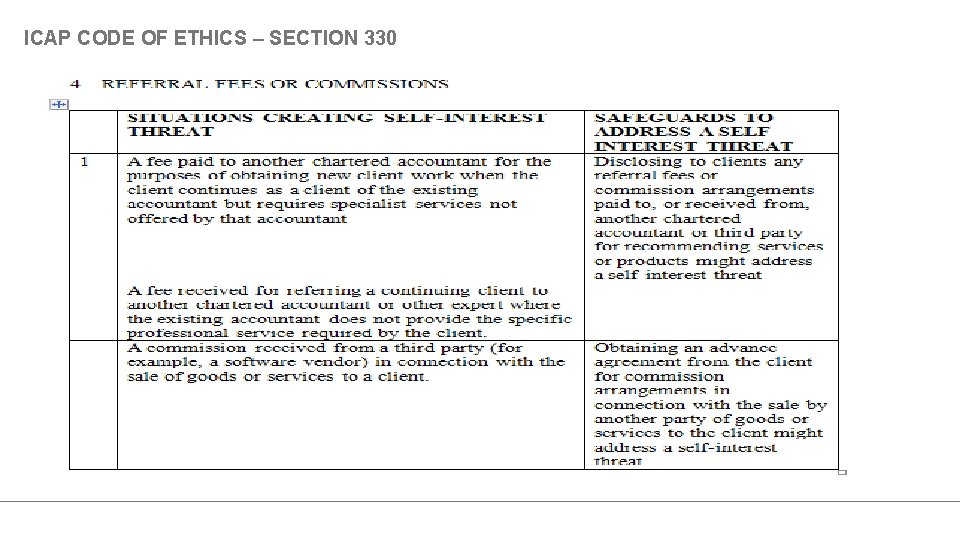
ICAP CODE OF ETHICS – SECTION 330
ICAP CODE OF ETHICS – SECTION 330 Misconducts as per Part 1, Schedule I of the CA Ordinance, 1961: (2) pays or allows or agrees to pay or allow, directly or indirectly, any share, commission or brokerage or the fees or profits of his professional business to any person other than a member of the Institute or a partner or a retired partner or the legal representative of a deceased partner. Explanation: - In this clause, "partner" includes a person residing outside Pakistan with whom a Chartered Accountant in practice has entered into partnership which is not in contravention of clause (4) of this part; (3) accepts or agrees to accept any part of the profits of the professional work of a lawyer, auctioneer, broker, or other agent who is not a member of the Institute. (9) charges or offers to charge, accepts or offers to accept in respect of any professional employment fees which are based on a percentage of profits or which are contingent upon the findings or results of such employment except in cases which are permitted under any law for the time being in force or by an order of the Government;

Section 04: Marketing and Advertisement requirements ICAP Code of Ethics - Section 370
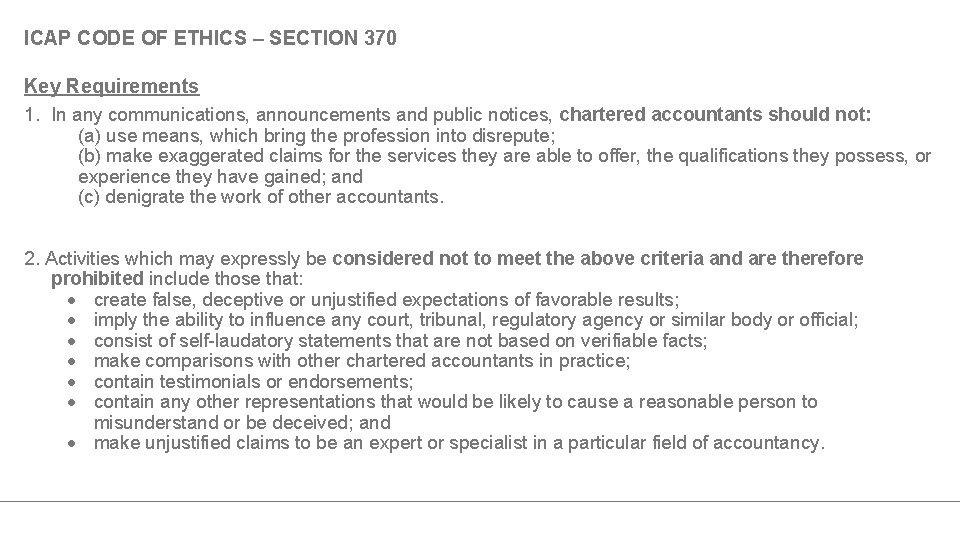
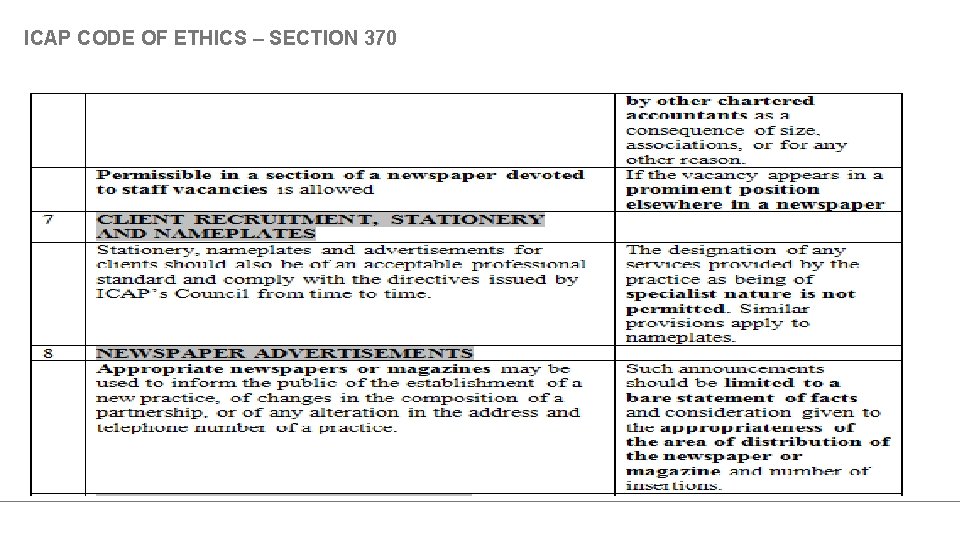
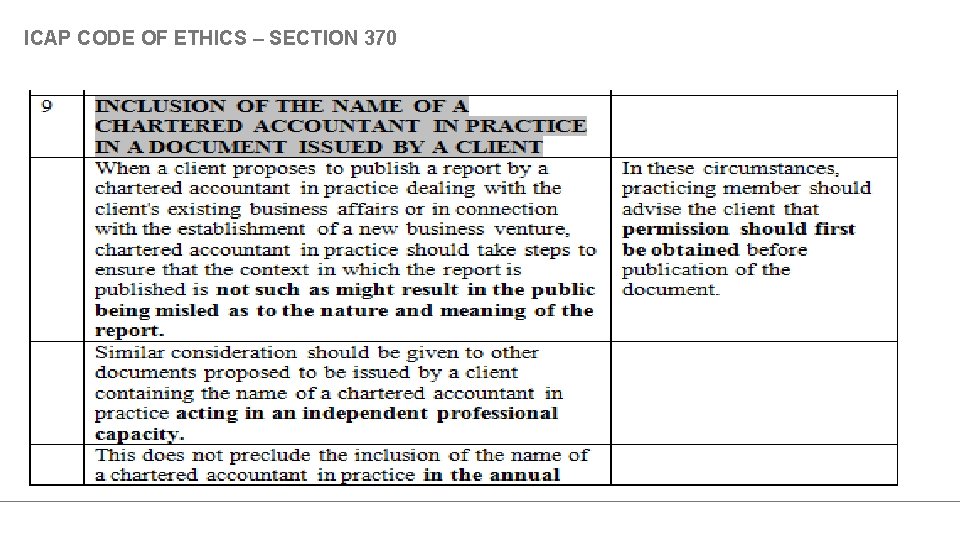
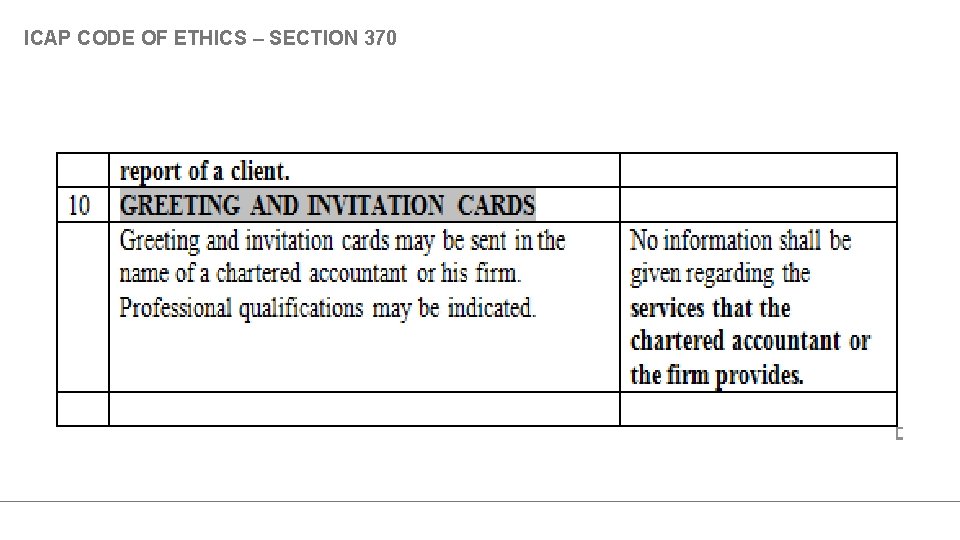
ICAP CODE OF ETHICS – SECTION 370 Key Requirements 1. In any communications, announcements and public notices, chartered accountants should not: (a) use means, which bring the profession into disrepute; (b) make exaggerated claims for the services they are able to offer, the qualifications they possess, or experience they have gained; and (c) denigrate the work of other accountants. 2. Activities which may expressly be considered not to meet the above criteria and are therefore prohibited include those that: create false, deceptive or unjustified expectations of favorable results; imply the ability to influence any court, tribunal, regulatory agency or similar body or official; consist of self-laudatory statements that are not based on verifiable facts; make comparisons with other chartered accountants in practice; contain testimonials or endorsements; contain any other representations that would be likely to cause a reasonable person to misunderstand or be deceived; and make unjustified claims to be an expert or specialist in a particular field of accountancy.
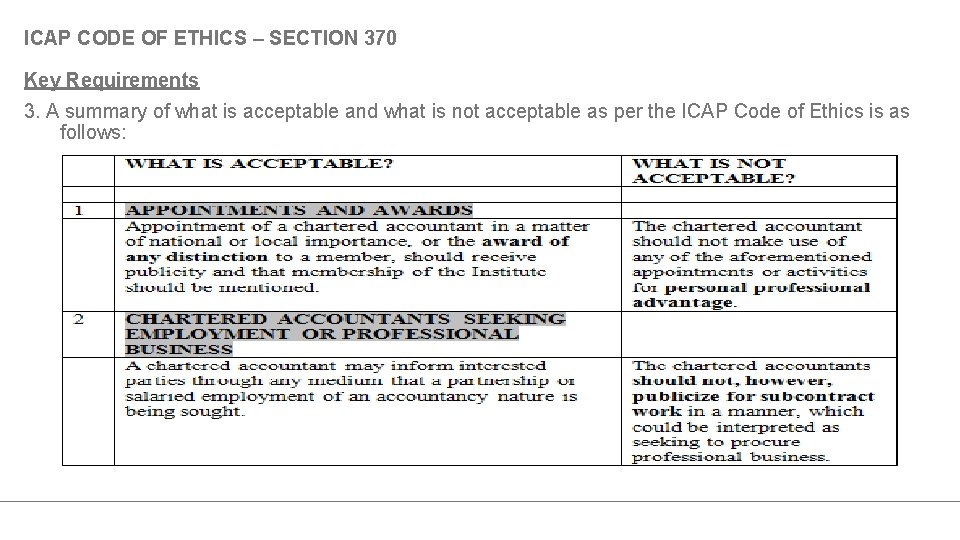
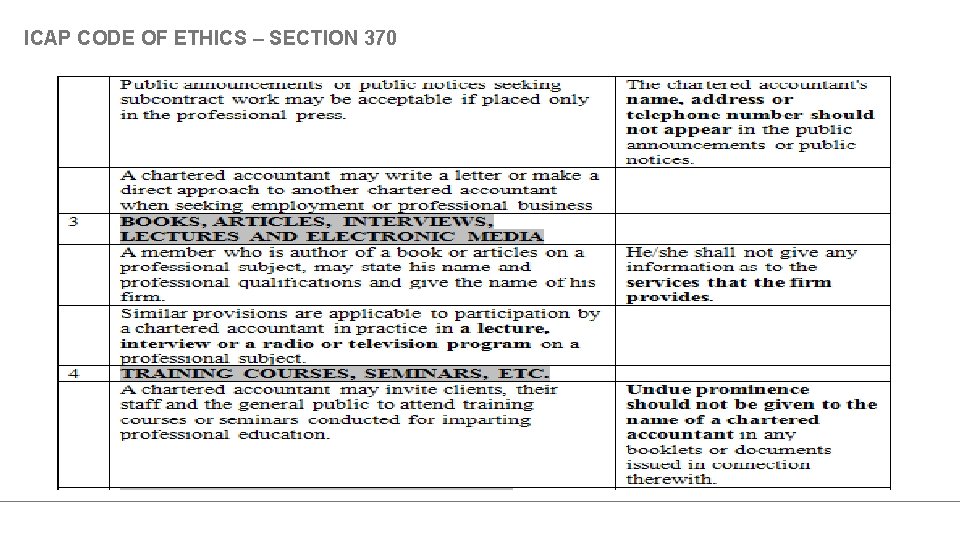
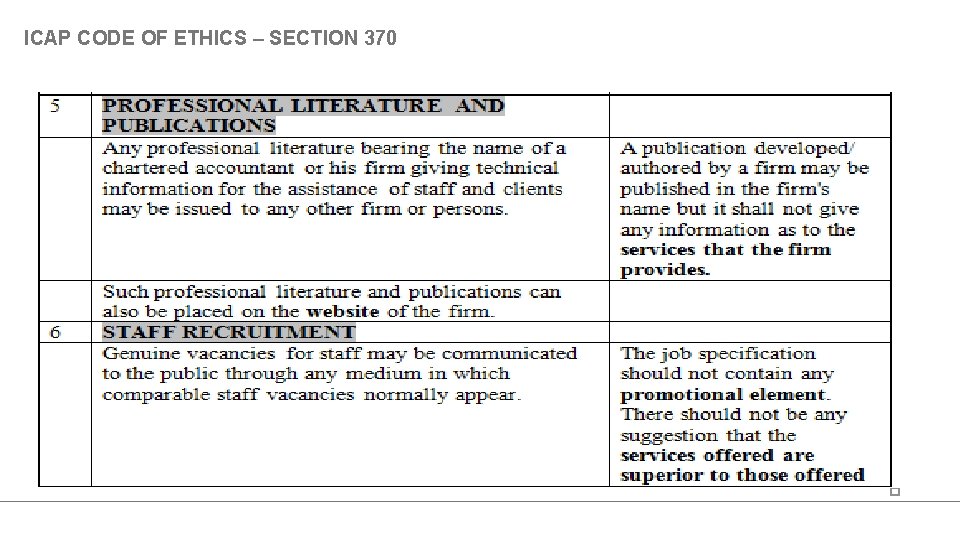
ICAP CODE OF ETHICS – SECTION 370 Key Requirements 3. A summary of what is acceptable and what is not acceptable as per the ICAP Code of Ethics is as follows:
ICAP CODE OF ETHICS – SECTION 370
ICAP CODE OF ETHICS – SECTION 370
ICAP CODE OF ETHICS – SECTION 370
ICAP CODE OF ETHICS – SECTION 370
ICAP CODE OF ETHICS – SECTION 370
ICAP CODE OF ETHICS – SECTION 370 Misconducts as per Part 1, Schedule I of the CA Ordinance, 1961: (5) Solicits clients for professional work either directly or indirectly by circular, advertisement, personal communication or interview or by any other means; (6) Advertises his professional attainments or services, or uses any designation or expression other than chartered accountant on professional documents, visiting cards, letter head or sign boards, unless it be a degree of a University established by law in Pakistan or recognized by the Federal Government or the Council;

Section 05: Requirements of Companies Act, 2017
THE COMPANIES ACT, 2017 The provisions relating to Audit and Auditors have been dealt within Sections 246 to 253 of the Companies Act, 2017

THANK YOU !
- Slides: 27