
Auditing the Technological Revolution and Public Good Miklos
Auditing, the Technological Revolution, and Public Good Miklos A. Vasarhelyi KPMG Distinguished Professor of AIS Rutgers Business School June 30, 2017 PIOB, MADRID

Audit Analytics THE STORY The world is rapidly changing, technology enables a 365/24/7 economy How has the audit profession evolved? Some major transformations… Robot arm is developed for assembly lines 1970 s Sampling is introduced First virtual reality glasses and gloves 1980 s IT audit becomes common Rutgers Business School Source: Pw. C 2017 and Matthews 2006 Deep Blue defeats chess player 1990 s Move to Risk-based approach Smart Phone is developed Driveless cars 2000 s 2010 s Disclose audit fees Adopts KAM Society Audit
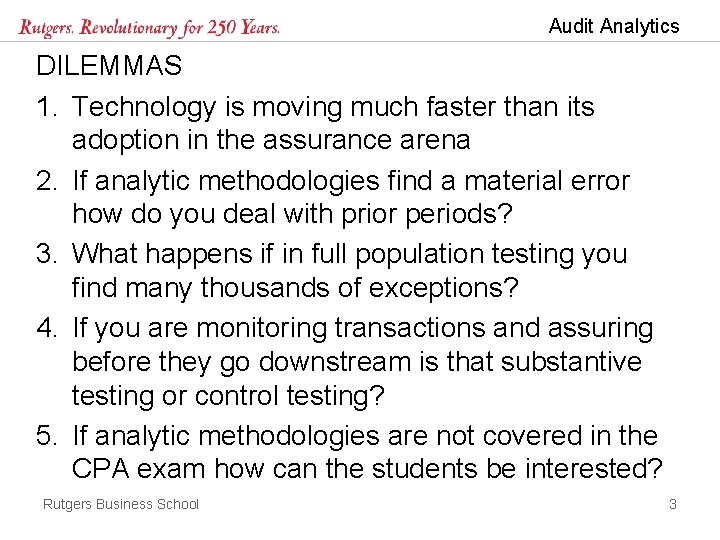
Audit Analytics DILEMMAS 1. Technology is moving much faster than its adoption in the assurance arena 2. If analytic methodologies find a material error how do you deal with prior periods? 3. What happens if in full population testing you find many thousands of exceptions? 4. If you are monitoring transactions and assuring before they go downstream is that substantive testing or control testing? 5. If analytic methodologies are not covered in the CPA exam how can the students be interested? Rutgers Business School 3
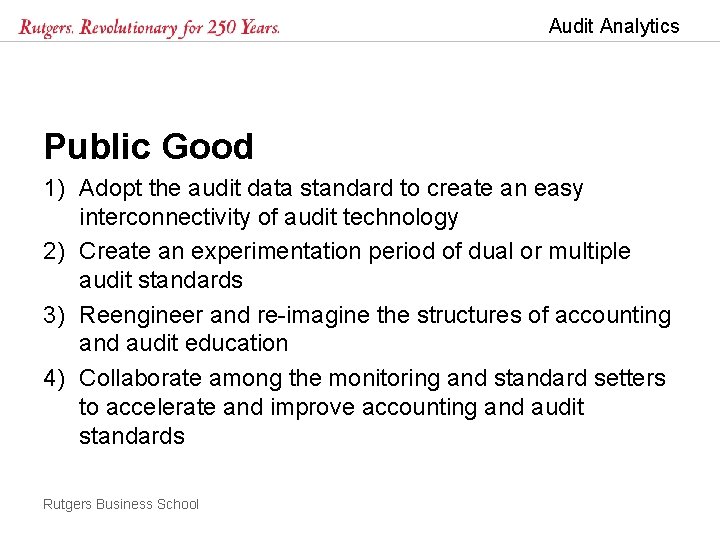
Audit Analytics Public Good 1) Adopt the audit data standard to create an easy interconnectivity of audit technology 2) Create an experimentation period of dual or multiple audit standards 3) Reengineer and re-imagine the structures of accounting and audit education 4) Collaborate among the monitoring and standard setters to accelerate and improve accounting and audit standards Rutgers Business School
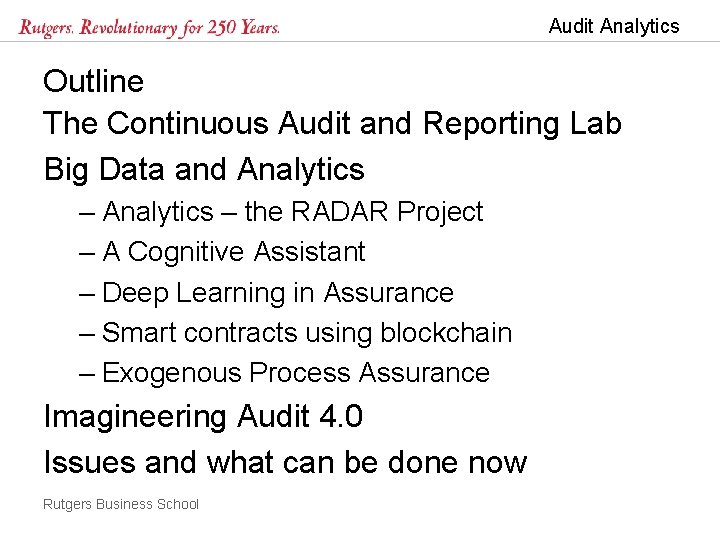
Audit Analytics Outline The Continuous Audit and Reporting Lab Big Data and Analytics – the RADAR Project – A Cognitive Assistant – Deep Learning in Assurance – Smart contracts using blockchain – Exogenous Process Assurance Imagineering Audit 4. 0 Issues and what can be done now Rutgers Business School
The Car. Lab Continuous Audit and Reporting Laboratory –Graduate School of Management –Rutgers University
Audit Analytics Rutgers Business School
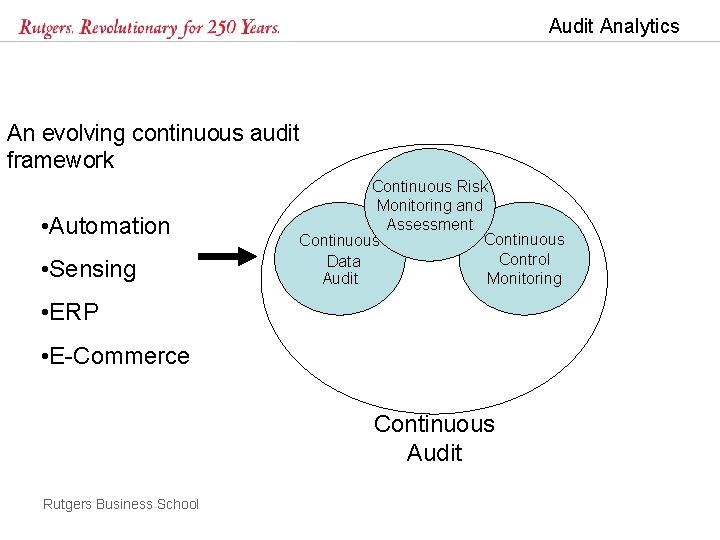
Audit Analytics An evolving continuous audit framework • Automation • Sensing Continuous Risk Monitoring and Assessment Continuous Control Data Monitoring Audit • ERP • E-Commerce Continuous Audit Rutgers Business School
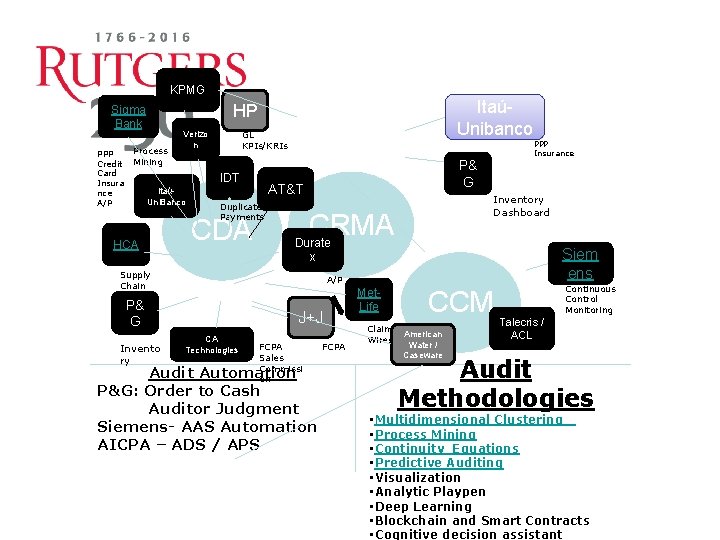
KPMG Sigma Bank PPP Credit Card Insura nce A/P Process Mining GL KPIs/KRIs Verizo n IDT Itaú- Uni. Banco HCA ItaúUnibanco HP CDA P& G AT&T Duplicate Payments Inventory Dashboard CRMA Durate x Supply Chain Siem ens A/P P& G Invento ry PPP Insurance J+J CA Technologies FCPA Sales Commissi on Audit Automation P&G: Order to Cash Auditor Judgment Siemens- AAS Automation AICPA – ADS / APS FCPA Met. Life CCM Claims American Wires Water / Caseware Continuous Control Monitoring Talecris / ACL Audit Methodologies • Multidimensional Clustering • Process Mining • Continuity Equations • Predictive Auditing • Visualization • Analytic Playpen • Deep Learning • Blockchain and Smart Contracts • Cognitive decision assistant
Audit Analytics BIG DATA Rutgers Business School 10
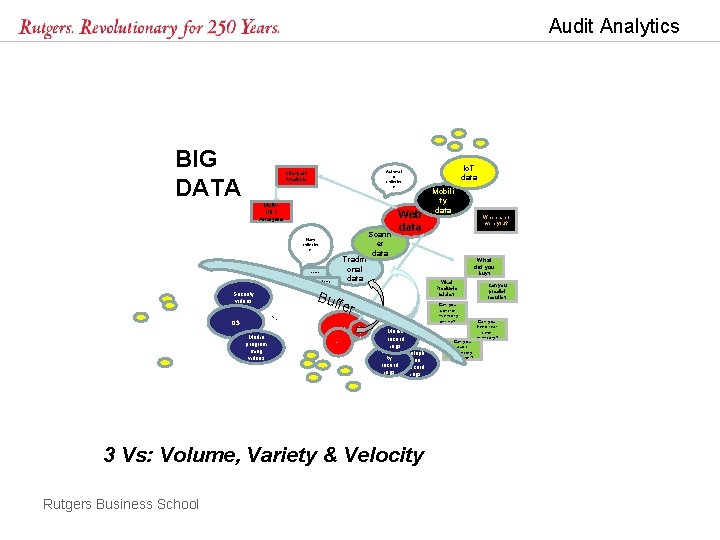
Audit Analytics BIG DATA Automat ic collectio n Clickpath Analysis Multi. URL Analysis Hand collectio n Traditi onal data ERP data legacy data Security videos os Newspieces What did you Can you control inventory online? Media record ings Securi Teleph ty one record ings 3 Vs: Volume, Variety & Velocity Rutgers Business School Where are / were you? buy? fer E m a i l s Mobili ty data What Products relate? Buf Social media Media program ming videos Scann er data Web data Io. T data Can you audit inventory real time ? Can you predict results? Can you keep real time inventory?
Audit Analytics ANALYTICS Rutgers Business School 12

Audit Analytics Data Analytics Illustration: Revenue Three-Way Match Entity ABC has revenue of € 125 million generated by 725, 000 transactions. The three way match procedure is executed with the following results: Amount (€) % 119, 750, 000 95. 8 691, 000 95. 3 Quantity differences 3, 125, 000 2. 5 16, 700 2. 3 Pricing differences 2, 125, 000 1. 7 17, 300 2. 4 No differences Number of Transactions % Outliers: Note: Materiality for the audit of the financial statements as a whole is € 1, 000. Rutgers Business School

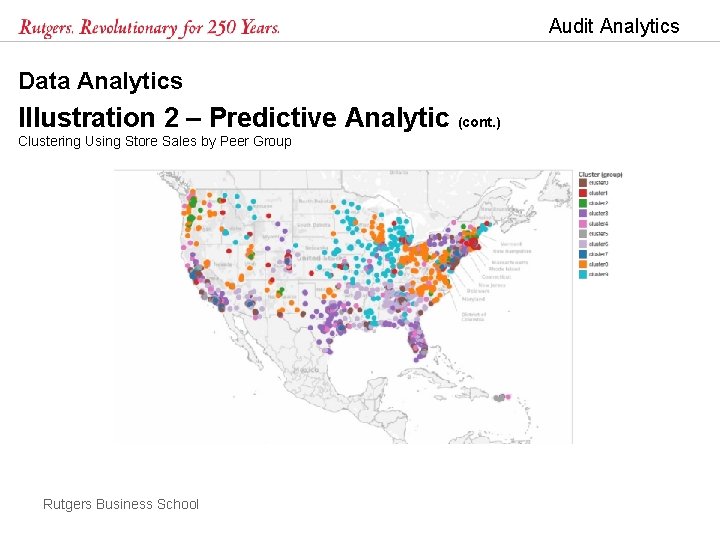
Audit Analytics Data Analytics Illustration 2– Predictive Analytic (cont. ) Data and Model Description § Objective: Predict revenue at the store level (approximately 2, 000 stores) for a publicly held retail company using internal company data and non-traditional data (e. g. , weather). § Forecasting daily store level sales (one step ahead forecasting). § Multivariate regression model with / without the peer store indicator and weather indicators. § AR(1)+…+AR(7) with / without the peer store indicator and weather indicators. Rutgers Business School
Audit Analytics Data Analytics Illustration 2 – Predictive Analytic (cont. ) Clustering Using Store Sales by Peer Group Rutgers Business School
Audit Analytics Data Analytics Illustration 3 – Clustering Multidimensional clustering is a powerful tool to detect groups of similar events and identify outliers – Audit Sampling (AS 2315) Can be used in most set of data examination procedures (preferably with a reduced set of data). Looking for anomalous clusters and outliers from the clusters - Statistically complex. Multidimensional Clustering for audit fault detection in an insurance and credit card settings and super-app Sutapat Thiprungsri, Miklos A. Vasarhelyi, and Paul Byrnes Rutgers Business School
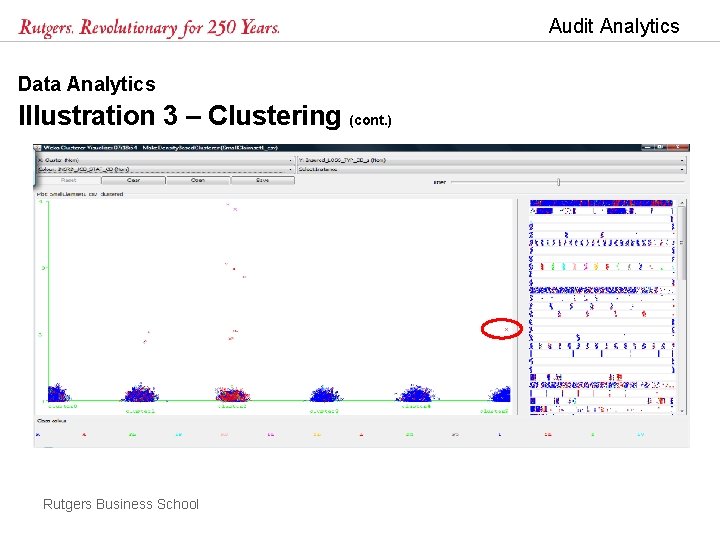
Audit Analytics Data Analytics Illustration 3 – Clustering (cont. ) Rutgers Business School
Audit Analytics Rutgers AICPA Data Analytics Research Initiative RADAR Rutgers Business School
Audit Analytics The RADAR project Rutgers, AICPA, CPA Canada, and 8 largest firms Started officially in June 2016 3 projects currently – Exceptional Exceptions (MADS) – Process Mining – Visualization as Audit Evidence Rutgers Business School
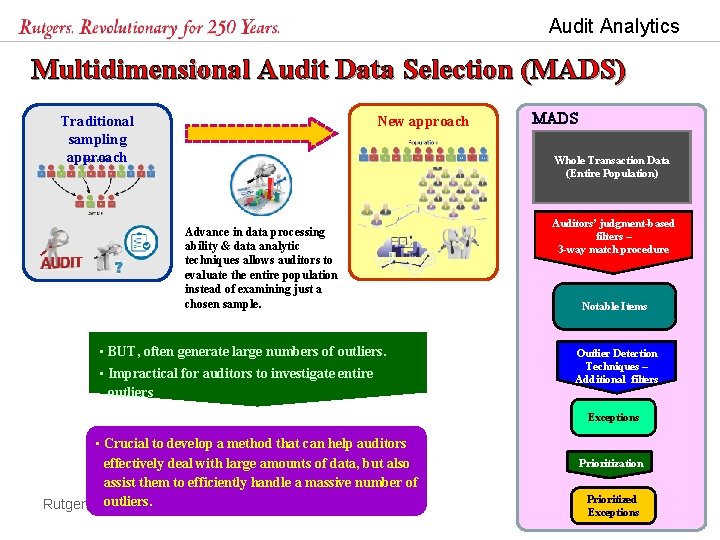
Audit Analytics Multidimensional Audit Data Selection (MADS) Traditional sampling approach New approach MADS Whole Transaction Data (Entire Population) Advance in data processing ability & data analytic techniques allows auditors to evaluate the entire population instead of examining just a chosen sample. • BUT, often generate large numbers of outliers. • Impractical for auditors to investigate entire outliers Auditors’ judgment-based filters – 3 -way match procedure Notable Items Outlier Detection Techniques – Additional filters Exceptions • Crucial to develop a method that can help auditors effectively deal with large amounts of data, but also assist them to efficiently handle a massive number of outliers. Rutgers Business School Prioritization Prioritized Exceptions
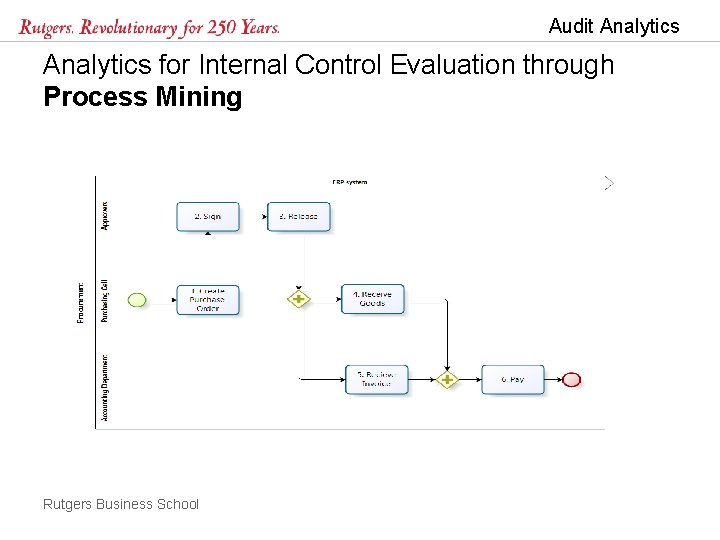
Audit Analytics for Internal Control Evaluation through Process Mining Rutgers Business School
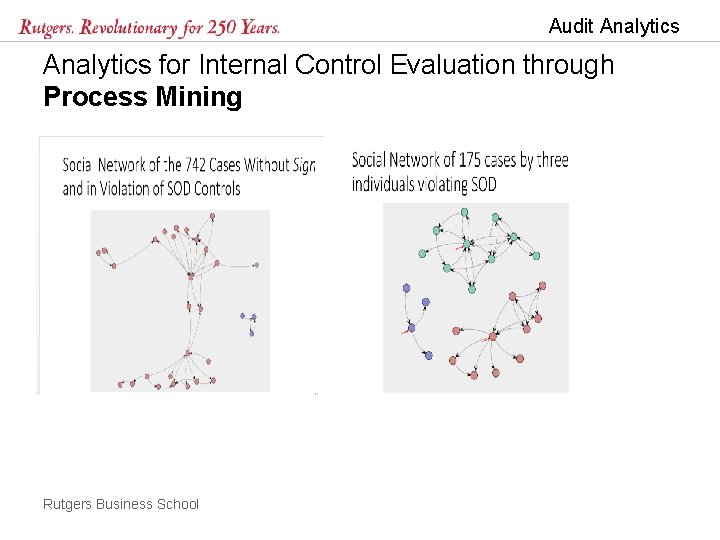
Audit Analytics for Internal Control Evaluation through Process Mining Rutgers Business School
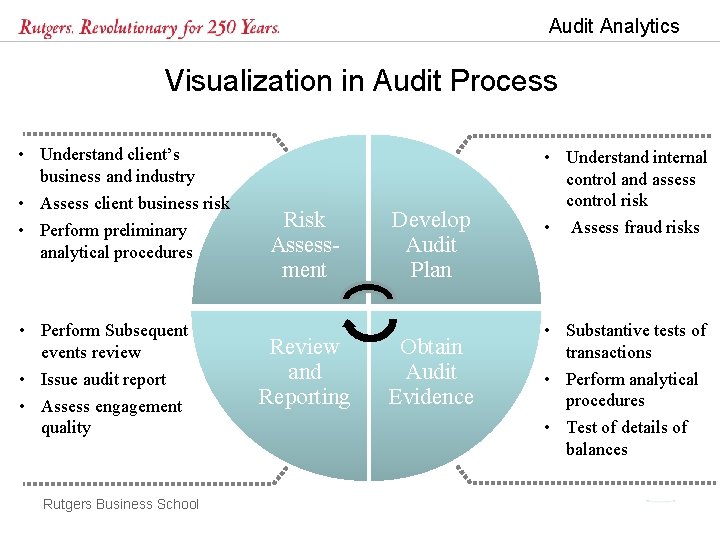
Audit Analytics Visualization in Audit Process • Understand client’s business and industry • Assess client business risk • Perform preliminary analytical procedures • Perform Subsequent events review • Issue audit report • Assess engagement quality Rutgers Business School Risk Assessment Review and Reporting Develop Audit Plan Obtain Audit Evidence • Understand internal control and assess control risk • Assess fraud risks • Substantive tests of transactions • Perform analytical procedures • Test of details of balances
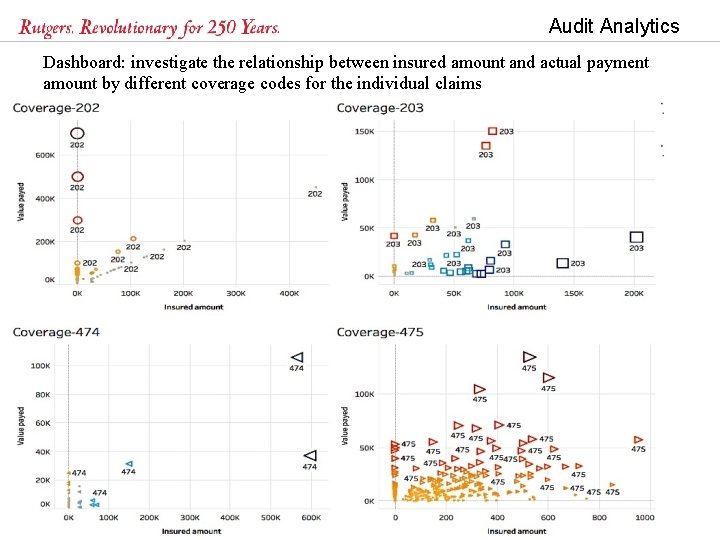
Audit Analytics Dashboard: investigate the relationship between insured amount and actual payment amount by different coverage codes for the individual claims Rutgers Business School
Developing an intelligent cognitive assistant for brainstorming meeting in audit planning and risk assessment Qiao Li Miklos Vasarhelyi 2017/5/2
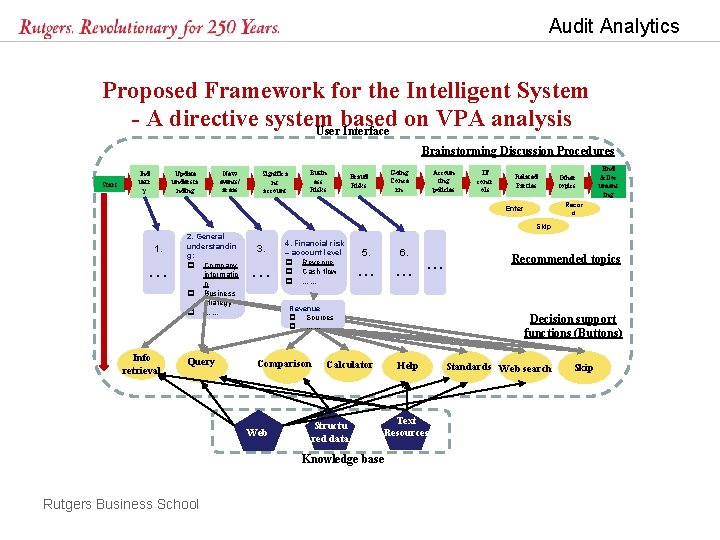
Audit Analytics Proposed Framework for the Intelligent System - A directive system based on VPA analysis User Interface Brainstorming Discussion Procedures Start Ind ustr y Update understa nding New events/ areas Significa nt account Busin ess Risks Going Conce rn Fraud Risks Accoun ting policies IT contr ols Related Parties Other topics End &Doc ument ing Recor d Enter Skip 1. … Info retrieval 2. General understandin g: p Company informatio n p Business strategy p …… Query 3. … 4. Financial risk – account level p Revenue p Cash flow p …… 5. 6. … … … Revenue p Sources p …… Comparison Web Decision support functions (Buttons) Calculator Structu red data Help Text Resources Knowledge base Rutgers Business School Recommended topics Standards Web search Skip
Audit Analytics Ting Sun And Miklos A. Vasarhelyi DEEP LEARNING IN AUDITING Rutgers Business School
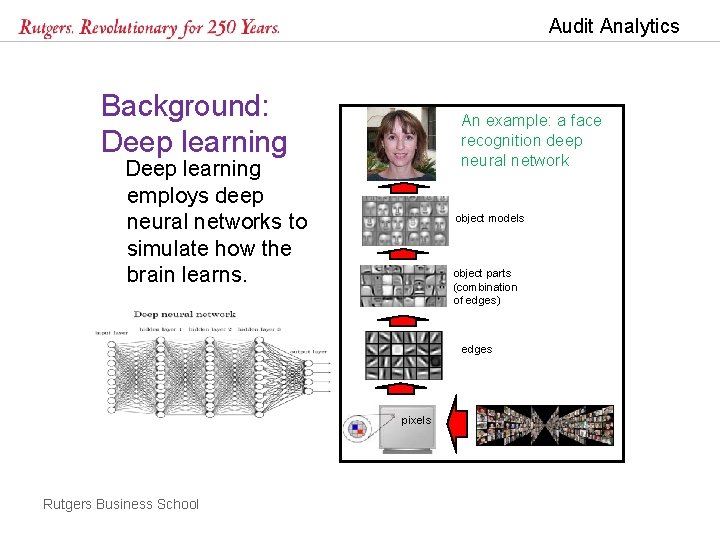
Audit Analytics Background: Deep learning An example: a face recognition deep neural network Deep learning employs deep neural networks to simulate how the brain learns. object models object parts (combination of edges) edges pixels Rutgers Business School
Audit Analytics Dissertation Essays Research 1. The incremental informativeness of management sentiment for internal control material weakness prediction: An application of deep learning to textual analysis for conference calls Research 2. The performance of sentiment feature of 10 -K MD&As for financial misstatements prediction: A comparison of deep learning and bag of words approach Research 3. Do Social Media Messages Provide Clues for Audit Planning? - An Application of Deep Learning Based Textual Analysis of Tweets to Audit Fee Prediction Rutgers Business School
Audit Analytics Jamie Frieman and Miklos A Vasarhelyi SMART CONTRACTS USING BLOCKCHAIN Rutgers Business School
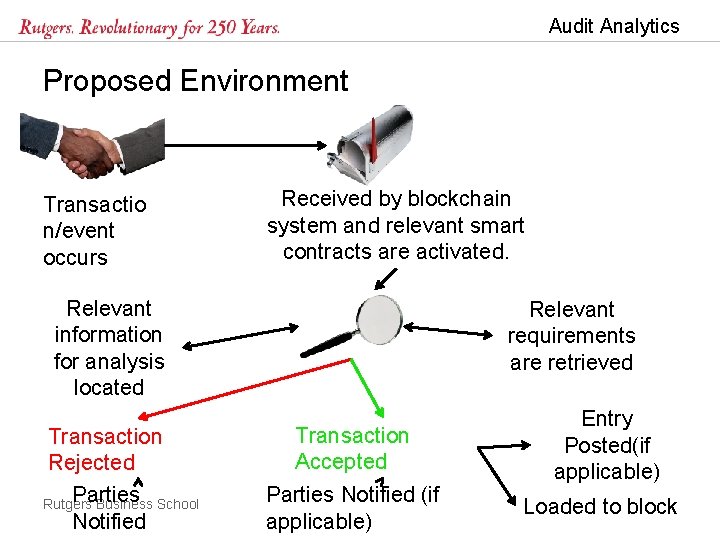
Audit Analytics Proposed Environment Transactio n/event occurs Received by blockchain system and relevant smart contracts are activated. Relevant information for analysis located Transaction Rejected Parties Rutgers Business School Notified Relevant requirements are retrieved Transaction Accepted Parties Notified (if applicable) Entry Posted(if applicable) Loaded to block
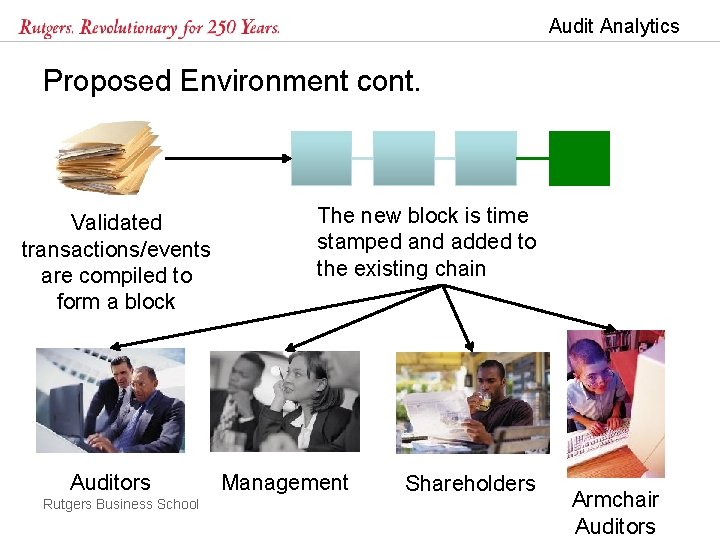
Audit Analytics Proposed Environment cont. Validated transactions/events are compiled to form a block Auditors Rutgers Business School The new block is time stamped and added to the existing chain Management Shareholders Armchair Auditors
Audit Analytics Can a system (data) be audited without going directly into the client data? ASSURANCE WITH EXOGENOUS (BIG) DATA Rutgers Business School
Audit Analytics Can there be auditing without getting data directly from the client? Of course assertions by management are needed (to be verified) Big data provides a plethora of information progressively more and more relevant Moon (2016) showed that social media can indicate variances in revenue streams (his CRMA dissertation) Revenues show high correlation with items such as advertising, social media utterances, supply chain flows, transactions in electronic purchases, Io. T measures, etc. Costs can be associated to online prices, third party orders, process discontinuities, etc. Most models until more research is performed are ad hoc Rutgers Business School
Audit Analytics Can there be auditing without getting data directly from the client? (cont) The level of probable error on these measurements is clearly larger but much less susceptible to tampering Easier (likely) to create a continuous reporting system that can serve for assurance Standards would have to radically change IS THIS AUDITING? Rutgers Business School
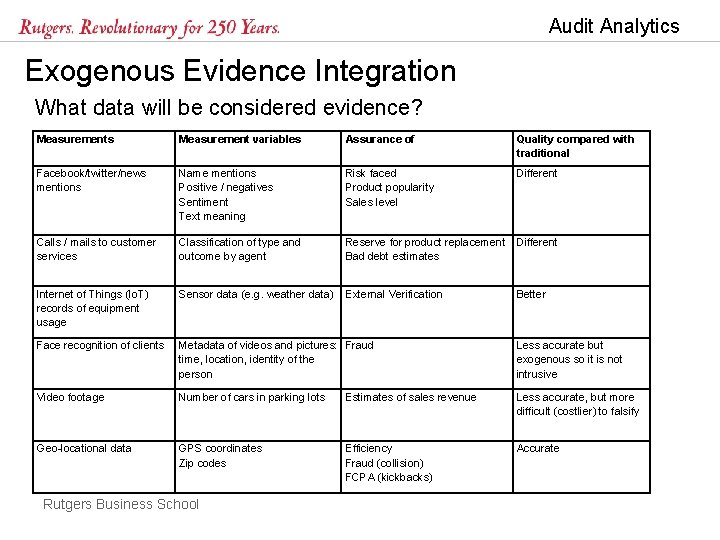
Audit Analytics Exogenous Evidence Integration What data will be considered evidence? Measurements Measurement variables Assurance of Quality compared with traditional Facebook/twitter/news mentions Name mentions Positive / negatives Sentiment Text meaning Risk faced Product popularity Sales level Different Calls / mails to customer services Classification of type and outcome by agent Reserve for product replacement Bad debt estimates Different Internet of Things (Io. T) records of equipment usage Sensor data (e. g. weather data) External Verification Better Face recognition of clients Metadata of videos and pictures: Fraud time, location, identity of the person Less accurate but exogenous so it is not intrusive Video footage Number of cars in parking lots Estimates of sales revenue Less accurate, but more difficult (costlier) to falsify Geo-locational data GPS coordinates Zip codes Efficiency Fraud (collision) FCPA (kickbacks) Accurate Rutgers Business School
Audit Analytics AUTOMATING THE AUDIT Rutgers Business School
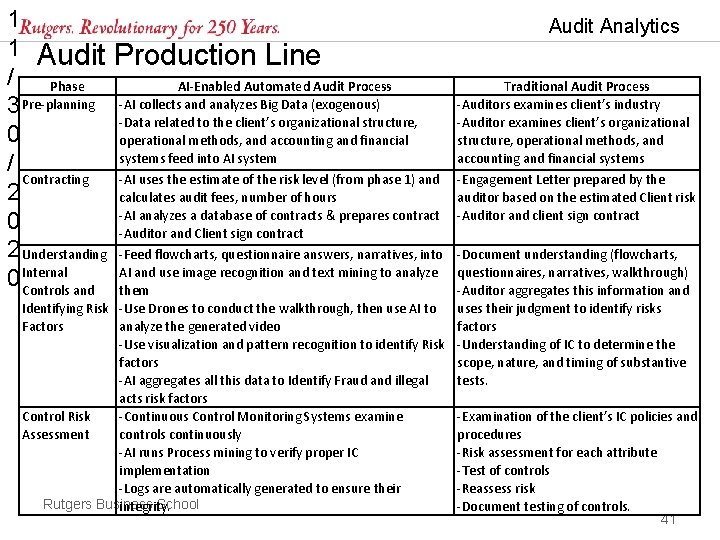
1 1 Audit Production Line / Phase AI-Enabled Automated Audit Process 3 Pre-planning -AI collects and analyzes Big Data (exogenous) -Data related to the client’s organizational structure, 0 operational methods, and accounting and financial systems feed into AI system / Contracting -AI uses the estimate of the risk level (from phase 1) and 2 calculates audit fees, number of hours -AI analyzes a database of contracts & prepares contract 0 -Auditor and Client sign contract 2 Understanding -Feed flowcharts, questionnaire answers, narratives, into AI and use image recognition and text mining to analyze 0 Internal Controls and them Audit Analytics Traditional Audit Process -Auditors examines client’s industry -Auditor examines client’s organizational structure, operational methods, and accounting and financial systems -Engagement Letter prepared by the auditor based on the estimated Client risk -Auditor and client sign contract -Document understanding (flowcharts, questionnaires, narratives, walkthrough) -Auditor aggregates this information and Identifying Risk -Use Drones to conduct the walkthrough, then use AI to uses their judgment to identify risks Factors analyze the generated video factors -Use visualization and pattern recognition to identify Risk -Understanding of IC to determine the factors scope, nature, and timing of substantive -AI aggregates all this data to Identify Fraud and illegal tests. acts risk factors Control Risk -Continuous Control Monitoring Systems examine -Examination of the client’s IC policies and Assessment controls continuously procedures -AI runs Process mining to verify proper IC -Risk assessment for each attribute implementation -Test of controls -Logs are automatically generated to ensure their -Reassess risk Rutgers Business School integrity. -Document testing of controls. 41
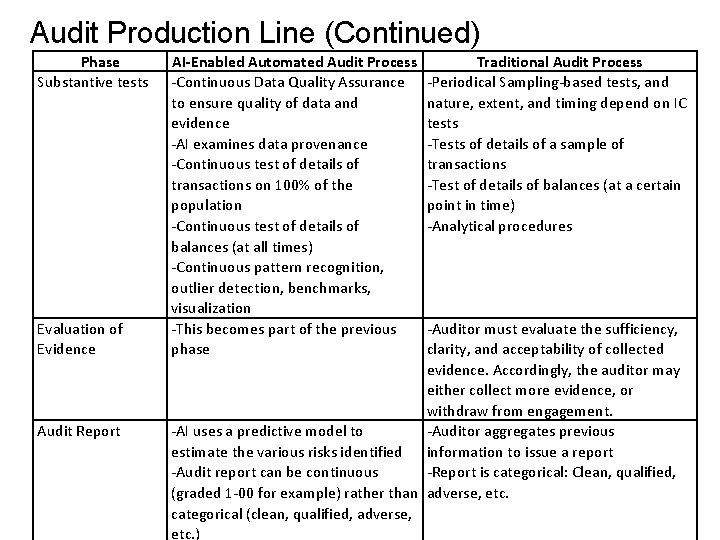
Audit Production Line (Continued) Phase Substantive tests Evaluation of Evidence Audit Report AI-Enabled Automated Audit Process -Continuous Data Quality Assurance to ensure quality of data and evidence -AI examines data provenance -Continuous test of details of transactions on 100% of the population -Continuous test of details of balances (at all times) -Continuous pattern recognition, outlier detection, benchmarks, visualization -This becomes part of the previous phase Traditional Audit Process -Periodical Sampling-based tests, and nature, extent, and timing depend on IC tests -Tests of details of a sample of transactions -Test of details of balances (at a certain point in time) -Analytical procedures -Auditor must evaluate the sufficiency, clarity, and acceptability of collected evidence. Accordingly, the auditor may either collect more evidence, or withdraw from engagement. -AI uses a predictive model to -Auditor aggregates previous estimate the various risks identified information to issue a report -Audit report can be continuous -Report is categorical: Clean, qualified, (graded 1 -00 for example) rather than adverse, etc. categorical (clean, qualified, adverse, etc. )
Audit Analytics The Thinking that must go into change IMAGINEERING THE FUTURE AUDIT Rutgers Business School
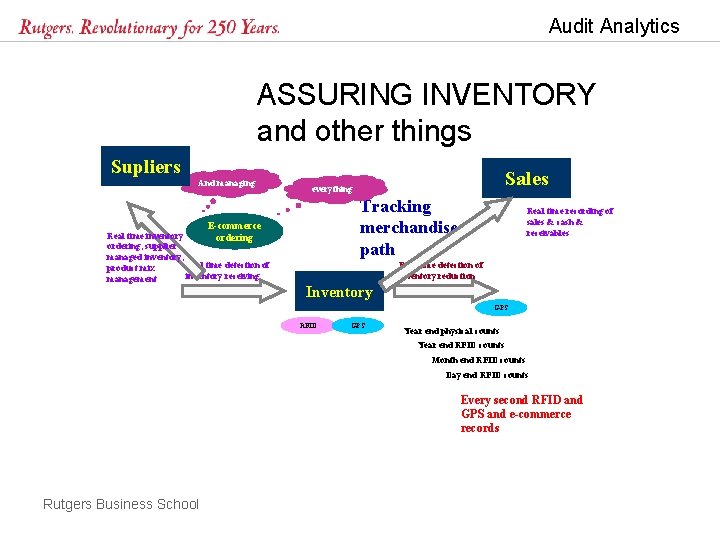
Audit Analytics ASSURING INVENTORY and other things Supliers And managing Tracking merchandise path E-commerce Real time inventory ordering, supplier managed inventory, Real time detection of product mix inventory receiving management Sales everything Real time recording of sales & cash & receivables Real time detection of inventory reduction Inventory GPS RFID GPS Year end physical counts Year end RFID counts Month end RFID counts Day end RFID counts Every second RFID and GPS and e-commerce records Rutgers Business School
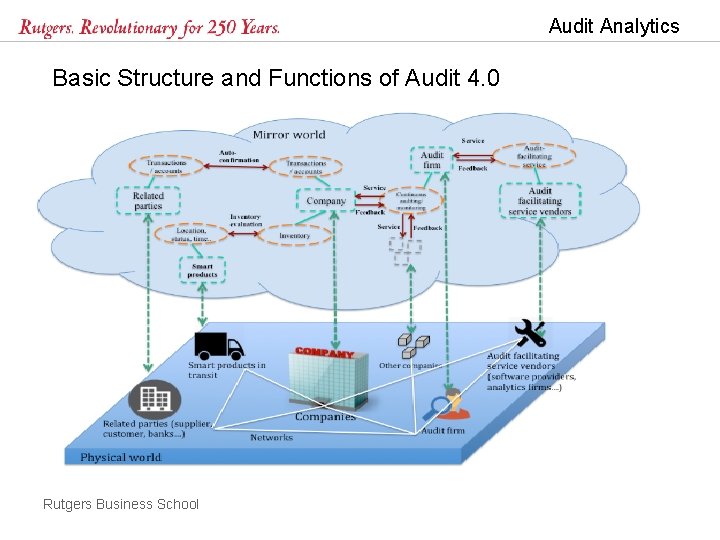
Audit Analytics Basic Structure and Functions of Audit 4. 0 Rutgers Business School
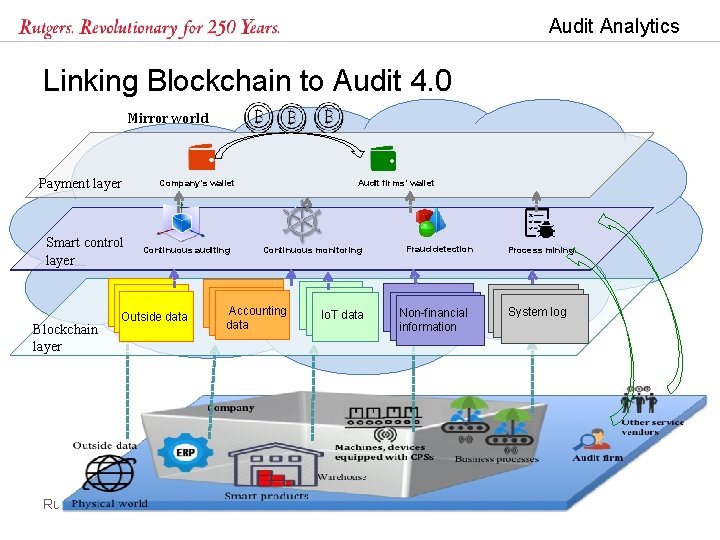
Audit Analytics Linking Blockchain to Audit 4. 0 Mirror world Payment layer Company’s wallet Audit firms’ wallet Smart control layer Blockchain layer Continuous auditing Outside data Rutgers Business School Continuous monitoring Fraud detection Process mining Accounting data Io. T data Non-financial information System log 46
Audit Analytics ISSUES AND WHAT CAN BE DONE NOW Rutgers Business School
Audit Analytics AUDIT DATA STANDARD Rutgers Business School
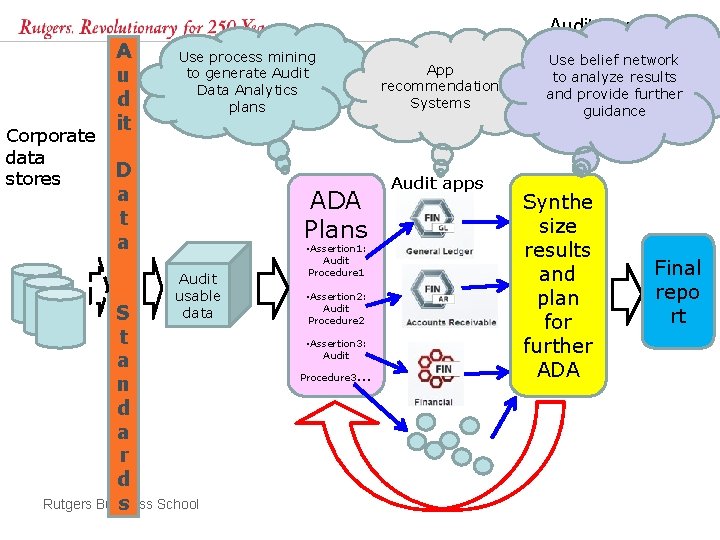
Audit Analytics Corporate data stores A u d it Use process mining to generate Audit Data Analytics plans D a t a App recommendation Systems ADA Plans Audit usable data S t a n d a r d Rutgers Business School s • Assertion 1: Audit Procedure 1 • Assertion 2: Audit Procedure 2 • Assertion 3: Audit … Procedure 3 Audit apps Use belief network to analyze results and provide further guidance Synthe size results and plan for further ADA Final repo rt
Audit Analytics AN EXPERIMENTATION PROGRAM Rutgers Business School
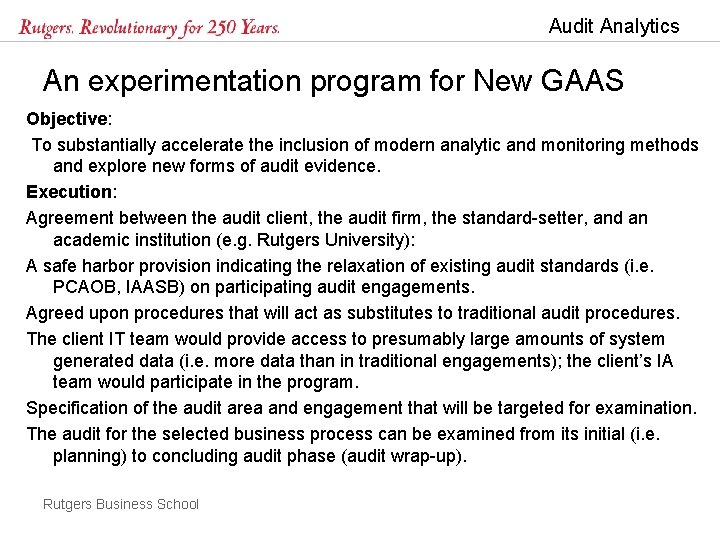
Audit Analytics An experimentation program for New GAAS Objective: To substantially accelerate the inclusion of modern analytic and monitoring methods and explore new forms of audit evidence. Execution: Agreement between the audit client, the audit firm, the standard-setter, and an academic institution (e. g. Rutgers University): A safe harbor provision indicating the relaxation of existing audit standards (i. e. PCAOB, IAASB) on participating audit engagements. Agreed upon procedures that will act as substitutes to traditional audit procedures. The client IT team would provide access to presumably large amounts of system generated data (i. e. more data than in traditional engagements); the client’s IA team would participate in the program. Specification of the audit area and engagement that will be targeted for examination. The audit for the selected business process can be examined from its initial (i. e. planning) to concluding audit phase (audit wrap-up). Rutgers Business School
Audit Analytics EDUCATION Rutgers Business School
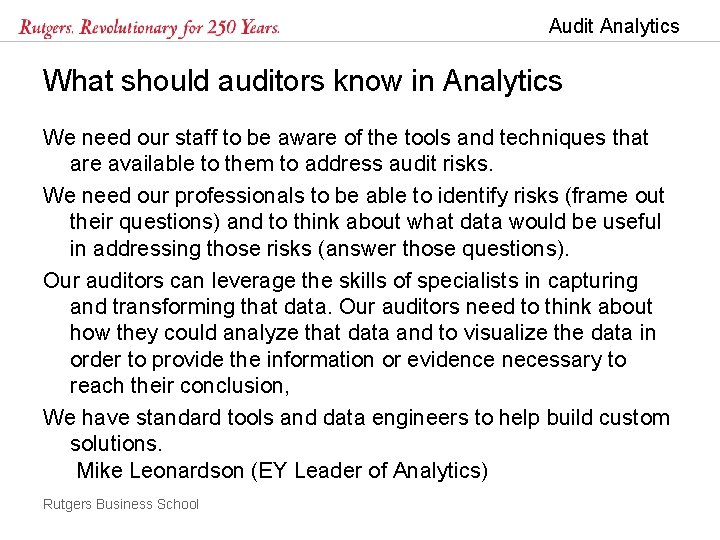
Audit Analytics What should auditors know in Analytics We need our staff to be aware of the tools and techniques that are available to them to address audit risks. We need our professionals to be able to identify risks (frame out their questions) and to think about what data would be useful in addressing those risks (answer those questions). Our auditors can leverage the skills of specialists in capturing and transforming that data. Our auditors need to think about how they could analyze that data and to visualize the data in order to provide the information or evidence necessary to reach their conclusion, We have standard tools and data engineers to help build custom solutions. Mike Leonardson (EY Leader of Analytics) Rutgers Business School
Audit Analytics CONCLUSIONS Rutgers Business School
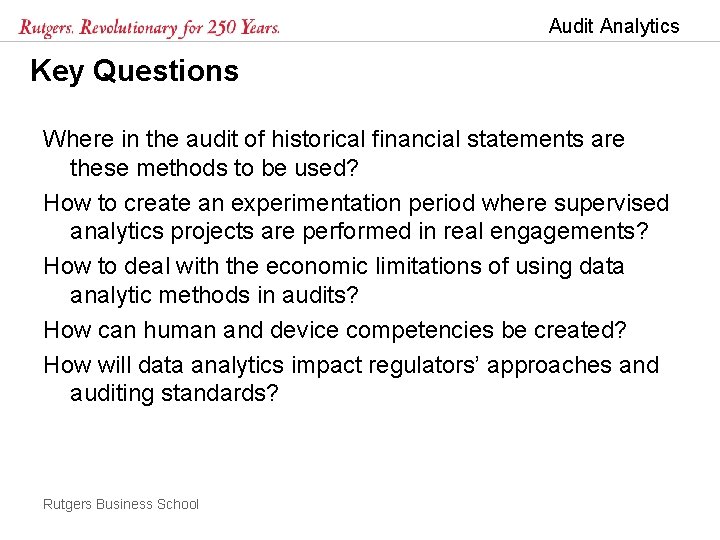
Audit Analytics Key Questions Where in the audit of historical financial statements are these methods to be used? How to create an experimentation period where supervised analytics projects are performed in real engagements? How to deal with the economic limitations of using data analytic methods in audits? How can human and device competencies be created? How will data analytics impact regulators’ approaches and auditing standards? Rutgers Business School
Audit Analytics Observation It should be clear that the art of leveraging technology and data analytics will further enhance the quality of the audit and achieve better protection of the public interest. Audit regulation has the power to accelerate the rate of adoption of analytics and this is a great opportunity for standard setting. Rutgers Business School
Audit Analytics Public Good – Actions to consider 1) Adopt the audit data standard to create an easy interconnectivity of audit technology 2) Create an experimentation period of dual or multiple audit standards 3) Reengineer and re-imagine the structures of accounting and audit education 4) Collaborate among the monitoring and standard setters to accelerate and improve accounting and audit standards Rutgers Business School
Audit Analytics Thanks!! Contact me at miklosv@rutgers. edu Visit http: //raw. rutgers. edu Rutgers Business School
Audit Analytics EXTRA SLIDES Rutgers Business School 59
Audit Analytics Resource: Audit Data Analytics free on You. Tube from the Rutgers Curriculum 1. Introduction to Audit Analytics: https: //www. youtube. com/playlist? list=PLauep. KFT 6 DK 8 ns. UG 3 EXi 6 l. YVX 0 CPHUngj 2. Special Topics in Audit Analytics: https: //www. youtube. com/playlist? list=PLauep. KFT 6 DK-Ppuse. Jt. SMl. Iy-YBha. V 4 TH 3. Information Risk Management: https: //www. youtube. com/playlist? list=PLauep. KFT 6 DK 8 uxe. Ph. PCo. Hj. Df 8_Dlh. Rt. GS 4. Tutorials for Risk Management: https: //www. youtube. com/playlist? list=PLauep. KFT 6 DK 9 Grq 8 J 67 NMy. Gp. Yh 1 As. Bb-- For more information please visit: http: //raw. rutgers. edu/accounting-courses. html Rutgers Business School
- Slides: 57