
Audit Planning and Analytical Procedures 2008 Prentice Hall




- Slides: 35
Audit Planning and Analytical Procedures © 2008 Prentice Hall Business Publishing, Auditing 12/e, Arens/Beasley/Elder 8 -1
Acceptance of Clients Juan M. Garcia Merced © 2008 Prentice Hall Business Publishing, Auditing 12/e, Arens/Beasley/Elder 8 -2
First Standard of Field Work The work is to be adequately planned, and assistants, if any, are to be properly supervised. © 2008 Prentice Hall Business Publishing, Auditing 12/e, Arens/Beasley/Elder 8 -3
Obtaining Clients Through: Acquisitions Business contacts Social contacts Advertising © 2008 Prentice Hall Business Publishing, Auditing 12/e, Arens/Beasley/Elder 8 -4
Auditor’s Business Risk A thoroughly investigation of prospective clients should be made. © 2008 Prentice Hall Business Publishing, Auditing 12/e, Arens/Beasley/Elder 8 -5
Submitting a Proposal Should include: Nature of services Qualifications Fees & other information Audit committee © 2008 Prentice Hall Business Publishing, Auditing 12/e, Arens/Beasley/Elder 8 -6
Communication with Predecessor Auditor The successor auditor must ask management to authorize the predecessor to respond fully. Key issue in deciding whether to accept the engagement. © 2008 Prentice Hall Business Publishing, Auditing 12/e, Arens/Beasley/Elder 8 -7
Auditor inquiries will include: • Disagreements with management over accounting principles or scope limitations • The predecessor’s understanding for the change in auditors • The integrity of management • Communications with audit committees regarding important audit issues © 2008 Prentice Hall Business Publishing, Auditing 12/e, Arens/Beasley/Elder 8 -8
Items Included in Engagement Letters • Name of the entity • Management responsibilities – – – Financial statements Establishing effective internal control over financial reporting Compliance with laws and regulations Making records available to the auditors Providing written representations at end of the audit, including that adjustments discovered by the auditors and not recorded to the financials are not material • Auditor responsibilities – Conducting an audit in accordance with GAAS – Obtaining an understanding of internal control to plan audit and to determine the nature, timing and extent of procedures – Making communications required by GAAS © 2008 Prentice Hall Business Publishing, Auditing 12/e, Arens/Beasley/Elder 8 -9
Engagement Letters--Optional Items • Arrangements regarding – Conduct of the audit (e. g. , timing, client assistance) – Use of specialists or internal auditors – Obtaining information from predecessor auditors – Fees and billing • Other services to be provided, such as examination of internal control over financial reporting © 2008 Prentice Hall Business Publishing, Auditing 12/e, Arens/Beasley/Elder • Limitation of or other 8 - 10
ENGAGEMENT LETTER Required!!!!!!!! © 2008 Prentice Hall Business Publishing, Auditing 12/e, Arens/Beasley/Elder 8 - 11
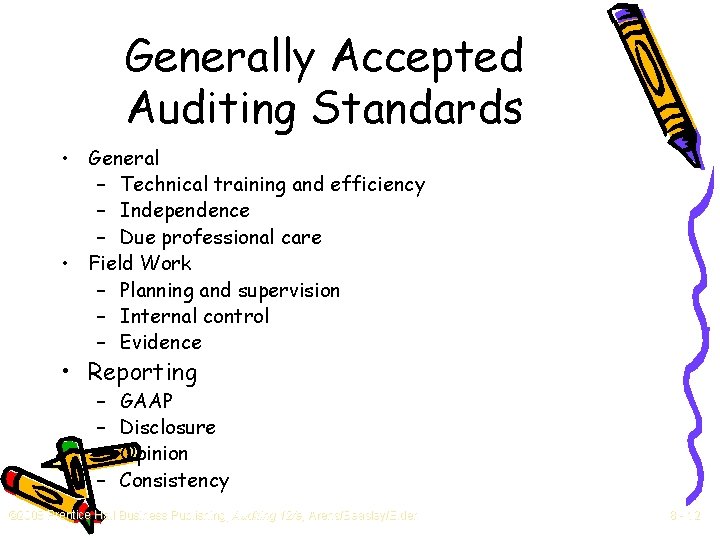
Generally Accepted Auditing Standards • General – Technical training and efficiency – Independence – Due professional care • Field Work – Planning and supervision – Internal control – Evidence • Reporting – – GAAP Disclosure Opinion Consistency © 2008 Prentice Hall Business Publishing, Auditing 12/e, Arens/Beasley/Elder 8 - 12
Audit Planning • Gain an understanding of the • client’s business and industry. © 2008 Prentice Hall Business Publishing, Auditing 12/e, Arens/Beasley/Elder 8 - 13
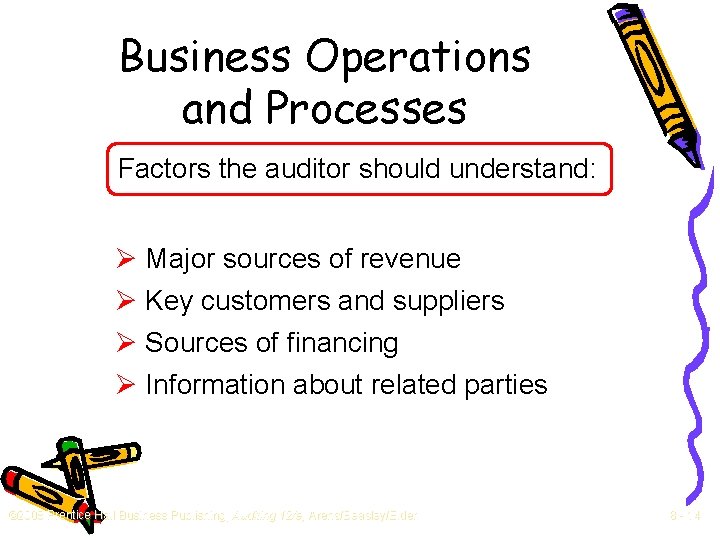
Business Operations and Processes Factors the auditor should understand: Ø Major sources of revenue Ø Key customers and suppliers Ø Sources of financing Ø Information about related parties © 2008 Prentice Hall Business Publishing, Auditing 12/e, Arens/Beasley/Elder 8 - 14
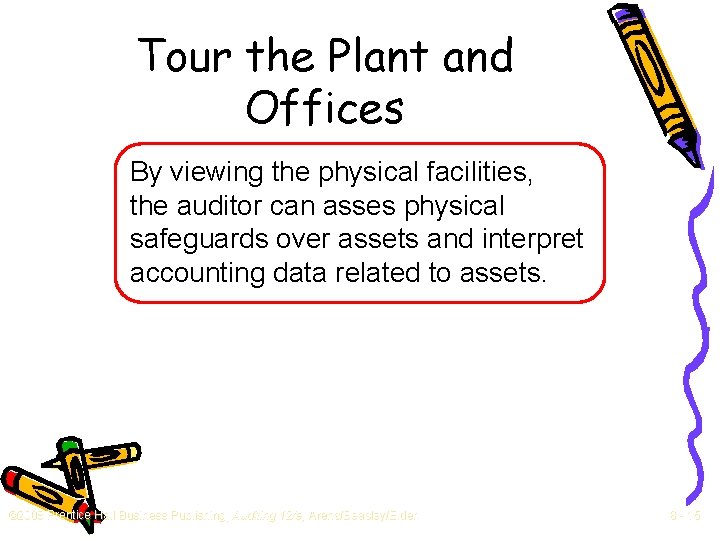
Tour the Plant and Offices By viewing the physical facilities, the auditor can asses physical safeguards over assets and interpret accounting data related to assets. © 2008 Prentice Hall Business Publishing, Auditing 12/e, Arens/Beasley/Elder 8 - 15
Management and Governance Management establishes the strategies and processes followed by the client’s business. Governance includes the client’s organizational structure, as well as the activities of the board of directors and the audit committee. Ø Corporate charter and bylaws Ø Code of ethics Ø Meeting minutes © 2008 Prentice Hall Business Publishing, Auditing 12/e, Arens/Beasley/Elder 8 - 16
Measurement and Performance The client’s performance measurement system includes key performance indicators. Examples: Ø market share Ø sales per employee Ø unit sales growth Ø Web site visitors Ø same-store sales Ø sales/square foot Performance measurement includes ratio analysis and benchmarking against key competitors. © 2008 Prentice Hall Business Publishing, Auditing 12/e, Arens/Beasley/Elder 8 - 17
Assess Client Business Risk Client business risk is the risk that the client will fail to achieve its objectives. Ø What is the auditor’s primary concern? Ø Material misstatements in the financial statements due to client business risk © 2008 Prentice Hall Business Publishing, Auditing 12/e, Arens/Beasley/Elder 8 - 18
Perform preliminary analytical procedures. © 2008 Prentice Hall Business Publishing, Auditing 12/e, Arens/Beasley/Elder 8 - 19
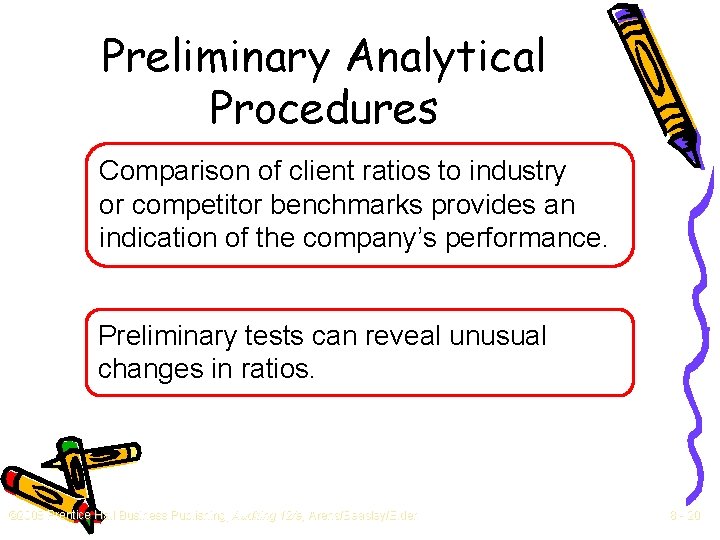
Preliminary Analytical Procedures Comparison of client ratios to industry or competitor benchmarks provides an indication of the company’s performance. Preliminary tests can reveal unusual changes in ratios. © 2008 Prentice Hall Business Publishing, Auditing 12/e, Arens/Beasley/Elder 8 - 20
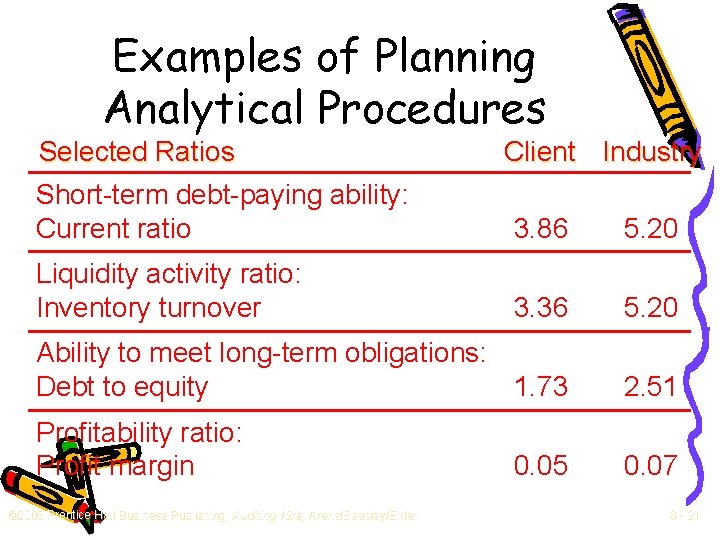
Examples of Planning Analytical Procedures Selected Ratios Short-term debt-paying ability: Current ratio Client Industry 3. 86 5. 20 3. 36 5. 20 Ability to meet long-term obligations: Debt to equity 1. 73 2. 51 Profitability ratio: Profit margin 0. 07 Liquidity activity ratio: Inventory turnover © 2008 Prentice Hall Business Publishing, Auditing 12/e, Arens/Beasley/Elder 0. 05 8 - 21
Summary of the Parts of Auditing Planning A major purpose is to gain an understanding of the client’s business and industry. © 2008 Prentice Hall Business Publishing, Auditing 12/e, Arens/Beasley/Elder 8 - 22
Key Parts of Planning Perform preliminary analytical procedures © 2008 Prentice Hall Business Publishing, Auditing 12/e, Arens/Beasley/Elder 8 - 23
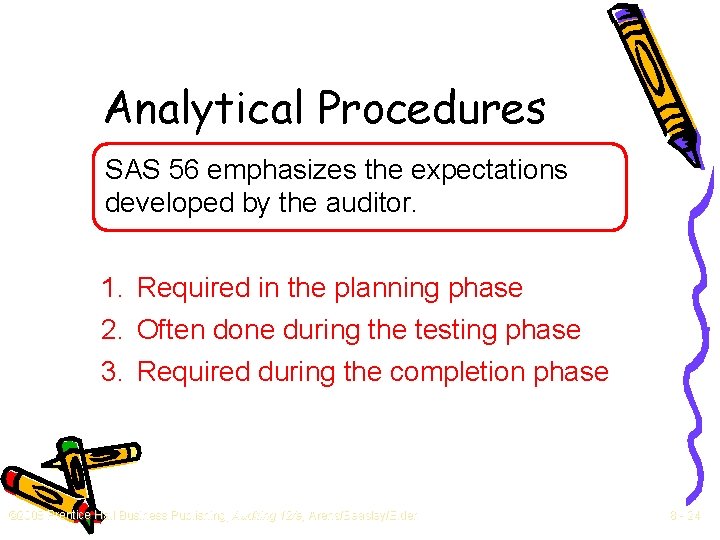
Analytical Procedures SAS 56 emphasizes the expectations developed by the auditor. 1. Required in the planning phase 2. Often done during the testing phase 3. Required during the completion phase © 2008 Prentice Hall Business Publishing, Auditing 12/e, Arens/Beasley/Elder 8 - 24
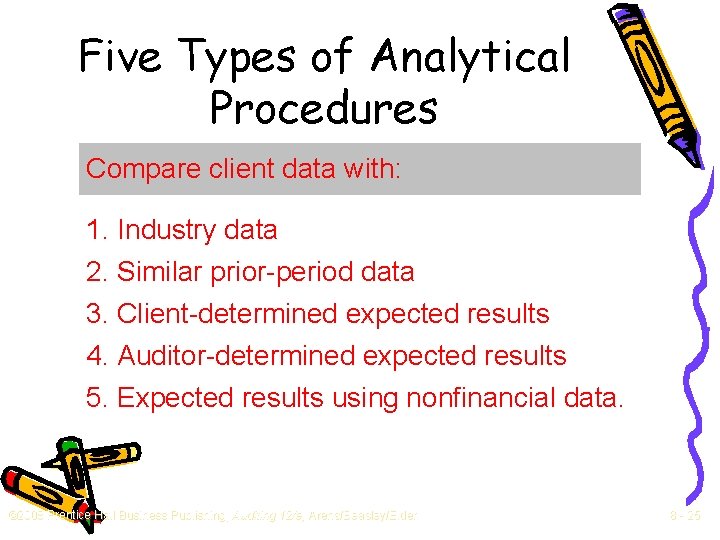
Five Types of Analytical Procedures Compare client data with: 1. Industry data 2. Similar prior-period data 3. Client-determined expected results 4. Auditor-determined expected results 5. Expected results using nonfinancial data. © 2008 Prentice Hall Business Publishing, Auditing 12/e, Arens/Beasley/Elder 8 - 25
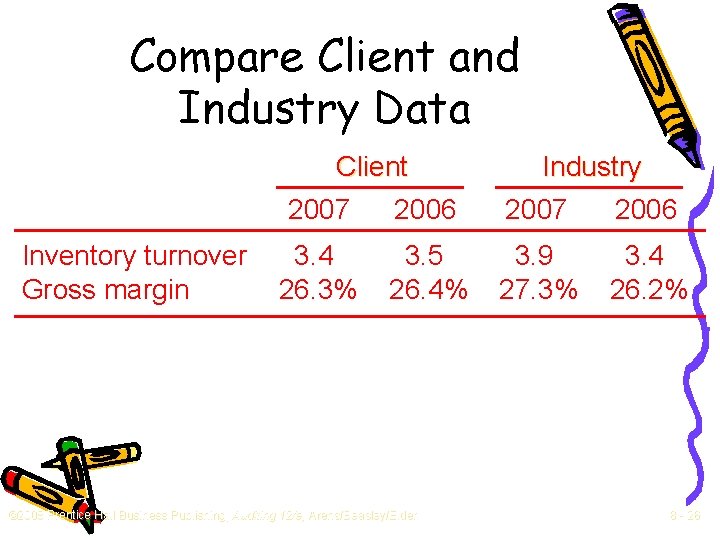
Compare Client and Industry Data Client Inventory turnover Gross margin Industry 2007 2006 3. 4 26. 3% 3. 5 26. 4% 3. 9 27. 3% 3. 4 26. 2% © 2008 Prentice Hall Business Publishing, Auditing 12/e, Arens/Beasley/Elder 8 - 26
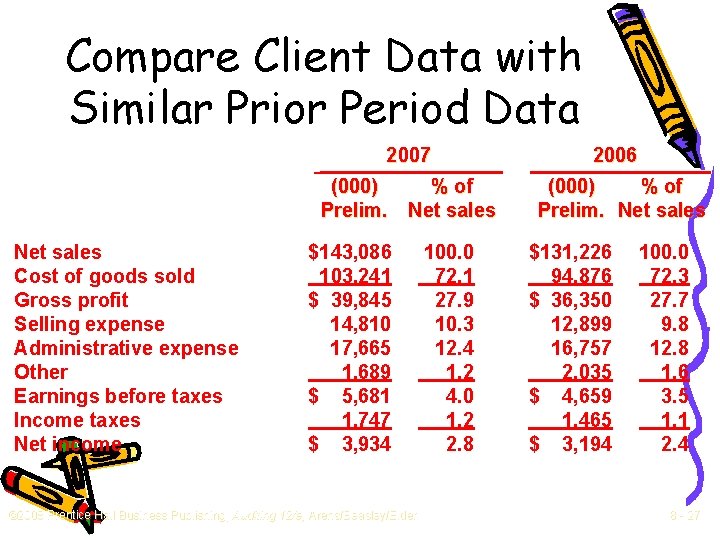
Compare Client Data with Similar Prior Period Data 2007 (000) % of Prelim. Net sales Cost of goods sold Gross profit Selling expense Administrative expense Other Earnings before taxes Income taxes Net income $143, 086 103, 241 $ 39, 845 14, 810 17, 665 1, 689 $ 5, 681 1, 747 $ 3, 934 © 2008 Prentice Hall Business Publishing, Auditing 12/e, Arens/Beasley/Elder 100. 0 72. 1 27. 9 10. 3 12. 4 1. 2 4. 0 1. 2 2. 8 2006 (000) % of Prelim. Net sales $131, 226 94, 876 $ 36, 350 12, 899 16, 757 2, 035 $ 4, 659 1, 465 $ 3, 194 100. 0 72. 3 27. 7 9. 8 12. 8 1. 6 3. 5 1. 1 2. 4 8 - 27
Common Financial Ratios Ø Short-term debt-paying ability Ø Liquidity activity ratios Ø Ability to meet long-term debt obligations Ø Profitability ratios © 2008 Prentice Hall Business Publishing, Auditing 12/e, Arens/Beasley/Elder 8 - 28
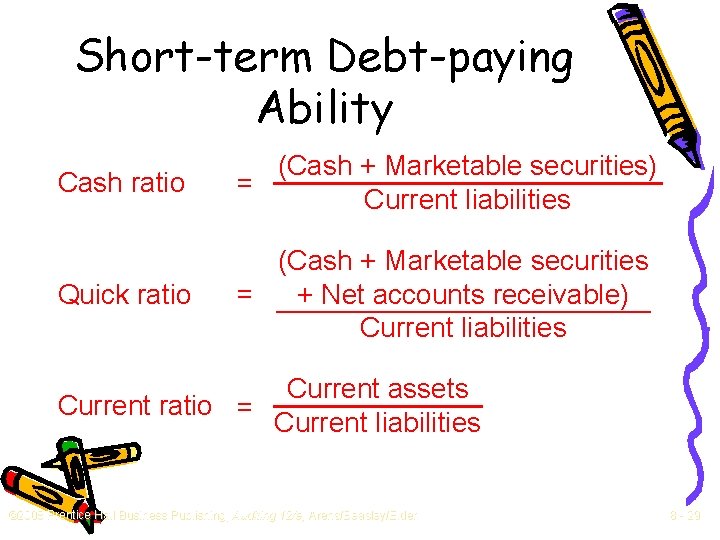
Short-term Debt-paying Ability Cash ratio (Cash + Marketable securities) = Current liabilities Quick ratio (Cash + Marketable securities + Net accounts receivable) = Current liabilities Current assets Current ratio = Current liabilities © 2008 Prentice Hall Business Publishing, Auditing 12/e, Arens/Beasley/Elder 8 - 29
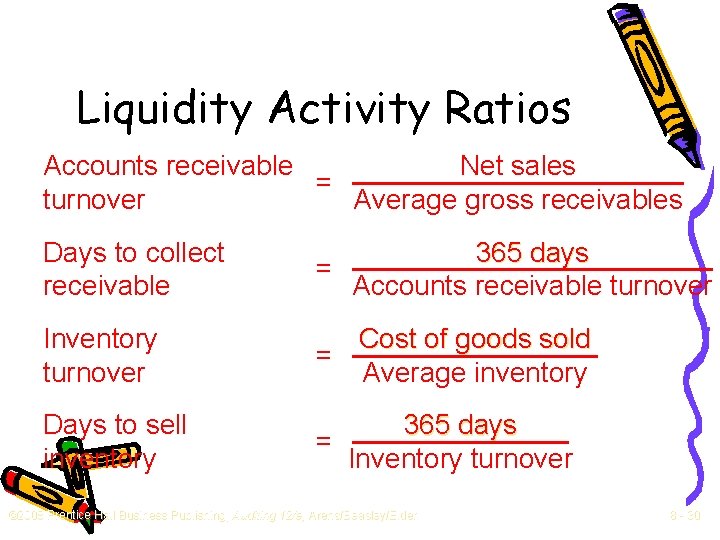
Liquidity Activity Ratios Accounts receivable Net sales = turnover Average gross receivables Days to collect receivable 365 days = Accounts receivable turnover Inventory turnover Cost of goods sold = Average inventory Days to sell inventory 365 days = Inventory turnover © 2008 Prentice Hall Business Publishing, Auditing 12/e, Arens/Beasley/Elder 8 - 30
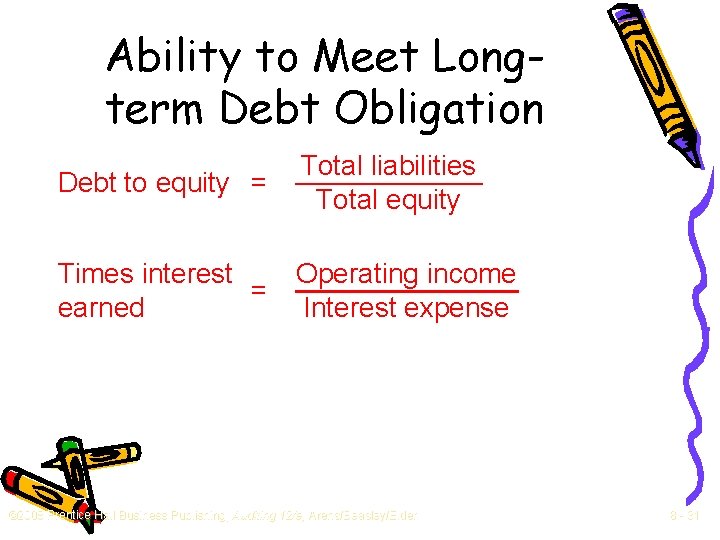
Ability to Meet Longterm Debt Obligation Debt to equity = Total liabilities Total equity Times interest = earned Operating income Interest expense © 2008 Prentice Hall Business Publishing, Auditing 12/e, Arens/Beasley/Elder 8 - 31
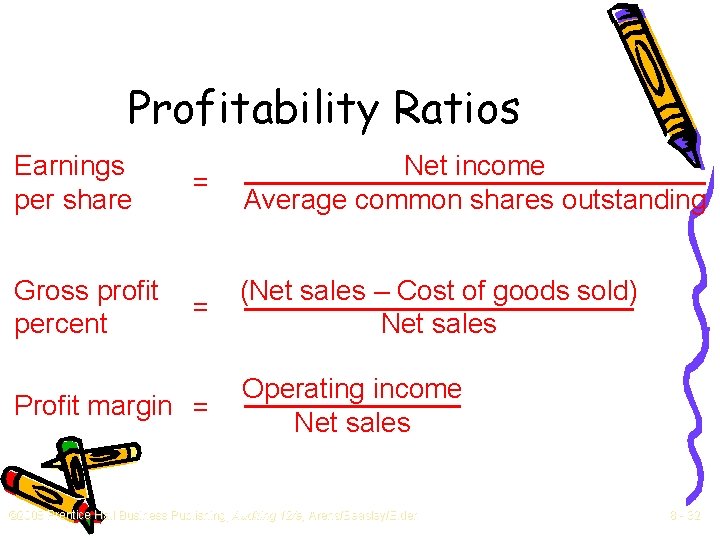
Profitability Ratios Earnings per share Gross profit percent = Net income Average common shares outstanding = (Net sales – Cost of goods sold) Net sales Profit margin = Operating income Net sales © 2008 Prentice Hall Business Publishing, Auditing 12/e, Arens/Beasley/Elder 8 - 32
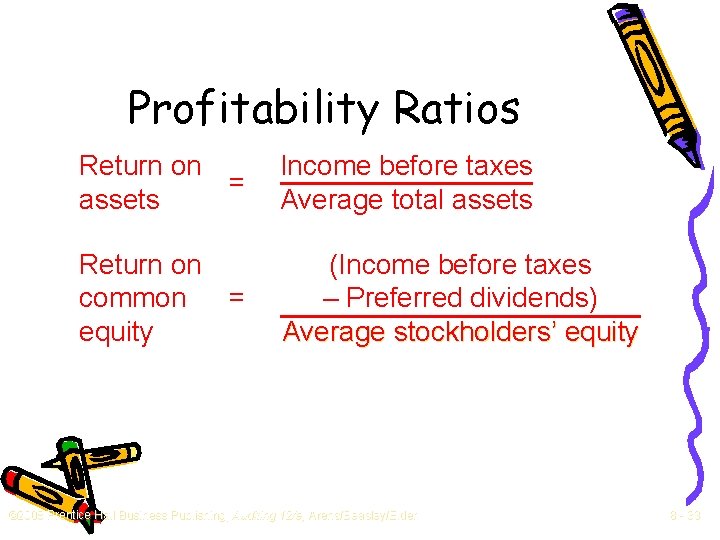
Profitability Ratios Return on = assets Income before taxes Average total assets Return on common = equity (Income before taxes – Preferred dividends) Average stockholders’ equity © 2008 Prentice Hall Business Publishing, Auditing 12/e, Arens/Beasley/Elder 8 - 33
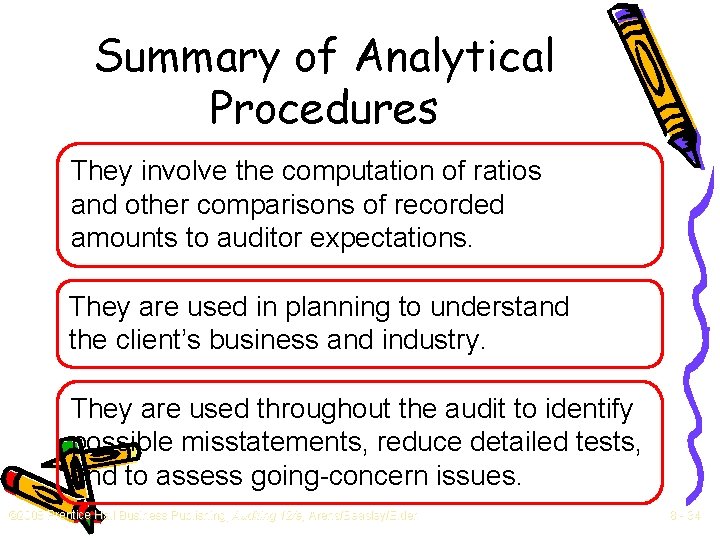
Summary of Analytical Procedures They involve the computation of ratios and other comparisons of recorded amounts to auditor expectations. They are used in planning to understand the client’s business and industry. They are used throughout the audit to identify possible misstatements, reduce detailed tests, and to assess going-concern issues. © 2008 Prentice Hall Business Publishing, Auditing 12/e, Arens/Beasley/Elder 8 - 34
End of Chapter © 2008 Prentice Hall Business Publishing, Auditing 12/e, Arens/Beasley/Elder 8 - 35