
Audit of the Capital Acquisition and Repayment Cycle

- Slides: 32
Audit of the Capital Acquisition and Repayment Cycle Chapter 21 © 2003 Prentice Hall Business Publishing, Auditing and Assurance Services 9/e, Arens/Elder/Beasley 21 - 1
Learning Objective 1 Identify the accounts and the unique characteristics of the capital acquisition and repayment cycle. © 2003 Prentice Hall Business Publishing, Auditing and Assurance Services 9/e, Arens/Elder/Beasley 21 - 2
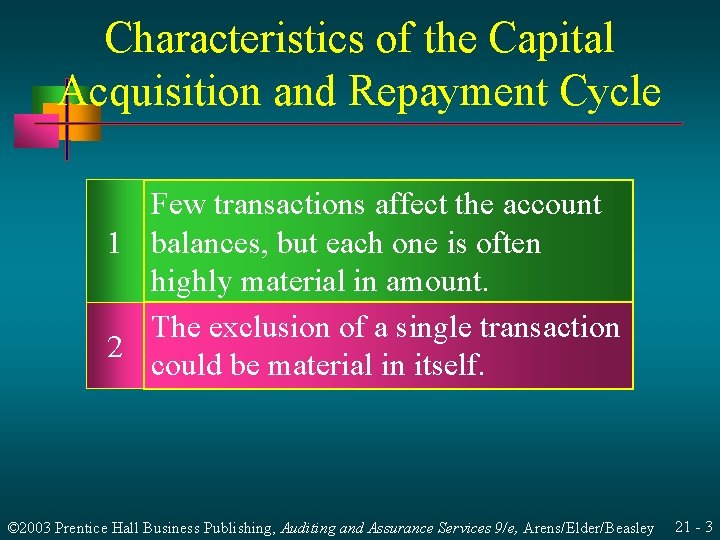
Characteristics of the Capital Acquisition and Repayment Cycle Few transactions affect the account 1 balances, but each one is often highly material in amount. The exclusion of a single transaction 2 could be material in itself. © 2003 Prentice Hall Business Publishing, Auditing and Assurance Services 9/e, Arens/Elder/Beasley 21 - 3
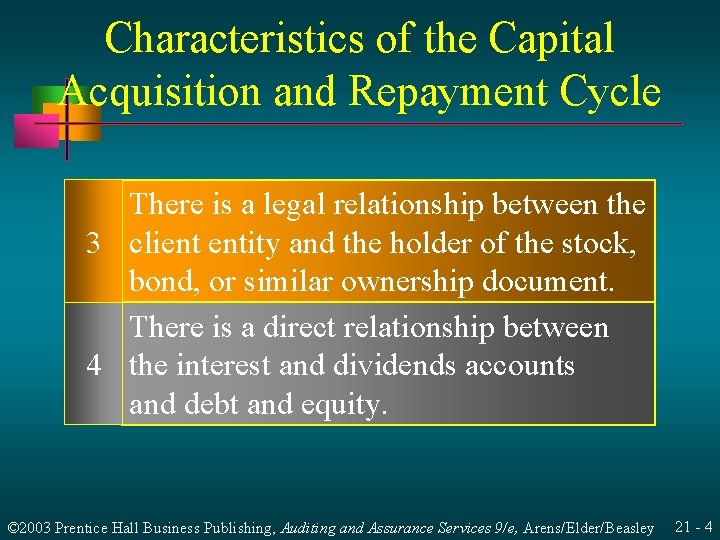
Characteristics of the Capital Acquisition and Repayment Cycle There is a legal relationship between the 3 client entity and the holder of the stock, bond, or similar ownership document. There is a direct relationship between 4 the interest and dividends accounts and debt and equity. © 2003 Prentice Hall Business Publishing, Auditing and Assurance Services 9/e, Arens/Elder/Beasley 21 - 4
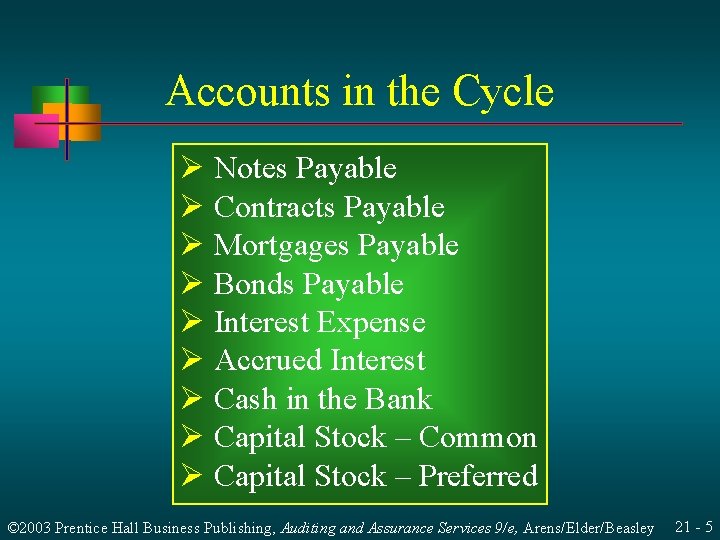
Accounts in the Cycle Ø Notes Payable Ø Contracts Payable Ø Mortgages Payable Ø Bonds Payable Ø Interest Expense Ø Accrued Interest Ø Cash in the Bank Ø Capital Stock – Common Ø Capital Stock – Preferred © 2003 Prentice Hall Business Publishing, Auditing and Assurance Services 9/e, Arens/Elder/Beasley 21 - 5
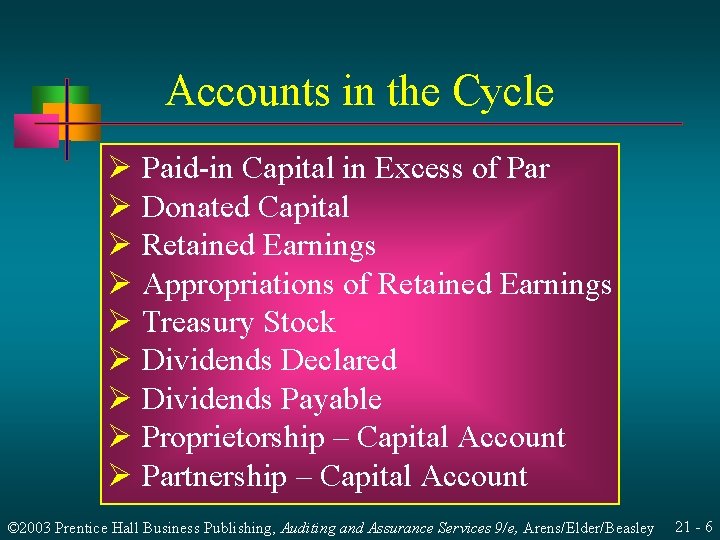
Accounts in the Cycle Ø Paid-in Capital in Excess of Par Ø Donated Capital Ø Retained Earnings Ø Appropriations of Retained Earnings Ø Treasury Stock Ø Dividends Declared Ø Dividends Payable Ø Proprietorship – Capital Account Ø Partnership – Capital Account © 2003 Prentice Hall Business Publishing, Auditing and Assurance Services 9/e, Arens/Elder/Beasley 21 - 6
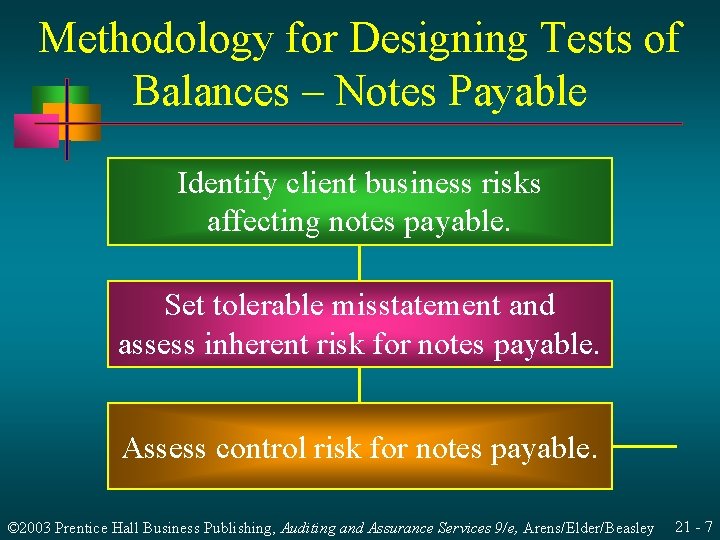
Methodology for Designing Tests of Balances – Notes Payable Identify client business risks affecting notes payable. Set tolerable misstatement and assess inherent risk for notes payable. Assess control risk for notes payable. © 2003 Prentice Hall Business Publishing, Auditing and Assurance Services 9/e, Arens/Elder/Beasley 21 - 7
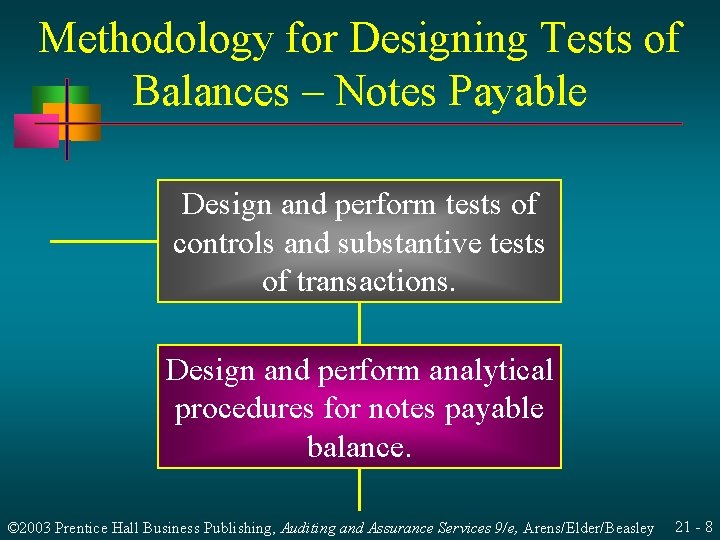
Methodology for Designing Tests of Balances – Notes Payable Design and perform tests of controls and substantive tests of transactions. Design and perform analytical procedures for notes payable balance. © 2003 Prentice Hall Business Publishing, Auditing and Assurance Services 9/e, Arens/Elder/Beasley 21 - 8
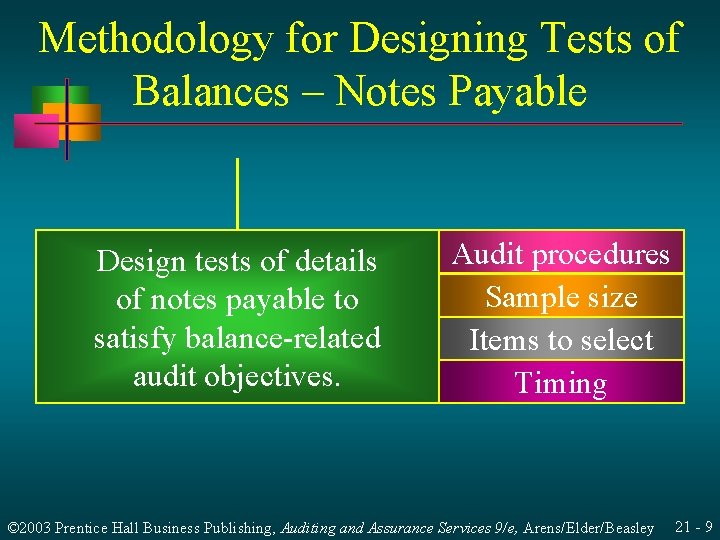
Methodology for Designing Tests of Balances – Notes Payable Design tests of details of notes payable to satisfy balance-related audit objectives. Audit procedures Sample size Items to select Timing © 2003 Prentice Hall Business Publishing, Auditing and Assurance Services 9/e, Arens/Elder/Beasley 21 - 9
Learning Objective 2 Design and perform audit tests of notes payable and related accounts and transactions. © 2003 Prentice Hall Business Publishing, Auditing and Assurance Services 9/e, Arens/Elder/Beasley 21 - 10
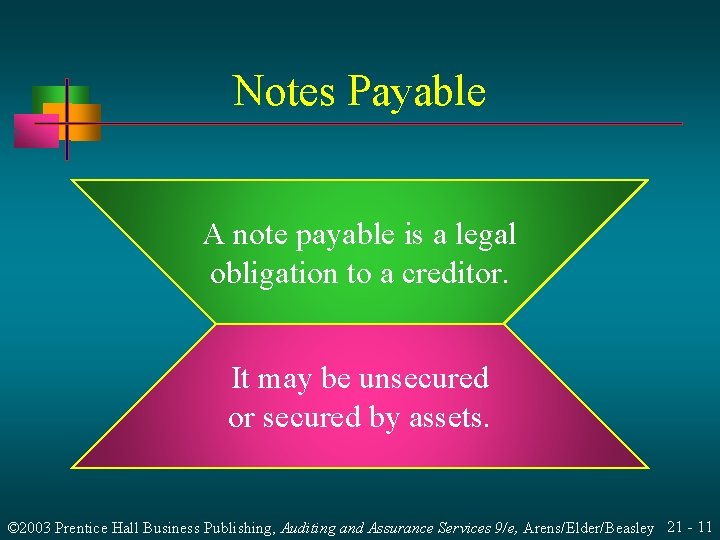
Notes Payable A note payable is a legal obligation to a creditor. It may be unsecured or secured by assets. © 2003 Prentice Hall Business Publishing, Auditing and Assurance Services 9/e, Arens/Elder/Beasley 21 - 11
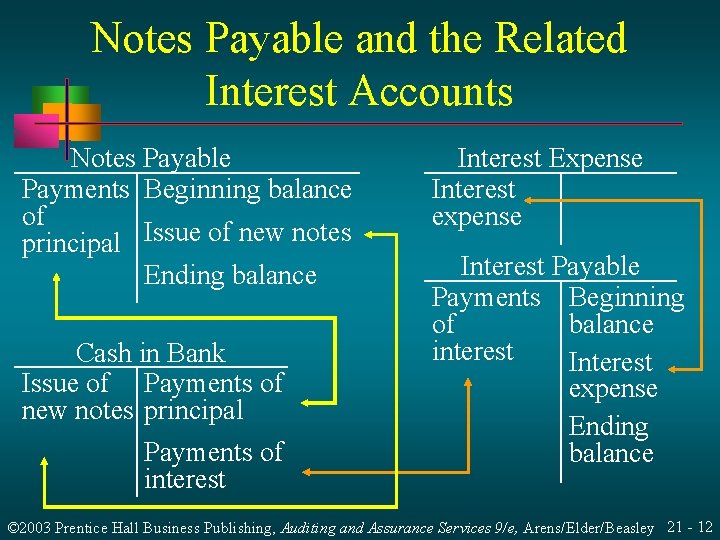
Notes Payable and the Related Interest Accounts Notes Payable Payments Beginning balance of principal Issue of new notes Ending balance Cash in Bank Issue of Payments of new notes principal Payments of interest Interest Expense Interest expense Interest Payable Payments Beginning of balance interest Interest expense Ending balance © 2003 Prentice Hall Business Publishing, Auditing and Assurance Services 9/e, Arens/Elder/Beasley 21 - 12
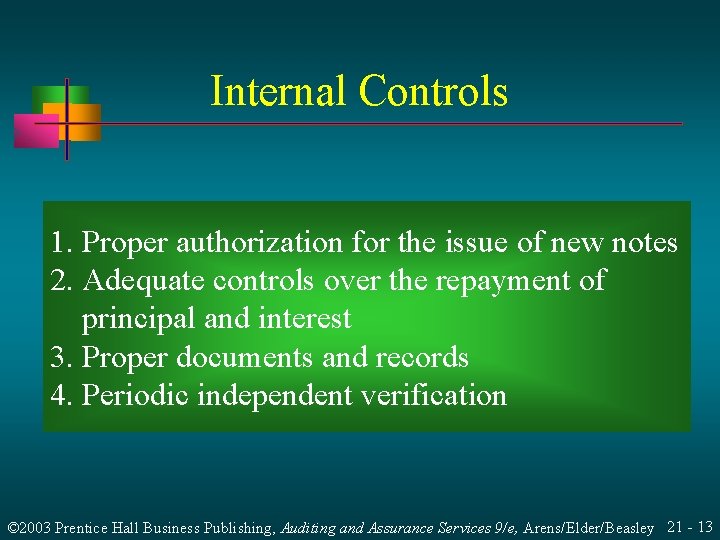
Internal Controls 1. Proper authorization for the issue of new notes 2. Adequate controls over the repayment of principal and interest 3. Proper documents and records 4. Periodic independent verification © 2003 Prentice Hall Business Publishing, Auditing and Assurance Services 9/e, Arens/Elder/Beasley 21 - 13
Tests of Controls and Substantive Tests of Transactions Tests of notes payable transactions involve the issue of notes and the repayment of principal and interest. © 2003 Prentice Hall Business Publishing, Auditing and Assurance Services 9/e, Arens/Elder/Beasley 21 - 14
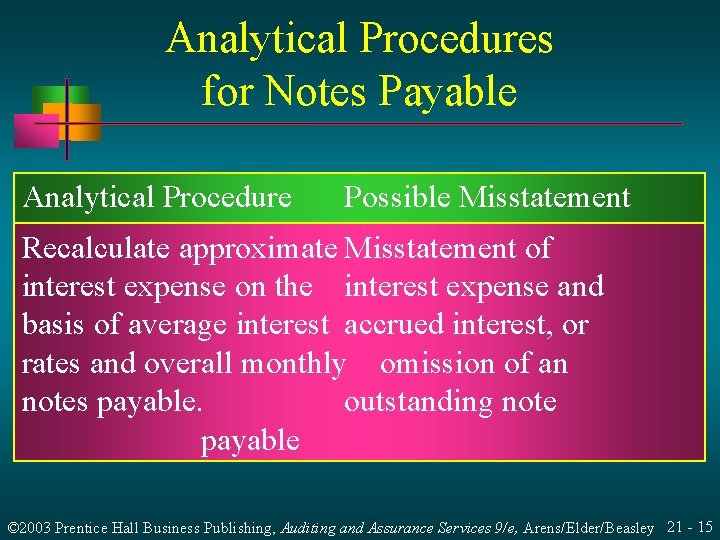
Analytical Procedures for Notes Payable Analytical Procedure Possible Misstatement Recalculate approximate Misstatement of interest expense on the interest expense and basis of average interest accrued interest, or rates and overall monthly omission of an notes payable. outstanding note payable © 2003 Prentice Hall Business Publishing, Auditing and Assurance Services 9/e, Arens/Elder/Beasley 21 - 15
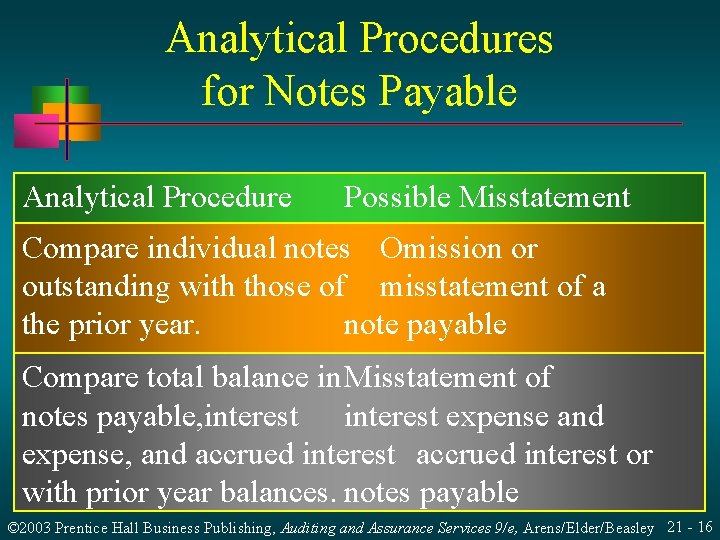
Analytical Procedures for Notes Payable Analytical Procedure Possible Misstatement Compare individual notes Omission or outstanding with those of misstatement of a the prior year. note payable Compare total balance in. Misstatement of notes payable, interest expense and expense, and accrued interest or with prior year balances. notes payable © 2003 Prentice Hall Business Publishing, Auditing and Assurance Services 9/e, Arens/Elder/Beasley 21 - 16
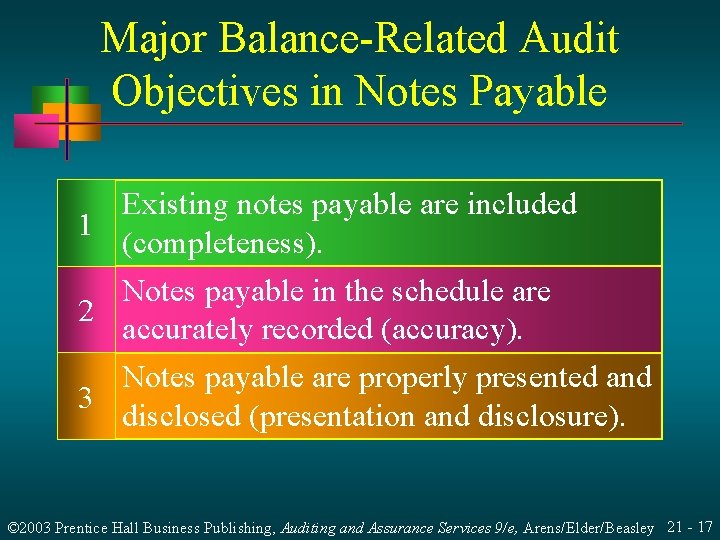
Major Balance-Related Audit Objectives in Notes Payable Existing notes payable are included 1 (completeness). Notes payable in the schedule are 2 accurately recorded (accuracy). Notes payable are properly presented and 3 disclosed (presentation and disclosure). © 2003 Prentice Hall Business Publishing, Auditing and Assurance Services 9/e, Arens/Elder/Beasley 21 - 17
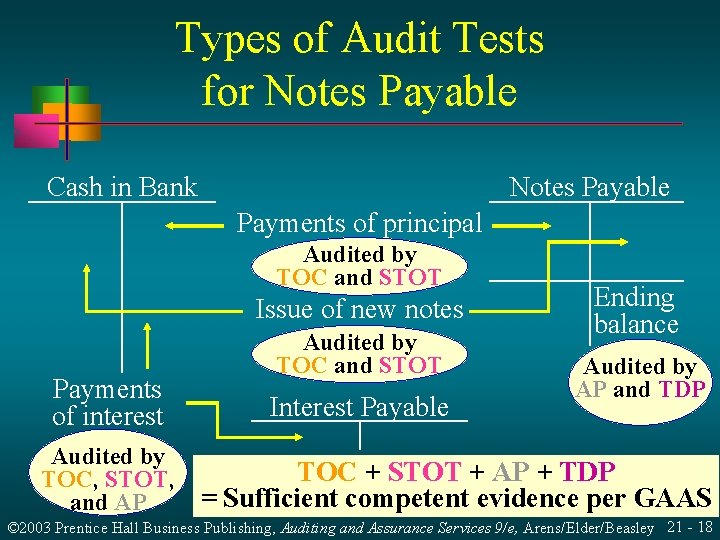
Types of Audit Tests for Notes Payable Cash in Bank Notes Payable Payments of principal Audited by TOC and STOT Issue of new notes Payments of interest Audited by TOC, STOT, and AP Audited by TOC and STOT Interest Payable Ending balance Audited by AP and TDP TOC + STOT + AP + TDP = Sufficient competent evidence per GAAS © 2003 Prentice Hall Business Publishing, Auditing and Assurance Services 9/e, Arens/Elder/Beasley 21 - 18
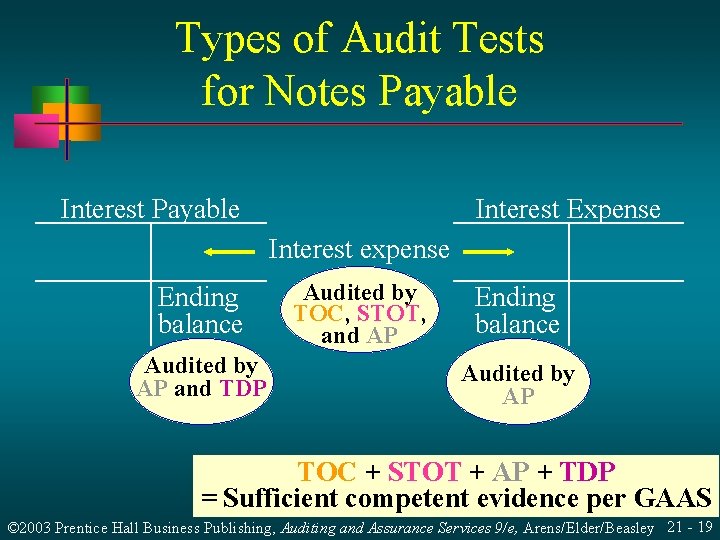
Types of Audit Tests for Notes Payable Interest Expense Interest expense Ending balance Audited by AP and TDP Audited by TOC, STOT, and AP Ending balance Audited by AP TOC + STOT + AP + TDP = Sufficient competent evidence per GAAS © 2003 Prentice Hall Business Publishing, Auditing and Assurance Services 9/e, Arens/Elder/Beasley 21 - 19
Learning Objective 3 Identify the primary concerns in the audit of owners’ equity transactions. © 2003 Prentice Hall Business Publishing, Auditing and Assurance Services 9/e, Arens/Elder/Beasley 21 - 20
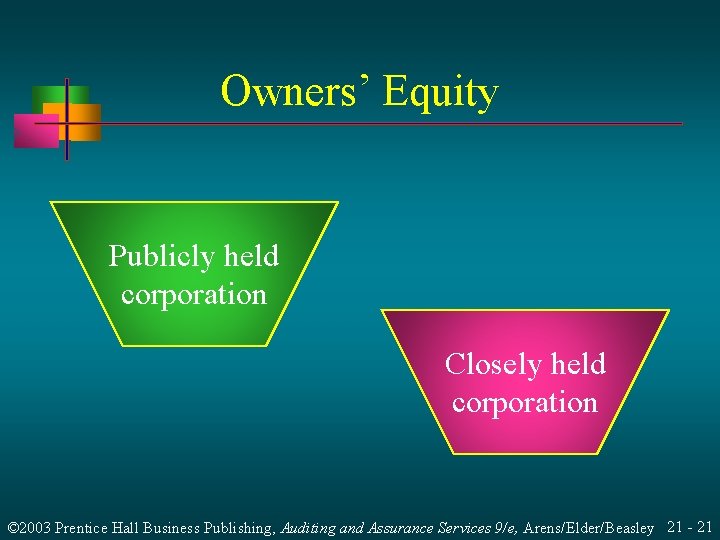
Owners’ Equity Publicly held corporation Closely held corporation © 2003 Prentice Hall Business Publishing, Auditing and Assurance Services 9/e, Arens/Elder/Beasley 21 - 21
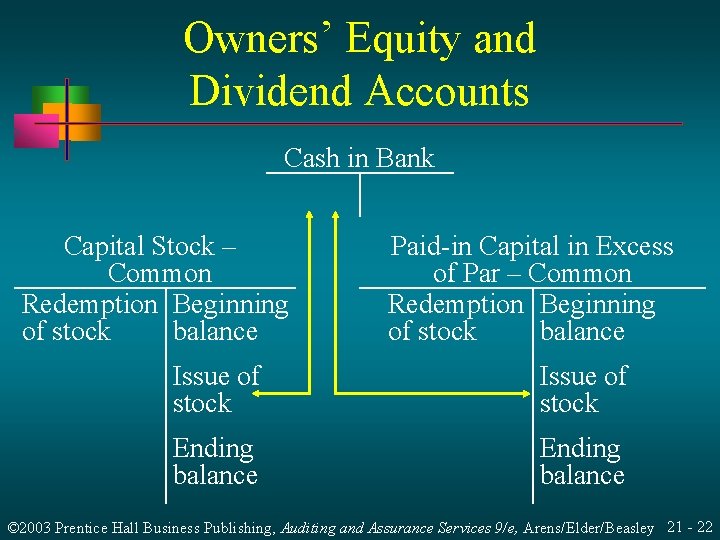
Owners’ Equity and Dividend Accounts Cash in Bank Capital Stock – Common Redemption Beginning of stock balance Paid-in Capital in Excess of Par – Common Redemption Beginning of stock balance Issue of stock Ending balance © 2003 Prentice Hall Business Publishing, Auditing and Assurance Services 9/e, Arens/Elder/Beasley 21 - 22
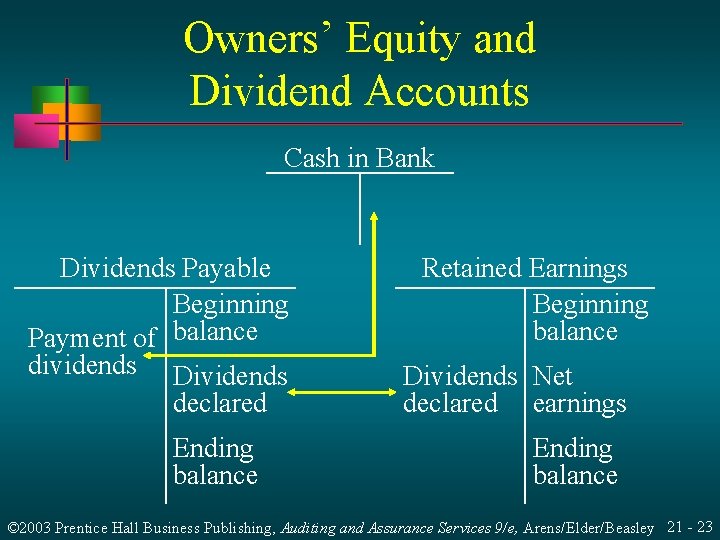
Owners’ Equity and Dividend Accounts Cash in Bank Dividends Payable Beginning Payment of balance dividends Dividends declared Ending balance Retained Earnings Beginning balance Dividends Net declared earnings Ending balance © 2003 Prentice Hall Business Publishing, Auditing and Assurance Services 9/e, Arens/Elder/Beasley 21 - 23
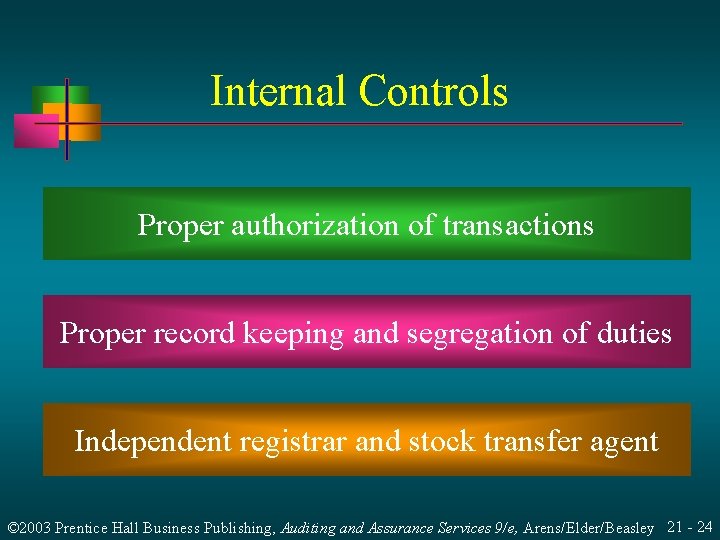
Internal Controls Proper authorization of transactions Proper record keeping and segregation of duties Independent registrar and stock transfer agent © 2003 Prentice Hall Business Publishing, Auditing and Assurance Services 9/e, Arens/Elder/Beasley 21 - 24
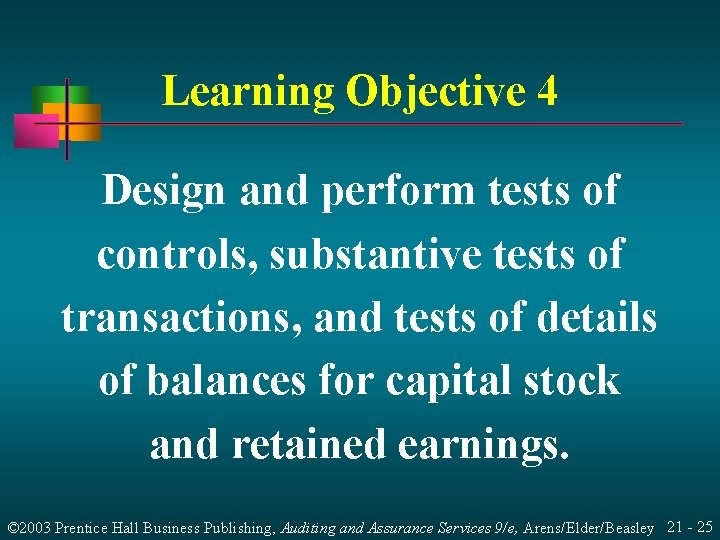
Learning Objective 4 Design and perform tests of controls, substantive tests of transactions, and tests of details of balances for capital stock and retained earnings. © 2003 Prentice Hall Business Publishing, Auditing and Assurance Services 9/e, Arens/Elder/Beasley 21 - 25
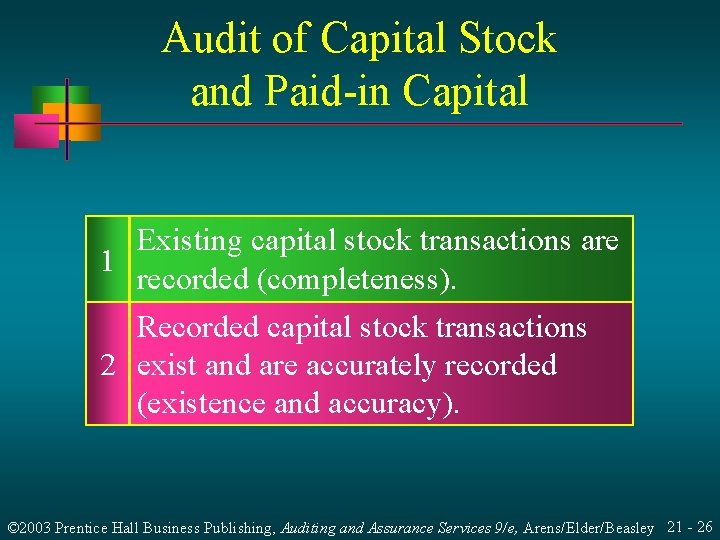
Audit of Capital Stock and Paid-in Capital Existing capital stock transactions are 1 recorded (completeness). Recorded capital stock transactions 2 exist and are accurately recorded (existence and accuracy). © 2003 Prentice Hall Business Publishing, Auditing and Assurance Services 9/e, Arens/Elder/Beasley 21 - 26
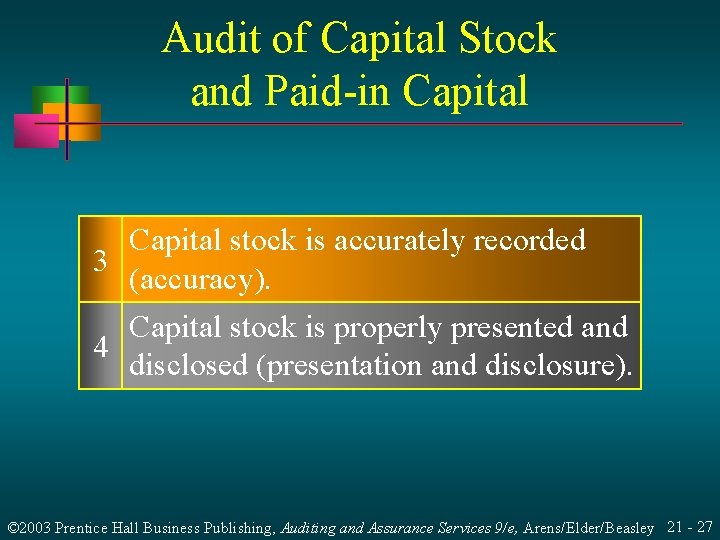
Audit of Capital Stock and Paid-in Capital stock is accurately recorded 3 (accuracy). Capital stock is properly presented and 4 disclosed (presentation and disclosure). © 2003 Prentice Hall Business Publishing, Auditing and Assurance Services 9/e, Arens/Elder/Beasley 21 - 27
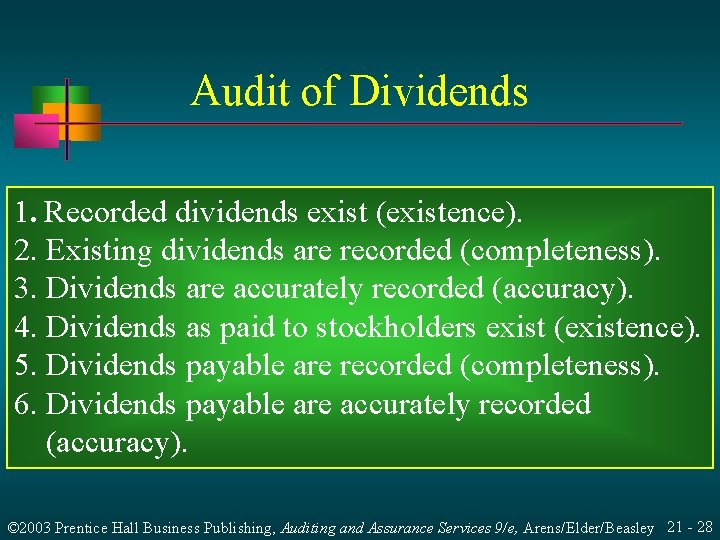
Audit of Dividends 1. Recorded dividends exist (existence). 2. Existing dividends are recorded (completeness). 3. Dividends are accurately recorded (accuracy). 4. Dividends as paid to stockholders exist (existence). 5. Dividends payable are recorded (completeness). 6. Dividends payable are accurately recorded (accuracy). © 2003 Prentice Hall Business Publishing, Auditing and Assurance Services 9/e, Arens/Elder/Beasley 21 - 28
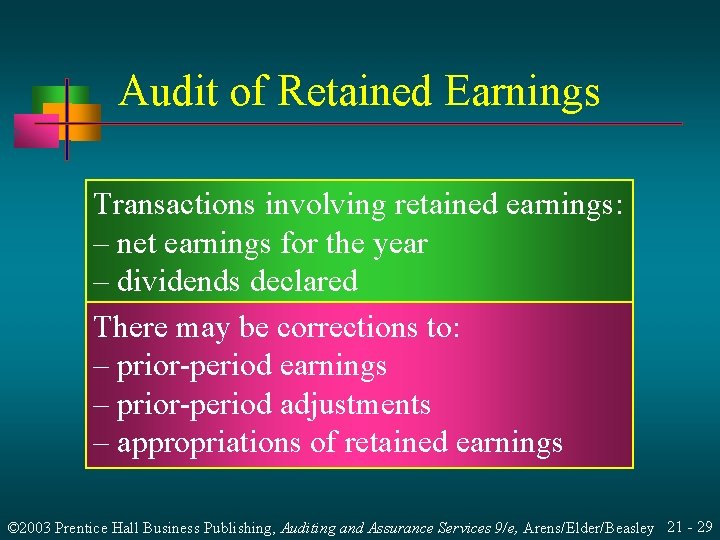
Audit of Retained Earnings Transactions involving retained earnings: – net earnings for the year – dividends declared There may be corrections to: – prior-period earnings – prior-period adjustments – appropriations of retained earnings © 2003 Prentice Hall Business Publishing, Auditing and Assurance Services 9/e, Arens/Elder/Beasley 21 - 29
Learning Objective 5 Identify capital acquisition issues for Internet-based companies. © 2003 Prentice Hall Business Publishing, Auditing and Assurance Services 9/e, Arens/Elder/Beasley 21 - 30
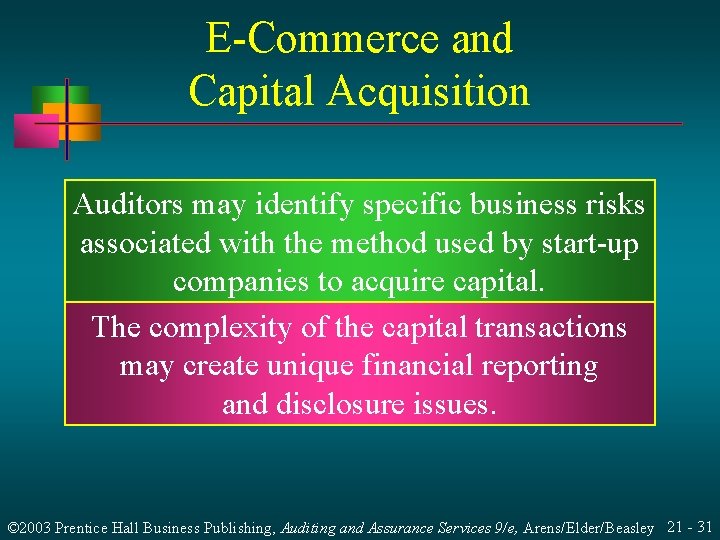
E-Commerce and Capital Acquisition Auditors may identify specific business risks associated with the method used by start-up companies to acquire capital. The complexity of the capital transactions may create unique financial reporting and disclosure issues. © 2003 Prentice Hall Business Publishing, Auditing and Assurance Services 9/e, Arens/Elder/Beasley 21 - 31
End of Chapter 21 © 2003 Prentice Hall Business Publishing, Auditing and Assurance Services 9/e, Arens/Elder/Beasley 21 - 32