
Audit Its a Process Presented by Jackie Gonzalez
Audit: It’s a Process Presented by: Jackie Gonzalez
Agenda • • • The Basics Audit Process Common Challenges Preparation Tips Discussion 2

The Basics
THE BASICS – WHAT? The objectives of our audit are • the expression of opinions as to whether your basic financial statements are fairly presented, in all material aspects. • the reporting on internal control related to the financial statements and compliance with the provisions of laws, regulations, contracts, and grant agreements, noncompliance with which could have a material effect on the financial statements in accordance with Government Auditing Standards • • The reporting on internal control over compliance related to major programs the expression of an opinion (or disclaimer of opinion) on compliance with federal statutes, regulations, and the terms and conditions of federal awards that could have a direct and material effect on each major program in accordance with the Single Audit Act Amendments of 1996 and Title 2 U. S. Code of Federal Regulations (CFR) Part 200, Uniform Administrative Requirements, Cost Principles, and Audit Requirements for Federal Awards (Uniform Guidance). 4
THE BASICS – WHY? • Required by Texas Administrative Code, Title 19, Part 2, Chapter 109, Subchapter B http: //texreg. sos. state. tx. us/public/readtac$ext. Tac. Page? sl=R&app=9&p_dir=&p_rloc=&p_tloc=&p_ploc =&pg=1&p_tac=&ti=19&pt=2&ch=109&rl=23 • If the District or educational entity expends more than $750, 000 in federal awards, a Single Audit is also required by Uniform Guidance (Subpart F). https: //www. ecfr. gov/cgi-bin/textidx? SID=fb 8 c 03 bc 486 ee 3163 c 5 f 9 be 893 ae 11 d 1&mc=true&node=se 2. 1. 200_1501&rgn=div 8 • Provides financial transparency to the educational entity’s board, tax payers and those they serve 5
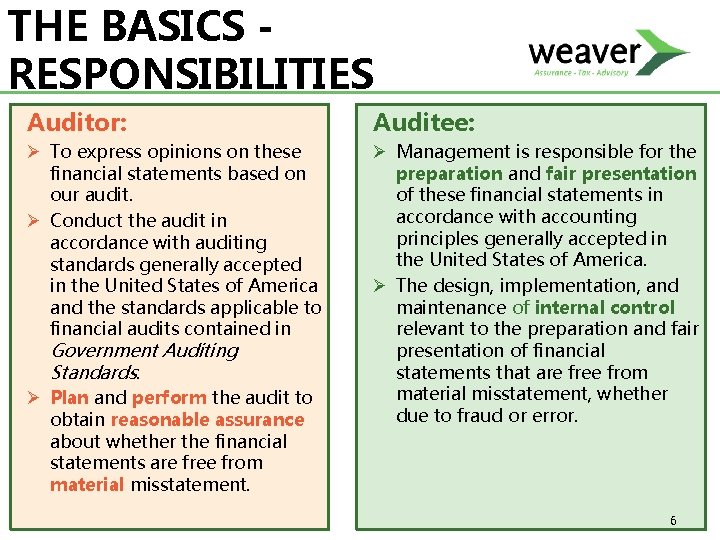
THE BASICS RESPONSIBILITIES Auditor: Auditee: Ø To express opinions on these financial statements based on our audit. Ø Conduct the audit in accordance with auditing standards generally accepted in the United States of America and the standards applicable to financial audits contained in Government Auditing Standards. Ø Plan and perform the audit to obtain reasonable assurance about whether the financial statements are free from material misstatement. Ø Management is responsible for the preparation and fair presentation of these financial statements in accordance with accounting principles generally accepted in the United States of America. Ø The design, implementation, and maintenance of internal control relevant to the preparation and fair presentation of financial statements that are free from material misstatement, whether due to fraud or error. 6
Audit Process
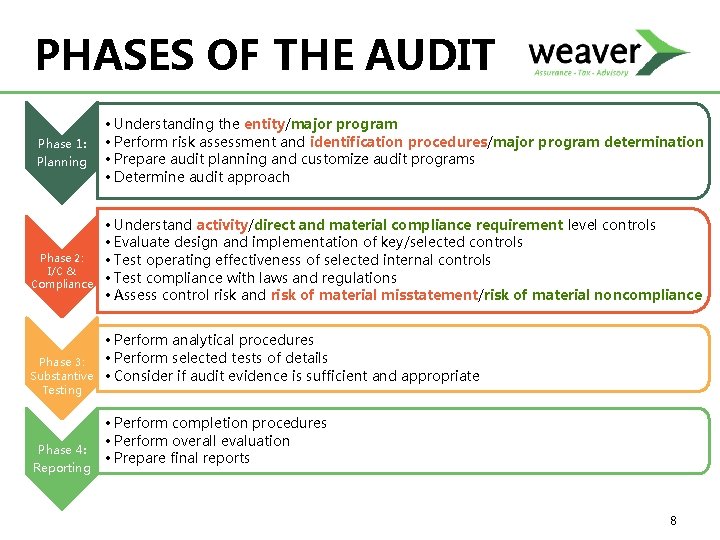
PHASES OF THE AUDIT Phase 1: Planning Phase 2: I/C & Compliance Phase 3: Substantive Testing Phase 4: Reporting • Understanding the entity/major program • Perform risk assessment and identification procedures/major program determination • Prepare audit planning and customize audit programs • Determine audit approach • Understand activity/direct and material compliance requirement level controls • Evaluate design and implementation of key/selected controls • Test operating effectiveness of selected internal controls • Test compliance with laws and regulations • Assess control risk and risk of material misstatement/risk of material noncompliance • Perform analytical procedures • Perform selected tests of details • Consider if audit evidence is sufficient and appropriate • Perform completion procedures • Perform overall evaluation • Prepare final reports 8
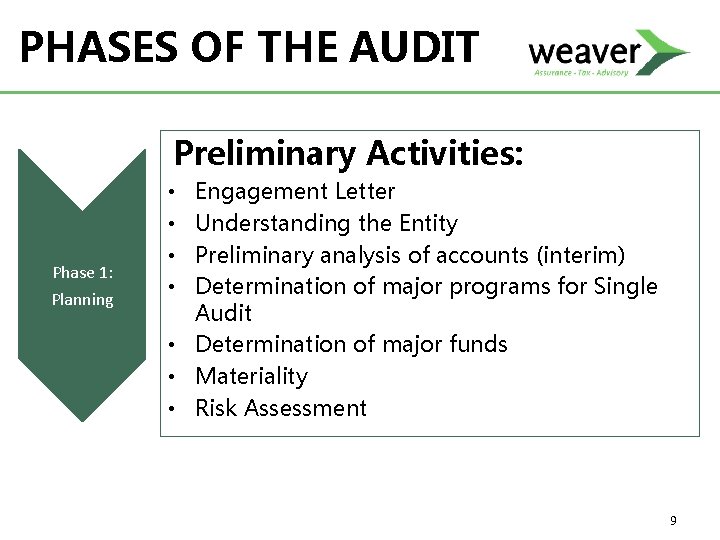
PHASES OF THE AUDIT Preliminary Activities: Phase 1: Planning Engagement Letter Understanding the Entity Preliminary analysis of accounts (interim) Determination of major programs for Single Audit • Determination of major funds • Materiality • Risk Assessment • • 9
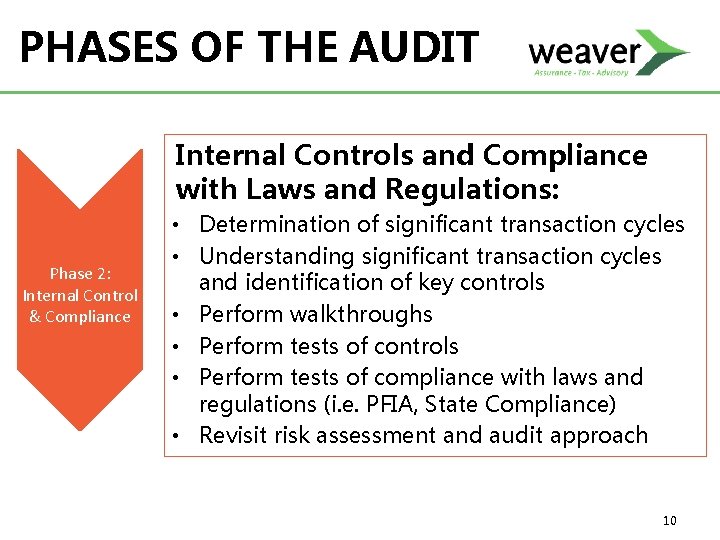
PHASES OF THE AUDIT Internal Controls and Compliance with Laws and Regulations: Phase 2: Internal Control & Compliance • Determination of significant transaction cycles • Understanding significant transaction cycles and identification of key controls • Perform walkthroughs • Perform tests of controls • Perform tests of compliance with laws and regulations (i. e. PFIA, State Compliance) • Revisit risk assessment and audit approach 10

PHASES OF THE AUDIT Substantive Tests: • Test of financial statement balances by opinion unit PHASE 3: SUBSTANTIVE TESTING – Analytics – Test of material or important items – Detail test of transactions • Fraud Responses • If Single Audit – test of compliance 11
Common Challenges
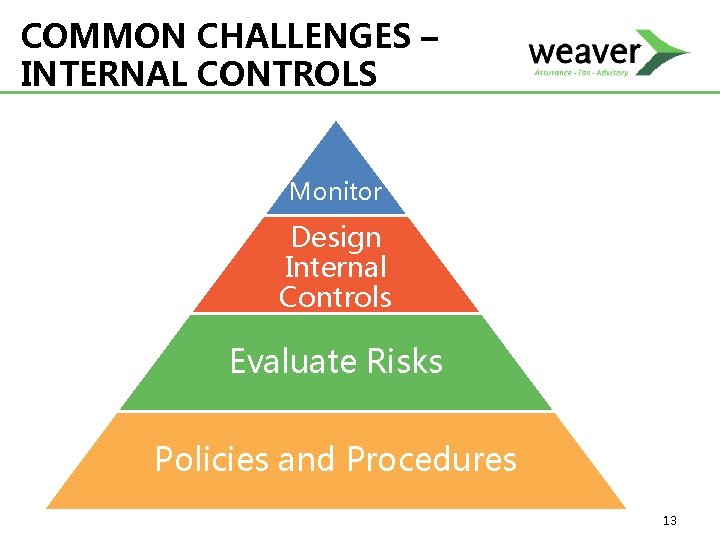
COMMON CHALLENGES – INTERNAL CONTROLS Monitor Design Internal Controls Evaluate Risks Policies and Procedures 13
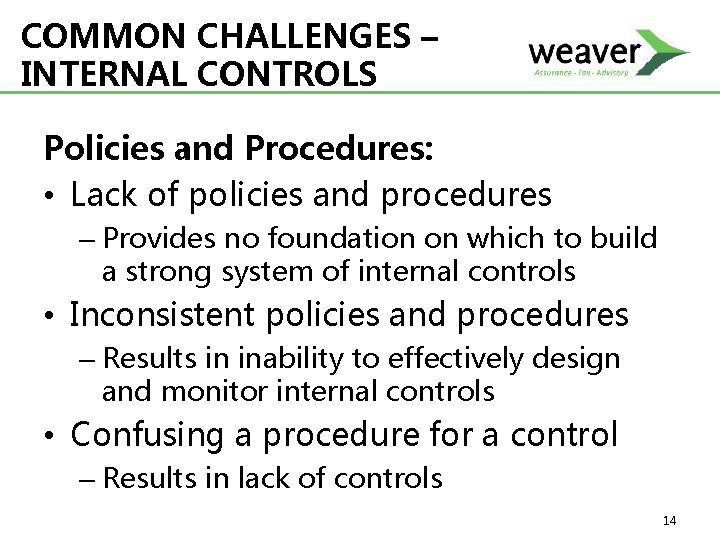
COMMON CHALLENGES – INTERNAL CONTROLS Policies and Procedures: • Lack of policies and procedures – Provides no foundation on which to build a strong system of internal controls • Inconsistent policies and procedures – Results in inability to effectively design and monitor internal controls • Confusing a procedure for a control – Results in lack of controls 14

COMMON CHALLENGES – INTERNAL CONTROLS Procedure • • Originate, transfer or change data Can introduce errors Example: Employees complete their timesheets Control • Procedures designed to prevent, detect and correct errors resulting from processing of accounting information • Cannot generate errors Example: Department supervisor approves timesheets 15
COMMON CHALLENGES – INTERNAL CONTROLS Internal Controls: • Poorly designed controls – Control will not prevent or detect errors • inappropriate person reviewing/approving • Control is that PO’s must be approved but not all purchases require PO • Lack of evidence – Without evidence there is no proof (i. e. audit trail) that the control occurred • Control is not operating as designed – Inconsistently (i. e. monthly balance sheet reconciliations only performed for 10 months) 16
COMMON CHALLENGES – SUBSTANTIVE TESTING Financial Statements Areas: • Pooled Cash • Capital Assets • Student Activity Funds vs. Campus Activity Funds • Leases – Capital vs. Operating • Fund Balances 17
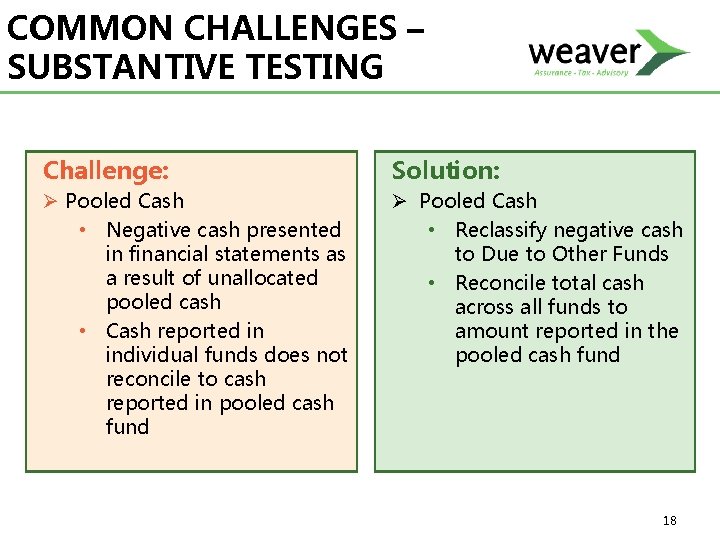
COMMON CHALLENGES – SUBSTANTIVE TESTING Challenge: Solution: Ø Pooled Cash • Negative cash presented in financial statements as a result of unallocated pooled cash • Cash reported in individual funds does not reconcile to cash reported in pooled cash fund Ø Pooled Cash • Reclassify negative cash to Due to Other Funds • Reconcile total cash across all funds to amount reported in the pooled cash fund 18
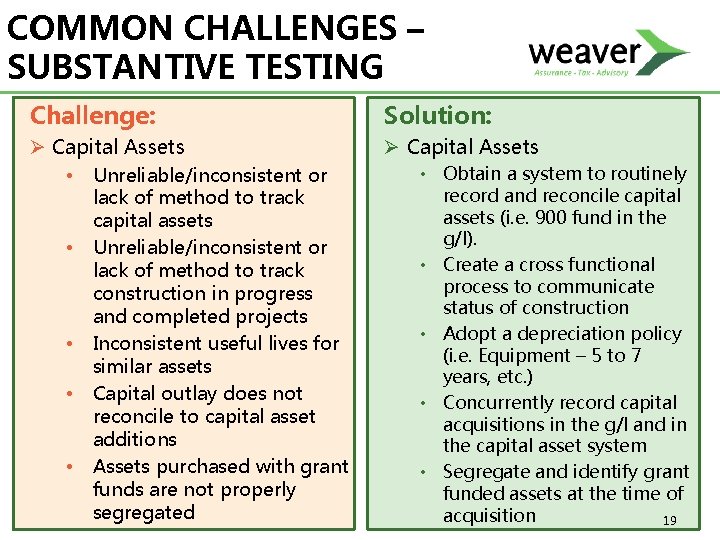
COMMON CHALLENGES – SUBSTANTIVE TESTING Challenge: Solution: Ø Capital Assets • Unreliable/inconsistent or Ø Capital Assets • • lack of method to track capital assets Unreliable/inconsistent or lack of method to track construction in progress and completed projects Inconsistent useful lives for similar assets Capital outlay does not reconcile to capital asset additions Assets purchased with grant funds are not properly segregated • Obtain a system to routinely record and reconcile capital assets (i. e. 900 fund in the g/l). • Create a cross functional process to communicate status of construction • Adopt a depreciation policy (i. e. Equipment – 5 to 7 years, etc. ) • Concurrently record capital acquisitions in the g/l and in the capital asset system • Segregate and identify grant funded assets at the time of acquisition 19
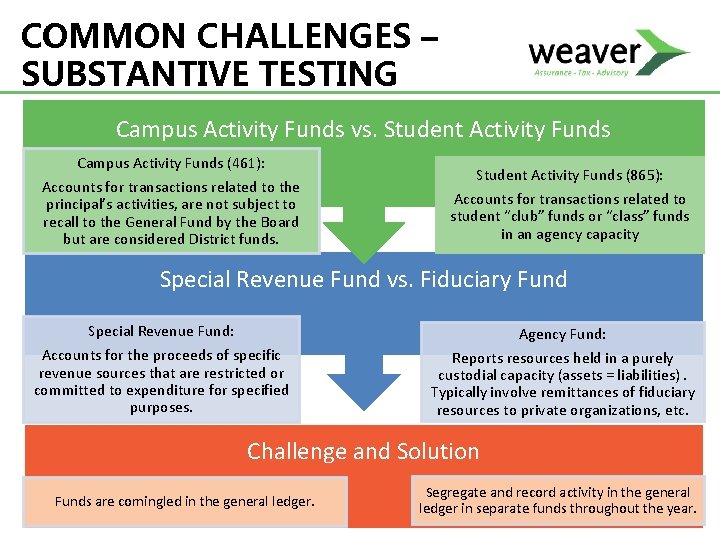
COMMON CHALLENGES – SUBSTANTIVE TESTING Campus Activity Funds vs. Student Activity Funds Campus Activity Funds (461): Accounts for transactions related to the principal’s activities, are not subject to recall to the General Fund by the Board but are considered District funds. Student Activity Funds (865): Accounts for transactions related to student “club” funds or “class” funds in an agency capacity Special Revenue Fund vs. Fiduciary Fund Special Revenue Fund: Accounts for the proceeds of specific revenue sources that are restricted or committed to expenditure for specified purposes. Agency Fund: Reports resources held in a purely custodial capacity (assets = liabilities). Typically involve remittances of fiduciary resources to private organizations, etc. Challenge and Solution Funds are comingled in the general ledger. Segregate and record activity in the general ledger in separate funds throughout the year. 20
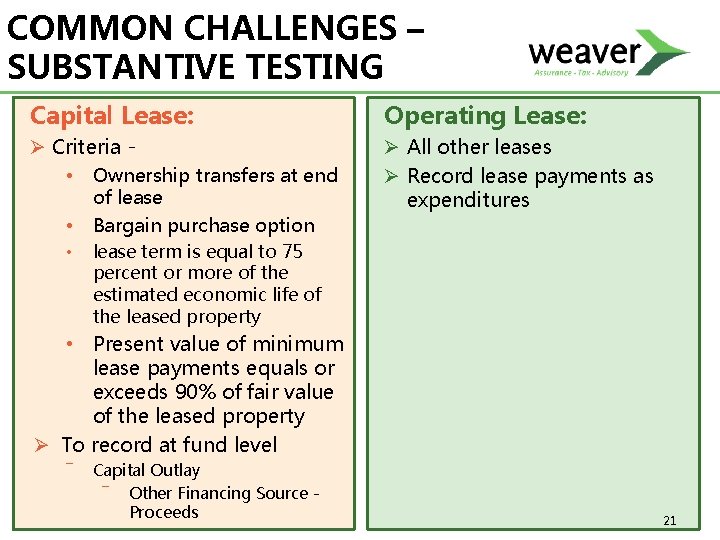
COMMON CHALLENGES – SUBSTANTIVE TESTING Capital Lease: Operating Lease: Ø Criteria • Ownership transfers at end Ø All other leases Ø Record lease payments as expenditures • • of lease Bargain purchase option lease term is equal to 75 percent or more of the estimated economic life of the leased property • Present value of minimum lease payments equals or exceeds 90% of fair value of the leased property Ø To record at fund level ― Capital Outlay ― Other Financing Source Proceeds 21
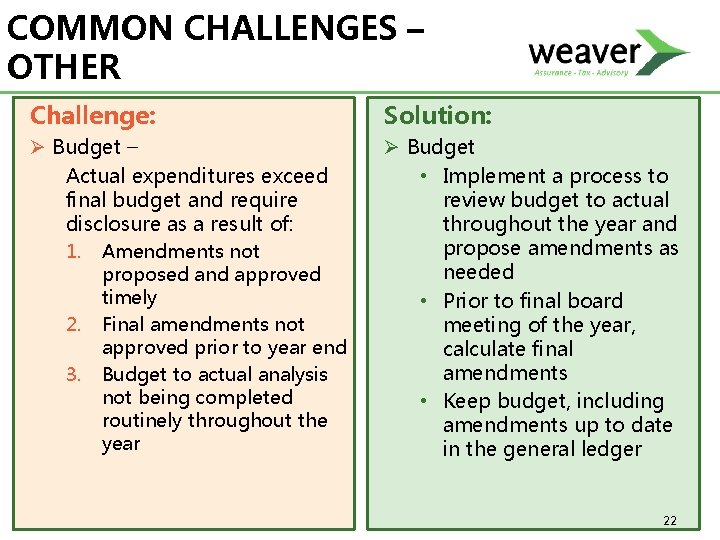
COMMON CHALLENGES – OTHER Challenge: Solution: Ø Budget – Actual expenditures exceed final budget and require disclosure as a result of: 1. Amendments not Ø Budget • Implement a process to review budget to actual throughout the year and propose amendments as needed • Prior to final board meeting of the year, calculate final amendments • Keep budget, including amendments up to date in the general ledger 2. 3. proposed and approved timely Final amendments not approved prior to year end Budget to actual analysis not being completed routinely throughout the year 22
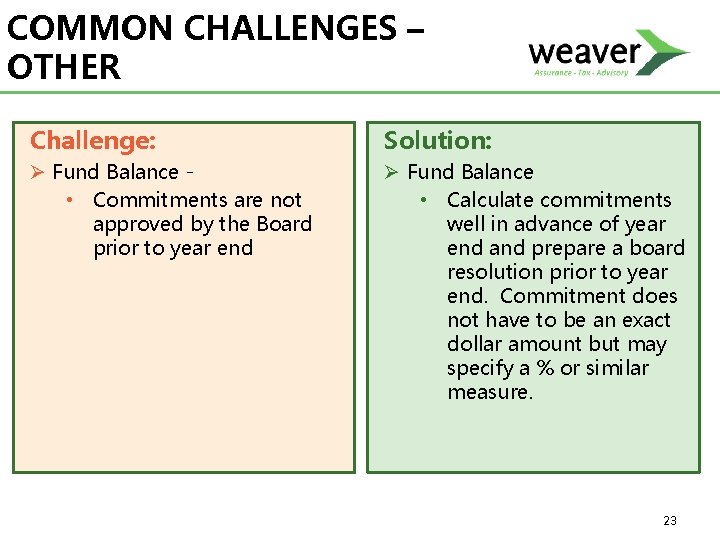
COMMON CHALLENGES – OTHER Challenge: Solution: Ø Fund Balance • Commitments are not approved by the Board prior to year end Ø Fund Balance • Calculate commitments well in advance of year end and prepare a board resolution prior to year end. Commitment does not have to be an exact dollar amount but may specify a % or similar measure. 23
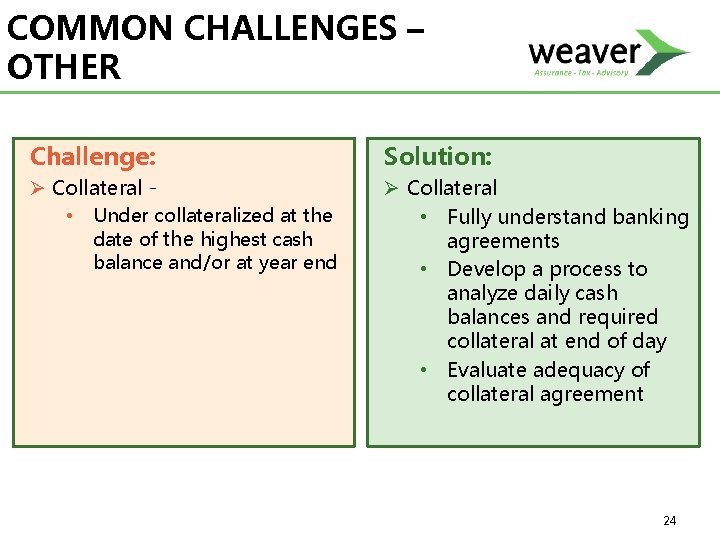
COMMON CHALLENGES – OTHER Challenge: Solution: Ø Collateral • Under collateralized at the date of the highest cash Ø Collateral • Fully understand banking agreements • Develop a process to analyze daily cash balances and required collateral at end of day • Evaluate adequacy of collateral agreement balance and/or at year end 24
Preparation Tips
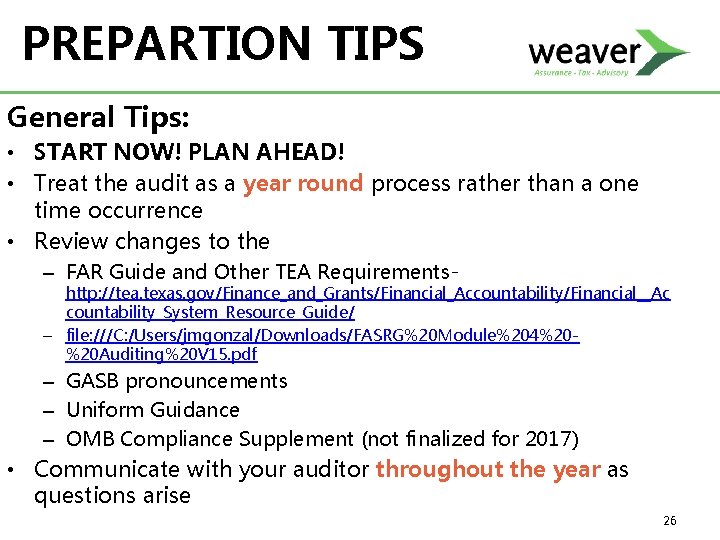
PREPARTION TIPS General Tips: • START NOW! PLAN AHEAD! • Treat the audit as a year round process rather than a one time occurrence • Review changes to the – FAR Guide and Other TEA Requirements- http: //tea. texas. gov/Finance_and_Grants/Financial_Accountability/Financial__Ac countability_System_Resource_Guide/ – file: ///C: /Users/jmgonzal/Downloads/FASRG%20 Module%204%20%20 Auditing%20 V 15. pdf – GASB pronouncements – Uniform Guidance – OMB Compliance Supplement (not finalized for 2017) • Communicate with your auditor throughout the year as questions arise 26
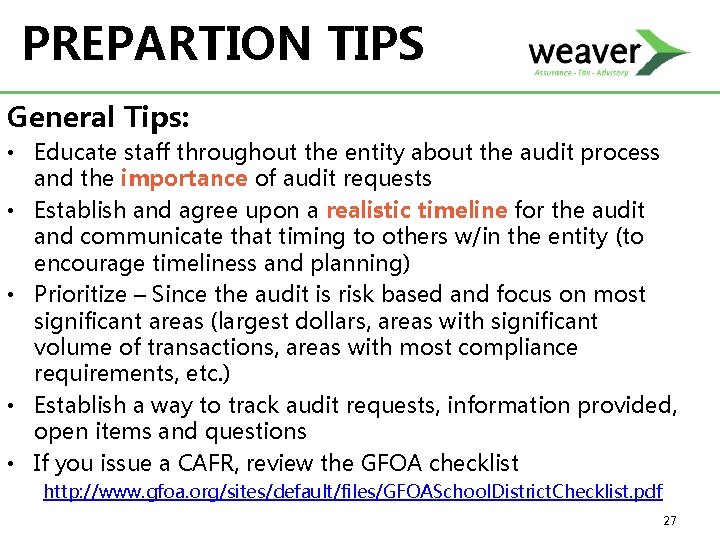
PREPARTION TIPS General Tips: • Educate staff throughout the entity about the audit process and the importance of audit requests • Establish and agree upon a realistic timeline for the audit and communicate that timing to others w/in the entity (to encourage timeliness and planning) • Prioritize – Since the audit is risk based and focus on most significant areas (largest dollars, areas with significant volume of transactions, areas with most compliance requirements, etc. ) • Establish a way to track audit requests, information provided, open items and questions • If you issue a CAFR, review the GFOA checklist http: //www. gfoa. org/sites/default/files/GFOASchool. District. Checklist. pdf 27
PREPARTION TIPS Balance Sheet: Fund Balance – • Ensure that fund balance rolls forward – Agee fund balance for each fund per the general ledger to the prior year audit report. – IF these amounts do not agree, an entry is required because no journal entries should be posted directly to fund balance throughout the year unless the entry is to reclassify amounts between fund balance classifications. – Ensure all commitments and assigned have been approved and documented 28
PREPARTION TIPS Balance Sheet: Cash – • Ensure all cash accounts are fully reconciled at year end. • Compile all bank reconciliations and bank statements for last month of the year and the following month Accounts Receivable – • Review all balances and determine: – If the balances are accurate – If amounts have been collected subsequent to year. If not should a deferred inflow be record? – If any amounts allowance are adequate – If any amounts should be written off 29
PREPARTION TIPS Property Taxes – • Prepare property tax roll forward (J-1) • Compile information received from the Tax Assessor/Collector • Record “ 60 day accrual” Due to/from– • Ensure internal balances zero across the entity Capital Assets – • Ensure beginning balances agree to prior year audit report • Ensure all capital asset acquisitions have been capture • Reconcile capital outlay to additions • Ensure completed construction projects have been transferred to the appropriate depreciable category • Calculate depreciation and allocate among functions • Ensure all disposals have been captured any gain/loss calculated 30
PREPARTION TIPS Accounts Payable and Accruals– • As invoices are received, review service/receipt date to determine whether or not the invoice should be accrued. • Calculate accrued payroll Long-term Liabilities – • Prepare roll forward, ensure beginning balances agree to prior year audit report • Ensure refundings and capital leases have been record because they may not have had any cash impact. • Prepare amortization schedules (premiums, deferred gain/loss on refundings) • Obtain TRS schedules in order to record Pension Liability and related amounts 31
PREPARTION TIPS Revenue • Review Summary of Finances to ensure Foundation, Per Capita, EDA and IFA revenue has been properly recognized • Review TEA Payment Ledgers to capture any additional adjustments • Prepare a grant roll forward to ensure that revenues = expenditures for expense reimbursement grants. • Agree total expenditures to Schedule of Expenditures of Federal Awards Expenditures and Budget– • Review budget to actual by function and determine reasons for large fluctuations. Internal Service Funds – • Provide documentation for methodology used for internal charges • Reconcile revenue in ISF to expenditures in other funds 32
PREPARTION TIPS Audits can be a daunting and stressful process, however, with an adequate amount of preparation and communication between the you and the auditor, the process can add value to your operations. Being prepared will also save time in the wrap-up stage and allow everyone to have a stress free Thanksgiving (June year end) or Christmas (August year end)! 33

Contact Us Jackie Gonzalez, CPA Partner 817. 882. 7758| Jackie. gonzalez@weaver. com Stephanie Wilson, CPA Manager Discussio n Jackie Gonzalez, CPA | Assurance Partner 817. 882. 7758 | jackie. gonzalez@weaver. com 817. 882. 7336| Stephanie. wilson@weaver. com
- Slides: 34