
Audio Theory What is Sound Sound is vibrations
Audio Theory
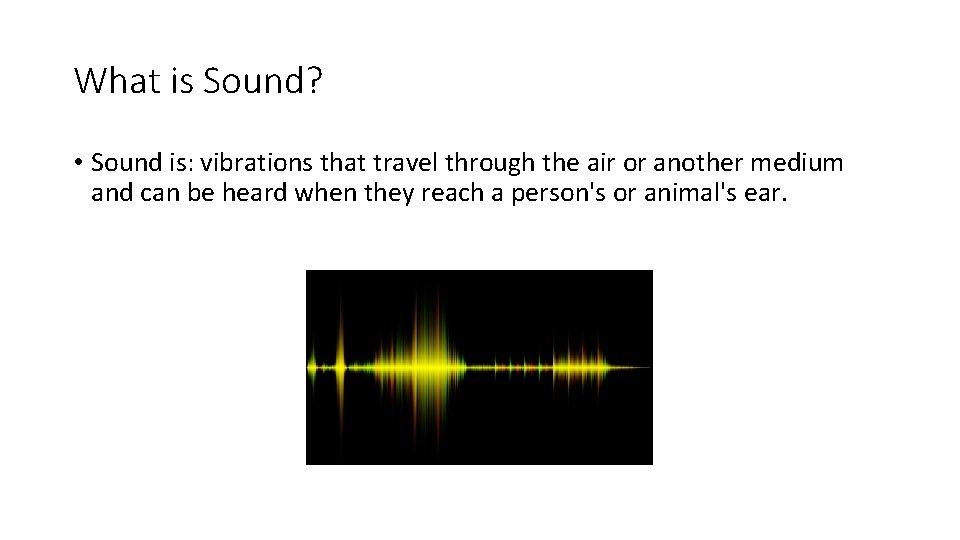
What is Sound? • Sound is: vibrations that travel through the air or another medium and can be heard when they reach a person's or animal's ear.
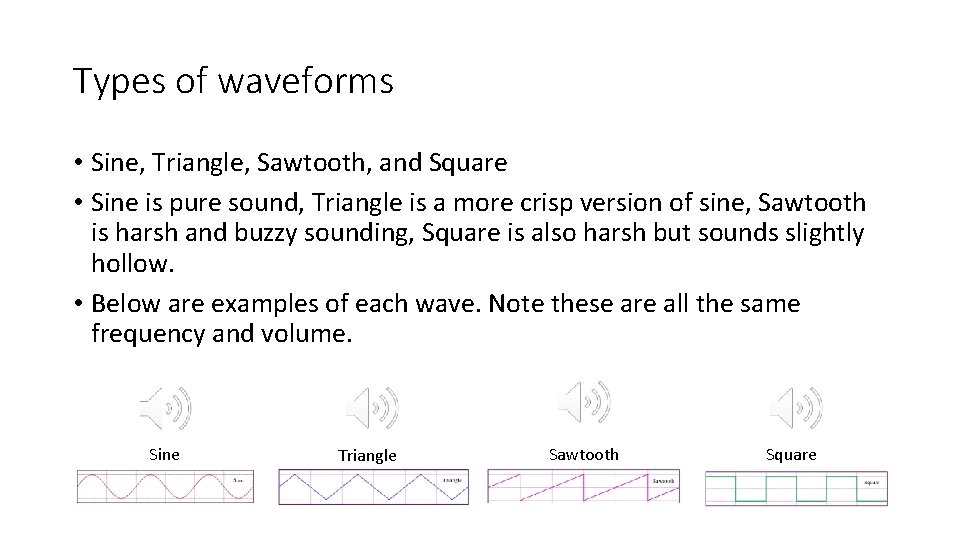
Types of waveforms • Sine, Triangle, Sawtooth, and Square • Sine is pure sound, Triangle is a more crisp version of sine, Sawtooth is harsh and buzzy sounding, Square is also harsh but sounds slightly hollow. • Below are examples of each wave. Note these are all the same frequency and volume. Sine Triangle Sawtooth Square
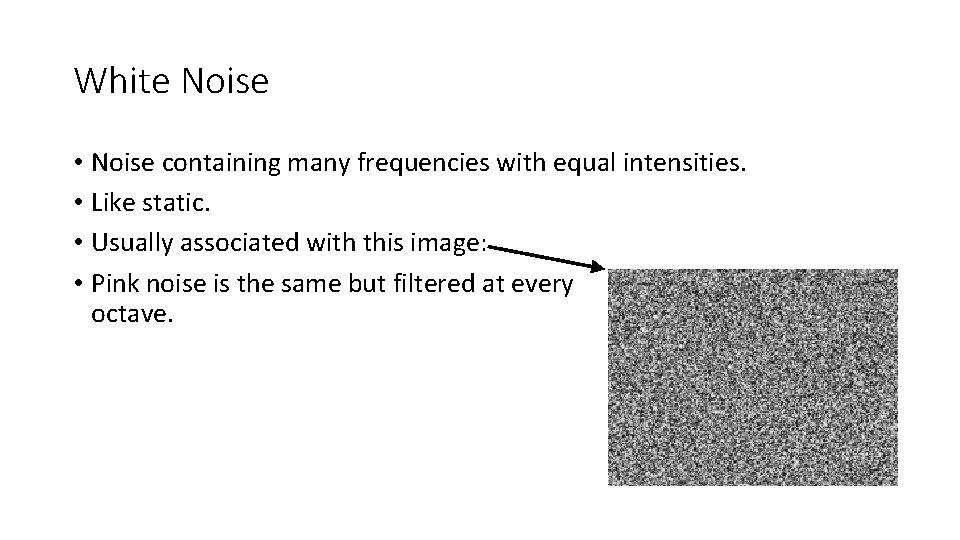
White Noise • Noise containing many frequencies with equal intensities. • Like static. • Usually associated with this image: • Pink noise is the same but filtered at every octave.

Amplitude • Amplitude is the fluctuation or displacement of a wave from its mean value. With sound waves, it is the extent to which air particles are displaced, and this amplitude of sound or sound amplitude is experienced as the loudness of sound. TL; DR: Amplitude is how loud the sound is. • Amplitude is measured in decibels (db).

Wavelength • The distance between successive crests of a wave, especially points in a sound wave.
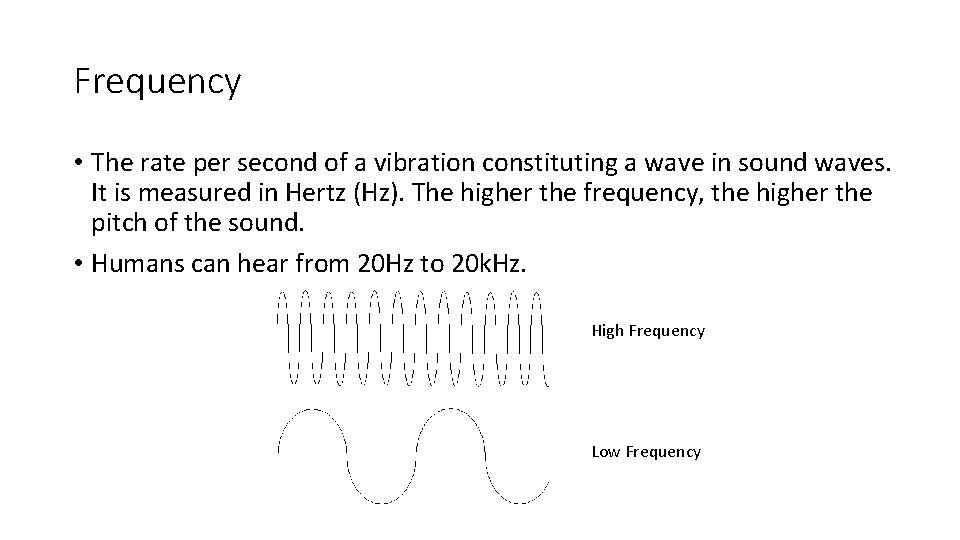
Frequency • The rate per second of a vibration constituting a wave in sound waves. It is measured in Hertz (Hz). The higher the frequency, the higher the pitch of the sound. • Humans can hear from 20 Hz to 20 k. Hz. High Frequency Low Frequency
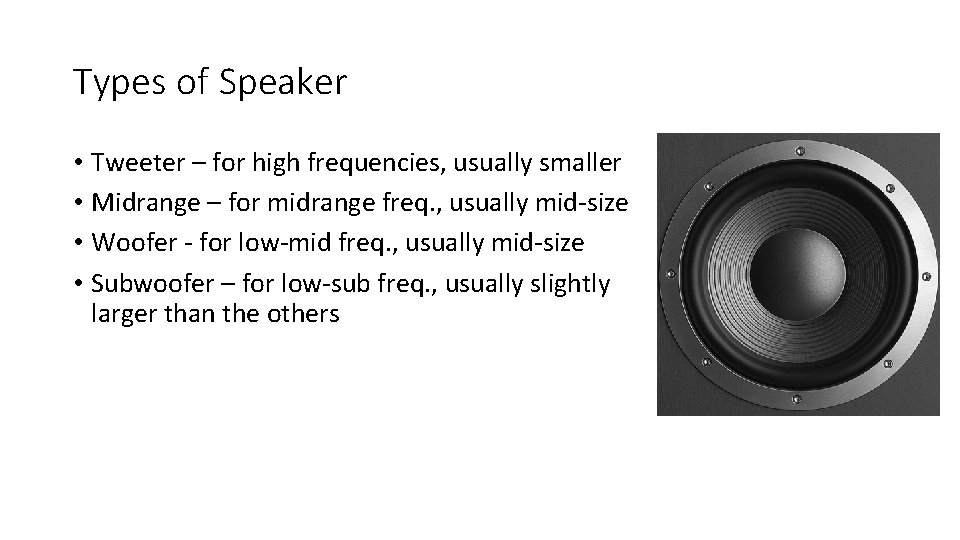
Types of Speaker • Tweeter – for high frequencies, usually smaller • Midrange – for midrange freq. , usually mid-size • Woofer - for low-mid freq. , usually mid-size • Subwoofer – for low-sub freq. , usually slightly larger than the others

Mono and Stereo Audio • Monaural or monophonic sound reproduction (often shortened to mono) is intended to be heard as if it were a single channel of sound perceived as coming from one position. • Stereo means sound which is divided into two separate channels. These two channels are played back simultaneously via separate speakers. The effect is to create a fuller sound, and provide the ability to mix certain sounds between channels.

Surround Sound • Common Surround Sound formats are: 5. 1, 7. 1, and 9. 1, although 9. 1 is rarely used. Note: the. 1 is just the amount of subwoofers, although this is very rarely more than 1. This means you could possibly have 5. 2, 7. 2 etc. • Layouts: 5. 1 Layout 7. 1 Layout
3 D Audio • The difference between 3 D audio and surround sound is that surround only has sound around you and above you. However 3 D audio has depth i. e. there’s sound below you. • 3 D audio isn’t very common nowadays as not many people have access to the technology required to hear 3 D audio properly. As most people only have surround, people won’t get the full effect of the 3 D audio. • Games won’t use 3 D audio at the moment as it would be pointless adding something to a game that most people won’t be able to appreciate/ use.
References • http: //beautiful-sound. mpacula. com/graphics/super 8. png (Wave image on slide 2) • https: //en. oxforddictionaries. com/definition/sound (Definition of sound slide 2) • http: //onlinetonegenerator. com (Sine, Tri, Saw and Square sounds slide 3) • https: //upload. wikimedia. org/wikipedia/commons/7/77/Waveforms. svg (Waveforms slide 3 [cropped in slide]) • https: //upload. wikimedia. org/wikipedia/commons/thumb/f/f 6/White-noise-mv 255 -240 x 180. png/220 px-White-noise-mv 255 -240 x 180. png (White noise slide 4) • http: //www. sengpielaudio. com/calculator-amplitude. htm (Amplitude info slide 5) • http: //www. bbc. co. uk/staticarchive/566 d 1059 d 04772 c 2 c 60 b 8 ed 7779 edba 3 afe 6 a 97 d. gif (Amplitude image slide 5 + used on slide 6) • http: //www. qrg. northwestern. edu/projects/vss/docs/media/Communications/frequency. gif (Frequency image slide 7) • https: //images-na. ssl-images-amazon. com/images/G/01/electronics/detail-page 2/B 00166 VDLC. ES 150 PWblk_SUB_LRG. jpg (subwoofer image slide 8) • http: //www. crutchfield. com/S-Ulo 7 k. Vpk. Tzn/learningcenter/home/speaker_placement. html ( surround sound layout [5. 1 + 7. 1] slide 10) • Definitions of some topics found through google (“define X topic”) but this method does not always give a source
- Slides: 12