
Audio Slide Project Instructions examples tools Why audio
- Slides: 30
Audio Slide Project Instructions, examples & tools
Why audio slideshow? • Slideshow is one of the oldest forms of multimedia reporting, dating back to 1800. • There are many reasons why journalists still use slideshow for storytelling. For example, video can be too obtrusive. • Best part may be that it tells story with pauses and time for reflection, letting ambient noise and images linger for emphasis. • Video can give you some of these results, but audio slideshows provide a further level of emphasis, detail and intimacy with the subject matter.
Audio slideshow project • Audio slideshow storytelling is two tasks in one: a slideshow, and a news story. • Skill needed: 1. Taking & editing photos 2. Conducting an interview 3. Editing sound and pace 4. Verbal narration
<Work flow> 1. Gather material and research 2. Write a script (synopsis/pitch and storyboard) 3. Choose your location 4. Gather natural sound + Take a wide shot photo 5. Prepare your subject • Take medium shot photo • Try delayed recording : some rehearsing needed. • Mark the best spots, find operative words for recording. 6. Get action shots 7. Add narration. Add music sound or photo 8. Edit with software (Adobe Premiere): Which is first?
Planning: Shaping the structure
Shaping visual stories: narrative style • Structure: Stories are presented in narrative styles. Typically they have beginning –middle – end. • Set up: characters, location, time and other elements. -in a way that allows events to unfold so that audience wants to know more and more about it -tell how are your characters are affected -how they develop a solution (or not) and finally where they go from there.
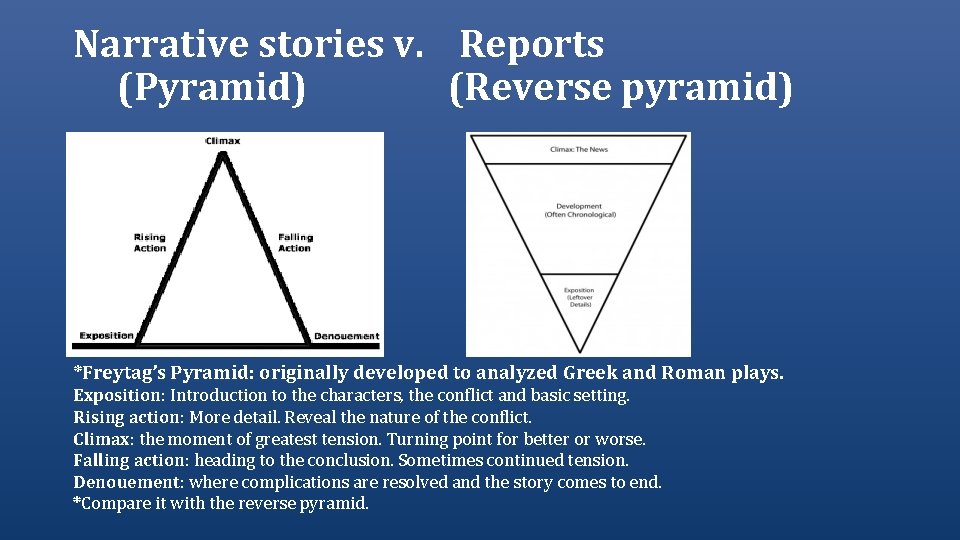
Narrative stories v. Reports (Pyramid) (Reverse pyramid) *Freytag’s Pyramid: originally developed to analyzed Greek and Roman plays. Exposition: Introduction to the characters, the conflict and basic setting. Rising action: More detail. Reveal the nature of the conflict. Climax: the moment of greatest tension. Turning point for better or worse. Falling action: heading to the conclusion. Sometimes continued tension. Denouement: where complications are resolved and the story comes to end. *Compare it with the reverse pyramid.
In our projects most stories will be shaped according to 3 act principle. Storytellers think of story structure as three act play (Means recommended by the instructor). Act 1. Introduce your characters. Let us meet them. Show location and time. Give a reason why we should care about them. Act 2. Reveal the complication. Usually the longest part of the story. Let the complication intensify. Act 3. Resolve the complication. And finish the story in a satisfying way. What choices were made in the crisis?
Point of view (POV) • First-person POV: e. g. Greys anatomy. Many of bio videos. • Second-person POV: Direct address by the actors to the audience. e. g. Think of on-spot TV anchors. • Third-person POV: Most common in storytelling. Audience are detached observers. • Character POV: One character is dominant in a series of stories. e. g. sit com Seinfeld. • Conflicting POV: Mixture of different point of view.
Exercise: identifying structure and POV • “Hungry: Living with the Prader-Willi Syndrome” Identify the three part acts. https: //vimeo. com/5717103 https: //www. youtube. com/watch? v=H 5 BSpxvq. L 2 A • Sofa by Wayne Richard https: //www. youtube. com/watch? v=VPrn. DD 51 Y 5 s&list=PL 7 AC 307 C 5 535 EF 045
Image: Building a sequence
Types of camera shots. To build a complete story, you have to capture different aspects of an object using a series of different shots – wide shot (WS), medium shot (MS), Close-up (CU), Reaction shot (RS), Point of view (POV), and others. Here are types of camera shots from mediacollege. com. Please understand study each type. • http: //www. mediacollege. com/video/shots/
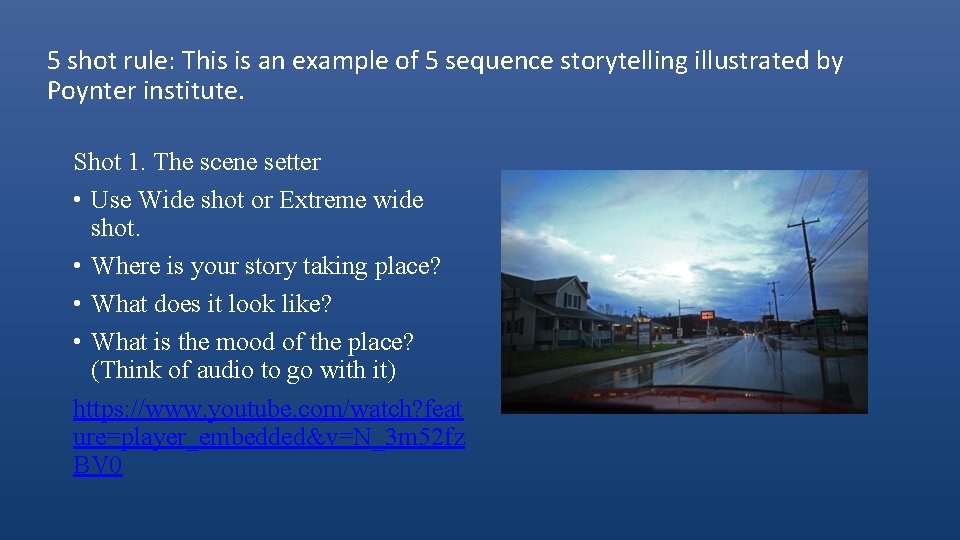
5 shot rule: This is an example of 5 sequence storytelling illustrated by Poynter institute. Shot 1. The scene setter • Use Wide shot or Extreme wide shot. • Where is your story taking place? • What does it look like? • What is the mood of the place? (Think of audio to go with it) https: //www. youtube. com/watch? feat ure=player_embedded&v=N_3 m 52 fz BV 0
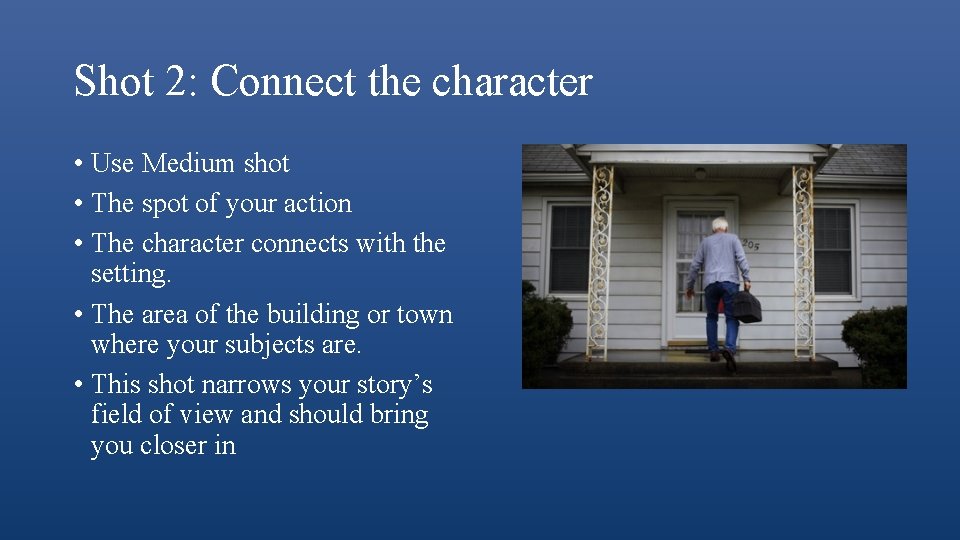
Shot 2: Connect the character • Use Medium shot • The spot of your action • The character connects with the setting. • The area of the building or town where your subjects are. • This shot narrows your story’s field of view and should bring you closer in
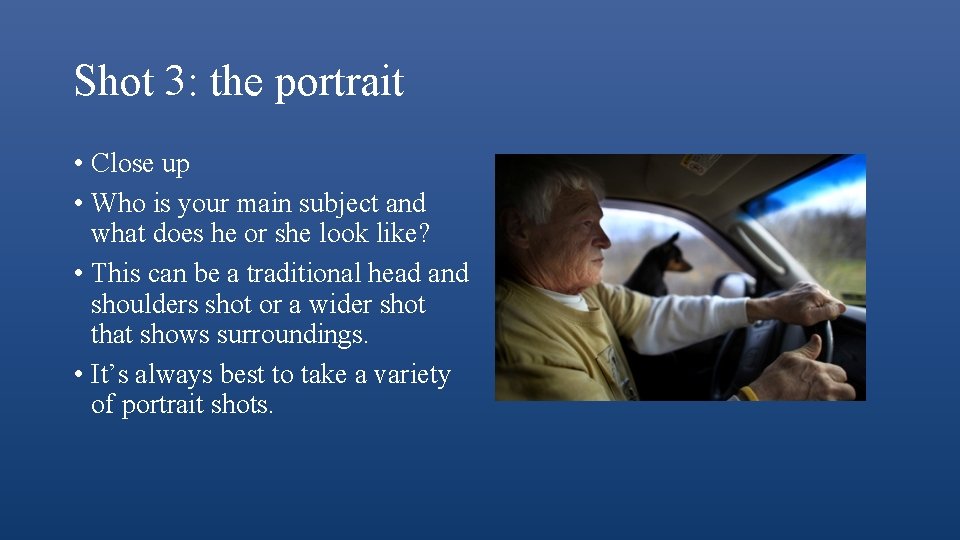
Shot 3: the portrait • Close up • Who is your main subject and what does he or she look like? • This can be a traditional head and shoulders shot or a wider shot that shows surroundings. • It’s always best to take a variety of portrait shots.
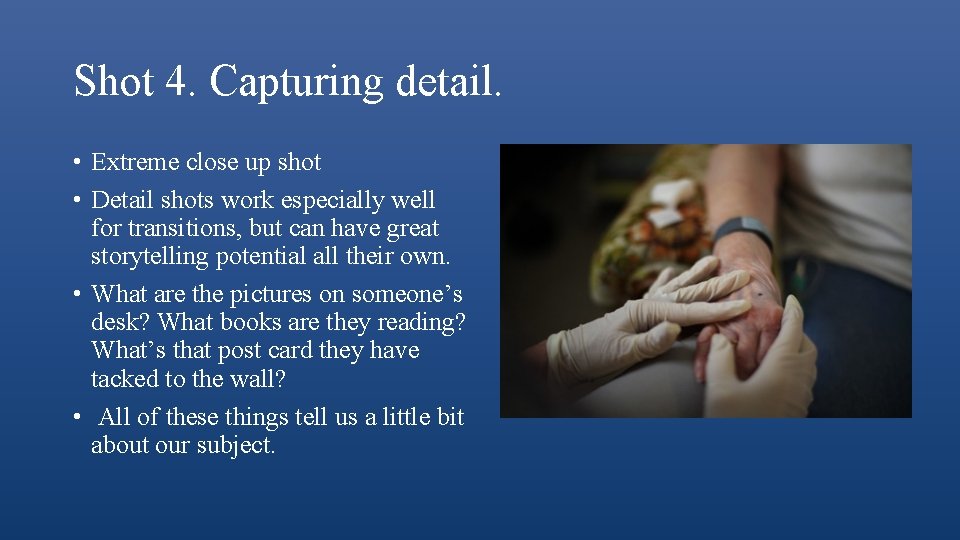
Shot 4. Capturing detail. • Extreme close up shot • Detail shots work especially well for transitions, but can have great storytelling potential all their own. • What are the pictures on someone’s desk? What books are they reading? What’s that post card they have tacked to the wall? • All of these things tell us a little bit about our subject.
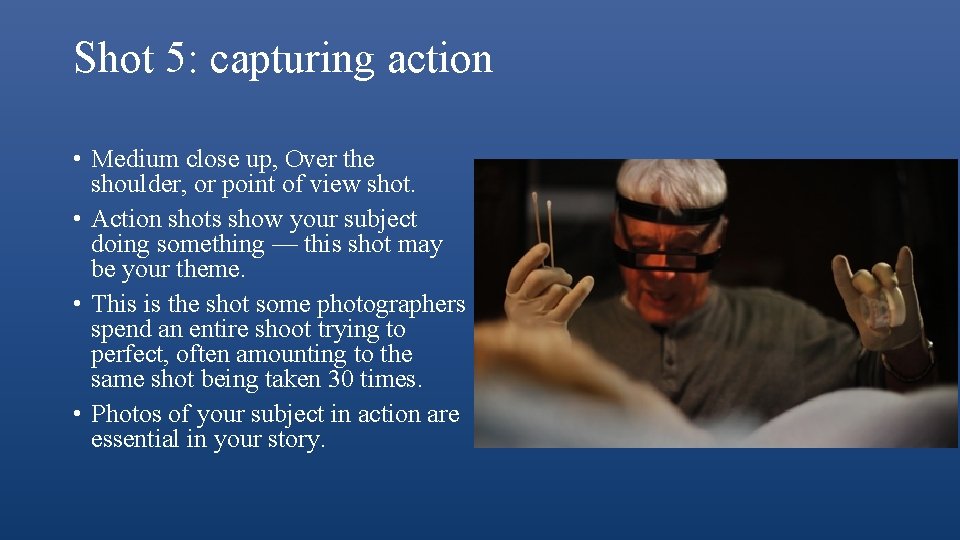
Shot 5: capturing action • Medium close up, Over the shoulder, or point of view shot. • Action shots show your subject doing something — this shot may be your theme. • This is the shot some photographers spend an entire shoot trying to perfect, often amounting to the same shot being taken 30 times. • Photos of your subject in action are essential in your story.
Audio & Editing
Narration & sound • Not too much narration. Its essence is conveying a sense of space, shifting time and place, and atmosphere. • A good audio slideshow makes extensive use of sound effects. Look around, see and hear the local circumstances. If the sounds are relevant, use them as a deliberate feature. In a forest, for example, you might use the sounds of moving through the trees. • When on location there will always be some background sound. This could be the hum of an office or a noisy street scene. Make sure you record plenty of this, even if you do not think you need it.
Audio is very important. Interviews and sounds lets you tell powerful stories. Example of story where natural sound is crucial. • Desperate journey http: //kobreguide. com/video/? pare nt=7488&meta=22870 Example of story where music crucial. • The magic castle https: //vimeo. com/13533092
Interviews • Limit the interviewees to three or four. And leave room for the ambient noise, sound effects and music. • Get interviews so that you have plenty to choose from, leaving unused but interesting material for other features. • Complex content should be accompanied by image or texts. • Practice narration or interview first (delayed interview). Do scripted interview. • Bad example
Editing 1. 2. 3. 4. Overall structure of the story Edit audio file first in most cases. Movement and pace: Photo sequencing. Zoom and Pan. Play around with the structure. Begin with the ending and end with the beginning.
Movement • We don’t want the slideshow to consist entirely of stills, but we don’t want it to be all moving pictures either. Use a few stills in a segment, followed by a segment of moving pictures, followed by another still segment, and this pattern repeats till the end. • Bad example https: //youtu. be/yp. MF 0 kms. KDI • Extreme case. No more than three or four photos (still or moving) in one sequence. https: //www. youtube. com/watch? feature=player_embedded&v=4 Ma. GX m. BKx. BE
Example: Localizing national issues • Use ordinary people for a highly reported cases. • Often present different cases. • Sometimes require time and skill • Carriers of the economy
Example: Climate Wisconsin Points to watch 1. Using natural sounds 2. Delayed beginning 3. Close-up shots of an object 4. Narration
Example: Advocacy story, Journey of a girl Points to watch 1. Types of shots 2. Movement of still images 3. Pace 4. Narration
Example: Long story short No conductors need apply • This story will be a good match up with print feature story. • Multiple narrators. • Sequence shots of different angles.
Example: Using file photos 1. BBC: Jewish life in UK • Using file photos • Heavy content. Documentary style intense narration. 2. BBC: Apartheid in South Africa in 1970 • If you have a lot of file photos, you can use them as the main image. • But you must somehow connect the past to the present. • Interview is one of such methods.
Exercise: Give response to following slideshows. • Local issue: Seattle art community evacuated by city project (U of Washington) https: //www. youtube. com/watch? v=e. Ys. HLKqb. Pfo Student project 1. To make the story more interesting, what kind of sound would you use more? For example, interview, narration or natural sound? 2. What kind of photo shots would you use more? 3. What kind of information would you add to the story?
Requirement of your story assignment 1. Photos: Even 5 pictures make a story. Examples we saw were over 20. I ask you to do include at least 10 photos and images. 2. Time: 2: 00 to 2: 30 minutes is the standard. 3. Audio: More than 3 different types audio files. Examples of audio are narration, interview, music, natural sound, sound track from other media. 4. Interview: At least one person related to the story. This interviewee cannot be your family or classmate. 5. Titles and captions. 6. Photos should have movements (pan & zoom). Do not distribute the same time for all pictures.