
Audio processing using Matlab Elena Grassi Sampling Read
Audio processing using Matlab Elena Grassi

Sampling • Read values from a continuous signal • Equally spaced time interval (sampling frequency)
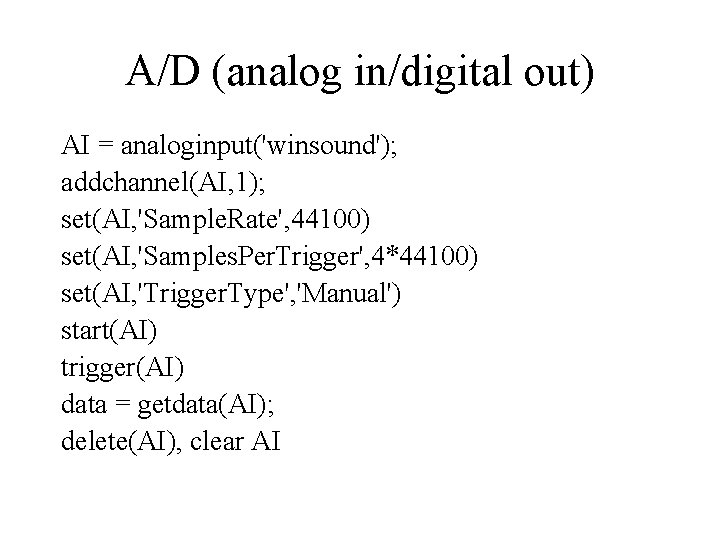
A/D (analog in/digital out) AI = analoginput('winsound'); addchannel(AI, 1); set(AI, 'Sample. Rate', 44100) set(AI, 'Samples. Per. Trigger', 4*44100) set(AI, 'Trigger. Type', 'Manual') start(AI) trigger(AI) data = getdata(AI); delete(AI), clear AI
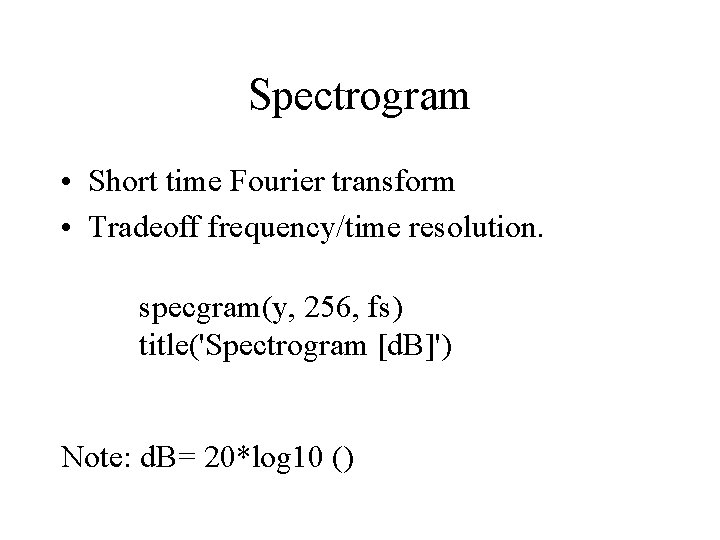
Spectrogram • Short time Fourier transform • Tradeoff frequency/time resolution. specgram(y, 256, fs) title('Spectrogram [d. B]') Note: d. B= 20*log 10 ()
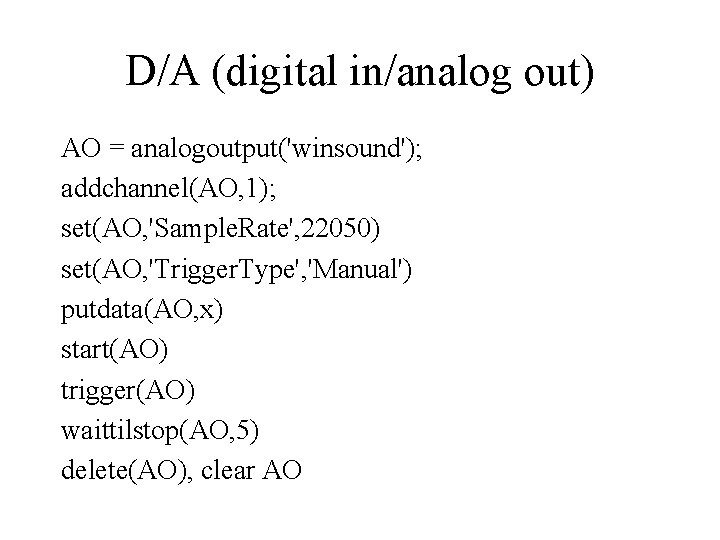
D/A (digital in/analog out) AO = analogoutput('winsound'); addchannel(AO, 1); set(AO, 'Sample. Rate', 22050) set(AO, 'Trigger. Type', 'Manual') putdata(AO, x) start(AO) trigger(AO) waittilstop(AO, 5) delete(AO), clear AO
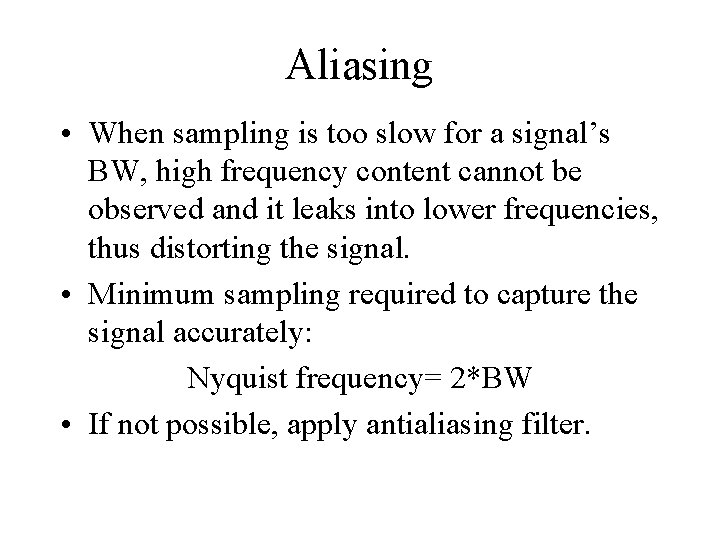
Aliasing • When sampling is too slow for a signal’s BW, high frequency content cannot be observed and it leaks into lower frequencies, thus distorting the signal. • Minimum sampling required to capture the signal accurately: Nyquist frequency= 2*BW • If not possible, apply antialiasing filter.
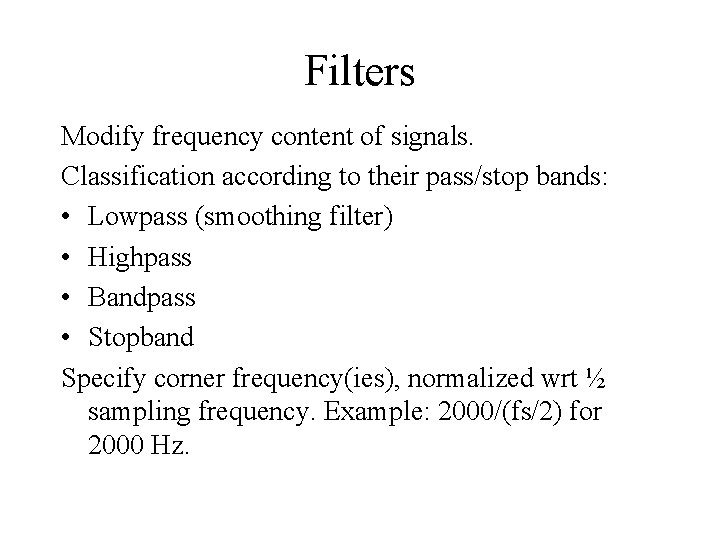
Filters Modify frequency content of signals. Classification according to their pass/stop bands: • Lowpass (smoothing filter) • Highpass • Bandpass • Stopband Specify corner frequency(ies), normalized wrt ½ sampling frequency. Example: 2000/(fs/2) for 2000 Hz.
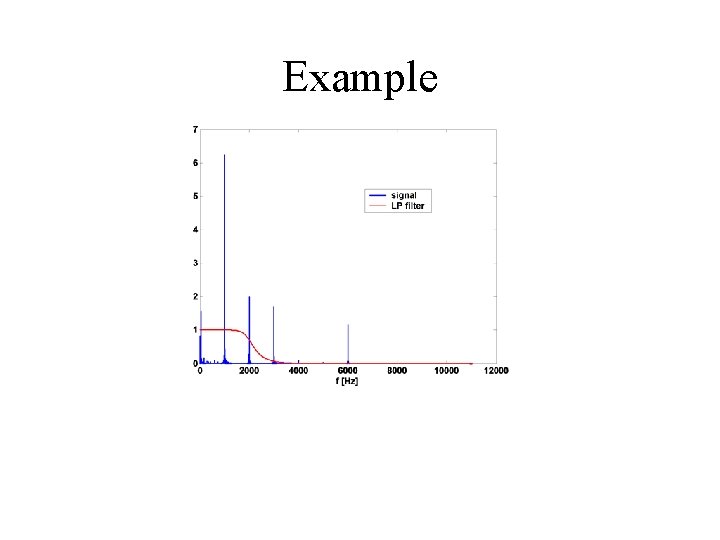
Example
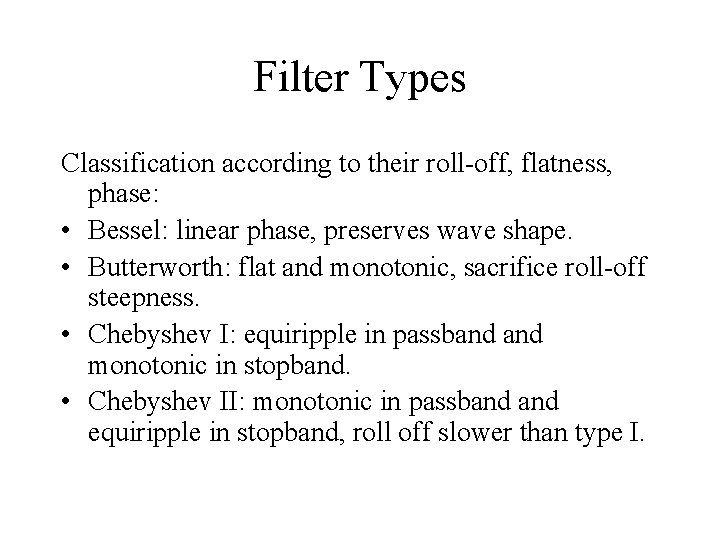
Filter Types Classification according to their roll-off, flatness, phase: • Bessel: linear phase, preserves wave shape. • Butterworth: flat and monotonic, sacrifice roll-off steepness. • Chebyshev I: equiripple in passband monotonic in stopband. • Chebyshev II: monotonic in passband equiripple in stopband, roll off slower than type I.
![Example [b, a]= butter(6, 2000*2/fsi, 'low'); sampling freq order corner freq b= numerator polynomial](http://slidetodoc.com/presentation_image/1a71ab5074c2b5ac39286b3ae2cfba6a/image-10.jpg "Example [b, a]= butter(6, 2000*2/fsi, 'low'); sampling freq order corner freq b= numerator polynomial")
Example [b, a]= butter(6, 2000*2/fsi, 'low'); sampling freq order corner freq b= numerator polynomial in z a= denominator polynomial in z
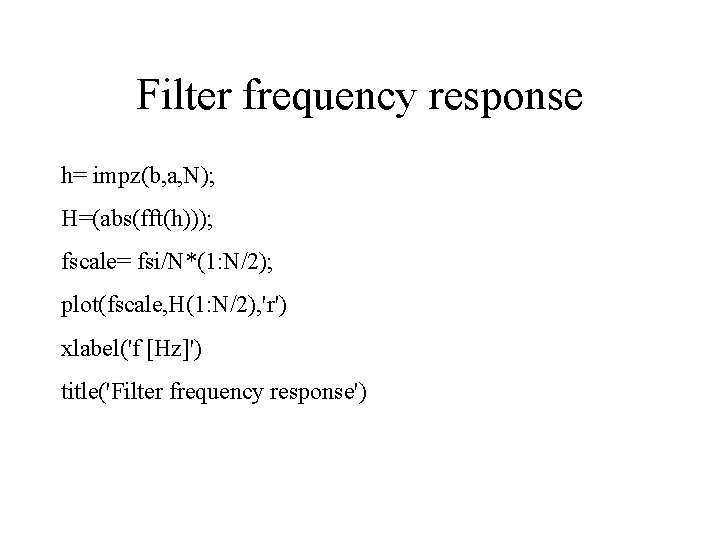
Filter frequency response h= impz(b, a, N); H=(abs(fft(h))); fscale= fsi/N*(1: N/2); plot(fscale, H(1: N/2), 'r') xlabel('f [Hz]') title('Filter frequency response')
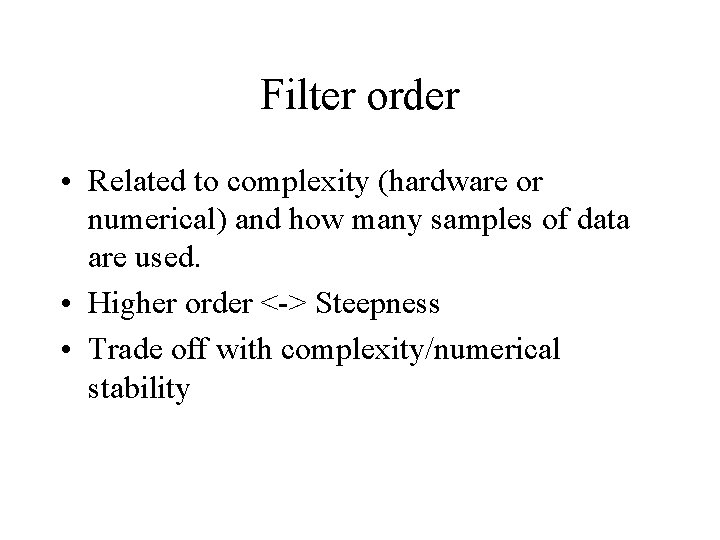
Filter order • Related to complexity (hardware or numerical) and how many samples of data are used. • Higher order <-> Steepness • Trade off with complexity/numerical stability
- Slides: 12