
Audio Compression Usha Sree CMSC 691 M 101204


- Slides: 23
Audio Compression Usha Sree CMSC 691 M 10/12/04
Motivation Efficient Storage l Streaming l Interactive Multimedia Applications l
Compression Goals l Reduced bandwidth l Make decoded signal sound as close as possible to original signal l Lowest Implementation Complexity l Robust l Scalable
Compression Techniques l l l Voc File Compression Linear Predictive Coding Mu-law compression Differential Pulse Code Modulation MPEG
MPEG l Moving Picture Experts Group l Part of a multiple standard for ¡ Video compression ¡ Audio, Video and Data synchronization to an aggregate bit rate of 1. 5 Mbit/sec
MPEG Audio Compression l l l Physically Lossy compression algorithm Perceptually lossless, transparent algorithm Exploits perceptual properties of human ear Psychoacoustic modeling MPEG Audio Standard ensures inter-operability, defines coded bit stream syntax, defines decoding process and guarantees decoder’s accuracy.
MPEG Audio Features l l l No assumptions about the nature of the audio source Exploitation of human auditory system perceptual limitations Removal of perceptually irrelevant parts of audio signal It offers a sampling rate of 32, 44. 1 and 48 k. Hz. Offers a choice of three independent layers
MPEG Audio Feautures cont. All three layers allow single chip real-time decoder implementation l Optional Cyclic Redundancy Check (CRC) error detection l Ancillary data may be included in the bit stream l Also features such as random access, audio fast forwarding and audio reverse are possible. l
Overview Quantization, the key to MPEG audio compression l Transparent, perceptually lossless compression l No distinction between original and 6 -to-1 compressed audio clips l
The Polyphase Filter Bank Key component common to all layers l Divides the audio signal into 32 equal-width frequency subbands l The filters provide good time and reasonable frequency resolution l Critical bands associated with psychoacoustic models l
Psychoacoustics The aim is to remove irrelevant parts of the audio signal l The human auditory system is unable to hear quantization noise under conditions of auditory masking l Masking occurs whenever a strong signal makes a neighborhood of weaker audio signals imperceptible l
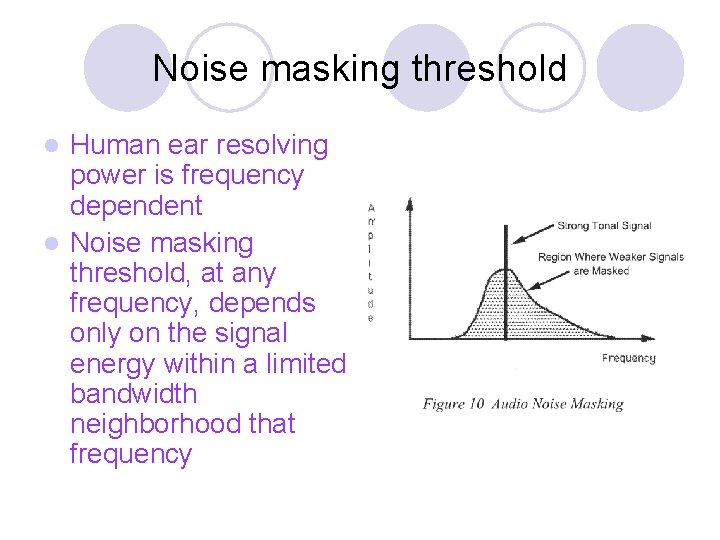
Noise masking threshold Human ear resolving power is frequency dependent l Noise masking threshold, at any frequency, depends only on the signal energy within a limited bandwidth neighborhood that frequency l
The Psychoacoustic Model Analyzes the audio signal and computes the amount of noise masking as a function of frequency l The encoder decides how best to represent the input signal with a minimum number of bits l
Basic Steps l l l l Time align audio data Convert audio to frequency domain representation Process spectral values into tonal and non-tonal components Apply a spreading function Set a lower bound for threshold values Find the threshold values for each subband Calculate the signal to mask ratio
MPEG Audio Layer I Simplest coding l Suitable for bit rates above 128 kbits/sec per channel l Each frame contains header, an optional CRC error check word and possibly ancillary data. l Eg. Philips Digital Compact Cassette l
MPEG Audio Layer II l l l Intermediate complexity Bit rates around 128 kbits/sec per channel Digital Audio Broadcasting (DAB) Synchronized Video and Audio on CD-ROM Forms frames of 1152 samples per audio channel.
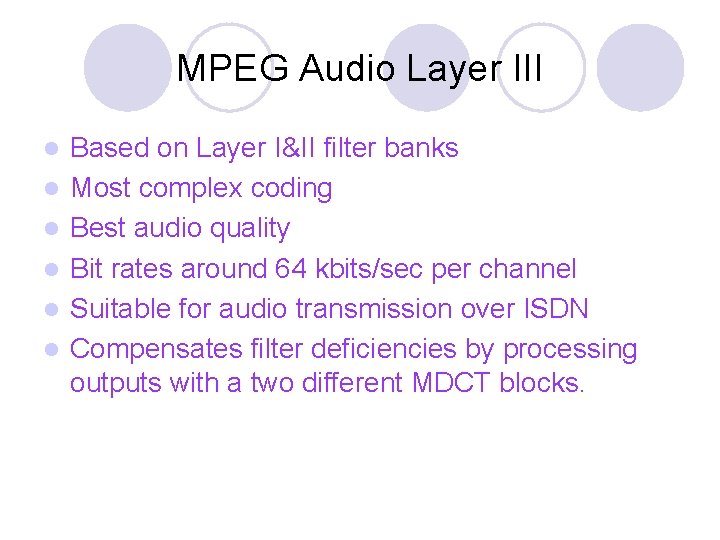
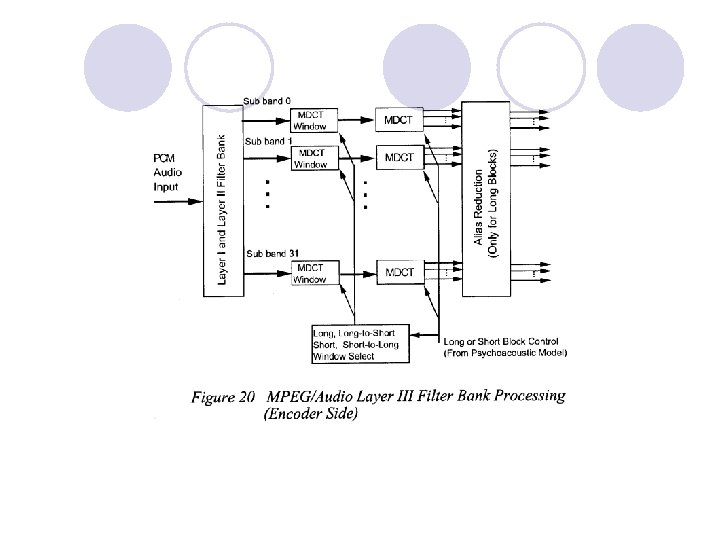
MPEG Audio Layer III l l l Based on Layer I&II filter banks Most complex coding Best audio quality Bit rates around 64 kbits/sec per channel Suitable for audio transmission over ISDN Compensates filter deficiencies by processing outputs with a two different MDCT blocks.
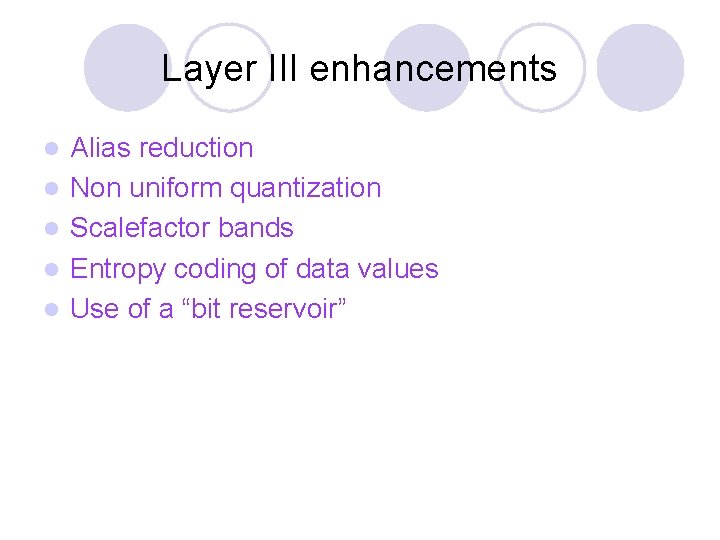
Layer III enhancements l l l Alias reduction Non uniform quantization Scalefactor bands Entropy coding of data values Use of a “bit reservoir”
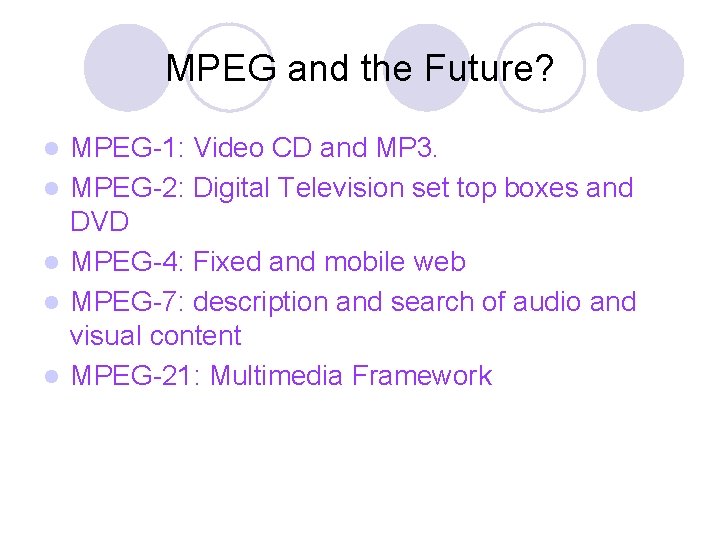
MPEG and the Future? l l l MPEG-1: Video CD and MP 3. MPEG-2: Digital Television set top boxes and DVD MPEG-4: Fixed and mobile web MPEG-7: description and search of audio and visual content MPEG-21: Multimedia Framework
References l Digital Audio Compression http: //das. iocon. com/res/docs/pdf/Digital_Audio_Compression_01 oct 1993 D TJA 03 P 8. pdf l MPEG Audio Standardwww. cs. columbia. edu/~coms 6181/slides/6 R/mpegaud. pdf
Thank You