
Audio Compression Multimedia Systems Module 4 Lesson 4
- Slides: 16
Audio Compression Multimedia Systems (Module 4 Lesson 4) Summary: r Simple Audio Compression: m Lossy: Prediction based Sources: r http: //www. cs. sfu. ca/Course. Central /365/li/ r Psychoacoustic Model r MPEG Audio m Layer I and II m MP 3 (MPEG Layer III) Dr. Ze-Nian Li’s course material at: r MPEG Audio: http: //www. mpeg. org/MPEG/audio. h tml 1
Simple Audio Compression Methods r r Silence Compression - detect the "silence", similar to runlength coding Adaptive Differential Pulse Code Modulation (ADPCM) e. g. , in CCITT G. 721 -- 16 or 32 Kbits/sec. m m r r Encode the difference between two or more consecutive signals; the difference is then quantized --> hence the loss Adaptive quantization It is necessary to predict where the waveform is headed Apple has proprietary scheme called ACE/MACE. A Lossy scheme that tries to predict where wave will go in next sample. Gives about 2: 1 compression. Linear Predictive Coding (LPC) fits signal to speech model and then transmits parameters of model. It sounds like a computer talking, 2. 4 kbits/sec. Code Excited Linear Predictor (CELP) does LPC, but also transmits error term --> audio conferencing quality at 4. 8 kbits/sec. 2
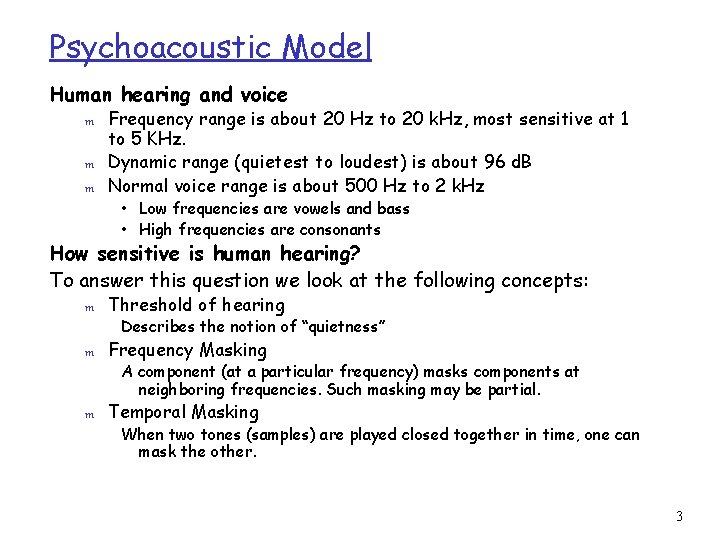
Psychoacoustic Model Human hearing and voice m m m Frequency range is about 20 Hz to 20 k. Hz, most sensitive at 1 to 5 KHz. Dynamic range (quietest to loudest) is about 96 d. B Normal voice range is about 500 Hz to 2 k. Hz • Low frequencies are vowels and bass • High frequencies are consonants How sensitive is human hearing? To answer this question we look at the following concepts: m Threshold of hearing m Frequency Masking m Temporal Masking Describes the notion of “quietness” A component (at a particular frequency) masks components at neighboring frequencies. Such masking may be partial. When two tones (samples) are played closed together in time, one can mask the other. 3
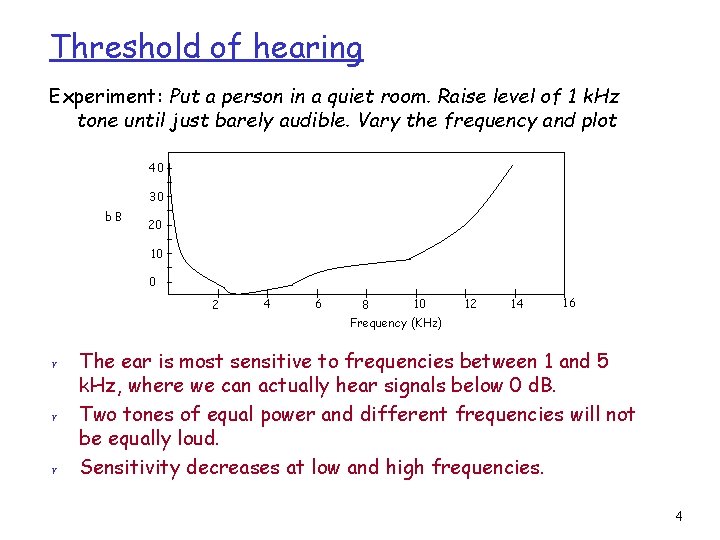
Threshold of hearing Experiment: Put a person in a quiet room. Raise level of 1 k. Hz tone until just barely audible. Vary the frequency and plot 40 30 b. B 20 10 0 2 r r r 4 6 10 8 Frequency (KHz) 12 14 16 The ear is most sensitive to frequencies between 1 and 5 k. Hz, where we can actually hear signals below 0 d. B. Two tones of equal power and different frequencies will not be equally loud. Sensitivity decreases at low and high frequencies. 4
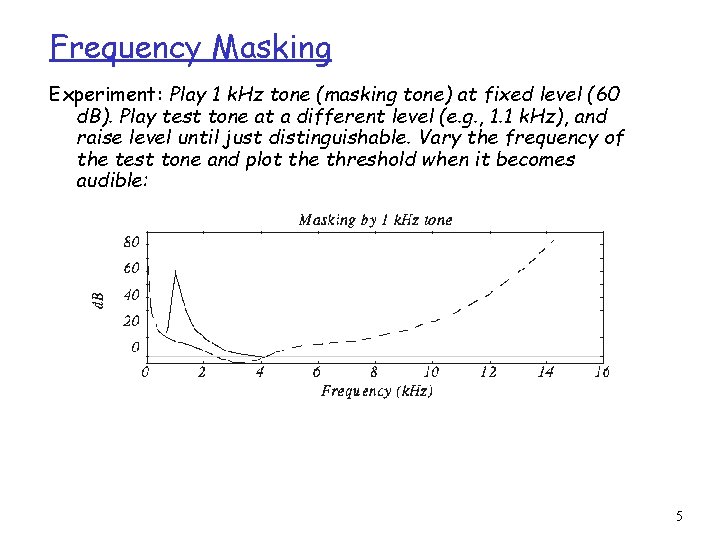
Frequency Masking Experiment: Play 1 k. Hz tone (masking tone) at fixed level (60 d. B). Play test tone at a different level (e. g. , 1. 1 k. Hz), and raise level until just distinguishable. Vary the frequency of the test tone and plot the threshold when it becomes audible: 5
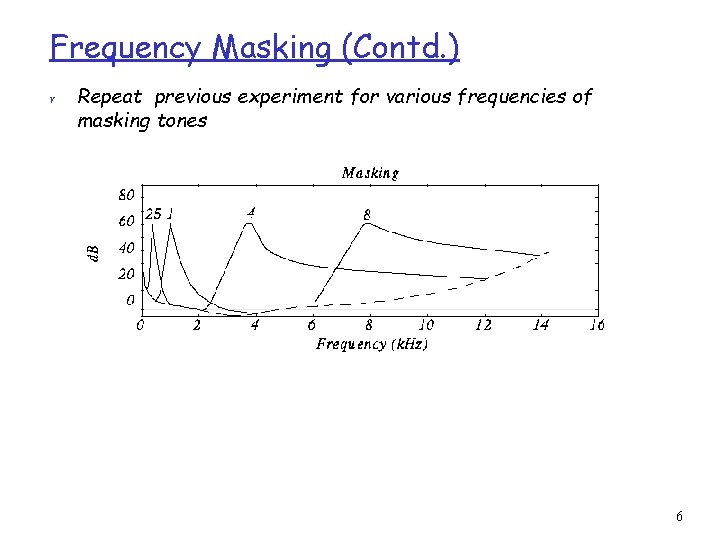
Frequency Masking (Contd. ) r Repeat previous experiment for various frequencies of masking tones 6
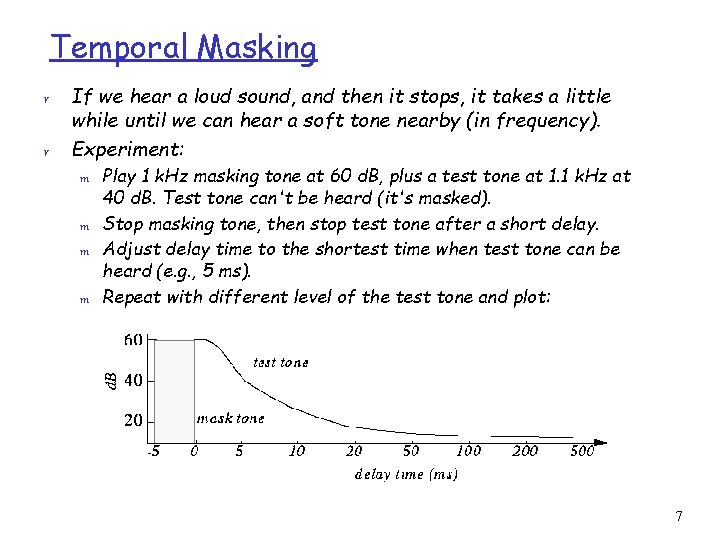
Temporal Masking r r If we hear a loud sound, and then it stops, it takes a little while until we can hear a soft tone nearby (in frequency). Experiment: m m Play 1 k. Hz masking tone at 60 d. B, plus a test tone at 1. 1 k. Hz at 40 d. B. Test tone can't be heard (it's masked). Stop masking tone, then stop test tone after a short delay. Adjust delay time to the shortest time when test tone can be heard (e. g. , 5 ms). Repeat with different level of the test tone and plot: 7
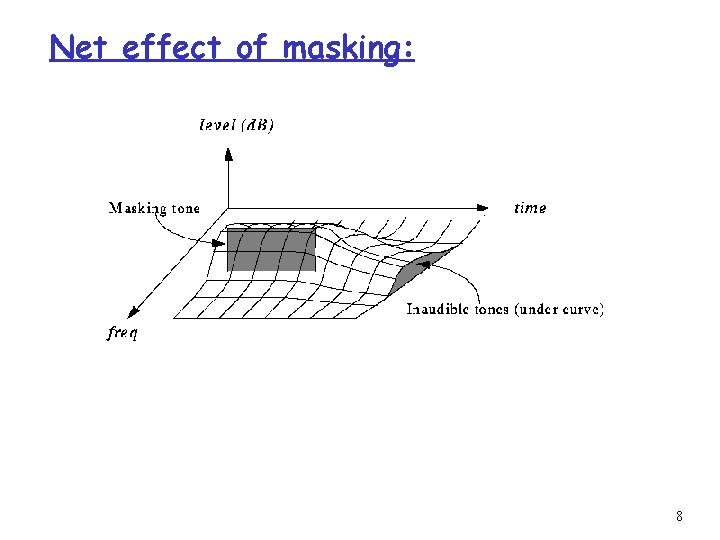
Net effect of masking: 8
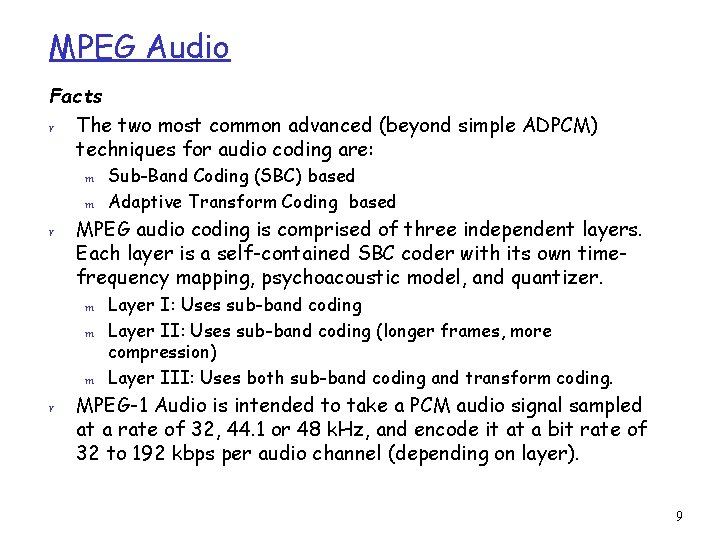
MPEG Audio Facts r The two most common advanced (beyond simple ADPCM) techniques for audio coding are: m m r MPEG audio coding is comprised of three independent layers. Each layer is a self-contained SBC coder with its own timefrequency mapping, psychoacoustic model, and quantizer. m m m r Sub-Band Coding (SBC) based Adaptive Transform Coding based Layer I: Uses sub-band coding Layer II: Uses sub-band coding (longer frames, more compression) Layer III: Uses both sub-band coding and transform coding. MPEG-1 Audio is intended to take a PCM audio signal sampled at a rate of 32, 44. 1 or 48 k. Hz, and encode it at a bit rate of 32 to 192 kbps per audio channel (depending on layer). 9
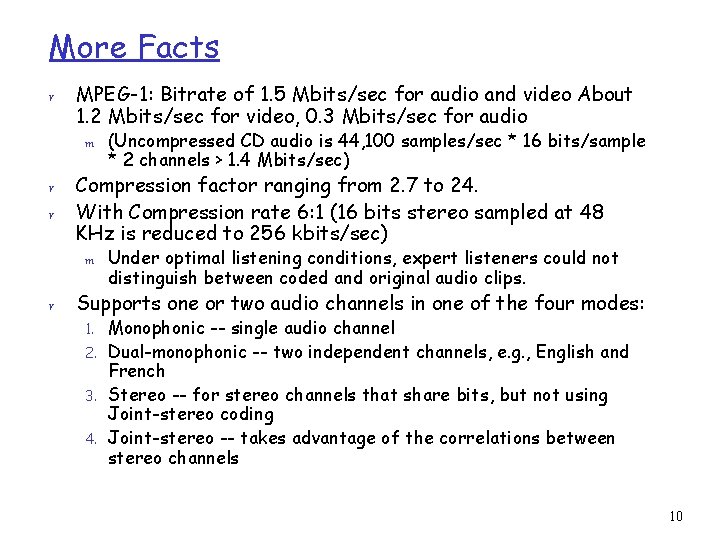
More Facts r MPEG-1: Bitrate of 1. 5 Mbits/sec for audio and video About 1. 2 Mbits/sec for video, 0. 3 Mbits/sec for audio m r r Compression factor ranging from 2. 7 to 24. With Compression rate 6: 1 (16 bits stereo sampled at 48 KHz is reduced to 256 kbits/sec) m r (Uncompressed CD audio is 44, 100 samples/sec * 16 bits/sample * 2 channels > 1. 4 Mbits/sec) Under optimal listening conditions, expert listeners could not distinguish between coded and original audio clips. Supports one or two audio channels in one of the four modes: 1. 2. 3. 4. Monophonic -- single audio channel Dual-monophonic -- two independent channels, e. g. , English and French Stereo -- for stereo channels that share bits, but not using Joint-stereo coding Joint-stereo -- takes advantage of the correlations between stereo channels 10
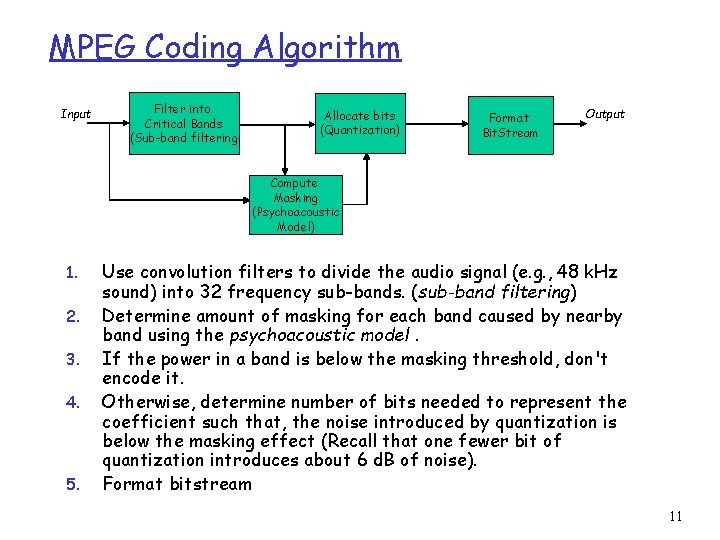
MPEG Coding Algorithm Input Filter into Critical Bands (Sub-band filtering Allocate bits (Quantization) Format Bit. Stream Output Compute Masking (Psychoacoustic Model) 1. 2. 3. 4. 5. Use convolution filters to divide the audio signal (e. g. , 48 k. Hz sound) into 32 frequency sub-bands. (sub-band filtering) Determine amount of masking for each band caused by nearby band using the psychoacoustic model. If the power in a band is below the masking threshold, don't encode it. Otherwise, determine number of bits needed to represent the coefficient such that, the noise introduced by quantization is below the masking effect (Recall that one fewer bit of quantization introduces about 6 d. B of noise). Format bitstream 11
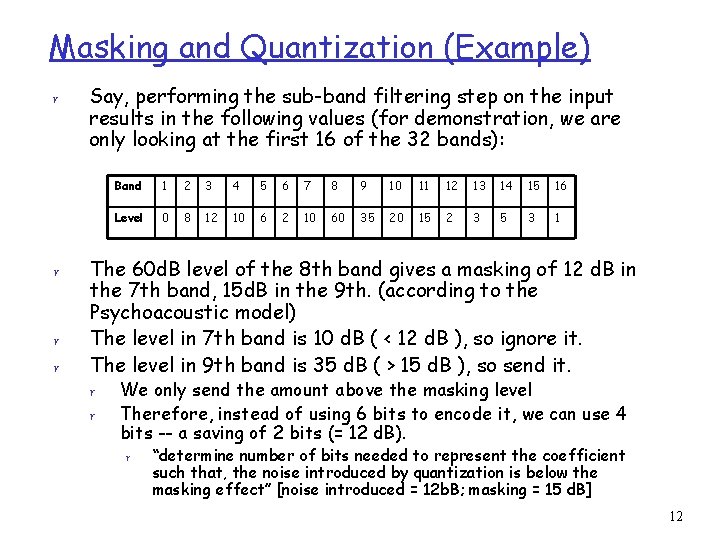
Masking and Quantization (Example) r r Say, performing the sub-band filtering step on the input results in the following values (for demonstration, we are only looking at the first 16 of the 32 bands): Band 1 2 3 4 5 6 7 8 9 10 11 12 13 14 15 16 Level 0 8 12 10 60 35 20 15 2 3 5 3 1 The 60 d. B level of the 8 th band gives a masking of 12 d. B in the 7 th band, 15 d. B in the 9 th. (according to the Psychoacoustic model) The level in 7 th band is 10 d. B ( < 12 d. B ), so ignore it. The level in 9 th band is 35 d. B ( > 15 d. B ), so send it. r r We only send the amount above the masking level Therefore, instead of using 6 bits to encode it, we can use 4 bits -- a saving of 2 bits (= 12 d. B). r “determine number of bits needed to represent the coefficient such that, the noise introduced by quantization is below the masking effect” [noise introduced = 12 b. B; masking = 15 d. B] 12
MPEG Coding Specifics 12 12 12 samples Sub-band filter 0 Audio Samples Sub-band filter 1 Sub-band filter 2. . 12 12 12 samples Sub-band filter 31 Layer I Frame Layer II, III Frame 13
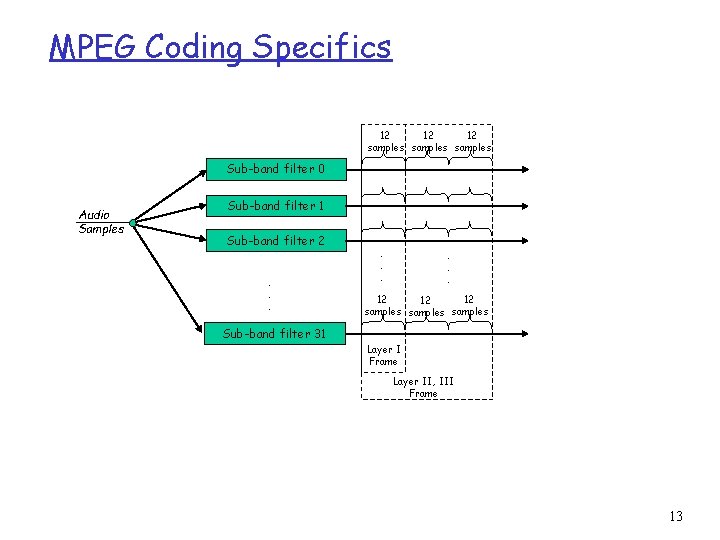
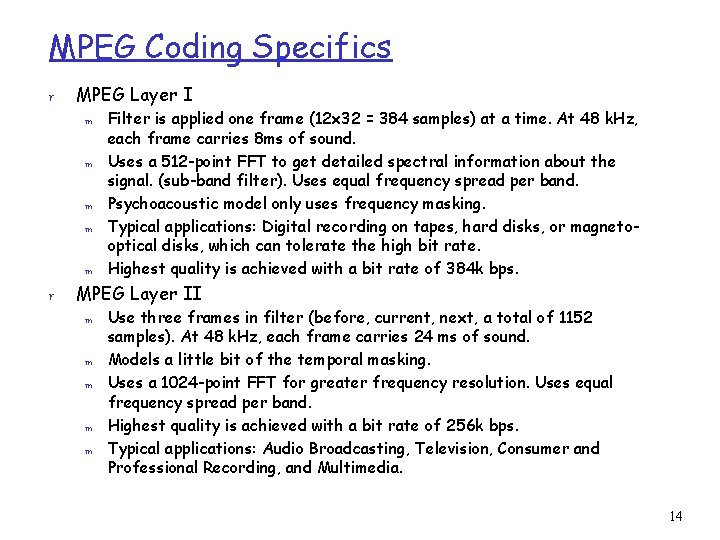
MPEG Coding Specifics r MPEG Layer I m m m r Filter is applied one frame (12 x 32 = 384 samples) at a time. At 48 k. Hz, each frame carries 8 ms of sound. Uses a 512 -point FFT to get detailed spectral information about the signal. (sub-band filter). Uses equal frequency spread per band. Psychoacoustic model only uses frequency masking. Typical applications: Digital recording on tapes, hard disks, or magnetooptical disks, which can tolerate the high bit rate. Highest quality is achieved with a bit rate of 384 k bps. MPEG Layer II m m m Use three frames in filter (before, current, next, a total of 1152 samples). At 48 k. Hz, each frame carries 24 ms of sound. Models a little bit of the temporal masking. Uses a 1024 -point FFT for greater frequency resolution. Uses equal frequency spread per band. Highest quality is achieved with a bit rate of 256 k bps. Typical applications: Audio Broadcasting, Television, Consumer and Professional Recording, and Multimedia. 14
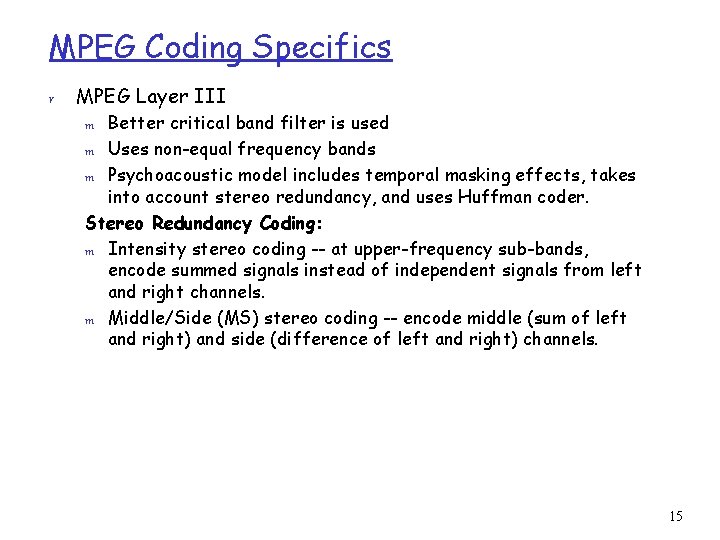
MPEG Coding Specifics r MPEG Layer III Better critical band filter is used m Uses non-equal frequency bands m Psychoacoustic model includes temporal masking effects, takes into account stereo redundancy, and uses Huffman coder. Stereo Redundancy Coding: m Intensity stereo coding -- at upper-frequency sub-bands, encode summed signals instead of independent signals from left and right channels. m Middle/Side (MS) stereo coding -- encode middle (sum of left and right) and side (difference of left and right) channels. m 15
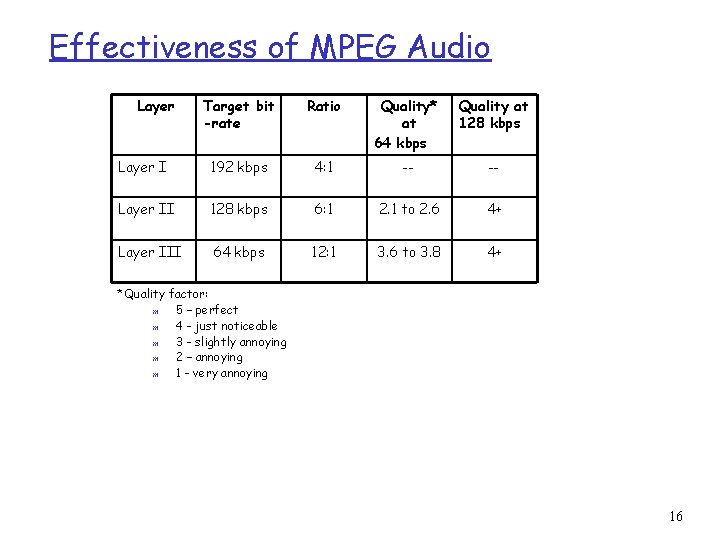
Effectiveness of MPEG Audio Layer Target bit -rate Ratio Quality* at 64 kbps Quality at 128 kbps Layer I 192 kbps 4: 1 -- -- Layer II 128 kbps 6: 1 2. 1 to 2. 6 4+ Layer III 64 kbps 12: 1 3. 6 to 3. 8 4+ *Quality factor: m 5 – perfect m 4 - just noticeable m 3 - slightly annoying m 2 – annoying m 1 - very annoying 16