
AUDIENCE THEORY THE EFFECTS MODEL THE HYPODERMIC MODEL
- Slides: 7
AUDIENCE THEORY
THE EFFECTS MODEL & THE HYPODERMIC MODEL Media texts such as T. V, internet, newspapers, etc… has an outcome and influence in the audience. This effect consumed by the audience and normally it is negative. The audience is submissive and takes in all the message being said. This is also known as the hypodermic model - the audience is injected with information. However, the audience is powerless and forced to comsume the information injected.
THE BOBO DOLL EXPERIMENT The BOBO doll experiment supports the hypodermic model. In this experiment, children are shown an adult beating up a bobo doll. Afterwards, they were put into a room with the bobo doll and 88% of the children imitated the same violent acts. The children even went further and used other toys to beat up the bobo doll. Thus, this proves that children do copy everything that has been shown to them in media texts such as TV, especially violent behaviour. Flaws of this experiment: This experiment is unreliable as children could behave differently as they come from different backgrounds and was raised in different cultures. Therefore, you cannot generalise and assume all children will behave the same way
USES AND GRATIFICATION MODEL Uses and Gratification Model opposes to the Effects Model. It is theory that the audience is somewhat active and use text media rather than text media using the audience. Thus, the audience choose what they want to watch for an instance and it is not forced upon them- they choose the text for their gratification and pleasure. The power lies within the audience and not the producers- audience has authority to reject text media. However, the flaws to uses and Gratification Model is that it is argued that audience does not actually have the power of choice of text media. Producers put out various choices for the audience to choose from. Therefore, the audience has power to an extent- they choose what producers put out there for them to select from.
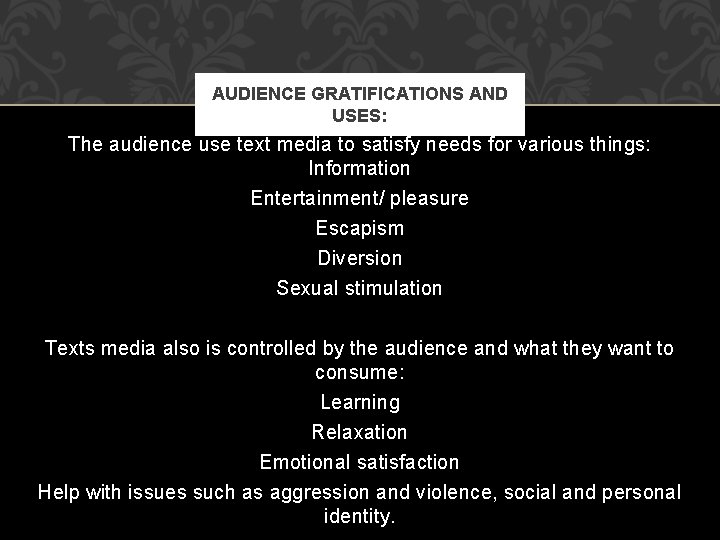
AUDIENCE GRATIFICATIONS AND USES: The audience use text media to satisfy needs for various things: Information Entertainment/ pleasure Escapism Diversion Sexual stimulation Texts media also is controlled by the audience and what they want to consume: Learning Relaxation Emotional satisfaction Help with issues such as aggression and violence, social and personal identity.
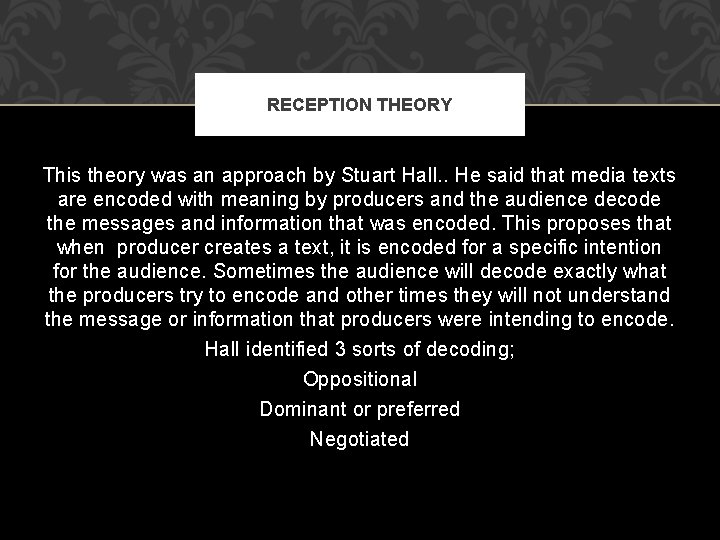
RECEPTION THEORY This theory was an approach by Stuart Hall. . He said that media texts are encoded with meaning by producers and the audience decode the messages and information that was encoded. This proposes that when producer creates a text, it is encoded for a specific intention for the audience. Sometimes the audience will decode exactly what the producers try to encode and other times they will not understand the message or information that producers were intending to encode. Hall identified 3 sorts of decoding; Oppositional Dominant or preferred Negotiated
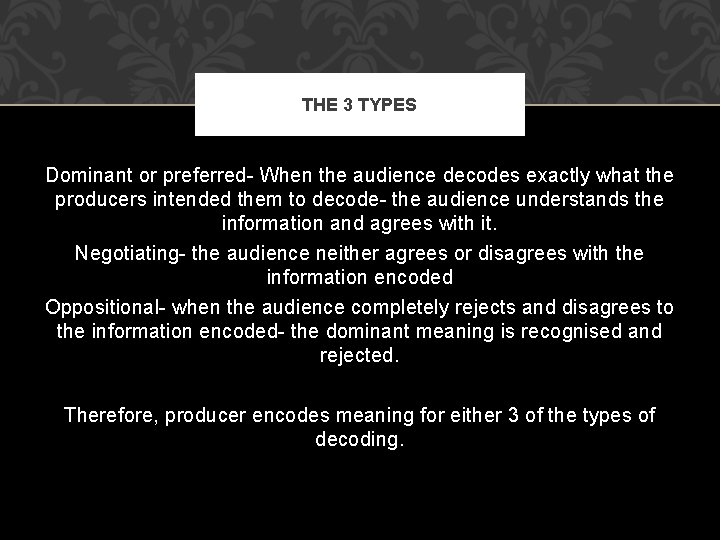
THE 3 TYPES Dominant or preferred- When the audience decodes exactly what the producers intended them to decode- the audience understands the information and agrees with it. Negotiating- the audience neither agrees or disagrees with the information encoded Oppositional- when the audience completely rejects and disagrees to the information encoded- the dominant meaning is recognised and rejected. Therefore, producer encodes meaning for either 3 of the types of decoding.