
Audience Awareness Enabling Students To Think Outside of
Audience Awareness Enabling Students To Think Outside of Themselves
Non-Audience-Focused Writing to Think Writing to yourself Concentrating on thoughts, feelings, and problems Personal, expressive, exploratory, or merely informal writing
Non-Audience-Focused Writing Also called Writer-Based Prose A verbal expression written by a writer to himself and for himself. It is the record and the working of his own verbal thought. Examples: Journals/Diaries Freewrites Personal Letters Notes
Audience-Focused Writing to Communicate To convey an idea clearly and logically Writing to Imagine To create art- poetry, fiction, drama, and song
Audience-Focused Writing Also called Reader-Based Prose A deliberate attempt to communicate something to a reader Examples: Essays Magazine Articles Directions Emails
Student Issues with Reader Based Prose Student problems with coherence stem almost entirely from the inability of some writers to put themselves in their reader’s place and write their work from a reader’s point of view. These problems are associated with writers who have what they want to say so clear in their own minds that they do not realize they have left out material needed to allow readers to make sense of their ideas.
Student Issues with Reader Based Prose These problems also stem from writers being so involved with the order in which a set of ideas came to them that they do not realize these ideas would be clearer to their readers ordered in another way.
Solution Get students to recognize a reader outside of themselves Emphasize the importance of clarity Because of the purposeful nature of persuasive writing, it is absolutely essential that readers can easily and clearly identify the writer’s ideas and the logical connections between them.
The Shapes Activity Ask class to split into pairs Describers will describe a given shape and Drawers will attempt to draw the shape without looking at their partner No communication is allowed except for the Describers instructions: No questions can be asked by the Drawer Each student will be given the opportunity to be both Describer and Drawer
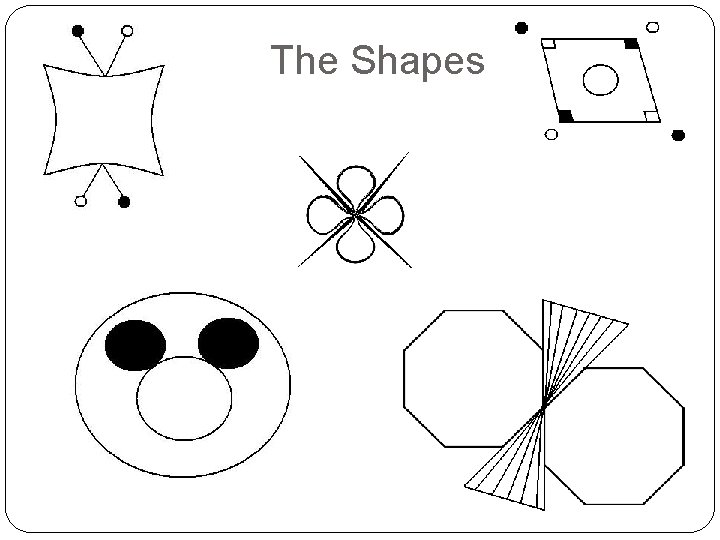
The Shapes
Shapes Activity Questions How similar was your drawing compared to the original shape? What challenges arose when trying to describe your shape to your partner? When describing the shapes, what words did you use? Did your partner use terminology with which you were unfamiliar? What assumptions did you make about your partners understanding of the shape? What did you learn from this activity?
Results Students realize that it is hard to escape their own perspectives and tend to relay information through private associations and personal connotations. Through the Shapes Activity, students recognize that even a simple shape can be difficult to describe. The connection can then be made that presenting a complicated argument must be carefully and tactfully done in order to properly persuade an audience.
A Wider Audience Once students recognize a reader outside of themselves, they often write their essays for their professor and classmates Students will sometimes include phrases such as the following: “As we discussed in class” “Just like Professor Mayle said” Many times students will omit definitions discussed in class because they assume the professor and classmates will know this information if they were present during
Solution Get students to recognize a reader outside of the classroom Emphasize the importance of writing for a wider audience Especially in English 155, the audience of an essay will move beyond the professor and classmates: The portfolio graders will be part of the audience at the end of the semester The Wings editors may eventually become part of the audience If selected for publication in Wings, hundreds of students from other English 155 classes will also
The Ultimate Peer Review Pair up with an English instructor who teaches at the same time as you Inform your students ahead of class to bring two printed out copies of their complete essay draft Write half of your student’s names on blue name tags Write the other half of your student’s names on green name tags Send the student’s who have blue name tags to the classroom with the other instructor You will now have half of your own class and half of the other instructor’s class
The Ultimate Peer Review Group students into pairs so that each pair has a student from each class Instruct students to introduce themselves, explain the prompt, and exchange essays Conduct the peer review with specific questions for each student to address Ask students to reflect in a Web. CT Discussion Post on their experience working with another class
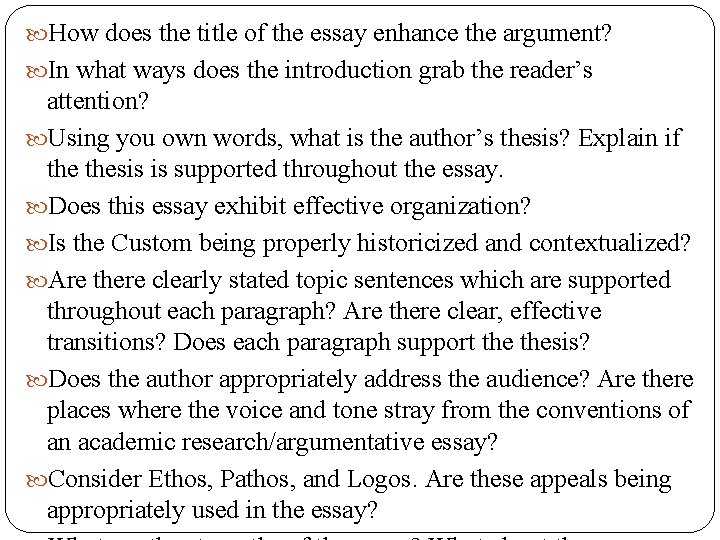
How does the title of the essay enhance the argument? In what ways does the introduction grab the reader’s attention? Using you own words, what is the author’s thesis? Explain if thesis is supported throughout the essay. Does this essay exhibit effective organization? Is the Custom being properly historicized and contextualized? Are there clearly stated topic sentences which are supported throughout each paragraph? Are there clear, effective transitions? Does each paragraph support thesis? Does the author appropriately address the audience? Are there places where the voice and tone stray from the conventions of an academic research/argumentative essay? Consider Ethos, Pathos, and Logos. Are these appeals being appropriately used in the essay?
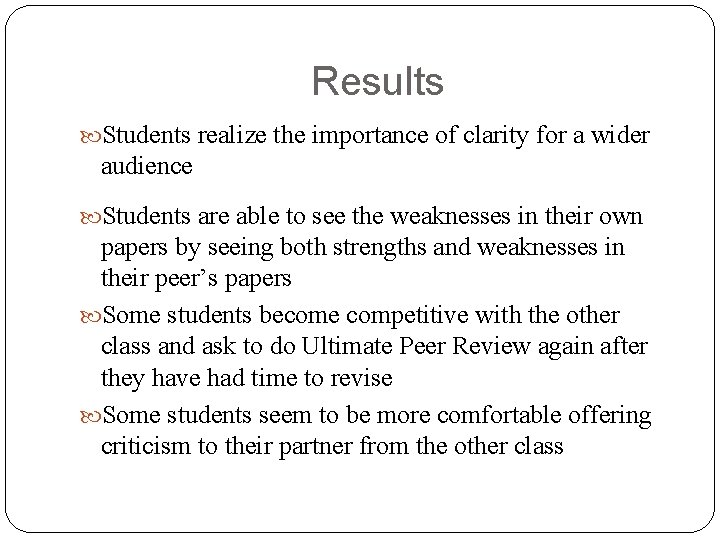
Results Students realize the importance of clarity for a wider audience Students are able to see the weaknesses in their own papers by seeing both strengths and weaknesses in their peer’s papers Some students become competitive with the other class and ask to do Ultimate Peer Review again after they have had time to revise Some students seem to be more comfortable offering criticism to their partner from the other class
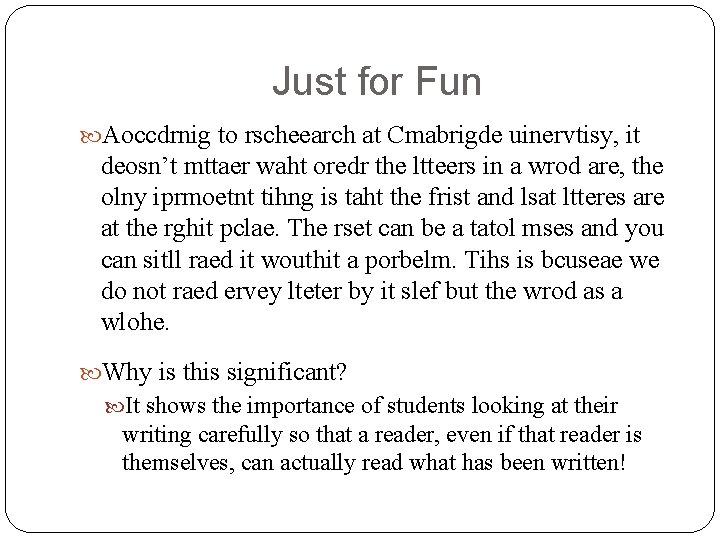
Just for Fun Aoccdrnig to rscheearch at Cmabrigde uinervtisy, it deosn’t mttaer waht oredr the ltteers in a wrod are, the olny iprmoetnt tihng is taht the frist and lsat ltteres are at the rghit pclae. The rset can be a tatol mses and you can sitll raed it wouthit a porbelm. Tihs is bcuseae we do not raed ervey lteter by it slef but the wrod as a wlohe. Why is this significant? It shows the importance of students looking at their writing carefully so that a reader, even if that reader is themselves, can actually read what has been written!
Audience Awareness Enabling Students To Think Outside of Themselves
- Slides: 20