
Audience Analysis Chapter 6 Adapt to Audience Psychology
- Slides: 14
Audience Analysis Chapter 6
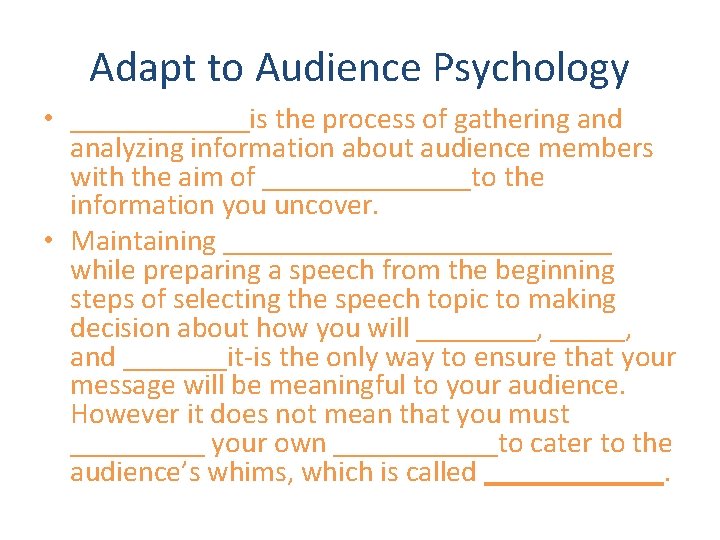
Adapt to Audience Psychology • ______is the process of gathering and analyzing information about audience members with the aim of _______to the information you uncover. • Maintaining _____________ while preparing a speech from the beginning steps of selecting the speech topic to making decision about how you will ____, _____, and _______it-is the only way to ensure that your message will be meaningful to your audience. However it does not mean that you must _____ your own ______to cater to the audience’s whims, which is called ______.
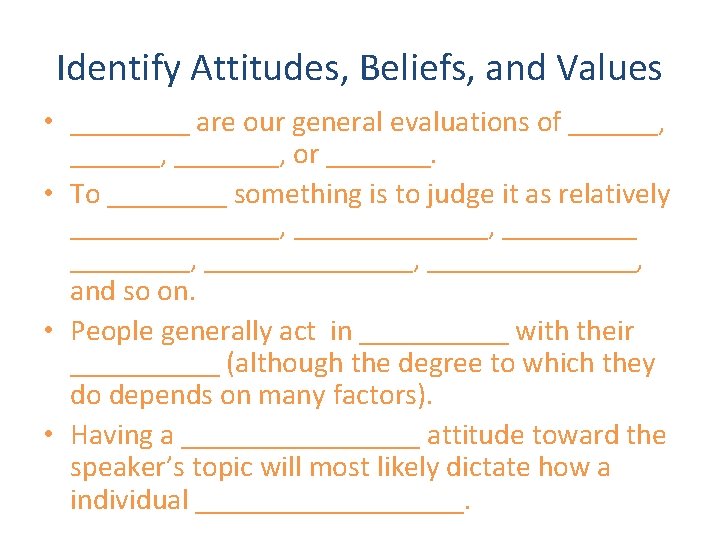
Identify Attitudes, Beliefs, and Values • ____ are our general evaluations of ______, _______, or _______. • To ____ something is to judge it as relatively _______, ________, __________, and so on. • People generally act in _____ with their _____ (although the degree to which they do depends on many factors). • Having a ________ attitude toward the speaker’s topic will most likely dictate how a individual _________.
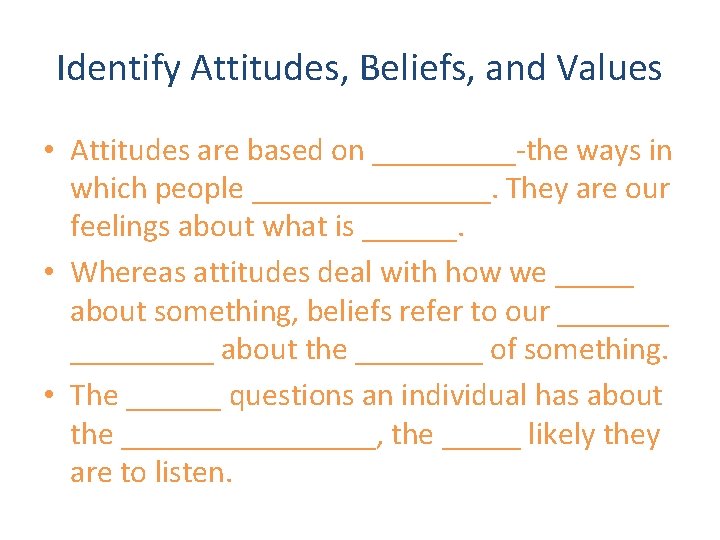
Identify Attitudes, Beliefs, and Values • Attitudes are based on _____-the ways in which people ________. They are our feelings about what is ______. • Whereas attitudes deal with how we _____ about something, beliefs refer to our _________ about the ____ of something. • The ______ questions an individual has about the ________, the _____ likely they are to listen.
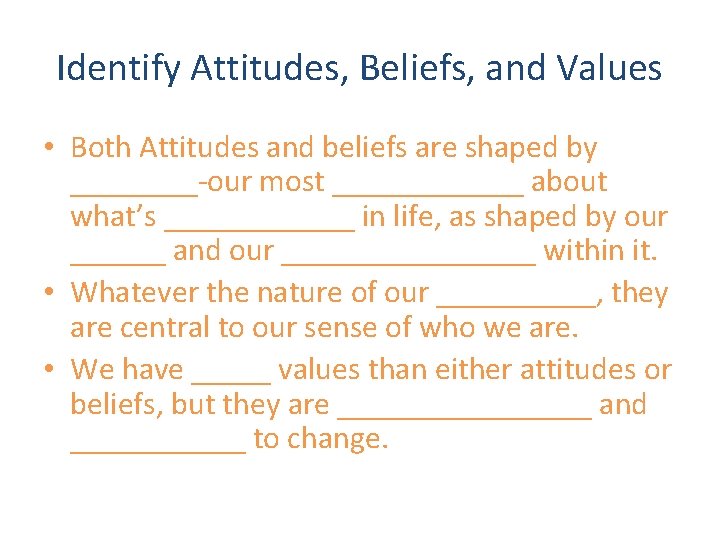
Identify Attitudes, Beliefs, and Values • Both Attitudes and beliefs are shaped by ____-our most ______ about what’s ______ in life, as shaped by our ______ and our ________ within it. • Whatever the nature of our _____, they are central to our sense of who we are. • We have _____ values than either attitudes or beliefs, but they are ________ and ______ to change.
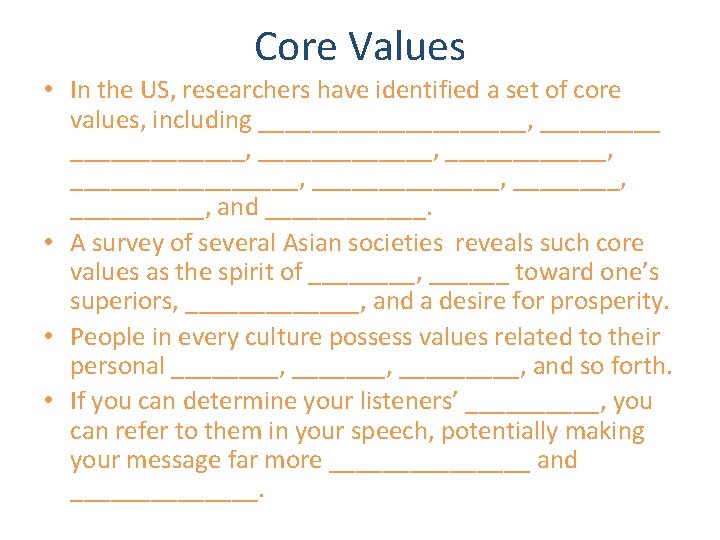
Core Values • In the US, researchers have identified a set of core values, including __________, _____________, ______________, and ______. • A survey of several Asian societies reveals such core values as the spirit of ____, ______ toward one’s superiors, _______, and a desire for prosperity. • People in every culture possess values related to their personal ____, _________, and so forth. • If you can determine your listeners’ _____, you can refer to them in your speech, potentially making your message far more ________ and _______.
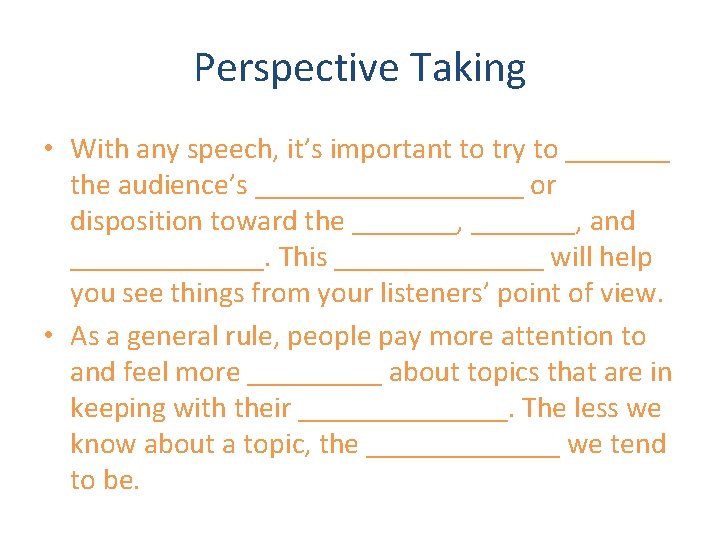
Perspective Taking • With any speech, it’s important to try to _______ the audience’s _________ or disposition toward the _______, and _______. This _______ will help you see things from your listeners’ point of view. • As a general rule, people pay more attention to and feel more _____ about topics that are in keeping with their _______. The less we know about a topic, the _______ we tend to be.
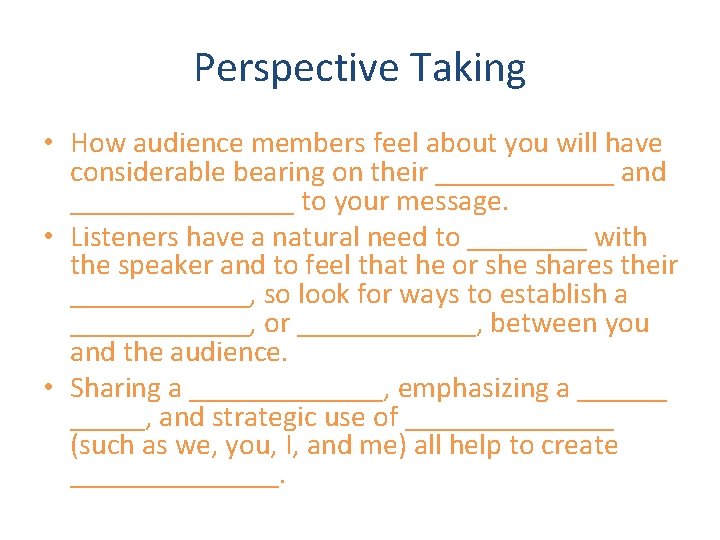
Perspective Taking • How audience members feel about you will have considerable bearing on their ______ and ________ to your message. • Listeners have a natural need to ____ with the speaker and to feel that he or she shares their ______, so look for ways to establish a ______, or ______, between you and the audience. • Sharing a _______, emphasizing a ______, and strategic use of _______ (such as we, you, I, and me) all help to create _______.
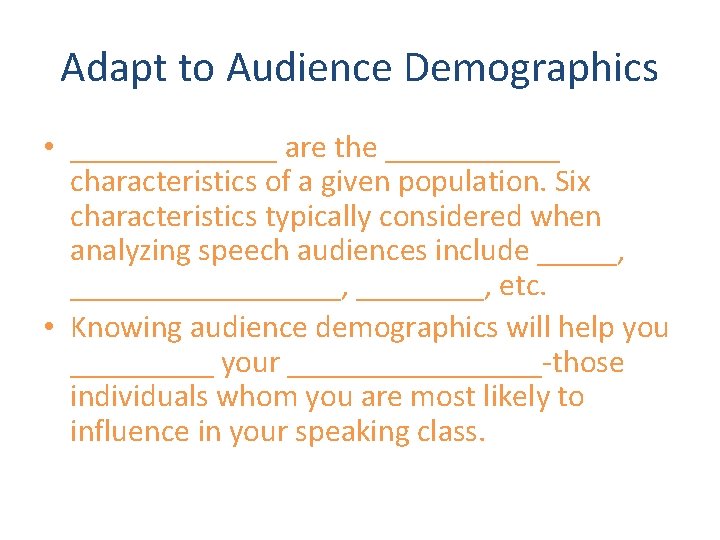
Adapt to Audience Demographics • _______ are the ______ characteristics of a given population. Six characteristics typically considered when analyzing speech audiences include _____, _________, etc. • Knowing audience demographics will help you _____ your ________-those individuals whom you are most likely to influence in your speaking class.
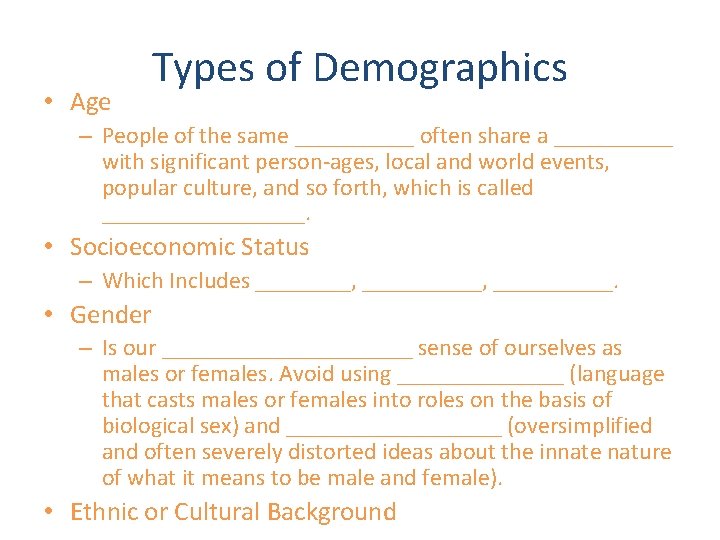
• Age Types of Demographics – People of the same _____ often share a _____ with significant person-ages, local and world events, popular culture, and so forth, which is called _________. • Socioeconomic Status – Which Includes ________, ______. • Gender – Is our ___________ sense of ourselves as males or females. Avoid using _______ (language that casts males or females into roles on the basis of biological sex) and _________ (oversimplified and often severely distorted ideas about the innate nature of what it means to be male and female). • Ethnic or Cultural Background
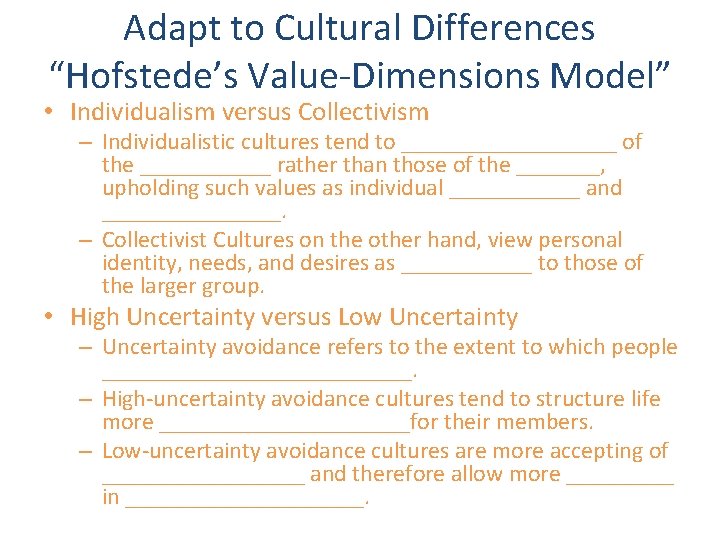
Adapt to Cultural Differences “Hofstede’s Value-Dimensions Model” • Individualism versus Collectivism – Individualistic cultures tend to _________ of the ______ rather than those of the _______, upholding such values as individual ______ and ________. – Collectivist Cultures on the other hand, view personal identity, needs, and desires as ______ to those of the larger group. • High Uncertainty versus Low Uncertainty – Uncertainty avoidance refers to the extent to which people _____________. – High-uncertainty avoidance cultures tend to structure life more ___________for their members. – Low-uncertainty avoidance cultures are more accepting of _________ and therefore allow more _____ in __________.
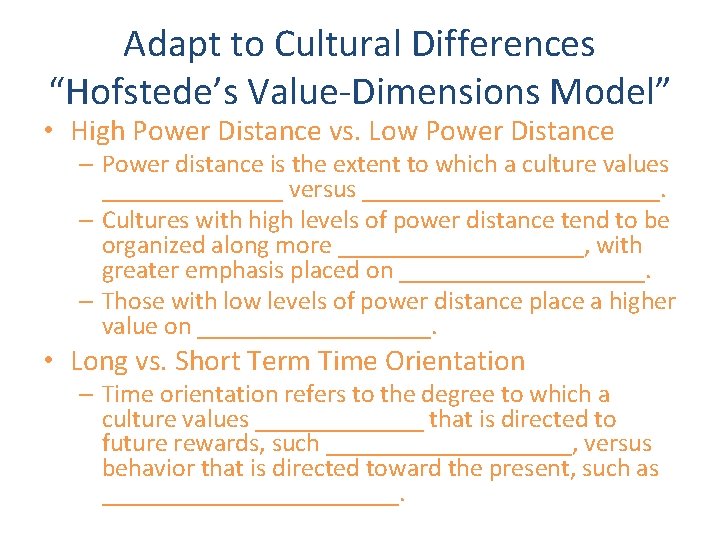
Adapt to Cultural Differences “Hofstede’s Value-Dimensions Model” • High Power Distance vs. Low Power Distance – Power distance is the extent to which a culture values _______ versus ____________. – Cultures with high levels of power distance tend to be organized along more __________, with greater emphasis placed on __________. – Those with low levels of power distance place a higher value on _________. • Long vs. Short Term Time Orientation – Time orientation refers to the degree to which a culture values _______ that is directed to future rewards, such __________, versus behavior that is directed toward the present, such as ____________.
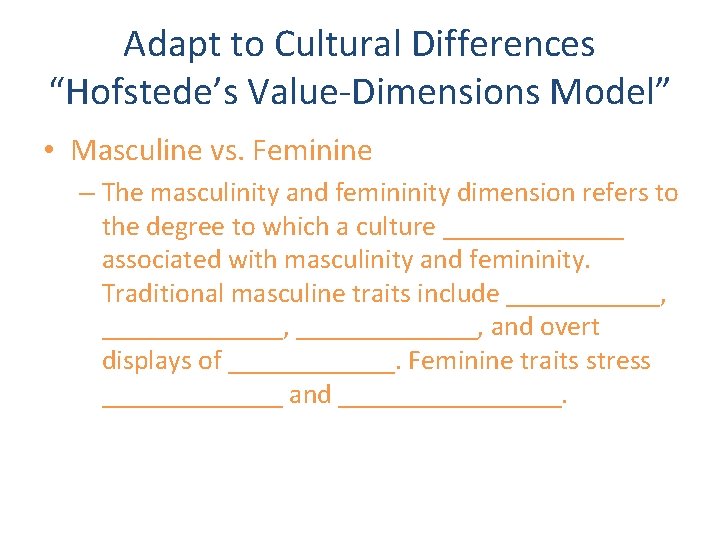
Adapt to Cultural Differences “Hofstede’s Value-Dimensions Model” • Masculine vs. Feminine – The masculinity and femininity dimension refers to the degree to which a culture _______ associated with masculinity and femininity. Traditional masculine traits include ___________, and overt displays of ______. Feminine traits stress _______ and ________.
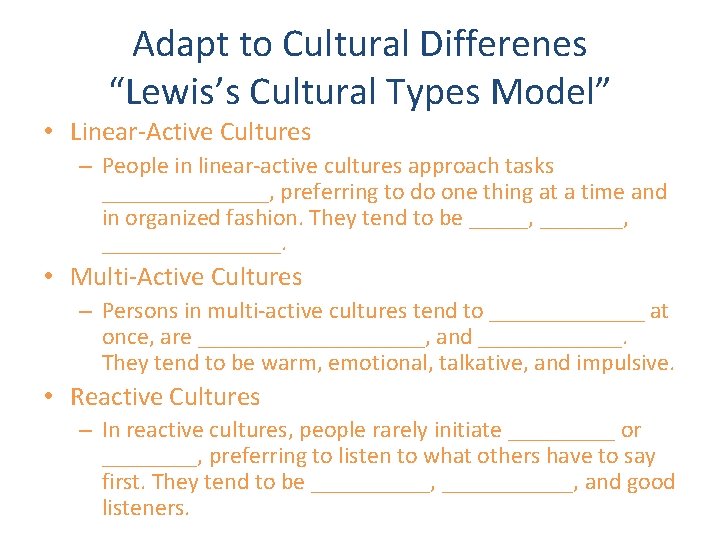
Adapt to Cultural Differenes “Lewis’s Cultural Types Model” • Linear-Active Cultures – People in linear-active cultures approach tasks _______, preferring to do one thing at a time and in organized fashion. They tend to be _____, _________. • Multi-Active Cultures – Persons in multi-active cultures tend to _______ at once, are __________, and ______. They tend to be warm, emotional, talkative, and impulsive. • Reactive Cultures – In reactive cultures, people rarely initiate _____ or ____, preferring to listen to what others have to say first. They tend to be _____, ______, and good listeners.