
Auction Theory Class 3 optimal auctions 1 Optimal


![Optimal auctions: proof A key insight (Myerson 81’): In equilibrium, E[revenue] = E[virtual valuation]](https://slidetodoc.com/presentation_image_h/1aa14ddf91fb6e3d9788342cab1fec81/image-18.jpg "Optimal auctions: proof A key insight (Myerson 81’): In equilibrium, E[revenue] = E[virtual valuation]")
- Slides: 28
Auction Theory Class 3 – optimal auctions 1
Optimal auctions • Usually the term optimal auctions stands for revenue maximization. • What is maximal revenue? – We can always charge the winner his value. • Maximal revenue: optimal expected revenue in equilibrium. – Assuming a probability distribution on the values. – Over all the possible mechanisms. – Under individual-rationality constraints (later). 2
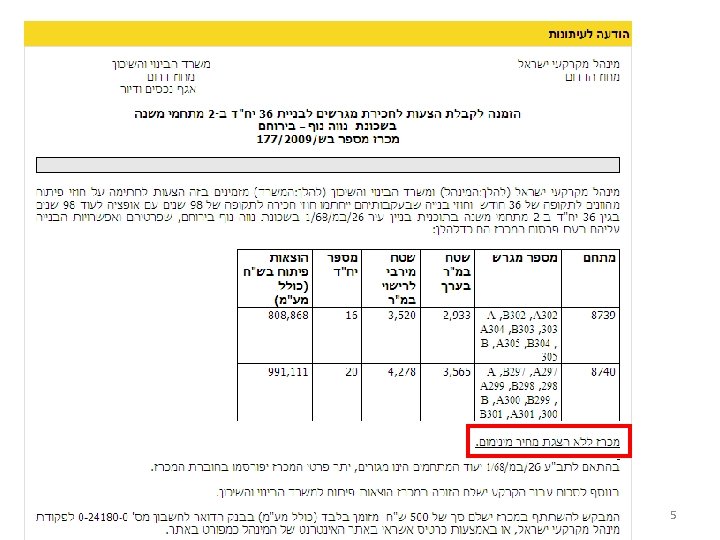
Next: Can we get better revenue? • Can we achieve better revenue than the 2 nd-price/1 st price? • If so, we must sacrifice efficiency. – All efficient auction have the same revenue…. • How? – Think about the New-Zealand case. 3
4
5
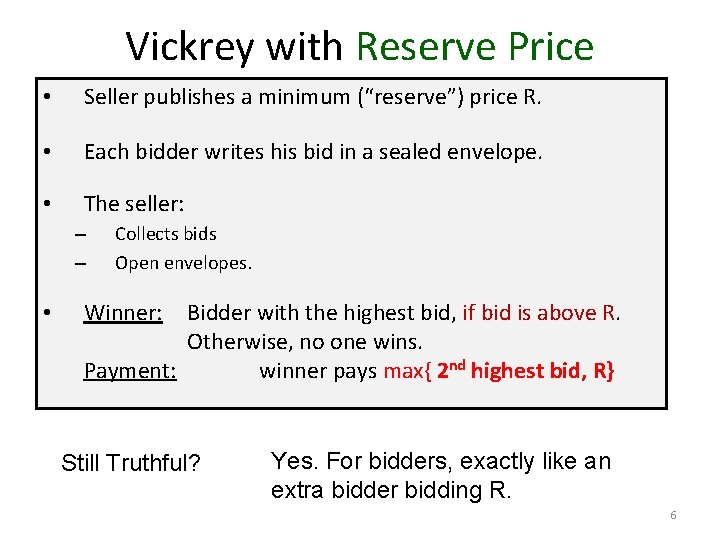
Vickrey with Reserve Price • Seller publishes a minimum (“reserve”) price R. • Each bidder writes his bid in a sealed envelope. • The seller: – – • Collects bids Open envelopes. Winner: Bidder with the highest bid, if bid is above R. Otherwise, no one wins. Payment: winner pays max{ 2 nd highest bid, R} Still Truthful? Yes. For bidders, exactly like an extra bidder bidding R. 6
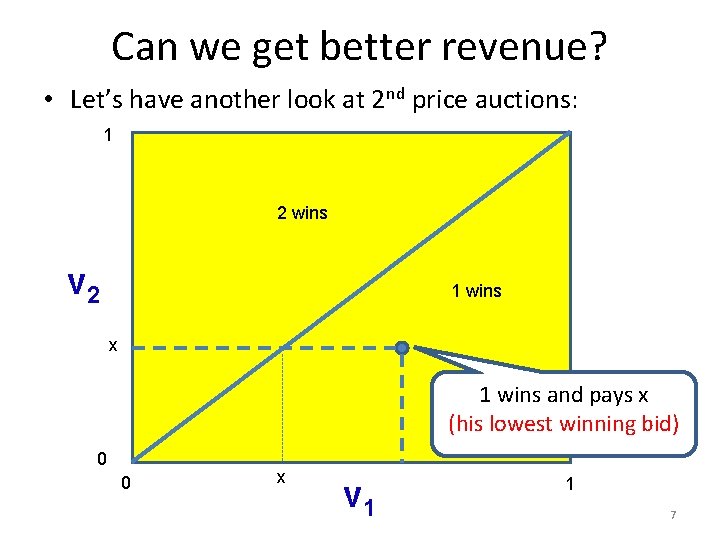
Can we get better revenue? • Let’s have another look at 2 nd price auctions: 1 2 wins v 2 1 wins x 1 wins and pays x (his lowest winning bid) 0 0 x v 1 1 7
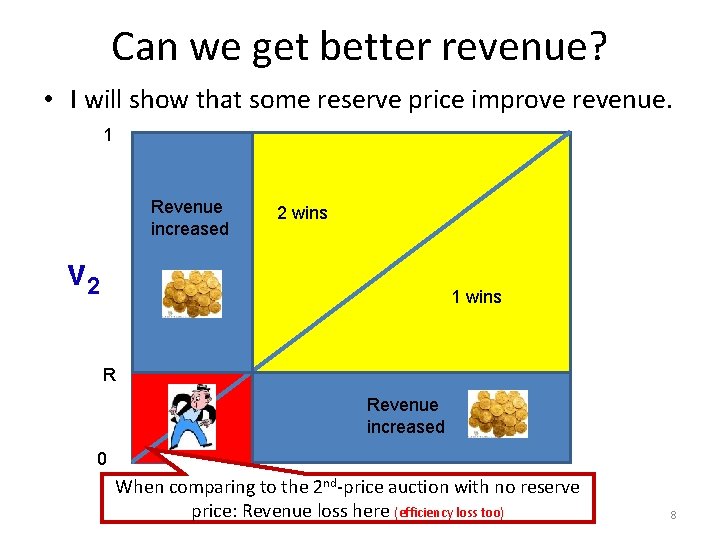
Can we get better revenue? • I will show that some reserve price improve revenue. 1 Revenue increased 2 wins v 2 1 wins R Revenue increased 0 0 1 When comparing R to the 2 nd-price auction with no reserve 1 (efficiency loss too) price: Revenue loss here v 8
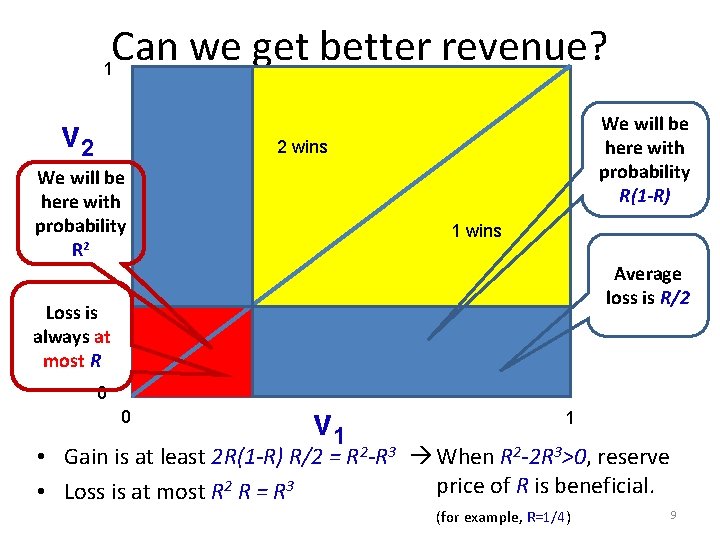
Can we get better revenue? 1 v 2 We will be here with probability R(1 -R) 2 wins We will be here with probability R 2 1 wins Average loss is R/2 Loss is always at most R 0 0 v 1 1 • Gain is at least 2 R(1 -R) R/2 = R 2 -R 3 When R 2 -2 R 3>0, reserve price of R is beneficial. • Loss is at most R 2 R = R 3 (for example, R=1/4) 9
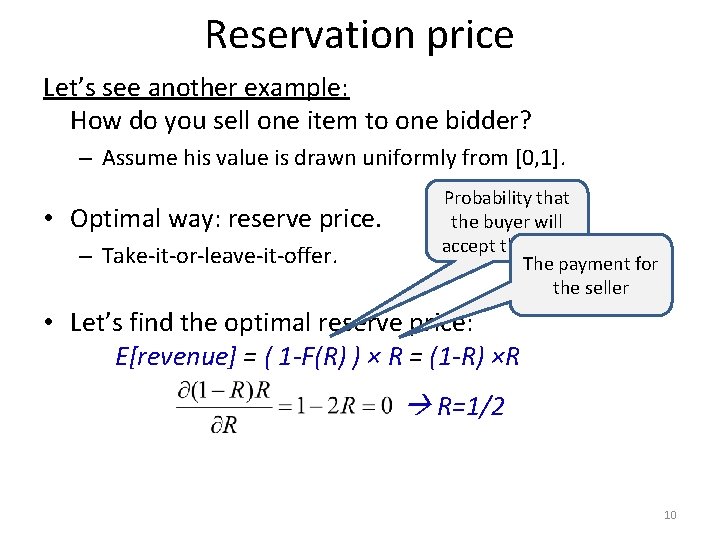
Reservation price Let’s see another example: How do you sell one item to one bidder? – Assume his value is drawn uniformly from [0, 1]. • Optimal way: reserve price. – Take-it-or-leave-it-offer. Probability that the buyer will accept the price The payment for the seller • Let’s find the optimal reserve price: E[revenue] = ( 1 -F(R) ) × R = (1 -R) ×R R=1/2 10
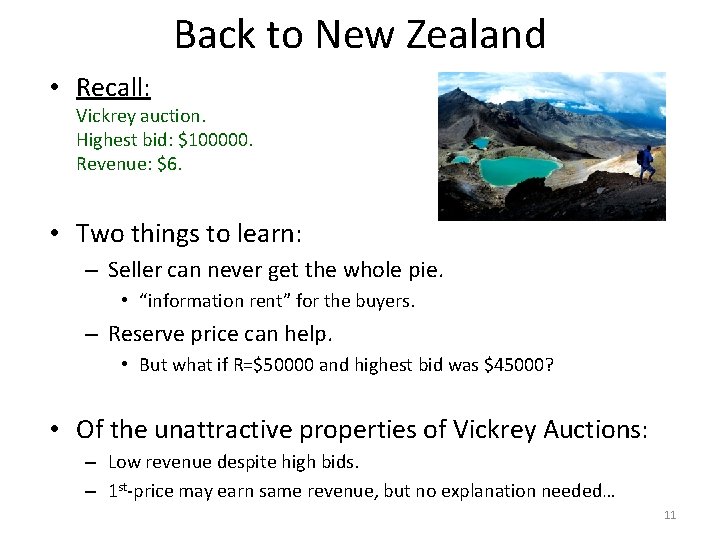
Back to New Zealand • Recall: Vickrey auction. Highest bid: $100000. Revenue: $6. • Two things to learn: – Seller can never get the whole pie. • “information rent” for the buyers. – Reserve price can help. • But what if R=$50000 and highest bid was $45000? • Of the unattractive properties of Vickrey Auctions: – Low revenue despite high bids. – 1 st-price may earn same revenue, but no explanation needed… 11
Optimal auctions: questions. • Is indeed Vickrey auctions with reserve price achieve the highest possible revenue? • If so, what is the optimal reserve price? • How the reserve price depends on the number of bidders? – Recall: for the uniform distribution with 1 bidder the optimal reserve price is ½. What is the optimal reserve price for 10 players? 12
Optimal auctions • So auctions with the same allocation has the same revenue. • But what is the mechanism that obtains the highest expected revenue? 13
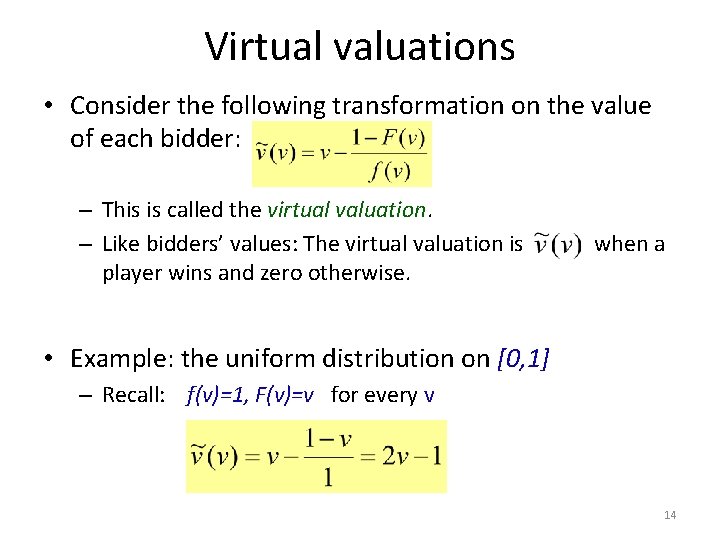
Virtual valuations • Consider the following transformation on the value of each bidder: – This is called the virtual valuation. – Like bidders’ values: The virtual valuation is player wins and zero otherwise. when a • Example: the uniform distribution on [0, 1] – Recall: f(v)=1, F(v)=v for every v 14
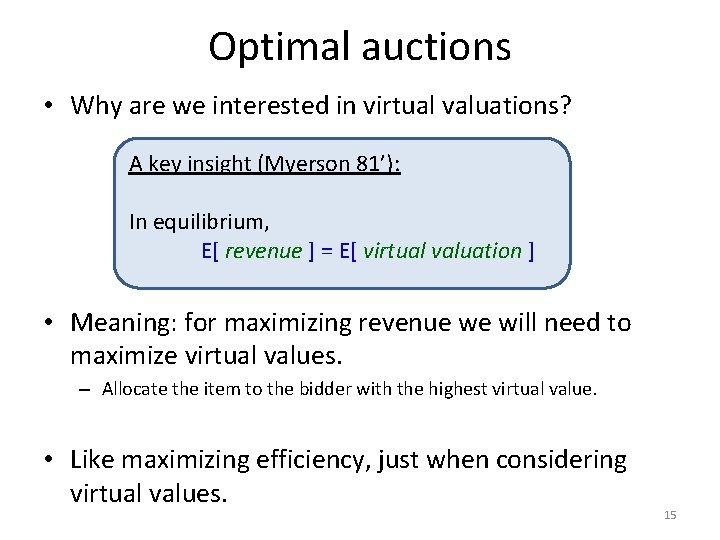
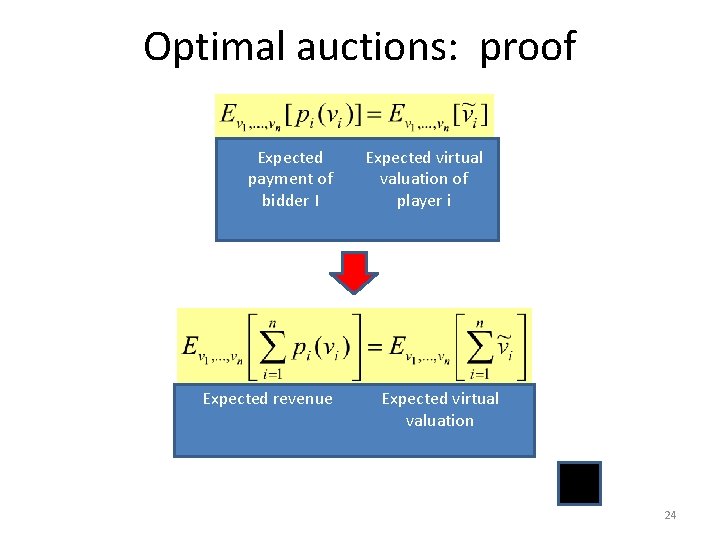
Optimal auctions • Why are we interested in virtual valuations? A key insight (Myerson 81’): In equilibrium, E[ revenue ] = E[ virtual valuation ] • Meaning: for maximizing revenue we will need to maximize virtual values. – Allocate the item to the bidder with the highest virtual value. • Like maximizing efficiency, just when considering virtual values. 15
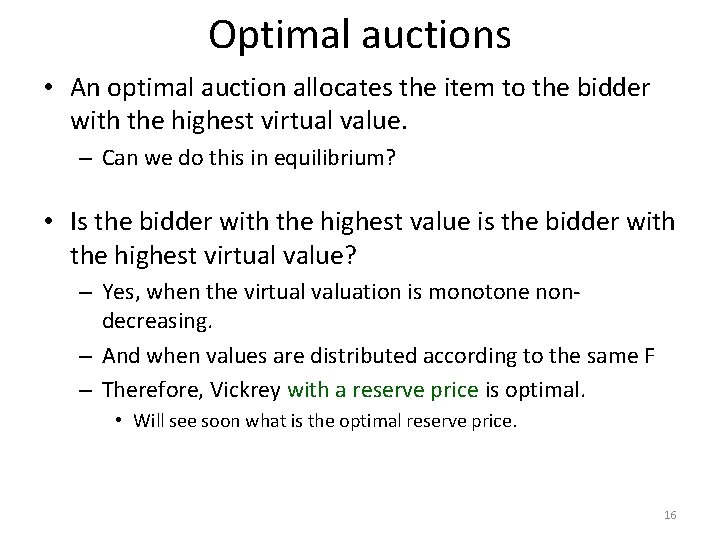
Optimal auctions • An optimal auction allocates the item to the bidder with the highest virtual value. – Can we do this in equilibrium? • Is the bidder with the highest value is the bidder with the highest virtual value? – Yes, when the virtual valuation is monotone nondecreasing. – And when values are distributed according to the same F – Therefore, Vickrey with a reserve price is optimal. • Will see soon what is the optimal reserve price. 16
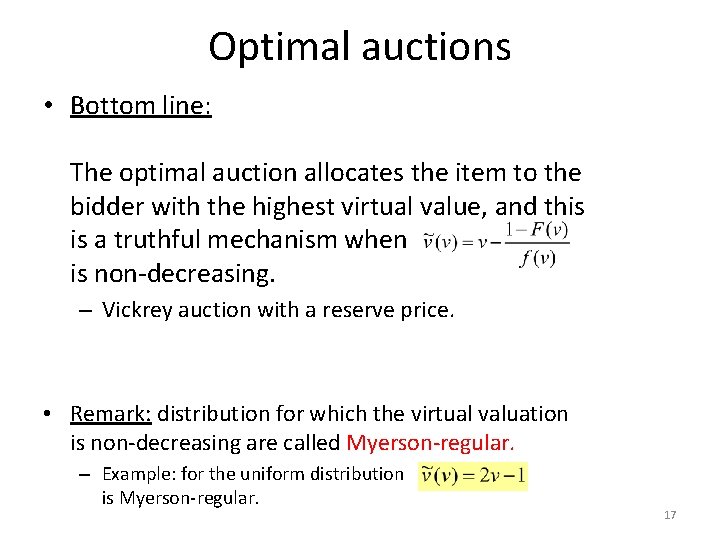
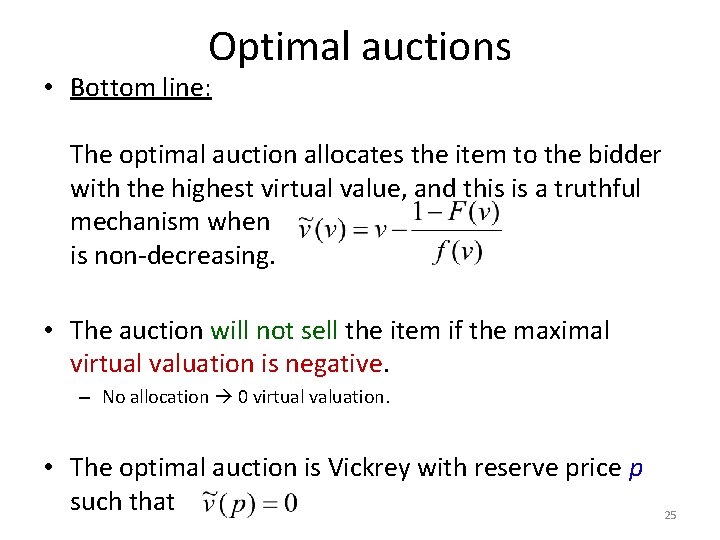
Optimal auctions • Bottom line: The optimal auction allocates the item to the bidder with the highest virtual value, and this is a truthful mechanism when is non-decreasing. – Vickrey auction with a reserve price. • Remark: distribution for which the virtual valuation is non-decreasing are called Myerson-regular. – Example: for the uniform distribution is Myerson-regular. 17
Optimal auctions: proof A key insight (Myerson 81’): In equilibrium, E[revenue] = E[virtual valuation] where the virtual valuations is: (Note: this theorem does not require that the virtual valuation is Myerson-monotone. ) 18
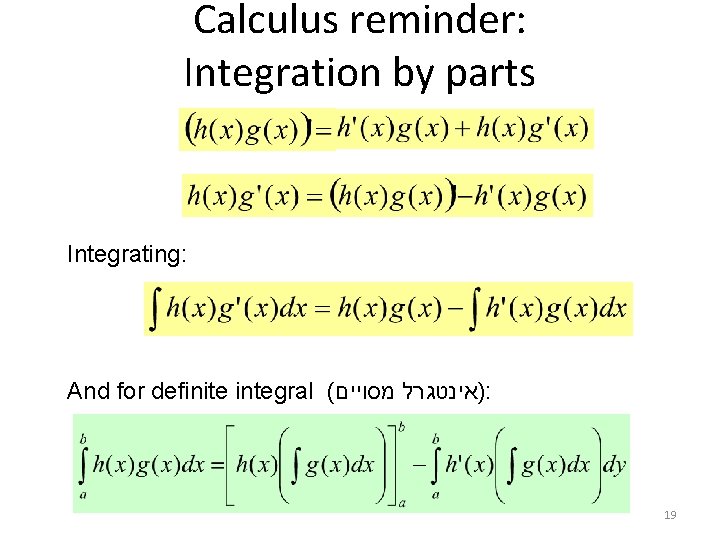
Calculus reminder: Integration by parts Integrating: And for definite integral ( )אינטגרל מסויים : 19
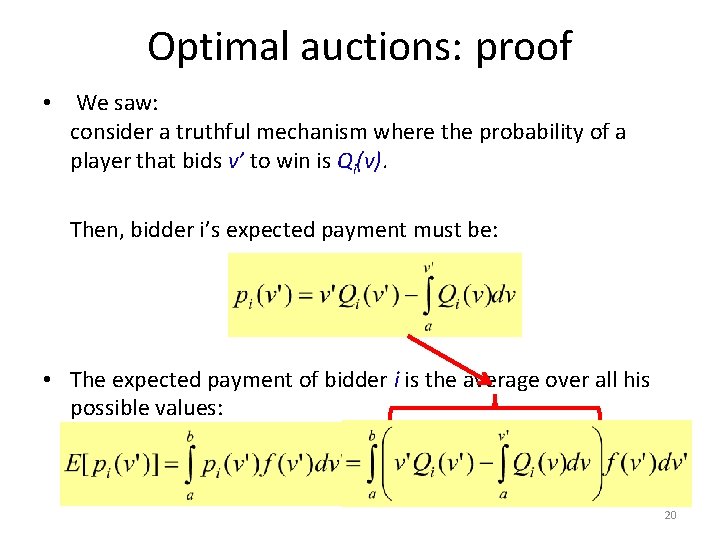
Optimal auctions: proof • We saw: consider a truthful mechanism where the probability of a player that bids v’ to win is Qi(v). Then, bidder i’s expected payment must be: • The expected payment of bidder i is the average over all his possible values: 20
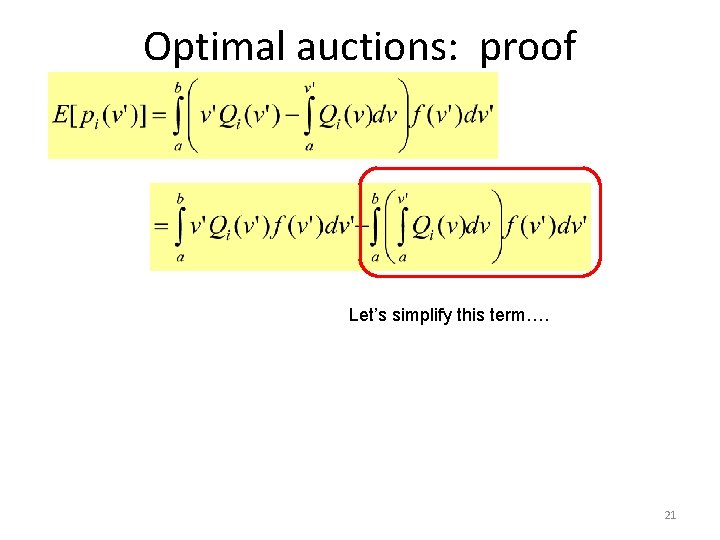
Optimal auctions: proof Let’s simplify this term…. 21
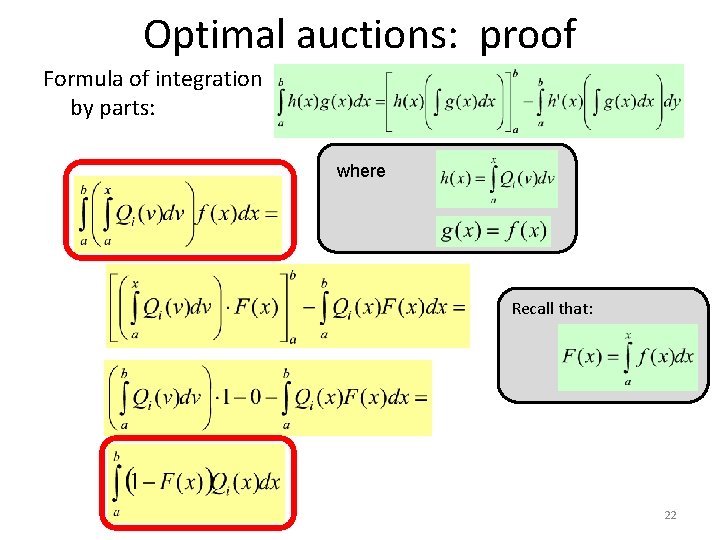
Optimal auctions: proof Formula of integration by parts: where Recall that: 22
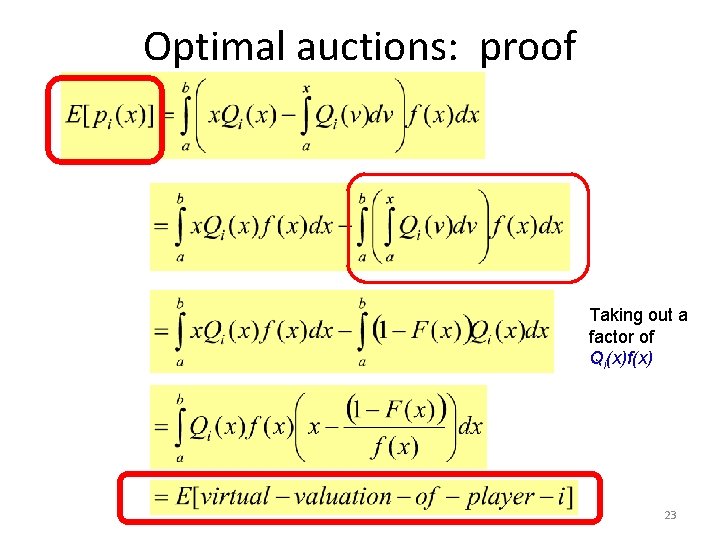
Optimal auctions: proof Let’s simplify this term…. Taking out a factor of Qi(x)f(x) 23
Optimal auctions: proof Expected payment of bidder I Expected revenue Expected virtual valuation of player i Expected virtual valuation 24
Optimal auctions • Bottom line: The optimal auction allocates the item to the bidder with the highest virtual value, and this is a truthful mechanism when is non-decreasing. • The auction will not sell the item if the maximal virtual valuation is negative. – No allocation 0 virtual valuation. • The optimal auction is Vickrey with reserve price p such that 25
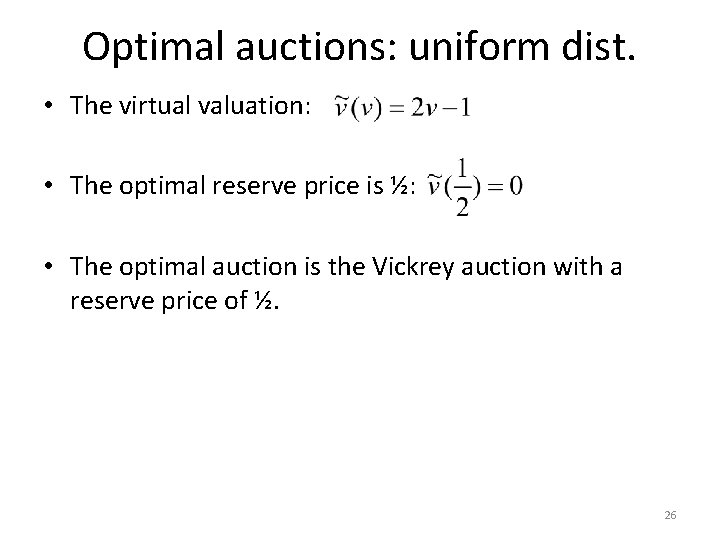
Optimal auctions: uniform dist. • The virtual valuation: • The optimal reserve price is ½: • The optimal auction is the Vickrey auction with a reserve price of ½. 26
Remarks • Reservation price is independent of the number of bidders – With uniform distribution, R=1/2 for every n. • With non-identical distributions (but still statistically independent), the same analysis works – Optimal auction still allocate the item to the bidder with the highest virtual valuation. – However, Vickrey+reserve-price is not necessarily the optimal auction in this case. • (it is not true anymore that the bidder with the highest value is the bidder with the highest virtual value) 27
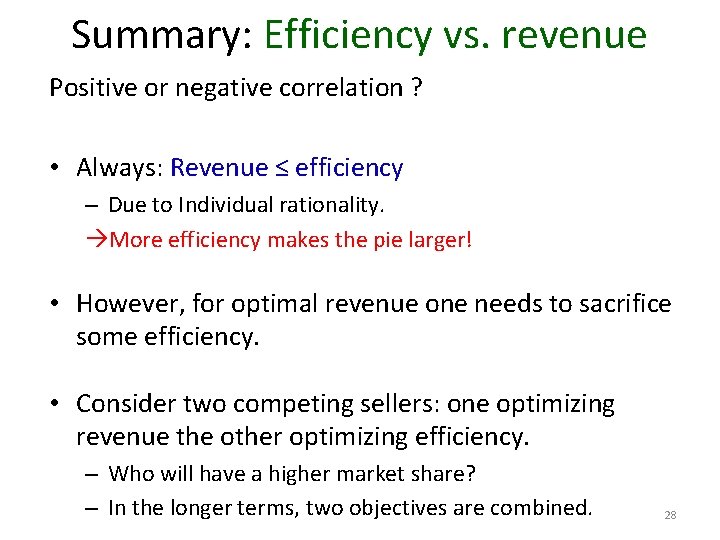
Summary: Efficiency vs. revenue Positive or negative correlation ? • Always: Revenue ≤ efficiency – Due to Individual rationality. More efficiency makes the pie larger! • However, for optimal revenue one needs to sacrifice some efficiency. • Consider two competing sellers: one optimizing revenue the other optimizing efficiency. – Who will have a higher market share? – In the longer terms, two objectives are combined. 28