
Attribution Chapter 17 Social Cognition What is Attribution
Attribution Chapter 17: Social Cognition
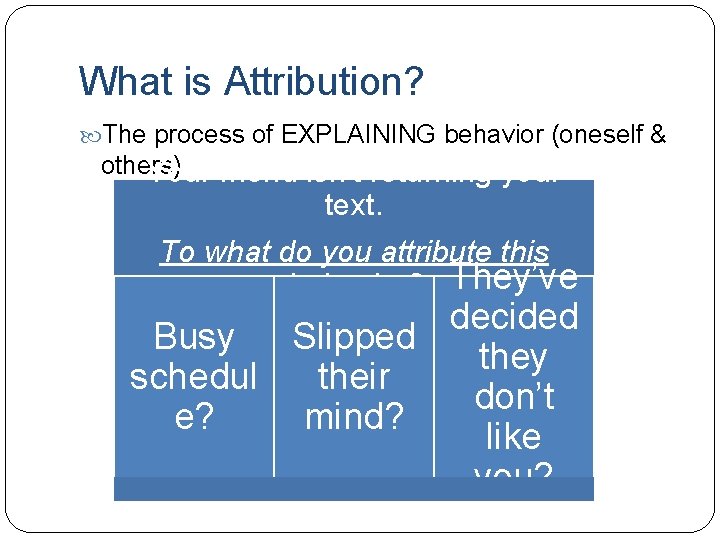
What is Attribution? The process of EXPLAINING behavior (oneself & others) Your friend isn’t returning your text. To what do you attribute this behavior? They’ve decided Busy Slipped they schedul their don’t e? mind? like you?
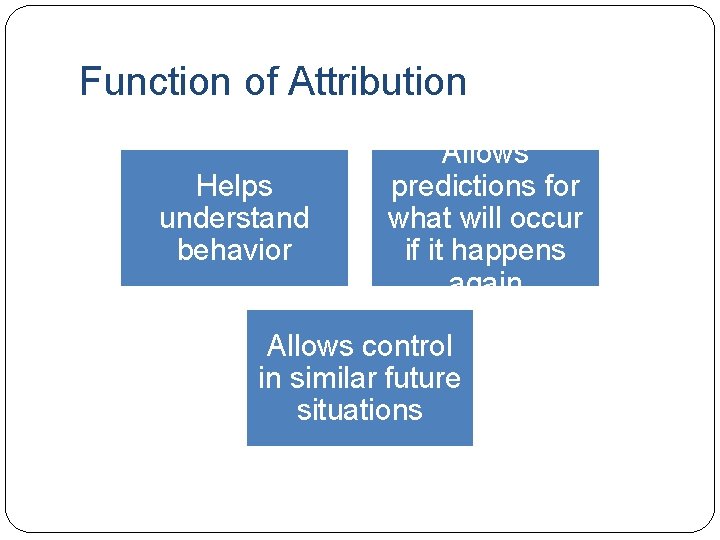
Function of Attribution Helps understand behavior Allows predictions for what will occur if it happens again Allows control in similar future situations
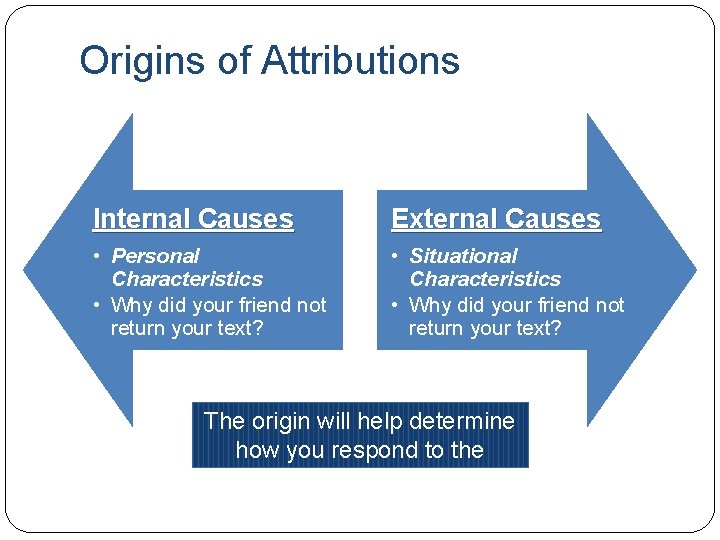
Origins of Attributions Internal Causes External Causes • Personal Characteristics • Why did your friend not return your text? • Situational Characteristics • Why did your friend not return your text? The origin will help determine how you respond to the behavior.
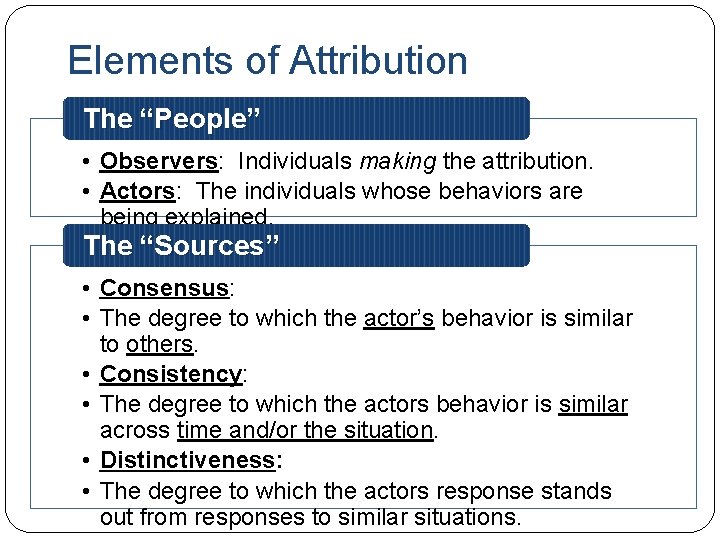
Elements of Attribution The “People” • Observers: Individuals making the attribution. • Actors: The individuals whose behaviors are being explained. The “Sources” • Consensus: • The degree to which the actor’s behavior is similar to others. • Consistency: • The degree to which the actors behavior is similar across time and/or the situation. • Distinctiveness: • The degree to which the actors response stands out from responses to similar situations.
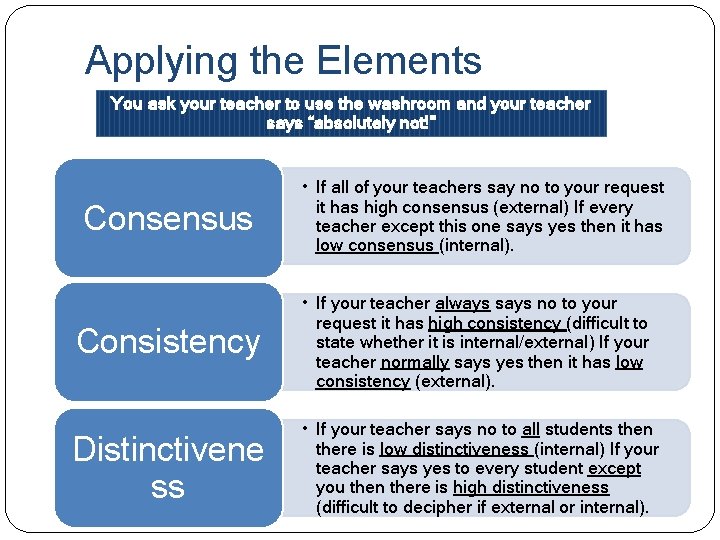
Applying the Elements You ask your teacher to use the washroom and your teacher says “absolutely not!” Consensus • If all of your teachers say no to your request it has high consensus (external) If every teacher except this one says yes then it has low consensus (internal). Consistency • If your teacher always says no to your request it has high consistency (difficult to state whether it is internal/external) If your teacher normally says yes then it has low consistency (external). Distinctivene ss • If your teacher says no to all students then there is low distinctiveness (internal) If your teacher says yes to every student except you then there is high distinctiveness (difficult to decipher if external or internal).
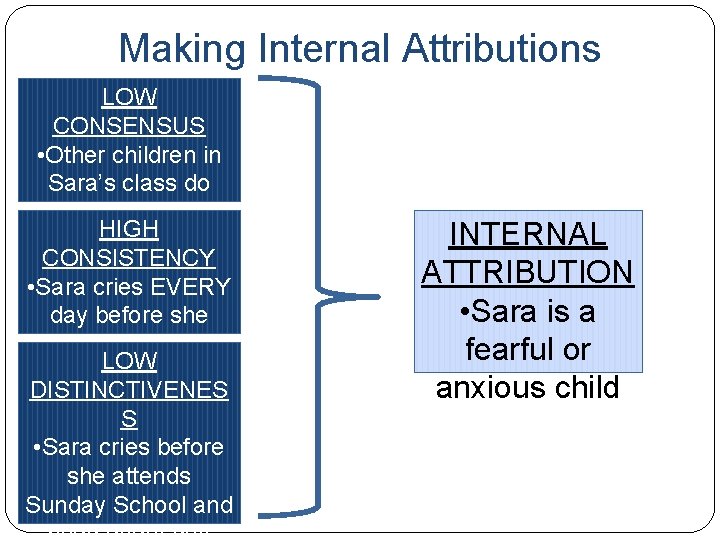
Making Internal Attributions LOW CONSENSUS • Other children in Sara’s class do NOT cry. HIGH CONSISTENCY • Sara cries EVERY day before she goes to school. LOW DISTINCTIVENES S • Sara cries before she attends Sunday School and INTERNAL ATTRIBUTION • Sara is a fearful or anxious child
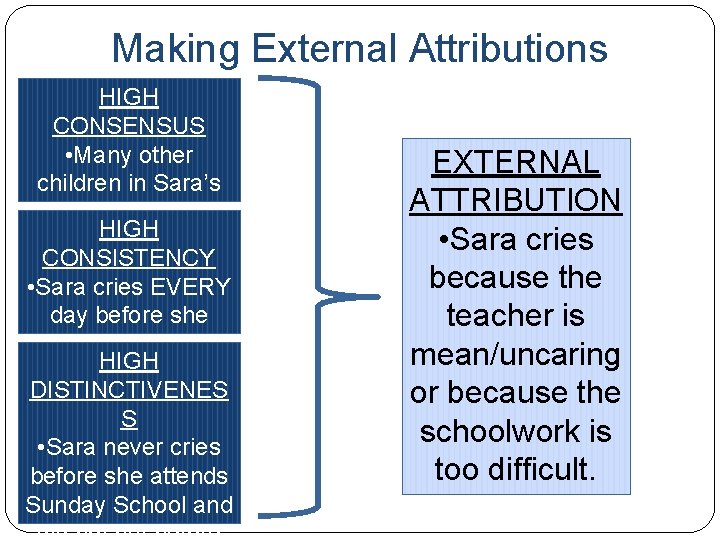
Making External Attributions HIGH CONSENSUS • Many other children in Sara’s class cry before HIGH school CONSISTENCY • Sara cries EVERY day before she goes to school. HIGH DISTINCTIVENES S • Sara never cries before she attends Sunday School and EXTERNAL ATTRIBUTION • Sara cries because the teacher is mean/uncaring or because the schoolwork is too difficult.
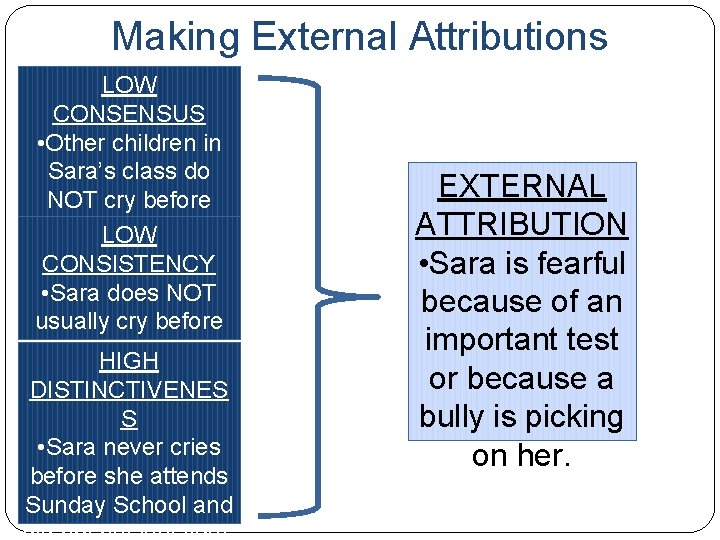
Making External Attributions LOW CONSENSUS • Other children in Sara’s class do NOT cry before they go. LOW to school. CONSISTENCY • Sara does NOT usually cry before she goes to school. HIGH DISTINCTIVENES S • Sara never cries before she attends Sunday School and EXTERNAL ATTRIBUTION • Sara is fearful because of an important test or because a bully is picking on her.
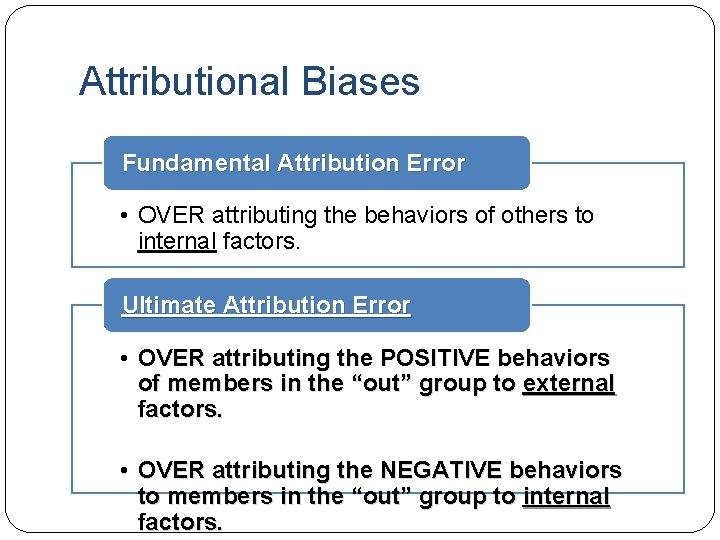
Attributional Biases Fundamental Attribution Error • OVER attributing the behaviors of others to internal factors. Ultimate Attribution Error • OVER attributing the POSITIVE behaviors of members in the “out” group to external factors. • OVER attributing the NEGATIVE behaviors to members in the “out” group to internal factors.
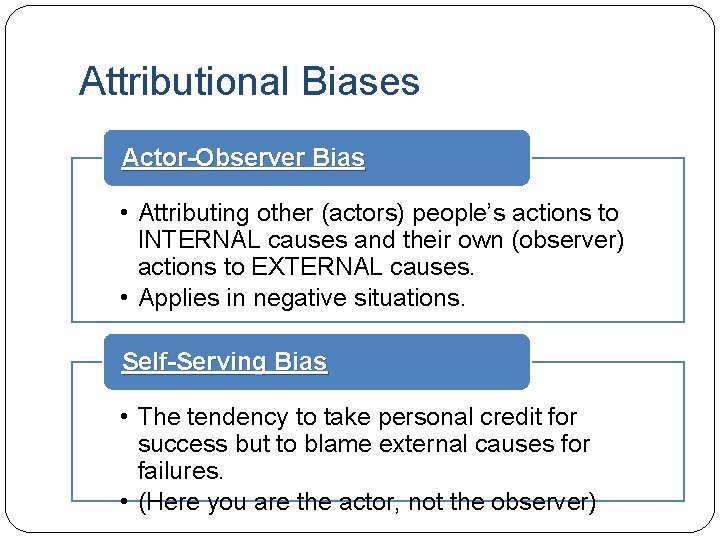
Attributional Biases Actor-Observer Bias • Attributing other (actors) people’s actions to INTERNAL causes and their own (observer) actions to EXTERNAL causes. • Applies in negative situations. Self-Serving Bias • The tendency to take personal credit for success but to blame external causes for failures. • (Here you are the actor, not the observer)
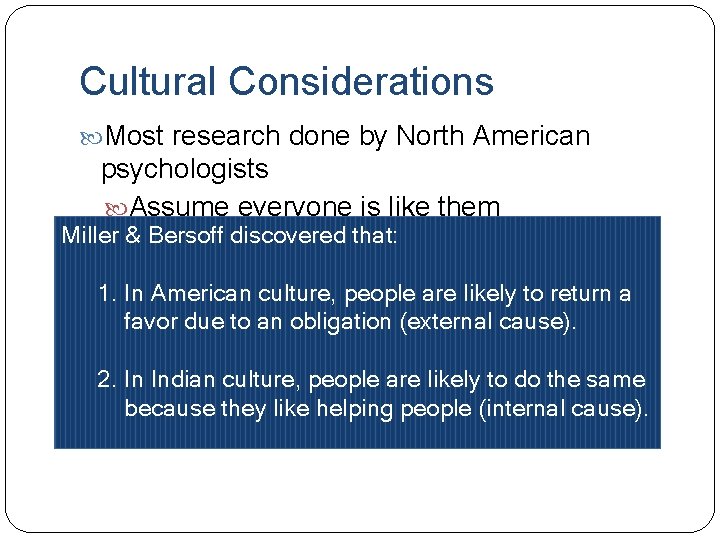
Cultural Considerations Most research done by North American psychologists Assume everyone is like them Miller & Bersoff discovered that: 1. In American culture, people are likely to return a favor due to an obligation (external cause). 2. In Indian culture, people are likely to do the same because they like helping people (internal cause).
- Slides: 12