
Attributes Model ABET Engineering Criteria 2000 a An
Attributes Model – ABET Engineering Criteria 2000 a. An ability to apply knowledge of math, science, and engineering b. An ability to design and conduct experiments, as well as to analyze and interpret data c. An ability to design a system, component, or process to meet desired needs d. An ability to function on multi-disciplinary teams
ABET ENGINEERING CRITERIA 2000 ATTRIBUTES (CONTINUED) e. An ability to identify, formulate, and solve engineering problems f. An understanding of professional and ethical responsibility g. An ability to communicate effectively h. A broad education necessary to understand the impact of engineering solutions in a global and societal context
ABET Engineering Criteria 2000 Attributes (continued) i. A recognition of the need for, and an ability to engage in, life-long learning j. A knowledge of contemporary issues k. An ability to use the techniques, skills, and modern engineering tools necessary for engineering practice
What is Engineering? If someone (father, grandmother, aunt, friend, fellow student) asked you the question: “What is engineering? ” How would you respond? “Engineering is the profession in which a knowledge of the mathematical and natural sciences, gained by study, experience, and practice, is applied with judgment to develop ways to utilize, economically, the materials and forces of nature for the benefit of [hu]mankind. ”
Rewards and Opportunities of an Engineering Career 1. 2. 3. 4. 5. 6. 7. 8. 9. 10. Varied opportunities Challenging work Intellectual development Social impact Financial security Prestige Professional environment Understanding how things work Creative thinking Self esteem
The Engineering Design Process 1 - Customer need or business opportunity 2 - Problem definition/specifications and constraints 3 - Data and information collection 4 - Development of alternative designs 5 - Evaluation of designs/selection of optimal design 6 - Implementation of optimal design 7 - Testing and evaluation of the design 8 - Redesign and retest, if necessary
How Things Work � � Internet (e. g. , www. howstuffworks. com) Trade magazines (e. g. , Popular Mechanics, PC World, etc. ) Engineering society websites and magazines (e. g. , www. spectrum. ieee. org) Reverse engineering
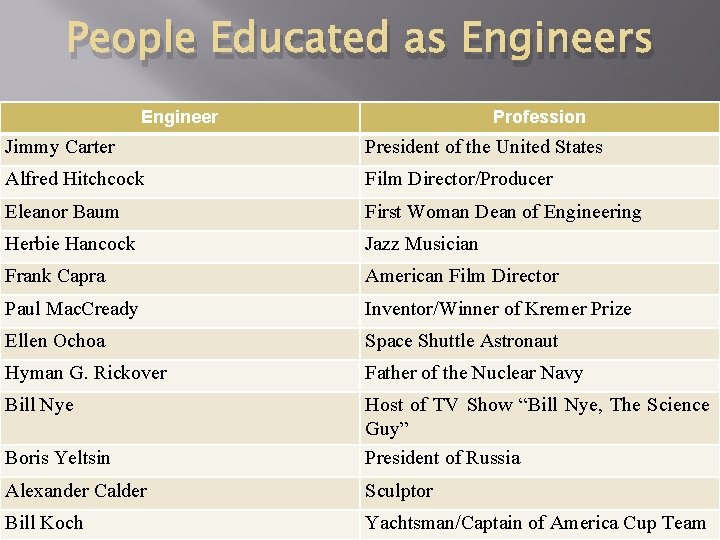
People Educated as Engineer Profession Jimmy Carter President of the United States Alfred Hitchcock Film Director/Producer Eleanor Baum First Woman Dean of Engineering Herbie Hancock Jazz Musician Frank Capra American Film Director Paul Mac. Cready Inventor/Winner of Kremer Prize Ellen Ochoa Space Shuttle Astronaut Hyman G. Rickover Father of the Nuclear Navy Bill Nye Boris Yeltsin Host of TV Show “Bill Nye, The Science Guy” President of Russia Alexander Calder Sculptor Bill Koch Yachtsman/Captain of America Cup Team
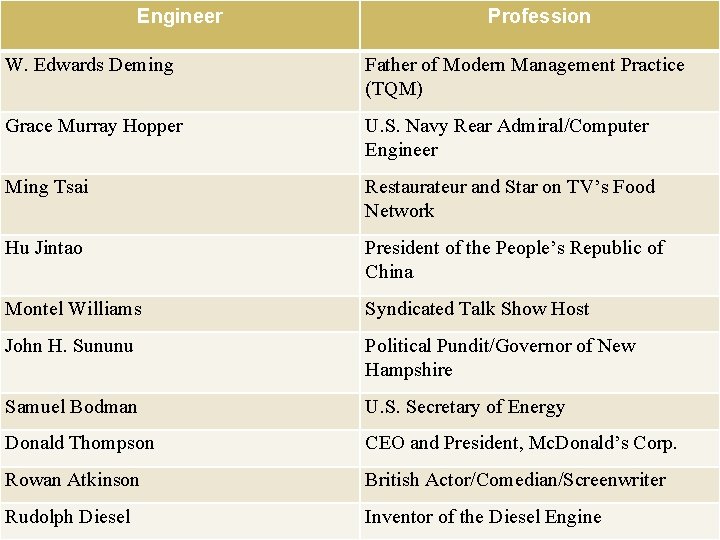
Engineer Profession W. Edwards Deming Father of Modern Management Practice (TQM) Grace Murray Hopper U. S. Navy Rear Admiral/Computer Engineer Ming Tsai Restaurateur and Star on TV’s Food Network Hu Jintao President of the People’s Republic of China Montel Williams Syndicated Talk Show Host John H. Sununu Political Pundit/Governor of New Hampshire Samuel Bodman U. S. Secretary of Energy Donald Thompson CEO and President, Mc. Donald’s Corp. Rowan Atkinson British Actor/Comedian/Screenwriter Rudolph Diesel Inventor of the Diesel Engine
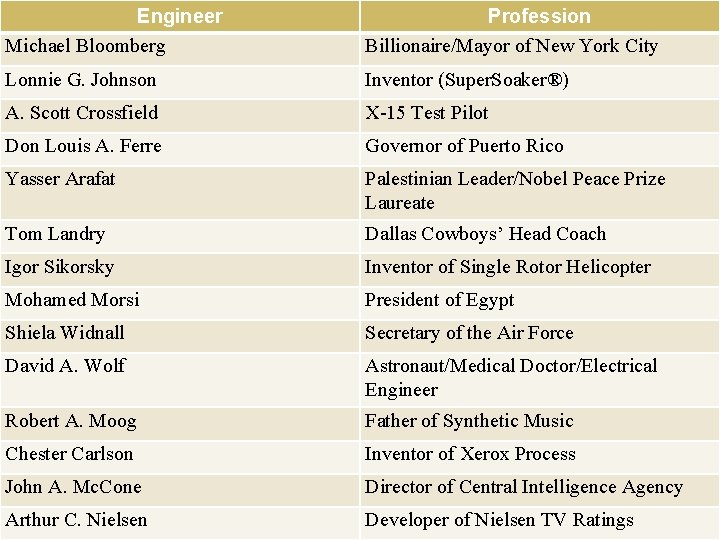
Engineer Michael Bloomberg Profession Billionaire/Mayor of New York City Lonnie G. Johnson Inventor (Super. Soaker®) A. Scott Crossfield X-15 Test Pilot Don Louis A. Ferre Governor of Puerto Rico Yasser Arafat Palestinian Leader/Nobel Peace Prize Laureate Tom Landry Dallas Cowboys’ Head Coach Igor Sikorsky Inventor of Single Rotor Helicopter Mohamed Morsi President of Egypt Shiela Widnall Secretary of the Air Force David A. Wolf Astronaut/Medical Doctor/Electrical Engineer Robert A. Moog Father of Synthetic Music Chester Carlson Inventor of Xerox Process John A. Mc. Cone Director of Central Intelligence Agency Arthur C. Nielsen Developer of Nielsen TV Ratings
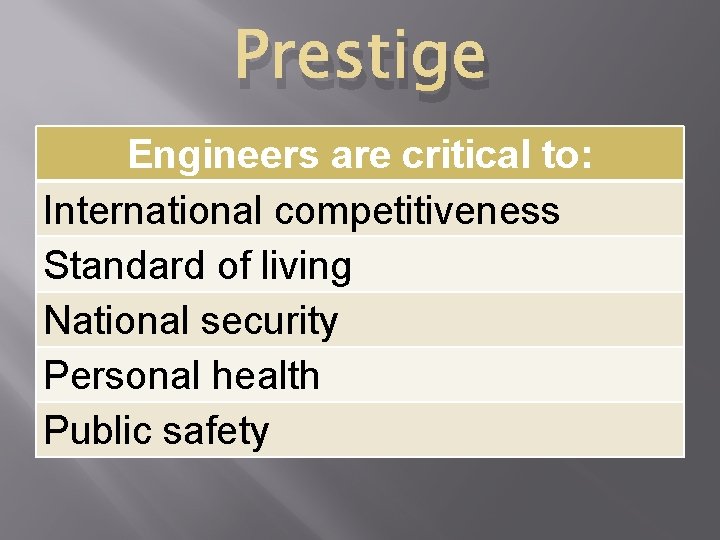
Prestige Engineers are critical to: International competitiveness Standard of living National security Personal health Public safety
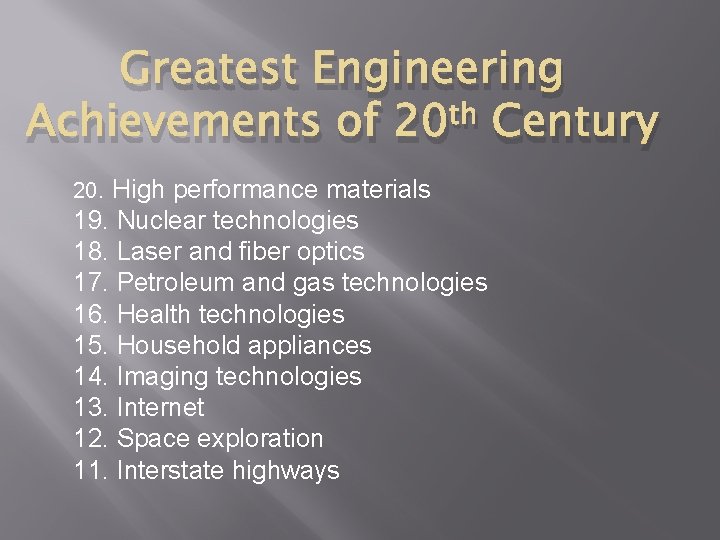
Greatest Engineering Achievements of 20 th Century 20. High performance materials 19. Nuclear technologies 18. Laser and fiber optics 17. Petroleum and gas technologies 16. Health technologies 15. Household appliances 14. Imaging technologies 13. Internet 12. Space exploration 11. Interstate highways
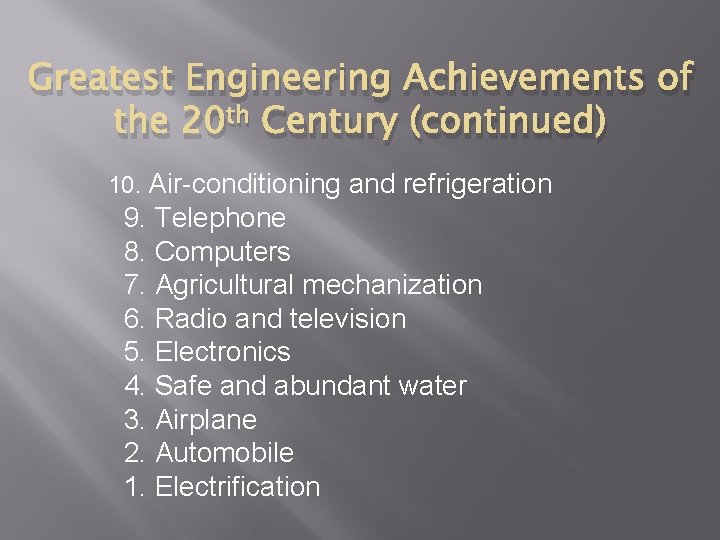
Greatest Engineering Achievements of the 20 th Century (continued) 10. Air-conditioning and refrigeration 9. Telephone 8. Computers 7. Agricultural mechanization 6. Radio and television 5. Electronics 4. Safe and abundant water 3. Airplane 2. Automobile 1. Electrification
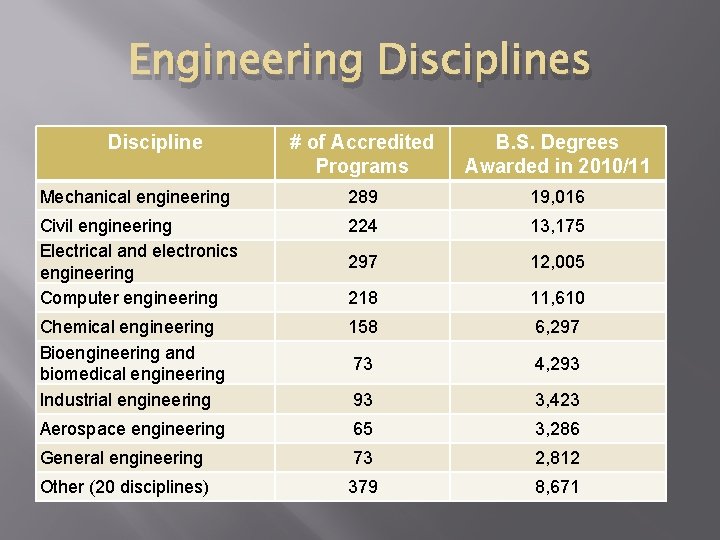
Engineering Disciplines Discipline # of Accredited Programs B. S. Degrees Awarded in 2010/11 Mechanical engineering 289 19, 016 Civil engineering Electrical and electronics engineering Computer engineering 224 13, 175 297 12, 005 218 11, 610 Chemical engineering Bioengineering and biomedical engineering Industrial engineering 158 6, 297 73 4, 293 93 3, 423 Aerospace engineering 65 3, 286 General engineering 73 2, 812 Other (20 disciplines) 379 8, 671
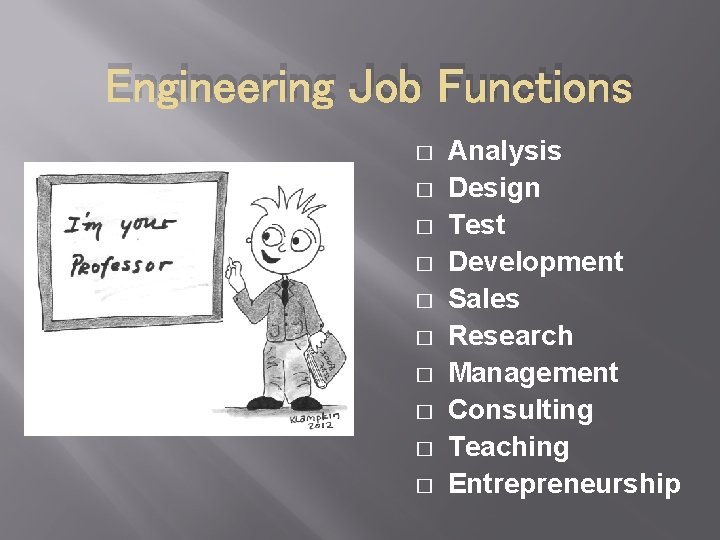
Engineering Job Functions � � � � � Analysis Design Test Development Sales Research Management Consulting Teaching Entrepreneurship
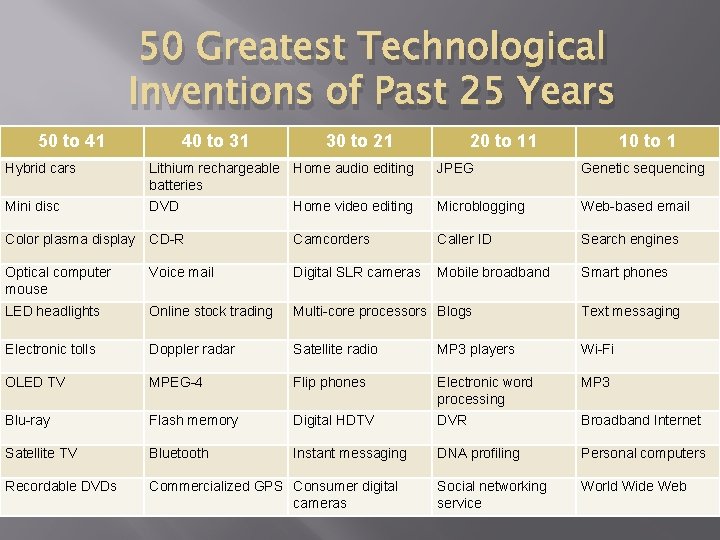
50 Greatest Technological Inventions of Past 25 Years 50 to 41 40 to 31 30 to 21 20 to 11 10 to 1 Hybrid cars Lithium rechargeable Home audio editing batteries JPEG Genetic sequencing Mini disc DVD Home video editing Microblogging Web-based email Color plasma display CD-R Camcorders Caller ID Search engines Optical computer mouse Voice mail Digital SLR cameras Mobile broadband Smart phones LED headlights Online stock trading Multi-core processors Blogs Text messaging Electronic tolls Doppler radar Satellite radio MP 3 players Wi-Fi OLED TV MPEG-4 Flip phones Electronic word processing MP 3 Blu-ray Flash memory Digital HDTV DVR Broadband Internet Satellite TV Bluetooth Instant messaging DNA profiling Personal computers Recordable DVDs Commercialized GPS Consumer digital cameras Social networking service World Wide Web
Major Events and Changes Affecting the Future � � � Fall of the Berlin Wall Advances in computer technology Advances in communications The knowledge and information explosion Globalization (outsourcing, off-shoring) Environmental challenges/sustainability World population explosion Democratization Pandemic diseases/drug resistant germs Climate change/natural disasters Nuclear proliferation Events of September 11, 2001/threat of terrorism
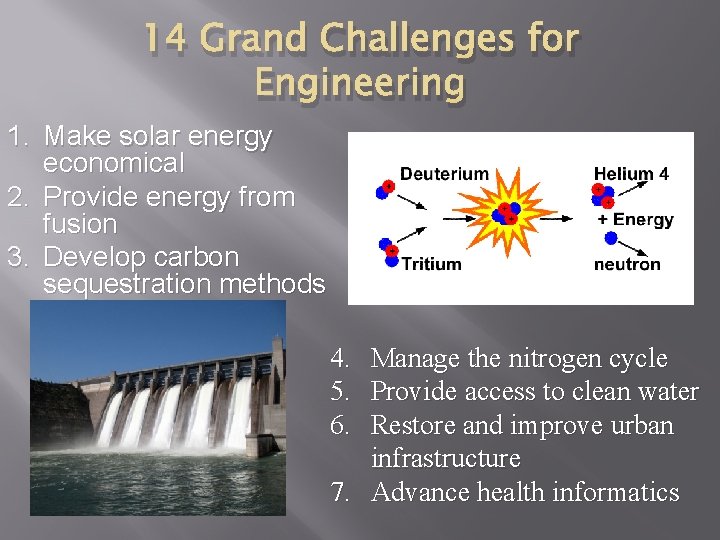
14 Grand Challenges for Engineering 1. Make solar energy economical 2. Provide energy from fusion 3. Develop carbon sequestration methods 4. Manage the nitrogen cycle 5. Provide access to clean water 6. Restore and improve urban infrastructure 7. Advance health informatics
14 Grand Challenges for Engineering (continued) 8. Engineer better medicines 9. Reverse-engineer the brain 10. Prevent nuclear terror 11. Secure cyberspace 12. Enhance virtual reality 13. Advance personalized learning 14. Engineer the tools of scientific discovery
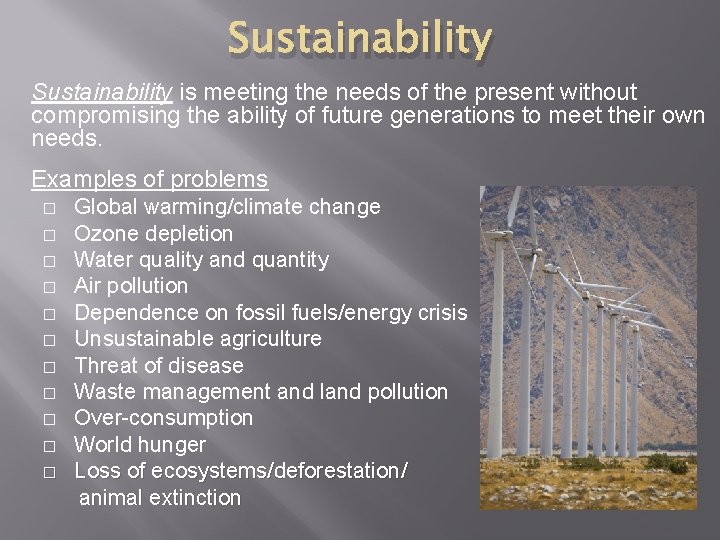
Sustainability is meeting the needs of the present without compromising the ability of future generations to meet their own needs. Examples of problems � � � Global warming/climate change Ozone depletion Water quality and quantity Air pollution Dependence on fossil fuels/energy crisis Unsustainable agriculture Threat of disease Waste management and land pollution Over-consumption World hunger Loss of ecosystems/deforestation/ animal extinction

PROJECT THE PROSPECTS OF ENGINEERING IN THE 21 ST CENTURY AND BEYOND 12 -08 -2016
- Slides: 22