
Attractive Forces There are two types of attractive
- Slides: 6
Attractive Forces • There are two types of attractive forces involved in molecules: – Intramolecular forces – Intermolecular forces
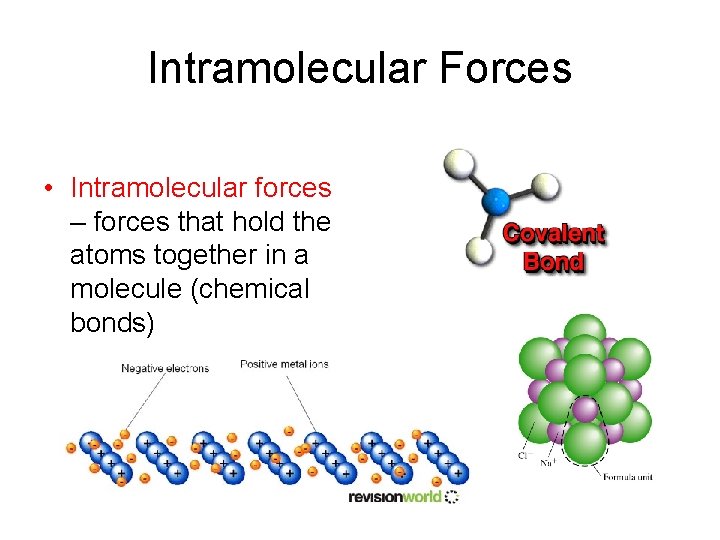
Intramolecular Forces • Intramolecular forces – forces that hold the atoms together in a molecule (chemical bonds)
Intermolecular Forces • Intermolecular forces – attractive forces between molecules. • Depend on the intramolecuar forces such as ionic vs covalent, polar vs nonpolar • These are responsible for some physical properties like solubility, melting point, boiling point, and hardness
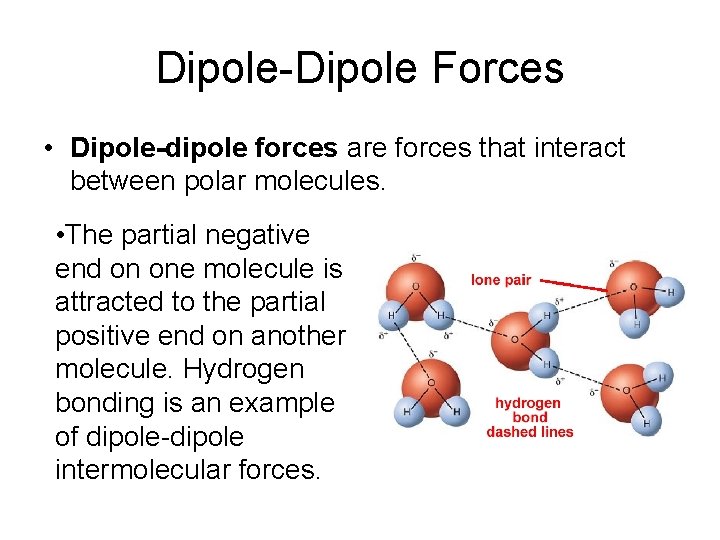
Dipole-Dipole Forces • Dipole-dipole forces are forces that interact between polar molecules. • The partial negative end on one molecule is attracted to the partial positive end on another molecule. Hydrogen bonding is an example of dipole-dipole intermolecular forces.
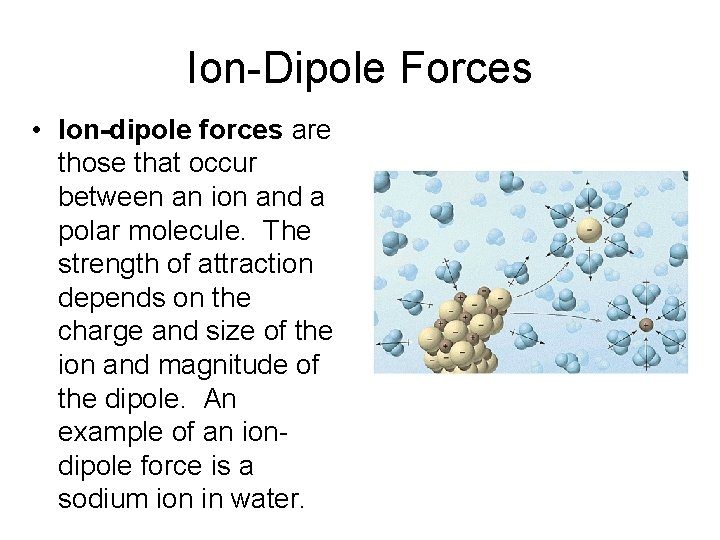
Ion-Dipole Forces • Ion-dipole forces are those that occur between an ion and a polar molecule. The strength of attraction depends on the charge and size of the ion and magnitude of the dipole. An example of an iondipole force is a sodium ion in water.
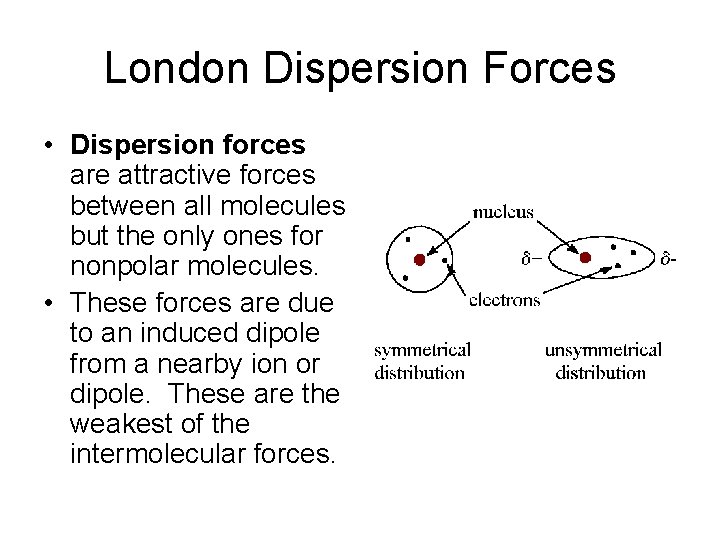
London Dispersion Forces • Dispersion forces are attractive forces between all molecules but the only ones for nonpolar molecules. • These forces are due to an induced dipole from a nearby ion or dipole. These are the weakest of the intermolecular forces.