
Attitude and their influence on performance and lifestyles
- Slides: 14
Attitude and their influence on performance and lifestyles. Mr. P. Leighton Sports Psychology.
Today’s Session… n n n Understand how attitudes are formed- Where do we gain our opinions and prejudices from? Recognize the components of attitude- can we change our attitudes or those of others? Work for you…
Attitude then… n n A mode of behaviour that is thought to be the typical response of an individual. Attitudes are interlinked with Personality. Moody (1980) defined attitude as… “ A mental state of readiness organised through experiences that influences the response of an individual towards any object or situation with which it is related”. Basically, Your understanding of a situation influenced by your own or others experiences around you in differing circumstances.
Can attitudes be changed? n n n Attitudes can be enduring as well as unstable… What is your attitude towards racism? But what is your attitude towards your team/ favourite player cheating?
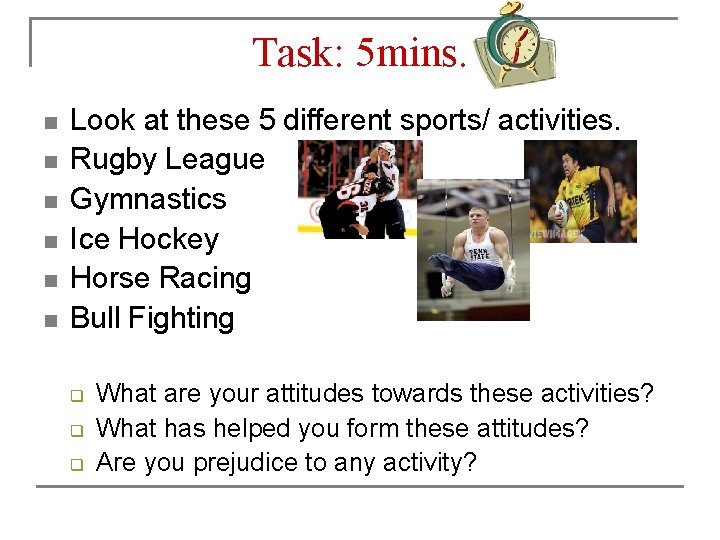
Task: 5 mins. n n n Look at these 5 different sports/ activities. Rugby League Gymnastics Ice Hockey Horse Racing Bull Fighting q q q What are your attitudes towards these activities? What has helped you form these attitudes? Are you prejudice to any activity?
Attitude objects and Prejudice. n n Attitudes are directed towards an ATTITUDE OBJECT. The object could be a place, situation or the behaviour of others i. e. Karl Pryce at Wigan. This negative attitude towards fitness training develops and can influence the behaviour of the player in the future. PREJUDICE is created by prejudgements based on unfounded beliefs or opinions… q q q i. e. all black men are fast runners. all scousers are thief's. Ron Atkinson’s Outburst.
Children’s development of prejudice in sport… n n Prejudice can be directed towards the sport in general. The young person may be discouraged by being the victim of prejudice e. g. racism, sexism etc.
Attitude Definitions… n n “ A mental state of readiness organised through experiences that influences the response of an individual towards any object or situation with which it is related” “ An attitude is a predisposition to act in a certain way towards some aspects of the environment including other people”
Negative and Positive Prejudice. n n Have you ever played for a coach who thought you were lazy because you opted out of additional sessions? If there is good reason (like mine) negative prejudices can be displayed towards the player. Negative prejudices have also lead to female participants being under-represented in sport. POSITIVE prejudices do also existfavouritism?
Origins of Attitudes. n n n n n Attitudes are formed through experience. PE example? Positive Vs. Negative experience? Sport can become an object of avoidance or pursuit. SOCIALISATION is another key element of attitude formation. Who plays the biggest role in formation of attitudes? Parents (Cognitive Development in Play etc) The PEER GROUP in the teenage years plays the biggest part i. e. game of football? The MEDIA also facilitates attitude. CULTURE can also play a part- Religion, race, peer groups i. e. Rugby League and Golf.
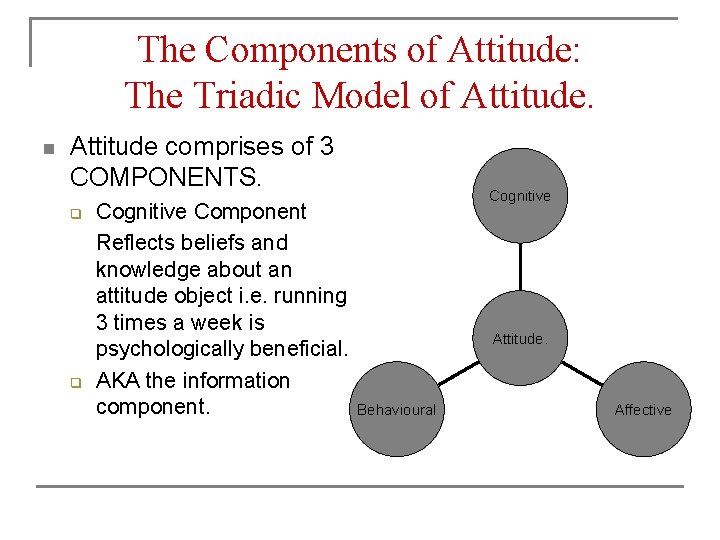
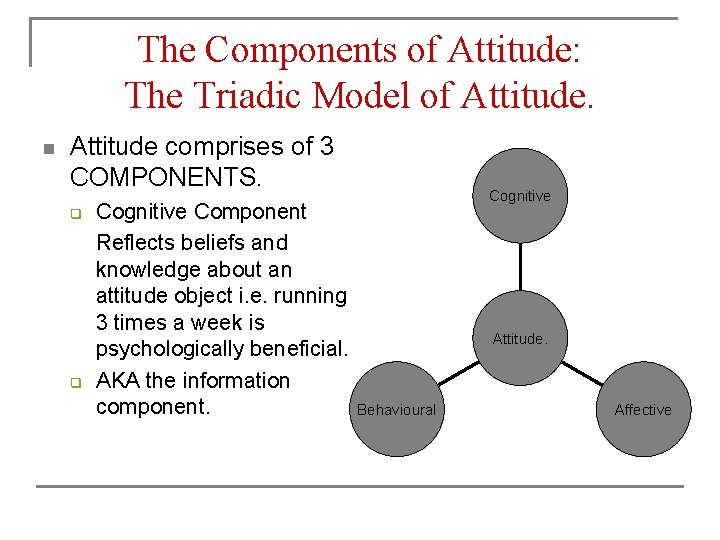
The Components of Attitude: The Triadic Model of Attitude. n Attitude comprises of 3 COMPONENTS. q q Cognitive Component Reflects beliefs and knowledge about an attitude object i. e. running 3 times a week is psychologically beneficial. AKA the information component. Cognitive Attitude. Behavioural Affective
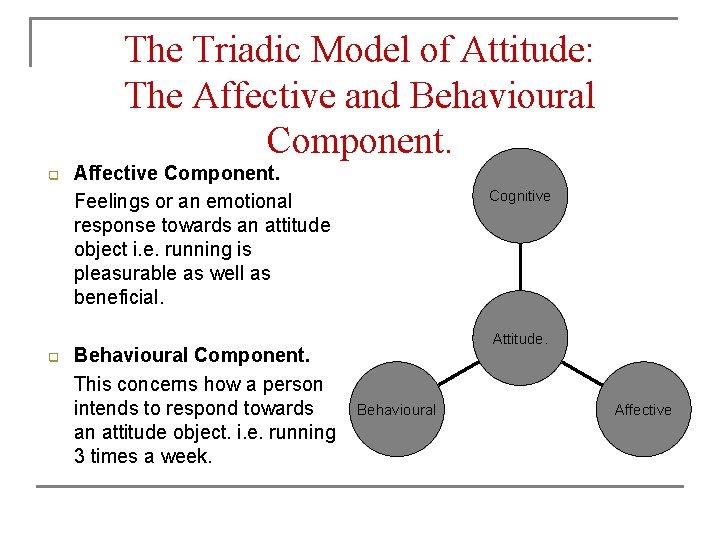
The Triadic Model of Attitude: The Affective and Behavioural Component. q q Affective Component. Feelings or an emotional response towards an attitude object i. e. running is pleasurable as well as beneficial. Behavioural Component. This concerns how a person intends to respond towards an attitude object. i. e. running 3 times a week. Cognitive Attitude. Behavioural Affective
The Components of Attitude: The Triadic Model of Attitude. n Attitude comprises of 3 COMPONENTS. q q Cognitive Component Reflects beliefs and knowledge about an attitude object i. e. running 3 times a week is psychologically beneficial. AKA the information component. Cognitive Attitude. Behavioural Affective
How can you change attitude? Work for you… n n n Cognitive Dissonance Theory. Persuasive Communication Theory. Read up on these 2 theories and create 2 separate information sheets- for your notes and everyone else’s. Pg. 206 -207. Hand in on WEDNESDAY.