
AttentionDeficitHyperactivy Disorder ADHD Physical Activity Roman Waldera M

- Slides: 18
Attention-Deficit/Hyperactivy Disorder (ADHD) & Physical Activity Roman Waldera, M. S. , Doctoral Student Dr. Joe Deutsch, Professor
What is ADHD? A chronic condition that effects children and adults Symptoms often include some combination of inactivity, hyperactivity, and impulsivity; as well as problems with self-esteem, relationships, and performance in school. 1
What is ADHD? Symptoms are often detected in childhood and sometimes may carry on into adulthood. 2 The strategies for treating childhood diagnosed ADHD may help alleviate the symptoms into adulthood. 2
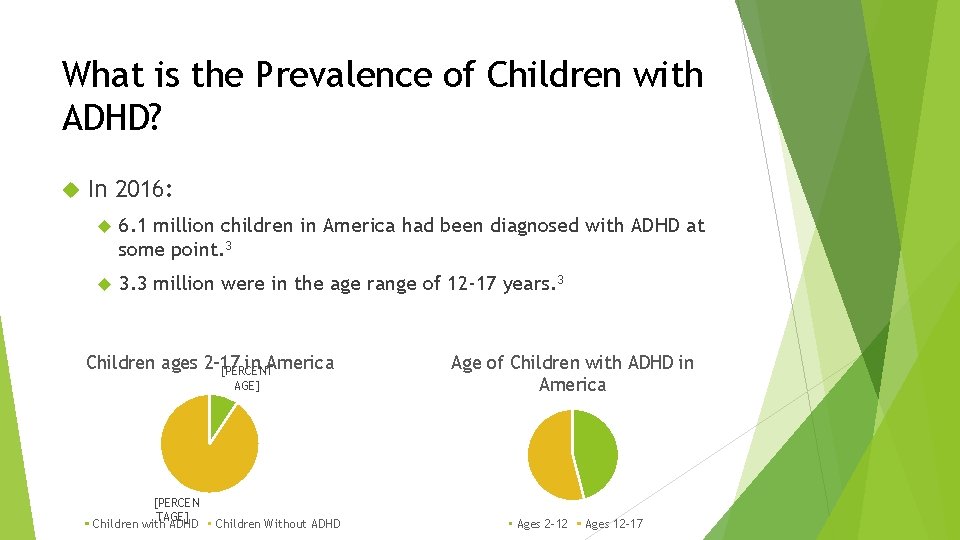
What is the Prevalence of Children with ADHD? In 2016: 6. 1 million children in America had been diagnosed with ADHD at some point. 3 3. 3 million were in the age range of 12 -17 years. 3 Children ages 2 -17 in America [PERCENT AGE] [PERCEN TAGE] Children with ADHD Children Without ADHD Age of Children with ADHD in America Ages 2 -12 Ages 12 -17
What Causes ADHD Symptoms? Children with ADHD have: Irregular cortical pathways 4 Difficulty regulating executive function, impulses, and behavior 4 Especially during complex tasks 4 This can be understood as an under-arousal of cortical activity. 5
How are ADHD Symptoms Treated? ADHD medications increase thinking and attention stimulating catecholamines (ex. dopamine and epinephrine). 6 In a large sample of American children with ADHD (n = 2, 495), most of the children (90. 8%) received medication to treat their symptoms. 7 Most of the children from the sample (85. 8%) also received school and classroom accommodations. 7
How are ADHD Symptoms Treated? Pharma-logical treatments are often accompanied or replaced by: Behavioral and social skills training 8 Cognitive training 8 Dietary modification 8 Physical Activity (PA) interventions may present additional non-pharmaceutical opportunities to reduce ADHD symptoms. 2
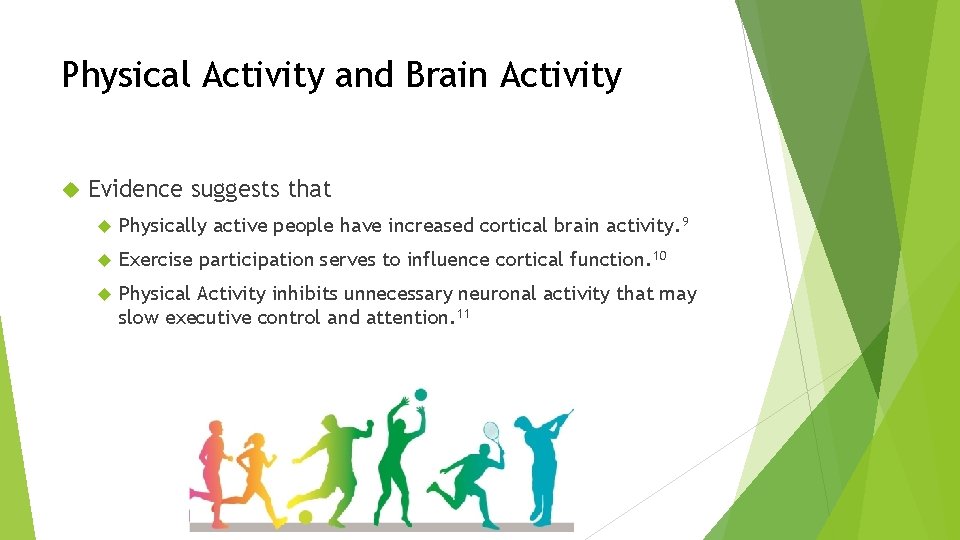
Physical Activity and Brain Activity Evidence suggests that Physically active people have increased cortical brain activity. 9 Exercise participation serves to influence cortical function. 10 Physical Activity inhibits unnecessary neuronal activity that may slow executive control and attention. 11
Physical Activity and Brain Activity Within studies of children’s brain activity: Children with ADHD displayed more optimal values of neural activity after short bouts (20 -30 mins) of aerobic activity (cycling or treadmill). 11, 12, 13 Performance within cognitive tasks also improved. 11, 13
Physical Activity and Brain Activity Measurement within these research studies was directly after exercise, therefore acute exercise bouts serve to normalize brain activity for children with ADHD Chronic aerobic exercise participation and overall physical fitness are also related to optimizations of neural activity 14, 15 and improvements in executive function and attention 16, 17
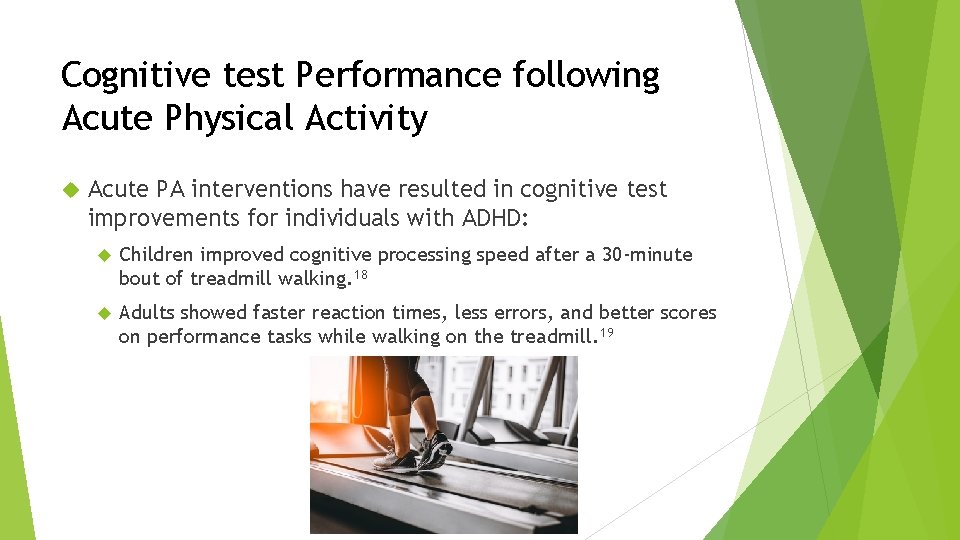
Cognitive test Performance following Acute Physical Activity Acute PA interventions have resulted in cognitive test improvements for individuals with ADHD: Children improved cognitive processing speed after a 30 -minute bout of treadmill walking. 18 Adults showed faster reaction times, less errors, and better scores on performance tasks while walking on the treadmill. 19
Cognitive test Performance following Chronic Physical Activity Chronic PA interventions have resulted in cognitive test improvements for individuals with ADHD: Children who participated in eight weeks of swim training significantly increased psychological and neurological test scores compared to those who did not participate. 20 Children with ADHD who participate in eight weeks of high intensity interval training (HIIT) may serve to improve their cognition during manual tasks. 21
Parent and Teacher Reports of ADHD Symptoms Following Physical Activity Positive associations reported for: parent- and self-reports of children’s ADHD symptoms after an eight week high intensity interval training (HIIT) interventions. 21 Teacher-reports of children’s ADHD symptoms after a 12 -week intervention including both physically and cognitively challenging exercise. 22 Parent and teacher ratings of behavior for children without ADHD show that overweight and obese children have significantly more behavior problems. 23
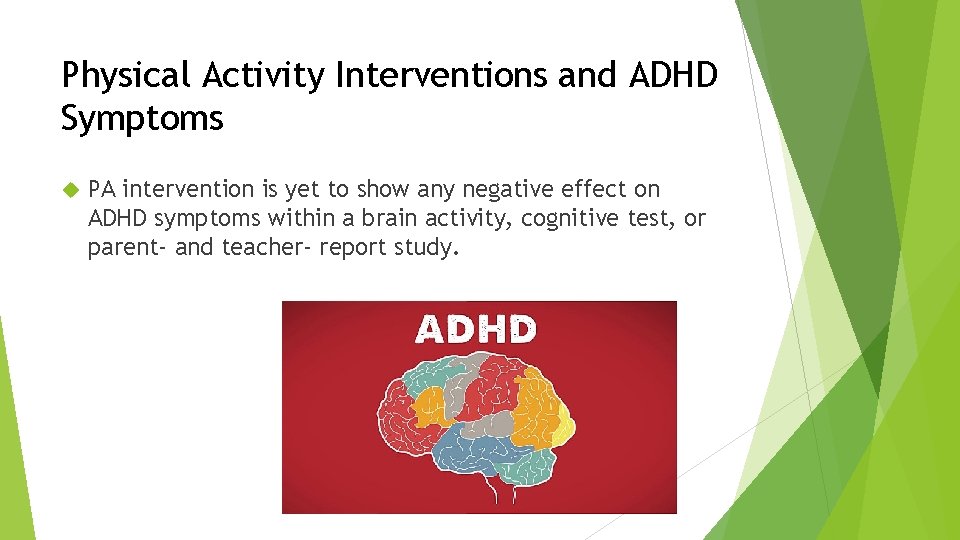
Physical Activity Interventions and ADHD Symptoms PA intervention is yet to show any negative effect on ADHD symptoms within a brain activity, cognitive test, or parent- and teacher- report study.
Area for Future Research A portion of children likely are participating in sport that require more cooperative skills within a team than previously noted interventions such as walking, swimming, HIIT, and cycling: Organized team sport activities may not produce desired changes in behavior because of inherent challenges of the game that may inhibit benefit. For example, children with ADHD may struggle more to follow rules and control reactive aggression in fast-paced team sports than their traditional developmental piers (ex. soccer). 24
Area for Future Research The type and timing of PA required to exhibit a positive effect on ADHD symptoms may be unique to the individual. For example, dose dependence may be a factor where Individuals with ADHD who are typically quite active may show less symptom improvement following PA interventions than sedentary individuals.
Concluding Statements In addition to pharmaceutical and behavioral training remedies, the inclusion of daily exercise may further potentiate ADHD symptom relief. This presents a tremendous opportunity for adults, children, and adolescents with ADHD as: PA interventions can be easily adapted into a daily schedule in preparation for bouts of attentional effort PA interventions can be utilized completely free of cost and health -care professional reliance.