
Attentiondeficithyperactivity disorder ADHD Outline Overview History Diagnostic Criteria
- Slides: 27
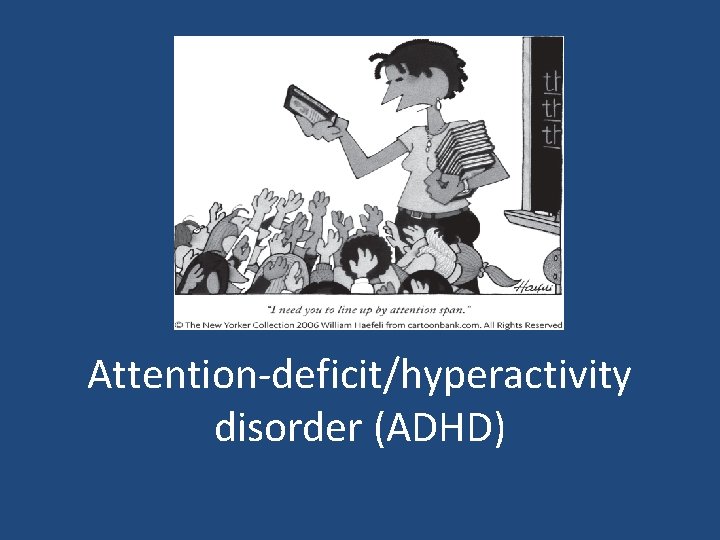
Attention-deficit/hyperactivity disorder (ADHD)
Outline • • Overview History Diagnostic Criteria Sub-types • • • Prevalence Course Causes Co-occurring problems Treatment
Overview of ADHD • Diagnosed based on behavioral observations • Frustrating to family members, teachers, peers • Children with ADHD experience feelings of – Frustration – Not fitting in – Being different – Hopelessness
History • Descriptions of ADHD-like behaviors as early as 1798 • More detailed description in early 1900 s, coinciding with increased emphasis on group education • 1950 s = emphasis on hyperactivity • 1970 s = increasing focus on impulse control, inattention • 1980 s = attention on stimulant use in treatment of ADHD (controversial!)
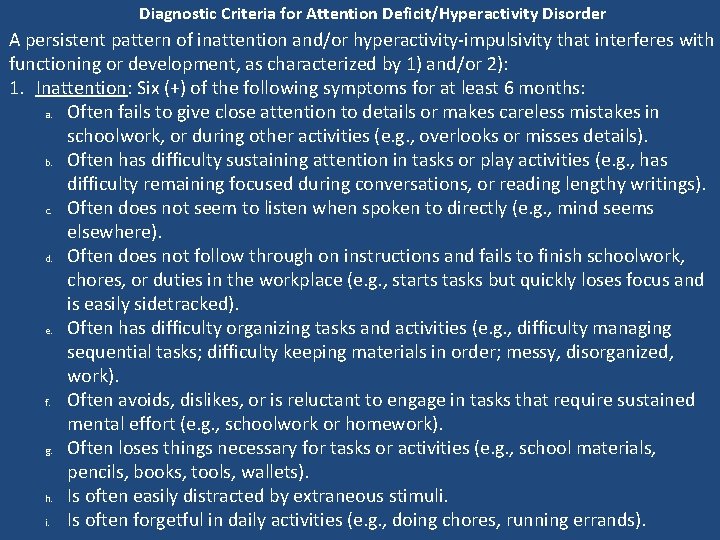
Diagnostic Criteria for Attention Deficit/Hyperactivity Disorder A persistent pattern of inattention and/or hyperactivity-impulsivity that interferes with functioning or development, as characterized by 1) and/or 2): 1. Inattention: Six (+) of the following symptoms for at least 6 months: a. Often fails to give close attention to details or makes careless mistakes in schoolwork, or during other activities (e. g. , overlooks or misses details). b. Often has difficulty sustaining attention in tasks or play activities (e. g. , has difficulty remaining focused during conversations, or reading lengthy writings). c. Often does not seem to listen when spoken to directly (e. g. , mind seems elsewhere). d. Often does not follow through on instructions and fails to finish schoolwork, chores, or duties in the workplace (e. g. , starts tasks but quickly loses focus and is easily sidetracked). e. Often has difficulty organizing tasks and activities (e. g. , difficulty managing sequential tasks; difficulty keeping materials in order; messy, disorganized, work). f. Often avoids, dislikes, or is reluctant to engage in tasks that require sustained mental effort (e. g. , schoolwork or homework). g. Often loses things necessary for tasks or activities (e. g. , school materials, pencils, books, tools, wallets). h. Is often easily distracted by extraneous stimuli. i. Is often forgetful in daily activities (e. g. , doing chores, running errands).
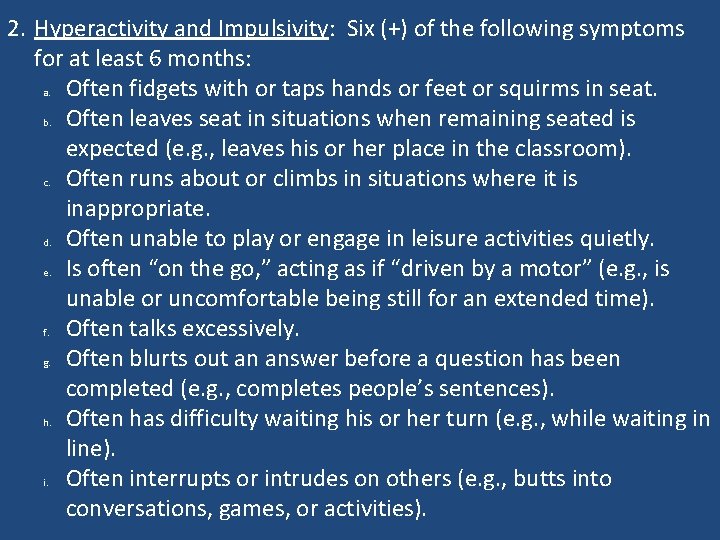
2. Hyperactivity and Impulsivity: Six (+) of the following symptoms for at least 6 months: a. Often fidgets with or taps hands or feet or squirms in seat. b. Often leaves seat in situations when remaining seated is expected (e. g. , leaves his or her place in the classroom). c. Often runs about or climbs in situations where it is inappropriate. d. Often unable to play or engage in leisure activities quietly. e. Is often “on the go, ” acting as if “driven by a motor” (e. g. , is unable or uncomfortable being still for an extended time). f. Often talks excessively. g. Often blurts out an answer before a question has been completed (e. g. , completes people’s sentences). h. Often has difficulty waiting his or her turn (e. g. , while waiting in line). i. Often interrupts or intrudes on others (e. g. , butts into conversations, games, or activities).
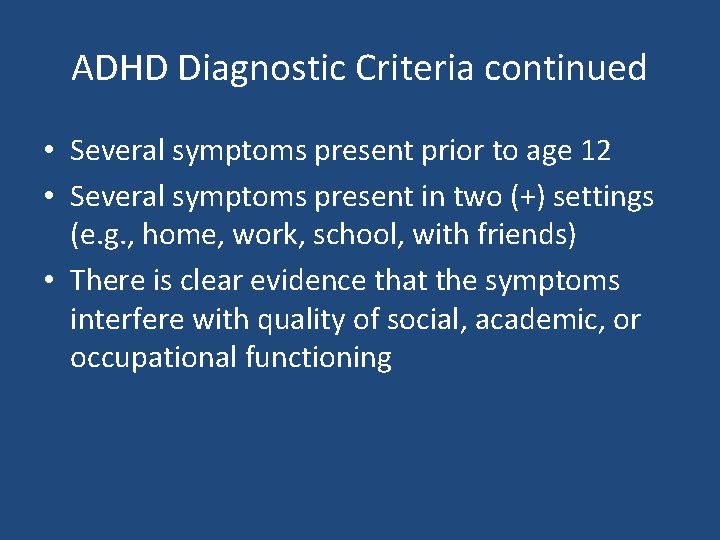
ADHD Diagnostic Criteria continued • Several symptoms present prior to age 12 • Several symptoms present in two (+) settings (e. g. , home, work, school, with friends) • There is clear evidence that the symptoms interfere with quality of social, academic, or occupational functioning
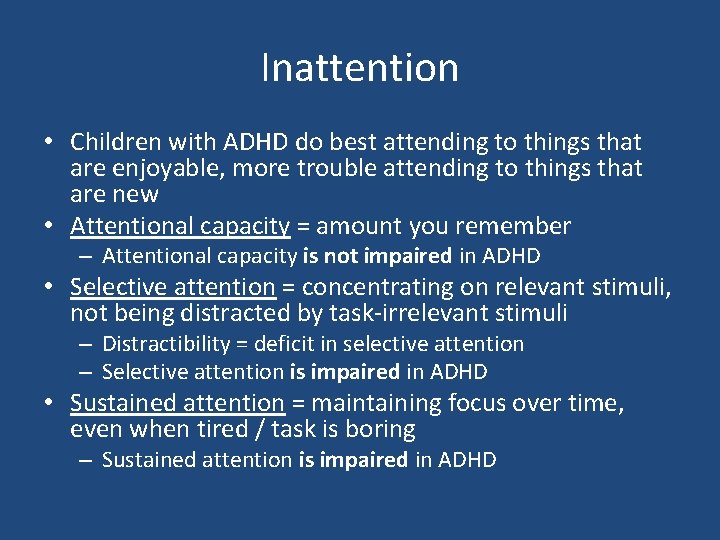
Inattention • Children with ADHD do best attending to things that are enjoyable, more trouble attending to things that are new • Attentional capacity = amount you remember – Attentional capacity is not impaired in ADHD • Selective attention = concentrating on relevant stimuli, not being distracted by task-irrelevant stimuli – Distractibility = deficit in selective attention – Selective attention is impaired in ADHD • Sustained attention = maintaining focus over time, even when tired / task is boring – Sustained attention is impaired in ADHD
Hyperactivity • Fidget, squirm, climb, run in inappropriate settings • Touch everything • Tap, bounce • Active, but not goal directed
Impulsivity • Don’t think before they act • Impaired behavior regulation (e. g. , yell something inappropriate) • Interrupt conversations, lash out in frustration, trouble with delay gratification • 3 forms of impulsivity – Cognitive • Hurried thinking – Behavioral • Impulsively calling out • Acting without thinking of consequences – Emotional • Impatience • Low frustration tolerance • Quick to anger
ADHD Subtypes 1. Predominantly Inattentive Presentation (ADHD-PI) – – – 2. 3. Inattentive, drowsy Daydreaming Spacey In a fog Socially withdrawn Comorbid mood disorder common Predominantly Hyperactive-impulsive Presentation (ADHD-HI) – – – Problems inhibiting behavior Aggressive Defiant Rejected by peers Often suspended from school, special ed classes Rare Combined Presentation (ADHD-C) – Same profile as #2 (except older kids, not as rare; referred for tx)
Prevalence • Significant increase in ADHD diagnosis over last several decades – Growing knowledge about ADHD – Pressure from parents seeking treatment for children – Adults identifying their own ADHD • 5 -9% of school age children & adolescents in North America have ADHD (just over 5% worldwide) • 50% of children referred for MH treatment show symptoms of ADHD
Gender • Prevalence by sex – girls: 2 -4% – boys: 6 -9% • Boys referred more frequently due to defiance & aggression • Girls with ADHD show inattentive behaviors • Less research on girls with ADHD
SES & Culture • Higher rate of ADHD in lower SES groups – Related to co-occurring conduct problems in children with ADHD • Highest rates of ADHD in South America and Africa (8 -12%); lowest rates in Japan and China (2 -5%); European and North American rates (4 -9%) are in-between – Varying cultural norms & tolerance for the symptoms of ADHD
Course • ADHD diagnosed beginning around 3 yrs • Preschoolers (3 -4 yrs) with ADHD: – Act without thinking – Move quickly from activity to activity – Grab at immediate rewards – Easily bored – Roam around classrooms; disrupt others’ activities – Parents report difficulty managing their child
Course • Elementary school children with ADHD: – ADHD often identified at this age – Oppositional behaviors begin • Adolescents with ADHD: – Continued impairment in social, emotional, behavioral realms – Some children outgrow the disorder; some cope with it – Better outcomes for those who: • Had less severe symptoms • Received good care, supervision, and support from parents and teachers • Have access to economic and community resources • Adults: – Many adults with ADHD as children still suffer from symptoms – Many adults with ADHD have never been diagnosed
Etiology 1. Genetic influences – ADHD runs in families • Parent with ADHD, 60% chance of child developing ADHD – Twin studies show high heritability estimates for ADHD (75%) – Dopamine regulation implicated in ADHD 1. Dopamine involved in psychomotor activity & reward seeking 2. Brain structures implicated in ADHD also have dopamine activity, & there is dopamine dysregulation in those brain areas 3. The meds targeting ADHD symptoms act by increasing dopamine
Etiology 2 Pregnancy, Birth, Early Development risk factors – Pregnancy & birth complications – Maternal exposure to extreme stress during pregnancy – Low birth weight in child – Malnutrition of child – Early neurological trauma (i. e. , brain damage) in child – Infancy diseases in child • These risk factors are not random
Etiology 3. Neurobiological Factors – Differences on measures of brain activity (e. g. , difficulty inhibiting one’s responses) – Differences in blood flow to the prefrontal regions of the brain (i. e. , prefrontal cortex and basal ganglia) – People with ADHD have smaller prefrontal cortexes
Etiology 4. Diet, Allergy, & Lead – Sugar does not cause ADHD – Artificial dyes do not cause ADHD – Lead exposure (dust, water, soil, flaking paint) can be associated with development of ADHD
Etiology 5. Family Influences – Interfering/insensitive early caregiving practices in families of kids with ADHD – Goodness-of-fit = match between child’s temperament and parent’s style of interaction – Direction of causality? • Family problems may result from interacting with an impulsive, difficult to manage child – Negative cycles of family/parenting behavior starting when a child develops ADHD increase risk for CD/ODD
Co-occurring Symptoms & Disorders • 80% with ADHD have co-occurring psychological d/o • Oppositional Defiant Disorder / Conduct Disorder – 50% of children with ADHD meet criteria for ODD – 30 -50% of children with ADHD develop CD – ADHD, ODD, & CD commonly co-occur in families • Anxiety Disorders – 25% of children with ADHD have excessive anxiety • Mood Disorders (e. g. , depression) – ADHD is a risk factor for depression, especially in girls
Associated Characteristics 1. Cognitive deficits – IQ tests – Academic functioning 2. Speech & Language impairment – 1/3 to 1/2 of kids with ADHD 3. Motor difficulties – 1/3 to 1/2 with poor coordination – Problems with gross motor (sports) and fine motor (handwriting) – Tic Disorders often comorbid
Associated Characteristics 4. Accident proneness & risk taking – Serious accidental injuries – Early substance abuse, risky sexual behaviors – Reduced life expectancy 5. Family problems – Sibling conflict – Parental overcontrol – Parental distress, marital difficulties 6. Peer problems – Peer rejection common
Treatment • Gold Standard: Stimulant medication + parent management training + educational intervention • Stimulants – Discovered in 1930 s – Dexedrine and Ritalin – Impact the level of dopamine; may also help with structural abnormalities – Meds general safe; side effects, mild – Side effects: decreased appetite, weight loss, slowed growth – Effects of stimulants are temporary – Stimulant meds don’t address the peer, family, social, etc. , issues, so additional treatment may be helpful
Treatment • Stimulants – the controversy – Pros • 80% of children show increases in attention, impulse control, work effort; decreases in task irrelevant activity & noisy & disruptive behaviors while on stimulants • Stimulants also help with cooperative behavior, physical coordination (i. e. , handwriting, sports), academic productivity • Side effects are minor; the drugs are well-tolerated – Cons Lead to over-diagnosis? Used as a quick fix? Overprescribed? There are so many people taking these medications, and there are direct marketing efforts by drug companies • Limited research on LT effects of taking stimulants, esp for growing children • • – As we understand more about this disorder, more & more children are receiving drug treatments
Treatment • Parent Management Training – For children with ADHD, traditional parenting/discipline doesn’t work – Goals of PMT • • Manage child’s oppositional and noncompliant behaviors Cope with the emotional demands of raising a child with ADHD Contain the problem so that it doesn’t get worse Keep the problem from adversely affecting other family members – Provide parents with psychoeducation about ADHD to understand biological basis of the disorder • Removes guilt – Parents given suggestions • • • Using more immediate, frequent, and powerful consequences Striving for consistency Planning ahead Not personalizing the child’s problems Practicing forgiveness – Highly effective treatment