
Attention Multiple types brain resonances psychological functions and
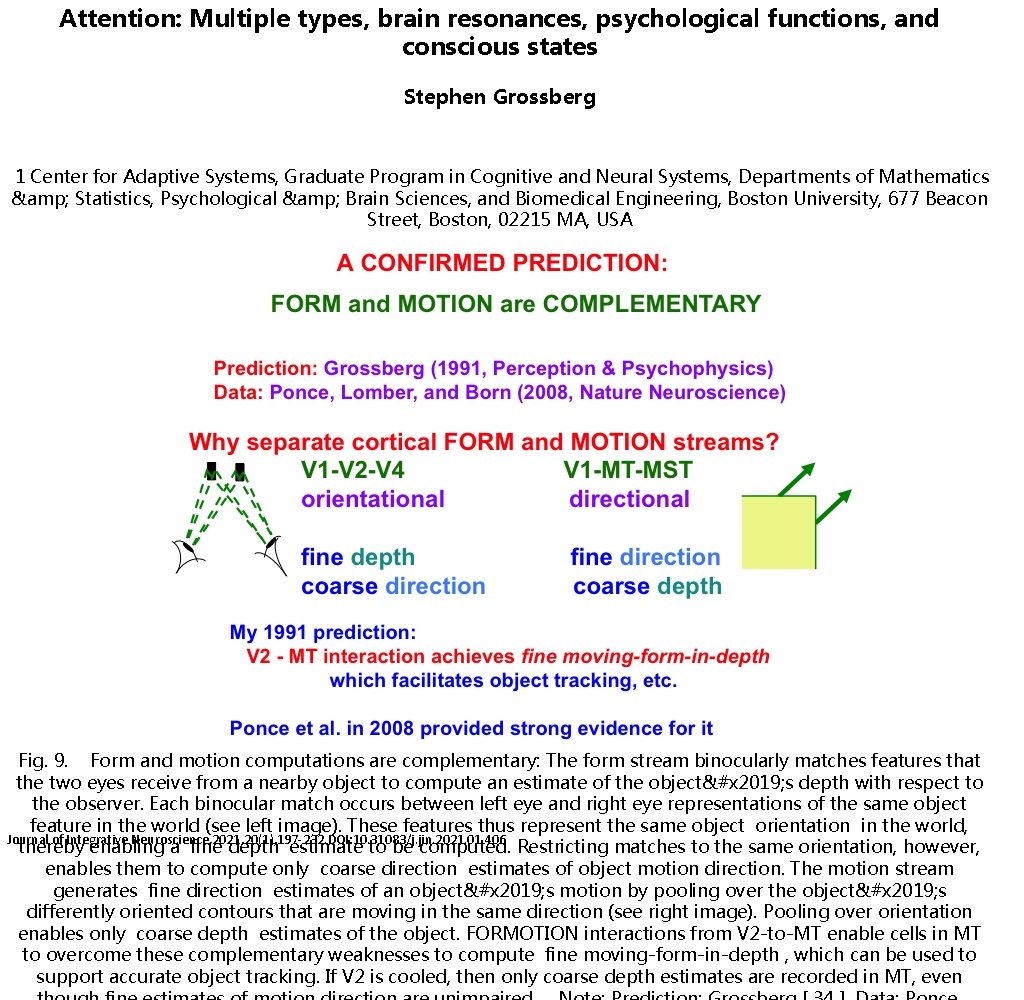
Attention: Multiple types, brain resonances, psychological functions, and conscious states Stephen Grossberg 1 Center for Adaptive Systems, Graduate Program in Cognitive and Neural Systems, Departments of Mathematics & Statistics, Psychological & Brain Sciences, and Biomedical Engineering, Boston University, 677 Beacon Street, Boston, 02215 MA, USA Fig. 9. Form and motion computations are complementary: The form stream binocularly matches features that the two eyes receive from a nearby object to compute an estimate of the object&#x 2019; s depth with respect to the observer. Each binocular match occurs between left eye and right eye representations of the same object feature in the world (see left image). These features thus represent the same object orientation in the world, Journal of Integrative Neuroscience, 2021, 20(1), 197 -232. DOI: 10. 31083/j. jin. 2021. 01. 406 thereby enabling a fine depth estimate to be computed. Restricting matches to the same orientation, however, enables them to compute only coarse direction estimates of object motion direction. The motion stream generates fine direction estimates of an object&#x 2019; s motion by pooling over the object&#x 2019; s differently oriented contours that are moving in the same direction (see right image). Pooling over orientation enables only coarse depth estimates of the object. FORMOTION interactions from V 2 -to-MT enable cells in MT to overcome these complementary weaknesses to compute fine moving-form-in-depth , which can be used to support accurate object tracking. If V 2 is cooled, then only coarse depth estimates are recorded in MT, even
- Slides: 1