
Attention Deficits Hyperactive Disorder ADHD Three major types

- Slides: 55
「過度活躍症 / 注意力不足過動症」 的認知及處理 Attention Deficits & Hyperactive Disorder (ADHD)
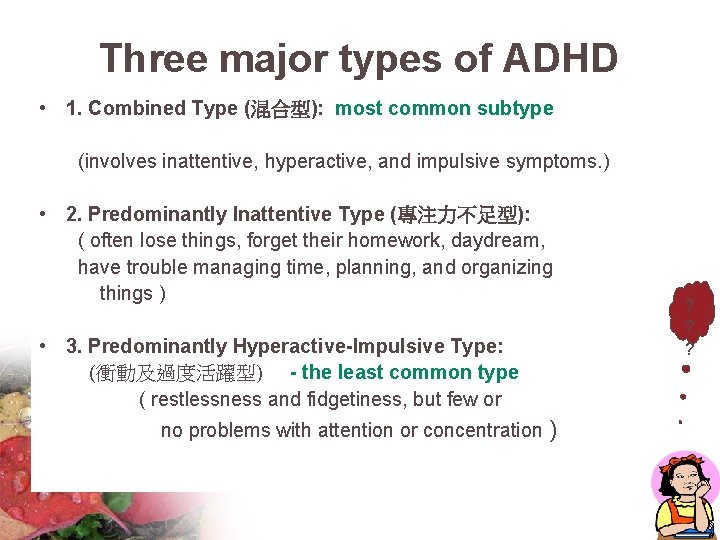
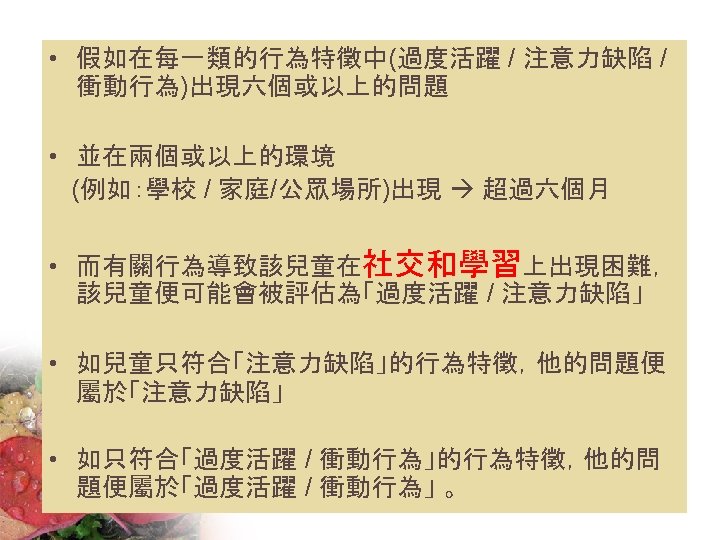
Three major types of ADHD • 1. Combined Type (混合型): most common subtype (involves inattentive, hyperactive, and impulsive symptoms. ) • 2. Predominantly Inattentive Type (專注力不足型): ( often lose things, forget their homework, daydream, have trouble managing time, planning, and organizing things ) • 3. Predominantly Hyperactive-Impulsive Type: (衝動及過度活躍型) - the least common type ( restlessness and fidgetiness, but few or no problems with attention or concentration ) ? ? ?
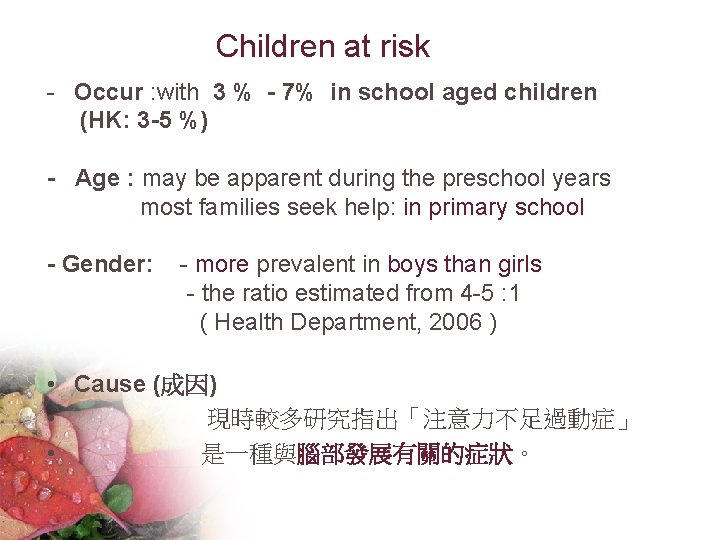
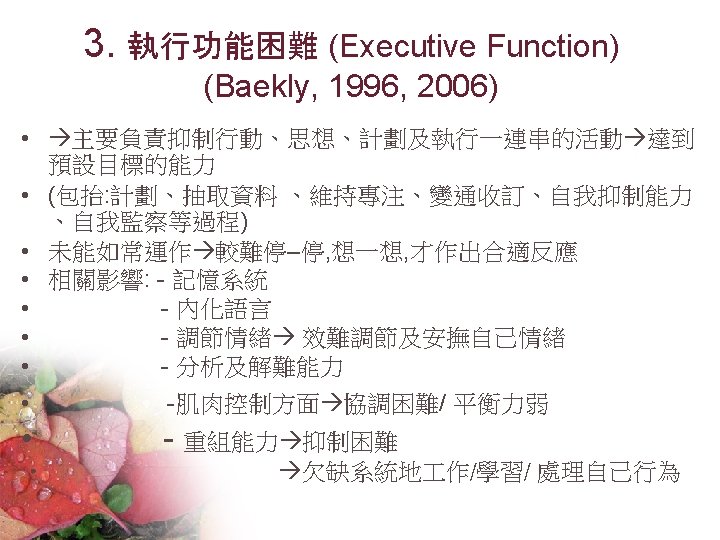
Children at risk - Occur : with 3 % - 7% in school aged children (HK: 3 -5 %) - Age : may be apparent during the preschool years most families seek help: in primary school - Gender: - more prevalent in boys than girls - the ratio estimated from 4 -5 : 1 ( Health Department, 2006 ) • Cause (成因) • 現時較多研究指出「注意力不足過動症」 • 是一種與腦部發展有關的症狀。
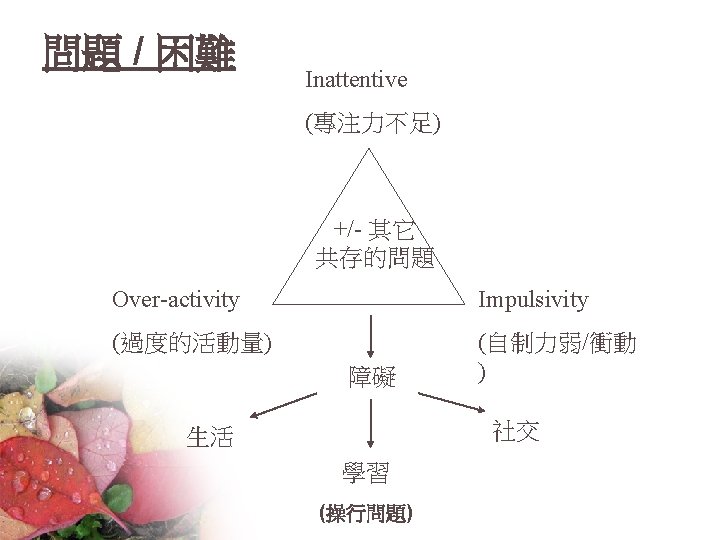
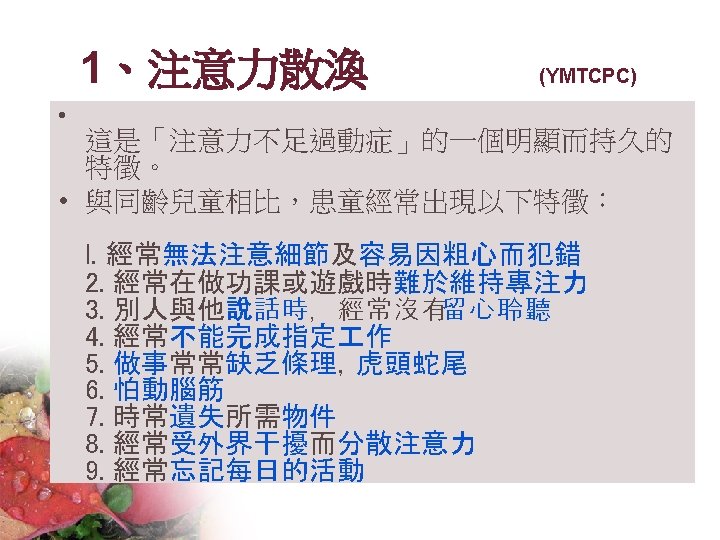
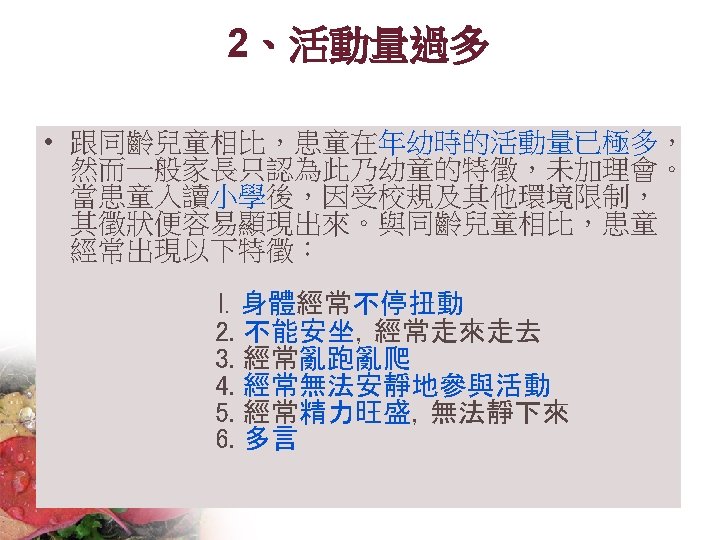
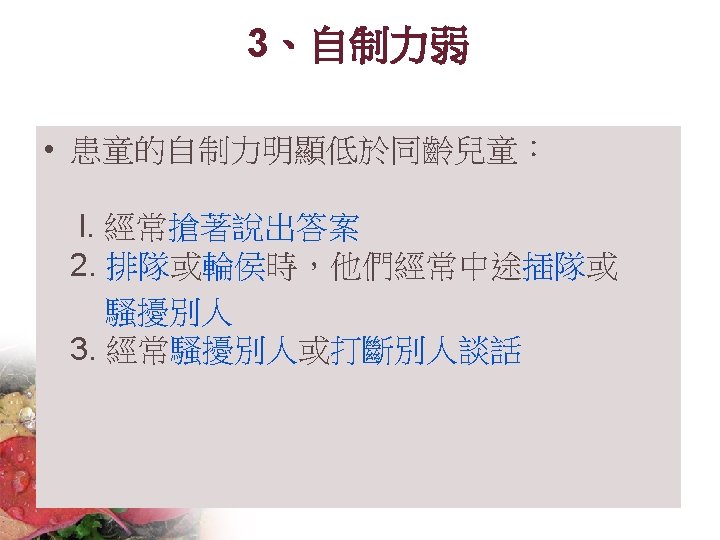
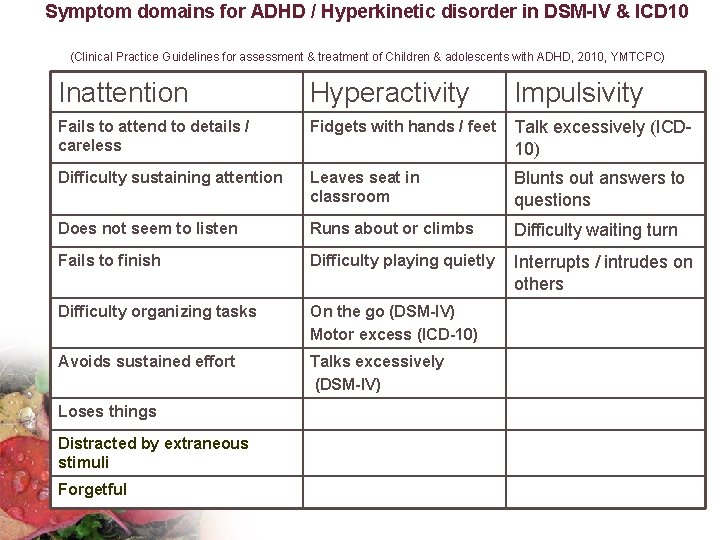
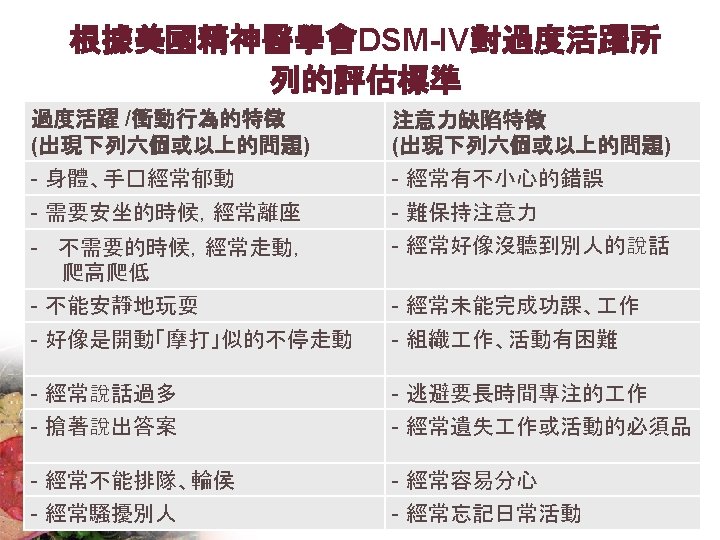
Symptom domains for ADHD / Hyperkinetic disorder in DSM-IV & ICD 10 (Clinical Practice Guidelines for assessment & treatment of Children & adolescents with ADHD, 2010, YMTCPC) Inattention Hyperactivity Impulsivity Fails to attend to details / careless Fidgets with hands / feet Talk excessively (ICD 10) Difficulty sustaining attention Leaves seat in classroom Blunts out answers to questions Does not seem to listen Runs about or climbs Difficulty waiting turn Fails to finish Difficulty playing quietly Interrupts / intrudes on others Difficulty organizing tasks On the go (DSM-IV) Motor excess (ICD-10) Avoids sustained effort Talks excessively (DSM-IV) Loses things Distracted by extraneous stimuli Forgetful
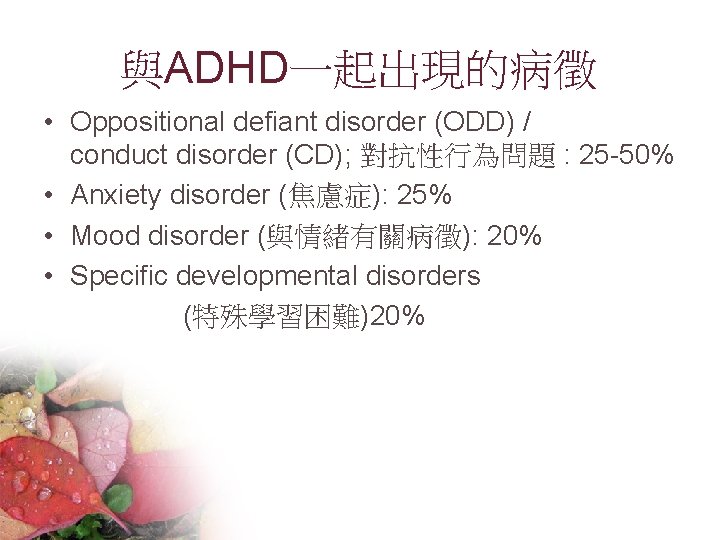
與ADHD一起出現的病徵 • Oppositional defiant disorder (ODD) / conduct disorder (CD); 對抗性行為問題 : 25 -50% • Anxiety disorder (焦慮症): 25% • Mood disorder (與情緒有關病徵): 20% • Specific developmental disorders (特殊學習困難)20%
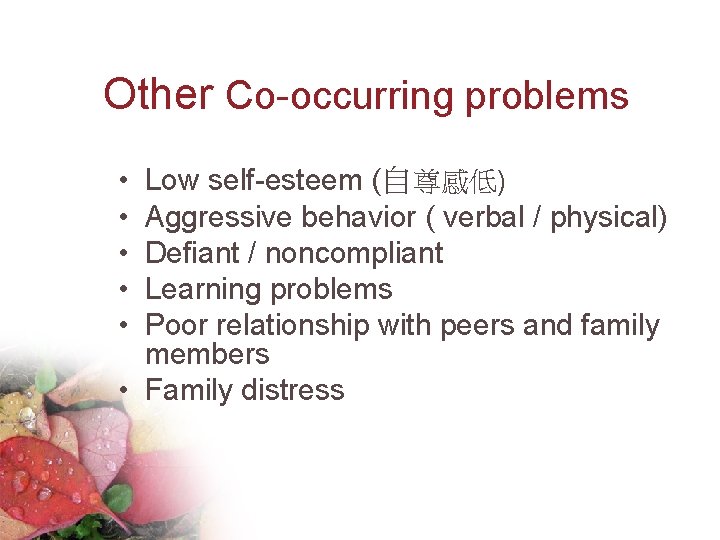
Other Co-occurring problems • • • Low self-esteem (自尊感低) Aggressive behavior ( verbal / physical) Defiant / noncompliant Learning problems Poor relationship with peers and family members • Family distress
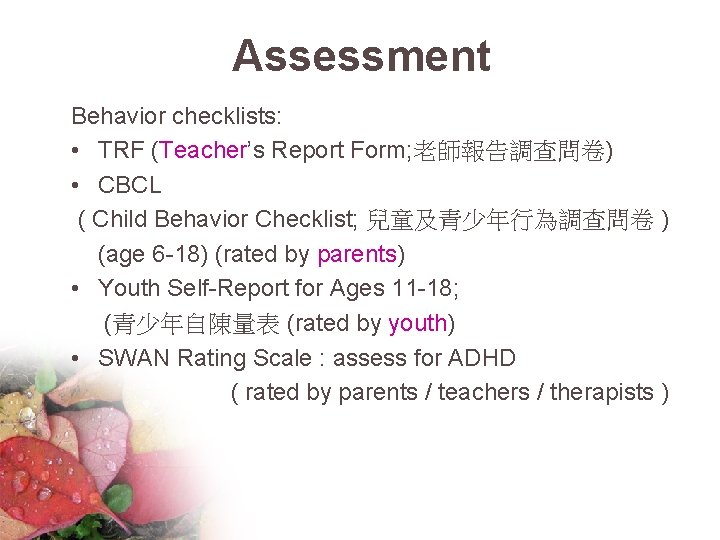
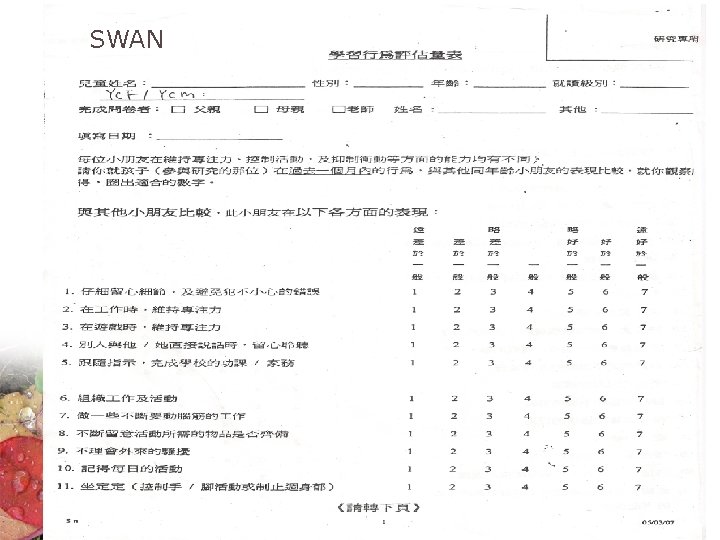
Assessment Behavior checklists: • TRF (Teacher’s Report Form; 老師報告調查問卷) • CBCL ( Child Behavior Checklist; 兒童及青少年行為調查問卷 ) (age 6 -18) (rated by parents) • Youth Self-Report for Ages 11 -18; (青少年自陳量表 (rated by youth) • SWAN Rating Scale : assess for ADHD ( rated by parents / teachers / therapists )
SWAN
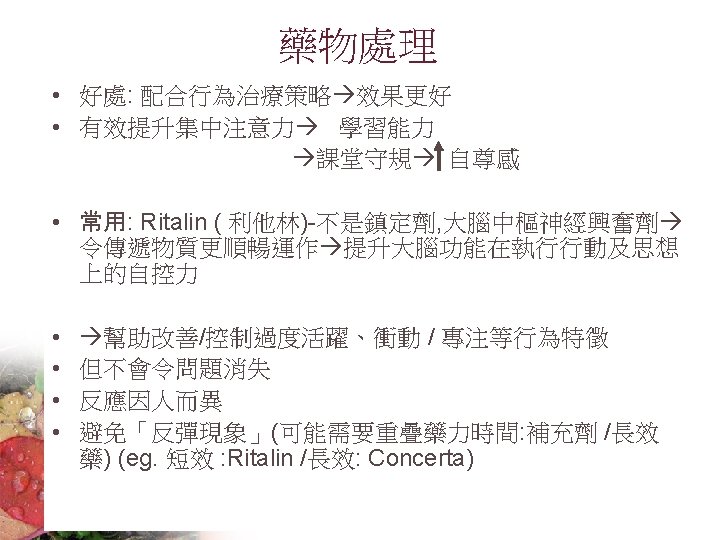
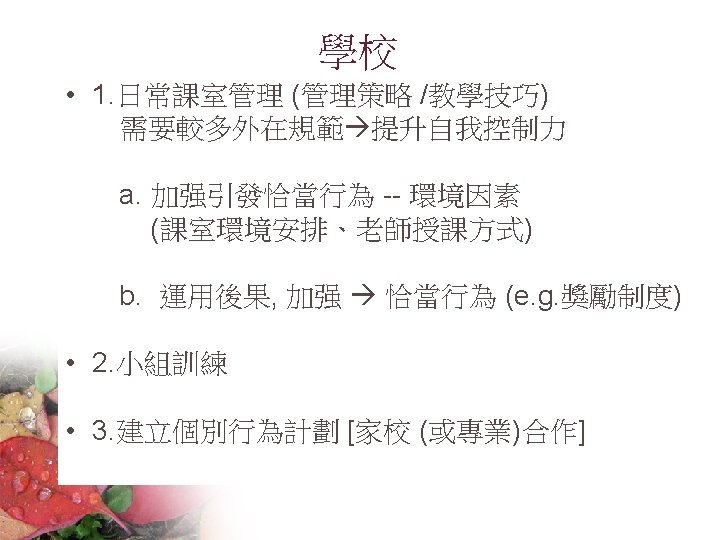
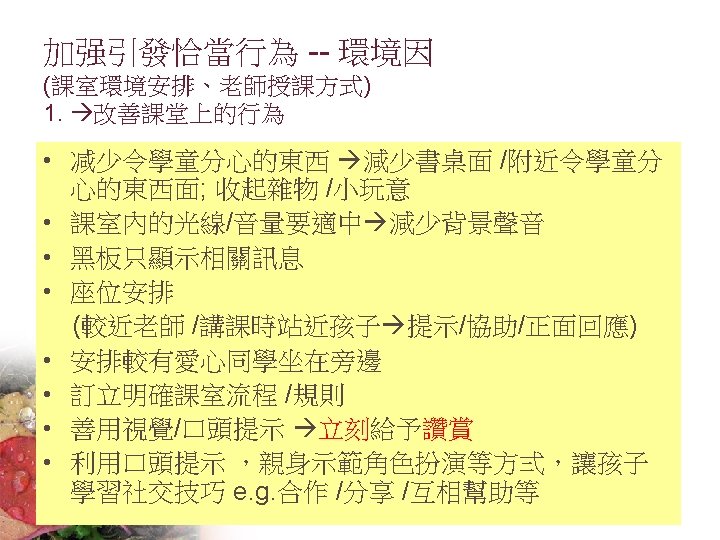
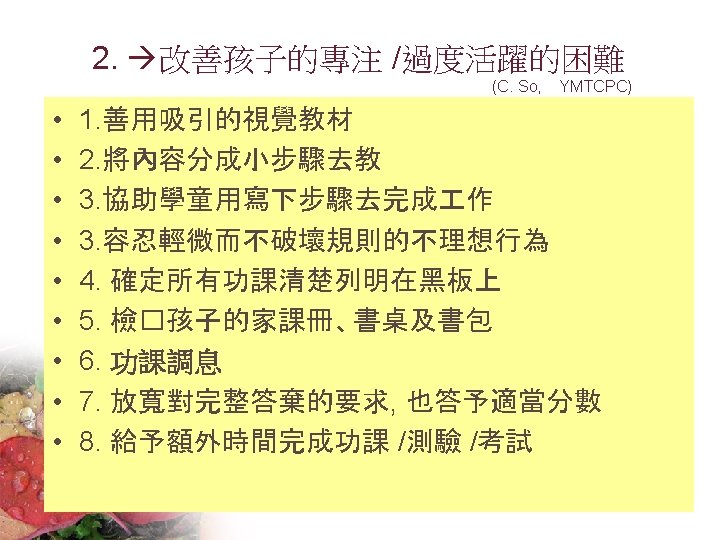
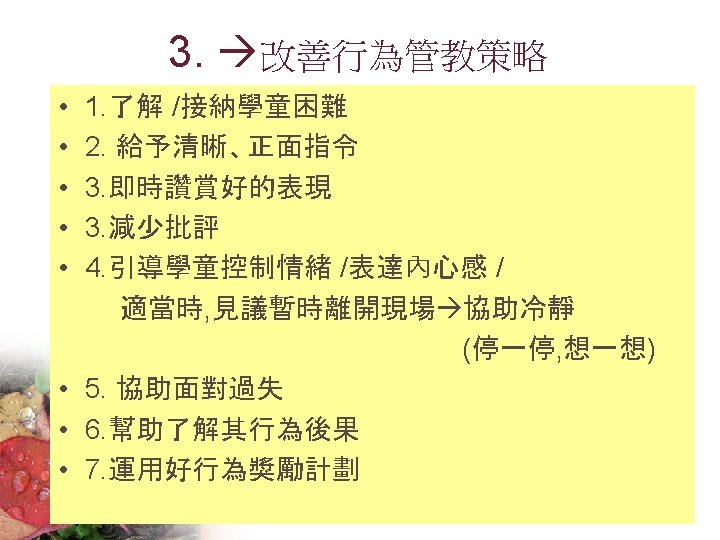
Evidence based treatment measures 1. Medication (葯物治療) 2. Psychotherapy ( Behavior Therapy) (行為治療 e. g. 自我控制技巧) 3. Effective teaching strategies (有效的教學策略及課室管理技巧) 4. Parental management training (家長處理訓練)
Basic Principles during training and teaching parenting for ADHD Children 1. Immediate feedback and consequence (即時回饋及後果) 2. Clear and favorable / impressive consequence 3. Set effective reinforcement system (有效獎勵制度) 4. Deal with misbehaviors eg. Conflict management / temper control / exercise of time out 5. Be consistent 6. Teaching with effective elements Brevity 簡短 Interest 有趣 Variety 多變化 Involvememt 多參與
Multidisciplinary Approaches in Managing ADHD ( Hill & Taylor, 2001) Useful Intervention: 1) Individual 2) Family 3) Parent 4) Teachers 5) Medication as an integral part (e. g. Methylphenidate: Ritalin / Concerta Atomoxetine) 6) Remediation of Social skills to improve interpersonal interaction 7) Coaching to improve organization & study skills *Others: Nutrition & alternative therapies
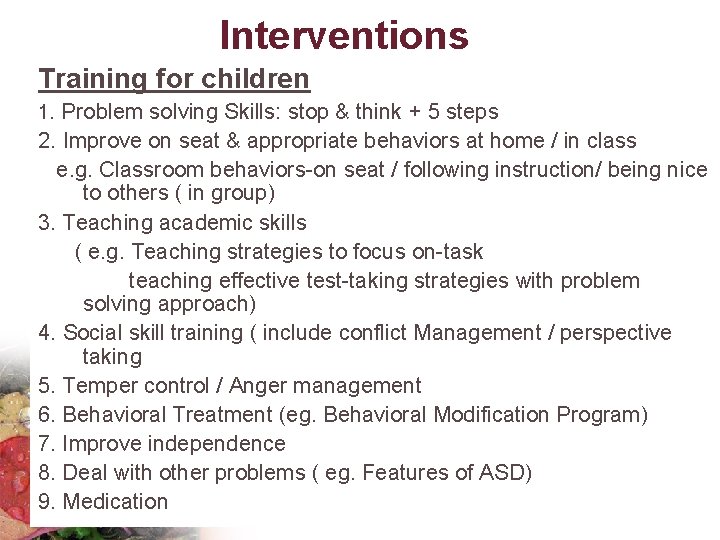
Interventions Training for children 1. Problem solving Skills: stop & think + 5 steps 2. Improve on seat & appropriate behaviors at home / in class e. g. Classroom behaviors-on seat / following instruction/ being nice to others ( in group) 3. Teaching academic skills ( e. g. Teaching strategies to focus on-task teaching effective test-taking strategies with problem solving approach) 4. Social skill training ( include conflict Management / perspective taking 5. Temper control / Anger management 6. Behavioral Treatment (eg. Behavioral Modification Program) 7. Improve independence 8. Deal with other problems ( eg. Features of ASD) 9. Medication
Treatment for Children: Interventions: Individual / Group
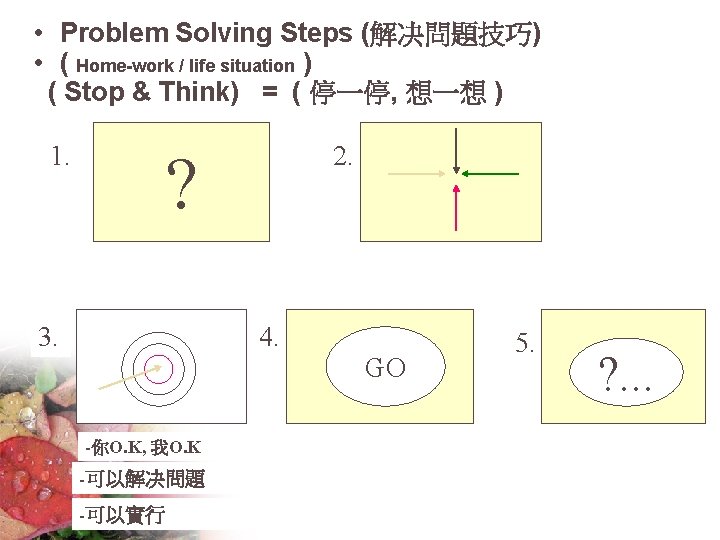
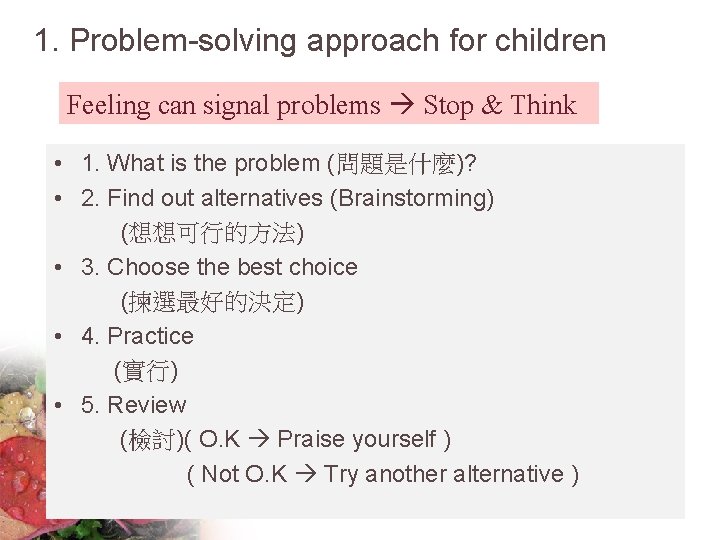
1. Problem-solving approach for children Feeling can signal problems Stop & Think • 1. What is the problem (問題是什麼)? • 2. Find out alternatives (Brainstorming) (想想可行的方法) • 3. Choose the best choice (揀選最好的決定) • 4. Practice (實行) • 5. Review (檢討)( O. K Praise yourself ) ( Not O. K Try another alternative )
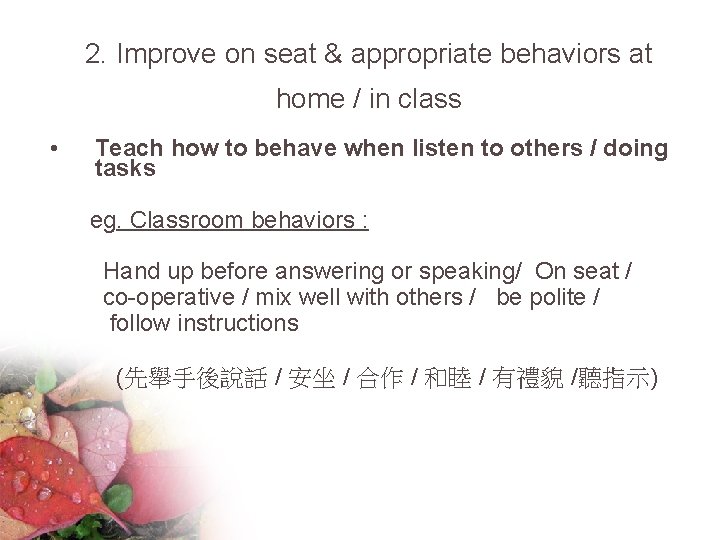
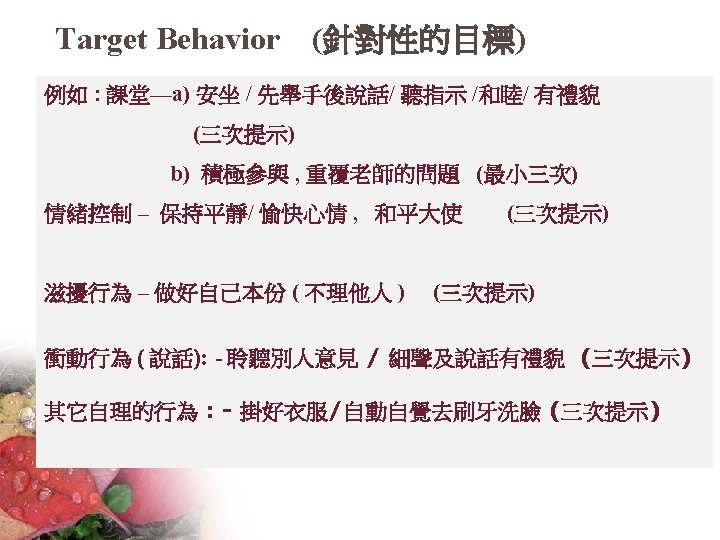
2. Improve on seat & appropriate behaviors at home / in class • Teach how to behave when listen to others / doing tasks eg. Classroom behaviors : Hand up before answering or speaking/ On seat / co-operative / mix well with others / be polite / follow instructions (先舉手後說話 / 安坐 / 合作 / 和睦 / 有禮貌 /聽指示)
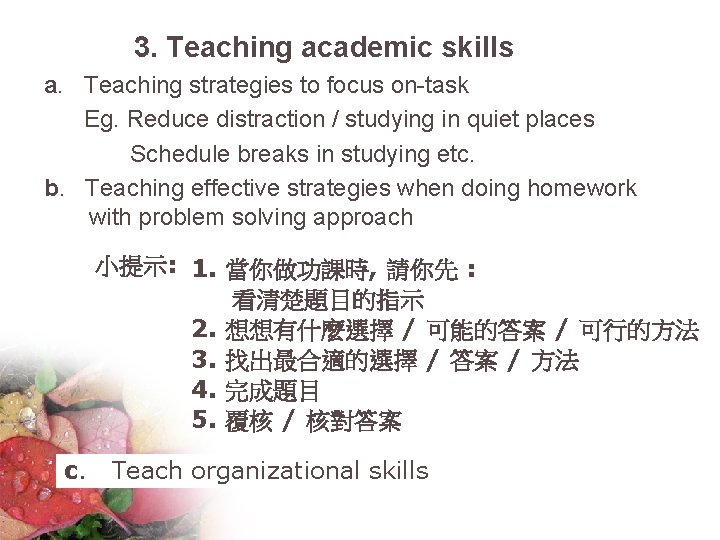
3. Teaching academic skills a. Teaching strategies to focus on-task Eg. Reduce distraction / studying in quiet places Schedule breaks in studying etc. b. Teaching effective strategies when doing homework with problem solving approach 小提示: 1. 當你做功課時, 請你先 : 看清楚題目的指示 2. 想想有什麼選擇 / 可能的答案 / 可行的方法 3. 找出最合適的選擇 / 答案 / 方法 4. 完成題目 5. 覆核 / 核對答案 c. Teach organizational skills
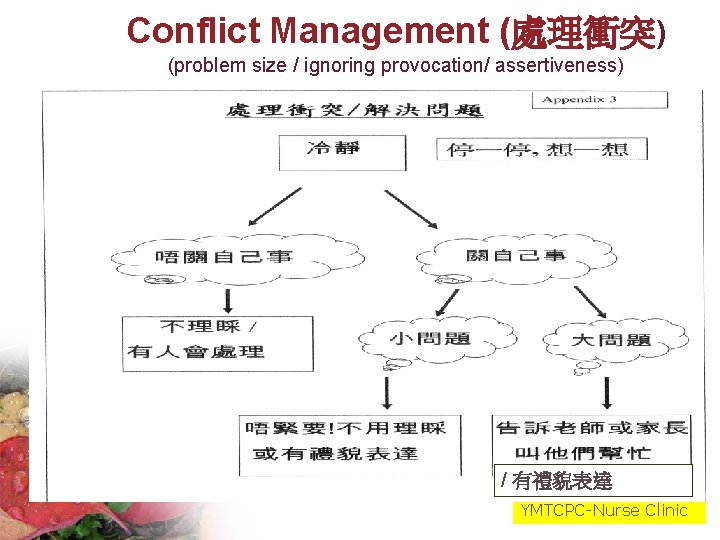
Conflict Management (處理衝突) (problem size / ignoring provocation/ assertiveness) / 有禮貌表達 YMTCPC-Nurse Clinic
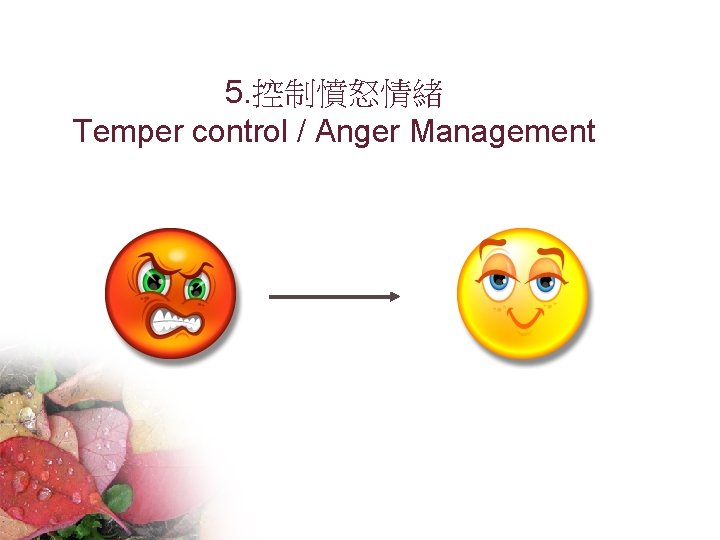
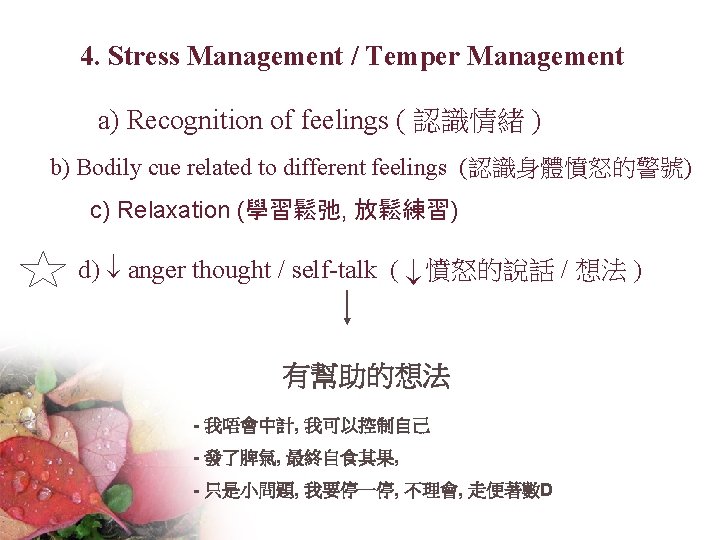
5. 控制憤怒情緒 Temper control / Anger Management
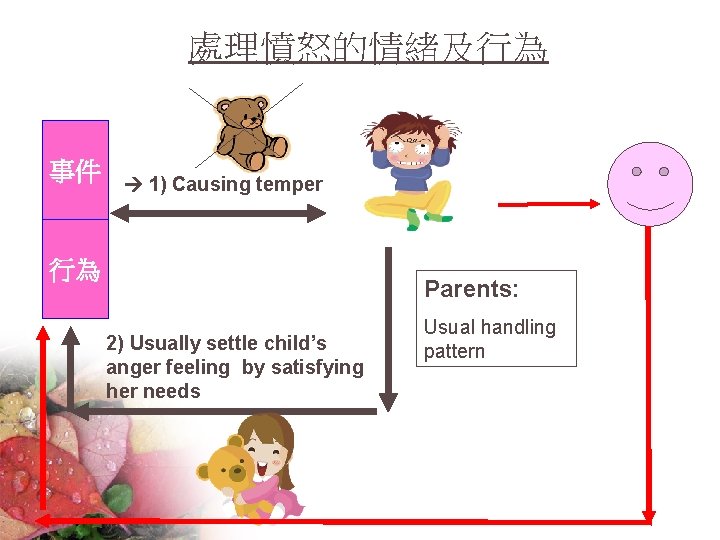
處理憤怒的情緒及行為 事件 1) Causing temper 行為 Parents: 2) Usually settle child’s anger feeling by satisfying her needs Usual handling pattern
e) Temper management • Be calm and non-judgmental • Show understanding of their emotions • Help to calm down • Help to solve the problem / learn to use appropriate way to express anger feelings • Firmly confront client’s impulsive behavior, exercise time out and give appropriate consequence if the situation is required
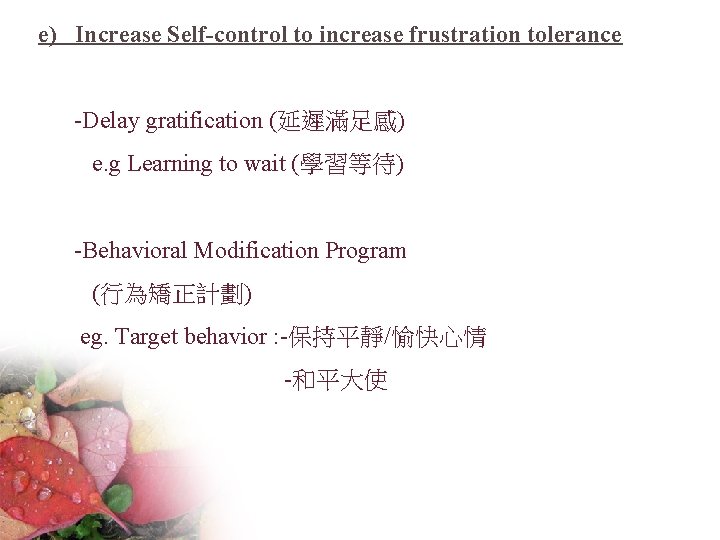
e) Increase Self-control to increase frustration tolerance -Delay gratification (延遲滿足感) e. g Learning to wait (學習等待) -Behavioral Modification Program (行為矯正計劃) eg. Target behavior : -保持平靜/愉快心情 -和平大使
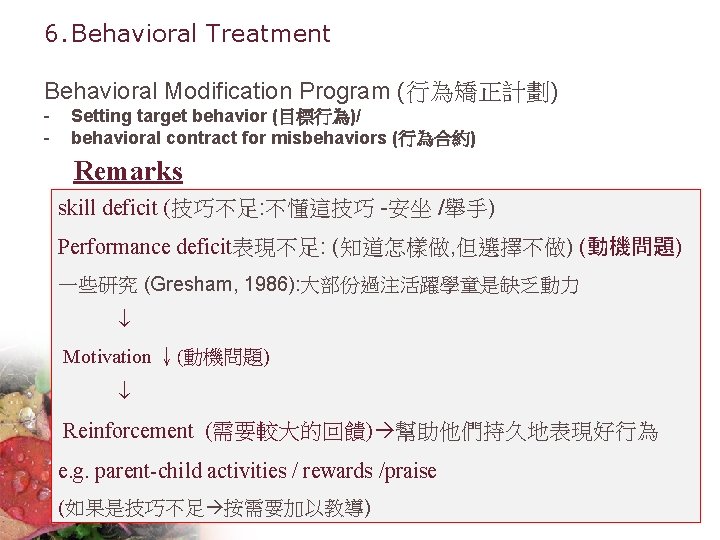
6. Behavioral Treatment Behavioral Modification Program (行為矯正計劃) - Setting target behavior (目標行為)/ behavioral contract for misbehaviors (行為合約) Remarks skill deficit (技巧不足: 不懂這技巧 -安坐 /舉手) Performance deficit表現不足: (知道怎樣做, 但選擇不做) (動機問題) 一些研究 (Gresham, 1986): 大部份過注活躍學童是缺乏動力 Motivation ↓(動機問題) Reinforcement (需要較大的回饋) 幫助他們持久地表現好行為 e. g. parent-child activities / rewards /praise (如果是技巧不足 按需要加以教導)
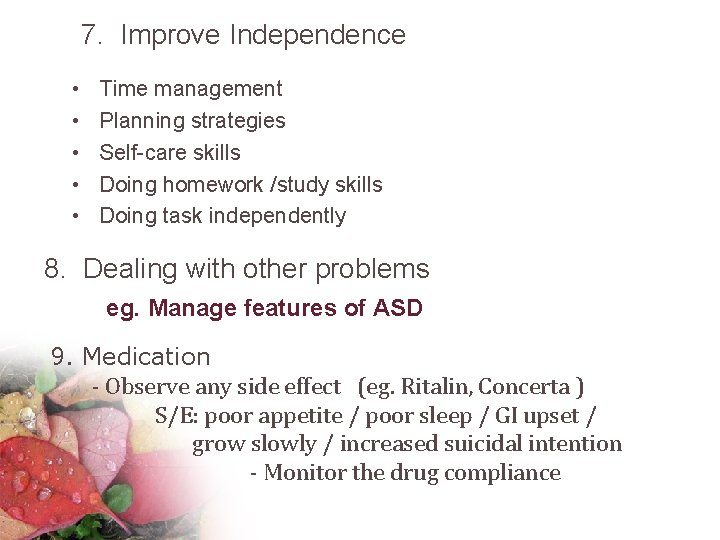
7. Improve Independence • • • Time management Planning strategies Self-care skills Doing homework /study skills Doing task independently 8. Dealing with other problems eg. Manage features of ASD 9. Medication - Observe any side effect (eg. Ritalin, Concerta ) S/E: poor appetite / poor sleep / GI upset / grow slowly / increased suicidal intention - Monitor the drug compliance
Parental Management Training
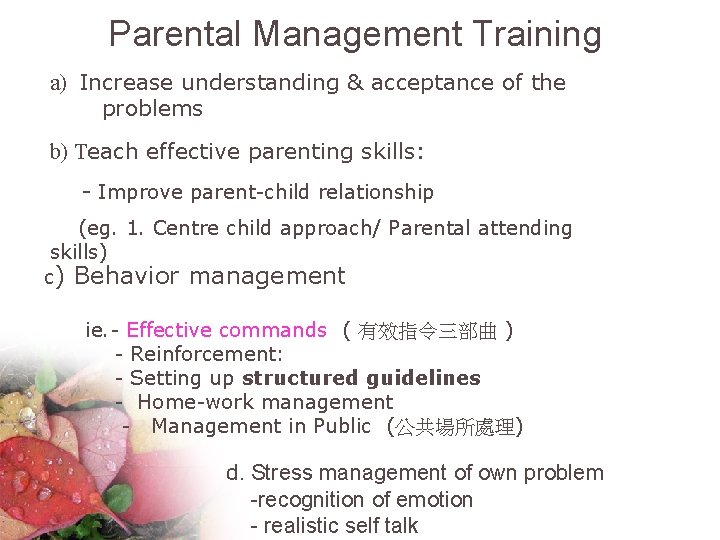
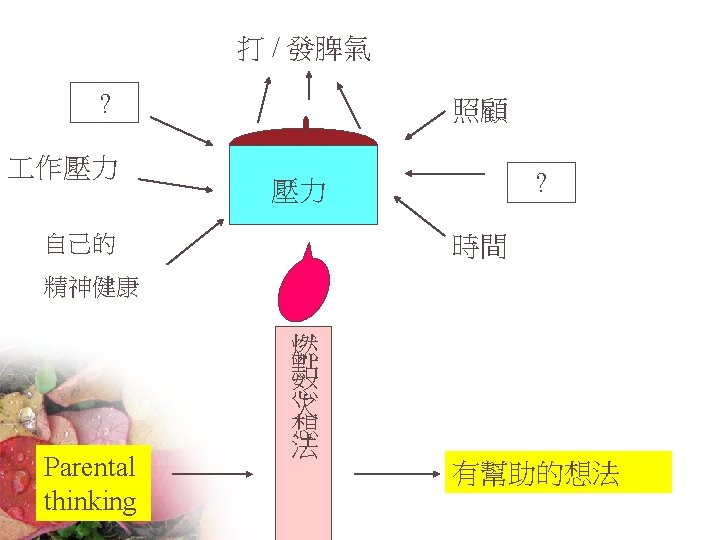
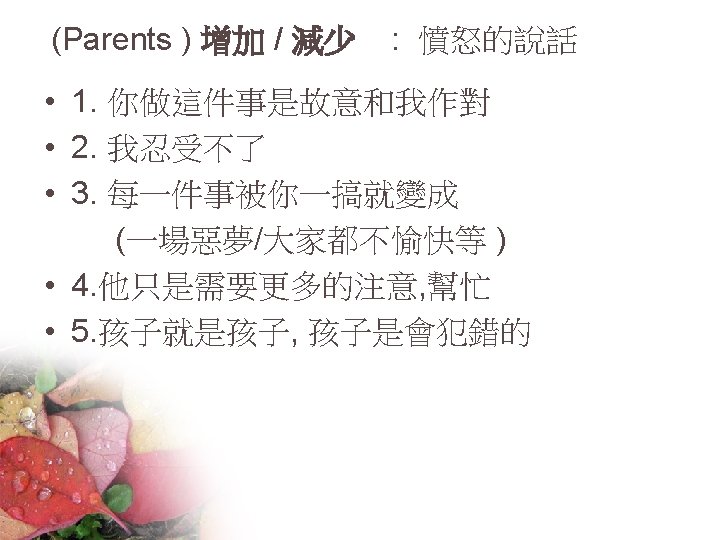
Parental Management Training a) Increase understanding & acceptance of the problems b) Teach effective parenting skills: - Improve parent-child relationship (eg. 1. Centre child approach/ Parental attending skills) c) Behavior management ie. - Effective commands ( 有效指令三部曲 ) - Reinforcement: - Setting up structured guidelines - Home-work management - Management in Public (公共場所處理) d. Stress management of own problem -recognition of emotion - realistic self talk
Educational Intervention
- www. ha. org. hk /kch/adhd - Video
I want a happy life