
Attention Based Glaucoma Detection A Largescale Database and
Attention Based Glaucoma Detection: A Large-scale Database and CNN Model CVPR 2019 Poster 2020/2/27 1
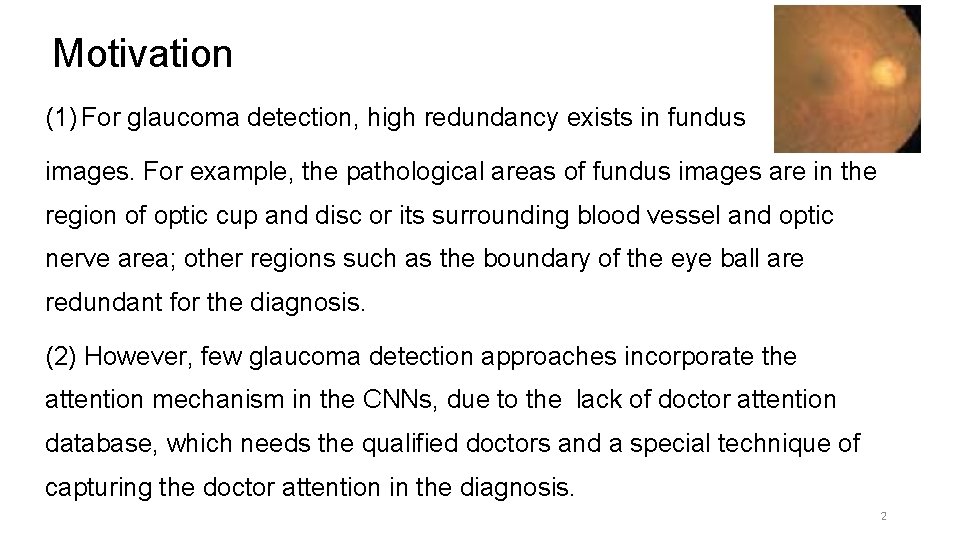
Motivation (1) For glaucoma detection, high redundancy exists in fundus images. For example, the pathological areas of fundus images are in the region of optic cup and disc or its surrounding blood vessel and optic nerve area; other regions such as the boundary of the eye ball are redundant for the diagnosis. (2) However, few glaucoma detection approaches incorporate the attention mechanism in the CNNs, due to the lack of doctor attention database, which needs the qualified doctors and a special technique of capturing the doctor attention in the diagnosis. 2
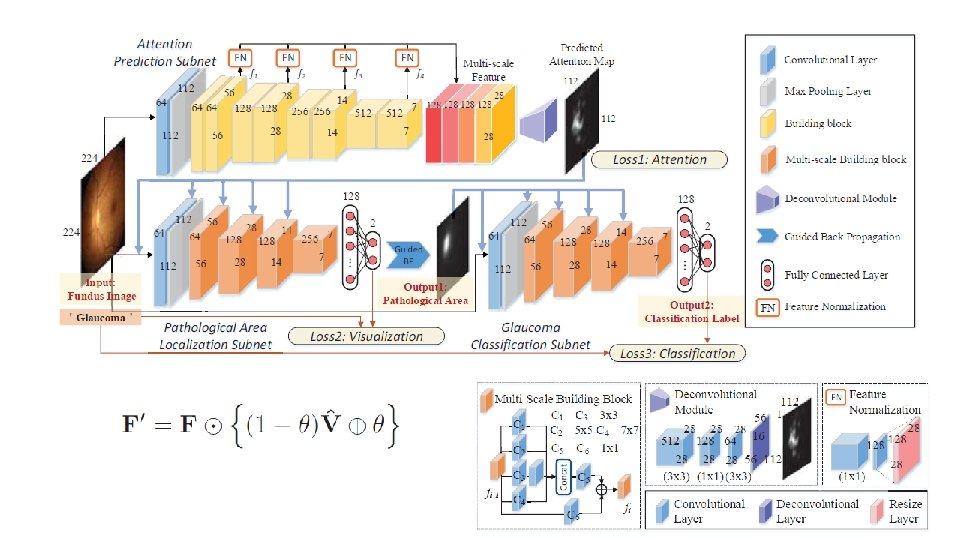
Main Contribution (1) A large-scale attention-based database(LAG) with 5, 824 fundus images, along with their labels and attention maps is established. (2) The attention maps are incorporated in CNN, such that the redundancy can be removed from fundus images for glaucoma detection. (3) A new CNN architecture is designed, which visualizes the CNN feature maps for locating pathological area and then classifies binary glaucoma. 3
4
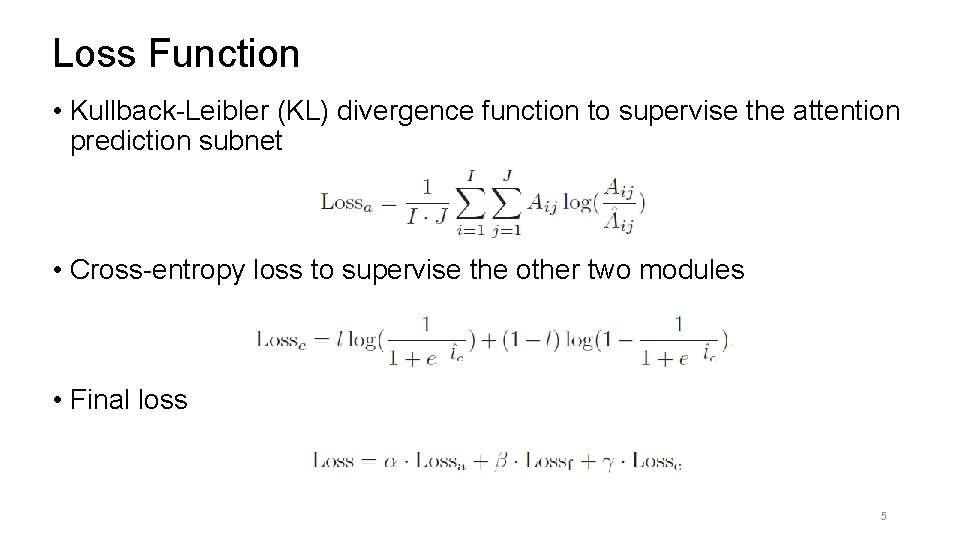
Loss Function • Kullback-Leibler (KL) divergence function to supervise the attention prediction subnet • Cross-entropy loss to supervise the other two modules • Final loss 5
Experiments • Ablation study • Experiments on two datasets 6
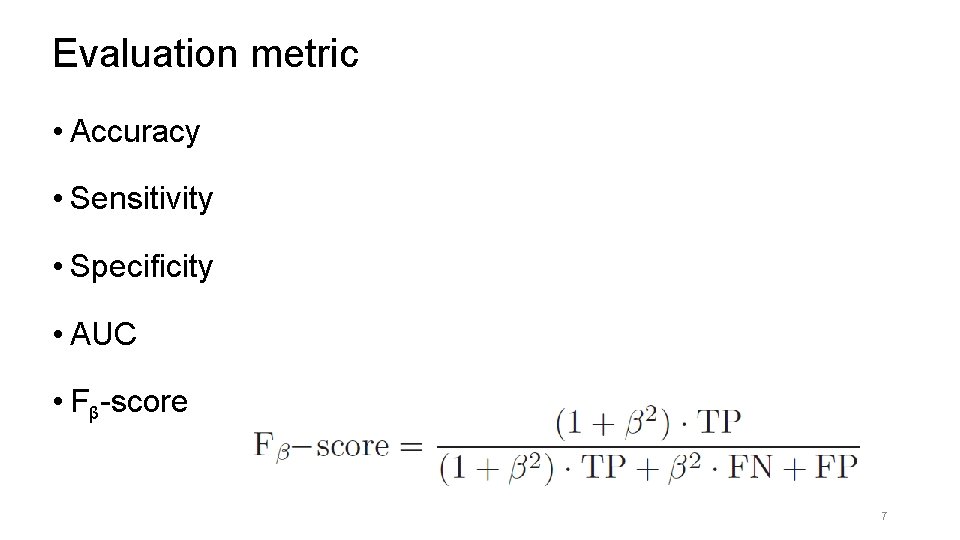
Evaluation metric • Accuracy • Sensitivity • Specificity • AUC • Fβ-score 7
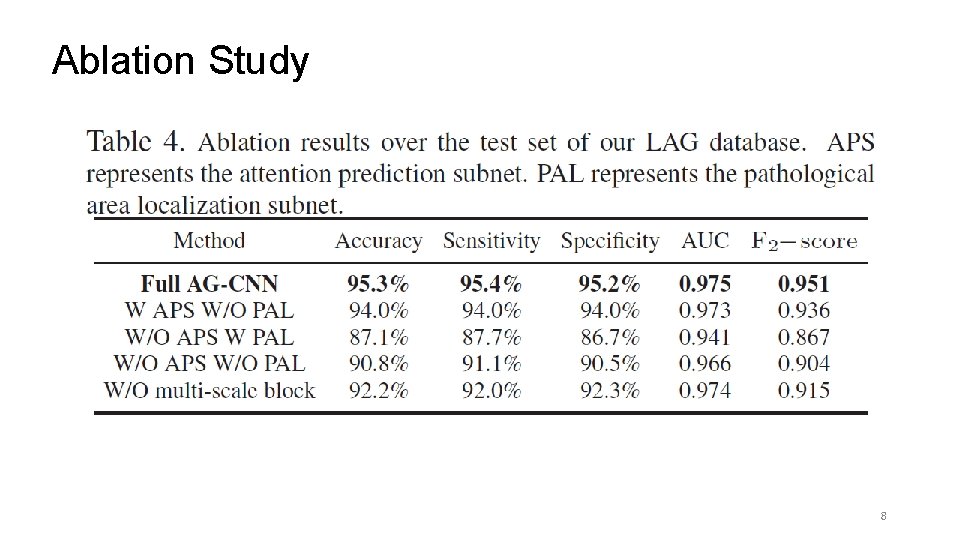
Ablation Study 8
Dataset • LAG dataset • RIM-ONE dataset 9
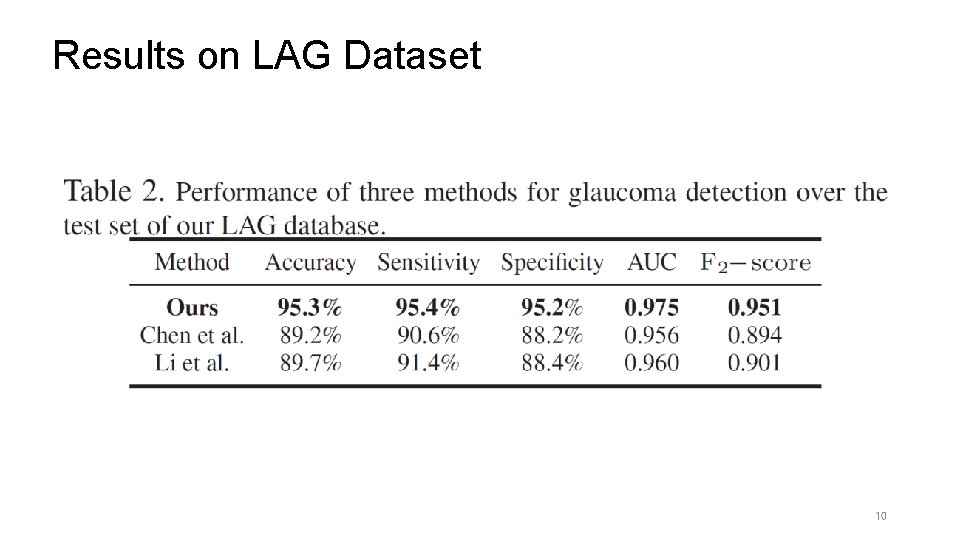
Results on LAG Dataset 10
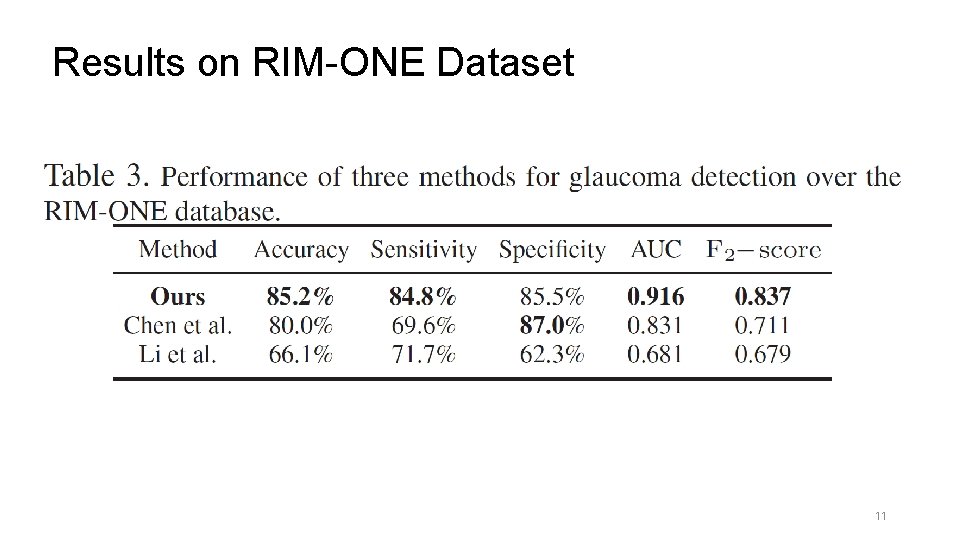
Results on RIM-ONE Dataset 11
Conclusion • The idea of introducing attention mechanism to glaucoma detection task is good • The idea of focusing on the pathological area instead of just focusing on the salient region of fundus images is important for this task • The writing is confusing and has a lot of gramma mistakes 12
- Slides: 12